
The harsh reality of demographics means that the numbers of stipendiary clergy will continue to decline significantly over the next ten years. What will that mean in practice for the future of the Church? What issues does it raise—and is anyone actually facing up to these questions?
Save the Parish, who are campaigning (not least in the context of General Synod elections) for a return to a ‘traditional’ conception of parish ministry, have produced a report on the crisis in stipendiary clergy numbers, and you can download it and read it here. They have done a fantastic job of getting it publicised, launching it in the House of Lords and getting widespread media coverage, including in the national press and Radio 4.
They have also done a great job of considering a wide range of issues (the report is not very long and will only take a couple of minutes to read it) and the reason is that it came out of a consultation in March this year in which they genuinely involved people from across the range of traditions in the Church of England. You can read the list of names of those who participated in the report, and I was genuinely impressed by the breadth. (You would need to recognise the names and know their tradition to see this.)
In this article, I was intending to comment on the main points of the report, which I mostly agree with, and on each of which I have myself been writing and campaigning for a long time (if you don’t believe me, just search for ‘clergy’ in the search bar to the right). But there is one major issue they do not consider, which has ended up taking up most of the space, and there are some consequences from their report which I think are seriously questionable.
The major issue which the report seriously underplays is demographics. In fact, it wrongly suggests that other factors are more important (in a previous consultation “clergy well-being far outweighed demographic changes”). I first started drawing attention to this just over ten years ago, drawing on my background as a personnel manager in industrial business.
If you are responsible for maintaining a workforce, the basic reality you have to engage with is cohort analysis. For each grade, and for each age group, how many are joining (through promotion and recruitment) and how many are leaving (through promotion, resignation, retirement) and therefore what will each group look like in future? The problem with the C of E is that, until very recently, no-one has been asking that centrally or doing the analysis which has controlled decision making. It is part of the problem of each diocese being (for most issues) independent and autonomous, when issues around the ordination and deployment of clergy have always been national.
The root cause of many of our problems was the disastrous decision by those in what was then called the Advisory Board for Ministry (ABM) to push the average age of ordination up by ten years over about ten years. Just pause for a moment, and reflect on what that does to the age profile of clergy. To illustrate: when I entered ordination training in Nottingham in 1989, I was 27, and was pretty much slap bang in the middle of the age profile of ordinands at the college. When I left in 1994 (having started a PhD), age 32, I was pretty much slap bang in the middle of the age profile of ordinands at the college. When I returned as a tutor in 2004, aged 42, I was pretty much slap bang in the middle of the age profile of ordinands at the college. In my first term back, the most common question ordinands asked me was ‘So which course are you doing?’
This decision has had a catastrophic effect on the age profile of the whole clergy cohort—but of course it is an effect that would not (in the 1990s) be felt until all those ordained over those ten years, who all happened to be the same age but ordained at different times and at correspondingly different ages, would be facing retirement 30 years hence—which is now.
I first wrote about this 10 years ago, and I am not sure many people really paid attention then. I have to give credit, though, to David Keen (who has just moved from ministry in Yeovil to Jersey) who was doing the sums even earlier, in 2012, when he asked ‘What would the church look like with only 5,000 stipendiary ministers’.
When I wrote about this in 2016, the statistics unit of the C of E was producing age profile graphs for clergy, and projecting the looming crisis (I am not sure they have continued with this). Here is what it looked like then:

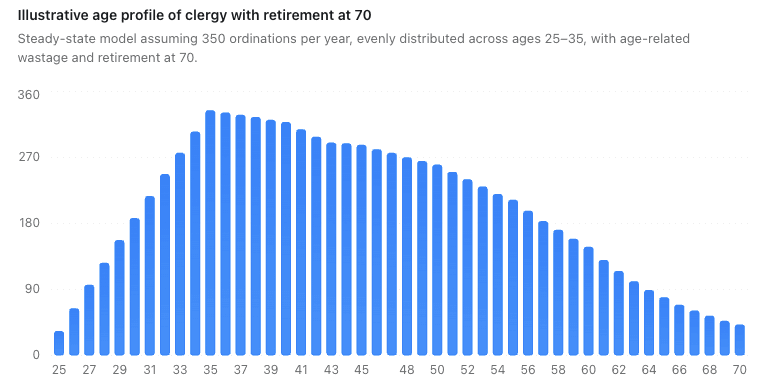 You can see the cliff edge creeping along year by year. And if you are not sure how disastrous and unbalanced this is, I add for comparison a theoretical age profile that would result from the long term, consistent, ordination of 350 a year spread evenly over the age decade 25–35, with normal assumptions about wastage through transfer, resignation, and other factors. Notice how different the shape is. (Women are consistently ordained older than men, so even theoretically this graph would shift further to the right. But the contrast is still striking.)
Going back to real life, here is a rather cruder version from the less detailed statistics released in June, this time grouped in five year age bands. The last non-trivial column is the age band 65–69, and the tallest is 60–64. There are four things worth noting.
 First, peak has shifted ten years (in ten years) from mid-50s to mid-60s. No surprises there! Secondly, the concave slope before the peak has been filled in, and this is the result of older ordination of those in their 40s and more in the last few years. Thirdly, the quite steep drop off between the last two bands, reflecting the fact that very, very few clergy now continue to 70, most preferring to retire as soon as they can in their 60s.
But the fourth striking feature is that the cliff drops off even more steeply. If we have had a problem with declining clergy numbers in recent years, that is only going to get worse in the next five to ten years, regardless of what happens with ordination numbers. Both I and David Keen have been pointing this out for a long time!
I asked two AI agents what we would need in terms of ordination numbers to sustain a stipendiary clergy cohort of 10,000, and I got two different answers.
ChatGPT started with a blank sheet of paper, and did the kind of analysis of wastage and recruitment that I did as a personnel manager.
A reasonable steady-state assumption would be:
- Average effective ministry career after ordination: 25–30 years
- Therefore annual wastage through retirement, death, resignation and movement out of parish ministry: roughly 3–4%
- On a stock of 10,000, that means replacing about 300–400 clergy per year.
So the answer is roughly 350 ordinations a year
For good measure, it threw in the C of E’s own assessment from 2016:
And the Church’s own 2016 projections are useful as a reality check: it concluded that increasing candidates for ordination from about 500 to 750 annually was required to produce a stable pool of around 7,600 FTE clergy, given the then age structure and wastage.
The difference here points to our current problem: we are not starting with a blank sheet of paper, but with a massively skewed age profile. Claude took the trouble to read my blog (which it cited!) and so took this into account.
The core idea is a stock-and-flow one: in a genuine steady state, the number ordained each year has to equal the number leaving parish ministry each year (through retirement, resignation, ill-health, death in post, or moving into other work). So the answer is essentially:
Ordinations needed per year ≈ target headcount ÷ average time a clergyperson actually spends in active parish ministry.
The tricky part is that “average time in ministry” for the C of E is shorter than you’d guess from career-length alone, because entrants skew older (many are second-career vocations, so average ordination age is often into the late 30s/40s rather than the mid-20s) and there’s meaningful “wastage” before retirement — resignations, health-related departures, and people moving out of stipendiary roles — on top of the retirements that cluster around age 65–66 even though the formal retirement age is 70.
And it comes to this conclusion:
For context on scale: the Church currently ordains around 400–430 people a year for stipendiary ministry in total (its best year in over three decades), which is already short of what’s needed to sustain even the current, shrunken clergy body of under 7,000 — let alone get back to 10,000, a number last seen around 1990 when there were just over 11,000 stipendiary clergy.
So, in short: to maintain 10,000 clergy in steady state under the Church’s own typical wastage assumptions, it would need to ordain roughly 600 people a year — around 50% more than its current best annual intake.
Just note the obvious thing that Claude points out, which appears to have completely bypassed the good folk at ABM: the older the age of ordination, not only the relatively more expensive the training, but also the more people you need to ordain each year. One person ordained in their 20s is worth two people ordained in their 40s, in terms of actually deploying people into ministry.
There’s the old joke: ‘How do I get to the Albert Hall from here?’ ‘If I were you, I wouldn’t start from here!’ How do we recover to the historic level of stipendiary clergy? The realistic answer is that we cannot, starting from here—at least not in the short or even medium term. How long does it take to change the age profile of a cohort that spans 40 years (from age 30 to 70)? Answer: 40 years. Or perhaps 30 or 20 to make a significant change. Even with significantly higher ordinations, the number of clergy will certainly continue to fall for the next 10 years.
What does all this mean for the Save the Parish report, and our approach to ministry?
My first comment is that I do think that all the issues that the report raises are quite right, and need addressing anyway. I won’t copy and paste them here; do go and read the report for yourself. The key issues they raise are the question of vocations, the mixed messages given when dioceses foolishly cut clergy numbers, the need for better, less pragmatic, and more clearly Anglican ordination training, and addressing key questions of clergy morale (though they don’t say much explicitly about questions of stipend and pension). As you can see from the links, I have been raising most of these questions for a very long time! I was delighted when, having campaigned in Archbishops’ Council and then through a Private Members Motion in Synod, this was followed up with a fantastic team and we managed to reverse the 40% cut in clergy pension and 10% decline in stipend last year. I still do not understand why no-one in the House of Bishops spoke up about this.
What is interesting in the report is the range of other issues that is missing, which I have noted previously in my own assessment of why vocations to ordained ministry are not recovering, and why clergy are resigning as much as retiring early.
The first is loss of confidence in episcopal leadership; perhaps that was too ‘political’ for STP to include.
The second is the immense damage done by the endless conflict over sexuality, and now issues around ethnicity and ‘race’. STP are avoiding that, because on both those issues, they themselves are a house divided.
Thirdly, the certainty of declining numbers of clergy (and in many, but not all, areas of the Church, consequent continuing decline in the attendance numbers) means that the now top-heavy numbers of bishops, archdeacons, dioceses, and diocesan staff are really unsustainable. I cannot see any signs yet of even the beginnings of a realistic discussion about this.
Finally, the question of finance and parish organisation. STP have campaigned vigorously on particular examples like the merger of parishes in the Kerrier Deanery in Truro Diocese. As I have noted previously, their argument is primarily that, if only the Church Commissioners would release more money into parishes, then these problems would be solved, and we could have a ‘priest in every parish.’ I am afraid that this is entirely delusional, for the demographic reasons above. And there is a real danger that they are operating with a strange (and historical unAnglican) kind of clericalism.
The report warns that the Church of England’s claim to provide “a Christian presence in every community” will have “no meaning” if it cannot attract and retain more priests, who are currently “drowning under burdens of administration”.
The idea that a ‘Christian presence’ is only effected by having clergy there betrays the C of E’s own belief in the ‘priesthood of all believers’ which is actually headlined in the ordination liturgy.
For practical reasons of demographics, the C of E is going to have to completely reimagine what pastoral ministry looks like, not least in rural areas, and I am not sure that, for all the good and right things that they say, STP have actually grasped that yet. (In my 2016 assessment, I even laid out the differential impact this is going to have in different dioceses.) If dioceses and the national church do not do that proactively (and it should have been done ten years ago) then we are going to be always playing catch up in a way that will harm ministry and demoralise clergy further.
But there are also profoundly spiritual reasons why we need a serious rethink. Stuart Browning, vicar of Holy Trinity, Cambridge, expressed it like this on Facebook a year ago:
I’m not being melodramatic when I say that, personally, I think probably one of the Church of England’s greatest spiritual dangers is its wealth from historic assets (as with many Western mainline denominations). None of the most rapidly growing denominations in the UK have any meaningful historic assets, they rely on discipleship, missional vision and the generosity of their congregations—even in very deprived areas.
I’m not denying that faithful and faith-filled churches are greatly blessed by central grants or local assets & buildings, and use them wisely for the Kingdom. But something has gone toxic in the CofE’s bigger picture relationship with money and if left unchecked it leads to the death of dependency on God, faith, prayer, the need to convert and disciple people, and the accountability to normal congregation members who give to sustain the mission of the church.
Or, as Carl Hughes said in introducing the finance debate in Synod last year, this is primarily a spiritual issue and not a financial one.
 Buy me a Coffee















As the number of worshippers declines, we need fewer buildings. If I were responsible for four factories, each working at 25% capacity, I know what I’d recommend to the board.
Consolidating our worship centres saves money on very expensive assets and builds morale: would you rather be in a congregation of thirty or a hundred and fifty? With modern travel facilities, most of us can get to a church five or more miles away — and we can still have midweek home groups to build relations with those in our town or village. And with 150 people paying to maintain a church, rather than 30, there are more funds free for mission, facilities and socialising.
Obviously, the above has implications for the diocese. With, say, sixty churches rather than three hundred, you need fewer administrators and (shock horror!) fewer archdeacons. You could well argue we would need fewer dioceses and fewer bishops — although I doubt the latter will occur before the CofE is bankrupt as chiefs look after each other (the Royal Navy has 60 ships and 40 admirals).
Consolidation with fewer clergy and fewer, more vibrant, churches will maintain the church’s presence until there is widespread revival. Certainly, the early church in England was founded on the minster principle, and only became parochial over time. Why not reset with that model?
Spot on David. I read somewhere that, even in rural areas, 95% of the population are within 15 minutes drive of a town which has a church in it.
But I am afraid that too many are emotionally attached to buildings for this kind of reality to kick in…
Elderly people especially don’t want to have to do a half hour round trip in the car to a town church when they can walk 5 or 10 minutes to their nearest village church. Rural churches are also more often the heart of the community than urban churches. Quite right too they are emotionally attached to our beautiful medieval churches which must be maintained and kept open at all costs
First, they happily drive 30 mins for lunch or golf or shopping. Can’t we expect the same commitment to church? 150 years ago our ancestors would happily have walked for an hour to church maybe twice a day. And a minibus is a lot cheaper than a church for those who can’t drive.
Secondly – at any cost? Are you serious? You’d literally see the worshipping life of a community collapse before you close even one building? With exceptions for genuinely poor parishes, who should expect grace and resources, if people want a church in their community, they need to fund it. If they can’t fund it I can’t see why healthy churches should have a millstone on their finances. And it’s an opportunity cost even if it’s not a direct cost – central grants could go to growing missional faithful churches of all traditions rather than prop up empty buildings.
They don’t. Some villages will still have their own shop for starters and if they no longer do then they will often get their weekly shop delivered rather than go to the nearest town. If they want lunch they are more likely to go to the village pub than into town and even golf courses are often found on the edge of villages. 150 years ago or longer again villagers walked to the village church, indeed some of them would barely ever set foot outside their village where they were educated and worked, often in agriculture. Minibus petrol and running costs are also obviously more expensive than just walking to your village church.
As I live in a village I will of course fight to keep our village churches at all costs, that is what we members of Save the Parish are fighting for. It is those who want to close village churches who want to see worshipping life collapse there. Most of the village congregation want to worship in their own village, they have no interest going to a town church. Nor should they, we are the Church of England, built on rural churches and city cathedrals, town and city C of E churches though have to be compete with Roman Catholic, Methodist, Baptist, Orthodox, Pentecostal churches to name just a few. The backbone of the C of E and where it is unique is its grade listed rural churches. Most churches in rural areas still self fund but church commissioners should redirect more central funds to village churches to ensure every village in England has a church for villagers to attend as is the basis of parish ministry. If you have a town or city church with a large congregation that supports it healthily with donations then it doesn’t need central grants does it, it can fund itself and expand itself if it wishes
Minibus and petrol costs are not obviously more expensive than the full running costs of keeping a church open for a congregation of thirty. The comparison only looks unfavourable if you ignore the actual bills for heating, insurance, maintenance and compliance on a listed building.
The claim that villagers can get everything they need locally, and therefore have no reason to travel, does not match the reality most of us see. In my own village we have two pubs, a shop and a garage, yet almost everyone still goes into the nearest town regularly for shopping, appointments, leisure and work. People are perfectly willing to travel when it suits them. The reluctance appears when the destination is church. That is not primarily a transport problem; it is a spiritual one.
Competition from other denominations is not unique to towns and cities. Many villages already have a Roman Catholic church or a Baptist chapel (or both). The existence of alternatives does not, by itself, explain why Anglican rural congregations are often small and ageing.
Calling the grade-listed rural churches “the backbone” of the Church of England and its unique contribution is an assertion, not an argument. The Church of England is a church, not a heritage management organisation. Buildings matter, and many of them are beautiful and historically important, but they are not the purpose of the Church. Most rural churches do still raise a significant share of their own costs, yet that model is under increasing pressure and is unlikely to remain sustainable indefinitely. Looking ahead, as Ian is asking us to do, is precisely the point.
A healthy town or city congregation that can largely fund itself is a good thing. That does not remove the opportunity cost. Every pound spent maintaining buildings that no longer support a living congregation is a pound that cannot be spent on ministry, discipleship or growth elsewhere. By all means support rural models that are actually working and growing. The conversation we need is about what those models look like and how we recognise them, rather than treating every historic rural church as automatically non-negotiable.
Minibus and petrol costs every week are probably at least as expensive as just having a service once or twice a week in a village church which won’t requirement much heating. It is also part of the Church of England’s job to preserve and fund the maintenance of our historic grade listed rural churches along with village fund raising efforts to repair the church roof from time to time.
As you state yourself your own village still has a pub, so no need to go to a restaurant or pub in your nearest town and a shop, so no need to do the weekly shop in the nearest town either. Unless you work in that town, which doesn’t apply to the retired or want to do say a big clothes shop or go to the leisure centre you hardly ever need to go into that town. There is no reason at all either why you should want to go to a church in the nearest town when you have a perfectly good and probably older and more beautiful church in your village.
Most villages do not have a Roman Catholic church now, they did before the Reformation of course but those churches are now Church of England. Most villages also do not have a Baptist or Methodist chapel either, there are 4 villages in our benefice and not one has a chapel from another denomination or a Roman Catholic church but it does have 4 C of E churches. Hence we get Roman Catholics worshipping in our village churches. Most rural areas have more elderly populations anyway, as unless you are a farmer or farm worker most people move to cities and big towns for universities and work and to the suburbs and commuter towns to raise a family and only move to rural villages once they retire.
Rural churches are of course “the backbone” of the Church of England along with our great city cathedrals. The Church of England is not just a church, it is also an organisation with a responsibility to maintain our nation’s great historic grade listed churches and cathedrals. Otherwise you may as well be in any old denomination worshipping in a town or cathedral in some modern 20th or 21st century building or new church. Looking ahead, church commissioners should put more of their large income from investments and rents and dividends into rural parish churches.
If you have no interest preserving our beautiful historic often medieval grade listed churches and instead just want to be in evangelical mission in some modern church then you may as well be Baptist or Pentecostal where you can do that to your hearts content. Or join a C of E church like Holy Trinity Brompton which self funds its own mission and I have no problem with self funded mission and self funded urban church planting. Central C of E funds should largely go into rural churches to ensure every parish in our established church keeps a vicar and church and any of our great cathedrals which do not get enough tourist ticket income and donations and events income to sustain them
I’m pretty confident that the majority of the elderly congregants will drive (or ask for a lift) rather than walk five to ten minutes.
Well, I do have a counterexample – which is my own father (over 90) who walks down a rather steep hill to get to church (approx 20 minutes) and then walks back up it (approx 30 minutes) to get home again. Other congregants of his age do the same because they see it as a good way to get much needed exercise. If his local church were to pack in (a distinct possibility since they don’t have a minister and the C. of S. has greater difficulties than the C. of E. in finding ordinands), I don’t think we’d allow him to drive to any neighbouring town – we’ve seen some worrying lapses of judgement with his driving.
Well said, many elderly village residents like your father will only walk to their village church, they won’t drive to a town or city church
Sadly, that is correct.
In rural ministry the attitude “that’s my parish church, that’s the one I don’t go to, and I’m certainly not going to go to another”
Is very prevalent.
Closing buildings that are not supported sounds sensible, until you think about the picture and message that a village church that’s closed sends: not “there’s a thriving worshipping community 2miles down the road”, but “the Church has withdrawn from this community and therefore Christianity is finished”.
Having recently visited the church of which my father was Vicar when I was born over 60 years ago, it was clear that it was being ignored by the local town parish to which it had become attached after his departure. There was no evidence of life, no indication on the disordered notice board as to when the next service would be, let alone an indication of where a key could be obtained.
I was not a happy visitor…
‘Ignored by the local town parish’? Or is the reality that there isn’t a meaningful worshipping community? If people (in any location) want a thriving church, they need to lean in themselves, rather than expect someone else to provide. I certainly don’t think maintaining noticeboards requires ordination, for example.
Ian, I think you miss the key issue here of evangelism and mission. The paramount issue is not the frustration of current members of rural churches not wanting to travel to a nearby town church. But now living in a rural area I have discovered that the people who are exploring faith initially want to go to their village church and would not consider going 20 mins into a larger church.
Thanks Dave. I have forgotten where you are exactly.
Yes, I can see they might want to go ‘to their village church’. But most ‘village churches’ have small and unsustainable congregations. And are you saying that people really seeking faith won’t travel as far as they go for their weekly shop to do so?
Most people in villages get their shop delivered now, they don’t travel to a town or city for their shopping normally even if the village no longer has a village shop
Unsustainable? Whatever happened to “Fear not, little flock”?
I believe in not fearing. But I also believe in facing the facts!
Ian, is there any evidence that rural churches don’t pay their way or are ‘unsustainable’…at least any more than their town counterparts?
Of course the population and attendance numbers are usually smaller, but has anyone done the numbers on whether groups of rural churches pay less in Parish Share than a benefice of town churches – which of course themselves are often put together as groups of 2,3 or more themselves?
I say that because my own churches over my ministry, generally in rural areas, people pay everything that’s been asked of them – thinking of that notional £55k per vicar – and in the deaneries I’ve been part of I’m not aware of any major issues. To put it another way – my experience is that on a per-person basis rural churchgoers, as a whole, give vastly more than townies…and obviously that supports deployment.
Regarding closures, there was a study in the late 2010’s of C of E church closures that I think showed that rural churches were generally more robust than many urban ones – they find ways to keep going. The most vulnerable churches were in urban areas where deanery or diocesan ‘schemes’ would see churches reduced from say 6 to 4.
Are there any wide-ranging studies that show that towns and cities are subsidising rural areas?
Thanks Peter. Those are good questions, and I don’t have answers to hand. I think you are right that rural individuals may well contribute more per capita.
But I am also aware that the number of clergy per capita is double in rural areas what it is in towns, on average. And that (perhaps not surprisingly) church attendance per capita is higher too.
Remember too that in most villages the only church is a Church of England one. Whereas in towns and cities you will normally have a Roman Catholic and Baptist church and often a Pentecostal, Methodist and Orthodox church as well as a Quaker Meeting House to choose from too.
The heart of the Church of England is rural churches and city cathedrals, town and city churches are fine for Anglicans who live they but urban churches are competing with every other denomination with a church in an urban area
Yes, that is my experience Ian. Its surprising I realise but I think there is a sense of safety in the local when you are exploring faith. I would be interested if others have the same experience.
Well, that is interesting. But if that is a trend rather than an anecdote, how is it that it is mostly non-conformist and ‘new’ churches which are growing, where traditional parish churches mostly are not…?
Non conformist and new churches are basically identical to Pentecostal churches, if you wish to be Pentecostal fine. The C of E though is built on the Parish system and representation in every city, village and town in the land
There is a Lear-ian quality to this sort of reasoning that unsettles me.
‘What need one?”
Why does anyone need a parish at all? If a church is to be simply a meeting house then why keep freeholds at all? The Covenanters kept their churches on the moors and in the caves. The Methodists similarly.
I think there remains something ominously unacknowledged in any view of the English church that views our parish system as simply incidental Christian worship.
The parish system has been the backbone of the English church for the entirety of its organised existence. The Lord does appear to have looked with favour on it. It has survived Paganism, invasion, medieval neglect, Reformation, religious war, absenteeism, pluralism, industrial revolution, the agricultural collapse, world wars and incipient digital modernity.
In many ways the parish has acted as a spiritual retention pool in the life of the nation in times when we have turned aside and served other Gods. The parish church is both an Ebenezer Stone (’til now the Lord has helped us’) and a Stone of Witness (‘a witness against you, lest you deal falsely with your God’).
What do we mean by Christian presence? What do we understand the Bible to suggest by it? We know that each and every one of us is a Temple of the Lord. And we know the Holy Ghost does not work by simple aggregation. “For where two or three are gathered together in my name, there am I in the midst of them.” So we must be making a different claim for our church buildings in-and-of-themselves when we say they possess something. The immediate fear is that we make an idol of place. But we should also eschew the rigorism which smashes beautiful and precious things, imagining that to be pleasing to God.
We also know that Our Lord had mercy upon the harmless spiritual infirmities of his followers. “For he that in these things serveth Christ is acceptable to God, and approved of men”.
That He acommodated His own person to their need of a physical sign. That He works in and through created matter, transcending and fulfilling that which is physical by His spiritual Truth.
When Christ does speak to what we might understand as the holiness of place (to the Samaritan woman of instance) His point is to insist that holiness comes first. That places does not sanctify people but rather people sanctify places. But that is not the same as saying that ‘place’ is utterly indifferent.
So it is at least arguable, to my mind, that so long as it never comes at the cost of true discipleship, and still serves a Christian function, the old English Parish system is defensible and should be defended.
Thanks William. Can you explain what you mean by ‘the parish system’?
Are you referring to the idea that you drawn lines arbitrarily on a map and call that a ‘parish’?
Or do you mean ‘building + vicar = Christian presence’? Or what?
The ancient and hostoric system whereby every acre of English ground and every soul within it is legally attached to, and entitled to, a local Christian community, an ordained minister and a visible place of Christian worship.
It is place, people, community and ministry.
Of course in many parts of the nation it has fallen into decay as it did in the past – by the end of Medieval period and the lowest ebb of the Georgian period.
It has fallen to our lot, as Anglicans in this generation, to find ourselves inheritors of this ancient edifice of witness at this time. There are no accidents in God’s plan.
Are we then, in the Established church (such is our lot) called to be like the servants who traded speculatively in the talents bequeathed unto them? Or are we rather to see ourselves as the ‘faithful and wise steward’ who watched and waited on the inheritance he held in trust?
These are serious questions for us all to ponder, knowing that we will be asked to give account.
This works on a business rather than an ecclesial model, and, depending on the ‘churchmanship’, I might well prefer to worship in a congregation of 30, rather than one on 150. But the main problem is what to do with all those redundant churches for which the CoE is still responsible?
Where am I using a business model? All I am doing is actually looking at reality, which the C of E has been reluctant to do.
You might ‘prefer’ to worship in a congregation of 30 (I notice your use here of consumerist language) but unless you and others are going to donate, say, one quarter of your income, you won’t be able to do that in a dedicated building or have a full time clergy person.
Churches are not redundant, but buildings might be. I would suggest an honest appraisal of what is needed for a start.
I didn’t claim that you were using a business model. My reply was to David. Who did. Yes, I am using ‘consumerist’ language. Most people do. But I worshipped for many years in a church with a congregation of 10-15 because I lived in the parish. I know that isn’t sustainable (and the Rector was in charge of 8 churches), but there are two problems with this. The first is that rural congregations are often hefted to their churches and won’t travel a mile to another church, let alone 5 miles. And, ministry only being available in suburban and urban areas, to which people have to travel, is even more consumerist. Of course when I mentioned redundant churches, I meant buildings, which is why I used lower case ‘c’.
I think it’s an intractable problem. STP has some strengths, but is, obviously, rather clericslised. On the other hand, having worked in lay ministry and lay learning for some time, that also raises problems; one of which is a ministry of plugging the gaps. But, I agree that it is a spiritual issue more than it is a financial one. The theology needs to be done.
Thanks Penny. Apologies for misreading the direction of your comment.
‘The first is that rural congregations are often hefted to their churches and won’t travel a mile to another church, let alone 5 miles.’ That is the spiritual problem. I don’t think it is consumerism to suggest people travel 10 or 15 minutes. I think it is realism.
By all means meet locally. But the word for that is Home Group.
But, Ian, you are not supposed to have Communion in Anglican homegroups without someone ordained.
What is to prevent people in their homes breaking bread together and remembering Jesus dying and rising for them?
Thanks Ian. I think it’s a problem when people won’t travel to a neighbouring church; they travel for shops, doctors etc.
I think if you choose a church for the quality of its worship, as I have done in the past, that’s quite consumerist.
But I also regret the loss of local, rural ministry (and, again, what is the CoE to do with all those redundant buildings?). The ministry of place is important.
That’s why I said it was intractable. And a theological as well as a financial issue.
As you have to have an ordained priest conducting communion in the Church of England. Most of us on the Catholic wing of the C of E have no interest at all in attending a home group beyond an occasional bible study, we attend church for weekly communion primarily
Many villages have also already lost their shop and sometimes even their pub and primary school too, losing their church would be an utter disaster. It is not only used for services but for concerts, nativity plays, hosting fetes in the grounds etc
Ian: Canon B12 prevents it.
Anthony, Canon B12 prevents the celebration of ‘the holy sacrament of the Lord’s Supper’ being presided at by others. But I am talking about eating bread and drinking wine together, and reading from 1 Cor 11, or Luke’s gospel, and remembering Jesus dying and rising for us. These are two different things.
The notion that breaking bread and eating bread and drinking wine together, reading from 1 Cor 11 or Luke’s gospel, and remembering Jesus dying and rising for us, is not the same as Communion, is sophistry.
Personally I don’t give a hoot about conforming to Canon B12, but if the practice you describe is acceptable in the Church of England then B12 should be repealed as a matter of consistency between regulation and praxis.
No, it is not sophistry. If you think that canon law dictates what believers can and cannot do in their own homes, then I think we have a problem.
Ian
What I am not prepared to do is say to a vicar, “Yes, some of your congregation broke bread and shared wine and read from the gospel accounts of the Last Supper and remembered Jesus with me in my home last night, but as nobody ordained was present it wasn’t Holy Communion.” Because I would be lying. Are you in favour of a “Don’t ask, don’t tell” situation? If so, surely the thing to do is campaign openly against Canon B12?
Supposedly someone ordained is needed to ‘consecrate’ the elements. Given that we don’t believe in transubstantiation, what exactly does ‘consecrate’ mean?
Ian Paul – well, I’m pretty sure that somewhere in Canon Law you’ll find that believers are not allowed, even in the privacy of their own homes, to carry on with extra-marital affairs. (I stand to be corrected – I’ve no idea what C. of E. canon law states).
You state ‘Canon B12 prevents the celebration of ‘the holy sacrament of the Lord’s Supper’ being presided at by others.’ What Anthony describes is *precisely* ‘the celebration of the “holy sacrament of the Lord’s Supper” being presided at by others’ – unless (of course) canon law has given a meaning that is nowhere to be found in Scripture to the ‘holy sacrament of the Lord’s supper’.
Plenty of rural churches often have very wealthy members of the congregation, as with a few exceptions like London and Bristol and a few towns in Surrey and Bucks most English villages are wealthier per head than the average town or city. Church commissioners should also put more central funds into rural Parishes
Sadly, that is correct.
In rural ministry the attitude “that’s my parish church, that’s the one I don’t go to, and I’m certainly not going to go to another”
Is very prevalent.
Closing buildings that are not supported sounds sensible, until you think about the picture and message that a village church that’s closed sends: not “there’s a thriving worshipping community 2miles down the road”, but “the Church has withdrawn from this community and therefore Christianity is finished”.
Exactly
Just an aside – the Royal Navy does not have 60 Admirals (unless you’re counting pensioners on the retired list and you shouldn’t). It has no serving Admirals at all at the moment. It has 7 Vice-Admirals (plus another 2 who are in the Reserves), and 20 Rear-Admirals, and 1 Surgeon Rear-Admiral. And of course Admirals aren’t just there to command squadrons of ships – you have the Defence Staff, the National Hydrographer, the engineering side etc. etc..
I said 40 (not 60) admirals and 60 ships, thanks to Mr Google.
What was the ratio of admirals to ships in 1900?
What was the ratio of bishops to regular worshippers in 1900?
I suspect the answer to both is a multiple of current ratios.
Even your figure of about 30 would still give a hugely adverse ratio.
I agree with fewer administrators and archdeacons and suffragan bishops but absolutely not fewer churches. 45% of grade 1 listed buildings in England are places of worship, most of them C of E cathedrals and churches. Most rural C of E churches are grade listed as they were built in medieval times and part of the role of the C of E as established church is preserving those medieval churches. Even if that means say having 4 of them in one rural benefice and just having only 1 service in each church per month but all attended by the same congregation from across the benefice
Hmm, I thought people were dead set against travelling out of their own village even to a church in a neighbouring village, just as to the nearest town.
Ah yes. ‘Spiritual’. Discuss. Till the cows come home.
Discussions to be adjourned sine die.
And who, what, why, and how is a Christian?
Back to the future.
I believe that the root cause of the problem is that the Church of England persists with a system of social control that it inherited from its Roman predecessor; a system which assumes that all citizens are Christians. Rome maintained this social control by limiting the dispensing of the sacraments – in day-to-day use, Communion – to those it had ‘ordained’. The CofE pays lip service to the priesthood of all believers but does not act according to it. This means that, relative to the Acts/Epistles model, one man (or woman) now has to do all of the things that a spiritually empowered congregation should be doing. The task is impossible, which is why most clergy give up and either become fat and callous (as in the 18th century) or burn out (today). The second problem is that episcopal leadership is meant to give oversight to parish leadership, but in practice it prioritises its own reputation when scandal blows up – and, in a secular society, unlike in Christendom, this cannot be covered up. A further problem is that secular beliefs have polluted Christian beliefs, and Satan has succeeded in making the problem worst in episcopal leadership. We need to remember not only that we have Christ on our side (if we do what he says) but we have an intelligent and active enemy.
My best guess is that these debates will rattle on until persecution comes, rendering such debate irrelevant. Then the church will be purified.
The C of E is a church with an episcopate and ordained ministers conducting communion, that is part of its role
And why I believe it will die, or at least divide into a faithful remnant that doesn’t have this structure and an apostate public church that goes along with secularism.
There are plenty of open evangelicals who back same sex marriage in church and would gladly have most of their services in a wood or a field. Plenty of conservative Anglo Catholic churches in medieval churches in say Norwich or Chichester diocese who support traditional marriage so don’t see what relevance your point has there
Please stop playing orwellian tricks with the world ‘evangelical’.
It isn’t a trick, there are open evangelicals and conservative evangelicals and liberal Catholics and conservative Anglo Catholics in the C of E still.
Indeed you will often find some C of E conservative Anglo Catholic and conservative evangelical churches agree in opposing female ordination and PLF and same sex marriage even if they disagree on churchmanship. While there are open evangelicals who will agree with liberal Catholics and want not only PLF but same sex marriage too
You spoke of ‘open evangelicals who back same sex marriage”.
It is impossible to debate people who privatise the meaning of words. They will not be understood, either.
I have been in both, a congregation of 30 and a one of 150. Neither of which were static in numbers. But there were similarities and differnces, not merely in scale, organisation and money but in demographics. The larger one has a large children’s and youth population, believers with children and leaders who subscribe to 39 Articles and has recently grown a young family man, a product of Oak Hill, who is now the minister of a new church plant, funded largely by the sending churches. It is not just the minister who is planting but some of the members of three churches joining together. But I’d say the demographics were largely university/professional in all adult age groups. And without a survey and detailed knowledge, I’d say, raised by Christian parents.
Most travel by car to attend.
(One couple met and were converted at a Billy Graham rally, I understand!)
Is the CoE structure too rigid, inflexible?
Thanks for this Ian. I suspect the position is even worse than you predict. I’m 54 and had all other things being equal I would have been one of the historically common guys who by now had trained a sought ordination as MSM/SSM with the thought of a useful next 15 yrs of house for duty or whatever. But 15 years in the CofE is now so unattractive for a conservative evangelical that none of my peers can see the point of doing it- another cohort who will never be repeated and the loss of potential clergy with 30 years of accumulated experience in the workplace. Instead, like me, for some years now, such people keen to serve are looking about just about any other option (including, inevitably, abroad).
I am sorry to hear that. There is still plenty of room eg in my diocese!
With all respect and deference, brother, I can’t understand this.
Nineveh was no doubt an ‘unattractive’ option for Jonah when the Lord called upon him to witness the faith. To serve is to suffer but can we compare our ‘sufferings’ in this generation with that of Christians in times gone by?
Some generations face hidden hypocrisy and secret sin. It is our lot to serve and strive in the midst of a context of false doctrine – that is all.
What you describe in seeking out a more comfortable office doesn’t, to my mind, align with the Biblical pattern of vocation.
If God is truly calling you to serve in the office of a minister, if you have felt the inconceivable privilege of that call, you should go where he needs you, not where you would best like to serve.
Lay presidency is surely part of the answer. I am surprised that does not get more attention
And there is a great Grove booklet on that!
https://grovebooks.co.uk/product/w-208-lay-presidency-an-anglican-option-2011/
As a Catholic but Reformed church the Catholic side expects an ordained minister to conduct its communion services. Lay ministers can lead family services but not lead communion
Simon,
I know. I am a lay minister. My point is that lay presidency is a possible partial answer to the nonsense of expecting clergy to look after eight or more churches.
For family services yes not communion services
Thanks, Ian – that is really helpful
The Prayer Book makes allowance for just this model by its provision whereby a layman or Parish Clerk can read the entire office of Matins except for the Absolution, replacing it with the Collect for the 21st Sunday after Trinity –
“Grant, we beseech thee, merciful Lord, to thy faithful people pardon and peace; that they may be cleansed from all their sins, and serve thee with a quiet mind; through Jesus Christ our Lord. Amen.”
I have attended such services, where a minister has been unexpectedly absent, and they have always been deeply prayerful and moving.
The policy of employing lay readers to read Matins was precisely the method used the last time there was a shortag of ordained ministers, at the close of the Elizabethan era.
I agree Ian – spot on.
I went to theological college in 1971 and was regarded as a slightly mature student. I was 25 and had worked for 5 years after university. At that time a mature student was over 30 and studied under the “essay scheme” for just 2 years. In 1978, I moved to the USA. There I found they had already made the same switch as you commented on in England – they sought older ordinands with experience “in the world.”
Fast forward to the late 90s – my first US diocesan bishop worked for the Church Pension Fund and was a Harvard MBA. He produced a report in which he forcast both the cliff you mention and the resulting hugse clergy deficit. That acute shortage of clergy hit us about twenty years ahead of England. The result is that I have been busy for the last two decades. I could be more busy if I wanted, but I decided to slow down once I turned 80. That was nearly two year ago! The even sadder news is that the decline of the Episcopal Church has meant that so many churches are on life support as congregations dwindle in size and can no longer support full time stipendiary ministry.
One other comment. The deliberate raising of the average age of ordination has changed the character of the priesthood. When we recruited from among University students; indeed we sought out possible ordinands from high school communities, youth groups, camps etc., we were “grooming” possible clergy. Several of my friends were ordained at the youngest possible age – 23. They then gave a lifetime of service and brought huge amounts of experience to the episcopate and echelons of leadership. This all changed and ordination became a “second career.” That also meant a fair share of people who were faithful in church life but perhaps not so successful in the secular world. It also lead to a managerial attitude to “leadership,” rather than a spiritual or pastoral one. In my opinion this created a deficit of both experience and leadership with a secular focus that has ultimately not served well the church of today and which cannot sustain a rapidly shrinking Church in the western world.
What we missed out on was the zeal and energy of young Christians entering the ordained in favor of sometimes tired, sometimes failed, often jaded middle aged parish clergy. We have done so for far too long. So, old relics in their eighties (I speak of myself) are left reminiscing and praying for a revival that will never happen in our lifetime. Ministry is being reshaped to cope with reality. we can, and I do, pray for a fifty year plan to revive Sunday School, youth ministry and ministry among the college age that will then find resources to enable those with Christian passion, zeal and energy to embrace the challenges that becoming a new kind of church that survives and then thrives in our new world.
I love the “Save the Parish” idea and ideals. I wish the bishops and other leaders might have listened a while ago. My hope for the future is based on what I see in the developing world where there is both zeal and energy and yet a huge struggle to exist as a minority faith, even in the face of persecution. IMHO, stipendiary ministry may be a thing of the past in the western world. How can parishes survive and thrive in this coming age? Tentmaking ministry?
The Roman Catholic church and the C of E have billions in assets and investments to put into stipendiary ministry. Evangelical churches that grow can raise more funds from their congregation to support stipendiary ministry
Ordained at age 23? How little one knows of the world at that point. Leaders of congregations in the New Testament are not called Elders (presbyteroi) for no reason. These are the same as the episkopoi (overseers) who are to be mature family men according to 1 Timothy 3.
Even in the Old Testament (Numbers) the Levites had to be 30 before they could serve in the Tent of Meeting did they not?
Ordination doesn’t create a “vicar” at that point. First you’re made a deacon for a year (typically) , “Assistant Curate” is normally hatched. Then ordination as Presbyter. I served 7 years in two posts of increasing responsibility before I took on the role of vicar…being made Deacon at 27, Vicar responsibility at 34.
Ian – Thank you for adding to the excellent airing that the STP ‘Windsor Report’ has had over the last week. Thank you too for recognising its quality and in particular the way we drew together participants from across the broad church.
First, I would like to deal with one significantly erroneous point (not for the first time). You write “STP have campaigned vigorously … and we could have a ‘priest in every parish.’”. STP has never campaigned for a priest in every parish. Our recently published manifesto suggests up to five parishes per priest might be workable. Please stop mis-reporting our position on this.
Secondly, you place great store by the apparent determinism of demography of the clergy population. Not so. Unlike most ‘professions’ which expect more experience and expertise with age, the calling to ordination can take place right across the age spectrum. You point out that the younger cohorts of the demographic curve have moved from concave to convex; there is no structural reason why it could not move to bulging. The Church just has has to put right the things that we both recognise – in particular restoring confidence in Anglican ordained ministry and stopping creating impossible mega-parish incumbencies.
Finally, I wonder if you share my concern that little immediate personnel action is being taken to address the crisis in clergy numbers. Having been Head of Personnel for 40,000 men and women, may I suggest the following:
– Stop cutting clergy posts
– Cancel the near compulsory retirement age of 70
– Offer ‘light’ parishes to PTOs who regret retiring or resigning
– Take bold action to help clergy under stress, such as halving their number of parishes
– Assign parishes to Archdeacons, Assistant Archdeacons and Enabling Archdeacons (yes!)
– Assign parishes to the nearly 1000 clergy in ‘office jobs’
– Structurally reassign ‘office jobs’ that do not require ordination to lay people.
Stronger leadership and determination in this direction would help enormously and in short order.
James
Dear James
Thank you for your comments. Yes, I do think that the consultation process, and as a result the key recommendations in the report are excellent. And I hope you recognise that I have been raising almost all of those on this blog, in Synod, and at AC for the last ten years!
You are correct to challenge my broad-brush citation of STPs aims; I was inaccurate. What I had in mind was specific discussions with individual STP members (some of them prominent) who appeared to take this view. One even said to me ‘Look at all the people in their 20s who are out of work. Can’t we recruit them?’ which rather reduced more serious issues of vocation to mere recruitment. I realise that is not the official voice of STP, but it does appear to be present.
I more or less agree with all of your points, and again have argued for many of them. I would actually go further, and have bishops based in parishes too. I think much of the work that our bishops have become obliged to do bears little relation to scripture, Christian history, or even the ordinal. It needs to change.
I wonder if you know that, in my diocese (Southwell and Nottingham) Paul Williams made an explicit commitment some years ago not to cut any clergy posts, and not to merge parishes as neighbouring dioceses have done. Since there is a national shortage, we have had to generate vocations locally.
The net result last year was that the diocese grew in attendance by just under 10%. It would be good if more people came and asked us how this happened!
Just to say I think your point about vocation is critically important; even if clergy stipends were increased ten-fold, how many suitable candidates would be out there? (My suspicion is that people with a sense of call are relatively price inelastic – they seek ordination because they feel an overwhelming need to follow that path, rather than because they see it as a path to financial security – though there might be impacts on retention).
The CofE is not alone with this problem – and perhaps rather better off than other churches. My sense is that money is not a silver bullet. Rather, churches need to think about both the barriers to ministry (unreasonable expectations of churches, impractical pastorates etc) as well as developing worshipping communities that draw people in, and accompany their discipleship journeys, helping them articulate a sense of call where appropriate. We need plenty of Elis* to identify and encourage the Samuels*! (* the biblical parallel that came to mind first; in today’s church, women can obviously be both Elis and Samuels…)
The 800lb gorilla in the corner is the reality that most Evangelicals have zero confidence in the reality of faith of large parts of the church, and, at times, the feeling is mutual. In that context the expectation of much of the church that diocesan funding (aka the product of the parish quota) will keep their parishes afloat is going to fail.
The CofE remains an excellent boat to fish from. However much of the superstructure is at best redundant and at times the cause of major problems. ‘What is the difference between Jurassic Park and the bench of bishops?’ ‘One is a pack of dinosaurs charging around causing chaos and the other is a Hollywood film’.
A major shift would be achieved by replacing the parish quota with a letter from the bishop to the PCC stating: ‘The cost of the stipendiary ministry that you are receiving is about £80,000 a year’ (for a one priest parish). We are proposing to offer you a subsidy of ‘….’ Please let me know if you want to continue on this basis’.
The alternative letter would be: ‘The cost of stipendiary ministry…’ We are asking you to contribute a further ‘…’ to the cost of stipendiary ministry elsewhere in the diocese. We hope you will look favourably on this request.’
Love the joke and the suggestion. I can tell you what the answer to the second question would usually be…
(Btw, has the 800lb gorilla displaced the large grey quadruped with the prehensile proboscis?)
He tells me he now identifies as an 800lb gorilla. I’m not going to argue with him…
A couple of points:
There’s also a cultural phenomenon in the Church that complicates any attempt to move back to having ordinands in their early 20s: the Church membership is fine with married clergy, and can be fine with single clergy, but (in my experience) really struggles with clergy who are dating. With several generations of ordinands entering the clergy once their family lives are ‘settled’ – they’re married, they’ve had children etc. – and a perception that they have ‘seen a bit of life’ reversing that is going to be a culture shock.
I have to disagree with Stuart Browning. If the assets and endowments of the church are a problem, then it’s a problem we’ve had since the founding of the English Church in Saxon times. The Church of England has never lived off the collection plate, and always been funded by assets and endowments (hence the whole phenomenon of vicars having a ‘living’). Interestingly when you look into the New Testament when churches are gathering up collection money it’s not for stipends or buildings to worship in, it’s for charitable causes like feeding the poor (1 Corinthians 16, Acts 6, 1 Timothy 5 etc.).
Yes if more Church Commissioner funds went into funding stipends and maintaining church buildings, more church collections in the C of E could go into foodbanks and helping the poor
Adam:
Actually many commentators understand 1 Timothy 5.17 ‘worthy of double honour’ to be a reference to a stipend for teaching just as other teachers in the ancient world were paid.
For much of its history, the Church of England was funded by tithes and the church rate. Pew rents were another important source of income.
And were an important deterrent that favoured nonconformism. Read the book “Free seats for all” by Gill Hedley about the campaign to stop charging Anglicans for their seats in church.
Orthodoxy – which allows married priests – bans single priests from getting married; you remain in the state that you were in when you were ordained, unless, of course you are widowed.
On the other hand I suspect the pattern of young single curates newly revved up arriving at parishes and accumulating a wife there was fairly common in the old days; I’m the product of such an occurrence…
This puts me in mind of EZEKIEL.36 V 36 ff
36:36 Then the heathen that are left round about you shall know that I the LORD build the ruined places, and plant that that was desolate: I the LORD have spoken it, and I will do it.
36:37 Thus saith the Lord GOD; I will yet for this be enquired of by the house of Israel, to do it for them; I will increase them with men like a flock.
36:38 As the holy flock, as the flock of Jerusalem in her solemn feasts; so shall the waste cities be filled with flocks of men: and they shall know that I am the LORD.
New Living Translation Micah 2:12
“Someday, O Israel, I will gather you; I will gather the remnant who are left. I will bring you together again like sheep in a pen, like a flock in its pasture. Yes, your land will again be filled with noisy crowds!
One can imagine that Ezekiel’s message put quite a bit of fire into the bellies of the Remnant Returnees.[along with some of the minor prophets]
What calibre of man does God require to be a builder ?
When the builder Nehemiah arrived in Jerusalem he observed, as any pew dweller might, the dire state of the situation; the burnt stones,
the charred timbers, the piles of steaming ordure so congested that his beast had no sure footing or passage.
He had no guarantees given him.
Many can observe the dire states of today’s churches , many are they that respond dejectedly, that it’s not worth the effort of sacrifice, no-one to put fire in their bellies.
Nehemiah said “Right, let’s start building”
In Building His Church who does Christ look to ? Overcomers.
It should be noted that throughout, the builders and allied prophets
the phrase recurs “The Lord “stirred up the spirit/s of….”
Which led to one of the Prophets declaring the Word of God
“Not by might or by power [i.e. changing the current power dynamics]
But by My Spirit says the Lord”.
As He says in Ezekiel “I will yet for this be enquired of by the house of Israel, to do it for them; I will increase them with men like a flock.
Carpenter seeks Joiners ? No,Builders!. Only God can “take away our reproach”. Shalom.
As a 58 year-old priest who has been ordained almost 30 years my observation is the most clergy retire when they can financially afford to do so. Because the ordination age has gone up that means that people have pensions from previous jobs and own houses so can take retirement earlier in their 60s.
Of course retired and self supporting clergy are vital, especially in rural parish churches, in helping lead services given the shortage of ordained clergy means there is normally at most 1 stipendiary priest per benefice. In rural areas often covering 4+ churches rotating services over the month.
I doubt issues of sexuality have much impact. even PLF are voluntary for clergy and the Roman Catholic church has even fewer ordinands in England than the Church of England does. The Vatican still does not allow its clergy to perform same sex marriages or blessings of same sex couples yet increasingly it has to import clergy from Africa and the Philippines.
Being a Parish based church is of course part of the key role of the Church of England as established church. It is not a purely evangelical church like say the Baptist church or Pentecostal churches where each church relies on donations from its members to fund its ministers. Instead as the article mentions it has billions in inherited assets and investments and rental income it should put into increasing stipends for C of E clergy so each village, town and city in England still has a paid C of E Vicar. That may also mean halving the numbers suffragen bishops and archdeacons and cutting administrative posts at diocesan level too and putting funds into paid clergy in parishes instead.
Being a C of E Vicar may no longer offer a grand Georgian Rectory with lots of bedrooms and large garden and dining room for entertaining (most of which now cost millions and are to be found on the pages of Country Life or the Savills website). Nonetheless Vicars do still get a modern Vicarage now with plenty of room, so no need to pay rent or a mortgage for their main residence. If the Church Commissioners had a target of a median salary for full time Vicars of £35- £40,000 (about the median UK full time salary) and increased pension contributions that could be a very attractive package for Christians with the house as well
You can sustain a religious fellowship of thirty people, but not if most of the folk are elderly, on fixed incomes and have a medieval building to maintain.
Renting a village hall or library or school hall makes more sense. That is how AMiE has largely spread. A cupboard for books, communion articles, vestments etc is handy.
Thanks to the internet, online services can connect small communities at minimal cost. Investing in a minibus (or hiring it from the Scouts etc) is another way forward.
Gathering people is necessary to have viable children’s work, so a central building is important.
I have seen start up African churches in our town using community centres and buying their own minibus.
Country churches with no sustainable congregation should be given to the Historic Places Trust for maintenance.
Of course you can maintain a religious fellowship of thirty people if the Church Commissioners put more central funds into Parish ministry. In some wealthy villages in the home counties or Cheshire you might find that those 30 elderly people in a medieval church are nearly all millionaires anyway who could help significantly to keep the church and its Vicar going.
In some villages there won’t be a library or school with a hall anymore but there is still a church, people also don’t want to use the village hall for services but for community activities. Not all small villages and hamlets which still have a church will have a village hall either. They certainly don’t want to travel from their beautiful medieval church to some more modern urban church which might have little to no aesthetic merit.
We aren’t Africa either, Africans only really became Christians from the 19th century due to western missionaries. Our churches have been going since the medieval period. We must maintain our country churches and keep them for worship too. The Historic Places Trust can assist but not replace that
I understand your psychological difficulties with what I suggest, Simon: you have an altar ego and an edifice complex.
There were actually Christians in Africa centuries before there were any to speak of in England: in Egypt and Ethiopia for example. North Africa was the Bible Belt of the late classical world.
The elderly millionaires in your lucky village no doubt use their Porsches and Audis to go shopping at Waitrose’s or to get to their golf course.
I’m sure they could give the village pauper a lift to church.
I live in a village so it is an important issue for me. Apart from a few pockets like Ethopia most of Africa was Muslim or traditional African religions until the Christian missionaries arrived.
Most of the elderly millionaires as I said upthread order in food deliveries from Occado or Waitrose if their village no longer sadly has a village shop. Golf courses are often found on the edges of villages.
The village pauper does not want a lift every Sunday from the local rich when he can walk to his local village church on his own
Pauper. Two weeks ago I was attending to a deflates car tyre, when the paper ‘ boy’ asked if he could help. Yes, newspapers continue to be delivered early morning.
He had been delivering on foot for the last 10 year. He was in his late 60’s early 70’s.
But I recognized him from the past and he said he did the job 50 years ago as a school boy. We touched on age, and I said that wisdom doesn’t automatically increase with age. He agreed: ‘you have to work at it’. Wisdom indeed from, too me, from appearance and demography, class, an unlikely source.
Much more work to be done.
Not in my rural church in Cheshire! If only! We don’t have a single millionaire, alas. Instead we have about 30 people living on pensions, and only a couple of wage earners in the congregation. Consequently, after 30 months of vacancy since early 2023, we can only offer a house for duty plus a small fraction of the full stipend. But thanks be to God, an applicant has accepted these terms, so we’ll see where we go from here. Nevertheless, this busy season (November and December) we will have over 2000 villagers (that does include some repeat visits, e.g. the aforementioned congregation) through our doors. Our church truly is the centre of our community. That we’ve kept going over the past few years is a testament to the grace of God and the congregation’s faithfulness, despite our proximity to Chester which has several thriving, well resourced, evangelical C of Es (plus lots of other churches), to which many others in our villager travel on Sundays. Don’t knock the village churches!
How wonderful!
Our evangelical church has helped revitalise three local churches by sending people back to the ones local to where they live. Could you do the same?
Whatever the solution is, it isn’t Minster Communities.
Any diocese that looks at the Methodist Circuit system for ministry and thinks “Yeah, that’ll work for us today” needs their head checking.
Exactly so. So why have the bishops of Leicester, Derby, and others done exactly that? It is madness.
You can sustain a religious fellowship of thirty people, but not if most of the folk are elderly, on fixed incomes and have a medieval building to maintain.
Renting a village hall or library or school hall makes more sense. That is how AMiE has largely spread. A cupboard for books, communion articles, vestments etc is handy.
Thanks to the internet, online services can connect small communities at minimal cost. Investing in a minibus (or hiring it from the Scouts etc) is another way forward.
Gathering people is necessary to have viable children’s work, so a central building is important.
I have seen start up African churches in our town using community centres and buying their own minibus.
Country churches with no sustainable congregation should be given to the Historic Places Trust for maintenance.
Thanks, for this, Ian. Like all dioceses, Leeds is facing the same issues. I’m not sure that closing buildings is much help. Buildings are a cost to the PCC, and they vary a lot, but stipends are a cost to the DBF. Usually, closing a building does not as such save a stipendiary post, and it adds cost to the DBF which becomes responsible for insurance, essential repairs etc.
What do you think of Bob Jackson’s new Grove book on Oversight and Focal Ministry?
That is a very good question. I need to read it!
There is no pleasure in recalling that I wrote about this in 2012 and the Church of England is no further on than it was then. https://davidkeen.blogspot.com/2012/06/leading-of-5000-redesigning-cofe.html
We need to get ahead of the curve and work out a) what the CofE looks like if we have a full time workforce of 5000 clergy b) either stop putting 1000 clergy through parish curacies that are going to end up in chaplaincy roles (army, prison etc) or splice the chaplaincy roles with parishes c) Drastically reduce the number of parish buildings, central overheads, and compliance requirements, to enable clergy to do what they are trained for.
I’m incredibly blessed in having been called to a parish with a single church. With 12,000 parishioners I will still be incredibly busy, but at least there’s a chance here that I will be able to concentrate on the 4 priorities of Acts 6 – prayer, the ministry of the word, setting vision, and raising up the next generation of leaders.
I’m encouraged by the clear hand of God in the defeat of assisted suicide legislation today, maybe he’s not finished with the UK yet, and maybe He’s also not finished with the CofE, but we need to wake up and inhale a biblical proportion of coffee.
Thanks for your pioneering work David—very inspiring.
‘ The root cause of many of our problems was the disastrous decision by those in what was then called the Advisory Board for Ministry (ABM) to push the average age of ordination up by ten years over about ten years’
Are you suggesting that this was an actual decision – – in which case do you know the answer ‘why would one possibly think that was a good idea?’ – or just simply merging that ended up happening by the decisions they made?
Yes, it was a decision. The view was ‘Clergy should have more experience of the outside world before ordination.’
Speaking as someone who entered ministry after 30 years in secular, corporate employment across three continents, I disagree with this stance. Yes, my experience has been helpful in some areas and has given me a different perspective, but if our issues are spiritual, the more time spent in ministry the better. The first call for a minister must be to holiness, not worldly experience. There is a place for a subset of vocations to be older, but the majority should be young.
Having said which, it’s the Holy Spirit that does the calling, so what do I know?
Thanks. Well, assuming that you listen to the Spirit, probably quite a lot!
The question here is about the relation of skills and competence to vocation and gifting, which I think is key.
Thank you for the response – what an awful error.
In my context (PCANZ) we do the same thing. Good candidates told “not yet – you need more life experience.” In my selection year, that happened – the candidate in question is now a Baptist pastor.
A loss!
That puzzles me. PCANZ practices infant baptism. How can you go from being so ok with infant baptism that you’d like to perform the baptism, to joining a denomination defined by its rejection of that?
Adam – I think I can answer that – the reason is that if one is a believer, i.e. one has the ‘blessed assurance’ of one’s destiny (the heavenly life and eternal communion with God once one has passed from this life to the next) and one inwardly accepts that this comes only through Christ’s atoning work, then one doesn’t really consider baptism to be a key fundamental issue. As I understand it, PCANZ is a Presbyterian denomination – which probably takes its view of baptism from the Westminster Confession (which seems to equate Christian baptism with Old Testament circumcision somehow). I personally take the view that believer baptism is correct; it is a public declaration of what Christ has done in one’s life (and I understood the ‘public declaration’ part of this when I spent time in Ireland in the early 1990’s). But when I studied in Edinburgh (mid 1980’s), I affiliated myself with a Church of Scotland – I preferred the style, although several of us did, from time to time, go and listen to Derek Prime who was pastor of Charlotte (Baptist) Chapel at that time, for a refreshing change (and, at the same time, some from Charlotte Chapel came along to our services from time to time). Salvation is the important issue – and, on the grand scale of things, how one does baptism (whether believer baptism, or infant baptism following the Westminster confession) is very small potatoes.
Jock,
I can’t agree about the public confession part of believers’ baptism. There is no such command in the New Testament, and what you you think happens to converts who try it in North Korea or Yemen?
The symbolism of baptism is: going under – death; being under – getting washed clean; coming up – new birth. Nothing corporate.
Anthony – agreed that there is no such explicit command, but that is what they did. Jesus was baptised publicly by John the Baptist, after which he endured 40 days in the desert, resisting temptations. Everybody else baptised by John the Baptist was getting baptised quite openly. No, it’s not a commandment, but it is a terrific witness – and it is a way you can declare your faith without actually having to say anything.
But if you discount that – then even more reason why the difference between the Presbyterian view (as outlined in the Westminster Confession) and the Baptist view is small potatoes (simply an exercise in dotting the i’s and crossing the t’s – but not a decisive factor that would prevent a PCANZ candidate – Westminster confession of 1647 from switching to the Baptist confession of 1689).
We need a multitude of bespoke solutions to turn this around. Waiting for a strategy from NCIs/General Synod will be pointless. We need bishops and dioceses (e.g. S&N) to lead the way in their context, not waiting to see what their ‘fair share’ of the diminishing national pool of clergy might be. At even at diocesan level the deployment model will need to be varied – broad brush approach across deeply varied geography and demographics can never work. There may be what look like inequalities as the cycle of growth begins again. But that is the price of the years of managed decline. Dioceses which are adjusting ministry provision now to manage with fewer clergy are being responsible. But they must make provision for a future rise in clergy numbers – don’t sell all the parsonages – and make sure they talk as much about the clergy deployment number for 2040 as they do for 2030. Otherwise we are trapped in a short term doom loop. Having an aspirational plan for 15 years ahead goes against the usual practice of forming strategy around the term of office for a diocesan bishop. But we are at the stage where vision needs to outlast personality.
What I find odd is that there seems to be scant mention of a sense of calling, career yes, calling no.
And what is calling? Called to what?
To what degree does ordination require Christian theological and scriptural competence, belief even, in the church doctrine and creeds?
New Age, pluralism, syncretism, atheism, agnosticism, unbelief, an uncertain trumpet call, filtered out.
Although I would count as a (moderate) high churchman, I wouldn’t have a problem with lay presidency at the Eucharist. But try getting it through General Synod? If you can’t do that, it won’t happen.
Here Steve, is the crux. What is a high churchman? What are the qualifications, the beliefs? Superiority in some way as the description implies? Some special setting apart? Does it extend to a high(er) priesthood?
Please forgive my ignorance?
Speaking as a gutter level evangelical… this isn’t correct ”
“Superiority in some way as the description implies? ”
“High” usually refers to a conciously high value of the Sacraments in daily ministry and in evangelism. Whether that comparison to others is correct being another thing.
Pomposity occurs in every corner of church life on occasion but I have known godly “high churchmen” who love the Lord, serve him and his people faithfuly and no strangers to evangelism.
Geoff: I suggest that ‘high church’ is characterised by the way services are conducted. It correlates with certain beliefs, but I think this is a starter toward a definition that both Highs and Lows would agree upon. The next step is to specify what makes a ‘high’ service. That’s not difficult, but (as a Low) I leave it to others.
Geoff – a high churchman is a churchman who hasn’t had a wash for some time.
I presume you mean smells and bells, Jock.
Any other suggestion would be in bad odor.
You can’t hold a candle to a high churchman – they get thuribly incensed about that.
That is so insubstantial, almost an indulgence.
Transubstantiation is required, James.
Steve, how interesting!
I don’t know if you will pick this up—but I would love to hear your theological reasoning!
Too many minds the Church appears to be a “failed state”
Why hang around, why bother to engage in any form of ministry,
Why bother to attempt any changes or be a repairer of the breaches?
This reminds me of the ecclesia of Sardis.
And unto the angel of the church in Sardis write; These things
saith he that hath the seven Spirits of God, and the seven stars;
I know thy works, that thou hast a name that thou livest, and art dead.
3:2 Be watchful, and strengthen the things which remain, that are ready to die: for I have not found thy works perfect before God.
3:3 Remember therefore how thou hast received and heard,
and hold fast, and repent. If therefore thou shalt not watch,
I will come on thee as a thief, and thou shalt not know what hour
I will come upon thee.
3:4 Thou hast a few names even in Sardis which have not defiled their garments; and they shall walk with me in white: for they are worthy.
3:5 He that overcometh, the same shall be clothed in white raiment; and I will not blot out his name out of the book of life, but I will
confess his name before my Father, and before his angels.
3:6 He that hath an ear, let him hear what the Spirit saith unto the churches.
The church has a reputation for being active and alive, but spiritually it is dead or asleep.: Most users on Reddit agree that the verse addresses a backslidden state or spiritual decline, urging believers to take stock of their remaining faith, wake up, repent, and hold fast to what they first heard before it completely fades.
We have all met those builders and tradesmen who surveying our sorry condition take a sharp intake of breath between their teeth.
Repairing and strengthening are a large part of the builders work
and lauded by God.
Wouldn’t it be great if God might say of us –
Isa 58:12 And they that shall be of thee shall build the old waste places: thou shalt raise up the foundations of many generations; and thou shalt be called, The repairer of the breach, The restorer of paths to dwell in.
As the prophet Haggai preached for 23 days “It is time to build the House of God”
“Whose temple you are” says Paul.
Or as NEHEMIAH “ For they all made us afraid, saying, Their hands shall be weakened from the work, that it be not done. Now therefore, O God, strengthen my hands.
Or the Psalmist “ Psalm 18:32-35 It is God that girdeth me with strength, and maketh my way perfect…
“ When you are converted strengthen your brethren” Jesus/Peter.
Shalom.
Out of interest, how many dioceses does the Church of England have?
About five years ago, The Salvation Army in the UK & Ireland launched a structural review which lead to cutting the number of Divisions (our equivalents of ‘dioceses’) from 22 to 14…..
There are 42 dioceses in the Church of England. These include Gibraltar in Europe (Canterbury Province) and Sodor & Man, which consists of the Isle of Man (York Province).
Three dioceses merged some years ago to form the Diocese of Leeds. My understanding is that it was not a happy process and there is some reluctance to replicate it. There is some talk of dioceses sharing back office functions rather than have a complete merger.
It wasn’t happy at the time but the people of West Yorkshire seem to be content with the result now. The chief lesson from turning Wakefield, Ripon & Leeds, and Bradford into a single diocese of Leeds is, I think, that merging dioceses can be a good idea, but creating new dioceses out of old ones is a terrible idea, and avoid redrawing boundaries if you can.
I am very wary of seeking to share back office functions. We have a problem with dispersed authority and it not being clear who is in charge. Shared functions exacerbate that enormously. If your governance is fine, and the ‘back office’ is genuinely uncontroversial, then maybe the savings are worth it. But what is the CofE ‘back office’? If it’s things like safeguarding, ordinand training, church and vicarage repairs etc., then it will be a nightmare. If it’s things like diocesan IT contracts, HR support etc., then maybe but I’d think about where the merged back office fits back into CofE structures – e.g. archdiocese?
But if we do want to merge dioceses and restructure, my preferred scheme:
Have three Archbishops (with much reduced, essentially nominal, dioceses): Canterbury, York and Winchester.
Dioceses unchanged:
London, Chelmsford, Southwark, St Albans, Manchester, Lichfield, and Chester.
Mergers:
Durham (merged with Newcastle and Carlisle), Liverpool (merged with Blackburn), Coventry (merged with Birmingham), Sheffield (merged with York), Rochester (merged with Canterbury), Salisbury (merged with Winchester and Portsmouth), Lincoln (merged with Nottingham & Southwell), Derby (merged with Leicester), Chichester (merged with Guildford), Bristol (merged with Bath & Wells), Hereford (merged with Worcester and Gloucester), Exeter (merged with Truro), and Ely (merged with Peterborough).
That would give us 3 Archbishops and 23 diocesan Bishops (neatly fitting the 26 bishops seats in the House of Lords), and a set of dioceses serving an average population of 2.5 million and ranging in size from Chester (1.7m) to London (4.2m). That contrasts with the current 40 dioceses serving an average population of 1.4 million and ranging in size from Hereford (0.3m) to London (4.2m).
Your scheme seems to omit quite a few dioceses – Oxford, Norwich, St. Edmundsbury, Manchester for a start. And are Sheffield and York even contiguous?
I get why people ask the question about the number of dioceses, bishops and clergy deployed outside parish ministry. But an honest appraisal needs to look at how the context has changed – how the expectations of bishops have changed, greater prioritisation of safeguarding, and, in common with other denominations, I suspect that falling lay engagement has meant ordained clergy are picking up things that they would not have had to do in a previous age. It would also need to consider future pressures and opportunities; is the pastoral care for all clergy adequate, and how might that need to evolve as the job of being a minister changes.
Good spot Gordon – terrible typos on my part.
To confirm:
3 Archbishops with tiny nominal dioceses: Canterbury, York, and Winchester
9 dioceses unchanged: London, Chelmsford, Oxford, Southwark, St Albans, Leeds, Manchester, Lichfield, and Chester.
14 dioceses after mergers:
Durham (merged with Newcastle and Carlisle), Sheffield (merged with York), Liverpool (merged with Blackburn), Lincoln (merged with Nottingham & Southwell), Derby (merged with Leicester), Coventry (merged with Birmingham), Hereford (merged with Worcester and Gloucester), Bristol (merged with Bath & Wells), Exeter (merged with Truro), Salisbury (merged with Winchester and Portsmouth), Chichester (merged with Guildford), Rochester (merged with Canterbury), Ely (merged with Peterborough), and Norwich (merged with Ipswich & St Edmundsbury)
Sheffield is contiguous with York (which basically covers the eastern half of old Yorkshire from Whitby down to Hull). Of course this is all just a suggestion, that came from a thought experiment: could you create a structure that looked viable if you were restricted to merging rather than drawing new diocesan boundaries everywhere (and I self-imposed getting the number down to 26 because of the Lords Spiritual).
No doubt if you actually tried to do it there would be howls of protest, and I concede the most controversial aspect is to change the role of the Archbishops by stripping them of any more than a nominal diocese of their own. But I think that speaks to your point about needing to think about what we actually want/expect from the dioceses and bishops. Is it better to make the Archbishops national figures with national responsibilities and focus (and take away their local dioceses)? If we need to have better support for safeguarding, help with accounting, etc. and want to merge the ‘back office’ would merged, large dioceses enable that merged function to have clear ownership, leadership and lines of responsibility? Then there’s the whole question of what to do about suffragan bishops in this set up.
Looks well thought out, and suggest bureaucracy posts be diminished by a similar proportion, while retaining a church in every village and town.
The thing is, Peter thought himself quite strong when he had a sword in his hands Lashing out at the Lord’s adversaries, events showed that he had little core – strength
Christ prayed for him that his faith might not Fail
I wonder if he reflected Paul’s prayers ?
“that he would grant you, according to the riches of his glory… that ye may be strengthened with power through his Spirit in the inward man” (Eph. 3:16);
“that ye may be… strengthened with all power, according to the might of his glory, unto all patience and long-suffering with joy” (Col. 1:9,11).
Christ stated, “My grace is sufficient for you, for my power is made perfect in weakness.” — 2 Corinthians 12:9,
When Peter was converted at Pentecost, he did in fact strengthen the brethren as attested later; New International Version Acts.9:31;
Then the church throughout Judea, Galilee and Samaria enjoyed a time of peace and was strengthened {Edified – Built -up} Living in the fear of the Lord and encouraged by the Holy Spirit, it increased in numbers Shalom.
Was Peter “converted” at Pentecost? Don’t think I’ve met that idea before. Is it a common concept?
No, it’s a common misconception that Peter was playing rugby at Pentecost, that he really tried and even converted, but we know in fact that he was playing cricket, because Scripture tells us he stood up with the eleven and was bowled. This was prophesied in the Wisden of Solomon.
I must brush up on this stuff …
James – Actually I am more of a cyclist myself. Elijah was a obviously classic “grimpeur” – always alone on the mountain. John the Baptist was clearly a lead-out man for the sprints – he who comes after me is greater than I am. The bulk of the peloton are usually designated as “domestiques”, probably a reasonable translation of “doulos”.
Ezekiel’s your man – he was big on wheels.
Elijah is the patron saint of extreme BBQ enthusiasts. And marathon running.
Jesus by contrast was a talented footballer – Luke tells us he was left back in Jerusalem.
Moses didn’t go in for sports. He was the first biker though: we’re told in Exodus that the roar of his Triumph could be heard throughout the land.
I’ll get my coat…
Peter received the Spirit fully on Pentecost. He was already a follower.
Core Strength {or lack of}
If the body’s core strength is deficient the whole body cannot function efficiently.
That applies also to a corporate as well as an individual body.
This is constantly reiterated throughout Holy Scripture.
In sports and general well being the ‘core’ is the group of muscles in our midsection that help support the spine when we move. Just about every movement we make somehow involves core strength, even our breathing. It is the basis of physical ability.
In recognising a dysfunctional body and lack of stamina amongst it’s adherents or a general malaise and neglect of engagement, a lack of zeal or stamina, perseverance or endurance;
How does one encourage resilience? in short how does one Build Spiritual Core Strength ?
First of all don’t dwell on the woeful condition of their body, focus on Hope and Action:
True biblical encouragement does not just make a person feel comfortable; it restores resolve, inspires faithfulness, and refocuses the mind on hope in God.
Unlike secular positivity or casual flattery, biblical encouragement points people directly to God’s character, promises, and grace.
The root word for encouragement in the New Testament comes from para (alongside) and kaleo (to call), meaning “to call alongside to help”. This is the same root used to describe the Holy Spirit as the Helper or Comforter (Parakletos).
: God is described as the “God of endurance and encouragement” (Romans 15:5).
Divine encouragement grounds a believer’s security not in changing circumstances, but in God’s unchanging presence
Believers are commanded to “encourage one another daily” (Hebrews 3:13) and “build each other up” (1 Thessalonians 5:11) so that hearts are not hardened by sin or worn down by suffering frustrations or negative counsellors,
Think Job who was regaled with all his faults or supposed faults; He did have faults but by an act of further Revelation and Grace he was Built Up ,to flourish abundantly and to pray for the doom loop “comforters”[?] Shalom.
Paul as a Master Builder.
Wanted the church to be quick to encourage, not quick to condemn.
His love for encouragement makes sense because God is the great encourager. God is always rejoicing in the truth. He loves to highlight His own grace and glory.
He called Jesus His “beloved Son” and speaks just as kindly to us—“beloved,” “little children,” “new creations,” “holy ones.”
Because of the work of Christ, God accepts us when He would otherwise reject us, which means He can encourage instead of condemn. And by this same work of Christ, we can encourage all those who belong to Christ.
Encouragement is not spotlighting a person but underlining God’s grace. It is not about commending nice people to make them feel good but about commending the work of the gospel in others to the glory of God.
The definition above can help differentiate encouragement from flattery.
Encouragement is based on what is true about a person.
Flattery affirms through exaggeration or falsehood.
Encouragement keeps human praise in proportion, lifting everything up for God’s praise.
Flattery gives too much influence to human agency.
Encouragement blesses for the sake of the blessed and the Blessed One. Flattery harbours ulterior motives and looks for favours or reciprocal affirmation.
While God despises flattery, He delights to see Christians encourage each other. One reason we know this to be true is because He inspired Paul to record his encouragements in Romans 16 where we can notice four characteristics of Paul’s encouragement.
{SOURCE – .ligonier.org/devotionals/encourage-another. Shalom.
“…And some mocked” [Paul]
The motif of mockery in the Scriptures is very significant
God hates them, they have many unfortunate characteristics
To be accounted blessed according to the first Psalm is not to sit down in the company of mockers.
In summary, the biblical portrayal of a mocker is one of pride, resistance to correction, and a source of conflict. The consequences for such behaviours are very severe. Shalom.
Jude vs 17 and 18.
Alan
Is this aimed at me? My question about Peter was quite genuine, it’s not a comment I’ve heard before and I am interested to know where it came from. Whether it was a tradition in a part of the church I am not familiar with. No offence intended.
As for cycling, I am a cyclist and have always seen a lot of parallels between cycling and the Christian faith. I’ve even preached on the Tour de France from the pulpit. It was well received.
In ’96 along with a friend, I cycled the Paris-Roubaix (Hell of the North). He went on to do the Paris- Brest.
I’m envious. I’ve toured abroad, but nothing to that standard. Chapeau !
Only a photo left, taken by the randomee sponsored photographer, and my mid encased bike when I got home. Though in June , it pored down. The Arenberge Forest was hideous, paving stones the size of small hovos loaves with gaps between to trap and buckle wheels.
Gear cable snapped and I was stuck in one gear. Many punctured but my tubs on wolber sprint rims didn’t.
The only comparison to riding over the cobbles would be ride at speed over white lines at the side of the road which have bumps to warn drivers they are too near the edge.
Hands, arms, shoulders, neck took the brunt, but perhaps most surprising was the effect on vision, from the constant, jolting and jarring, of eyes in their sockets.
The velodrum was somewhat delapidated and the shower were agricultural, unchanged from old b&w photos of the Merckx era.
The b&w video, ‘ A Sunday in Hell’ graphically captures the atmosphere as do more recent coloured videos with dry and parched days, broken bikes, broken bodies.
Is he or Pig the GOAT, Greatest Of All Time?
Cue Jesus.
Plenty of sermon illustrative material.
Double well done Geoff – Admiration !
Geoff
I have a line drawing / painting above my desk of Merckx and his Molteni squad out training on the Flemish dykes c 1971. Pog has a way to go yet, but might get there, accidents permitting.
When I was riding time trials on Sundays I didn’t attend church much, but when I was out training I held the pain in my thighs as long as I could, imagining Jesus on the Cross holding the pain for my sake. He was always my Friend, companion and inspiration when I was out alone on the bike.
As you say, a multitude of spiritual analogies.
I’m now 82, but get out when I can, have just done my 40min circuit this morning.
40 min circuit at 82 Frank and time trailer competing against self. Chapeau x2
BTW after a heart by-pass and subsequent stroke, I have come to learn and relearn how performance based our Christian life and theology can become. It was the lung function test that brought that home to me, years ago pre by pass, and again this year, a test for a different medical purpose.
I too have a friend of my age who did PBP, he could get the miles in while I was doing church stuff.
Yes, it is riding the qualifying events that make it even more difficult, time consuming. I wasn’t able to commit. And with hindsight, not sure I wanted too.
One last sermon illustration: I took my lovely 753 frame to a local but nationally renounced frame builder to be resprayed. Internal examination revealed rust and pin holes not visible from the outward appearance and he wouldn’t do it. A new frame was needed, as much as I loved the old one and it was a wrench to scrap it! (BTW I was yet to be converted to Christ). The new frame, ( titanium) will outlive me!!! Even if It is not being used for its created teleological purpose? It did come with a ‘ lifetime guarantee’ !)
Old frame, old life: New frame, New Life.
I bought a kitchen knife with a ‘lifetime guarantee’ and then twigged that its lifetime ended when it ceased to be sharp. The phrase is meaningless.
Depends who’s being mocked and who’s doing the mocking, though, don’t you think?
Doesn’t Jesus mock the disciples and/or his critics in Mark 7 and Matthew 15 with his jibe about throwing food to the dogs? St Paul mocks the High Priest and his acolytes in Acts 23 (and quotes Exodus 22 to do it), does he not?
Context is everything otherwise a text becomes a pretext.
Psalm 1: “there is the only one who truly fits this description, the man Christ Jesus. He uniquely and supremely is the man of Psalm 1… the only one who can declare the words of Psalm 1 with complete integrity….” And there is more when saying the Psalm ‘we join in with this Righteous Man, in affirming that the blessings that rest on him and are to be found in him alone… This will save us responding in a moralistic way (stir myself up to be more like a good person and less like the wicked)”
From Teaching Psalms Volume 2 by Christpher Ash.
And again Psalm 1 ‘should be read in the light of what Psalm 2 says about the King… As we begin the Psalms, we are looking for a Psalm 1 man who will be the Psalm 2 King, the King who is ri
Righteous, the Righteous Man who is King. ” C. Ash as before.
Context is necessary: see the whole of Jude.
But to return to the original context: Where have all the clergy gone?
We have two Anglicans who we see from time to time who come to our Baptist Church. Their own Anglican church is served by a vicar who oversees 4 other Anglican churches in the local area and they tell us on the rare occasions he appears, he shoots immediately off to another service somewhere else.
‘Spot the vicar’ is a regular pastime around here.
In those circumstances it makes sense for each of those Anglican churches to have just one Sunday service a month each. That way the vicar can concentrate on that service and each village church still gets a service and if the congregation want to travel to the other churches in the benefice’s services and increase their congregation too they can. That is what we do
Drive? Drive??? Heresy, Simon, heresy!
You can walk to the next village in half the time you can to the next town. It isn’t compulsory anyway, you still get a monthly service in your own village church
Still fighting for the 18th century. Well done, that man!
It isn’t fighting for the 18th century, people in villages want their own village pub, their own village primary school, their own village hall, their own village church and ideally their own village shop and post office and GP too. They don’t want to have to go into the nearest town or city for everything, they want a village community
I love this list, and it could be extended by the bus stop, bus shelter, village green (and maypole).
Village Greens certainly, nothing like cricket on a village green on a sunny afternoon. The heart of traditional England of which Maypoles also very much a part and add some Morris dancing too
One service a month kills churches – or at least rules out them ever growing. The keen Christian who comes into the parish will travel somewhere where they have weekly services. The person who feels a call to explore faith (probably) rock up to a closed building.
Not true at all, in our village churches most of the congregation attend all 4 services in the different churches. Those who don’t though still get at least one service a month in their own village church they attend. Keen Christians who want weekly services in the same church each week are more likely to be urban Christians anyway not village Christians who come from village and rural people. Those who want to explore faith know they get at least one service a month in their local village church with a real community and well known local Vicar
Hi Frank @ September 13, 2026 at 8:43 pm
My comment was a general one concerning a couple of tranches of levity that the post had descended into on such
a very serious issue.
The Bible provides numerous references to mockers, highlighting their characteristics, behaviours, and the consequences they face.
See @ https://biblehub.com/topical/t/the_mockers.htm
Germain to this post, Allison Pearson last week penned to the Nation a two-page spread in the Features section of the Telegraph on this set question for those interested in the current Issues of the CofE.
“The CofE has abandoned its mission in the UK” @
.telegraph.co.uk/authors/a/ak-ao/allison-pearson/
How do we escape this doom loop? This reproach?
At the time I was reading of the constrictions and frustrations of Christ
“I am come to scatter fire on the earth; and what is my desire? Oh that it were already kindled! But I have a baptism to be baptized with; and how am I straitened [pent up] till it be accomplished” (Luke 12:49.50, A.S.V.)
.@ austinesparksnet.
“The Release of the Lord, or, Solving the Missionary Problem”
Written in 1945, I think it speaks volumes to our times.
Trigger warning! it is strong meat, it covers some modern Church histories as to when and how ecclesias exploded
and flourished and countless numbers devoted themselves zealously to the furtherance of the Gospel.
Commencing at the Monrovians, many nations were impacted, Including ours through John Wesley.
If our future looks bleak then there are many accounts of the years of the high hand of our God recorded for us in Scripture
Therefore humble yourselves under the mighty hand of God, that He may exalt you in due time, 1 Peter 5:6-6
See @
https://joshuageneration.org/media/vew/888/the-high-hand-of-god/watch Shalom.
Alan
Because we don’t understand Jewish humour very well, we often overlook just how much humour there is in the Gospels. A dry irony which does not always suit the modern mind.
But you are very right, there is a time and a place, and we should be respectful. “A time to to weep and a time to laugh, a time to mourn and a time to dance.” Times & seasons.
Cycling has taught me how to value Jesus’ friendship outside a religious setting. Church has afforded me opportunities to serve Him in mission, albeit often in Christian enterprises (schools, charities – so called para-church ministries) outside the local parish church system. Which puts a different spin on mission.
We need to treat ordinands seriously. I have a friend who is about to start training. A man in his late 20s, early 30s who has a place offered at two colleges not far from each other. His clear preference is for one (not just for church manship reasons but for personal circumstances). The Diocese has a clear preference for the other college. Last time I spoke to him the Diocese has not ‘declared its hand” and he was left waiting until 2nd September (when everyone had returned from holiday) for it to be resolved. One college begins as of now, the other follows university terms and begins in Oct.
That is candidly no way to treat people, and its down to simple commonsense humanity, let alone how we should treat people as Christians. I have to add that my experience in the 60s was totally different with a couple of old fashioned Canons – one a DDO, the other a College Principal. Nothing was too.much trouble, there was constant encouragement and I knew exactly what I was doing. But then we were people, now we’re ‘the workforce’
David James
September 14, 2026 at 5:47 pm
Indeed, interestingly Nehemiah the Builder asked a
similar question, “where are all the Levite priests” ?
his solution was quite interesting.
Just goes to show that there is nothing new under the sun!
Shalom.
More specifically; Where have all the Preachers gone?
Following on from Stott’s short judgement, assessment, has the situation improved subsequently?
https://learn.ligonier.org/podcasts/things-unseen-with-sinclair-ferguson/what-is-wrong-with-preaching-today
Every now and again you encounter an article that blows your mind. There are really parts of the Church (and the part that venerates R C Sproul) that seriously discuss whether they like preaching or whether it’s important relative to home groups?!?! Bizarre.
I can only think that something’s happening where the preacher treats the sermon like an extended bible study – one man at the front thrashing our every angle and perspective on a reading. And that might raise the question for people of whether they prefer sermons or bible study groups, lectures or seminars, for learning. If that is what’s going on then there are problems. That doesn’t sound like a sermon that people can remember and think about. It sounds like an extended intellectual game. There is no single answer for a ‘good’ sermon – I’ve heard many in different shapes, approaches, from academic high-flyers, from the academically insecure, from clergy in their ninth decade, and from new curates. The most obvious mistake is to try and cover everything and show how much you’ve read around the passage. The most obvious good point is when there is a clear point being made or question asked about Christian faith and how that applies in the life of the believer.
This is really not a question of veneration of anyone. Nor is it a question of perspectives, nor preferences.
Preaching and the presence of God. What place, what priority in a worship service, in calling, in training.?
Your response Adam is telling and seemingly far from CoE John Stott’s judgement on contemporary preaching.
I can also recall hearing Dick Lucas say he really only came to understand a passage, of Scripture when he had to study it in preparation to preach.
If recalled correctly he was speaking about his series on Hebrews, which I heard over the internet some years ago.
Errr John Stott’s judgement wasn’t on today’s contemporary preaching. The man died in 2011 at the age of 90. So without knowing when Ferguson asked him, it would seem most likely that Stott was referring to the preaching he saw and heard in the 1990s (or earlier), i.e. the preaching of 30 years ago…
And I asked, if there had been any changes since then, Stotts judgement.
And I don’t think it was a personal conversation between Ferguson and Stott was on public record, but I stand to be corrected.
Thrashing out the text in context is not an intellectual game. Anyone who thinks they can say anything about a passage which they do not first understand is, of course, self-contradictory.
A lot of the thrashing out should be done in preparation rather than from the pulpit. Thank God therefore for the commentators.
I wanted to reply to your reply to me, further up, but there was no reply button below your response. It would be wonderful if one (or more) of the churches in Chester thought of sending people back to our village to support the church. But that never seems to occur to anyone. Internally within the city, some years ago in a couple of instances thriving evangelical churches sent several of their members to other churches on the point of closure and transformed them into thriving fellowships. Our problem seems to be that we aren’t in the Chester deanery, and our deanery has enough struggles of its own….
In the context of a discussion on this general topic, sooner or later it will be time to introduce a revolutionary proposal:
Why do we need ‘live’ preachers at all?
A single website – sermonaudio.com – contains over 3 million recorded sermons in English by thousands of ministers around the world (and yes there are dozens more languages represented), on every conceivable Bible passage and topic. They’re all available to play in church.
By way of comparison, even in an entire lifetime of zealous churchgoing, an individual isn’t going to hear more than 10,000 sermons. In other words, the choice is effectively inexhaustible.
This potentially takes a large burden off the overall service preparation effort for multiple village churches each with a tiny congregation.
The pastoral side of clerical work is unaffected, as e.g. 50 people require the same support regardless of whether they’re in a single congregation or split up into 10 villages.
Thoughts?