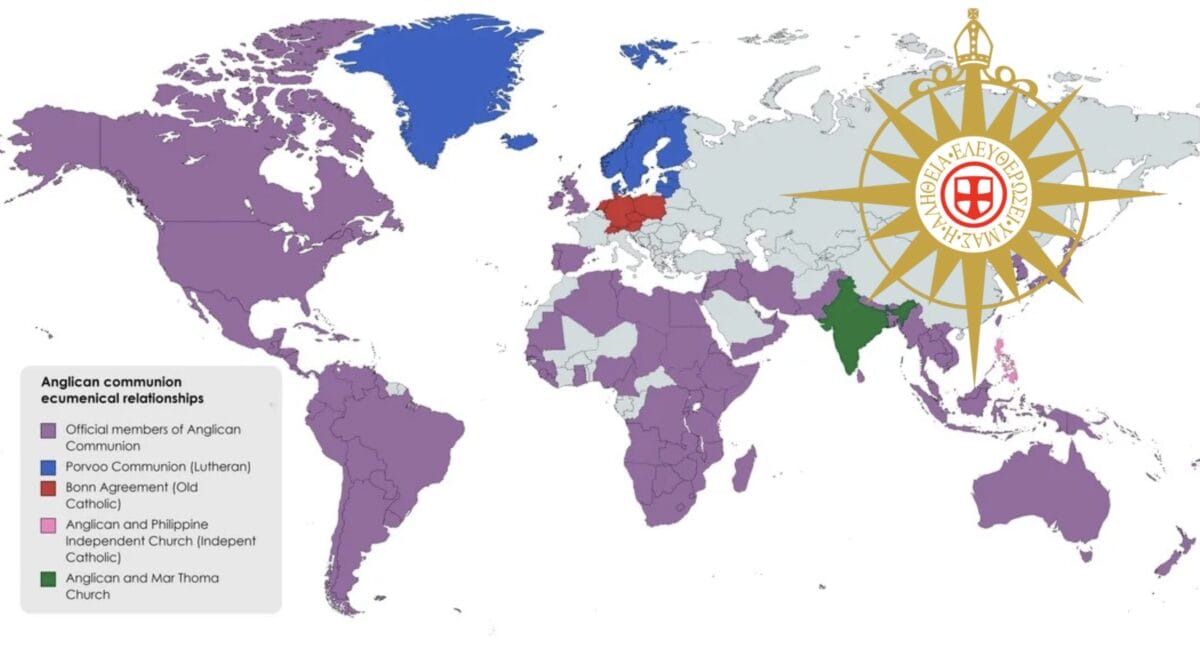
The Inter-Anglican Standing Commission on Unity, Faith and Order (IASCUFO) has recently published the Nairobi-Cairo proposals for reimagining the Anglican Communion. Here Andrew Atherstone, one of the contributors to the proposals, explains why they deserve a fair hearing and how they might bear good fruit.
I have a dream for the Anglican Communion. It is a beautiful dream, of a fellowship of autonomous Anglican churches in diverse regions across the globe, from many different nations, languages and people groups, who are united in their common commitment to the apostolic gospel. These Anglicans are in full communion with one another, bound together by bonds of affection and mutual interdependence. They share a common Anglican story, stretching back to St Augustine’s mission to England in the sixth century, and they express and inhabit the gospel in a common way, rejoicing in the great Anglican texts of the Reformation such as the Thirty-Nine Articles of Religion and the Book of Common Prayer. In my dream, these Anglican provinces delight in their gospel partnership and their common faith, mission, and discipleship. It is nothing less than a foretaste of heaven. This is the Anglican Communion ideal. It chimes closely with the classic statements on Anglican identity made by the Lambeth Conferences of 1920 and 1930, and with the standard Anglican textbooks of the twentieth century.
If, God forbid, sin and error invade this Edenic picture, in my dream there is a coherent biblical method for dealing with any Anglican province which departs from the gospel essentials of faith and holiness. First an erring province would be called lovingly to repent. Next, if unrepentant, they would be disciplined and temporarily removed from Anglican fellowship and decision-making. Finally, as a last resort, a recalcitrant province would be expelled from the Communion and their place taken by gospel-centred Anglicans from that region. In this way, harmony is restored and the dream continues.
If you share this dream for the Anglican Communion, I say WAKE UP! It is a wonderful dream, but a dream only. This Anglican Communion does not exist in the real world. It is a mirage, a figment of our imagination, a fantasy. If it ever existed, it certainly exists no longer. It is time to let go of the old Anglican textbooks, written by theorists, and face facts. We need to wake from our stupor and look at the Anglican Communion with clear-eyed realism.
IASCUFO is team of Anglican theologians helping the Communion to think in new ways about our ecclesiology and interprovincial relationships. Its membership is diverse, drawn from Australia, Barbados, Brazil, Burundi, Canada, Chile, Congo, Egypt, England, Eswatini, India, Kenya, Malaysia, Singapore, the United States, and Wales. IASCUFO has been set the challenge of offering practical proposals for reimagining and renewing the structures of the Anglican Communion. Its ambition is not to turn the clock back to an idealized, imaginary Anglican past, but to look current facts firmly in the face. We are no longer living in the 1920s and 1930s. We need practical, achievable, real-world proposals for Anglican life in the 2020s and 2030s. This is not mere pragmatism, however. The Nairobi-Cairo proposals build a serious ecclesiological case for a new Anglican Communion structure. They open a pathway to global Anglican renewal which is deeply theological, rooted in the Anglican tradition while also borrowing crucial insights from the world of ecumenism.
Faced by the undeniable evidence of deep divisions in the Anglican Communion today, four main responses are possible.
1. Keep Dreaming
One option is to keep pursuing the old dream for the Anglican Communion. This has been urgently expressed, for several decades, through proposals like To Mend the Net (2001) and Repair the Tear (2004), which called for repentance, discipline, and the restoration of godly order and authority. The Windsor Report (2004) offered a practical method for building the dream, through an Anglican Covenant to be adopted by all the provinces of the Communion, but the proposals collapsed, rejected by progressives and conservatives alike.
What have we learnt from the failures of the last 20 years? That the dream will never be fulfilled, certainly not in our lifetimes. The Windsor proposals had good potential, in theory, but crashed in practice. The likelihood of the whole Anglican Communion covenanting together is zero. It will not happen, at least not for the foreseeable future. Those who are still hoping for erring provinces to be disciplined or excluded will be waiting a long time. If the success of the ‘instruments of Communion’ is to be measured by their ability to exercise discipline, then the instruments have failed. But that is not a fair test, because the old instruments were never designed in this way. For Anglican dreamers to go on banging their heads against a brick wall, trying to set the clock back to pre-2003, is a waste of energy. It is tilting at windmills. It is living in an illusion.
2. Keep Pretending
Another option is to pretend that Anglican unity already exists. Anglican adiaphorites see every dispute as a secondary or tertiary issue, never a core gospel concern. Divisions are downplayed as ultimately insignificant, perhaps even a positive expression of our glorious Anglican comprehensiveness, certainly not serious enough to disrupt our relationships or break our eucharistic fellowship.
The Nairobi-Cairo proposals deliberately eschew an adiaphoric approach. The IASCUFO report is frank in its analysis (§41-42) that the current crisis in the Communion is centred upon the blessing of same-sex relationships which, on both sides of the dispute, are viewed as a matter of deep significance involving sin and offence to God. It helps no one to pretend otherwise.
3. Keep Separating
A third option, in face of these deep divisions, is for Anglican provinces to separate from one another completely and absolutely. Most radically, we could burn down the Anglican Communion, dismantle all the old structures, and start again. IASCUFO has begun to consider what would happen if provinces ask to be removed from the Communion. There is an existing process for welcoming a new province into the Communion, but no process for bidding farewell to a province wishing to depart.
The recent collapse in corporate Anglican identity has led some provinces to break eucharistic fellowship or refuse to send delegates to global Anglican gatherings. But no province—not even the more bullish members of the GAFCON movement like Nigeria, Uganda, and Rwanda—has left the Anglican Communion or hinted that they plan to do so. That day might come, but there are no signs of it yet.
4. Keep Engaging
The final option is for Anglican provinces to keep engaging with each other, despite their deep disagreements, as generously as possible. We are never short of identifying ways in which the Anglican Communion is failing. That analysis is important, but the question also needs to be flipped around and asked the other way. What is good about the Anglican Communion? What can we do better together than apart? How would we be poorer if the Anglican Communion is dismantled? Surely no one, even the grumpiest curmudgeon, can see nothing at all good in the Anglican Communion?
To reiterate, Anglican engagers are not adiaphorites! A policy of generous engagement does not pretend that all is rosy or that disagreements are secondary, but it does—in the best ecumenical fashion—seek to build on what is good. Anglican provinces may now have grown so far apart in our understanding of Christian faith, that united evangelism, discipleship and theological education is impossible. But does that mean we should stop talking to each other? Or that we have no common cause in areas such as creation care, safeguarding, domestic abuse, assisted dying, artificial intelligence, abortion, human trafficking and modern slavery, to name just a few?
To take an historic parallel, the doctrine of justification by faith alone in Christ alone is not a secondary issue but drives at the very heart of the gospel. It is one of the chief reasons that ecclesial separation was necessary at the Reformation between evangelicals and Roman Catholics. But does that mean evangelicals and Roman Catholics, in their separate churches, should have no relationship, never meet, never pray together, never share resources, never stand on the same platform? On the contrary, we can hold firmly to gospel essentials and still engage across the divide.
Binary approaches to Anglican ecclesiology are naïve—that Anglican provinces must either be united or separated, either walking together or walking apart, either sharing ‘full communion’ or ‘no communion’. By reimagining the Anglican Communion, at least in part, in ecumenical terms, we discover a richer range of options. To borrow a classic ecumenical idea, it is good to seek ‘the greatest degree of communion possible’ between divided Christians, even if that communion is severely restricted. This ecumenical sliding scale is messy, and does not suit Anglican dreamers, but it is realistic.

So then, while powerful centrifugal forces are driving Anglican provinces further apart, what changes to the structures of the Anglican Communion are necessary to facilitate our continued engagement? Three significant ideas are found at the heart of the Nairobi-Cairo proposals, which are new ways of conceiving the global Anglican project.
1. Embrace Covenantal Renewal
The 2004 Windsor proposals for an Anglican Covenant failed to win sufficient support, partly because the covenant was to be imposed upon the whole Communion, which some provinces viewed as theologically coercive. Now the Global South Fellowship of Anglican Churches (GSFA)—formally recognized by the Anglican Communion since the 1990s—has reimagined the covenant as an invitation to closer Anglican relationships on a voluntary basis. GSFA’s covenantal structure was inaugurated at its assembly in Egypt in May 2024, with nine Anglican Communion provinces as full covenanted members and others likely to join soon. GSFA have consistently affirmed that they have no intention of leaving the Anglican Communion.
The growing influence of GSFA explicitly sets the context for IASCUFO’s deliberations (§7-8). It would be possible, of course, for the Communion to carry on as if nothing has changed, or to hold GSFA at arm’s length. The IASCUFO report does the opposite. It deliberately welcomes the role of GSFA in helping the Anglican Communion to discern ‘doctrinal and ethical truth’, and highlights GSFA’s hopes ‘to see the Communion articulate afresh with vigour the catholic and apostolic faith and order of the Church as a renewal of her mission’ (§56). It also publicly praises GSFA, and its covenantal commitments, for enriching relationships between the provinces of the Anglican Communion and global Christianity more broadly (§68-69). GSFA is not treated as a competitor to the Anglican Communion but, on the contrary, as an essential driver of Anglican theological renewal.
IASCUFO’s communiqué from its recent Kuala Lumpur meeting (December 2024) reiterates this welcome of GSFA’s ‘voluntary intensification of fellowship within the Communion’—that is, GSFA’s covenantal commitments—‘as a potential source of renewal and fresh missional energy, the fruits of which may inspire others’. It concludes:
Despite our divisions, the Anglican Communion needs to find ways for the contribution of the GSFA to be more fully recognised and received within its wider life and mission.
These are significant and sincere expressions of welcome. Two senior GSFA primates (the Archbishops of Alexandria and South-East Asia) are signatories to the Nairobi-Cairo proposals, but IASCUFO has also committed itself to reaching out to GSFA’s leadership for further dialogue. These are all healthy and hopeful developments.
2. Decentre Canterbury
For the last century and a half, the Anglican Communion has been conceived as a family of autonomous churches which are all ‘in communion with the see of Canterbury’. This idea was popularized by Victorian ecclesiologists and took pride of place in the 1930 Lambeth Conference’s classic description of the Anglican Communion (Resolution 49). It is regularly rehearsed in the standard Anglican textbooks. For example, Paul Avis asserts in The Identity of Anglicanism: Essentials of Anglican Ecclesiology (2008):
The litmus-test of membership of the Anglican Communion is to be in communion with the See of Canterbury.
He goes so far as to call it ‘the ultimate criterion’. Furthermore, the constitution of the Anglican Consultative Council (ACC) defines membership of the Anglican Communion in similar terms, as ‘churches in communion with the Archbishop of Canterbury’. (For fuller analysis, see Andrew Atherstone, ‘In Communion with the See of Canterbury?’, The Global Anglican, Spring 2024.)
Here, again, Anglican theories clash with Anglican realities. In its 2023 Ash Wednesday Statement, GSFA publicly rejected Justin Welby’s leadership of the Anglican Communion and declared that the Church of England, by its innovative liturgies for same-sex couples, has departed from the historic faith and broken communion with orthodox provinces. The possibility that Welby’s successor at Canterbury will reverse the Church of England’s trajectory is infinitesimally small. Several GSFA provinces have now begun the process of removing the phrase ‘in communion with the see of Canterbury’ from their constitutions. In a post-colonial world, there have long been strong reasons for decentring the role of England’s primate within the global Communion. But there are also now urgent theological reasons for this shift in the structures of the Communion.
The Nairobi-Cairo proposals recommend that ‘communion with the Archbishop of Canterbury’ in the ACC constitution is replaced by ‘historic connection with the see of Canterbury’. This is deliberately looser and open to wider interpretation, so that provinces no longer in full communion with Canterbury are still publicly validated as bona fide members of the Anglican Communion. It is a highly significant and long overdue change in Anglican self-understanding, from which other reforms of the old structures will naturally cascade.
3. Loosen the Straitjacket
As IASCUFO’s communiqué observes, the Nairobi-Cairo proposals are intended to help the Anglican Communion
to face our theological differences and associated fractures more productively, as we seek responsible and creative ways to remain together, albeit to varying degrees.
One important way to give disparate Anglican provinces the space to breathe is by loosening the Anglican straitjacket which, until now, has insisted that Anglican provinces all share a common apostolic faith. The theological idealism of the standard Anglican textbooks has been suffocating. It has left some provinces with no option but to break eucharistic fellowship and to absent themselves from Anglican meetings, as a way of demonstrating their dissent.
The 1930 Lambeth Conference declared triumphantly that all the provinces of the Anglican Communion ‘uphold and propagate’ the catholic and apostolic faith and order as set forth in the Book of Common Prayer. The Nairobi-Cairo proposals revise this description as ‘seek to uphold and propagate’. These two little words—‘seek to’—are not mere tinkering. On the contrary, they are a fundamental reconception of the nature of the Anglican Communion, harnessing the language of ecumenism. This significant shift in Anglican self-understanding faces up to the harsh reality that catholic and apostolic faith and order are no longer necessarily held in common across the Communion. It provides a vital theological ‘firebreak’ between disparate provinces, thus enabling us to hold better together.
I previously outlined this idea in ‘Grieving the Anglican Communion’ (February 2023), but it is worth repeating here:
Reimagining global Anglican relations as an ecumenical project is a fruitful way to dispel some of our current angst. When someone living in my house is trying to burn it down, I will grow fierce and fight them away. In those conditions, it is impossible to live together under the same roof without being constantly at war. But if they are burning down their own house, at the other end of the street, I can relax if there is a firebreak between us. Instead of warring against each other, we can find a safe space to meet for constructive conversation. For too long, we have stubbornly proclaimed, against all the evidence, that the Anglican Communion is ‘one body’ theologically and structurally. But, counterintuitively, this mantra simply drives us further apart, because it forces provinces to shout more loudly to make their differences heard. If, on the other hand, we start speaking of the Anglican Communion as an “ecumenical body”, and build in the necessary structural firebreaks, it will help us to stay closer together.
Of course, the ecumenical parallels are not exact. Anglican relationships are stronger and deeper than typical ecumenical relationships, partly because we inhabit the same story and share the same liturgical texts. But a century of ecumenism has refined many of the ecclesiological tools which Anglicans now need as we navigate the future.
Towards Belfast 2026
The Nairobi-Cairo proposals are offered to the Anglican Communion for wider deliberation. They will be discussed in detail at the Anglican Consultative Council’s next plenary gathering in Belfast in June 2026, along with structural changes to the ACC’s constitution. In the meantime, during 2025, the proposals provide much rich material for corporate reflection and assessment, so they deserve serious and constructive engagement.
If the Nairobi-Cairo proposals are adopted, they open the door to Anglican theological renewal and a paradigm shift in the way interprovincial relationships are understood. They create a generous and hopeful way forward, not harking back to impossible dreams for the Anglican Communion a century ago, but positive and practical reforms which look our current Anglican realities squarely in the face.
 Dr Andrew Atherstone is Professor of Modern Anglicanism at the University of Oxford, and Latimer research fellow at Wycliffe Hall, Oxford. He is a member of the Anglican Consultative Council and a consultant to IASCUFO, though writing here in a personal capacity.
 Buy me a Coffee













>>To take an historic parallel, the doctrine of justification by faith alone in Christ alone is not a secondary issue but drives at the very heart of the gospel. It is one of the chief reasons that ecclesial separation was necessary at the Reformation between evangelicals and Roman Catholics.<<
A somewhat romantic view.
Wasn't the central issue at the heart of the English Reformation that of ecclesiastical authority and the relationship between the Bishop of Rome and the Church in England? It wasn’t deeply theological in England. It was the belief that the King is sovereign in his own lands and no foreign ruler – the Pope – held authority and power. In England, the Reformation began as a personal act of the King because he wanted a divorce.
The Church in England initially in schism, once separated from the universal Church then embraced theologies considered to be heretical by her. Indeed, Henry VIII, outside of rejecting papal supremacy over the Church in England, expressed faithfulness to the Church’s doctrines. In 1539, he had Parliament pass the ‘Act of Six Articles Abolishing Diversity of Opinion’, that affirmed Catholic teachings. It was only after Henry’s death, during the reign of the child Edward VI (1547-1553), that the Church in England under Cranmer who, for reasons of his own, embraced teachings contrary to the traditional Apostolic faith.
Is it any wonder that a church – the “Anglican Communion” – that originated in the rejection of central ecclesiastical authority and insisted on the autonomy of a local church, is now facing the full consequences of such centrifugal forces.
On the continent the Reformation began spiritual and then went political. In England it began political and then went spiritual.
Too simplistic, Anton.
The revolt that began in Germany was fed by a growing German nationalist movement, with resentment directed against the papacy, and the avarice of the German nobility for Church lands and wealth. Sure, the separation began, in Hilaire Belloc’s words, “as a sort of spiritual family quarrel” and “continued as a spiritual civil war,” then “an actual civil war.” A conflict not “between two religions but a conflict within one religion.” The cleaving of Christendom did result in the establishment of a new spiritual culture separate from the dominant, centuries-long Catholic culture.
It’s what’s now happening now in the Anglican Communion. There’s a rejection by more traditional Christian national churches of the path trodden by the western Church of England since the 1930s (acceptance of contraception, abortion and divorce), and the inevitable end-point of this (acceptance of same sex relationships). Untethered from past doctrines, once considered binding and unchanging, means all teachings are open to change.
You quote Belloc on the Reformation? I recognise what you are summarising as coming from his book The Great Heresies. But he is highly economical about the causes of the Reformation. He speaks of the Western schism that began in 1309, when a disagreement between the papacy and a strong French king over tax revenue from French clergy caused the papacy to be displaced to Avignon for a lifetime (until 1376), after which Europe witnessed competing Popes in Rome and Avignon for four decades. This schism was finally resolved at the Council of Constance, 100 years before Luther began his protest. The idea that church councils were above Popes was necessary to resolve the schism, and it echoed round the Catholic church for those 100 years to Luther’s time. Luther’s appeal for a council to consider the papal bull Exsurge Domine, promulgated against him by Leo X in 1520, generated some support as a result. But that is unlikely to have been as polarising a factor within the Catholic church as the theological issues raised by Luther. If the schism had reduced the Catholic church’s reputation by 1517, it only had itself to blame.
Belloc next considers as a factor the Black Death, which killed one-third to one-half of Europe’s population in the mid-14th century. But people actually turned toward the church as the plague came; the subsequent weakening of the feudal system under the changed demographic might more wisely have been welcomed by church authorities, as alleviating the lot of the peasantry. But the Catholic church sided with an oppressive aristocracy trying to limit wages in the face of increased demand for labour. This lost the church much popular support.
Upon one cause of the Reformation, Catholic church corruption, Belloc treads lightly. The archives of the Provveditori Sopra Monasteri, a group of magistrates charged with cleaning up Venice’s convents in the 16th century, include 20 volumes of trials for cohabitation of monks and nuns. Erasmus wrote in 1528 that many convents were public brothels (Life and Letters of Erasmus, J.A. Froude, 1894, p.352). When Pope Paul III began Rome’s response to Luther by commissioning a group of Cardinals to write a report on church corruption, the Consilium… de emendanda ecclesia, its contents so embarrassed his successor Paul IV when it was delivered that he placed it on the Index of books which Catholics were forbidden to read. The Consilium said nothing that Savonarola had not been burnt for saying, a few decades earlier.
As well as churchly corruption and greed, a further factor in fuelling the Reformation was the invention of printing. Once Gutenberg of Mainz had invented printing in Europe using moveable metal type in the 1450s, any educated man could glance at a printed Latin Bible and read out a rough translation in the vernacular to a listening audience. By this means people could compare Catholic practice against the New Testament for themselves. Within a lifetime, a sufficiently vigorous and courageous polemicist, as Luther was, was able to exploit the result. Belloc was patently too embarrassed to include printing as a reason for the Reformation, but historians are unanimous that it was vital. The Catholic church could not ignore Luther’s critique, as it had ignored Erasmus’s, because Luther’s diatribes against the corrupt selling of Indulgences were a threat to church income.
Belloc divides the Reformation into a first phase during which it was regarded as an internal church quarrel, then a second phase of Catholic versus protestant. Belloc never explains that the watershed occurred because the Catholic church refused to take Luther’s critiques of corruption and unbiblical theology seriously, and excommunicated him and his followers – after which it ignited wars of religion to eradicate the new movement resulting from its actions. Protestantism survived, and the ensuing stalemate gave rise to the principle of cuius regio, eius religio: protestant rulers imposed protestant Christianity in their lands, and Catholic rulers imposed Catholicism in theirs.
Belloc’s bottom line is that church unity was destroyed by the Reformation. This is nonsense, for Christendom had already been split five centuries earlier, and split by Rome. Schism into Roman Catholic and Eastern Orthodox churches took place in 1054, when Rome demanded a change to the Creed concerning a detail of the Trinity which scripture says nothing about. Disunity after 1054 led to military defeat by Muslim forces in the Crusading wars, and to the ingress of Islam into the Balkans. Belloc felt these losses keenly, but he showed no understanding of the deeper reasons for them.
Little is said by Belloc about some significant actions and alliances during the early years of protestantism. The Catholic monarch Francis I of France allied himself with Muslim Turks of the Ottoman dynasty to keep Catholic Holy Roman Emperor Charles V at bay on Francis’s eastern border. Charles V in turn allied with the Persians, who promised to attack the Turks’ eastern flank if the Turks attacked Charles. Protestant forces meanwhile proved themselves loyal at arms under Catholic command when the Turks, who had reached the gates of Vienna in 1529 before being repulsed, marched up the Danube valley and tried again in 1532. Belloc suggests that protestantism would have been eradicated if Catholic forces had not been busy keeping the Turks out of Western Europe. More accurate is that protestantism might have been wiped out if Catholic France and Catholic Charles V had not continued fighting vain wars against each other.
As for the frightful Thirty Years War (1618-48), it began when protestant Bohemia objected to a new and ardently Catholic ruler who had already stamped out protestantism in Styria. The protestant regimes of Denmark and Sweden joined in on behalf of the protestant States, and against the Habsburg dynasty of this new Holy Roman Emperor (Ferdinand II) – a dynasty which also ruled Spain and Austria. Spain was already battling to maintain its interests in the Low Countries, and it entered on behalf of the Catholic States and the Emperor. Then France, although Catholic-ruled, joined in against the Catholic Habsburgs who were confronting it on two borders. The principle of cuius regio, eius religio was eventually confirmed in 1648, but at a terrible price in German blood. Belloc plays up Cardinal Richelieu’s bribe to protestant Gustavus Adolphus of Sweden to enter the conflict against the Habsburgs, but has less to say about Catholic France’s later direct entry in 1635, an action which prolonged the bloodshed for a further 13 years.
it is ridiculous that Belloc labels protestants as heretics while he prays to Mary as well as to Jesus, and insists that his church system is led by a man who is infallible whenever that man says he is. Are you aware that he dismissed much of the Old Testament as Jewish folklore and even described Jesus, the man who performed the archetypal act of heroism seen in war films by giving his life for his friends, as a milksop whom he found personally repellent (see AN Wilson’s biography of Belloc, p.330)?
Anton, I quoted a few appropriate lines from Belloc!
I wrote:
>>Sure, the separation began, in Hilaire Belloc’s words, “as a sort of spiritual family quarrel” and “continued as a spiritual civil war,” then “an actual civil war.” A conflict not “between two religions but a conflict within one religion.” The cleaving of Christendom did result in the establishment of a new spiritual culture separate from the dominant, centuries-long Catholic culture.<<
You disagree with these points?
I have already given above a considerably more in-depth answer to your question than a mere Yes or No would permit.
History is always more complex than you think. The ideas of the Reformation had been around a long time, with the Lollards in England and the Hussites in Bohemia, for instance. It should be remembered that these, like the classical Reformers Luther and Calvin, were concerned to, as the name implies, reform the Church, bringing it back from the way it had wandered. Luther did not know about the Hussites until people started pointing out that his ideas seemed very like theirs. So there was in, say, 1510 an undercurrent in many places about the way the Roman church was going.
What enabled these ideas to take more positive root at this point was political change. In the Germanic states, the issue was the authority of the Holy Roman Emperor. Supporting the theology of Luther and the ilk was a way of rebelling against political authority. The same rebellion in England had a different root, but with the same effect. Having loosed the chains from the centre, those sympathetic to the Reformation were able to move the local church in tat direction. Even Henry moved somewhat, under the influence of Katharine Parr, his last wife. On his death, Cranmer et. al. were able to make greater moves in the Reformation direction. However, as a title of a book expresses it, there were Reformations in England. It was not really completed until the Elizabethan Settlement. This process was helped along the way by the behaviour of Queen Mary – Foxe’s Book of Martyrs was a significant influence following her departure – and the Pope in declaring it a Good Thing for Elizabeth to be killed.
If the Council of Trent had been held 60 years earlier would the Reformation have happened?
>>If the Council of Trent had been held 60 years earlier would the Reformation have happened?<<
Certainly the Catholic Church in the 16th century was plagued by abuse, including sexual abuse, nepotism, simony, and the sale of indulgences. The institution certainly needed reform. It was these abuses that gave traction to the earlier "proto- protestants" Wycliffe and Hus in the 13th and early 14th centuries who laid the groundwork for the likes of Luther, Calvin and Zwingli.
The Council of Trent did make major reforms to the Church. It's goal was not only to reform the Catholic Church, but also to secure reconciliation with the Protestants, as well as clarify Catholic doctrine.
Alas, it did come too late.
Secure reconciliation with the Protestants … by anathematising the Gospel as they understood it. Interesting approach.
I’d say the English Reformation was not really completed until 1688 !
Well, yes, you would.
You think I am having a dig at Rome but that is when protestantism outside the Established church became legal as part of the Constitution.
Oh, Anton, meant to say that Cressida wishes you and your cat a Happy New Year.
Thank you Jack; and to her and hers.
Decentring.
Unlike Islam, all of Christianity, is geographically decentred.
It centres only on a Person and it is not Peter or Augustine.
And people groups ‘of the Book’ as satellite bodies.
Islam has no global Pope though, at most there are just senior Imams in each nation though none even really with the authority of even an Archbishop
Try Mecca.
A pilgrimage site like Lourdes or Canterbury or Santiago de Compostela
Not at all an equivalent of Hajj one of the five pillars pf Islam.
And, prompted by Happy Jack’s comment about Henry ‘decentering’ from Rome, perhaps it should be part of Anglicanism not to be ‘centered’.
The Anglican Communion is of course a relatively recent creation, dating from the 19th century and largely a product of the expansion of the British Empire, especially in Africa. It has never been as unified and top down as the Roman Catholic church which is centuries older than even the Church of England (and indeed was the national church even in England before the Reformation) and where what the Pope and Vatican says largely goes for Roman Catholics globally.
Instead the Anglican Communion is just a loose connection of churches which use or have used the Book of Common Prayer and 39 Articles and have Bishops of Apostolic Succession. To survive it needs to be a largely loose relationship for a post Empire age, much like the Commonwealth is trying to be. Even now the Archbishop of Canterbury only leads it as first amongst equals. It is possible in future leadership of the Anglican Communion would be rotated amongst the Archbishops who lead each Anglican province around the world. Indeed Prince William has suggested he too might no longer be permanent leader of the Commonwealth when he becomes King but the role should be rotated amongst Commonwealth heads of state instead
I mean, sure. But this seems much more concerned with how this thing called the Anglican Communion works, rather than an articulation of what it actually is. Perhaps this is just entirely ignorance on my part, but I don’t know if I could answer that question.
What is the Anglican Communion really for? Is it simply a voluntary expression of unity? Does it bind or obligate it’s members to anything? How and what would a church (be that a local or national one) benefit from this association? Organisations like the EA, or FIEC, build their unity on confessions, or codes of practice, that the individual member churches might lack but the Anglican communion doesn’t appear to provide anything that the national structures of Global Anglicanism doesn’t provide already.
It feels, and this is a bit cynical, like an attempt to play at being Catholics; having a trans-national identity but without the steps this would actually entail to make that unity actually mean something.
You might not be the only one who thinks that…!
Having said that, it does point to the historical reality that the Church of England was once an international missionary movement…
>>It feels, and this is a bit cynical, like an attempt to play at being Catholics; having a trans-national identity but without the steps this would actually entail to make that unity actually mean something.<<
And what would those steps be, I wonder.
The problem is (1) that this is about redefining sin away from what scripture says, which man has no authority to do; and (2) it is not a minor province doing it, but Canterbury.
I would suggest this. If the faithful provinces believe that Canterbury will eventually repent, they should stick it out. If they don’t, they should sever links, start their own arganisation, and tell Canterbury it is welcome to join if it repents, but not on the basis of the old organisation. Either way, Canterbury should be given a time limit.
Anton
As I’ve pointed out before, the Anglican position on gay people in the church since the 90s has been that they may not marry or have sexual relationships, but must be welcomed as equals and some level of tolerance must be shown to those of them who sincerely disagree with Anglican theology of their relationships.
I’d argue there are zero provinces which have ever practiced this. There’s either de facto full support for same sex relationships (US) or homophobia and demonization, some times even violence (Uganda) or some combination of the two (England).
All in Christ are equal in Christ, whatever lusts heterosexual or homosexual their ‘flesh’ tempts them with. But the church and the world today have different criteria for what demands repentance and what does not. The church should take its criteria from the Bible, and whoever doesn’t like that should keep out of the church instead of trying to twist it to the world. They should ponder very soberly whether they are part of it anyway.
Anton
As I’ve pointed out before there’s no agreement on biblical interpretation.
The idea that it is difficult to deduce a biblical line on sexuality is absurd (as I’ve pointed out before). Those who say it is difficult are simply muddying clear waters. Would you like to discuss those awkward verses again?
The EA or FIEC model would fit on the face of things.
As for repentance, Canterbury wouldn’t comply, qualify for initial admission, entry.
As for discipline, didn’t the EA remove S Chalke for his divergence from doctrine?
Don’t membrr churches of the FIEC have to confirm, each year that they hold to the doctrines.
There do seem to be existing models that could be extrapolated to an Anglican Fellowship/Alliance.
It seems to me that a safe space to meet, discuss and understand each other better in an ecumenical way is an achievable reality, but it is not an Anglican Communion. That doesn’t make it a bad thing but it makes it a much less significant thing.
I’m always amazed how much discussion can take place without any reference to the heart of God, His love for the lost, the Kingdom of God, contending for the truth, heartfelt repentance over the state of the church, Scriptural descriptions of the church, or many of other key New Testament concepts.
I hear lots about organizational change, but nothing about deep love for Jesus and His Kingdom.
Perhaps that’s where these issues stem from. We need a rending of hearts, and Spiritual renewal more than new structures.
There were several reasons the original Covenant failed.
It was self righteous at its heart- ‘we are right and you are wrong’.
It was judgemental – ‘you have to go and sit on the naughty step while you think again’.
It traded on shame – ‘you don’t even realise how awful you are’.
It wanted a separatism – ‘let’s not have any impurity amongst us’.
All of these are apparent in these new proposals – slightly hidden behind a niceness and reasonableness – but nontheless still there.
I am at the stage of life – retired, no longer active in Church life, and despairing about the state of the CofE – so I don’t much care any longer if the CofE survives, and think the Anglican Communion is a huge irrelevance at best and has become all about a power grab. But I am very clear that any future organisation that embodies characteristics like those I have outlined above is very far from the Gospel and I want nothing to do with it.
Happy New Year all!
Great to hear. Already happier, thanks.
The C of E will survive, it has £8 billion in assets and is one of the wealthiest landowners and asset owners in the country. However whether it can contain conservative evangelicals who oppose even PLF and liberal Catholics who want full same sex marriage as well as conservative Anglo Catholics who still oppose women priests and bishops and PLF and ‘open’ evangelicals who welcome PLF and women bishops and women in ministry more generally is more of a difficult question. The same goes for divisions within the wider Anglican communion, especially the divisions between African Anglican churches from countries which don’t have same sex marriage (apart from South Africa) and in some of which same sex relationships are still illegal and western Anglican churches most of which come from nations where same sex marriage has been legal now for years.
Such divisions are not as big an issue in rural C of E churches which are mostly middle of the road and have little competition from other denominations but are more of an issue in bigger cities and in the wider Anglican world
Your final point is absolutely right and needs to be heeded by some on all sides who have strong party allegiances. A lot of the fractious debate of recent years is irrelevant in most rural parishes where people of very different theological and liturgical traditions have long ago developed the grace of getting along together and serving Christ and one another faithfully. It is noticeable that many of the loudest and most self-assured voices on the national stage are clergy from larger city centre gathered churches. They rarely have insight into the rural church nor have they learned from its wisdom. The rural church can show us all how to faithfully live with differences and disagree well. They offer a viable alternative to the alliance formed between pressure groups in England and some other parts of the Anglican Communion. We don’t have to give in to the voices of the most vocal.
Exactly. In our rural village and hamlet medieval churches we have Roman Catholics and evangelicals all worshipping together in C of E churches but churches which were of course originally Roman Catholic before the Reformation.
City churches could learn much from rural ministry on working together with Christians from all traditions to have a visible presence of Christ in the local community. The Anglican Communion too can also learn to be a loose alliance which respects some differences on doctrine
Indeed. From the rural church perspective some of the more assertive views expressed across the Anglican Communion look rather irrelevant and, frankly, unnecessary. Learning to love, pray with and serve alongside those we may disagree with (even on some very important issues) is more of a gospel imperative to many than ensuring unanimity on selected topics. I see little evidence unfortunately of larger, gathered urban congregations or their clergy learning from the de facto ecumenical experience of the rural church. And the IASCUFO report Andrew Atherstone comments shows no sign of listening to the rural church. There is another approach possible but perhaps too many people now have too much invested in one or other of the polarised positions to give any space to the alternatives.
Sensible comments, there is much to learn from rural churches if people are prepared to listen
On The Polity of the Church[s]
Of which much navel gazing;
Ian Paul has a time-line for how long churches in their current polities might endure.
Perhaps God might be doing a “new” thing, perhaps indicating that “you have not passed this way heretofore”. (Josh. 3 : 4&5 )
Perhaps lifting our eyes up might help?
Considering for example other ecclesiology’s, that have been used to advance the Kingdom of His Son.
One might consider J N Darby’s ecclesiology. An Anglican priest quite skilled in converting many Roman Catholics to Protestantism in Ireland.[1800’s]
The problem was the then Anglicanism was not fit for purpose. Hence, he left [but never rescinded his license to preach.]and feeling ironically that the Cof E was beyond reformation!
Consequently, his ecclesiology became bottom -up rather than top-down. with little or no structure.
Unfortunately, some of his acolytes reverted to type leading to all the usual abuses.
However, on the other hand Watchman Nee and Witness Lee [who was truly a witness in both China, the USA and worldwide] embraced it to amazing effect.
P.S Witness Lee’s web—site, I find very nourishing.
Royalty survived Prince Andrew’s scandals. I’m sure the communion will survive Welby.
Essentially the ‘Anglican Communion’ is a kind of accidental consequence of the old British Empire, even if as the map at the top shows it both associates with similar churches such as European Lutherans, and missionaries took Anglicanism to other territories, eg in South America. And the mother church of the communion is still very much the English established church, though most of the branches abroad are no longer formally established.
In turn, being established followed from the RC church’s place as the imperial state church of Rome, with a slightly different connection to the states of the Western empire; Anglicanism was perhaps more like ‘Orthodooxy’ in the Eastern Empire. Thing is, that state link in any of its forms was, well, heretical – not following the ‘kingdom not of/from this world’ pattern which is found in the NT. As I read it God wants us all, not just the Anglicans, to return to the NT pattern – which should not be a problem to Anglicanism which always recognised the Bible as supreme authority and has always in theory been open to revising its ideas to fit the Bible better. Any other option is actually wrong on Anglican terms and in Anglican terms would be faithless to God and should not be expected to succeed or be ultimately blessed by God.
That is a Baptist interpretation of Anglicanism which ignores the fact it has Bishops of Apostolic Succession or its very creation by King Henry VIII as a church with the English monarch as its head
But Simon/T1 where do you derive your understanding of the significance of apostolic succession?
The whole point of tactile succession was that the true kerygma, the teaching of the apostles, should be passed on. It was always about doctrinal continuity, not something magical about people which anointed them with infallibility.
The Church of England since its foundation has traced its Bishops via apostolic succession and the time when the Roman Catholic church was the national church back to St Peter himself
and if they abandon that apostolic faith, that is worthless. It is not magic!
T1
Article VI of the 39
“Holy Scripture containeth all things necessary to salvation: so that whatsoever is not read therein, nor may be proved thereby, is not to be required of any man, that it should be believed as an article of the Faith, or be thought requisite or necessary to salvation.”
“…not to be required of any man…” means that not even the King of England can require people to believe contrary to the Bible. Nowhere in the Bible is any special authority given to the Monarchs of England – or any other earthly king since OT Israel. All authority belongs to the Messiah Jesus – who rather authoritatively validated the scriptures.
In recovering from the mess that medieval Catholicism had become, Anglicanism didn’t get everything right first time; even what Henry did needed some reform via Elizabeth, and as the Puritans quickly realised even what she achieved was distorted by her political aims and was undesirable compromise. In particular early Anglicans, as sponsored by the monarchy, failed to realise what the Bible actually teaches about Church and state. It is way past time to follow that Article fully and in order to do so extract the Church from its establishment/entanglement in the state.
By the principle of that Article I don’t have to believe in the modern bishops but only in biblical-style bishops where the title is simply another word for an ‘elder’. Plus logically no matter how long the chain of laid-on-hands back to an apostle, no bishop can have authority to contradict scripture….. And perhaps especially not about sexuality…..
Article XXXVII ‘The King’s Majesty hath the chief power in this Realm of England, and other his Dominions, unto whom the chief Government of all Estates of this Realm, whether they be Ecclesiastical or Civil, in all causes doth appertain, and is not, nor ought to be, subject to any foreign Jurisdiction.’
The Church of England’s very articles affirm the monarch’s role as head of state in England and chief power too too of both the Civil and Ecclesiastical ie relating to being formal head of his government and Supreme Governor of the English church too. You by contrast are a nonconformist Baptist Puritan who wants to turn the Church of England from Anglicanism into being just a branch of the Baptist church or a Presbyterian church without the King as its Supreme Governor, without Bishops in the House of Lords (indeed without Bishops at all) and without the Book of Common Prayer. It was of course the House of Clergy and House of Laity who voted for PLF not just the House of Bishops
You are misreading. This article means other may not interfere. It does not mean that the king, or any other authority, can tell the Church to believe what is not true.
If the bishops vote for something which is contrary to the teaching of Scripture, then they are acting illegally. Canon law is very clear on that. And that is why the House has been so secretive.
T1
Yebbut – by what authority besides his own does the king claim that authority over God’s church? Nowhere in the scripture is any such authority given to an earthly king, and Jesus/God-incarnate is the actual king with authority in the Church.
Often when secular rulers try to claim such authority they base it on a loose interpretation of ‘being subject to the authorities’ in Romans 13. But of course Romans 13 was written for the first century situation where the Church was independent not to mention international, operating as Peter says as a ‘diaspora’ of ‘parepidemoi/resident aliens’. It is not about a ‘state church’ situation which Jesus’ “kingdom not of this world” was intended to preclude. In Romans 13 we are in a world where Christians may tell the authorities “We must obey God rather than men” – and ‘subjection’ means when they cannot obey, unlike other dissenters they do not rebel but remain subject in a different way, accepting the punishment the authorities may inflict on them.
The secular king claiming authority is a twisting that was only possible after the ‘hijacking’ of the Church by the Roman Empire which allowed an entanglement of church and state that could misinterpret Romans.
If the Church remains in the relationship to the state/world that the NT actually teaches, the Church itself will be the world’s “Christian nation”, under the authority not of any limited human king but of Jesus and the Bible.
It does however mean the King has authority over the government and the Church of England as its Supreme Governor.
Divorce, except for spousal adultery, women priests and bishops, even eating shellfish are also contrary to some teachings of scripture but the C of E has never been an absolutist church on all aspects of every passage of the Bible. Not that the Bishops or Synod voted for same sex marriage anyway, just PLF
The very authority by which the Church of England was founded, by the then King of England Henry VIII to make him its head not the Pope and as approved by Parliament. Anglicanism is not a pure evangelical denomination, it has Bishops and uses the BCP even in non established Anglican churches anyway. It is still distinct from your Baptist nonconformism even if not a state church and indeed the Anglican churches which now perform same sex marriages in the USA and Scotland are neither established churches anymore either
T1
Where the two conflict, we must obey God rather than man – so said the alleged first Pope, who at least had indisputable personal apostolic authority, in Acts 5; 29. Even when the man – or woman – is the monarch of England.
There is a Church of England because by c1300CE the Catholic church’s failings were worrying Catholics – failings including the indulgences scam which finally triggered Reform, but also such unChristian atrocities as jihad-like Crusades and the persecutory Inquisition, the Spanish form being particularly bad. And let’s be blunt – most of those problems were because the RC church claimed a false authority from ‘apostolic succession’ to disobey God by going against the Bible; the medieval Church is the best possible evidence that ‘apostolic succession’ is not valid.
Reformation was itself messy and not everything was got right at the start. In particular the entanglement with worldly states continued as selfish rulers used the Reformation to get out from under papal authority. Henry VIII wasn’t even Protestant anyway. But eventually the chaos opened space in which Christians studying the Bible for themselves could realise the deeper truth that Christianity is voluntary and a different kind of ‘kingdom’, with Jesus as King not earthly monarchs who have only limited authority from God.
The distortions of the faith that arose after the 4th Century (the 300sCE) have pretty much run their course – the future will be biblical churches obeying God rather than man, biblically faithful. To have a future the CofE will need to finish, fulfil or complete its Reformation by finally disentangling from the state and resolutely serving only one master, Jesus.
The then King of course created the Church of England in the first place precisely so he would be head of it not the Pope, whereas the Pope had headed the English national church until the 16th century.
Concerns over indulgences were more a driver for Lutheranism, Henry VIII created the Church of England mainly as he wanted to divorce Catherine of Aragan and marry Anne Boleyn and the Pope of the time refused him that. Indeed past English Kings like Richard I had even taken part in Crusades. The RC church of course has no women priests, has no women bishops, has no same sex marriages and indeed won’t even grant a divorce without an annulment, so on your definition is more biblical than many Protestant denominations now, including the C of E.
The Protestants who wished to defer to Jesus and God above all with no reference to Kings or Popes became, like you, Baptists or Methodists or Quakers or more recently Pentecostals. Anglicans however like Lutherans largely just created churches which originally were headed by their nations Kings rather than by Popes but still had elements in the Catholic tradition, including bishops of apostolic succession.
As for ‘disentangling’ from the state making a church automatically more biblical, I would point out the Quakers and the Methodists all now perform full same sex marriages in their churches despite having no links to the state at all. The Church of Scotland also performs same sex marriages yet while recognised as the national Scottish church is not an established church either. Yet despite its state links and being the established church the Church of England still does not perform same sex marriages in its churches, only PLF even now
‘The then King of course created the Church of England in the first place’.
The king did no such thing. The Church of England was in place; it didn’t need creating.
What Henry did is replace the Pope as head with himself as head.
Your language here is rather odd!
The Church of England before the Reformation was effectively the Roman Catholic Church. Only by the King replacing the Pope with him as its head do we now have the Church of England we know today
T1/Simon
That is too incoherent to attempt a detailed answer. Just a few points
1) “As for ‘disentangling’ from the state making a church automatically more biblical,…” It will make the church more biblical AT THAT PARTICULAR POINT. in the case of the CofE it can hopefully relieve some of the other pressures on the body and enable it to – well as I said, serve one master, God, rather than have a divided loyalty. If the Church does not return to Biblical standards it will fail because God will not support people who would effectively be telling Him to go jump! Quakers were always a bit unconventional and in the 19thC split with bible-believing Quakers largely joining the Brethren and the others moving further from the bible.
2) You still totally avoid explaining where Henry VIII could possibly get authority to be ‘Supreme Governor’ of any part of God’s Church. I recall when I first looked into this seriously, at Uni in the late 60s, that I was shocked to find that ‘establishment’ and similar church/state entanglements (a) have NO NT support, and (b) the NT actually teaches a very different coherent alternative.
No it won’t. As I have just told you of the churches which now perform same sex marriages eg the Methodists, the Quakers, the Church of Scotland, the Anglican churches of Scotland and the USA and most Lutheran churches most have no links to the state.
Henry VIII was King of England and used that very authority to make himself Supreme Governor of the Church of England.
T1/Simon
At the moment Christians everywhere are under pressure to conform to the world in these issues of sexuality – some have succumbed to the pressures, some have not. An established church in a state which permits same-sex marriage is under unusual pressure in that area. There is a real problem in being a state church at such odds with the state. A church which is disestablished will at least not be under that particular pressure. Hopefully it would at least be easier for the Church to resist the pressure and stay biblical.
“Henry VIII was King of England and used that very authority to make himself Supreme Governor of the Church of England”.
Henry was a man – and as Peter said, the Church must obey God rather than man. The scripture gives no authority to Henry to usurp the Supreme Governorship of the Church. Without such divine authority Henry acted improperly, and the sooner his improper acts are reversed the better for both Church and state.
Which is of course a ridiculous suggestion. Synod will still decide on same sex marriage whether the C of E is established or not as it did on PLF. As already stated which you ignored the only 2 Anglican churches which allow same sex marriage now are the US Episcopal Church and the Scottish Episcopal Church neither of which are established. So your argument falls at the first hurdle.
Indeed it is now proposed the Archbishop of Canterbury will no longer head the Anglican Communion anyway, the role will rotate amongst Archbishops from each province, making it easier for each province globally to take their own position on same sex relationships
https://www.thetimes.com/uk/religion/article/archbishop-of-canterbury-no-longer-world-anglican-leader-in-shake-up-plan-3ld60cqbr
Henry was a King, without whom the C of E would never have been created. If he was no longer Supreme Governor the C of E may as well revert to Roman Catholicism again with the Pope again head of the national church while evangelicals like you would become Baptist, as you already are, or Pentecostal
T1/Simon
Yes, Synod will decide. If the CofE is disestablished they will be free of very significant pressures that arise from trying to hold on to the rags of influence of the former state/church entanglement. Or as I’ve also put it, trying to serve two masters, God and state. They may still be tempted to conform to the world, to “let the world around you squeeze you into its own mould”, (Romans 12; 2, Phillips) – but if they do so conform it will be disobedience to God, and it’s a bit hard to see the point of a church that disobeys God!!
And seriously where does even the King of a small country in this small planet get the authority to didsobey God by usurping the title of ‘Supreme Governor’ – you talk as if this mere man and his merely human authority, outranks God. An ‘anointed king’ doing that becomes almost literally an ‘antiChrist’, a fake Messiah.
There is a clear liberal Catholic and open evangelical majority on Synod, otherwise PLF would not have passed nor would women priests nor would women priests. Just conservative evangelicals have more than 1/3 of the vote for now to block same sex marriage. Nothing whatsoever to do with it being established church which is irrelevant.
The Church of England was created by the then King to be the English national church, that was the WHOLE point of it. If it is just obedience to God you want you may as well be Baptist, Pentecostal, Roman Catholic or Orthodox or even Muslim or Jewish (given they still believe in the God of Abraham even if not the Trinity). Belief in God is not what marks out Anglicanism and the C of E as distinctive, having Bishops of Apostolic Succession, the Book of Common Prayer and in the case of the C of E the King as its Supreme Governor and the 39 Articles are what makes Anglicanism and the C of E distinctive
T1/Simon
You may well be right about the Synod majority – in which case the CofE is doomed, in the original sense of that word that it will suffer the ‘doom’ or judgement of God on its disobedience. The establishment is very relevant to this because the entanglement with the state has confused church and world and so encouraged conformity to the world in all kinds of ways including now sexuality. With the establishment already a disobedience to God, the choosing of same-sex marriage is a further step of disobedience, a clear message to God to “Go jump, we know better than You!” That cannot end well ….
“If it is just obedience to God you want ….” Actually almost the “WHOLE POINT” of any Church is ‘obedience to God’!! OK, there is much more to it but the obedience is an indispensable part. The supposed ‘Apostolic Succession’ is meaningless if the bishops defy original apostolic doctrine and encourage disobedience over sexuality.
Given the biblical teaching on church-and-state/church-and-world, Henry’s claim over the Church IN England was improper. Understandable perhaps as a phase in a gradual and still ongoing Reformation, but ultimately wrong, and the current King and the current English state should not be continuing it, but should free the Church to be as the Bible says God intended it to be. Biblically the Church itself is the world’s ‘Christian nation’, a nation of the ‘born again’ in a way that an earthly state cannot enforce, and even kings have no right to control. Yes Christians are ‘subject to’ the earthly authorities, but not in such a way that we ‘obey man rather than God’. Rather that we assert God’s authority in a peaceable way rather than with the violent rebellion seen for instance in the Ulster ‘Troubles’, and accept martyrdom when we cannot simply obey. No earthly king can simply as king claim authority in God’s Church.
I really think God has better things to do with his time than reign doom down on the CofE Synod for offering prayers in services for same sex couples already married in English law. As I already stated and I will repeat yet again the only provinces in the Anglican communion which allow same sex marriages are in the USA and Scotland, neither of which are established churches of the state. The Church of England of course despite being established church in England still does not allow same sex marriages in its churches.
Your view of a purely biblical church with no bishops of apostolic succession and made up solely of evangelical ‘born again’ Christians is of course also one the Catholic wing of the Church of England could not accept. If you want no bishops and no Kings as Supreme Governors and no Popes as head of your church you should really be in a Baptist or Pentecostal or Presbyterian church anyway not an Anglican church established or not
T1/Simon
God doesn’t exactly need to ‘rain doom’ on the errant CofE. John 3 vv18-21, “This is the judgement, that the Light (Jesus) has come into the world, and people have loved the darkness more than the Light because their deeds were wicked”. People who choose the darkness by wilful disobedience doom themselves because they turn from God; and if they are persistent enough despite the time God spends on ‘better things’ by trying to persuade them otherwise, they will get what they want; the darkness.
As I said, lots of churches, established and otherwise, are under pressure to ‘conform to the world’ over this and some CofE provinces are among those which have gone astray. English Anglicanism has not yet succumbed – but being established is a problem in all kinds of areas and being already improperly entangled with the state is a major pressure towards conformity with the world.
‘Born again’ Christians are not only to be found in the evangelical community; but what we neither want nor need are people who have not been born again but are effectively kidding themselves they are Christians because of their being ‘born once’ in a supposedly ‘Christian country’.
I don’t want to BE Anglican – but I want fellowship with, well, fellow Christians; Anglicanism makes that difficult by its confusion with the world.
The Church of England was set up precisely to be established church of the state, that was the whole point of it. I am a baptised Christian on the Catholic wing of the Church of England who certainly doesn’t need to be told by a Baptist non Anglican evangelical I am not a Christian and only born again evangelicals are.
I don’t want you to be an Anglican either, stick to your fellow Baptists, I won’t interfere with your denomination and you in turn don’t interfere with mine!
The Church of England was not ‘set up’! It already existed!
What do you mean by being ‘on the Catholic wing’? What doctrines of the Church of England do you not believe?
Yes but it already existed as a Roman Catholic church headed by the Pope. On that definition the Church of England was a Roman Catholic church until the Reformation. Half the C of E is Catholic, the other half is Evangelical, that has been the case since the Elizabethan settlement after Edward VI tried to make the C of E a purely Cramnerite, Protestant evangelical church and Mary I then reversed that and tried to revert the C of E to Roman Catholicism.
Those on the Catholic wing tend to be more high church basically and more likely to like formal Eucharist and traditional hymns and BCP services in a historic Parish church building or cathedral
Simon
I have not said and I am not saying that you are not a Christian. Though note that biblically if you are a Christian you must have been ‘born again’. As I said above “‘Born again’ Christians are not only to be found in the evangelical community”. Jesus himself in John 3 says it is a must if people are to see the kingdom of God.
There are things about which Christians disagree; if we are to be one as Jesus prayed we need to resolve those differences by talking together, and I am quite happy for you to challenge my ideas – if I’m getting them wrong I want to know!! Equally it is totally appropriate that I challenge you; whether in explaining to the world or to each other we should have as Peter said an ‘apologia’ – not grovelling ‘apology’ in the modern English sense but “fitting words” to defend and explain our position.
And here’s the problem; although I understand how and why it came about historically, BOTH the Catholic and Anglican (and the Orthodox) versions of state/church relations look to me to be biblically wrong. The ‘New Covenant’ has radically changed things from where Israel was both God’s people and a ‘kingdom of this world’, and Jesus fulfils his Messiahship, his ‘anointed kingship’ in a different way, as he explained to Pilate. He does not conquer militarily and impose his kingdom by the rules of earthly states, but seeks followers who through faith are both subjects and friends, adopted out of ‘the world’ into “God’s holy nation” the Church.
A church “set up precisely to be established church of the state” goes against that biblical teaching and confuses Church and world in a way unhelpful to God’s purposes.
Jesus at John 3 was mainly referring to following the light and Holy Spirit.
You are perfectly entitled to hold an evangelical view based on ‘faith alone’ but there are already plenty of non Anglican evangelical churches which do that. Including the Baptist church you are now in
Simon
By any normal use of language Jesus in John 3 says clearly that people need to be born again to see the kingdom. FULL STOP!! And John 1; 12 clearly links this to believing in Jesus’ name, ie faith. In John 3; 18-21 it talks clearly of condemnation for disbelieving Jesus (ie unfaith) and equates that with choosing darkness.
You seem to think that the Anglican church somehow takes a different view to scripture, which frankly is a worrying and risky idea.
Just a bit of clarification – although obviously a “believer’s baptism” of someone old enough to do their own believing is the ideal, I think it will be acceptable to God if an infant baptism, regarded as a kind of pledge, is later ‘confirmed’ by that person when grown. Again ideally the pledge on the child’s behalf should be made by parents themselves faithful, rather than just nominally conformist as will too often be the case in an established church situation; though God is unlikely to hold such defect against the unaware child.
I would also worry a bit about a ‘confirmation’ done merely as a social ritual for 11-year-olds; and to be fair, Baptists (and Anabaptists like the Amish) sometimes do baptism as such a social ritual for teenagers, and I’m not totally happy with that either.
“Women elders” (not ‘priests’ which though the word is derived from ‘presbyter/elder’ has acquired a somewhat different connotation) – as I understand it this at least may be an issue like slavery, where the new covenant makes a difference that in the early years is still being worked out but is clearly going a particular direction.
Well I would jolly well hope so as it is made clear in the C of E’s very own articles that infant baptism is not repugnant to the Word of God!
Simon
Article 27
“27. Of Baptism.
Baptism is not only a sign of profession, and mark of difference, whereby Christian men are discerned from others
that be not christened, but it is also a sign of Regeneration or New-Birth, whereby, as by an instrument, they that
receive Baptism rightly are grafted into the Church; the promises of the forgiveness of sin, and of our adoption to be
the sons of God by the Holy Ghost, are visibly signed and sealed, Faith is confirmed, and Grace increased by virtue
of prayer unto God.
The Baptism of young Children is in any wise to be retained in the Church, as most agreeable with the institution of
Christ”.
No real problem with the first para there, though of course for Baptists/Anabaptists ‘receiving rightly’ would mean consciously receiving as old enough to do their own believing. Indeed that verb ‘receive’ rather implies consciousness such as babies cannot have.
I know of no positive evidence for infant baptism in the NT. Interestingly I recently came across an account of a child martyr (Domnin, crucified by the Romans at age 12) who, though brought up in a Christian family, was not baptised till he asked for it at age 10 and gave evidence of the reality of his faith.
From where I’m standing the evidence looks like occasional baptism of infants not expected to survive infancy, but a wider practice only after ‘establishment’ in the Roman Empire whereby the emperors ultimately were not willing to let people choose their faith. I understand that in the Middle Ages a person baptised as an infant choosing to follow another faith was considered guilty of the capital crime of apostasy – a very hard position to justify.
As I said, given the history I strongly suspect God will not be too worried about the ‘infant baptism plus conscious later confirmation’. So in many ways this is secondary – the really important issue is the establishment and the way it defies biblical teaching. As I’ve also said, there is ZERO evidence for establishment in the NT, and a great deal presenting a very different view. And I’m still waiting for any actual evidence from you that a human king like Henry VIII (one is tempted to say ‘of all people’!) can possibly have authority to go against the NT teaching.
So as I said the articles affirm infant Baptism as a core sacrament of the C of E (and yes followed by confirmation as a teenager).
There is nothing in the Bible forbidding established churches and it is indeed the core foundation stone of the Church of England that it should be the English established church. As was set down by our original Supreme Governor Henry VIII. As a nonconformist Baptist it is no business of yours interfering in the status of the established English church
Simon .
Not just the Bible but Jesus himself forbids established churches. Do you really not get it that to try to give Jesus an ‘established-in-the-state’ church is precisely to try to give him the ‘kingdom of this world’ that he repudiated when on trial before Pilate. And Pilate got it – that’s why he declared Jesus innocent and tried to release him, and in face of political blackmail at least made the token gesture of ‘washing his hands’ of the death of a person he considered innocent. I explored this in this blog piece
https://stevesfreechurchblog.wordpress.com/2013/03/07/46/
It is shameful that Pilate, one of the least satisfactory human beings of his time, understood and believed Jesus better than Anglican “Christians” who in Henry’s time and for centuries after persecuted Christians who did follow the biblical teaching on state and church.
The fact Jesus said his non earthly Kingdom is not of this world has nothing whatsoever to do with him forbidding established churches for those still inhabiting the world.
It is also a fact that the Church of England was set up to be an established church headed by the English monarch rather than the Pope but still with Bishops of Apostolic Succession. That is the WHOLE point of it
Simon
Did you actually bother to read the blog piece? You seem to have missed this bit….
“The key sentence here is ‘My kingdom is not of this world’. In many bible commentaries this is almost passed over as a bit of airy-fairy spirituality or vague philosophising; but come on, this is not a casual conversation between friends at a Socratic symposium; this is a trial on a capital charge requiring the accused to give hard-as-nails answers to the judge! Yes, Jesus has said, I’m a king – BUT… I’m not the kind of king that concerns you, Pilate, not the kind of king who threatens your Roman rule with military rebellion and strife. I’m a different kind of king, seeking a different kind of following, disciples who will act very differently from those of the usual ‘messiah’. My followers won’t be fighting to save me from you; indeed if you check you will find that when one young hothead did draw a sword I stopped him and even healed the wound he had inflicted. My kingdom is not one of armies and weapons, but of people who recognise the truth I proclaim and follow that truth.
Now Pilate may be a bit scornful of this, as his rhetorical “What is truth?” suggests; but it is clear that he believes Jesus, that he accepts that Jesus is not the usual violent rebel messiah, and he is at least willing to make some effort to avoid what he realises is an injustice, though not to the point of putting his career at risk. As a result, the important point is made – Jesus is innocent and his crucifixion unjust”.
John gives the encounter between Pilate and Jesus some 30 verses – close to a full chapter out of a 21-chapter book. He does that because it’s very THIS WORLD important, not airy-fairy woffle but vital about the relationship between his kingdom and the world. From Pilate’s viewpoint, anything like an ‘established church’ is precisely the kind of political Messiahship it is his duty to squash; and Jesus receives the very important verdict of innocence from Pilate precisely by convincing Pilate that his kingdom was of an entirely different kind.
And that different kind of kingdom is what not just the John passage but the whole NT teaches – not a worldly ‘established church’ based on state power but a peaceable voluntary counter-culture.
Sure it is a fact that Henry set up the CofE as an established church – but in doing so he disobeyed God. END OF…..
Jesus was talking about his heavenly Kingdom, not forbidding established churches on earth.
Nonconformists may now be able to freely worship in England and hold public office and not be fined for non attendance of a C of E church as was the case in much of the 16th, 17th and early 18th centuries. That does NOT however given nonconfirmists like you who wish to undermine the established Church of England any right to do so. Stick to your Baptist church and keep your nose out of the affairs of the C of E! END OF..
Simon
Yes Jesus was talking about his heavenly kingdom – but this is given such prominence in John’s gospel because he was talking about how that heavenly kingdom operates IN THIS WORLD. And this was relevant to the trial before Pilate because Jesus explains that its operation in this sorld is such that Jesus – unlike more military Messianic claimants – would in Pilate’s terms be innocent, as would his followers. It is also relevant to the Church because it indicates the way state/church relations should work.
And the point is that an ‘established’ or similar church would be ‘of this world’ in a way that would make Jesus and his followers guilty in Pilate’s terms, a potential source of military rebellion. And likewise in other jurisdiction later in time and elsewhere. And thus yes, the passage does forbid established churches on earth.
In turn this would mean that a state-entangled church such as Catholic, Orthodox, or Anglican, could have no right to persecute Christians who operate as the NT intended, and indeed owe to those persecuted Christians a massive apology.
No, that is just your Baptist nonconformist interpretation if it.
The first Pope was of course also anointed by Christ himself, St Peter
Simon
Peter’s personal authority is not of course in question; indeed it is one of the ironies of the current situation that Anabaptists find I Peter to be a favourite epistle and wish that Catholics would pay more attention to the person they claim as ‘the first Pope’. I Peter is a major source for the NT position which is the alternative to ‘establishments’ and similar which the NT does NOT support at all.
But has it not occurred to you that the CofE’s rejection of Papal authority since Henry VIII has to imply at any rate a heavily qualified view of the whole ‘Apostolic Succession’ business – as in, to reject the Pope must imply that Anglicans don’t accept a legitimate succession in Peter’s case? And shouldn’t it also occur to you that if you do believe in the ‘Apostolic Succession’ of the Papacy, Anglicanism is at the very least an extremely inconsistent place for you to be? Accepting Papal authority looks like ” undermining the established Church of England” even more than Baptists who are at least fellow Protestants often able in my experience to agree with more of those 39 Articles than many purported Anglicans can.
No, as apostolic succession means current C of E bishops can trace their descent right back to Peter as first Bishop of Rome. After all bishops in the Church of England were Roman Catholic until the Reformation
Baptists don’t agree with any Bishops, let alone those of apostolic succession and infant baptism and some don’t even accept the authority of our King.
So we have bishops in apostolic succession who disagree with the Popes because they are evangelical/reformed bishops; and others who disagree with the Popes because they are theologically liberal bishops. Orthodox bishops are also in the succession to various apostles but disagree with the Popes. Popes in real terms disagreeing with Peter’s teaching in his epistle. Indeed Anglican bishops, despite being supposedly in that succession disagreeing with the Popes because as bishops they are Anglican and reject papal authority…..
This ‘apostolic succession’ doesn’t appear to be anything really concrete and meaningful…..
Baptists do in fact ‘agree with’ and believe in bishops – as presented in the Bible where the word/title ‘episkopos’ is simply a synonym for a ‘presbyter/elder’; in biblical terms the pastor at the church I attend is in fact a ‘bishop’.
For Christians the authority of a king – any king – is limited by the teaching of the first Pope that we must obey God rather than man; so we don’t accept the authority of a man who, under guise of kingship, imposes on the Church an ‘establishment’ which the Bible clearly does not teach.
No, they are bishops largely in the Catholic tradition just not Roman Catholic and just not under the authority of the Pope and Vatican.
The King is of course only King by grace of God anyway, indeed some would still say divine right, as affirmed at his anointing by the Archbishop of Canterbury at the coronation
Simon
Your use of the wording ‘just not…’ tries to minimise what are such massive disagreements as to call into doubt the practical usefulness of the ‘apostolic succession’ concept.
Any king or ruler is so by the grace of God, which is why we are required to be ‘subject’ to them. That does not, indeed cannot, give them authority such that Christians must obey the rulers and disobey God – see Peter’s words in Acts 5; 29. In such cases we express our subjection not by obedience to the ruler but by peaceable disobedience accepting martyrdom.
As I have said, the NT gives ZERO support to the establishment of churches in worldly states, and presents a positive alternative which Christians ought to follow in order to obey God. The rulers do not have and cannot have authority to impose an establishment which will necessarily cause confusion between church and world and put the Church under undesirable pressures to conform to the world as we are seeing at the moment over the sexuality issue
Except that doesn’t follow, otherwise Synod would have voted for same sex marriage not just PLF. There would also be no same sex marriages performed in non established churches like the Methodists, United Reform Church, Quakers, US Episcopal church and Scottish Episcopal Church and Church of Scotland, yet they all perform same sex marriages now
Simon
As was unfortunately clear in Northern Ireland, the ethos of having a ‘Christian country’ is not confined to the formally ‘established’ churches. And non-conformist churches are also tempted by theological liberalism. Plus some non-conformist churches are themselves would-be establishments. All kinds of different pressures are washing around in our society and affecting churches.
A church which purports to be the national church but where the reality of weekly attendance is barely 2% of the population is under significant pressures to conform to the surrounding world – in 2012 for example Cameron was telling the CofE to ‘get with the programme’ on women bishops, and more recently senior politicians of all major parties have put pressure on about same-sex marriage. A non-established church is at least not under that kind of pressure.
If you think the liberal wing of the CofE will stop at ‘PLF’ and not a few years down the line push all the way to same-sex marriage – you are almost certainly kidding yourself. And I am pretty sure that if thinking reversed and it became clear that the CofE would positively reject same-sex marriage I think the politicians would decide that it could no longer be the national church. A ‘national’ church in a democracy cannot realistically be that much at odds with the voters.
Yes but a non established Church of England is completely pointless. The WHOLE point of the C of E is to be established church, offering weddings and funerals to all parishioners and headed by the King and with services of BCP.
The liberal wing of the C of E can push all they like for same sex marriage but it won’t pass because they are blocked by the conservative evangelicals who prevent it getting the 2/3 majority it needs to pass Synod. Sod all to do with establishment. No party leader has proposed disestablishing the C of E over PLF either, which is seen as the accepted compromise.
Of course if disestablished though conservative Anglo Catholics would cross the Tiber en masse and become Roman Catholic and conservative evangelicals would leave and become Baptist and Pentecostal. Some open evangelicals might become Methodists too. Primarily those who would remain in the C of E would be liberal Catholics and then same sex marriage really would be inevitable in the Church of England, exactly as it already is in the Scottish Episcopal Church or the Episcopal Church in the USA, the main Anglican church in the US. In the US indeed conservative Catholics are virtually all Roman Catholic (with a handful in the breakaway Anglican Church of North America) and almost all white conservative evangelicals are Baptist and most black conservative evangelicals are Pentecostal. The non established Episcopal Church however is dominated by liberal Catholics and performs full same sex marriages in its churches as a result
Simon
So ‘the WHOLE point’ of the CofE is to disobey God about Church-and-state relations. Why would God like and support that, especially if the church effectively also tells God to “Go jump, we know better than You about sexuality too….”?
The real ‘WHOLE POINT’ of a Christian Church is to trust, obey and serve God and represent him to the world to call people out of the world into the Kingdom of God. OK we’re human, we probably won’t get it all perfect – but go far enough from that and we will neither have a message that will attract the world nor support from God. That is where your approach will lead…..
You as a nonconformist Baptist have no interest in the C of E anyway. The C of E was created to be the established church in England. If you are ideologically fanatically anti established churches anyway, as you are, and fanatically anti any recognition of same sex couples, as you also are, while also being a fanatically evangelical Christian and Biblical purist, as you also are, you should be in a Baptist or Pentecostal church, you shouldn’t be anyway near a Church of England church. As thankfully you now aren’t!
Simon
As a Christian I have a legitimate interest in Jesus’ Church, and indeed in any organisation that claims to be part of that Church, even such bodies as the Jehovah’s Witnesses. I have never been narrowly denominational and work with other Christians as much as possible to spread God’s kingdom. In the interests of the unity which Jesus prayed for I have basically friendly discussions to try and resolve the differences between us which can hinder the kingdom.
I oppose the idea of Christian states both because it simply isn’t in the Bible while a positive alternative is, and because of the horrendous historical record of such states engaging in often lethal ‘holy wars’ and persecutions, frequently against other Christians. Remember that one of the early acts of Henry VIII’s Church of England was to burn to death ten peaceable Dutch Anabaptists.
It is certainly a major point of the CofE that “The C of E was created to be the established church in England”. The question is whether that was God’s point, or whether it was a human point arising from the selfish interests of the English state and its monarchy. IF it is God’s point one would expect the NT to teach it – IT DOESN’T. The NT does not teach ‘established churches’ in supposedly Christian nations, but a radically different idea in which yes there is a Christian nation in the world, but that nation is the Church itself in a ‘new covenant’ continuation of the OT people of God Israel. As such the Church operates throughout the world in a way similar to the Jewish ‘Diaspora’ (citizens of the Kingdom of Heaven ‘living abroad’ like Jews living outside Israel), and as ‘resident aliens’ calling people out of ‘the world’ into the Church as a peaceable counterculture only a threat to despots like Henry VIII and the likes of Vladimir Dracula – er, sorry, Putin….
So here is the point – can you prove from scripture that ‘establishment’ is God’s way under the new covenant? That we should disregard what the scriptures do teach in that new covenant and disobey God to follow Henry VIII and other self-serving mere humans? Not being a fanatic I’m open to that proof IF you can produce it…..
No, there are 2 billion Christians in the world, there are also Muslims and Jews who believe in the God of Abraham too. That doesn’t mean they get a say in how the Church of England runs its affairs and as a Baptist neither do you.
You may no longer be burnt at the stake for being a nonconformist trying to undermine the established church headed by the King, as sometimes happened in Henry VIII’s day. That doesn’t mean as a Baptist you could get any say in how the C of E organises itself, tough. I don’t need to prove anything regarding establishment to you as you are not in an established church anyway so it is none of your business. Leave we Christians like me on the Catholic wing who are fervently committed to the C of E as the established church and will never accept otherwise to our church.
Simon
Yes you do have to prove things about establishment not only to me but literally to everybody. That is required of you by the words of a guy you may possibly have heard of called Peter, who certainly has more authority in these matters than any mere king of England. In I Peter 3; 14 he said “… be always ready to give a logical reply (Gk apologia) to everyone who asks you for a reason of the hope that is within you….” OK that mainly applies to the gospel but I think it also has to apply to beliefs you hold that can and have resulted in people being killed in the name of your church. EVERYBODY is absolutely entitled to a proper account of that one!!!! That people killed on behalf of your church were ‘people like me’ gives me an absolute right to hear you justify such conduct. Either you can show God’s and Jesus’ approval of that or you have no right to demand that your ideas be part of the ‘law of the land’.
And looking at your last sentence, seriously which of the two of us is actually the unreasonable fanatic??