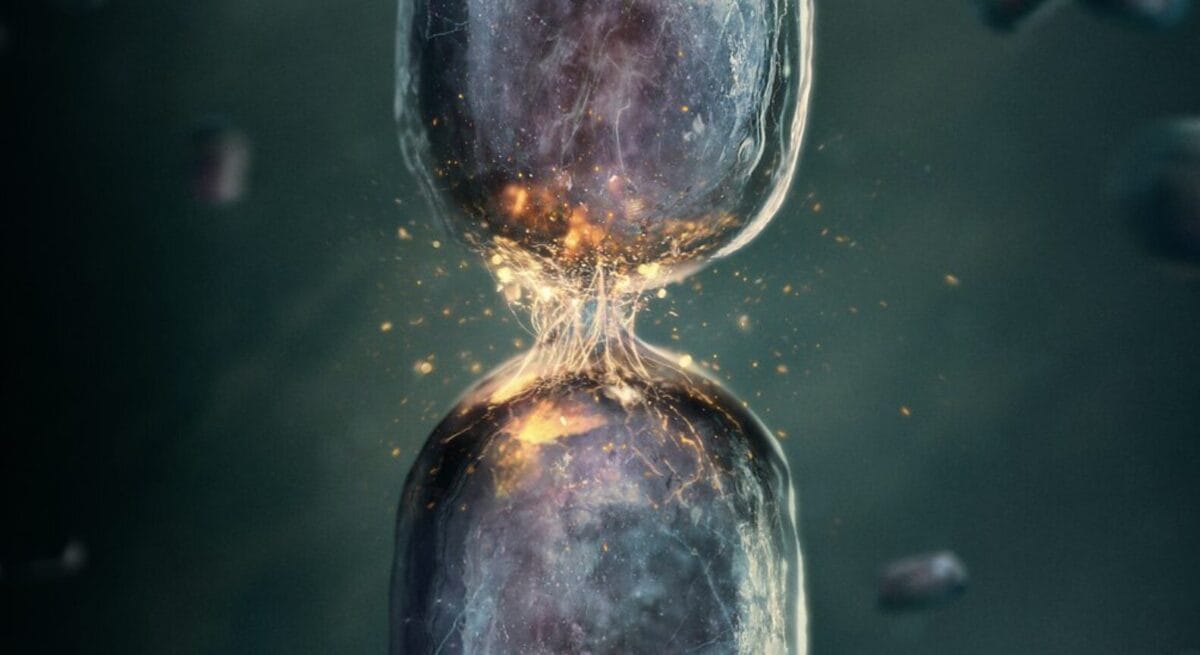
Dr Zachary Ardern writes: The Nicene Creed affirms:
We believe in one God, the Father, the Almighty, maker of heaven and earth, of all that is, seen and unseen.
The BBC Science Unit apparently neither shares nor countenances this belief. 45 seconds into the first episode of the beautifully produced new five part series “Evolution”, science and theology are placed in quite direct opposition; the series states and restates with various formulations that evolutionary processes rule out divine involvement. The much-dismissed “new atheism” is perhaps not yet as passé as we’re often told. The series ends in a similar way, teaching that we simply were not “made”.
Here are some quotations from series narrator Chris Packham; repeatedly the message is that because there are processes involved, we are the product of nature rather than foresight.
It’s easy to imagine that all of this is like somehow preordained … that it’s been made, a world of balance and purpose. But the truth—the truth is much wilder. This is a world of survivors. [Ep. 1: 0m 45s]
There was no blueprint, no grand design. Evolution is a process, shaped by powerful invisible drivers. [Ep. 1: 4m 51s]
We’re not perfect, and we weren’t made. We’ve been shaped by exactly the same forces that have shaped every living organism on this planet. [Ep. 5: 52m 5s]
Theologically of course, humans per se (One excepted) are neither perfect nor the center of the universe—we are after all, a little lower than the angels. And the idea that God uses secondary causes, such that processes and providence are in no conflict, is thoroughly biblical. We can talk intelligibly about secondary causes without mentioning God, and that’s fine and how science generally works. The overstep comes when theological concepts of providence, design, and human uniqueness are asserted to be simply ruled out by the science.
Perhaps unsurprisingly, Dr. Adam Rutherford, genetics populariser and president of the British Humanist Association (BHA), loves the series. “Evolution should be compulsory viewing for everyone over the age of five.” It seems the BHA’s opposition to “indoctrination” of children ends swiftly when they like the message. Rutherford starts his review citing the famous statement that “Nothing in biology makes sense except in the light of evolution”. This is the title of a 1973 essay by a founding father of modern evolutionary genetics, Theodosius Dobzhansky. Few who quote it actually read the essay. In it, Dobzhansky (an Eastern Orthodox Christian) was at pains to emphasise that science and Christian faith are not in conflict, ending the essay stating that in the view of one of his own heroes, “Creation is realised in this world by means of evolution”.
Back to the BBC series. Setting aside the secular humanist lens reflexively but not reflectively propounded, there is much to enjoy here. While I have some minor technical quibbles, I definitely appreciate how the science was communicated and displayed. Each episode starts with a charismatic modern organism and traces the history of some feature of the organism. This involves some repetition of key evolutionary events across the episodes, which might make it hard to follow closely, for those not very familiar with the history of life on Earth; or perhaps rewinding the tape of life multiple times will help to reinforce the narrative.
Some will watch critically, looking for scientific implausibilities. I encourage them to consider the full weight of the evidence (which the series can only touch on). It’s typically much easier to be a skeptic than to put forward a positive position that tries to account for all of the data; I find this is true both for naturalistic critics of Christian faith and Christian critics of evolution. With this perspective, here are some comments on the first three episodes, from my perspective as a Christian active in evolutionary research.
Episode 1: the Elephant—the evolution of complexity
This episode is an introduction and looks at the evolution of complexity via natural selection. One of the interesting aspects is how it introduces the concept of the “last universal common ancestor”, LUCA. This is the farthest point which we can trace evolutionary history back to based on currently available genomes—not to be confused with the origin of life itself, or the first complex cell, or any particularly special point in evolutionary history. The episode is somewhat unclear on these distinctions, but they’re subtle and mixing them up is common!
The idea of the universal ancestor is a remarkably elegant theory, and in my view modern genetics has given it a strong boost. We find, for instance, that the genome of any given living organism you might show me encodes some proteins which are extremely widely shared across diverse forms of life, with an overall pattern of similarity in gene sequences which points to a tree of life. These shared proteins and “nested hierarchy” pattern of similarity allows us to trace out the broad shape of the history of life (including parts which do not strictly follow a simple “tree” shape), using the sequence of letters.
This approach is rather like the way in which we can trace the history of languages by comparative linguistics, or can trace the history of many minor scribal errors in New Testament manuscripts (and infer the original text) through comparing geographically diverse manuscripts. “Errors” in genomes are mutations, which accumulate over the generations as the genome is copied by replication.
As we find more diverse genomes (as is very likely to continue) or improve our phylogenetic methods (also very likely), the exact nature of LUCA inferred will shift. LUCA is the most recent ancestor of all known modern species, and as our knowledge of modern species expands, our understanding will shift slightly. What has been consistently inferred in recent studies (thus far) however is that LUCA was remarkably complex. As is noted in the “evidence” section at the end of this episode, a recent study suggested LUCA had 2600 genes; more than many modern bacteria or archaea.
If this ancestor, like modern cells, really was “more complex than any machine ever made by any human”, and did arise not long after Earth became habitable, its existence is truly remarkable indeed. At some point there was a break between non-life and life, and while it is an active field of research and there are some very interesting hints, we are very far away from a good understanding of the trajectory between the two. Some more awe and wonder at life itself may be in order.
Incidentally, for a different Christian review of the series (with which I’m in partial agreement), including a more critical take on LUCA, see Prof. Richard Buggs’ recent blogposts, starting here.
Episode 2: the Ostrich—the evolution of sex
This focuses on the evolution of sex and reproduction. The early stages of the evolution of eukaryotes and the evolution of sex are highly debated, with many different models available—but a clean story is presented (~7mins). It’s also massively oversimplified, as other forms of genetic mixing had existed long prior to the events discussed. The series has a tendency to advance somewhat speculative hypotheses about what selective factors drove the evolution of particular biological features.
In reality, these are often highly contested. Inventing biological “just so stories” about events in the distant past is easy, but finding decisive evidence for any particular suggestion is hard. How much major events in evolution are really driven by natural selection is also debated. The evolution of land-dwelling tetrapods from lobe-finned fish is however much better evidenced and nicely explained in this episode.
Discussing the origin of asymmetric flight feathers, Packham notes “if it was a mistake, it was a very fortunate one.” [47:05] The same could be said about many events in the evolutionary past. Do we have a right to take repeated good fortune for granted?
Episode 3: the Bat—the evolution of feeding
Tracing the evolution of jaws provides persuasive evidence of how vertebrates are related to each other, and this episode spells out some of this evidence. Talking about the ear bones, as at various points throughout the series, we hear that “no designer was involved in making these bones” [38:26]. But, also consistent throughout the series, Packham alternates between insisting we know there’s no underlying providential guidance and wondering at the sheer improbabilities of particular events occurring in the order that they did. We do indeed have good evidence that these events occurred, but they remain remarkable.
A few minutes later, for instance, we learn of the remarkably precise asteroid hit (falling near land rather than the nearby deep ocean, on the spinning Earth) which led to the decline of the dinosaurs and the rise of mammals.
And it was such a twist of fate. Had that asteroid impacted just 30 seconds later […] those giant reptiles might not have died out.
Similarly, a study has suggested if the angle of incursion of that asteroid were not approximately 60 degrees, the consequences would have been less severe and presumably evolution would have played out differently. Life’s history involves many such fortunate events, and it seems to me that whether you’re inclined to ascribe the full set of such events ultimately to many remarkable and fundamentally inexplicable twists of fate or divine providence over the natural order is not a scientific question.
From the 51 minute mark in this episode there is some dramatic music and an attempt to draw some significance from evolution; seeking to inspire us towards caring for our environment. To one sharing the host’s worldview, this will be music to their ears, but to me it seems like a stretch. While creation is of course inspiring, creatures are indeed extraordinary, and creation care is one of the human race’s great responsibilities, naturalistic evolution by itself does not give us any moral instruction. Confusing this, committing the naturalistic fallacy with an evolutionary angle, has led to all kinds of unfortunate errors.
Summary
The philosophy of atheistic materialism is in this series, as in a large proportion of British popular science, presented as both intimately bound up with the project of science and just the way the world is. On deeper investigation, I suggest, it is actually a surprisingly poor fit with the project of science, a poor fit with human dignity and a poor fit with the (rightly) urgent message proclaimed regarding creation care. But, on the other hand, these very real failures of atheistic materialism don’t undermine the very real evidence for an evolutionary history to life on Earth.
Conflating the evidence for evolution with a naturalistic philosophy is a rhetorical move common to many atheists and many Christian opponents of evolution, but it is mistaken. Evolution is a very successful and impressive scientific theory, and has a lot going for it as a big picture view of life’s history. But it doesn’t answer our biggest questions as human beings, and the project of evolutionary biology, for all the difficult and interesting questions it may raise, fits within a wider finely tuned and remarkably comprehensible universe.
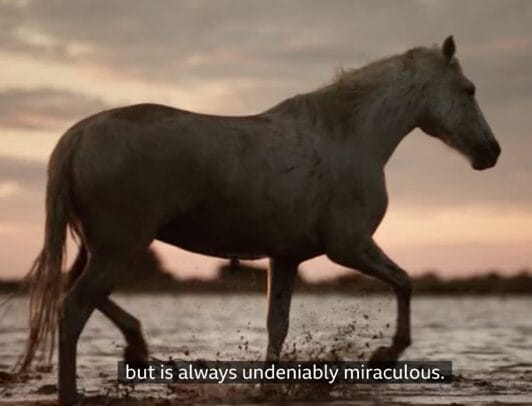
In my view, the events of evolution really are wonderful and genuinely worth studying. We are not just the obvious outworkings of simple natural processes, but should count ourselves fortunate to be here. I can happily agree with Chris Packham that (whatever he meant by it) the great interconnected family of life that we are part of really is “always undeniably miraculous” [Ep. 1, 51:50]. Is this beauty that we all see merely epiphenomenal on a deeper chaos, or a hint of a deeper order and rationality?
This same question has been asked at least since the ancient Greek philosophers, with defenders of each view among them, as well as in diverse cultures around the world. In my own research into evolutionary processes, I see both remarkable fortuitous contingency and underlying lawlike processes which give a deep structure to evolutionary change. A robust Christian doctrine of creation has room for both, and both provide at least a gentle challenge to an unreflective atheism.
 Charles Darwin summarised the beauty of an evolutionary view in the closing sentence, the peroration, of his masterpiece On the Origin of Species. There have been multiple leading evolutionary biologists over the last ~170 years who have been able to affirm both the Nicene Creed and Darwin’s Peroration. Perhaps we and the BBC can learn from them.
There is grandeur in this view of life, with its several powers, having been originally breathed into a few forms or into one; and that, whilst this planet has gone cycling on according to the fixed law of gravity, from so simple a beginning endless forms most beautiful and most wonderful have been, and are being, evolved.
 Dr Zachary Ardern is a research fellow in microbial evolutionary genomics at a leading research institute in Cambridge. He is also an Associate of the Faraday Institute for Science and Religion and a Fellow of the International Society for Science and Religion (ISSR). For occasional writing from him, see his Substack.
 Buy me a Coffee

















I regret the eagerness of both atheists and fundamentalists to square up to each other over evolution, and more generally over science and the Book of Genesis.
Here is an essay on the subject by an evangelical Christian who is a specialist in physical science but has educated himself to intelligent lay level in the molecular and macrobiology of evolution, seeing the logic of it while also believing that Genesis is truth (and not truth of a mythical type). If that sounds impossible, read it!
https://church14-26.org/wp-content/uploads/2026/07/sciencescripture.pdf
Just a pity that this evangelical Christian hasn’t educated himself to an intelligent lay level on how language works when he discusses things about words and translation.
Kindly give examples of where you consider I am wrong and why.
Anthony Williamson – as usual, this contributor has a problem with clear language, meaning, how language works, and has the arrogance to believe that everybody else is out of step other than him.
But I have an essential criticism – which are that the main point has been missed. The main point is the moral issue. I had never heard of Chris Packham before (and I don’t have access to BBC TV) so I did a quick google search and discovered that he has had some eccentricities in his private life – nothing ‘out of the box’ by today’s standards, but would suggest that he may have a wee problem with the creation ordinances of Genesis 2.
Scripture informs us that God is above and almighty and that everything was created by Him – including the laws of nature. ‘Evolution’ would not really contradict this – so his rejection of the creator God springs from something else (which is, of course, the moral issue).
Re Packham, play the ball not the man – in which regard please see William Sitwell’s essay about his deeds, “Chris Packham is no saint. He’s an environmental extremist to us country folk”:
https://www.telegraph.co.uk/news/2025/05/16/chris-packham-is-an-environmental-extremist/
Anthony – I’d probably disagree with this, since it is *the man* whom we would like to see saved – and experience tells us that an objection to a Creator God is invariably a rejection of the moral order.
One of the striking things about the book of Job is that God does not answer any of Job’s questions. Nevertheless, God *does* answer Job! He gives Job a divine revelation, to the heart.
There are people – and no doubt you have encountered them – who have lots of questions (for example, how can a creator God fit in with the theory of evolution) and even if you were able to answer all their questions, the outcome would not be the salvation of the questioner. What is needed is a divine revelation to the heart.
So I probably disagree with you quite profoundly here – if you want to be instrumental in bringing that about, you probably have to look behind the questioning – and play the man (rather than the somewhat facile ball that he has thrown into the court). Look for the moral need – and convince him that Christ can meet that need.
Of course I would like to see Chris Packham come to Christ, as I would like anyone else. But we are discussing his comments on evolution here, not ministering to him personally.
Anthony – which is basically what I am doing (discussing his comments). His comments amount to the fact that he doesn’t believe in a creator God – and he appeals to evolutionary theory as some sort of an excuse for this lack-of-belief. Such comments are old hat and in and of themselves are therefore very, very boring. Invariably, when people take this position (no creator God – and use evolution as an excuse for this), you can be guaranteed that there is a refusal to accept the fundamental moral issue. That is what makes it both interesting and vital. In fact, neglecting this makes the whole discussion a total waste of time.
You were having a go at Packham via his personal life, which you described as containing some eccentricities.
…. I was just pointing out public domain knowledge, available on a very elementary google search. I do not know if it is related (as I indicated nothing ‘out of the box’ by modern standards); that is pure conjecture on my part. I do, though, stand by the assertion that whenever you see someone who declares that he doesn’t believe in a creator God – and then uses some aspect of evolutionary theory as an excuse for this – that there is invariably something else, which is a rejection of Christian moral teaching.
You are probably correct about that, but plenty of people who do not share with Packham what you describe as the eccentricities in his private life are atheists. If he read what you wrote, would it be a good way to introduce the gospel?
Anthony – a very good question – to which I don’t know the answer. When Jesus pointed to eccentricities of the private life of the woman at the well (John 4), the effect wasn’t exactly negative.
I do know one thing: answering him directly on the issues and trying to prove to him, on his terms, that the universe is compatible with the hypothesis of a creator God, is a total waste of time – the gospel is a moral issue; what we should aspire to (Sermon on the Mount), our sinnerhood (failure to live up to the aspiration), the seriousness of our sin, need for redemption and God’s redemptive plan (crucifixion and resurrection). Once this is established, everything else (creator God) falls into place.
How would you introduce the basic message to someone like Chris Packham?
I don’t have enough information to answer that. In a 1:1 I’d spend a good half hour getting a sense of him before I introduced the gospel, unless an obvious opportunity arose. If you really insist on my answer to what I might impart to him cold, the gospel as tailored to secular persons is included in some of the paragraphs here:
https://church14-26.org/starting-a-church-14-26/
What an excellent link, well worth reading!
The supposed conflict between faith and science particularly with regards to evolution is not helped by the disingenuousness on both sides. A narrative is created which ignores the “gaps” in either evidence or credibility to give the appearance of a smooth explanation. The ancient question to instil doubt and unbelief can then be posed in a reformatted form: “Did God create?”
God as Creator (Designer) is the fundamental matter when it comes to belief. It was the answer to suffering when God spoke to Job; it was the foundation of worship for the psalmists; and it was the rebuke to sin and unbelief for Paul in Romans 1. The study of science can in fact enhance all three. But as ever the musings of atheists give no direction to the core needs of every human heart.
Sorry – ignore ‘the lack of’
updated
Never mind evolution, the most blatant conflict between science and scripture is about miracles. That blog has just discussed Peter walking on water and sinking as his faith wavered.
Is it a conflict? The miracles are miraculous, i.e. supernatural and not naturally explained. The argument is not, and never has been, that if you or I pray we too will walk on water. That would be scientifically testable, but it would also make it not supernatural or a miracle, because we’d arguing that physics worked by prayer. (And we’d also be making God our servant for parlour tricks, which is perhaps a bigger concern…).
Yes it is a conflict. The laws of physics are held to be applicable at all times and places, and they will never be able to explain Peter walking on water and sinking as his faith quavered.
are they, as we currently have them, applicable at the beginning of the universe?
We can use our knowledge of physics to predict what the universe looked like ever farther back in time. We find it shrinking ever smaller and getting ever hotter. Far enough back, the universe was so small and hot that, in order to go still further back with any accuracy, we would need a quantum theory of gravity. Physicists have figured out a lot about quantum theory and a lot about gravity, but they don’t want to go together and we don’t have a working quantum theory of gravity today. Our lack of understanding therefore acts as a veil over what happened earlier still. We can nevertheless say that about 14 billion years ago the universe was so small and hot that the expansion was explosive – a pretty large bang. (The universe does not expand into anything, because it is everything; rather, the expansion manifests as everything getting further from everything else.)
If it were not for quantum mechanics, Einstein’s theory assures us that the expansion of the universe would proceed from a point, in which not only space began, but also time. This is the ‘Big Bang’ scenario, and asking what happened before it took place is as meaningless as asking what is north of the North Pole.
Of course, speculation goes on about the early universe behind the veil of our ignorance. Some of this work is akin to science fiction, and is often stated by some naive physicists and most popularisers with undue confidence; wiser is to say “I don’t know”.
Maybe they should title the programme A Series of Fortunate Events
What an excellent suggestion!
Apart from Genesis 3 !
Felix culpa? (not ‘infelix culpa’)
“O felix culpa quae talem et tantum meruit habere redemptorem.”
– from the ‘Exsultet’ Mass
“Melius enim iudicavit de malis benefacere, quam mala nulla esse permittere.”
– Augustine (OK, not your favourite) after Ambrose
Well yes, but too far down that road and you end up with nonsense like (from Adam Lay YBounden)
“Nor had the apple taken been, then had never Our Lady a-been heaven’s queen… Blessed be the time the apple taken was.”
Felix culpa = The cat did it.
Great suggestion!
I confess to being ambivalent over the whole issue of evolution, whilst leaning towards the idea that this MAY have been the way that God brought His creation into existence. What concerns me – as is pointed out in this post – is the idea that evolution discounts any thought of design behind creation. A very poor and weak defensive argument from the atheistic mind.
An interesting idea was presented to me recently that God could have created the world to INDICATE that it came about through an evolutionary process! A little “tongue in cheek” perhaps, but my point is that, whilst God certainly appears to use scientific principles in His creative activity, he is not LIMITED by those principles.
Discussions of this nature generally bring to mind J. B. Phillips’ “Your God is Too Small”, cleverly updated by John Young in “Your God is STILL Too Small”!
When you met your wife at a party, you thought it was a chance encounter, but God arranged it. Why should evolution not be like that? Furthermore, optically sensitive organs have evolved independently in several environments and species; God seems to have put in some predispositions.
In the relation between science and scripture, eight questions open out the issues involved – stick to these and you will avoid wasting time on philosophical waffle. They are: Did God create time; Why is science beautiful; Do miracles occur; How old is the earth; Was Noah’s flood global; Who did Adam’s children marry; Do you believe that some people lived for centuries as Genesis states; What would you see if you had snapshots of your father, and his father, and so on, backwards in time?
Not sure I’ll watch it particularly as Packham as a presenter, grates and sweeping statements and conclusions (gaps) that the article draws attention to are something of an anethema in what purports to be incontrovertible scientific evidence.
I don’t believe these type programmes start from the beginning, that is, an open discussion or declaration of interest, if you will, of the a priori philosophy of science, and its teleological purposes, let alone its applications in technology, a potentially good servant, but bad master.
Refutations of God as involved in creation generally assume a god outside the system – a deus ex machina. In that case it would indeed be hard to see how creation works along scientific principles. However, if God is immanent, existing within creation [though not simply as part of it] there is no reason to suppose either that creationism is required for God to create, or that evolution is impossible to equate with divinity. Part of our understanding of the Spirit’s work is to raise creation toward God, to bring each species, be it never so basic and humble, to reach its potential within the whole of creation.
Often, too, creation is seen as a sort of house of cards, with the simplest organisms at the bottom and the most complex [humans] at the top. This is an incorrect assumption in my view since even the most complex depend entirely on the most basic elements of creation, so the picture should be more like ripples on a pond with the simplest at the centre and the more complex as expanding ripples, not superior to the simplest but dependent on them and building outward with what went before. I look for a God who is not just transcendent but immanent too, using the process of evolution to continue creation into multiple new forms of life.
I also hold fast to Bishop John Robinson’s words [Human Face of God] when he says that ‘the heart of what makes the universe tick, the mechanism of evolution, is not simply natural selection eliminating the unfit but the identification of love, redeeming the unfit.’ That ‘redeeming’ must not be viewed merely in terms of ‘Jesus died for me’ etc., but that it includes that process of the raising of creation to God himself.
I’ve never understood why my fellow Christians are supposed to have a problem with evolution. God created the universe and the world. We can spend our days working out the laws of physics, working out how chemical reactions take place (and which react and which don’t and why), and we can work out how biology develops. It’s all fascinating, but what the is the conflict supposed to be even for the most fundamentalist amongst us? I genuinely struggle to see the problem. I’d have thought dinosaurs existing and then going extinct was much more troublesome for the literalists.
The Book of Genesis speaks words which have implications for the age of the earth, the scope of Noah’s flood, the spouses (spice??) of Adam’s children, and (in the ‘after their own kind’ phrase in Genesis 1) what you would see if you put the videotape of life on earth onto fast rewind. Fundamentalists assert that Genesis contradicts science concerning all of these. A discussion in good faith *is* called for.
I am not a fundamentalist, I accept the authority of scripture and I do not hold Genesis to be myth – I just think that fundamentalists apply the most antiscientific interpretation of the translated English bible. This doesn’t need a 400-page book to sort out, but it can’t be dealt with in a paragraph. Here is my own take (which corrects the incorrect link in the first comment on this thread):
https://church14-26.org/wp-content/uploads/2026/08/sciencescripture.pdf
The answers to your questions are in your own name, Adam.
The original objections were that Darwinism destroyed the uniqueness of human beings as the imago Dei, the rational image bearers of God amongst whom God himself became incarnate. Darwinism seemed to be asserting that human beings are nothing other than naked apes that have developed the power of speech, and all of this purely by chance mutation that conferred reproductive advantage. Darwin wrote pre-genetics, so Neo-Darwinism is a synthesis of natural selection (always a metaphor – there is no Mother Nature and no selecting going on) and genetic mutation.
The contemporary objections focus on the perceived inadequacies of random mutation as an adequate explanation for the immense practical problems that Neo-Darwinism faces as an explanatory theory within the known age of the earth. These include the problem of numerics, the Cambrian explosion, the stupendous complexity of the simplest cell, the origin of information in the cell, the origin of consciousness, and the origin of life itself from abiogenesis. All these problems look insuperable at present and Neo-Darwinism looks inadequate to the task. It is not just Christians who make these complaints. The atheist philosopher Thomas Nagel has said the same. This is why Francis Crick became a proponent of panspermia.
The numerics argument is made by Dembski, the genetic argument ny Behe and Meyer, the information argument by Douglas Axe.
James, if you’ve taken the trouble to read those scholars then please add Nick Lane. Very few people (and certainly not philosophers) are expert in both macrobiology of organisms, biochemistry at molecular level, and selections pressure at both levels. Lane is. He answers that some questions which fundamentalists claimed *could* not be answered. Try his books Life Ascending and Transformer.
I am not saying that evolution and Genesis can be reconciled. I am saying that evolution is capable of explaining a lot more without broaching Genesis than is often supposed.
I have read Meyer, Dembski, Behe, Axe and Nagel, I haven’t read Nick Lane – maybe I’ll get to his work. I know that Stephen Gould and others were and are acutely aware of problems in the Neo-Darwinian synthesis, and Gould argued for saltationism and ‘hopeful monsters’. We see micro-evolution all the time but macro-evolution does seem a pretty big hurdle. I don’t think Lenski saw e. coli being anything other than e. coli after many thousands of generations: do we need millions of years to see results? Francis Crick certainly felt the problem and he was no believer. I think Fred Hoyle also opted for panspermia.
My own belief is that there were many, many acts of plant and creation across many millions of years, culminating in the creation of humans.
Since we never witness macro-biology or saltationism, I think one could be an excellent scientist without subscribing to macro-evolution.
There’s plenty we cannot observe but are able to infer in physical science; maybe the same in biology?
Gould held to a divergent evolution view; other hold a convergent evolution view which is probably closer to scripture. Anyway, please read Lane.
James, if you are thinking that the ‘after their own kind’ in Genesis 1 rules out mcroevolution, I believe it says simply that a male giraffe will mate with a female giraffe (not a lioness) and will produce giraffes (not tigers). And says also that the next generation will look like their parents’ generation – but says nothing about what things will look like after 1000 generations. Remember that Genesis came out af a farming culture and this is what farmers know and need to know.
What is omitted in any of this is the incarnation; John 1: 1-18
We are not talking of just any old creator in an abstract impersonal way.
Agreed. I make that point in my reply to Adam Bell above.
In short the Second Adam is not the 1001st naked ape.
If evolution is true, homo sapiens is destined to become homo sapientior or even another species altogether.
This was the basic idea behind Superman and the superhero comic genre set in a galaxy long ago and far away…
Or we could have reached the pinnacle of evolution and any further changes will be relatively minor. Interestingly body changes still happen, for example due to the ‘interference’ of modern medical practice. Previously women with wider hips were much more common as before the introduction of c-sections, women with small pelvis measurements struggled to give birth to large headed babies, so those women often died in childbirth and did not pass their body types to the next generation. It is reasonable to also consider that males will see wide hips as a positive factor in finding a mate, and that then reinforces the trait through differential reproduction. With the wide availability of c-sections, that no longer is as big a selective pressure, and small pelvises will then be passed on.
As a trained & qualified zoologist & geologist I find deep time, the evolution of the universe & it’s multitudes of stars, some now long dead, some being born, some dying, or in mid- life sustaining life, like our own Sun awe inspiring! Quite apart from the miracle of life on our planet through billions of years. This is clear evidence that we are not alone & we must worship the Creator, not the created. The created points you in the direction of worshipping the Creator. I get very frustrated with evangelical Christians who reject science. In doing so they diminish God’s greatness. I get very frustrated with scientists who are are so certain that there is no God. That certainty is not a valid scientific. position. Despite all we know, the universe is so vast & we occupy a miniscule experience of it in space & time. Only a fool would claim definitively that there is no God. Professing to be wise they became fools!
I too am a trained geologist, but don’t see things in the same way. First of all there is the biblical witness, which Jesus said was authoritative for his followers. That witness begins with the OT. In contrast to all the other nations, the deity that the Israelites worshipped – the deity that they encountered – was the one who created heaven and earth. In various places the Bible tells us, for perfect clarity, that God created heaven and earth ‘in the beginning’, in the course of ‘six days’, ‘with an outstretched arm’ (just as in the Exodus).
Lots of atheists find the creation ‘awe-inspiring’ but don’t see God as its author, but why should they, if the truth is that the present heaven and earth came into existence by themselves, assembling themselves from the primeval soup of the Big Bang’s atoms little by little as if Nature was God? Elijah called on Israel to stop trying to have it both ways – worship of the God who created them and saved them with his outstretched arm but also worship of Baal the promiscuous weather and fertility god. So it is with Christians today. They don’t know the first thing about the geological and fossil record, still less about galaxies, but they believe in the magic-working ‘Evolution’ just the same, because that is what Science has told them to believe. At the same time another authority, the Church, tells them to say the creed and pay lip service to Genesis. The NT is clear. You can’t serve two masters,. The wisdom of the world is foolishness with God. ‘Whoever wishes to be a friend of the world makes himself an enemy of God’.
The BBC, the universities, Chris Packham – they’re not innocent purveyors of uncontroversial, spiritually neutral truth. Unknowingly they are involved in a spiritual war, where what is at stake is the credibility of the Creator, of the Bible, of biblical Christianity as a profound and sufficient explanation of the origin and meaning of life, of the offer of forgiveness of sins through the atonement provided by the Creator’s Son.
So you think the geological record supports the theory that all living organisms have a common ancestor? You think that human beings, daffodils, lions, spiders, bees, swifts and everything else acquired their forms over time by natural selection operating on chance genetic mutations, starting with that common ancestor time back in the Archaean aeon? Then perhaps you could explain to me why marine animals do not appear until 6/7ths of the way through the geological record, and that when they do appear, it’s all of a sudden (geologically speaking), in what is called the Cambrian Explosion. Terrestrial plants and animals not until even later.
The highest level of animal classification is the phylum. The higher up the taxonomic scale you go, from species, to genus, to family, to order, to class, to phylum, the less alike these categories are. Two species within the same genus are very similar to each other, two genera within the same family somewhat less so. By the time you get to the class level, two classes within the same phylum are very different from each other. The theory of evolution predicts that the larger (higher) categories will appear progressively and successively, as species multiply (‘evolve’). As they multiply they will form evolutionary branches – genera, families and so on. Diversity and complexity will increase over time and eventually you will get multiple phyla.
But the geological record shows the opposite. Nearly all animal phyla are attested from the very start of the animal record, in the Cambrian. What one might call ‘evolution’ takes place within the phyla, within the fundamental body plans (sponges, molluscs, the various worm phyla, comb jellies and so on – there are dozens). The pattern is not at all consistent with Darwinian evolution.
I don’t mean to suggest that all speciation (evolution) takes place within the phyla. Often the taxonomic level is lower, because that is what the fossil record indicates. There’s no evidence that modern birds have a common ancestor. The various bird orders appear more or less simultaneously, in their own version of the Cambrian Explosion. Same with insects. Same with flowering plants. They are inexplicably resistant to being lumped together from the moment they appear.
Darwinism says that mutations get fixed in a population if they confer an advantage in the struggle for life and the mutated organisms bear more offspring. The idea claims to explain the history of life and all biological complexity. Explain to me, then, as a trained zoologist, how the theory explains the human chin, or eyebrows, or the outer ear, or peristalsis. Explain to me the monarch butterfly, woodpeckers, gall wasps. Explain metamorphosis. Explain the alternation of sporophytes and gametophytes.
Explain to me the goby fish, which featured in Planet Earth III (series 1.4 on freshwater). After months feeding out at sea, they return in their millions to the remote island of Bioko, Equatorial Guinea, in order to breed in freshwater. The safest place to lay their eggs is at the very top of a 30 metre waterfall. Only an inch long, at this stage the fish undergoes a bizarre physical transformation: it develops suckers to enable it to grip the shear rock face. Only 1% survive the climb.
Life is indeed awe-inspiring. It is so designed as to make the theory of evolution hopelessly inadequate as an explanation of anything significant.
Judgement is coming on the world precisely because it refuses to acknowledge that God the Almighty created all things, and by his will they existed and were created (Rev 4:11), believing instead in the magician Nature. It has been deceived, and willingly allowed itself to be deceived.
‘Then I saw another angel flying directly overhead, with an eternal gospel to proclaim to those who dwell on earth, to every nation and tribe and language and people. And he said with a loud voice, “Fear God and give him glory, because the hour of his judgment has come, and worship him who made heaven and earth, the sea and the springs of water.” ‘
Are you not confusing “Evolution hasn’t explained…” with “Evolution can never explain…”? Biology is so complex as to make physics look simple.
So let’s start with physics. How old do you believe the cosmos is (because the earth cannot be older)? I would agree that evolution is incompatible with a young-earth scenario.
It was geology not biology which challenged the literal six days. Rather, it was the signs that the planet was of great age which enabled the idea that species could change over time.
It all began when [I cannot remember who] observed a famous unconformity in a cliff face. Such an interface between an folded and eroded sedimentary rock with an overlying, different sedimentary rock does require a long time span.
How do you, as a trained geologist, understand such unconformities, or heavily metamophised sedimentary rocks?
(Or magnetic field reversals in the rocks of the Atlantic floor, which match either side of the central ridge, or etc. etc. )
Hi David, I believe you are referring to James Hutton. You may find this interesting:
https://creation.com/en/articles/unmasking-a-long-age-icon
Sam
You are asking scientifically big questions that can barely be answered adequately on a theological blog, but I will attempt some brief answers.
‘Geology’ – and in my mind you are referring to the ideology rather than the facts of geology – challenged the six days in two respects: (i) in respect of time, and (ii) in respect of the order of events through those six days.
(i) Geological time is measured by radioactive decay, based on present decay rates. How does one test that assumption scientifically (since rates could have been falling over time)? One looks to see whether the primary evidence – the rocks themselves, the fossil record itself – bears it out. In my opinion it does not (www.earthhistory.org.uk gives examples). In fact, it is accepted among geologists who have thought about the issue (there are not many) that where geological successions are stratified into beds (as they always are when particles exceed silt size), very little time is required and in order to reconcile them with the geological timescale, one has to posit huge, unevidenced passages of time in the gaps between beds.
(ii) The order of events in Genesis is: earth created first, then a subterranean (NB not surface) ocean (later called the ‘deep’), then plants, then the sun, moon and planets, then marine animals and aerial animals (birds, insects etc), finally terrestrial animals and man. This is very different from the evolution narrative: the sun first (not until 2/3rds of the way through cosmic history), then Earth (the existence of copious water on the Earth being still a mystery), the moon forming from a collision between Earth and another proto-planet, then 7/8ths of the way through Earth history marine animals, followed by vascular plants (including trees, though very different from most modern trees), followed by reptiles and insects, then mammals (very different from modern mammals) and birds (different from modern birds) and, last of all, in the last 1/5000th of geological time, man.
So, two different narratives, not remotely reconcilable, and a Christian must decide who to believe. The vast majority believe ‘geology’, but kid themselves that somehow Genesis can be accepted if one just stretches the individual days into hundreds, if not billions, of years. Jesus says that man was in existence ‘in the beginning’. If you follow the atheistic narrative, then he was talking through his hat.
In my opinion, the geological sequence of events is irrelevant, since Genesis says that in his wrath God destroyed the dry land (Gen 6:13, 9:11). The sequence of events as the Earth recovered is irrelevant to the sequence of events at Creation. Put another way, the geological sequence is one of gradual recolonisation following the global mass extinction that was the biblical mabbul.
That species change over time is not in question, but even in today’s world it does not require millions of years. All evolutionary change (certainly above the species level) is programmed change, not chance mutations, and the palaeontological record shows that class-level and order-level change was very rapid. As I have already said, classes within phyla already exist in the Cambrian, and the fossil record does not show evolutionary transitions preceding the classes. As with the long presumed gaps between beds, one has to presume that all these presumed transitions took place before the Cambrian and off-stage.
The famous unconformity is at Siccar Point. The unconformity requires a substantial time gap, but how big a gap depends entirely on the overall timescale and whether radio-decay rates have been constant through time. The faster the rate of decay, the greater the heat generated by the decay, and, because of plate tectonics, the heat generated in Earth’s mantle generates all geological change.
God controls the weather too. At the present time I cannot help thinking of Rev 7:1.
I think dwelling on the first 10 sayings of God is more insightful than the 7 days of creation. What God says is primary, what happens is secondary
Are you saying God uses words and speech? What language?
Come off it. The bible uses the words of human beings trying to make sense of what they perceive. The words in the bible are full of limitations. God is not limited. So there is a serious disconnect between what we read in the scriptures and what is actually the case. Hence the whole tradition of apophatic theology. We can say what we don’t know with much more clarity than saying what we do know.
The first ten ‘sayings’ of God that you refer to are simply ten human attempts. Spirit filled but limited.
Apophatic theology terminates in atheism. God is not; rather dwelling on who God is. His self revelation in scripture. The doctrine of revelation precedes and circumscribes who he is not.
Andrew G.
Of course God uses words and speech. ‘In the beginning was the Logos and the Logos was with God and the Logos was God.’
Logos means ‘speech’. This is Christianity 101. Apophatic theology is not Christian theology. Christian theology is divine revelation.
I really don’t know where your ideas come from, Andrew, but they are not from Christianity.
Not sure where you get your ideas from James.
The Word of God, which was from the beginning, is Jesus Christ. Not the words of scripture. That’s pretty basic theology and the Gospel of John.
Apophatic theology is of course Orthodox. Not sure how you have missed that.
Andrew, I get my ideas from the Bible. ‘And God said …’ (Gen 1). Language – from God in the beginning!
The Word of God from the beginning shows that language is divine and interpersonal. You don’t seem to understand that.
I am perfectly aware that apophatic theology is Orthodox. So are a lot of other daft ideas from Neo-Platonism. I think I know how you missed that.
I think your ideas are a bit stuck in former times James! The opening of epistle to the Hebrews is helpful.
Glad you understand that Apophatic theology is Orthodox. Are you somehow wanting to suggest that the Orthodox are not Christian? I think I know how you make that assumption.
The Latter to the Hebrews is full of the idea of God speaking – it’s in the very first verse, for goodness’ sake! Do you understand what you are reading?
Do I think all Orthodox ideas are correct? Of course I don’t – anymore than I think Russia’s Orthodox Church-supported war against Ukraine is conscionable.
If I thought all Orthodox idea were correct I would have to convert as you have.
Long ago God spoke to our ancestors in many and various ways by the prophets, but in these last days he has spoken to us by a Son.
The Word is a person, not words.
God is the creator Word, who became, flesh in Jesus. How do we know? By God’s self-revelation through Spirit inspired words. John 1
There is little apophatic about that.
God is limited in what He communicates to us because we, by definition, are limited creatures. In communicating He works with the human brain.
God doesn’t have any limitations. Otherwise God would not be God. The limitations are all in us – hence the scriptures have limitations because of the human component.
Can God tell a lie? Can he make 2*3 equal to 7?
You are asking human questions about the divine. A clear category mistake. As Jesus said to his followers, there are no human limits to God’s power.
I think it comes down, on reflection, to the meaning of the word ‘can’. Some people would say that God can tell a lie but he never will, whereas others who mean exactly the same thing would say that he cannot. I’m less sure about 2 * 3 = 7 in heaven though. Would you care to make further comment about that matter?
I think a philosophy of religion Professor decades ago pointed out that God couldn’t do the logically impossible.
Why would God want to?
Will there be mathematics in heaven?
Again, all of these things are projecting human concepts on to the divine.
But God has made a full revelation of himself to man in Jesus Christ.
Same essence but distinct persons.
Thank you for this, especially for the link to Richard Buggs’ review which is very helpful. Personally, I’ve been on quite a journey with this topic, starting in ~2016 when I set out to try to reconcile conflicting ideas I had. Here are some of the things which have helped me along the way:
“But in the past decade, without much notice by general audiences, a more wide-ranging debate has arisen from different areas of biology as well as from history and philosophy of science, about whether and in which ways evolutionary theory is affected, challenged or changed by the advances in biology and other fields. As usual in such cases, more conservative perspectives and more progressive ones are in conflict with each other, with differences ranging from minor to intense. A rising number of publications argue for a major revision or even a replacement of the standard theory of evolution [2–14], indicating that this cannot be dismissed as a minority view but rather is a widespread feeling among scientists and philosophers alike.” [1] Gerd Müller, Royal Society, 2016
“I have lately read Morley’s Life of Voltaire & he insists strongly that direct attacks on Christianity (even when written with the wonderful force & vigour of Voltaire) produce little permanent effect: real good seems only to follow from slow & silent side attacks.” [2] Charles Darwin, private letter, 1873
“At some future period, not very distant as measured by centuries, the civilised races of man will almost certainly exterminate and replace throughout the world the savage races. At the same time the anthropomorphous apes…will no doubt be exterminated. The break will then be rendered wider, for it will intervene between man in a more civilised state, as we may hope, than the Caucasian, and some ape as low as a baboon, instead of as at present between the negro or Australian and the gorilla.” [3] Charles Darwin, The Descent of Man, 1871
“Ota Benga was kidnapped from what is now the Democratic Republic of Congo in 1904 and taken to the US to be exhibited…More than a century after it drew international headlines for exhibiting a young African man in the monkey house, the Bronx Zoo in New York has finally expressed regret….The Bronx Zoo’s founding principals were among the most influential disseminators of specious racial inferiority theories that resonate still.” [4] BBC, 2020
“…former footballer Fabrice Muamba said his son faced racist abuse in a school rugby game. Mr Muamba tweeted that his 12-year-old son “received monkey chants” from opponents at Manchester Grammar School after scoring a try. ‘Racism is learnt; be careful what you are teaching your children,’ he said.” [5] BBC, 2021
“From one man he made all the nations, that they should inhabit the whole earth; and he marked out their appointed times in history and the boundaries of their lands. God did this so that they would seek him and perhaps reach out for him and find him, though he is not far from any one of us. ‘For in him we live and move and have our being.’ As some of your own poets have said, ‘We are his offspring.’” Acts 17:26-28
[1] https://royalsocietypublishing.org/rsfs/article/7/5/20170015/64164/Why-an-extended-evolutionary-synthesis-is
[2] https://www.darwinproject.ac.uk/letter/?docId=letters/DCP-LETT-9105.xml
[3] https://darwin-online.org.uk/content/frameset?itemID=F937.1&viewtype=text&pageseq=1
[4] https://www.bbc.co.uk/news/world-africa-53917733
[5] https://www.bbc.co.uk/news/uk-england-manchester-58536338
I’m saying there is something sublime in the text that is overlooked. It seems the human perspective is to see first the pattern of 7. Then the arguments to dismiss it on the grounds of evolution. The pattern of 10 evokes something deeper. I see the Word, full power acting. Within this framework God rests in creation. It evokes a poetic response. I’m even able to see, not a linear time frame but an explosive force. God remains at the centre, the ripples devolve outward. The first saying is at the perimeter now expanding ever outward. He stands in the centre on the first Easter morning.
By looking at it in this way I’m less interested in arguing a Sunday school creation and or a evolutionist pov.
… got go. Busy…
Thanks Steve. That is very helpful and I fully appreciate what you are saying here.
I think science helps us understand what actually happened – though science also has limited understanding. Our relationship with God helps us have appropriate awe and wonder at what actually happened. We need them both. The dangers come when we are fundamentalist about one or the other.
Genesis is, as you so helpfully put it, a poetic response. Very helpful.
As a non-scientist I have no problem with believing that God created us through evolution. The really interesting question me, is that if the earth is 4.5 billion years old and evolution has been at work for most of that time, why is it that for only the last 4-5,000 years have his creation (us) been able to know God? To put it another way, why now?
On the street this morning people who were willing to hear listened to the gospel. (Rule no. one: If the subject deviates I bring it back on course.) One person said it seemed as if we had approached her at a perfect moment. We said we had just prayed that Jesus would go before us and open hearts to receive. She knew it was the moment and so did we. Don’t speculate , get in the Spirit and ask God to lead the way. Why now? Why not? If not, when?
That’s encouraging. Steve.
Richard – well, we have lots of examples in Scripture where God’s time scale is not our time scale. For example, the Israelites are being oppressed and crying out to God. Moses is born and they have to wait another 80 years until he leads them out of Egypt – and during all that time, they don’t see any evidence that God is listening to them.
(I’m not saying anything here for or against the time scales that scientists are discussing for evolutionary theories – I’m only pointing out that God’s time scale very often seems to be very different from our own).
(I’m not saying anything here for or against the time scales that scientists are discussing for evolutionary theories – I’m only pointing out that God’s time scale very often seems to be very different from our own).
A man was once granted an interview with God.
‘Lord, is it true that a million years is like a second to You?’
‘Yes, my son.’
‘And a million pounds is like a penny to you.’
‘Indeed, my son.’
‘Say, could I have one of those pennies?’
‘Of course. Just a second.’
bceause evolution takes a while…
I think that is an interesting question Richard. A question that may be related to yours is whether or not God has created moral life in other star systems across the universe at diffenent times in the distant past. Owing to the vastness of space and the limitations of spacetravel, then we have no way of knowing. We only know what God has created here within our time frame.
It is important not to begin fretting and allowing our brains
to become overheated over the afore mentioned programme[s]
Because “The LORD knoweth the thoughts of man, that they are vanity.” Psalms 94:11
Beware lest any man spoil you through philosophy and vain deceit, after the tradition of men, after the rudiments of the world, and not after Christ. Colossians 2:8
Their own folly leads people astray; in their hearts they rage against the LORD.
Proverbs 19 v 3; ” when his own foolishness ruins his life. Here, fretting is an arrogant frustration directed at God’s sovereign governance.
Rest in the LORD, and wait patiently for him: fret not thyself because of him who prospereth in his way, because of the man who bringeth wicked devices to pass.PS. 37:7
In “hard sayings”and in the “strange works of God”according to the Bible in 2 Thessalonians 2:11-12, God sends a strong delusion as an act of judicial judgment. He gives people over to believing a lie because they actively rejected the truth, refused to love it, and chose instead to delight in wickedness and unrighteousness
The delusion acts to seal the judgement of those who have already hardened their hearts against God, confirming them in the path they chose for themselves.
Our confidence however is in the absolute Sovereignty of God and our responsibility [Obedience} is to walk in that Light.
Not all who call themselves “Christians” believe in the Sovereignty of God
It is for us to recognise that God’s “weakness” is awesome, And to bear witness to the truth.
Science cannot define what life actually is but the saint REIGNS in Life not just having life. As Jesus says “I have come that they may have life in abundance.
In the Bible, “reigning in life” comes from Romans 5:17, which says believers will “reign in life through the One, Jesus Christ”. It means having spiritual victory and dominion over sin, death, and daily hardships, living as an overcomer rather than a victim of your circumstances
Shalom
Methinks Mr Packham is confusing microevolution with macroevolution and hence his programme is more scientism than science perhaps?
… well, as I pointed out above, it looks to me more as if he is an atheist – based on his rejection of God’s moral order (and for this reason trying to convince himself that the evolutionary theories somehow contradict the hypothesis that God is above and Almighty and is Creator).
Actually, though, on a more careful reading, I’m not so sure that we can conclude that, based on the three quotes given (from Episodes 1, 1 and 5) towards the beginning of the piece. The main thing that I would object to would be ‘no blueprint, no grand design’, but I wonder what followers of Arminius, or Salvation Army people (who are fine Christians) might think. What I mean is that from the point of view of the Salvation Army, salvation can be gained (when you give up drinking) and lost again (when you are back on the bottle) – and the decision (to be on the wagon or back on the bottle) is a real decision with real consequences. So while they consider that God does have a great plan to save people and bring them to the heavenly kingdom, it can hardly be described as a ‘blueprint’ (which would be more in line with a deterministic predestined Calvinistic approach).
I very much liked the take that C.S. Lewis had on Philippians 2:12-13 (in his Mere Christianity); it is when God is working within me that I am also working out my own salvation ….
isnt macroevolution really just microevolution over much longer periods of time? It is the multitude of minor changes over millions of years that cause the major changes we call macroevolution. The same basic evolutionary mechanisms are involved.
No. Rather than believing God, you’ve fallen for the popular narrative that bears no relationship whatsoever to the geological and biological realities. See above re the Cambrian Explosion.
yet most geologists and biologists disagree with you about reality.
It is not a question of believing or not believing God. It is rather a question of believing your understanding of Genesis, and your understanding of scientific findings.
No geologist denies the Cambrian Explosion. You really should do some reading up on the subject before entering the discussion, and “So you say” is not a meaningful comment either.
Circa 1980 I was present when Derek Kidner, no mean Hebrew scholar, gave a talk on Genesis 1 (and probably 2:1-3). Evolution was as much in the frame then as now. His only comment on this area was (and I think these are his words):
“When God said ‘let the earth bring forth…’, is there not room enough in that for evolution?”
(The verb here is a Hifil, which means that ‘the earth’ (i.e. the dry land) is the causative agent.)
Thanks, glad to hear that Kidner thought this. Various people have commented on this. There are 2x “let the Earth produce/bring forth” and I think the same implications of secondary processes being allowed and even suggested are true for “Let the water teem with living creatures”.
The likes of Augustine were happy with secondary processes being involved (allowing for God’s creation to be instantaneous while its outworking took longer – in their case I take it seven days), although they were working from the Greek. Perhaps someone else can clarify whether the Greek here also makes the land & sea the active agents …