The Church Commissioners’ response to what has allegedly been learnt about the involvement of its predecessor, the Queen Anne’s Bounty (QAB), in the slave trade was first called Project Spire, and has been relabelled the Fund for Healing, Justice, and Repair. General Synod has been meeting this week, and in Questions, the first section pressed on issues of process and evidence; the Church Times’ article described this as ‘coming under fire’, but it is odd when legitimate questions of transparency and due process is seen as an ‘attack’.
Today, there is a fringe meeting at lunchtime, and we will be hearing from four people who have asked some of these important questions. Three of their speeches are published here.
The History of the QAB
Professor Richard Dale. Dr Richard Dale is an Emeritus Professor of the University of Southampton and a Fellow of the Royal Historical Society. His books include The First Crash: Lessons from the South Sea Bubble (Princeton University Press, 2016).
My purpose is not in any way to understate the full horrors of the transatlantic slave trade. Rather, I wish to focus on the need for historical truth when addressing the Church’s role in this grave injustice. Because I share History Reclaimed’s conviction that history should never be misrepresented to serve partisan causes or propaganda.
In February 2021 the accountants, Grant Thornton, were instructed by the Church Commissioners to review the ledgers of Queen Anne’s Bounty to “determine the extent to which the origins of the Endowment Fund may have been derived from the profits of the slave trade.”
Grant Thornton’s verdict was devastating:
We found that Queen Anne’s Bounty had purchased investments in an entity called the South Sea Company which is known to have transported 34,000 enslaved persons across the Atlantic. The South Sea Company ceased trading in enslaved people in 1739 at which point the Bounty had invested £443 million (in today’s terms).
These findings were incorporated into the Church Commissioners’ report on the Church’s links to slavery, publicised in the press and cited as the basis for Project Spire that was announced in January 2023.
The central argument of the Church Commissioners and their historical advisers is that Queen Anne’s Bounty profited hugely from their slavery-linked investments, derived principally from interest on its holdings of South Sea Annuities. Church leaders were understandably shocked by the Commissioners’ report. The then Archbishop of Canterbury publicly apologised for the fact that the Church had profited from slavery, and the Bishop of Manchester, who was also deputy chair of the Commissioners, wrote an open letter to Save the Parish in support of Project Spire. He said:
Having come to the full understanding of the extent of the involvement of Queen Anne’s Bounty in investing in the slave trade through research and forensic analysis…….. we cannot hold on to money gained so wrongly, any more than a burglar can hang on to profits from their activity.
And as recently as April 14th last year the Archbishop of York gave a keynote address to a UN sponsored forum on historical injustices in which he focused on the Church’s links to slavery:
The Church Commissioners who look after the historic endowment fund of the Church of England began research in 2019 into our links with the slave trade: how we invested in the South Sea Company and the very significant amounts of money we made from this.
The Archbishop went on to explain that the Church was committing £100 million to create an impact investment fund as an initial response to the Commissioners’ findings.
Here, then, is the historical narrative propagated by Church leaders and invoked as justification for Project Spire. However, this narrative is demonstrably false. The Church Commissioners’ historical advisers have misled the Commissioners, the Commissioners have misled Church leaders and Church leaders have misled the public at large. Because there is incontrovertible evidence that Queen Anne’s Bounty’s investments earned not one penny from the slave trade.
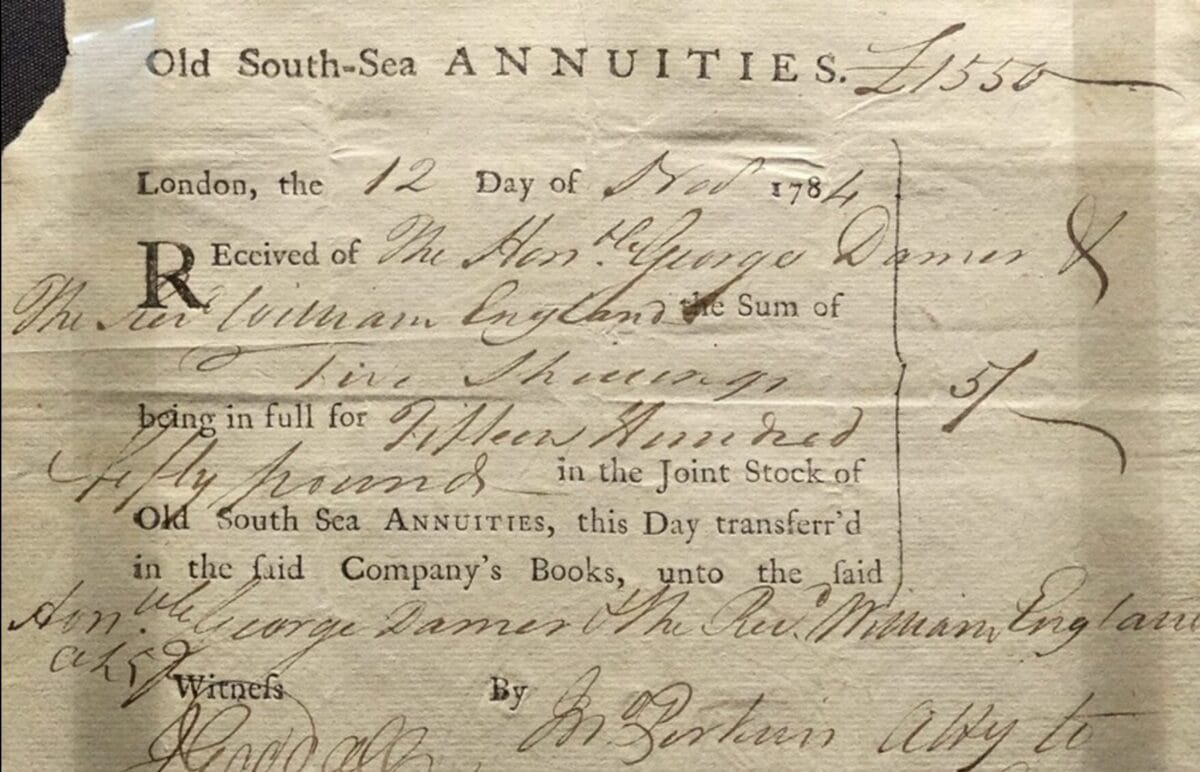
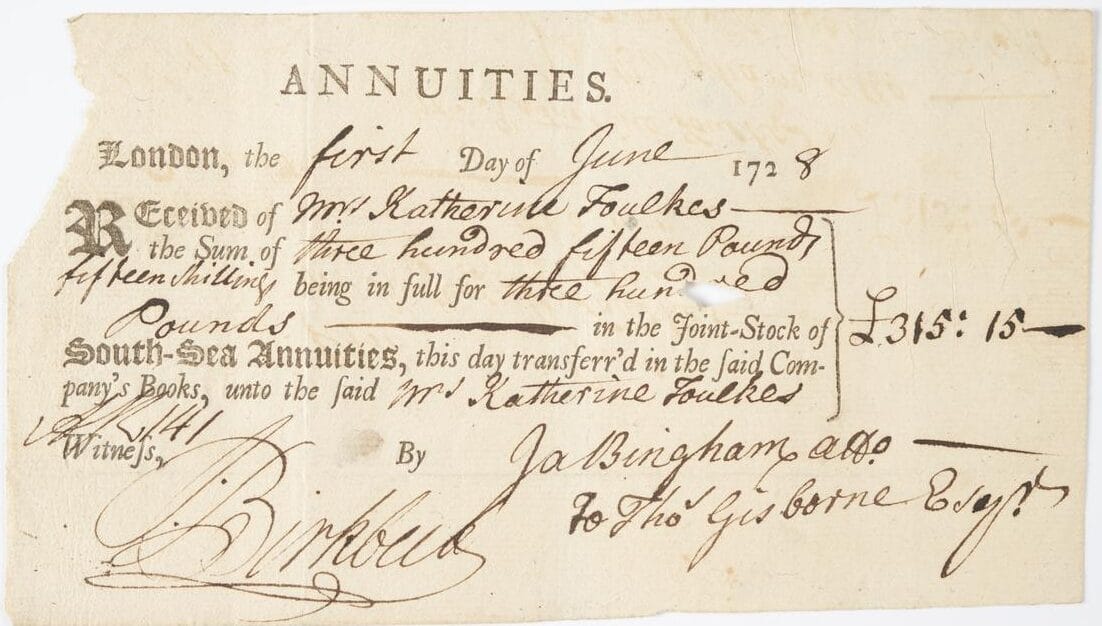 The South Sea Annuities, which formed the bulk of the Bounty’s investments invested exclusively in government debt and had nothing to do with the South Sea Company. This is made clear by statutes of 1723 and 1733 that created the Annuities as well as by a contemporary account of the South Sea Company’s chief clerk, Adam Anderson, and the wording of the annuity certificates themselves. Grant Thornton and the Commissioners’ historical advisers appear not to have examined, or at least not to have understood, the relevant legislation because they mistakenly refer to the Annuities as South Sea Company investments and include them as assets related to the slave trade. The Report’s glossary, in describing these assets as “Annuities in the South Sea Company”, provides clear proof of the authors’ extraordinary confusion over the status of a financial instrument central to their “forensic” investigation.
In fact the South Sea Company was neither issuer, vendor, counterparty or guarantor of the Annuities which were liabilities of a legally separate company with its own investor base and investment objectives. In short, the Annuities had nothing whatsoever to do with the South Sea Company’s commercial activities: they were payable at an office called South Sea House just as Bank Annuities were not liabilities of the Bank of England but government annuities payable at the Bank. The Commissioners’ Report muddles up two different companies both of which included the words “South Sea” in their name – the South Sea Company and the Joint Stock of South Sea Annuities.
The Bounty did, for a time, have a much more limited investment in South Sea Company stock before this was disposed of in 1728. However, none of the dividends paid out came from the slave trade because the Company’s trade was loss-making. In October last year Francois Velde, senior economist at the Federal Reserve Bank of Chicago, published a paper (An Institutional Investor in 18th Century Britain, Federal Reserve Bank of Chicago, October 2025) based on his archival research while a visiting Fellow at Cambridge. He found that the South Sea Company’s dividends were derived entirely from interest on its holdings of government debt, that it was forced to issue bonds to cover its trading losses and then, in 1732, to slash its dividend to a level below the interest it received on government debt. Stung by its losses the South Sea Company declined in 1748 to take up Spain’s offer to renew the Asiento contract on unchanged terms.
Velde shows also how the Bounty’s Treasurer calculated losses on the fund’s investment in South Sea Company stock. He concludes that all in all
[the Bounty’s] involvement in the South Sea Company was financially costly and within a few years it disposed of its equity and bond interests in the Company.
Up to this point the Church Commissioners and their advisers, faced with evidence of fundamental flaws in their research, have closed ranks, reiterated their ill-founded claims and refused to engage with their critics. I do not doubt that the Commissioners believe they are doing the right thing but one might suggest that their behaviour exhibits all the signs of “cognitive dissonance”. This may arise when discomfort is triggered by beliefs clashing with new information. In the words of Leon Festinger, the eminent American social psychologist who originated the theory:
Tell them you disagree and they turn away. Show them facts or figures and they question your sources. Appeal to logic and they fail to see your point.
Another tell-tale manifestation of this condition is “Belief Disconfirmation” where those affected double-down on a belief when confronted with evidence that it is wrong.
To conclude. I have not taken a view on whether Project Spire might or might not be a good thing. However, history matters and what is certain is that such a scheme should not be launched on the back of a false historical narrative. Project Spire should therefore be paused while the Church Commissioners, in accordance with their publicly declared commitment to transparency, accountability and evidence-based research, disclaim their original research findings and amend their report accordingly. Above all, they should withdraw the allegation, broadcast to the world, that Queen Anne’s Bounty made hefty profits by investing in the slave trade.
The Inhumanity of Project Spire
Dr Alka Sehgal Cuthbert is Director of Don’t Divide Us, an educationalist who believes that there is a positive story to be told about Britain and race issues.
The Church Commission claims Project Spire is motived by the desire for ‘Healing, Justice and Repair’—who but the most churlish, obdurate or perhaps merely misinformed, could disagree?
Well, I do.
I object to Project Spire not only because of the money involved, and ultimately, not even for what Project Spire is for, although it is true that I do find it strange that the recipients of the reparations or ‘ethical investment’ are entrepreneurs and public projects led by, or run for, black people exclusively. It sounds segregationist to me.
But the most important reason for my objection to Project Spire is that it is inhumane.
Its inhumanity lies partly in what it is against. The repentance at the heart of Project Spire may be performative but it is nonetheless powerful in its symbolic rupture with Christian tradition. The significance of transatlantic chattel slavery rises above social, historical and political moorings and becomes the epitome of evil – an evil that overshadows everything the Church has ever done, for good or bad, up to the present day.
Irrespective of whether the slavery tainted past of the CoE was more symbolic than real; and irrespective of whether we think a sin committed 2-300 years ago still has the power to cause present day disadvantages, what does Project Spire say to the majority of its parishioners, who in England happen to be white?
The hidden script of the Church Commissioners’ Project Spire tells congregations that everything they have believed in is tainted with sin; the liturgy and rituals of Christian tradition that have bound generations within a nation’s spiritual community, and then beyond to the universal Kingdom of God, are things which now need to be discarded. Unproven, unprovable sin of 200 years ago still needs to be be atoned for – despite all that has been done by the Church, ordinary parishioners, mill workers in Lancashire, abolitionist MPs and the sailors of the West African Squadron, in arguing for, and seeking to instantiate, the moral equality of all human beings.
Even if we discount all these efforts and acts of contrition, and still wonder if atonement may be what is required, the Church Commission denies parishioners the chance to deliberate, subject claims and evidence to open discussion, and to judge for themselves. This is an outsourcing of moral responsibility and repentance that would have Luther and Kant turning in their graves.
Racial Justice, a central commitment of the Church Commissioners since its the 2020 Lament to Action, is often justified by reference to familiar Biblical stories such as the Good Samaritan. For example, one local priest recently posted the following to publicise Racial Justice Sunday:
Jesus said love your neighbour and then told the story of the Good Samaritan to help us all to better understand how important it is for us to care for one another irrespective of colour, creed or race…
According to the priest this was our instruction from Jesus to challenge injustices in the world. Sounds good if a little trite. And she omits the rather important lead in which is that we need to love God with all our heart, our soul, strength and mind. We are urged us to place ourselves in the position of the Samaritan without for once considering whether the more profound and transformative reading would be to place ourselves in the position of the injured and robbed man—in need of God’s help and love.
Project Spire is an initiative that severs us from a theologically rich Christian tradition. What society needs from the Church of England is theology. There’s already too much mouthing of Social or Racial Justice platitudes. The Christian tradition may be feeble in contemporary England, but it remains a light tended by the faithful few for whom the liturgy and rituals are resources that help make individual and collective life meaningful. Now they are told that to revere such a tradition is to be complicit in a sin whose effects, the Commissioners claim, reverberate today. This is a profound act of inhumanity. It is also an act of social irresponsibility.
Its inhumanity also lies in its reduction of human beings to categories. Today, our world is beset by tectonic geopolitical shifts, and national culture and politics seem dire and a cause for despair: ethnic tensions run higher than I can remember in my lifetime. Into this cauldron, Project Spire thinks it is wise to allocate funds and the cultural status of victimhood on the basis of skin colour alone. It is like putting out a fire with gasoline.
- How can this encourage anything other than segregationist beliefs ?
- Does the Church Commission not think there will be a backlash?
If we allow our collective belief in a common humanity to give way to a world view where there are only victims and their allies on the side of the angels, and evil oppressors and their accomplices on on the devil’s side, people’s good will and tolerance will be stretched. And when we see signs of a backlash, as I think we are beginning to see today, polite society can point at crude populism all it likes, but many will know that the weight of responsibility lies with those holding the power, if not authority, to decide the contents of individuals’ consciences and determine the indulgences to be paid. This is contemptuous of people trying, in difficult circumstances, to uphold a tradition that they have treasured for most of their lives.
It would be better, more in keeping with Christian universalism, if the Church Commission devoted its financial, cultural and intellectual resources to ensuring the public has access to clergy better versed in Christianity’s theological riches with the necessary administrative help needed to provide for the spiritual needs of the parish: as well as warm churches with roofs that don’t leak. By all means look to help the disadvantaged through charity, but do it according to actual need not according to skin colour or a particular socio-political reading of events of two hundred years ago. Then the Church of England might find itself better placed to offer spiritual guidance to a public, including politicians, who desperately need it, and maybe contribute to creating shared projects which strengthen rather than weaken our already fraying social fabric.
Issues of Power and Process
Charles Wide is a retired Old Bailey judge and a Reader in his Anglican Church in Peterborough Diocese.
Process
For nerds like me, with a penchant for process, Project Spire is the gift that goes on giving. But meeting, week by week, hard-pressed Anglicans, battling to keep their churches going, brings home that process has real-life consequences.
The de facto Chair of the Church Commissioners yesterday told the General Synod that this project is about people. Indeed, it is. There are thousands of faithful parishioners, without vicars, who cannot pay their parish share and cannot raise the tens of thousands needed to keep open the sermon in stone which stands at the heart of their community. What about them?
Repeatedly, it is said this project does not affect the funding of parishes. It does. Parishes are principal beneficiaries of the Commissioners. Every penny which goes towards Project Spire is unavailable to them.
The topics covered just now have relevance to some aspects of process. There are more, but I want to mention two issues.
First, according to mandatory Charity Commission guidance, charities must consult before decisions are made. This involves transparency, providing balanced information, involving as many people as possible (especially beneficiaries), and sharing all the relevant details. The Commissioners (by which I mean the corporate charity) say they have. But have they?
When Project Spire was launched in January 2023, the decision was presented as emphatic and unequivocal. The terms of reference of an ‘Oversight Group’, appointed to help with implementation, were unambiguous:
We are now ready to move onto delivering the response that has been committed to.
When challenged about the issue of consultation, the Commissioners have laid great stress on ‘engagement events’ … particularly (but not exclusively) involving what they call ‘descendant communities’. But, all this ‘engagement’ (note the semantic shift from ‘consultation’) took place after the unequivocal decision had been taken. Of course, there were numerous other decisions along the way to which the guidelines equally apply. But on the big question, the horse had bolted.
Furthermore, I have formed the clear impression that these events were largely exercises in partisan advocacy for the project, largely to sympathetic audiences. This impression is reinforced by the entirely one-sided material found in the Church Commissioners’ part of the Church’s website—which I encourage you to read. Of course, I could be wrong. The Commissioners have not responded to my invitation to correct me if I am.
I should add that, other than members of General Synod, I have never met anyone who was even aware that these events were taking place, let alone been invited to one. Nor have I, despite being on an ‘interested stakeholders list’ since December 2024.
The very first guideline principle is that trustees must ensure that a project is within their legal powers. Didn’t an amber light glow? This charity’s purpose is to support, in particular, poor parishes, not to set up its own, rather political, intensely controversial, operation.
Specific questions were asked about this topic, but clear answer came there none. Pressure was increased by questions in Parliament last year. Finally, on 6th May, the Second Estates Commissioner revealed the intention:
to apply for authority to make an ex gratia payment under section 106 of the Charities Act 2011, on the basis of a moral obligation.
By this, a charity can ask the Charity Commission for authority to do something it cannot otherwise lawfully do. But there is a precondition: the trustees must know that they have no power to do it. So, here was the clear admission: the project was beyond their legal powers and they knew it.
At the launch in January 2023, nothing was said or written in public about this issue and the project was, from then on, presented as something that would not might happen.
The Charity Commission has revealed, in answer to an FOI request, that this issue was first raised with them in July 2023, when the Commissioners expressed…
a working assumption … that some form of charity commission authorisation might be appropriate…
and a number of options were mentioned. It seems that the Commissioners had not, even then, resolved whether the project is ultra vires.
How could the Oversight Group be expected to help shape delivery without knowing of this potential obstacle? How could any consultation exercise be meaningful without the public knowing it? How could it be right to raise expectations, here and abroad, without revealing it? Especially, after May 2024.
That was when, the Church Commissioners proposed to the Charity Commission setting up a new charitable company to receive the fund and said that they would need to make an application under S.106. Therefore, they have known since then, if not before, that they had no legal power to deliver Project Spire and a possible remedy.
Surely, the first thing to do next was to assess the chances of success. If this was done, they have kept pretty quiet about it. The Charity Commission has revealed that in March 2025, nearly a year ago, they told the Commissioners that the success rate for applications to set up a new charity…
is only 53% and for those that intend to set precedent [as Project Spire is] the success rate is considerably lower.
What about authority to make ex gratia payments? The Charity Commission has revealed that only 37% of such applications in non-wills cases get first-time approval. Very few applications involve sums of more than £100k. Project Spire would be a wholly unprecedented use of this section, in terms of character and scale. Furthermore, an application would be strongly contested.
Did the Church Commissioners, who continually stress their commitment to transparency, share any of this with the public? They did not. The reason given this week in the written answer to Q.11 is that the informal discussions with the Charity Commission had not concluded. But, so what? The Charity Commission was content to reveal what I have just set out, what possible reason could there be for the Commissioners not to do likewise?
They just ploughed on. Spending, we are told, about a million pounds by the end of 2024 (including £307k on accountants before the launch, but not including staff costs). Who knows how exactly much was spent in 2025 and on what?
What has the non-publication of last year’s Annual Report got to do with it? Does it explain the expenditure of hundreds of thousands of the charity’s money, to say vaguely, in answer to Q10, that:
expenditure to date … has been limited to proportionate research into the Church Commissioners’ source of funds and consideration of its response to that history.
Should each member of the Board, who is personally responsible for each determination, be asking some deep questions about the basis of each decision to authorise the expenditure of such enormous sums, on a project which may be undeliverable? Will the public be told? I imply nothing. I simply ask these questions, in good faith.
You can now find the videos of all four presentations on YouTube in two parts here:
 Buy me a Coffee















Based on the above I think any reparations should be limited solely to the equivalent of the QAB’s limited investment in South Sea Company stock pre 1728 and no further
Excellent idea!
Good we agree on this at least
That certainly needs to be the revised starting point. But that still does not address complex issues about the ethics of this.
I agree, Ian, it doesn’t. But do we really want yet another huge and divisive
rowdebate on top of those about LLF and safeguarding?I think just limiting reparations to original investment levels will ensure what is spent is not beyond what is being held account for. While also not antagonising BME Anglicans who will welcome some sort of reparations still
What were the political and religious beliefs of the Grant Thornton employees who inspected the 18th century documents and reached the conclusion that Queen Anne’s Bounty profited enormously from the slave trade?
The Church Commissioners have someone else they can blame, and it would be extraordinary if they did not regard the saving of a hundred million pounds as good news.
Perhaps an expert in charity law can inform us whether it is lawful for the Commissioners to pay out 100 million pounds on the basis of a false premise?
The Archbishop of Canterbury is the chair of the Church Commissioners. One of the first tests of her leadership will be to engage with serious flaws in the reparations project and to bring thew whole thing to a shuddering halt (just as LLF had to).
Many larger questions remain – one of the most obvious is the (presumably unintended) consequences of profligate spending by the Church Commissioners on what some see as vanity projects. How can people be asked to give to the church to fund ministry if the vast investments of the Church Commissioners are not used for the purpose for which they were always intended – the provision of parish ministry – and spent instead on slavery reparations (£100 million) and Net Zero (£90 million)? These are huge sums and are a huge disincentive to giving.
Another issue is the disintegrity (dishonesty) in saying that the Dioceses pay for parish clergy – when the truth is that parish clergy are paid by the Church Commissioners. That is easily proved by looking at any parish clergy payslip.
Bishops have a primary duty to provide clergy to serve in the parishes. At the moment they are shrinking the number of parish clergy, but increasing the number of clergy employed by dioceses, and increasing the huge investments of the Church Commissioners. Something is very seriously wrong – a first duty on a new Archbishop will be to make the Church Commissioner properly accountable to the General Synod and to insist on due process in all decision-making.
I won’t argue with these letters. Project Spire may be ahistorical. It may be cruel. It may be ultra vires. But these reasons fail to confront the heart of the matter.
Taking money from people who have never had anything to do with slavery to give to other people who never had anything to do with slavery but have the correct skin colour is as unjust as it is morally vacuous. Christianity teaches us that we are all individuals, responsible to other individuals (as in the Good Samaritan), rejecting collective virtue-signaling untethered from personal guilt (collectively tithing trifles and ignoring the weightier matters of the law, all of which are individual duties). Reparations may be the highest form of moral obtuseness yet invented. They are best understood as yet another fatuous secular virtue signal that accomplishes nothing of righteousness or worth.
Ah but you’re missing the point. Senior bishops and senior Church Commissioners tend to come from very privileged backgrounds. Clearly, giving their family wealth to the poor is impossible, so giving away the Church’s wealth instead makes them feel a whole lot better at no personal cost. You really need to catch up, John.
*sarcasm alert*
John, ‘Taking money from people who have never had anything to do with slavery to give to other people who never had anything to do with slavery but have the correct skin colour is as unjust as it is morally vacuous.’
That’s it in a nutshell.
Even shorter: Taking from the poor in a rich country to give to the rich in poor countries.
And if reparations were claims against individuals and states were not legal persons, you’d be right.
To the detriment of your argument, states are legal persons that can make treaties, incur liabilities and, yes, even pay reparations.
Reparations carry no implication of personal guilt or personal liability.
True, but they do raise the question of why taxes of, for instance, black British persons should go toward reparation; and if not then how you define black.
Well, certainly no more than the question of what proportion of part-Jewish German tax-payers’ money should fund reparations that go to Israel.
Unsurprisingly, the German state has not undertaken a detailed ethnic calculus in that regard…for obvious reasons.
This issue is totemic of the Church of England’s catastrophic descent into corrupt governance and the consequent loss of effective Christian witness to the people of England. There are some rather obvious symptoms:
1) The arrogance of a self appointing hierarchy which appears to have little connection with and even less respect for the people (clergy and congregations) it is there to serve.
2) Disregard both for its own doctrines and its administrative processes (legal and moral).
3) A lost understanding of how the only serious justification for remaining a nationally established church rests on the maintenance and promotion of a thriving, gospel centred parish system.
As overtly Christian organisations, churches are charitable in nature. They do not exist either to make money, to horde vast assets, or to spend money on anything which doesn’t directly or indirectly support the church’s regular ministry of worship, teaching, and evangelism.
On the other hand individual Christians may and will support, alongside the financial support of their local church, such charities or causes as they wish to help. What they will not do – and rightly so – is continue to support their church financially if its hierarchy starts to spend money over which it has control on issues and causes well beyond the regular ministry of the church.
So when I used the word ‘corrupt’ above, I wasn’t alleging purposeful theft or intended dishonesty. It’s the simple disregard for agreed purpose, due process, openness, and respect for the needs and opinions of ordinary people which soon enough can turn the whole thing rotten.
Truth forever on the scaffold. Wrong forever on the throne. Yet that scaffold sways the future. Behind the dim unknown stands God, Within the shadow keeping watch above his own.” James Russell Lowell
Perhaps paired with Bishop William Boyd Carpenter (1841–1918) poem
“Before Thy Throne, O God, We Kneel” if we are no nearer God nor futher from ourselves.
I have neither the capabilities or the intention to contest Richard Dale & Chales Wilde’s careful analysis of the financial and procedural problems of Project Spire. But I think Alka Seghal Cuthbert’s article will undermine rather than enhance the case against.
Racialised chattel slavery by the British in the Caribbean was an evil, inhumane crime. The British economy to an extent which is debated has benefited from it. The enslaved suffered not only appalling physical abuse but also the destruction of their cultural identity to an extent which certainly does have present day consequences – the observable overall difference of bearing between West African and Caribbean descendant people in Tottenham High Road bears present day witness to it.
As a church and society we are struggling to understand how best to appropriately respond to abuse and trauma today; especially as it seems that people have very varying capacities to ‘get over and get on’. So how we respond to the wholesale abuse we perpetrated against black slaves in the Caribbean up to 200 years ago is even more difficult to discern. Do reparations in effect damagingly institutionalise a sense of grievance (as Franz Fanon argued)? Are they an appropriate – albeit in any form, tokenistic – expression of remorse to a history which does (contra to several of your respondents) having continuing consequences?
Even if Project Spire is kicked into the long grass (like LLF?) it is an issue which won’t go away and how Christians should respond to our legacy of Caribbean enslavement needs serious moral and theological engagement.
John Root writes: “So how we respond to the wholesale abuse we perpetrated against black slaves in the Caribbean up to 200 years ago is even more difficult to discern.”
I can put hand on heart and say I did nothing of the sort, and neither did any of my ancestors.
My Scottish and Irish ancestors probably suffered because of the English aristocracy. But that was a long time ago and I am willing to forgive.
If John Root is saying West Africans today should be paying reparations because their ancestors sold their brothers and sisters into slavery, he may have a moral case but there are practical difficulties in his proposal. How much does he think Nigeria and Ghana should pay the West Indies? Would £100 million be about right?
James, most probably my grandfather suffered injustice from the aristocrat for whom, age 12, he worked as third footman. The suffering of the British poor did not go alongside the wholesale cultural obliteration that Caribbean slaves suffered. Neither you or I are guilty of that – but we have been the economic beneficiaries. And scripture is clear about the significance of generational continuity. I guess both you and I are glad to be British. Slavery doesn’t make me guilty, it does make me ashamed. Such shame requires both we accept it, and work through how we respond to it – but not shrugged off.
I think we evangelicals have been strong on responding to guilt – I think we need to explore more deeply how we experience and deal with shame.
John, I seriously doubt I have ever been a beneficiary of West Indian slavery, never having had shares in shipping or sugar. I do know of the enormous efforts and expense in money and lives the Royal Navy went to in stopping the Atlantic slave trade and then in the Indian Ocean, al, of this done at the immense expense of the British Exchequer. And I know of the great efforts that was put into providing education and health services in these colonies. If there was a monetary debt, I think it has been repaid many times since. For a very long time, the standard of living, health and education in the West Indies has been significantly higher than in West Africa.
I don’t think cultures are as easily obliterated as you might be suggesting; in any case, when a people becomes Christian, that does put an end to a lot of their previous cultural ways. That certainly happened in West Africa when the Gospel came – along with the embrace of western culture: literacy, schooling, western government, justice, technology and medicine – as well as imperfect versions of human rights that Africa now enthusiastically subscribes to, at least in theory.
You know as well that the extension of British colonialism in Africa meant the abolition of slavery there, along with many barbaric practices that were part of traditional African culture. We should challenge the popular but fallacious idea that the lives of most people in pre-colonial Africa were wholesome and good. They weren’t. For very many, life was pretty hellish. West Indian slavery was only possible because of pre-colonial West African culture and society.
Wholeheartedly agree. But what can an aged church member do about it?
As I wrote in a recent article for Evangelicals Now, the conflation of state liability with personal guilt is erroneous.
The “my particular
ancestors didn’t do it” and the “a son will not bear the iniquities of his father” (Ezek. 18:20) arguments fail because reparations relate to state/organisational liability, rather than personal culpability.
As with post-WWII Germany, reparations amount to the liability of the state (as a legal person), rather than any personal liability, or guilt.
If that wasn’t the case, then it would be impossible to justify the use of 20th and 21st century taxpayers’ money to service the long-standing public debt incurred by the £20 million that the British government borrowed in 1833 to compensate slave-owners.
David,
You present your own assertions as if you were stating matters of fact.
There is no single definition of the term “reparations”.
There is no credible legal basis to your argument.
Peter,
Your counter-assumes that any claim for reparations would amount to a charge of personal/ancestral guilt or liability.
I’ve just provided ‘real world’ examples of reparations that are based on the recognition of states as legal persons.
Of course, you’re free to provide counter-examples, but they cannot demonstrate that any claim for slavery reparations amounts to making individuals responsible (either personally or by descent).
David,
I am not making any assumptions at all about the burden of liability in regard to slavery reparations.
The moral and legal basis for such “reparations” is non-existent. It is an ideological fiction that has been invented for entirely political reasons.
You appear in your comments to take the affront to intellectual integrity one step further by claiming that reparations are wrong – but only because they cannot expunge the moral debt.
There is no such moral, legal or any other kind of debt against people alive today. Guilt does not pass down the generations and both of us (and everybody else) should be glad of that.
Just to be clear, when you state: “the moral and legal basis for such “reparations” is non-existent. It is an ideological fiction that has been invented for entirely political reasons”, are you referring to all reparations.
While your final paragraph conflates guilt and liability (they’re not synonyms), but I agree that “there is no such moral, legal or any other kind of debt against people alive today”.
The debt is against the state, as demonstrated by 21st century taxpayers’ money servicing the debt incurred by the Slavery Compensation Act 1837 and, by German taxpayers’ money servicing the debt incurred by the agreement at the 1951 Claims Conference.
In terms of intellectual integrity, you really can’t cherry-pick state liabilities.
David.
You make some interesting points.
I was referring to the “reparations” debate in the Church of England.
You make a reasonable point about cherry picking state liabilities.
I think you over state the distinctions between the state and the individual. That is clearly a matter of politics rather than law or morality.
To assert that debt rests with “the state” is a political statement not a legal or moral statement
“ To assert that debt rests with “the state” is a political statement not a legal or moral statement”.
It’s no more a political system than to declare that treaty-making power rests with the state. We can always question the morality (and even the legality) of states acting a legal persons in treaty-making and reparations, but the fact that states are internationally recognised as legal persons in such situations is based on longstanding legal precedent, rather than mere political opinion.
This raises the whole question of how on earth you trace any kind of link historically.
My English father’s forebears oppressed and killed my Irish mother’s forebears. So who is responsible to whom in my generation? Should I pay myself reparations?
Kemi Badenoch has said that her forebears were slave traders, and profited from it. But under Project Spire, she would be eligible for ‘reparations’. How does that make any moral, theological, or historical sense?
‘Which side of the guns at Amritsar’ is how I conceive of it.
In Modern Britain we must think of ourslves as having been on ‘both sides’ if we are to go forward as a nation.
As I wrote in a recent article for Evangelicals Now, the conflation of state liability with personal guilt is erroneous.
The “my particular
ancestors didn’t do it” and the “a son will not bear the iniquities of his father” (Ezek. 18:20) arguments fail because reparations relate to state/organisational liability, rather than personal culpability.
As with post-WWII Germany, reparations amount to the liability of the state (as a legal person), rather than any personal liability, or guilt.
If that wasn’t the case, then it would be impossible to justify the use of 20th and 21st century taxpayers’ money to service the long-standing public debt incurred by the £20 million that the British government borrowed in 1833 to compensate slave-owners.
But the State gets its money from taxes on the individual.
Why should black British have to pay a penny? And how do you decide who is black?
@Anthony Williamson,
“ But the State gets its money from taxes on the individual.”
“Why should black British have to pay a penny? And how do you decide who is black?”
I’m sure that a similar argument could be made for 20th and 21st century taxpayers servicing (until 2015) the public debt incurred by the compensation paid to slave-owners.
And, in terms of Holocaust reparations, I’m sure that there were some part-Jewish citizens whose taxes contributed to the payment of reparations to Israel.
States are legal persons. They make treaties that I and my family didn’t personally approve. They incur liabilities that I and my family didn’t personally authorise.
Just to be clear. I oppose slavery reparations, but for the same reasons that Menachem Begin opposed Holocaust reparations. And, for the same reason that Jesus denounced the Pharisees for attempting to reparatively bestow posthumous honours on martyred prophets, while expressing familial solidarity and continuity with those who murdered them.
At best, slavery reparations amount to a similarly demeaning theatrical gesture that lacks any sincerity or wholesale repudiation of British imperialism for its involvement in the transatlantic slave trade.
Thanks. I disagree with you about Alka’s contribution. She had a credibility that white men could not.
And the work of her organisation is vital.
What do you mean by saying ‘The issue won’t go away’? That people will continue to make racist and historically false claims about this? Then the response needs to be to continue to push back—doesn’t it?
Ian,
What would be just in the situation in which a Jew returned to postwar Germany and found a German family living in the flat that the Nazis had evicted him from – a German family who lost their home to bombing and were not the evictors? And in what ways is this analogous and not analogous to slavery?
I am uncertain of the answers to these questions, but progress in addressing concrete situations is possibly a better way to illuminate the general case than starting from philosophical considerations.
It is not analogous in the slightest, because none of the people, or even their great grandparents, were involved.
“ What would be just in the situation in which a Jew returned to postwar Germany and found a German family living in the flat that the Nazis had evicted him from – a German family who lost their home to bombing and were not the evictors?”
It’s an interesting question. In that case, there would be an onus is on the state to do two things. Both to re-house the Jewish returnee to the flat that was taken by force; and for the state to provide the German family with suitable equivalent nearby rehousing and transitional funding (at its own expense) with a public acknowledgement of responsibility for the upheaval and distress caused.
In fact, the remedy for your example amply demonstrates that reparations amount to an acknowledgment of state or organisational liability , rather than anything related to personal or even ancestral liability or guilt.
David,
The attempt to use the circumstances arising after the Holocaust as some kind of relevant paradigm for the discussion of the issue of “reparations” is a grotesque attempt to smear by inference.
You should apologise and withdraw the smear
“The attempt to use the circumstances arising after the Holocaust as some kind of relevant paradigm for the discussion of the issue of “reparations” is a grotesque attempt to smear by inference.”
So, you take issue with my reply to Anthony Williamson, who brought a hypothetical situation arising from the Holocaust into this discussion.
We’re all left to wonder why you’d single me out for a demand to withdraw my comment and apologise, rather than the person to whom I replied, who who first brought the hypothetical situation relating to the Holocaust into this discussion.
Probably, you have an axe to grind from previous exchanges.
Correction:
We’re all left to wonder why you’d demand that I withdraw my comment and apologise (@9:38pm 12/03/2026) before asking the same of the person to whom I replied (@10:06 12/02/2026) who first brought the hypothetical situation relating to the Holocaust into this discussion.
David,
You are entirely in error with your suggestion that I am criticizing you whilst not criticizing Anthony for committing the same reprehensible attempt to invoke Nazi Germany in your analysis.
I am emphatic in my criticism of Anthony.
I actually respect you for your willingness to engage with criticism which is rather more than Anthony is willing to do.
He resorts to sticking his fingers in his ears, which is worthy only of children.
If anybody brings the slaughter of the Jews into a discourse they need the decency and integrity to accept the criticisms that will and must follow.
Your attempt to suggest I have some kind of “axe to grind” is ridiculous David.
The Genocide of the ancient people of God is the issue and you need to accept that.
Perhaps, you can clarify why you first demanded a retraction and apology from me (before Anthony Williamson), when my comment was merely replying to his.
David,
You asked why I said you should apologise when I did not do the same to Anthony.
I think your comments are tougher and better articulated than Anthony. I think you are often wrong, but there is no doubt you know how to articulate an argument.
Anthony
Please will you withdraw your attempt to draw parallels with the Nazis.
It has always been a historically absurd sleight of hand used far too often by those intent on provoking racial divisions and antagonism.
In the aftermath of 7th October it is now morally inexcusable.
The Holocaust was unique. Nobody, anywhere is entitled to invoke it in relation their own sense of grievance
Peter,
I made no such inference, as you will find if you read my post more carefully. I am essentially not in favour of reparations but I want to ask questions that sharpen the debate.
Anthony.
In reply to your denial and claim I need to read your post more carefully.
I read the exact wording of your post. You reference Nazi Germany in your post. It is there is black and white, Anthony.
Please take responsibility for your own words. It is inexcusable to use Nazi Germany in a debate about “reparations”
I take full and unashamed responsibility for my words but they do not mean or imply what you seem to be suggesting.
Anthony,
If you make the deplorable decision to bring Nazi Germany into your analysis, you do not get to decide what that does or does not mean.
You made a mistake. Be grown up enough to accept that
Let readers see what I actually said and decide for themselves, You are not worth arguing with on this subject.
Ian,
Please can we be spared virtue signalling smears again the second largest ethic/gender group in the United Kingdom.
White men. They built the roads you use, the railways on which you travel, the buildings you inhabit.
A modicum of gratitude to them is in order
I am perplexed by your post. I am white, but brought up as an African in Kenya. Am I guilty? My forbears were Irish. Poor peasants on 4 acres of rainswept soil, paying rent to the Duke of Hamilton. Our extended family eventually rented 28 farms. After the great Irish famine only three families remained. Are we guilty? Cromwell sent 50,000 of our compatriots as slaves or indentured servants to work on plantations in the Caribbean and Virginia, where most died. Is anyone from Ireland guilty? What has my surviving family got to do with British slavery or profit from slave transport? I reject utterly the idea that events in Barbados 200 years ago have anything to do with me. If the new Archbishop persists in this nonsense I will withdraw my parish contribution and send it where it might be more appreciated.
Thanks. Not sure why you are perplexed by my post…as it appears to agree with you.
According to Nick Kristof of the NY Times, in his book Half the Sky, there were profound
economic implications for Britain’s eradication of slave trade. Presumably the church played some role in inspiring this change. How does one factor in the following:
1.Sugar production 1807 (the year it banned slave trade) Britain’s colonies produced 55% of world’s sugar, and carried 52% of slave trade. For the next 25 years, with no new slaves, Britain’s share of sugar industry fell 25% while production in competition rose 210%.
2. The British navy led the way in suppressing the trade; It led to the loss of some 5,000 British lives and higher taxes for the British.
3. for 60 years Britain sacrificed 1.8% GNP because of its moral commitment to end slavery. An astonishing total, combining more than a year’s total GNP. “It was a heroic example of a nation placing its values above its interests.”
Cf. p. 235 Half the Sky, Kristof and WuDunn from Robert Pape and Chaim Kaufman’s research.
Roger: this is what I said in reply to John Root but without your statistics. The British people in the 19th century paid back an enormous amount in eradicating slavery, as well as creating a standard of living, health and education far higher in the West Indies than anything ordinary people in West Africa would have known. The better life in the West Indies has persisted to this day.
Thanks–really interesting historical context.
In my own comment, I identified a very good (and biblical) reason for opposing reparations. Like adorning the tombs of martyred prophets (Matt. 23:29 – 32), it’s a theatrical gesture that lacks the authentic moral separation that St. Paul praised in 2 Cor. 7:11.
The role of the West Africa Patrol is irrelevant to reparations.
As an analogy, let’s say that a thief has stopped stealing and, instead, invests efforts in preventing others from stealing. Thereby, the thief has not “paid back” the victims of his crime.
We all know reparations are an immoral nonsense.
You are also wrong in your attempt to claim that there is a moral debt due by somebody to somebody.
There is no thief. All of us have ancestors who suffered atrocities. We have no claim on their suffering.
“ All of us have ancestors who suffered atrocities. We have no claim on their suffering.”
Then, it’s a wonder that a significant part of Germany’s reparations paid for civil infrastructure. In fact, from 1953 to 1963, the reparations money funded around one-third of investment in Israel’s electrical system, helping it to triple its capacity, and nearly half the total investment in Israel Railways, which obtained German-made rolling stock, tracks, and signaling equipment with reparations money.
Clearly, those reparations extended to others in Israel who, like all of us, “have ancestors who suffered atrocities”.
David,
Post second world war German reparations were not paid to benefit the descendants of long dead ancestors. Your argument is therefore without merit
Furthermore, the Holocaust is a unique event – the attempt to conflate arguments about slavery with the Nazis attempted genocide is not history – it is an attempt to gaslight people into a sense of guilt that is also entirely without merit
No state contributes to the civil infrastructure of an entire country without envisaging its benefit to future descendants.
If that was not intended, then the reparations would have been restricted to direct compensation of victims.
David,
That is a fair point. There is still a category distinction between reparations paid twenty years after the Second World War and “reparations” for events centuries ago
David: you know fully well that the Atlantic slave trade would not have been possible, were it not for the very active slave trade among the west African kingdoms which enslaved menbers of other tribes and sold them to European slave traders. The same thing happened, but began much, much earlier in the southern and eastern sides of Africa, which sold slaves to the Arabs for the Indian Ocean slave trade. The Indian Ocean slave trade went until much later u til the Royal Navy ended it, closing the slave market in Zanzibar. We know also of the heroic work of David Livingstone to stamp out this trade.
Where is the recognition in the west African states of their role in the slave trade? What reparations should Nigeria and Ghana make?
Your dismissal of the West Africa Patrol is very strange,
My position that the West Africa squadron is not some sort of moral offset is not strange at all. Offsetting might be valid in the context of carbon trading, but not it the context of atrocities.
What’s strange (and morally incoherent) is the notion that the Squadron (or David Livingstone) could act as a moral counterweight, retroactively launder slavery of its evil; or that African complicity somehow diminishes European responsibility. The notion that Europe didn’t embarked on the transatlantic slave trade without African permission and complicity does not bear serious scrutiny.
The notion that Europe didn’t embark on the transatlantic slave trade without African permission and complicity does not bear serious scrutiny.
While I commend the idea of encouraging us to repent and make remuneration where necessary for past wrongs, I do wonder whether there comes a point at which the whole issue just becomes a token for those in the public eye, and a penalty paid by those who have played no part in the issue. As far as I know, the Bible clearly stated that the new covenant would be a time when God would no longer visit the sins of the fathers upon the children, that is not to say there is not a recognition of past wrongs and an acknowledgment of an intent to repent, a turning away to a new position. This tokenistic stance, taken without any wider discussion and clearly not having explored some of the academic realities mentioned in the article does nothing but highlight the churches lack of credibility to speak truth or to acknowledge its errors along the way. I hope that Archbishop Mullaly may begin her time as primate by backtracking on this issue and showing us all that she is able to respond quickly to errors of judgement and learn from this that we do not want a pr machine but robust scholarship with real care for the flock she is here to serve.
Yes, I hope so too.
Slavery was and is abhorrent but generations of my ancestors toiled in the Lancashire coalmines and cotton mills in horrendous conditions for subsistence wages right down to my paternal grandfather who died of “miner’s lung” aged 48 in 1939 leaving my grandmother a destitute single parent..no decent pensions prior to nationalisation. My maternal grandmother left school aged 12 to work in the mill and was disabled as a result of malnutrition. The respectable mill owners and mine owners donated from their profits to build and endow churches in Lancashire towns and villages. May I have “reparations”?
Alison, I think that is a key question. In his talk, Nigel Biggar started by pointing out that ‘the past was dreadful’.
Much of this debate about slavery reparations dislocates slavery from the social conditions of the time. But how do we say that the conditions for many workers were as bad as the conditions of many slaves without being seen to minimise the abhorrence of slavery?
Ian
You assume there is some kind of calculator that means we can calibrate the sufferings of our ancestors.
It leads to absurd conclusions
My ancestors were Irish. The Irish suffered deportation across the Atlantic. They were treated as slaves. They were white.
Contemporary commentators engage in a risible rebuttal on the grounds they were “indentured labourers”. They therefore had legal rights.
The fact no court system existed to allow those theoretical rights is casually ignored.
History is a complicated place and the details are much more important than today’s moral crusaders understand
My story exactly Alison,my dad worked 12hours a day 6 days a week
and 4 on Saterday, when we did see him he was always asleep and we had to keep quiet or else. I never really knew him.
I support reparations for the catastrophic harm and evil done by people and institutions in England, Scotland and other nations. I commend the organisation ‘Heirs of Slavery’ which tries to set an example and take a moral lead. I think the Church of England should do the same.
And it does not seem wrong to me that most if not all reparations are directed to black communities. I wouldn’t call that ‘segregation’. It was black communities (aka slaves) who were violated by predominantly white plantation owners.
As for the counter argument that the poor in British nations were also exploited, I’m afraid I regard that as ‘whataboutery’. We can absolutely take steps to reverse the ongoing exploitation of the poor in our own countries (many of them black): it’s called socialism (and the struggle for a fairer society).
Slavery was real. It was sponsored by white ancestors investing in human trafficking, and channelled wealth into our nations’ lives at the cost of cruel labour, dehumanisation, the consequences of which still linger generationally.
If the Church of England resolves to take a moral lead, then I would call that living out theology, showing compassion, and acknowledging the ongoing sin that still goes on today in alarming episodes of racism, along with alarming language that insinuates white distance from black lives (which is itself a trend today toward xenophobia and segregation of humans from taking responsibility for one another).
So I guess you can see that I don’t align completely with opinions expressed on this page. I am proud that the Church of England can show moral leadership over this issue. I wish it would do more of the same over the shocking inequalities in England today. I have thought and prayed a lot about this because I am descended from slave traders and plantation owners myself. It is nothing to be proud of.
To take pride in my own nationality I want to see acknowledgment of national and institutional crimes against humanity in which our forbears participated. That seems to me to be Christian witness and a valuable message to send out in our multi-ethnic and multi-cultural society, at a time when racists and quasi-racists frame people of ‘foreign’ descent as ‘threats’ and ‘problems’. Reparations may be an act of healing and reconciliation.
Perhaps you might agree with Simon Baker in the opening comment beneath the essay about the amount of reparation due from the Church of England? And how would you calculate the amount of reparatoin you believe is due from Britain, who should pay it and who should receive it?
Anthony, I believe these calculations and decisions can be legitimately discussed and explored in General Synod and in Parliament. I welcome Ian’s participation in that because he sometimes makes very valuable contributions and has a forensic mind. My business is to present my conscience to God in prayer, and as for me and my house, we are making generational reparations. This matters to me because I am directly descended from plantation owners and also a slave trader who shipped slaves. Of one of his consignments, it is recorded that a “shipment of slaves had arrived – with 41 skeletons, and 8 others who could hardly stand on 2 feet. 4 of those survived.” This was recorded by Alexander Hamilton who worked for him. Each of those victims was created by God and loved by God. No payment is enough in reparation, but we do know that Christ died for each of those beloved human beings, and seeks to reconcile us too. Personally, I am glad that the Church of England as an institution witnessing to the reconciling work of Christ, is willing to take a moral lead.
What you do with your money is your business, and may God bless you if you spend it wisely and charitably; but this is also about what you believe should be done with other people’s money. May I at least press you to give, whatever else you wish to say, a Yes-or-No answer to whether you agree with Simon Baker’s first comment on the thread, about the amount of reparation due from the Church of England?
Anthony, I don’t feel sufficiently well-informed to make a judgment on that. I’m personally comfortable with a proposed lump sum reparation of £100 million from the Church of England, regardless of the sums involved centuries ago. I don’t think we can put any adequate price on the violated lives of so many human beings. But I am satisfied with it as an act of moral leadership, and a partial reparation toward reconciliation. I believe the need for reconciliation extends to today. However, there are probably many other people better qualified than me to assess the size, scale and ambition of the reparation.
The money is the Church’s and it is for the Church and its Commissioners to decide. That is a matter of collective moral conscience.
We’ve been told by Bishop Lake that it won’t impact on money going to parishes. Funding of parishes is a separate issue. The distribution of funds to parishes is a matter of political choice. As someone whose rural benefice has been in interregnum for years, I don’t say that lightly. However, I believe the decision to invest in reparations is a good one.
May God bless you too. With grace and hope and love.
How do we salve our consciences?
Well, get out of our studies, coffee and biscuits and overthinking echo chambers.
Perhaps do a bit of street pastoring.
Perhaps see what devastation that Sin causes, determine not to treat the symptoms but address the disease.
The church is elderly and mostly exhausted
and mostly of a generation that feels that it was exploited so is not all that concerned about what happened 200 years ago and the Sin then on the throne.
Many are nursing the symptoms and seeing the disease
increasingly overwhelming everyone.
True nursing can help alleviate discomfort but what is required is not paper doctors but doctors who know how to cure souls, who can tell the people that Jesus is the friend of Sinners who has overcome the Power of Sin nd brought such into the glorious liberty of the sons of God
Ian Paul is right to point out that South Sea Annuities were parcels of the national debt, rather than shares in the trading company.
At a state level, by 1850, there was still fiscal entanglement in slavery, since debts were serviced by revenue from the manufacture of cotton (from the American South). However, this is not the same as investment entanglement in slavery.
Nevertheless, the claim that the Annuities had nothing to do with the South Sea Company’s commercial activities or the slave trade is overstated. The South Sea Annuities continued as a minor category of national debt stock until the administration of Lord Aberdeen (a century after the SSC lost its slave-trading privileges with Spanish America).
At a state level, public debt was serviced by revenues from an economy in which cotton manufacture, which yielded half of British exports, depended on enslaved labour in the American South for most of its raw material. To that extent, the British state remained fiscally (and indirectly) entangled in slavery.
However, the South Sea Company’s administrative role in managing government annuities (after South Sea Company’s commercial slave‑trading ended in the 1730s) does not create moral, financial, or commercial continuity. That does not justify the Church Commissioners classifying a government annuity administered by a post‑commercial South Sea Company as a slave‑trade investment of Queen Anne’s Bounty.
In summary, the fact that the British state continued to reap revenues tainted with slave labour does not mean that Queen Anne’s Bounty invested in a slave‑trading corporation.
That said, the claim that the annuities were liabilities of a “legally separate company” is a major factual error. There was no separate company. The annuities were liabilities of the British state. The “Joint Stock of South Sea Annuities” was a fund, not a corporation. It had no charter, no directors, no legal personality, and no commercial activity.
Also, the post assumes that the location of payment amounts to evidence of the debtor. In fact, the pay office location (whether South Sea House, or Bank of England) does not determine the debtor. South Sea Annuities were not South Sea Company liabilities.
I’d add that the Lancastrian cotton industry accepted financial devastation during the American Civil War in order to side with the North for ethical reasons concerning slavery. Can you tell us what proportion of the South’s raw cotton exports went to Britain’s weaving industry?
Also, Britain prevented its shipyards from fulfilling orders from the South for warships – although a few had slipped through early on (e.g. the Alabama).
David.
You misunderstand the basics of law in your analysis. Case law and statute were obviously different at the time in question.
However, your general assertions go far beyond the facts of the matter.
To take just one example, a director is not a person with the title of director. Nor is it a person or body that meets the requirements of contemporary company law.
It would have been for a court to determine the matters on which you opine
Thank you all for your comments.
Please note that the scripts from Alka and Charles have been updated to match what they said in the meeting.
And the videos of the talks are added at the end.
There’s clearly broad agreement about the horror of Britain’s historical role in slavery (compounded by the abject cruelty of enforced translocation) but at least some relief from learning of our role in abolishing the practice. No amount of virtue signalling today with other people’s money can ever restore the lives which were destroyed long ago. In fact almost everyone’s ancestral history is likely to reveal past activity of pure wickedness somewhere in the mix of good and bad behaviour. We cannot change that.
What we can and should do is face up to what is happening now and what is destined to occur in our own nation (not least for our children) if, by passive ignorance or intentionally looking the other way, we choose to do nothing. In reality a new form of slavery is very much on the agenda of those who quietly wield immense power today in a Western world which was once made up of free, sovereign nations. For anyone who, over the last decade or so, has been taking note of what’s widely available online (as opposed to the tightly controlled mainstream media narrative) the picture exactly fits and makes sense of what we can see happening around us here in the UK. It’s extremely disturbing.
We’re looking at a new kind of global fascist order with a dark agenda of digital control across borderless nations which may retain the pretence of democracy but in which the governing powers no longer answer to the people in any meaningful sense. It’s been described as a new order of ‘Masters / Enablers / Slaves’. While the real power is held by a small and remote group of global ‘Masters’, our national governments (‘Enablers’) simply take orders, narratives and protocols from them and enforce them on the great mass of ordinary people. Digital control involves replacement of cash with CBDCs (which are programmable), digital IDs which will eventually grant or refuse access to all of life’s necessities, universal surveillance and tracking, and (of course) a tight reign on information and freedom of speech. Christians, who have a well founded understanding of how the individual’s choice was always a central part of God’s own reflection in the human soul, will or should have no difficulty understanding that atheism is the starting point for such a totalitarian vision for human living.
The jibe of ‘conspiracy theory’ when being faced by such unwelcome possibilities is gradually being replaced by a sickening sense that something’s wrong, that our democracy is a sham, that we’re being governed and informed by narrative rather than consultation, that we’re being ever more tightly controlled, and that cheerful dismissal is no longer an intelligent response.
So, when it comes to the issue of slavery, does the Church of England have nothing to say about any of this? Is the national Christian church’s priority forever to thrash around in the weeds of LLF and to signal its own new found virtue regarding the nation’s past sins? Or does the essential task of gospel proclamation and daily witness necessitate also that we face up to and call out the satanic forces that threaten to enslave us and the people around us right now in our own times?
Don: the Church of England is focused on the big issues of the day – how to ensure that Mullally and Cottrell can cover for each other’s blunders; and to proclaim to the world that cut flowers at funerals are evil.
It’s probably time to call a halt to al this historical navel gazing. ALL societies in the world practised slavery, often with extreme brutality; only Christian Europe put an end to it, eventually and at much great cost to itself.
I do not see Hindu India putting itself putting itself through paroxysms of guilt for its caste system.
You will not see the Islamic world punishing itself for its endemic slavery which only the west ended, thanks to colonialism.
Nobody in West Africa, which supplied slaves to the west for a price, is offering ‘reparations’ for selling their brothers and sisters.
So it is time to close the book on this political stunt.
It’s probably time to call a halt to al this historical navel gazing. ALL societies in the world practised slavery, often with extreme brutality; only Christian Europe put an end to it, eventually and at much great cost to itself.
I do not see Hindu India putting itself putting itself through paroxysms of guilt for its caste system.
You will not see the Islamic world punishing itself for its endemic slavery which only the west ended, thanks to colonialism.
Nobody in West Africa, which supplied slaves to the west for a price, is offering ‘reparations’ for selling their brothers and sisters.
So it is time to close the book on this political stunt.
Thank you…
I watched the Synod questions on this…. twice. It felt like stonewalling of any questioning… sometimes deemed “hostile”. All evidence was worth examining, apparently… as long as it was the given narrative. Depressing for both the subject in hand as well as the wider functioning of General Synod.
I’d be delighted to be disabused of my concluded observation…
I am expected to encourage elderly members of my congregation to dig deeper into their pockets. To give up a meal out with a friend. To lose the chance to buy a present for a grand child. To miss a holiday abroad.
All while £100 Million is given away.
It is an outrage to perpetrate the myth that this is necessary to remedy some entirely imaginary debt.
The victims in this fantasy world of “reparations” are the ordinary members of the Church of England who are being gaslighted into thinking they are “privileged”.
In particular the idea that reparations are the wrong answer because they fail to address the moral stain is gaslighting at its most pernicious
It is time this stopped.
Absolutely right. But how can elderly church members do anything, in our case when we do not even have a vicar? Someone is leaving Christ out of Christian behaviour.
Bob,
We need to confront the pernicious ideas behind it all.
The ideas advanced, for example, by David Shepherd are heavily influenced by Critical Race Theory – a really destructive set of ideas dreamt up by Americans.
(David’s personal sensibilities are very delicate, so for the avoidance of doubt I am criticising his ideas – not him personally)
CRT insists that white guilt is irredeemable, so you get the grotesque notion that “reparations” are wrong not because they are a moral affront – but because they cannot eradicate white guilt.
Again, for the avoidance of doubt, David Shepherd may entirely repudiate CRT which would be to his credit and mean it was pure coincidence that some of his ideas are consistent with CRT.
David Shepherd’s dismissal of the very costly sacrifices of the West African Patrol and the huge economic burden borne by the British people in eradicating the slave trade is highly uninformed and ethically confused.
David doesn’t seem to know that escaped slaves in Jamaica who fled to the interior of the island often became slave owners themselves.
David seems to know nothing either of the great efforts of Britain, including the work of David Livingstone, to end the Arab-led slave trade in the Indian Ocean.
Nor does David seen to know that slavery was endemic across Africa for centuries before the Atlantic trade, that it was the African petty kingdoms that practised it, enslaving members of each other’s tribe (and often members of their own), and that it was these traders that were *selling other Africans to the European traders. Kemi Badenoch herself is a descendant of Nigerian slave traders.
Does David have any idea what compensation Nigerian and Ghana should be paying to the West Indies today?
….. or if David does know any of these things, it is never reflected in his confused commentary.
Superb post, and equally insightful comments. For those whose mind has to ask the, ‘Why?’ question- and thus a hermeneutical key – once I reminded myself of the church of England’s 5 Marks of Mission I was able to better understand possibly why the bishops are so evangelical in their zeal re reparations. Here they are, courtesy of Wiki:
The 5 Marks of Mission, adopted by the Anglican Consultative Council and used by Churches Together in England, provide a holistic framework for 21st-century mission. They are:
To proclaim the Good News of the Kingdom.
To teach, baptise, and nurture new believers.
To respond to human need by loving service.
To transform unjust structures of society, challenge violence, and pursue peace.
To strive to safeguard the integrity of creation and sustain the earth.
In a nutshell, a possible loss of faith/nerve on the bishops’ part regarding the potency – or the cultural relevance – of #s1 & 2 in the light of the church’s diminishing numbers – and thus relevance – resulted in a conscious or unconscious relocation of all their eggs to an alternative/more ‘relevant/contemporary’ basket – one predominantly consisting of #s 4&5. Thus the ideological drive takes on its own evangelical zeal and militancy until justification is re-centred around justice and creation, devoid of cross, resurrection, ascension, glorification. All this takes place in the here and now, with every overcoming of injustice being the reinterpretation of ‘resurrection’. Sanctification, too, is reinterpreted thru the lens of social and climate justice. In doing so this way of refocusing priorities reflects the same theological method of Schleiermacher who, as one who (genuinely) believed in the Gospel and its power – go read his sermons – realised he had to change his theological method from centring on a divine locus (because his congregation lived an increasingly deistic/anthropocentric culture) to locating his starting point in a human, universal, and culturally acceptable norm: the sense of the divine. And thus was birthed the Liberal project – a relocating of the divine by the human in all matters theological.
Seems to me that a similar MO ( can’t really call it a theological method) is being used at the end of the modern project, (and at an equally culturally mercurial point in western civilisation) – only it is not the divine who is being displaced by the human, but the human by the planet/cosmos.
Nothing new really – see Andrew Walker’s great little book, Different Gospels, or read Neebigin
+4
The 5 Marks of Mission, adopted by the Anglican Consultative Council and used by Churches Together in England, provide a holistic framework for 21st-century mission. They are:
To proclaim the Good News of the Kingdom.
To teach, baptise, and nurture new believers.
To respond to human need by loving service.
To transform unjust structures of society, challenge violence, and pursue peace.
To strive to safeguard the integrity of creation and sustain the earth.
These five points are often summarized as Tell, Teach, Tend, Transform, and Treasure.
Thanks. Yes indeed—loss of confidence in proclamation leads to these kinds of pointless projects.
Lesslie Newbigin’s late books are superb.
Graham,
Surely the notion of “reparations” is a secular idea – I am not all convinced it has much of its origin in the Church.
Bishops have latched onto the idea with enthusiasm, but my observation is they have done so because of the emotional appeal of the oppressed/oppressor idea.
I doubt if your average Bishop could or would produce a coherent explanation for their support for reparations beyond insisting that it is self evident that all decent people will support them.
The problem is we have a HoB with less theological understanding that your average curate from forty years ago
In the Pentateuch, a thief has to pay back a multiple of what he stole – and to the person he stole from (not a fine to the State). Furthermore, if the thief can’t afford it then he is to be sold as an indentured labourer and the money given to the injured party. Shades of slavery, although in ancient Israel slaves were to be treated as human beibgs in the image of God rather than as property they were to be given the Sabbath and you should be executed for murdering one.
Let me reiterate as an olive branch that I did no more than ask questions above. That is why I am unable to apologise, and we are probably in greater agreement about this subject than you realise.
I wonder if one significant unintended consequence of reducing atonement to a ‘God and me only’ perspective is that the ‘neighbour’ aspect is diminished, even lost. What Leviticus teaches clearly is that sin is indeed social and that the social consequences were to be addressed by way of reparation, interestingly including unintentional sins that the sinner later realised had been committed. (The late Rabbi Jonathan Sacks’ commentary on Leviticus is quite brilliant reading for this). Set against this backdrop, the notion of reparation is not a secular one. Thus, the bishops have a biblical precedent, however tangential to the original context of cultic holiness in keeping Torah. Your point about it being secular becomes a valid one once the act of reparation is divorced from holiness and relationship with Jesus Christ and done for one group of those sinned against by the CofE and not all such groups, in the name of social justice.
Ian
Just realised I’ve posted the wrong version. Yesterday the blog wouldn’t accept my submission and for some reason it reverted to the first draft. Here’s the version I meant to post. Is it possible to remove the one posted and add the below?
Superb post, thanks, with equally insightful comments. This is probably for those of us whose mind has to ask the, ‘Why?’ question, and thus the need to find some kind of hermeneutical key. Once I reminded myself of the church of England’s 5 Marks of Mission I was able to better understand possibly why the bishops’ rationale annd why they are so evangelical in their zeal re reparations (and the planet).
Here they are:
1. To proclaim the Good News of the Kingdom.
2. To teach, baptise, and nurture new believers.
3. To respond to human need by loving service.
4. To transform unjust structures of society, challenge violence, and pursue peace.
5. To strive to safeguard the integrity of creation and sustain the earth.
I wonder if the bishops have experienced some possible loss of faith/nerve re the church’s core calling, or regarding the potency, or cultural relevance, of its central ‘product’ both of which are encapsulated in the first two mission keys. This may well be in response to the church’s diminishing numbers – and thus relevance – which has resulted in a conscious or unconscious reprioritising away from #s1&2 to an alternative/more ‘relevant/contemporary’ priority, one predominantly consisting of #s 4&5, as expressions of #3. This helps me understand the apparent ideological drive I am looking into, with its corresponding evangelical zeal and militancy. And as with all such movements, (I doubt Schleiermacher foresaw how his methodological shift would birth what it did) the law of unintended consequences kicks in where justification is re-centred around justice and creation, devoid of cross, resurrection, ascension, glorification. Rather everything takes place in the here and now, with each overcoming of injustice being the reinterpretation of ‘resurrection’. Sanctification, too, suffers similarly being reinterpreted thru the lens of participation in social and climate justice. In doing so this way of refocusing priorities reflects a similar theological method to that of Schleiermacher who, as one who (genuinely) believed in the Gospel and its power – go read his sermons – realised he had to change his theological method from centring on a divine locus (because his congregation lived an increasingly deistic/anthropocentric culture) to locating his starting point in a human, universal, and culturally acceptable norm: the sense of the divine. And thus was birthed the Liberal project – a relocating of the divine by the human in all matters theological.
Seems to me that a similar MO (can’t really call it a theological method) is operating here, at the end of the modern project, (and at an equally culturally mercurial point in western civilisation) – only it is not the divine who is being displaced by the human, but the human by the planet/cosmos.
Nothing new really – see Andrew Walker’s great little book, Different Gospels, or anything by Lesslie Newbigin. Might be dated – but both scholars profoundly prophetic.
Anthony,
That is kind of you, and much appreciated,
Racial grievance champions are causing enormous harm – we all shudder when we see the current political opinion polls
We have to unite and say enough is enough to the racial grievance lobby or we will reap a bitter harvest.