As we enter the season of Lent on Sunday, the lectionary for the First Sunday in Lent in Year A is of course Matt 4.1–11. The epistle for this Sunday is apt: Paul’s contrast in Romans 5.12–19 between the power of Sin and Death at work for those who are ‘in Adam’ contrasted with the power of Grace for those who are ‘in Christ’. You can see the video discussion of that passage here (and linked at the end of this article), and the video discussion of Matt 4 here, and also linked at the end.
It is worth noting that the lectionary and seasonal arrangement of the 40 days (46 calendar days minus the feast days of Sundays that exempt us from lenten discipline) corresponding to Jesus’ testing in the desert, then leading straight into Easter, does something quite odd. For Jesus, the days of testing and discipline then led into a time (three years according to the Fourth Gospel) of fruitful and powerful ministry, culminating in cross and resurrection, whereas in the calendar, this middle season is postponed till after Easter.
Perhaps part of the reflection here is that Jesus’ ministry (in healing, teaching and deliverance) is anticipatory of the victory of Easter, and is only released to us by the power of the resurrection and outpouring of the Spirit at Pentecost, so this re-ordering does have theological value. And, as we shall see, Matthew does make connections between the time of testing and elements of the Passion narrative later in his gospel.
As I have mentioned elsewhere, Felix Just, on his Catholic Resources page, includes a helpful table of comparison of the three Synoptic accounts of the temptations:
| . | Mark 1:12-13 | Matthew 4:1-11 | Luke 4:1-13 |
| I n t r o | 12 And the Spirit immediately drove him out into the wilderness. 13 He was in the wilderness forty days, tempted by Satan; and he was with the wild beasts… | 1 Then Jesus was led up by the Spirit into the wilderness to be tempted by the devil. 2 He fasted forty days and forty nights, and afterwards he was famished. | 1 Jesus, full of the Holy Spirit, returned from the Jordan and was led by the Spirit in the wilderness, 2 where for forty days he was tempted by the devil. He ate nothing at all during those days, and when they were over, he was famished. |
| T # 1 | x | 3 The tempter came and said to him, “If you are the Son of God, command these stones to become loaves of bread.” 4 But he answered, “It is written, ‘One does not live by bread alone, but by every word that comes from the mouth of God.‘ ” (cf. Deut 8:3cd) | 3 The devil said to him, “If you are the Son of God, command this stone to become a loaf of bread.” 4 Jesus answered him, “It is written, ‘One does not live by bread alone.‘ “(cf. Deut 8:3c) |
| T e m p t # 2 | x | 5 Then the devil took him to the holy city and placed him on the pinnacle of the temple, 6 saying to him, “If you are the Son of God, throw yourself down; for it is written, ‘He will command his angels concerning you,’ and ‘On their hands they will bear you up, so that you will not dash your foot against a stone.’ ” (cf. Ps 91:11-12) 7 Jesus said to him, “Again it is written, ‘Do not put the Lord your God to the test.‘ ” (cf. Deut 6:16) | 5 Then the devil led him up and showed him in an instant all the kingdoms of the world.6 And the devil said to him, “To you I will give their glory and all this authority; for it has been given over to me, and I give it to anyone I please. 7 If you, then, will worship me, it will all be yours.” 8 Jesus answered him, “It is written, ‘Worship the Lord your God, and serve only him.‘” (cf. Deut 6:13) |
| T e m p t # 3 | x | 8 Again, the devil took him to a very high mountain and showed him all the kingdoms of the world and their splendor; 9 and he said to him, “All these I will give you, if you will fall down and worship me.” 10 Jesus said to him, “Away with you, Satan! for it is written, ‘Worship the Lord your God, and serve only him.‘” (cf. Deut 6:13) | 9 Then the devil took him to Jerusalem, and placed him on the pinnacle of the temple, saying to him, “If you are the Son of God, throw yourself down from here, 10 for it is written, ‘He will command his angels concerning you, to protect you,’ 11 and ‘On their hands they will bear you up, so that you will not dash your foot against a stone.’ ” (cf. Ps 91:11-12) 12 Jesus answered him, “It is said, ‘Do not put the Lord your God to the test.‘ ” (cf. Deut 6:16) |
| E n d | 13d – and the angels waited on him. | 11 Then the devil left him, and suddenly angels came and waited on him. | 13 When the devil had finished every test, he departed from him until an opportune time. |
This is helpful in both highlighting common themes drawn out by the three gospel writers, but also in highlighting different emphases.
A common theme is the tension between the apparent power of Satan, and the sovereignty of God in the whole event. Mark expresses this rather brutally—the Spirit ‘throws’ or ‘drives’ (ballo) Jesus into the desert—where Matthew and Luke are a little more measured. But all three are also clear that Jesus was not alone, contrary to some readings of this narrative, and also contrary to the rather miserable hymn I remember from school days, Lead us Heavenly Father, lead us, which included the lines:
lone and dreary, faint and weary,
through the desert thou didst go
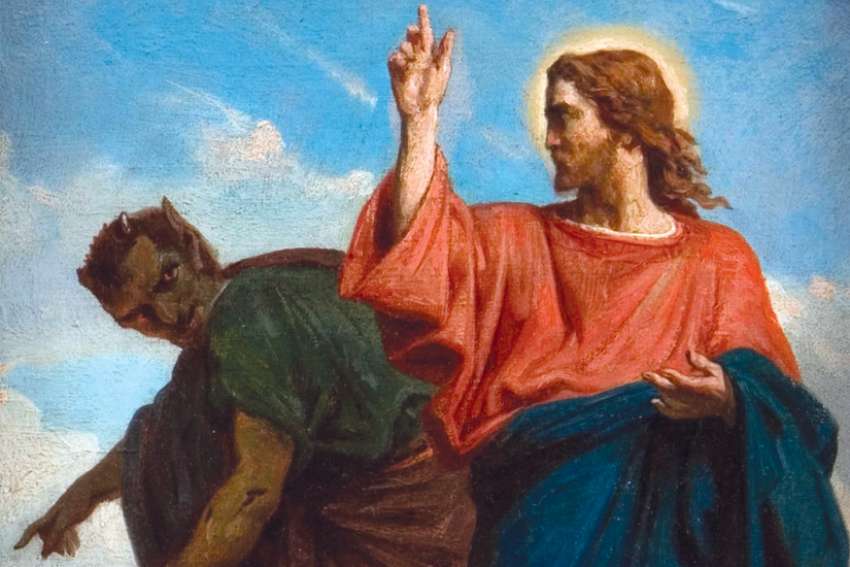
The temptations might not have been a bag of laughs, but Jesus is not depicted as ‘lone and dreary’; in Mark he is ministered to by angels and the wild beasts, and Luke is clear that he goes ‘filled with the Holy Spirit’ and with the words of his Father’s blessing ringing in his ears, and returns for ministry ‘in the power of the Spirit’ (Luke 4.14). In Matthew, the sequences of tests builds to a triumphant climax where Jesus dismisses Satan forcefully, captured I think rather nicely in the painting above by Félix-Joseph Barrias, a forgotten 19th C painter who taught Edgar Degas.
Matthew’s account, in its opening, holds together the two forces at work in this incident more clearly than either Luke or Mark. For these others, the Spirit throws or leads Jesus into the desert, and he meets testing there. But in Matt 4.1, the Spirit leads Jesus (literally, ‘led up’, that is, up from the river Jordan) with the clear purpose of his testing by Satan. Although Satan appears to have freedom and power, this whole episode is actually firmly placed under the sovereignty of Jesus’ loving Father.
This influences how we might translate the verb peirazo. Although the traditional translation characterises this as the ‘temptation’ of Jesus (perhaps under the theological influence of ‘he was tempted as we are yet without sin’ Heb 4.15), elsewhere in Matthew the verb is used in the quite different sense of Jesus being ‘tested’ by human opponents (Matt 16.1, 19.3, 22.18, 35)—so we should probably understand in this way here as well. For Matthew, this aligns Jesus’ 40 days with the (roughly) 40 years of Israel in the wilderness, where God ‘tested’ Israel (ekpeirazo) to ‘see what was in your heart, whether or not you would keep his commandments’ (Deut 8.2).
Mark does not even mention question of fasting in his summary account. Luke (perhaps writing for those less familiar with the biblical discipline of fasting?) emphasises the human reality that he ate nothing and so was famished; but for Matthew this is a period of ‘forty days and nights’ drawing his customary parallel with the experience of Moses (Ex 24.18, 34.28, Deut 9.9) of supernatural provision. Given Matthew’s interest in Elijah along with Moses, there is also likely an echo of Elijah’s time in the wilderness in 1 Kings 19.8. Surely the statement ‘He was hungry’ must rank as the greatest understatement in the New Testament!
Jesus’ opponent here is described using three different terms: ‘devil’ (v 1); ‘the tempter’ (v 3); and ‘Satan’ (on Jesus’ lips, v 10). He is later described as ‘Beelzebul’ (‘Lord of the flies’) in Matt 12.24, and ‘the Evil One’ in Matt 13.19. The Old Testament refers to this figure in different ways (notably in 1 Chron 21.1, Job 1–2 and Zech 3.1–2), but without this developed sense of Satan as the cosmic opponent of God and his people. This idea developed in the intertestamental period, and it was a Jewish understanding that the early followers of Jesus continued. The gathering together of the diverse OT titles, and basic characterisation of Satan as the ‘accuser’ (the meaning of satan in Hebrew and diabolos in Greek) is found in Rev 12.7–10).
Some interpreters have suggested that these three tests were related to Jesus’ Messianic agenda: was Jesus going to quickly gather the crowds by impressive displays of divine power? But that thesis fails on two counts. First, Jesus does indeed perform ‘signs and wonders’ in his ministry, and this does indeed gather ‘great crowds’, which is one of Matthew’s distinctive emphases. Second, the language of testing here has no audience in view other than Jesus himself. In fact (both in Luke and Matthew), the first and second (for Luke, first and third) tests rest on the challenge: ‘If you are the Son of God…’ This both looks back to the word of affirmation of Jesus by the Father at his baptism (Matt 3.17) but also anticipates the test all the way to the cross, and Jesus’ obedience to death, in the taunts of the crowd (Matt 27.40).
Jesus’ response to the first test (as for the others) is to cite Scripture, offering a well-rehearsed model for all his followers. It is notable that all three of his citations come from Deut 6–8, the passages following the central confession of Israel that ‘God is One’, the Shema (Deut 6.4). (It has been suggested that the three temptations followed the structure of the Shema in corresponding to the ‘heart, soul and strength’ with which we are to love God—but this is not entirely convincing.) These are the texts which orthodox Jewish boys still need to learn by heart and recite at their bar mitzvah. Jewish Matthew records a fuller section of the verse than gentile-focussed Luke.
The first part of Deut 8.3 (which Jesus does not cite) sets the context of the test as teaching Israel that there are more important things than material provision—even in relation to the apparently essential question of food and drink. Jesus’ unrealistic practice here surely shapes his apparently unrealistic teaching that closely follows in Matt 6.25–34; Jesus expects us to learn the lessons of trust that he has learnt. There is a strange ironic pun in this saying: rather than live by what goes into our mouths and thus our stomachs, we live by what comes out of God’s mouth, but goes in to our ears and thus our hearts. (There is a complementary bodily irony in Jesus’ teaching about what makes someone clean or unclean in Matt 15.11—not what goes into the mouth which then enters the stomach, but what comes out of the mouth which arises in the heart).
In both the second and third tests, the devil ‘takes’ or ‘transports’ Jesus to a high mountain, then to the temple in Jerusalem. Although this is the usual word that Matthew uses, for example, in Joseph taking Mary in Matt 2.13 and Jesus taking his disciples with him in Matt 17.1, we don’t need to interpret this as a literal journey. Apart from anything else, it is physically impossible to see ‘all the kingdoms of the world’ from any vantage point, so we should consider this as an exercise of the imagination, as indeed many film renditions of this episode suggest (compare Ezekiel’s visionary trip to Jerusalem in Ezek 8.1–3). For this reason, there is no need to try and identify exactly where the ‘pinnacle’ (pterygion) of the temple is. You can still sense, in Jerusalem today, the vertiginous drop from the corner of the Temple Mount into the Kidron Valley below, and in Jesus’ day it would have been even further; to fall from there would mean certain death.
If Jesus can cite Scripture, then so can the devil! James concurs with the narrative claim made implicitly here: it is possible to know Scripture and know doctrine (James 2.19) but not ‘know’ God in trusting relationship. Jesus is here not disputing the truth of Ps 91.11, but is disputing the devil’s use of it. When does looking to God’s provision and care cross over into making God our servant, so that he answers our prayers as a response to our demands on him, rather than as an answer to trust for his provision? The citation of Deut 6.16 looks back to the episode of Exodus 17.1–7, where Israel crossed just that line.
The sequential markers in Matthew (‘then’ v 5 and ‘again’ in v 8) suggest that this was the original order of the tests, which Luke has altered to emphasise the importance of Jerusalem as the climax of Jesus’ loyalty. But for Matthew and Jesus, and again reflecting the Shema, the test underlying all the other tests is this one: whom do we really worship? Here, Satan’s mask falls away, and all pretence at ‘biblical’ justification disappears from view. There is no sense of unwarranted hubris on Satan’s part in the claim he makes; he is repeatedly described in the NT as ‘the ruler of this world’ (e.g. John 12.31, 2 Cor 4.4, Eph 6.11, 1 John 5.19, Rev 12.9–17) which means that it his real power that Jesus overcomes in these tests, as a sign pointing to the real victory of the cross which releases the real power of the Spirit to effect real victory in the lives of Jesus’ followers.
There can be only one answer for Jesus: that we should ‘worship’ (the meaning of ‘fear’ in Deut 6.13) the Lord our God. Jesus summarily dismisses Satan with the same wording that he dismisses the suggestion of Peter that he should avoid suffering in Matt 16.23.
When eventually Jesus is able to claim on another mountain that ‘all authority has been given to me’, it will be as a result not of kowtowing to Satan but of suffering in obedience to God’s purpose, and then it will be all authority not only on earth but also in heaven, an authority which the devil was not able to offer (Matt 28.18). (R T France, NICNT, p135)
Though Luke comments explicitly that Satan will return ‘at the opportune time’, we can see implicit hints of this in Matthew’s later narrative. In the meantime, Matthew tells us, ‘behold’ angels come and minister to him, using his characteristic idou to communicate the suddenness of the change, as Satan departs, and the angelic aid promised in Ps 91.11 comes to him in God’s timing and with his provision.
Two final things are worth noting. First, the only way that we could have this narrative (assuming it is not simply imagined) is to note that (here and elsewhere) Jesus must have been ‘in the unfortunate habit of regaling his disciples with his personal experiences of God’. Perhaps this is not a bad habit for any leader to adopt.
Secondly, the temptations of Jesus are often preached as though they were moral examples for us to follow: we should go into the desert; we should face our demons; we should quote from Scripture; and so on. But to preach in this way is in danger of missing the most important thing in preaching: not to put ourselves in the narrative as if we were the most important subject, but to note what God is doing and what God has done. The focus for all three gospels writers is that Jesus has undone the failures of both Israel and Adam; when we are incorporate into Jesus, we are incorporated into this victory, and we share in it by grace rather than by our own efforts. That does not mean, as we face temptations and challenges this Lent, we can avoid the challenge of discipline and effort. But we face these things knowing that Jesus conquered them, in the power of the Spirit, and that the same Spirit is God’s gift to us, and it is his presence that brings victory and enables us to be ‘more than conquerors’ (Rom 8.37; compare Rev 2.7 and parallels).
Jesus is here not so much a model for us to follow, but a saviour for us to be rescued and secured by.
Join Ian and James as they discuss this text, its interpretation, and the implications for preaching and discipleship.
 Buy me a Coffee










Thank you for your frequent (and necessary) reminders that we should look at passages primarily as to what they say about God, not what they say about us!
Many thanks…
One thought that crossed my mind when I was considering why Jesus was temped to jump off a cliff. It occurred to me that a natural consequence of such a leap would be broken legs or worse.
John’s gospel tells us that at the Crucifixion those either side of Jesus had their legs broken to speed their end but not Jesus as he was already dead.
John adds…
These things happened so that the scripture would be fulfilled: “Not one of his bones will be broken”
Is there a link here back to the second wilderness temptation (is the devil seeking the disqualification of Jesus from his salvation mission) or am I overthinking it?
Although the Sundays during Lent are commemorations of the Resurrection, that doesn’t mean we jettison our Lenten discipline. Although fasting (the amount we eat) is relaxed, our abstinence (the omission of certain foods from our diet) continues unabated. If our abstinence is set aside every Sunday, we are always starting over again on Monday and forfeit the benefits that come from the momentum of our Lenten practice.
“not to put ourselves in the narrative as if we were the most important subject,”
As someone once quipped ( can’t recall who) and based on a song…
“You’re so vain you probably think this psalm is about you”.
We are grateful to Felix Just for showing us that Jesus had a proper education and said ‘One does not live by bread alone’, although the evangelists got this wrong and said ‘man’ (or ‘anthropos’; Deut 8.3 says ‘ha’adam’).
It’s interesting that although Luke’s order of the temptations differs, the content and Scripture citations are the same. I think there’s a new book out by Mark Goodacre attacking the Q hypothesis and arguing (IIRC) that Luke used Matthew.
Fasting as preparation has become a token gesture
for many “giving up meat or chocolate or booze”
In our battles with evil, in fightings for the soul of
our denomination, or attempts at tweaking the Constitution etc. without any discernible profit in our testing times,- this is a watershed moment to ponder.
As Jesus said “this kind goes not forth but
by much prayer and fasting”
This when Satan fought for the soul of Christ and
contends for our souls.
Other-wise this declares Jesus as Overcomer,
from the beginning the promise of Eden to crush satans head is commenced as Christs “mission” as Paul concludes his Romans Epistle:-
Rom 16:20 And the God of peace shall bruise Satan under your feet shortly. The grace of our Lord Jesus Christ be with you. Amen
Or consider He came to subdue all his enemies; see -Psa 2:6-10; or Psalm 110:1, “The Lord said unto my Lord, Sit thou at my right hand until I make thine enemies thy footstool.”
This is wonderfully depicted in Joshua chapter 10
At the watershed moment at the first entering the land.
Overcoming the 5 kings Joshua invited his soldiers
to come and put their feet on the necks of the defeated kings;
not only Christ but so also his people
Joshua 10:25 And Joshua said unto them, Fear not, nor be dismayed, be strong and of good courage: for thus shall the LORD do to all your enemies against whom ye fight.
Jesus we celebrate your victory!
It reminds me of Churchill speaking of a watershed moment
“Before El Alemain [Lit. Two Flags -Two worlds] we never won a battle after El Alemain we never lost one” Shalom.
The editors of the New English Hymnal, having cast nasturtiums on those who tinkered with the words of traditional hymns, nevertheless added “we did, however, think it right to remove the description of our Lord as ‘lone and dreary’.”