This Sunday’s lectionary reading in Year A is the baptism of Jesus from Matt 3.13–17. It is a short and compact reading, and needs careful reading in its own right. But it only fully makes sense if we know something of the Old Testament backstory and can, as ‘insiders’, spot the key allusions to it.
(You can watch the video discussion of the passage here, and it is also posted at the end of this article. For discussion of the ‘epistle’, which is Acts 10.34–43, see here and also linked at the end. It is worth considering preaching on this, as it is such a central passage offering, in effect, a narrative creedal summary of the gospel.)
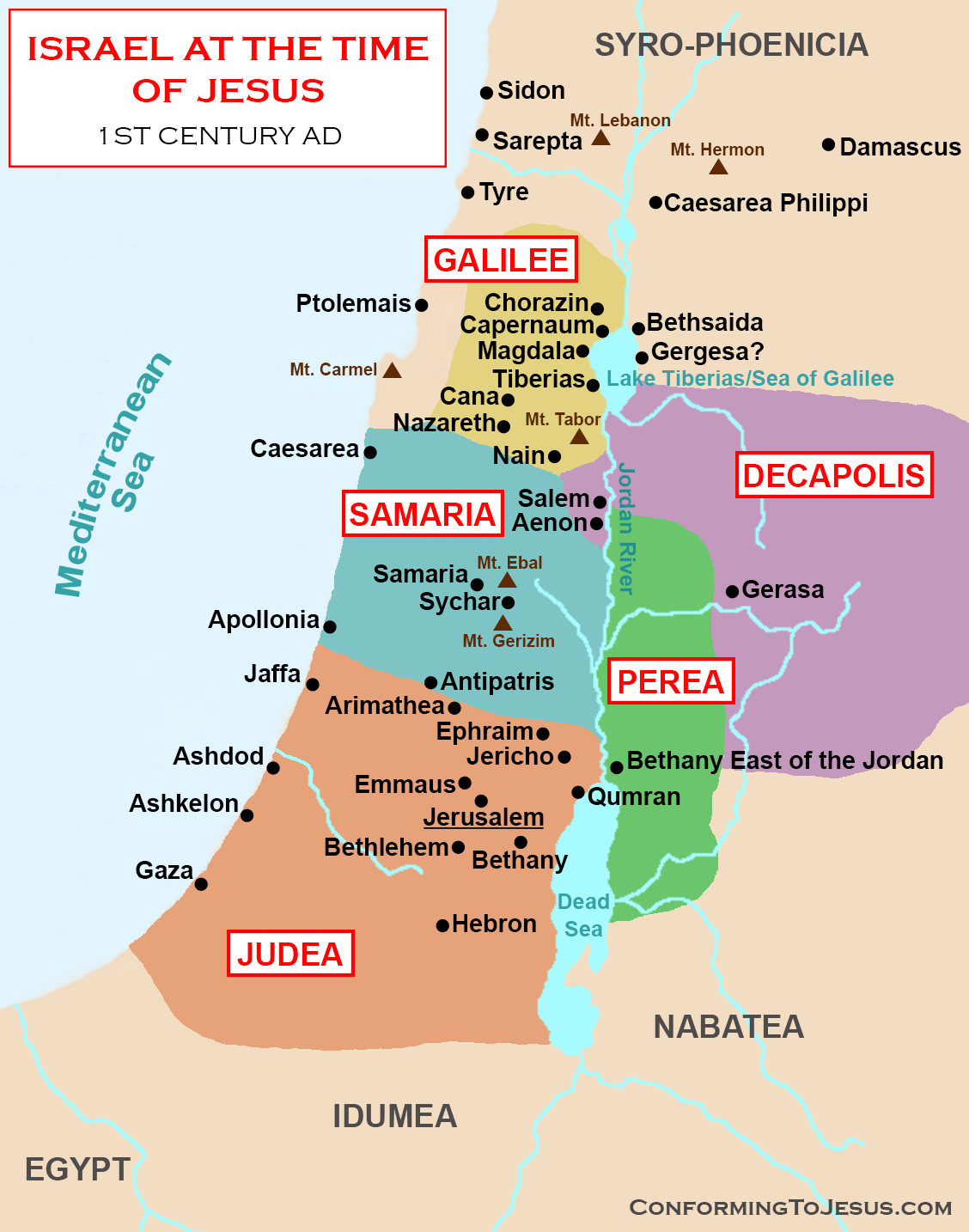 Our reading begins by announcing that ‘Jesus came from Galilee to the Jordan…’ Matthew has so far only indicated that John the Baptist has drawn followers from ‘Jerusalem and all Judea and all the region about the Jordan’ (Matt 3.5); we need to cross-reference with the Fourth Gospel, and meet John’s disciples from Galilee in John 1.35–51, to know that his ministry reached further. But Matthew gives the impression that this is a determined decision by Jesus, crossing territories from Galilee through the Decapolis and Perea, to join John’s eschatological renewal movement that is looking for the imminent coming of the kingdom of God.
Matthew is alone in recording the exchange between John and Jesus, in which John is reluctant to baptise Jesus. In the compressed narrative, we are not told why or how John recognises who Jesus is, but his objection is rooted in his earlier sayings about ‘the one who is to come after me’ in Matt 3.11. John appears to be saying ‘It is I who need your baptism in the Holy Spirit and fire, rather than you who needs my baptism in mere water!’
John’s earlier language could be interpreted to mean that Jesus will initially come as one of his disciples. The language of ‘coming after’ (Gk ὀπίσω, opiso) is language of discipleship, and is used by Jesus in his rebuke to Peter in Matt 16.23 ‘Get behind me, satan!’ meaning ‘Get in line as a disciple’. But Matthew appears to be using it only in a temporal sense here, so we should probably not read too much into it.
Later Christian reflection struggles with the idea of Jesus as the ‘one who knew no sin’ (2 Cor 5.21) undergoing a ‘baptism of repentance’; the lost ‘Gospel of the Hebrews‘ (quoted by Jerome, Pelag 3.2) imagines Jesus actually sinning by questioning whether he should in fact be baptised by John! Matthew’s answer comes in Jesus’ actual response that ‘it is fitting for us to fulfil all righteousness’. There are several things to note here.
First, Matthew uses ‘righteousness’ (Gk δικαιοσύνη) on seven occasions (Matt 3.16, 5.6, 5.10, 5.20, 6.1, 6.33 and 21.32), and it consistently seems to indicate the concrete, human ethical response to the demands of God. This is a very different sense from the theological use of the term in Paul.
Secondly, Jesus here talks about ‘fulfilling’ all righteousness. As we have seen earlier in Matthew, fulfilment language usually connects events to the previous salvation history of God’s people, and the way that Jesus is bringing that to completion.
Thirdly, Jesus invites John to share in this action; it is the two of them together must do this, not simply Jesus on his own. This then brings to mind the succession narratives in the OT—Joshua taking up and completing the task that Moses began in leading the people of Israel, Elisha taking up the mantle of Elijah and asking for a double portion of his spirit. As we noted previously, for Matthew John is not the end of the ‘old’, but the beginning of the ‘new’, and Jesus will complete the work of calling people to respond in repentance and faith to the coming of the kingdom that John began.
But for Matthew, Jesus’ ministry of healing and deliverance is about his identification with them. We will read in Matt 8.17 that his ministry fulfils words from Is 53.5: ‘He took up our infirmities and bore our diseases’. Later, we will read that he will ‘offer his life as a ransom for many’ (Matt 20.28) and will shed his blood for their forgiveness (Matt 26.28). Jesus cannot represent the people unless he identifies with them, and this identification begins with John’s baptism as Jesus demonstrates his solidarity with this movement who are preparing for God’s kingship over his people.
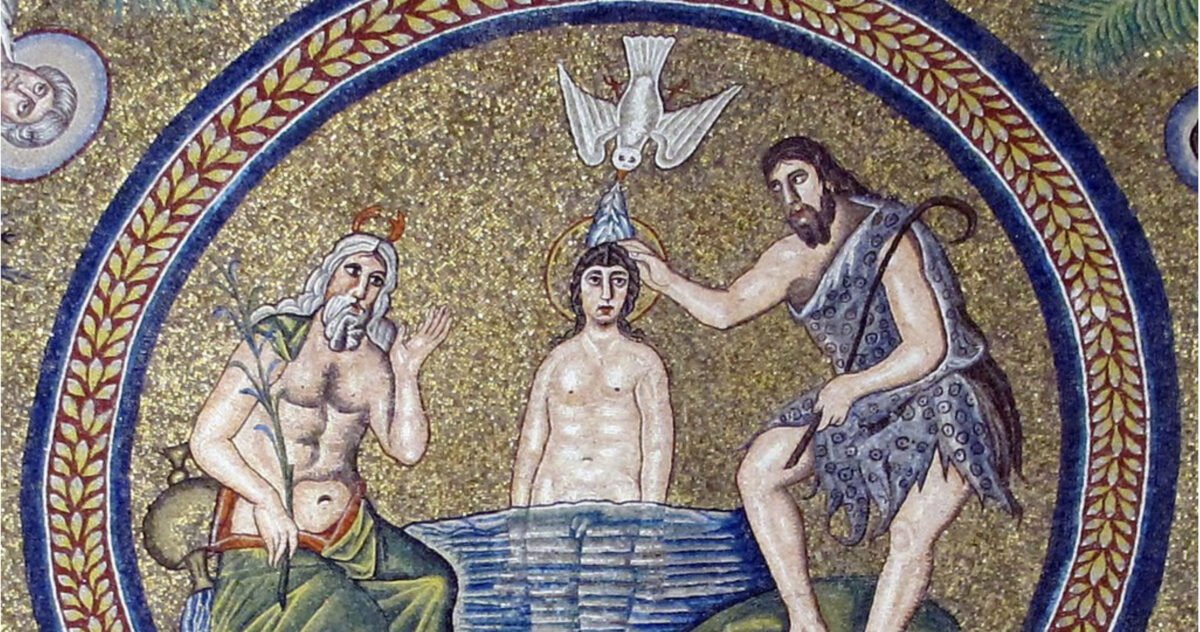
Contrary to all artistic depiction (including the mosaic above from Ravenna), what happens next occurs after Jesus has ‘gone up out of the water’, in other words, once he has left the river and is on the bank once more.
In Mark 1.9–10 the focus is on Jesus’ experience: he saw heaven opened and the Spirit descending, and the divine voice addresses him. In Luke, the divine voice is still addressed to him, but the opening of heaven and descent of the Spirit ‘bodily’ appears to be a public event. Matthew’s account leans more to Luke than Mark; we are to ‘behold’ the sudden opening of the heavens, and the divine voice affirms Jesus to the crowd.
The language of ‘my son, my beloved, in whom I delight’ take us back to at least two significant OT passages. The first is Gen 22.2, where God calls Abraham to offer his ‘son, whom you love’ as a sacrifice; the end of that narrative is the fulfilment of Abraham’s claim that ‘God will provide the sacrifice’. The second is the Servant Song in Is 42.1, where God’s servant ‘in whom I delight’ will be anointed with God’s Spirit, will bring justice to the nations, and has been called ‘in righteousness’ (Is 42.6). Matthew will go on to quote this passage explicitly in Matt 12.18.
But the whole episode suggests a range of other OT passages as well, some more strongly signalled than others. The combination of a dove and the Spirit over the water reminds us of the beginning of creation, when the Spirit of God broods over the chaotic deep. Do we have here a suggestion that Jesus is the one who brings the new creation (2 Cor 5.17?)
A dove also comes across the water in the account of Noah and the flood in Genesis 6–9. Noah’s father believed that Noah would bring people ‘rest’ and relief from the curse of sin (Gen 5.29), and he leads a faithful remnant, rescuing them from the judgement of God on the sin of the world after the ‘heavens were opened’ (Gen 7.11). Could Jesus be the one to rescue us from judgement, and give us true rest (Heb 4.1–11)?
Ezekiel (Ezek 1.1, 2.2) stands by a river, sees heaven opened, and receives a vision of God in which he is commissioned for is prophetic ministry promising God’s people a return from exile. Is Jesus the one who will finally bring his people home?
Passing through the waters of the Jordan was a key moment in the saga of God’s deliverance from slavery in Egypt, when they finally completed their journey and entered the promised land (Joshua 3–4). Is Jesus (his name being the Greek version of Joshua) the one who will finally deliver God’s people from all their slavery to sin, and complete the promise of God’s deliverance?
It might be challenging to spot all these allusions, and there is a large question as to whether Matthew is pointing us in these directions, or whether we find them by standing back and seeing connections between the different elements of the biblical narrative. And these connections are certainly not designed to create ‘insiders’ who are the only ones to get the ‘joke’. But when we are reminded of these other episodes in the life of God’s people, we can see how they are brought to completion in the ministry of Jesus—then and now.
God is not quoting the Old Testament, nor setting a puzzle for the scripturally erudite hearers to unravel. He is declaring in richly allusive words that this man who has just been baptised by John is his own son in whom he delights. From this point on, Matthew’s readers have no excuse for failing to understand the significance of Jesus’ ministry, however long it may take the actors in the story to reach the same Christological conclusion. (R T France, NICOT, p 124)
For discussion about this passage and its meaning, come and join the discussion between James and Ian here, and the discussion of Acts 10.34–43 is linked below it:
 Buy me a Coffee





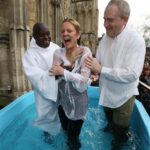







Van Dorn (as below) points out that Zechariah, John’s father, was a Levite and a priest (Luke 1:5) — therefore John was a Levitical priest (Exod 29:9; Num 25:13). John’s baptism was ‘for repentance’ and thus he asks Jesus why he needed to be baptised (Matt 3:11–15) — Jesus explains it is to “fulfil all righteousness” and with this explanation John consented.
He points to the necessity for baptism under Mosaic law before a priest begins his ministry and this explains Jesus’s comment to “fulfil all righteousness”. And that John understood this, and prepared Jesus to serve God as the high priest ready to start his earthly ministry (Luke 3:23). Thus, on his baptism, Jesus declares the start of that ministry, “The spirit of the Lord is upon me because he has anointed me to proclaim good news to the poor” (Luke 4:18–19; citing Isaiah 61:1–3).
He argues that there are multiple connections between Jesus’s baptism and the requirements for a Levitical priest under Mosaic law. And that Jesus was both circumcised and baptised, suggesting one is not a substitute for the other — Jesus’s baptism was done in fulfilment of priestly law, not the law of circumcision.
Van Dorn, Douglas. Waters of Creation: A Biblical Theological Study of Baptism. Colorado: Waters of Creation Publishing, 2007.
Thanks, that makes perfect sense.
Van Dorn argues that there were various ‘baptisms’ under the Mosaic law and gives a linguistic analysis. The priestly anointing included ‘washing’ by water (Exod 29:1–9) — ‘wash’ in v. 4 is ‘rachats’ — the same word used when Elijah told Naaman to ‘bathe’ in the Jordan — which the LXX translates as ‘baptise’ (2 Kings 5:14).
However, he acknowledges that the emphasis in the procedure of anointing a priest is on clothing — and draws attention to Gal 3:27, NIV “As many of you were baptised into Christ have clothed yourselves with Christ” — suggesting that we are all ordained as priests — ‘clothed’ and baptised as we share in Christ’s baptism.
Van Dorn futher points out:
The basin in the Tabernacle is for washing (‘rachats’) — a full ceremonial body washing by the priest as in a bath (Exod 30:18; 40:30) — and suggests the basin’s antitype is the sea of glass in Rev 4:6, “before the throne there was as it were a sea of glass.”
There was also something called the great sea (1 Kings 7:23) … tremendously large holding 10,000 gallons of water, as G. K. Beale notes, ‘Priests would have had to climb a ladder to wash in it’.
And points to the conscious typology in that the ark of the covenant has precisely the same proportions as Noah’s ark.
And more… All fascinating stuff.
Jesus was baptized into our sin, to fulfill all righteousness.
See my comment on the previous article. post, including response to Alan Kempson.
Ravenna, very much on my bucket list. And Bologna before the frescos inspired by Dante get vandalised.
Yup – already got all those points in readiness for preaching next Sunday but I overlooked to dove reference so time for a quick edit!
Some interesting theories here
The questions arise as to what is understood of the term[s]
Repentance ,a term seldom heared in modern times, unless directed
at Bishops perhaps[?]
How is Righteousness defined and why and how does it needs to be fulfilled.?
How and why is baptism foundational in the initial preaching of the Gospel?
Why does the writer of Hebrews encourage us to lay these aside
for us to go on from these foundational elements to Go on to perfection?
Some of the stated theories seem very odd to me, but some on the right path.
Alan,
Is not the righteousness of God is the measure? Alongside the Holiness of God.
I have no righteousness in my self, but in Christ, in union with him, have been baptized into his death and raised with him in union, justified, as righteous as Jesus. A divine exchange indeed.
If we are unsettled by this, we will be even more unsettled by the Marrow Controversy and the question of repentance, considered in book length form, by Sinclair Ferguson (with a foreword by Tim Keller), ‘The Whole Christ’.
The book is commended by Presbyterians, Baptist, former Anglican? David F Wells.
A series of 12 of Ferguson’s short (24 mins. or so) lectures, based on the book can be found on the Christian Institute site, here:
https://www.christian.org.uk/resources/series/the-whole-christ/
They go well beyond baptism: repentance, legalism, antinomianism.
Yours in Christ, Geoff
Ian,
illuminating conversation with James, and I am glad to hear (for the first time?) someone else expressing doubts about Tom Wright’s claim that first century Israel “still saw itself in exile”, an idea which you note isn’t expressed in any extant writings of the period. Though I think I may have read something years ago by Stephen Noll (formerly of Trinity Divinity School, Ambridge, then VC of Uganda Christian University) expressing a similar reservation.
Do you have any other examples of commentators questioning NTW on this claim?
One thing I don’t think I noticed either of you mentioning is the view, particularly in the Orthodox world, that the baptism of Christ is a revelation of the Trinity, as the Father designates his Son and the Spirit descends upon him.
Interesting James (and Geoff), that you go for NTW’s ‘return from exile’ on the basis of not being ‘expressed in any extant writings of the period’. Interesting, because of Ian and James’ discussion of ‘easter eggs’. Are sure you have completely understood what NTW was saying? (And indeed what James and Ian were saying?)
I note that Ian also said to a comment on NTW’s ‘return from exile’ ‘Thanks. There is *definitely something here about the return from exile*. I was re-reading Matthew’s genealogy this morning, was strike by reference to the ‘deportation’ (exile) but no reference to the return.’ (YouTube comments on this talk, 3 years ago, my emphasis).
Bruce:
Yes, I think I have a fair grasp of Wright’s ‘grand idea’ as well as what Ian and James were saying. Motifs of ‘Israel in exile’ can certainly be found in the NT, but so can a range of other motifs and ideas from the OT. e.g. ‘Israel in the wilderness’ in Hebrews (not the use of Psalm 95). Ezra-Nehemiah and Chronicles treat the return as real, though incomplete and short of the prophetic hopes of Deutero-Isaiah (see Neh 9, for example).
Michael F. Bird’s monograph (and article in JSNT) gives a fair assessment of the evidence. The images and motifs of exile are there but the ‘grand idea’ can’t bear the freight of the meta-narrative that Wright attributes to it – what I call ‘over-cooking’ one theme to the expense of others.
John Barclay has strongly challenged Tom Wright on a number of areas.
I think for me the question is at what level Wright is making the claim. He *appears* at times to be saying that Jews felt they had not really returned from exile. But as Barclay notes, it is hard to find that expressed anywhere in those terms.
I would rather take this as a theological claim—for example, when you read the Benedictus in Luke 1, how should we understand it?
I think it *is* helpful to say that Zechariah is here saying that *in effect* the return from exile has never been fully realised, which is slightly different.
Does that make sense?
Thank you James (Thomson) and Ian for your replies. I will follow them up. In the meantime, enjoy? this assurance from Google (to ‘Michael Bird return from exile’):
‘Therefore, there is no indication that Michael Bird the scholar has been in a personal exile or has physically “returned” in a newsworthy event. The phrase is central to his professional, theological discussions.’ Don’t you love AI? 🙂
There is a whole IVP book on the subject (which I haven’t read) of Wright engaging with essays from his critics. I think it’s always difficult to find a meta-narrative that embraces all the New Testament but Graham Goldsworthy’s old books on the Gospel and the Kingdom seems a reasonable approach to me. Maybe Wright is saying something similar when he says the New Testament is about “how God becomes King”.
I am glad to hear that the Michael Bird has not flown. I expect AI to discuss his contribution to ornitheology.
Hi James. Thanks for this. I agree with you on ‘Wright is saying something similar’ in ‘how God becomes King’ being what the New Testament is *’about’*. It’s the ‘about’ thing that I do harp on about — the enriched view of context that we humans use to understand and interpret pieces of language from (sorry for the jargon) Sperber & Wilson’s Relevance Theory. ‘Context’ includes much more than surrounding (or even distant) pieces of text, but, rather, speaker/hearer’s understanding of ‘what the world is like’, ‘how the world works’.
I wonder if it’s not so much a question of ‘*finding* a meta-narrative that embraces all the New Testament’ but of using one that helps us understand/interpret what the NT text is saying.
I am making a couple of comments above to Ian’s comment.
On ‘God becoming King’, I am particularly interested in the ‘Yahweh malak’ psalms (esp. Ps 96-99) which speak of Yahweh the King coming ‘to judge the earth’, ‘making known his righteousness’ and ‘working salvation’. Beyond Israelite particularism, there is a strong universalist theme in the Psalms and the Prophets that anticipates Yahweh’s universal kingdom acknowledged by the nations.
Thanks James. And, of course, Daniel 9 with its ‘seventy weeks of years’ is interesting in Wright’s discussion of the continuing exile.
Hi Ian. Thanks. Yes that makes sense, but a couple of comments further.
We are really back to discussing ‘cognitive metaphor’ — the ways that we humans seem to structure and describe our thinking about more abstract ideas by using more concrete ones, e.g. “I *spent* two hours getting here” where TIME=MONEY (we talk about what we ‘do with’ time in ways we talk about what we do with money), “Their relationship isn’t *going anywhere*” (LIFE=JOURNEY). One of the major ways we use what cognitive metaphors do/allow for is in talking about God’s relationship with us and our relationship with God. We can’t do otherwise—this is simply the way we use human language.
One of the primary things about cognitive metaphors is that we *use* them, we very rarely *explain* them or ‘express’ them more explicitly (possibly only in a semantics/linguistics book/class!! 🙂 ). So (contra the John Barclay ‘quote’) it is not surprising that ‘still in exile’ is not *explained* anywhere in literature. What NTW has provided are examples of language where such a view of the world does provide *context* for understanding/interpreting what is being said. I think your example of Zechariah’s ‘speech’ in Lk 1 is a good further example. Now, of course, we could ‘take this as a theological claim’ but I wonder if cognitive metaphor and an enriched view of context from linguistic pragmatics might handle these phenomena at a more basic level?
One helpful article on NTW I had found is Joel White’s paper in _God and the Faithfulness of Paul_ (ed. Heilig, Hewitt & Bird) – ‘N.T. Wright’s Narrative Approach’. White seems to have done a good job of sorting out and explaining what became of Wrights evidence for ‘continuing exile’ in the verbose 1500 pages of _Paul and the Faithfulness of God_. My heart leapt at White’s footnote 3: ‘Wright’s thoroughgoing reflection on literary criticism and hermeneutics has made him especially sensitive to the *pragmatic aspect of texts*, a modern linguistic insight that exegetes still too often ignore.’ (my emphasis). So this quote from White captures something of what Wright thinks Paul was doing: (p.184): ‘Wright is convinced that for Paul, “worldview” is primary, and theology is secondary; or as he puts it, “it is by studying Paul within “worldview” categories that we acquire a new way of seeing … what was really important” in his theology (_PFG_ 30). For Wright, the goal of Paul’s theologizing was not to delineate belief systems but to bring about a transformation in the mindset of the believers in the communities of Christ followers he founded.’ Now, of course, actant diagrams do not (usually?, necessarily?) help us understand “worldview” ‘issues’ 😉 . But it seems that ‘remaining in exile’ and ‘how God became king’ very much operate at ‘mindset’ level?
Sorry, ‘conceptual metaphor’, not ‘cognitive metaphor’.
Are diaspora and exile synonyms? Or does ‘diaspora maintain a collective myth of their homeland, which they consider their true homeland”.?
There are three references to diaspora in the NT: James 1:1, Peter 1:1 ” To the exiles of the diaspora…”; John 7:35
Or is exile a result of force, the exercise of political power?
Here is an article which may support first century Israel being considered to be in exile. Where one scholar sees the ‘destruction of Jerusalem by Rome as not unlike the Babylonian exile.’
https://www.bartehrman.com/jewish-diaspora/
Hmm, Repentance and Baptism are key initial steps of the Christian Life.
Rarely mentioned in modern preaching hence, little understood among pew-dwellers
Believe me, I have attended many baptisms in many denominations.
OK if you want teaching second hand but the Holy Scripture teach very clearly what Repentance is and what is required of people. And why the precept of Baptism was the Apostolic praxis.
True, it is demonstrated that this is a God in Trinity precept.
Why would Jesus want to “fulfil all righteousness” what would that
mean for John and subsequent followers?
Why do we need to move on from there to Perfection [Hebrews 5 & 6]?
Why does the Gospel now become “the Gospel of the Glory of Christ” [Paul’s Gospel] “the glorious gospel of the blessed God,” which speaks to the glory of it.
Why does Paul travail as in child – birth until Christ is formed in the embryonic saints?
Are such travailer’s much in evidence today?
Shalom
PS. I fail to understand what “Are diaspora and exile synonyms?” have to do with Baptism
It feels tangential.
Alan,
The mention of diaspora/exile relates to the comment of James and NT Wright.
Thanks Geoff, Understood.
The other Baptisms connected to this passage are
The Baptism of the Holy Spirit and the Baptism of Fire.
It is a large part of the Apostles Teaching which superceeds those of
Moses and John which were not a garauntee of Salvation.
Which raises the question does baptism confere salvation?
What do you mean by confere? Baptism would appear to be the outward visible sign of someone becoming a Christian. Yes it has symbolic meaning as outlined by Paul, but it is just a sign. I very much doubt it is anything beyond that given, for example, Paul’s view of circumcision, another outward sign.
Some use the language of an ‘effectual sign’: it puts someone in Christ, if they will be put.
But it is certain nothing magical! To paraphrase Paul: ‘someone who is baptised is only baptised truly if they are baptised inwardly’.
Baptism is the first steps into the kingdom as St.Paul
puts it “ a washing in water”, 1 Cor 6:11. Rev 7:14
Or as John B. would put it a “a Preparing of the Way, “
of itself not salvic.
2 COR.1 V 22
The Anointing, Sealing, or Baptism of the Holy Spirit that subsequently happens is the completion of the work.
So the one gift of the one Spirit, ‘anoints,’ ‘seals,’ and is the ‘earnest.’ He who has also put His seal on us [that is, He has appropriated us and certified us as His] and has given us the [Holy] Spirit in our hearts as a pledge [like a security deposit to guarantee the fulfilment of His promise of eternal life].
Further, these three metaphors all declare a universal prerogative of Christians. Every man that loves Jesus Christ has the Spirit in the measure of his faith,’ and if any man have not the Spirit of Christ, he is none of His.’
Cf.1 John 4:13.
It is prefigured in the anointing of a priest in OT.
Washing, changing into linen garments, anointing with
Blood and Oil. Shalom.
Further this “sealing” is a mark of ownership and God says even of us “This is my son in whom [Christ in us and we in Him] I am well pleased” this sealing in contrast to the mark of the Beast.
“The effect of all the divine indwelling, which is the characteristic gift of Christ to every Christian soul, is to mould the recipient into the image of the divine inhabitant. There is in the human spirit-such are its dignity amidst its ruins, and its nobility shining through its degradation-a capacity of receiving that image of God which consists not only in voluntary and intelligent action and the consciousness of personal being, but in the love of the things that are fair, and in righteousness, and true holiness.
His Spirit, entering into a heart, will make that heart wise with its own wisdom, strong with some infusion of its own strength, gracious with some drops of its own grace, gentle with some softening from its own gentleness, holy with some purity reflected from its own transcendent whiteness. The Spirit, which is life, moulds the heart into which it enters to kindred, and, therefore, similar life.[Mclaren on 2 COR.1.]
Shalom.
I assumed your original question referred to water baptism and to answer your question, no it does not confer salvation but it may be a sign of it. But you seem to have answered your own question.
Jesus is the baptizer of Holy Spirit.
I believed into Jesus and was baptized into Holy Spirit before being fully immersed baptized as an adult convert.
We are saved by Jesus his birth, life, death, resurrection, ascension and faith, trust in Him.
It is recalled, a summing up by Andrew Wilson, something along the lines that pedo-baptism has a better theology of children, but credo baptism is a better theology of baptism.
Some claim baby baptism brings people into churches but i see little evidence of that. There isn’t really any justification for it particularly when often the parents are not believers themselves which just leads them to making false oaths.
Regarding baptism in the Spirit, I tend to agree but i find it interesting that in Acts Paul could witness evidence of it. When do we see that today?
I knew one Methodist Superintendent who was more or less ostracized and ‘driven’ out of town as he refused to baptize a child of unbelieving parents who did not attend chapel and had no intention to do so.
As to him who baptises with the Holy Spirit.
Jesus had two baptisms Luke 12:50, Mat 20:22&23.
As to baptism with the Holy Spirit it happens all the time.
I refer not to the Pentecostalist iteration of it alone.
Throughout Christian biographical Literature some refer
to it as a “second blessing” which often transformed their failing ministries and lives in the most transformative ways,
leading to the establishing of multiple church plant, Keswick, orphanages, bible schools, worldwide Missions, etc.
Andrew Murray in his book “The two Covenant” Note A. – Chapter II: The Second Blessing references
“Dying to Self: A Golden Dialogue, by William Law,”
with notes by A. M.: “A great deal has been said against the use of the terms, the Higher Life, the Second Blessing.
In Law one finds nothing of such language, but of the deep truth of which they are the, perhaps defective, expression, his book is full.
The points on which so much stress is laid in what is called Keswick teaching, stand prominently out in his whole argument.
The low state of the average life of believers, the cause of all failure as coming from self-confidence, the need of an entire surrender of the whole being to the operation of God, the call to turn to Christ as the One and Sure Deliverer from the power of self, the Divine certainty of a better life for all who will in self-despair trust Christ for it, and the heavenly joy of a life in which the Spirit of Love fills the heart-these truths are common to both.
What makes Law’s putting of the truth of special value is the way in which he shows how humility and utter self-despair, with the resignation to God’s mighty working in simple faith, is the infallible way to be delivered from self, and have the Spirit of Love born in the heart,”
Yes I do often answer my own Questions much like any lecturer or teacher after listening to their scholar’s none answers.
Ps one can dig deeper into biography of saints including
G.Müller in the The Two Covenants/A.Murray Notes section
@.blueletterbible.org/Comm/murray_andrew/two/two_note_a.cfm
Shalom.
Alan, I have a number of books by Andrew Murray and one by William Law but none of the references, per se, answer your question; what does (water) baptism confer?
Neither does the question of Keswick and the Higher life.
It would seem that although you have quoted scripture that we should be moving on from baptism, what you want to prolong and draw it out. And we poor students of yours are unable to respond to your satisfaction leading to our correction, even if it really is not correction, but a redirection, tangential to your own question without a distinction between pedo and credo water baptism and methodology.
Let’s move on, particularly as this is not the place for such discussion, even though they continue in some Christian circles.
A few years ago there was one long internet dialogue as to whether Tim Keller (Presbyterian pedo- baptism) could ever be an elder in a prominent Baptist church in the USA. The answer from a senior elder in the Baptist church was no, if recalled correctly.
Some churches accept and carry-out both baptisms, as you will know.
Hi Geoff
I seem to have touched a nerve here.
I think that you are redirecting to start a discussion on
pedo- baptism.
You accuse me of distaining others on this blog, I refuse to engage with your calumny and contratemps.
I am just pointing out that baptism in general is far more nuanced and important than restriction to this passage.
I feel that to argue from all the scriptures is far better than other people’s comments which is a more academic praxis, somtimes I think
to avoid personal hard thinking to search the Scriptures and see if these things be so,the Bereans did not take the illustrious Paul’s teaching as “gospel”until they had verified them through thorough searching.
IF one were to read Murray’s comments on say George Müller
for instance GM’s “transformation”came about when he ditched all
his religeous books to read the Bible continually.
Shalom.
So Alan,
I have one of Mullers books. Can’t recall he mentioned anything about his biblical understanding of baptism.
Again your are authority referencing without substance.
Please clearly answer your own question, from scripture alone, without external references.
It is clear that you do not desire to move on, even as you don’t answer your own question. Our host is not involved in this theological question. Goodnight. Yours in Christ, Geoff
Goodnight Geoff,Sleep peacefully .
This passage is for me a fore-word of the soul’s experience of
Salvation Or enterance into the coming Kingdom.
Baptism I think has its origins in the OT
The Laver of the tabernacle and subsequent washing of the priests
Of which subsequently the people were commanded to “sanctify yourselves”prior to some important actions of God.
Ex 19:22. Leviticus 20:7 Josh 3 v 5
The baptism “into Moses” was not Salvic, all but two of that generation “Fell, through Unbelief “
See also the “baptism”of Joshua prior to the Jordan, John baptizing in the Jordan-Josh 3 v 5
A sanctifying of oneself, doing “works meet for salvation “
Jesus was sanctifying himself, fulfilling all the requirements of righteousness
John saw beyond this water baptism as A] A Preparation for a Divine Working
B]Being cleansed and clean ready for the coming Kingdom.
C] preparation for the incoming HOLY Spirit.
Jesus sent his disciples on mission with his same mission
to prepare the way,“Repent be baptized the kingdom is coming”
Hence the changed first message of The Church “Repent
be baptized AND you shall receive the gift,Holy Spirit”
[Who is the seal that you are purchased and owned by God]
He is the “down payment” of fabulous riches to come in the Kingdom of
The glorified King.
One can repent and yet not bring forth the fruits of Repentance [the “washed”Priests visiting John.]
One can claim to be baptised in the Spirit yet not bring forth the Fruits of that Spirit.
This chimes with “Work out your own Salvation with fear and trembling”.
Mortify therefore…. Put off the old man with his lusts…. walk worthily…etc.
The said passage I think is not so much a blue-print as a seminal event influencing later developments. Shalom.
l
Addendum
Forgive this intervention into what has ended up as an exchange of ideas having little or no connection with the primary topic : ” The baptism of Jesus in Matthew 3 as fulfilment of the Old Testament.” I see little reference to the possibility that the OT may have something more to say about the baptism of Jesus than has been provided thus far.
(a) 1 Chronicles17f : (the Davidic Covenant) -“When your days are fulfilled, I will raise up your offspring after you. I will establish his kingdom –*I will be to him a father and he shall be to me a son*. The same theme occurs in 2 Samuel 7 :12 – 16; including the sentence: “I will be to him a Father, and he shall be to me a son.
Act 3 : 17 – 25 sets the latter passage in the context of the resurrection of Jesus. Of specific significance here are vv 18, 19 and 24!
Psalm 2 is one of several messianic psalms. Verses 6 and 7 are of particular significance:As for me,I have set my King on Zion, my holy hill. I will tell of the decree: The Lord said to me, “You are my Son; today I have begotten you. Ask of me and I will make the nations your heritage and the ends of the earth your possession.”
The first Isaiac servant song, with particular reference to its first verse (Isaiah 42:1) declares : “Behold my servant, whom I uphold, my chosen in whom my soul delights, *I have put my Spirit upon him*, he will bring forth justice to the nations — a bruised reed he will not break, anda dimly burning wick he will not quench .” (c.f. Isaiah 52/53 , Isaiah 11 : 1 -5 [especially v 2] and Psalm 72 (Messianic) v1 ff.
Consequently, I believe that there is sufficient material in the OT to affirm that Matthew 3:13, alongside the corresponding passages in the other synoptics,is more than adequate to highlight that Jesus’ baptism is, at the very least,*the starting point of his messianic anointing and his role as the suffering servant*.
Finally, reference has previously been made to Matthew16:23, a rebuke to Peter: “Get thee behind me Satan .” What a pity that I can find nothing in relation to the previous section in that chapter – Peter’s affirmation of Jesus : ” You are the Christ (Messiah) the Son of the living God. “