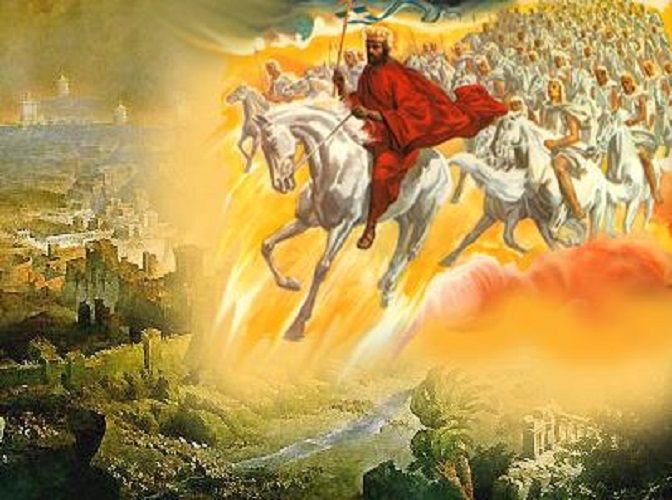
With the turn of the lectionary year, next Sunday we are in the first Sunday of Advent in Year B, and our gospel reading of Mark 13.24–37 plunges us straight into the questions around the anticipation of Jesus’ return at The End. (It is worth noting that there is no compelling (theo)logical reason why this should be connected with Christmas. The incarnation is described in terms of God’s coming to his people in the person of Jesus, for example in the opening of Mark or the Benedictus in Luke 1; but the return of Jesus at the end to complete the work of the kingdom of God, and finally unite heaven and earth, is never described as the ‘Second Coming’ in the New Testament, and instead is consistently paired with the Ascension rather than the incarnation.)
You will find below a discussion of this passage, and linked at the end is James and Ian’s video discussion of it also linked here. The epistle is 1 Cor 1.3–9, and the video discussion can be found here and also linked at the end.
Our passage comprises the two closing sections of Mark 13, which is parallel to the first part of Matt 24 and is known as either the Olivet Discourse (since it is set on the Mount of Olives) or the Little Apocalypse, because there are connections in structure and language with parts of the Book of Revelation. It is striking that, where the parable of the sower in Mark 4 (which seems relatively straightforward to the modern reader) provokes expressions of puzzlement and prompts a request for explanation by the disciples, this teaching seems to be received with perfect comprehension—whilst it leaves us baffled and confused. This should sound a warning note to the contemporary reader!
There are three main ways this has been read.
1. The ‘traditional’ approach, which goes back at least as far as Jerome in the fourth century, that this is primarily about the ‘end of the world’ though with specific predictions about the destruction of the temple mixed in.
This has a number of problems to it:
- The main one is Jesus stern saying in v 30 ‘Amen I say to you, this generation will not pass away until all these things have happened.’ There is some wriggling about the meaning of genea embedded in an NIV footnote as ‘race’—but all other uses of this in Mark (and the other gospels) make it clear that it really does mean ‘this generation’, that is, the people alive at the time Jesus was speaking. Mary Ann Beavis, in her 2011 Paideia commentary, say that this saying ’emphasises the authority of this discourse; the word of Jesus has the stature of the word of God, which is flawless and precedes the creation of the heavens and the earth’ (p 201).
- To solve this, commentators for the last couple of hundred years have seen a Jewish ‘apocalypse’ embedded here and (clumsily) incorporated. So in fact in context what Jesus’ saying means is ‘Amen I say to you, this generation will not pass away until around three of the five things I have just mentioned have happened.’ This is very unsatisfactory since, like much source criticism, it suggests that neither Mark nor his first readers really understood what Mark himself had written, and had not understood what Jesus said. As Ben Witherington (The Gospel of Mark, p 341) points out, there is simply nothing grammatical which suggests either that this is using sources or that it is the words of a later prophet, since the ideas, themes and OT allusions are typical of Jesus in this gospel.
- It fails to pay attention to Mark’s language. So Cranfield at one point comments on ‘Mark’s depiction of the Parousia’ without noticing that the word parousia is conspicuous by its absence in Mark 13.
- Some have tried to avoid this by claiming that ‘this generation’ refers to the generation who are reading this text now, in the ‘end times’. This is a bit like saying that, if I send you an email saying ‘I am enjoying living in this house’, you could interpret that as a reference to the house you are sitting in as you read the email. If that is the case, then we are really ignoring the plain meaning of words!
This was the view I was brought up with, and it was explained by means of the ‘prophetic telescope’: when you are looking to the future, you see things in the near and distant future next to one another, so you might not explain things in order. This does make Jesus look like he does not really know what he is talking about! And it also suggests that Mark, who in earlier chapters has very carefully structured his material to make narrative theological points, appears to have lost the plot.
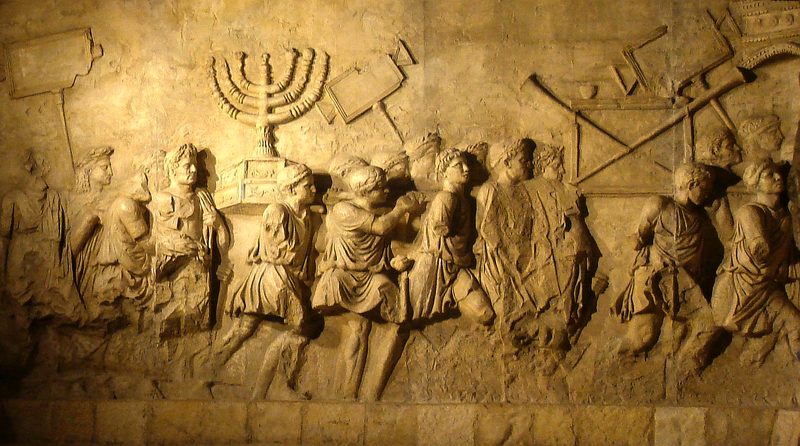 2. Tom Wright’s view is that this ‘whole chapter’ is about the destruction of the Temple (see Jesus and the Victory of God pp 339f and Mark for Everyone 176f). (However, he appears to have a different view when going to read the more extended version in Matthew 24–25; the ‘eschatological’ parables do in fact appear to be about ‘final judgement’.) A key to his argument is the language about the ‘coming of the Son of Man’:
- ‘The Son of Man coming on the clouds’ is an exact citation of Dan 7.13 LXX, and of course the ‘coming’ is not a coming to earth but a coming to the Ancient of Days, the Power (meaning the God of Israel) for vindication as the one personifying the faithful people of God. This is the sense it is used in the trial scene in Mark 14.62, and makes most sense of being understood as referring to Jesus’ vindication in his resurrection and the subsequent preaching of the good news about him. Note that ‘coming’ in this saying is erchomenos, the participle of erchomai, to come or approach to, and not parousia meaning ‘presence’ and used of the Emperor’s coming to cities in the Empire.
- The language of sun, moon and stars in Mark 13.24 comes from Isaiah 13 and 34, and refers to the fall and judgement of great empires and political powers (in this case, Assyria and Edom). It is also used in Joel 2, and strikingly is cited by Peter in Acts 2.17f. Peter appears to think that these ‘apocalyptic events’ are happening in his day.
The view that the whole of this passage is about events in the first century, with no anticipation of a more distant end to this age, is usually called ‘preterist‘ (from the Latin praeter, a prefix denoting that something is “past” or “beyond”) and is a quite well-developed minority view in scholarship. Andrew Perriman writes a blog from this perspective, in which he interacts with me and view three below—but I have never been convinced by his narrative readings in this direction.
3. Dick France sets out a third position, which agrees with much of Tom Wright’s revision of the traditional understanding of this passage—though (as Dick pointed out to me on several occasions before he died of pancreatic cancer) he was proposing this some years earlier, and so might well have influenced Wright’s own thinking. France was, in turn, influenced by that great scholar of a previous generation, George B Caird. Contra Wright, he believes that the last part (from v 32) is about Jesus’ return, for several reasons:
- Although there is quite a strong alla (‘but’) at v 24, the much stronger break comes in v 32 (though this is obscured in NIV and other English translations). This is the phrase peri de ‘Now concerning…’ which indicates quite strongly a change in subject. (Paul uses this phrase in 1 Corinthians to introduce a new subject in 7.1, 7.25, 8.1, 12.1, 16.1 and elsewhere in his letters).
- The sign of the fig tree in v 28 closes an inclusio in relation to the Temple, matching the example of the withered fig tree as an enacted parable in chapter 11.
- ‘That day or hour’ in v 32 is introduced without an antecedent; such a ‘day’ has not been mentioned before (the distress in the earlier verses is referred to as ‘those days’ in the plural).
- The idea of a long time of waiting is in marked contrast to the previous language of an intensity of specific ‘signs’.
 France also notes that the disciples’ initial question to Jesus, whilst focussed on when ‘all these things will be fulfilled’ in Mark, in Matthew is more explicitly made a double question: ‘When will this [the destruction of the Temple] happen, and what will be the sign of your coming and the end of the age?’ This is then given a double answer, in Matt 24.4–35 about ‘these things’ and then in 24.36f about that day.
It is also interesting to note that the focus in Mark is on the Temple events, but in Matthew there is a more extended interest in the signs of ‘the end’ following the Temple. This would make good sense if Mark was written in the 60s, possibly during the Jewish War, and Matthew was written post-70, so that the main interest in Jesus’ depiction of the fall of the Temple is in his words coming true, rather than as immediate advice. (France himself actually believed that both gospels were written prior to AD 70.)
Both these last two views leave the real problem for most readers of how to make sense of Mark 13.27: ‘He will send his angels [messengers?] and gather his elect from the four winds, from the ends of the earth to the ends of the heavens’, and this is a cause of stumbling to those encountering these readings for the first time. Some things to note:
- Jesus has already inserted language of the good news being preached to ‘all the nations’ prior to the destruction of the Temple in 13.10. This is, arguably, a key theological point behind the narrative of Acts, with Peter then Paul preaching to the known world prior to AD70. Indeed, it could be argued that knowing this saying of Jesus was part of Paul’s motivation in writing Romans to get support to fulfil this goal.
- It is clear elsewhere in the NT that the OT promise to ‘gather the elect’ from the nations has now been fulfilled in the preaching to the Gentiles, for example in 1 Peter and in the seven-fold phrase ‘every tribe, language, people and nation’ in Revelation.
 In the Matthew parallel, there is a ‘loud trumpet call’ (Matt 24.31) which we usually read in parallel with the ‘last trump’ of 1 Thess 4.16. But in fact the shofar, the ram’s horn, was used to call people to worship at the start of the Sabbath, an invitation to enter the rest of the seventh day, both in imitation of God’s resting at the end of creation, and the invitation to enter the promised ‘rest’ of the coming kingdom (Hebrews 4).

So I now find option 3 the most persuasive, since on the one hand it takes seriously the form of Mark 13 as we have it, and its first-century context, but addresses the criticisms of option 2 as underplaying the role of Jesus’ second coming within both Mark and Matthew. Without this, we really cannot make sense of Jesus’ serious statement in Mark 13.30, which (under the assumption of view 1), C S Lewis called ‘the most embarrassing verse in the New Testament’.
There are three things to note in conclusion.
First, it seems to me that almost all our confusions in this passage and others like it are caused by English translators using the same word, ‘coming’, to translate two quite different ideas in the Greek text. (I am sorry to go Greek-geek on you, and I would never recommend using this language in preaching, but it is important, so hear me out.)
Firstly, this word is used to translate the term erchomenos, which is the present participle of erchomai, to come or approach to, and in some sense this is fair, since ‘coming’ can also be a present participle of the English verb ‘to come.’ (It can also function as a gerund, an active verbal noun.) But the problem here is that, in English, we most often use this verb to describe motion towards us, and much less often motion toward something else. And the ‘coming of Jesus’ is inextricably linked to the idea of ‘the second coming’, which as I noted above is not New Testament language! And the real issue is that, in most places in the NT, the language of ‘coming on the clouds’ is an allusion to Dan 7.13, and so refers to Jesus ‘coming’ to the throne of God, that is, his Ascension—which we would normally describe as ‘going’!
Alongside that, the term ‘coming’ is also used to translate the (slightly technical term) parousia, which is a noun meaning ‘presence’; it has little sense of motion in it, and BDAG (one of the most commonly consulted Greek lexicons) gives its meanings as:
- the state of being present at a place, presence
- arrival as the first stage in presence
It has much more a sense of sudden presence than the journeying implied by the term ‘coming’, and I wish that ETs would change and translate this term as ‘presence’, not least so we could see what was being referred to.
Secondly, if you have been, as I was, raised in the first of these three views, then you might be feeling very uncomfortable just now! I remember, when I was confronted with this view (in a seminar), I experienced a dizzying sense of disorientation, and expressed my incredulity in no uncertain terms! But I was wrong, and once I had a chance to consider the evidence, needed to change my position—but it took time. It might take you time, and if you are in a position to teach this to others, it will take them time as well.
Thirdly, I think this passage, with its bridging from one part of Jesus’ teaching at the end of Mark 13 to the final element, has important things to teach us. The material in Mark 13.24–31 takes us into the horrors of the First Jewish War and the cataclysmic destruction of the Temple; as Ben Witherington comments, it wasn’t the end of the world, but it was the end of a world, and led to the Jews being once more a people in exile for nearly 2,000 years, which accounts for the use of cosmic language. In that kind of context—and in the practicalities of the personal and nation disasters we face—we too need to ‘read the signs’, and ‘look up’ as we seek to trust God despite the chaos around us.
But once we reach Mark 13.32 and its orientation away from whatever chaos there is in our present world, and towards the promised sudden presence of Jesus with us at the end of time (the parousia), then the guidance is completely different. There will be no warning signs; you will not be able to predict the arrival of Jesus, just as you cannot predict where lightning will strike (Matt 24.27). There is only one way to be ready for his return—to watch and pray, living each day as faithful disciples. That is the lesson of these closing verses, just as it is the lesson of the sequence of parables in Matt 24 and 25 that develop this idea, which we have been reading in the last few weeks.
It is a clarion call, not to endless speculation about the imminent future, but to faithful witness in the immediate present.
Join James and Ian as they discuss these issues and their implications:
And their discussion of 1 Cor 1 is here:




The start of Mark 13 is (abbreviated, and paraphrased):
What wonderful buildings!
Jesus: They are all going to be destroyed.
Disciples: When when these things happen, will there be signs beforehand?
I find it impossible to interpret the “these things” in v4 as referring to other than the destruction of the temple. It would be very odd for Jesus not to answer their question(s). So at least the start of the following verses must be related to the destruction of the temple.
Indeed. And it goes on.
One problem I have is at v26. This seems to come after the tribulation of the destruction of Jerusalem, not at the ascension which happened 40 years earlier. At face value Jesus is saying all these things will happen then you’ll see me coming in glory.
If that isn’t the case how do you explain the timeline in the passage ?
Except that we need to consider the temporal language quite carefully. ‘In those days’ is very general. And the event is not the ‘coming of the Son of Man’ but ‘they will see the coming…’
‘The coming of the son of man’ is a metonym for Jesus as the right hand of the Father, and their ‘seeing’ is understanding who Jesus is.
But who are ‘they’?
Good question – and not answered here. Is it impersonal and general?
As Ian says there are comparators (if that is the right word I am using):
Every eye that will see Him, Rev 1 – this is close in wording to Mt 24.30, which draws on Rev here;
You (Jewish leaders, and doubtless others) that will see Him, Mk 14.
This is the Son of Man, each time. So why would different groups of people be referred to?
Paul had good reason to be thankful for his co-worker in 1 Corinthians, Sosthenes
they being two peas of the same pod,
From persecutors to proclaimers.
Thankfulness is a key witness as to true spirituality.
It is liturgically found in the O.T. and developed through the Psalms and Prophets into the N.T., a key letter and exemplification of it is Colossians, where it is mentioned
6 or maybe 7 times.
It is the basis of the Eucharist liturgically.
It is the breaking up of the circles that so many revolve in amongst our churches in which one would dominate all other ones.
The unity of Paul and Sosthenes was not a human orchestrated unity but a great Sovereign work
of Almighty God, it is not something to be fought for worked towards or attained.
As Jesus remarked thankfulness is a rare thing when only one leper gave thanks for the transformation of his whole life.
It is well worth studying the motifs of the Thank Offering and Thanksgiving in it’s out- workings in the N,T, where it not just an occasional offering but the summum bonum of a saints life. Shalom.
Love your blog but this explanation is still unsatisfactory.
It requires the position that verses 26-27 are to be redefined to mean something other than their natural meaning, which seems a stretch.
Doing so then sounds a lot like the preterist arguments I’ve also read. Those spiritualize anything that didn’t physically occur in the 1st century.
Isn’t this doing the same?
Thanks for the encouragement—and push back.
What do you mean by ‘natural reading’? The natural reading of τὸν υἱὸν τοῦ ἀνθρώπου ἐρχόμενον ἐν νεφέλαις is that it is a quotation from Dan 7.13, as a number of ETs note. That means Jesus *going* to be at the right hand of God.
This is exactly the language Jesus uses of himself in Mark 14 at his trial, and that Stephen uses in Acts 7.
The ‘natural reading’ of ἀποστελεῖ τοὺς ἀγγέλους is just as much messengers taking the good news as anything else. This is the term in Matthew 11.10 and Mark 1.2 (referring to John the Baptist), and to John’s messengers in Luke 7.24, and in fact to Jesus’ sending out messengers in Luke 9.52. So angeloi can mean people and not just celestial beings.
Final, the term ‘gather’s natural reading is what Jesus came to do in his ministry, as a fulfilment of the promises of God. I have a full article on that term here: https://www.psephizo.com/biblical-studies/why-and-how-does-jesus-gather-his-people/
Does that answer your questions?
I started this when there were no comments. Now they are coming in (fast?), so apologies for any overlap.
There does seem to be an extra question (or two) that I cannot recall ever being discussed: Who exactly are the ‘they’ (NIV’s ‘people’ does not help), and where are ‘they’ when they ‘see’?
On the assumption that heaven (/the ‘heavenlies’) is not geo-located, any assumption that Jesus is going to ‘come’ at any specific earthly location would seem to be ruled out. If the ‘seeing’ is analogous to Stephen’s seeing “Jesus standing at the right hand of God”, or Paul’s man in the third heaven, or even our (already) being seated with Christ in the heavenlies, then the best guess might be that what is being seen is a vision of heavenly realities whether of welcome or judgement (note that a vision is something that one ‘sees’).
Any NT writing we have was written in Greek to a Greek-minded audience many of whom “spent their time doing nothing but talking about and listening to the latest ideas”. An audience who would have had no direct access to a Hebrew/Aramaic OT. They would have had theoretical access to the LXX (a whole library of scrolls…), but that would have been understood in the same ‘Greek’ way.
Jesus’ teaching frequently seems to raise as many questions as it does give answers.
Perhaps he is trying to get us to think bigger?
the Gospels may be in Greek, but they record Jesus speaking to a largely Jewish audience, presumably well versed in the OT. Even the writers of the Gospels seem to presume readers will either know the OT references they make or can look them up (or ask a Jewish convert amongst them).
I rarely comment on replies to comments, but this one seems to miss all the pointers (not conclusions) I was suggesting.
(1) Yes, we think “The Gospels… record Jesus speaking to a largely Jewish audience”. How large, and given that the first recorded split in the JERUSALEM church was between Greek and Aramaic speakers, which language they spoke, we simply do not know; also how well versed they all were in the Hebrew OT (as distinct to the LXX?) we cannot ‘presume’. [Even ‘Synagogue’ and ‘Sanhedrin’ are Greek words, as was Jesus given name – Iesous not Jeshua!].
(2) Whether Jesus spoke only Aramaic or also Greek is another question, though as he spent his early years in Greek speaking Egypt, it is likely he was bi-lingual (even the great Philo knew no Hebrew, whereas Gamaliel was apparently criticised by some Jews for teaching his family Greek).
(3) That “the writers of the Gospels seem to presume readers will… know the OT references they make” may well be true, but whether they knew the Hebrew text (not necessarily the MT) or the LXX we cannot know. Looking the OT up would only be possible in scrolls (multiple) in a Synagogue (not everywhere had one, e.g. Phillipi) and when there was a Synagogue it may well have been Greek speaking. The writer of the (so-called) ‘Letter to the HEBREWS’ apparently wrote much better Greek than St Paul and seems to know nothing of actual Jerusalem Temple practice, or the MT, but quite a lot that is directly available in the LXX.
One could add much more, e.g. on Josephus, the origin of the LXX, Egyptian Jewish Temples, etc., but…
This opening of Corinthians seems to me that
Paul setting out his Mission Statement i.e.
To “set forth Christ Jesus” which he reiterates later
As “I determined to know nothing among you but
Christ Jesus….
He speaks encouragingly of their strong points first
When Paul looked at the Corinthian church, he could say: “These people proclaim Jesus, they know about Jesus, there are the supernatural gifts of God among them, and they are excited about Jesus’ return.” Whatever problems they had, these are some pretty impressive strong points the work of the grace of God in them.
Can even this much be said about many churches today?
The Corinthian Christians were indeed gifted, yet carnal. “Should it not show us that gifts are nothing, unless they are laid on the altar of God; that it is nothing to have the gift of oratory; that it is nothing to have the power of eloquence; that it is nothing to have learning; that it is nothing to have influence, unless they all be dedicated to God, and consecrated to his service?” (Spurgeon)
Paul’s great confidence was in God alone.
He can be confident because God is faithful.
He is the One who has called them into the fellowship of His Son, so He is the One who will confirm them to the end and present them blameless.
“That there be no divisions among you” The ancient Greek word for divisions is “schismata.” Properly means to “tear or rend.”
Paul’s plea is that they stop ripping
each other apart, tearing up the body of Christ.
But that you be “perfectly joined together” this
disunion is unnatural, like a broken bone, and
must be cured.
Paul’s “This ministry” is fundamentally a ministry of
Reconciliation/ healing.
I pray God will visit us with His Salvation,
That He will lift up His Countenance upon us and
Give us Peace, one mind and one accord.
That He may be the Health of Our countenance.
Hosanna Lord.
Paul’s “this ministry” is predicated on the foundation
of his fervent prayers of Faith and of certain Hope. Shalom
Ian, I am almost persuaded by your ‘two-timing’ here, but I have four questions and/or obervations.
1. Anthony and Richard have asked: Who is the ‘they’ in Mark 13.26? Does it refer to anyone in particular or is it used impersonally?
2. In the close parallel in Mark 14.62, ‘you will see’ seems to apply specifically to the high priest and his fellow judges. Presumably you take ‘sitting at the right hand of the Power and coming with the clouds of heaven’ as synonyms, not two events?
3. Yet the present tense of ‘erchomai’, not the past participle, is used in Revelation 1.7, ‘behold, he comes (erchetai) with the clouds and every eye will see him …’; ‘I come quickly’ (erchomai tachu), Revelation 22.7, 12, 20; which suggests to me that Daniel 7.13 was also understood in a ‘Parousia’ sense – at least by the author of Revelation.
4. If Mark 13.24-31 does not refer to the Parousia, then verse 29 should be translated ‘it* is near, at the doors’, not ‘he* is near’. The subject of ‘estin’ would presumably be the foretold events. OTOH, James 5.9 ‘before the doors’ clearly refers to the expected judge. The translations seem to be fairly evenly divided on the meaning of ‘engus estin’.
Important questions, which I have answered myself on various occasions. They deserve an answer.
This and congener passages are raked over regularly on this site, one might ‘almost’ say ad nauseam, but the result is only confusion.
Motion put forward at C of E General Synod to ban clergy from joining Restore Britain, Lowe not happy
https://x.com/RupertLowe10/status/2125544917959327960?a=vKlrYF4vAzgS2zle6QA&s=20
Whether Synod see any growth in Restore as bringing the end times nearer remains to be seen
That is a good gambit to relate it to the topic.
People say that words from the pulpit should not recommend or condemn any political party. That really is nonsense. It entirely depends on how the political party is configured. It might easily be configured to stand squarely with or squarely against Christianity. So the message is that we should not preach in favour of the former or against the latter?
They have not thought this through.
Nor have those who think that Christians should commend a maximally politically pluralistic state.
The error is in seeing ‘political’ as some separate sphere. It could, to the contrary, scarcely be a more all-encompassing sphere.
I agree, political parties seen as clearly anti Christian can be incompatible with being an ordained member of the clergy. Hence Synod banned BNP membership for instance. I am not sure Restore is in the same league as the BNP though even if it has some white nationalists in it
I was thinking more of the (traditional) three main parties as they now are. Quite impossible to vote for any of them, yet not voting for the least worst is a wasted vote.
I believe that the civil peace that has long prevailed in England will end at the next general election (if held in 2029), or at least in the 2030s. Afterwards a government will likely be formed EITHER of Labour in coalition with the rising number (due to demographics in northern cities) of unaffiliated Muslim MPs, OR of Reform/Restore populists. In the first case the white working class, who see mass immigration as an existential threat in view of Muslim non-integration and expansionism, and refusing further 2-tier policing, will rise up. In the latter case the extreme Left and Muslims will rise up. Either way they will soon be fighting each other, with the authorities trying to keep order. We are near a major crisis in our national life.
Here are some consequent messages for various sets of people.
For the Left. You enacted multiculturalism and imported Islam to undo the capitalist-and-church society you hate by demographics and migrant votes for open borders and welfare. You put that above the absence of women’s rights in Islam. What you are ruining is a society in which, thanks to postwar social security nets, nobody had to go hungry or homeless, the poor had a better standard of living than mediaeval kings due to universal sanitation, modern medicine, powered transport and electricity, people could criticise and remove their rulers at elections, religious freedom already existed, there was security of property ownership and contract law was enforceable, and the wealth distribution was wider than in pre-industrial societies. You put the working class into welfare schemes (and farcical degrees) and imported enough migrants to do the work and change the culture, but you kept immigration out of your manifestos. You covered up the Muslim rape gangs, smeared whistleblowers as racist, and tried to outlaw peaceable criticism of Islam. The generation who won your freedom against the Nazis wonder why they bothered (see The Unknown Warriors, ed N. Pringle). Much good will your alliance with Islam be if Muslims win a civil war; revolutions are led by zealots, and you will be first against the wall.
For the traditional working class. You let yourself be bribed at elections by the Left even as they imported Europe’s longest-standing and most dangerous foe. Many of your teenage girls have been pack-raped by migrant gangs; where were you? The Sikh community defended itself. Too many of your girls had absentee fathers (not to mention promiscuous mothers). You cannot complain about a ‘great replacement’ when you have aborted as many children as the numbers of migrants who have come.
For the church. If Jesus Christ has all authority in heaven and earth (Matthew 28:18) then, since the Quran (17:111) denies his divinity, and death on the cross (Q4:157), why is he letting Islam rise here? The answer must be impending judgement by the God of the Bible. What for? J.D. Unwin (Sex and Culture, 1934, a secular study) found that a people rose when they kept chaste before marriage and fidelity within it, and fell after going promiscuous and liberalising divorce. Where the family has broken down, the way of life has followed. Loyalty and how to get on with people are learned by example within the family. UK statistics for unmarried cohabitation, births to a mother never married to the father, divorce and children living with one parent have gone from 2-5% over centuries to 20-50% in one lifetime. In 2008 a senior family court judge, Paul Coleridge, warned: “We are experiencing a period of family meltdown whose effects will be… catastrophic… stable family life has been co-extensive… with a stable and balanced society. Families are the cells which make up the body of society… almost all of society’s social ills can be traced directly to the collapse of family life.” He spoke of a “ceaseless river of human distress” passing through his court and warned of dire effects on national life within a generation; the teen suicide rate has trebled in 50 years. The prophet Jeremiah told people not to fight the invading Babylonians, since they were God’s inevitable judgement. For that, he was called a traitor. Secular people cannot see the link between Islam’s remarkable rise and family breakdown; trying to repel it is futile unless we undo our de-moralisation, but I doubt that the English retain their discipline and fortitude after a lifetime of family instability and entitlement due to the idea of human rights (guaranteed how?) and the Welfare State. After Jerusalem fell, Jeremiah wrote his Lamentations; forget saccharine prophecies of Victorian-style church revival that never comes. Persecution will purify the church by ridding it of nominal believers, liberal heretics and Laodicean hierarchies. Habakkuk wrote, as the Babylonians came, “my heart pounded… decay crept into my bones, and my legs trembled… though the olive crop fails and the fields produce no food, though there are no sheep in the pen and no cattle in the stalls, yet I will be joyful in God my Saviour.” How is that possible? Habakkuk understood that “The just will live by faith” (2:4). So must we.
Paul Coleridge championed ‘no fault’ d, the most satanic system that yearly not only (uniquely) consigns innocents legally to an absolute hell but also compounds this by (again uniquely) giving them no legal redress while admitting they may indeed be completely innocent.
It shows the corruption of the judiciary that something so illogical can be used by people to show that they are supposedly balanced (except with regard to anything reasonable or evidenced).
That’s hardly my point. But I’ve read what he said (*after* he quit the Bench) and it is hardly advocacy of a free-for-all. In view of what our laws were before the change, I can see both sides.
Thank you, Ian and James, for a most interesting (and very popular) topic.
I agree that Olivet refers to two time periods and I suggest that ‘this generation’ refers to two separate, individual generations that corresponded to those who will experience the fall of Jerusalem and those who will see the parousia – Lk.17:25 for the first ‘this generation’ and Lk. 21:32/ Mt. 24:34/ Mk. 13:30 for the second one. Towards the end of the intermediate period in Mark (Luke 21:24’s ‘times of the gentiles’) is Mk. 13:21-23 (false prophets etc). The parousia, in my opinion, begins at Mk. 13:24, rather than Mk.13:32, because the suffering up to Mk.13:20 is the Jewish War and Fall of Jerusalem. The ‘stronger break’ at Mk. 13:32 is because Jesus is closing this teaching by giving a warning to both generations.
I agree that ‘The Son of Man coming on the clouds’ ( Dan 7.13 ) to The Ancient of Days represents The Ascension. However, in Acts 1:10-11, the ‘two men in white robes stood by them. They said, ‘Men of Galilee, why do you stand looking up towards heaven? This Jesus, who has been taken up from you into heaven, will come in the same way as you saw him go into heaven.’ – and these verses are a reference to the parousia. The link with Daniel in Rev. 14:14 should be read with these verses (and the Ascension) in mind. In Revelation, I suggest Jesus’s death resurrection and the Ascension are actually referred to in Rev. 12:9-12 – when the Messiah assumes his authority.
I suggest the ‘gathering of the elect’ of Mk.13:27 corresponds to the Grain Harvest in Rev. 14:15-16. This represents a distribution of invitations to the wedding of the Lamb – open to everybody but individuals must accept or decline it. Those who accept are ‘gathered’ and those who decline will experience the Grape Harvest. What this will actually mean at the time, I do not know – but I am certain it will be nothing like the concept of ‘the Rapture’ (which I think is dangerously misleading for Christians because that generation will all have to live through pretty terrible times before the parousia, i.e. Revelation’s bowls).
Hello Lynn! How are you!
I am just unsure how one phrase ‘this generation’ can mean two completely different things. That isn’t really how language works…?
Ian, I can accept just about all the points you make about the passage. Your arguments about the language, its consistency, and the old testament references are very strong, and you make your point clearly. But, at the risk of being tedious, I echo the repeated question, which I don’t think you have satisfactorily answered specifically, if at all (apologies if I missed it): who are ‘they’ in v 26. The NIV translates ‘people ‘. It really sounds like something that is unmissable, so does it refer somehow to people in heaven? Otherwise it would seem to be a ‘select’ revelation for earthlies, since it seems unlikely that everyone on earth witnessed this ‘parousia’ before that generation passed. This seems to be the main sticking point for those who basically agree with you on the other points. However, it is unsatisfactory to avoid being specific, simply on the basis of your other arguments being so strong. Can you maybe help those of us who have posed this question to bridge this gap? Thanks