The late Richard Hays’ book The Moral Vision of the New Testament was a landmark work that offered a serious, structured approach to the question of how the New Testament should shape Christian ethical thinking.
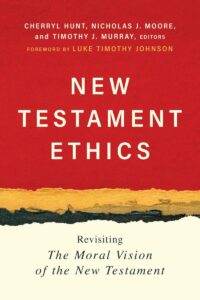
To mark 30 years since its publication, Cherryl Hunt, Nick Moore, and Tim Murray have edited a new volume New Testament Ethics: Revisiting The Moral Vision of the New Testament (Eerdmans, 2026). I had a chance to ask them about the volume, and the importance of Hay’s book.
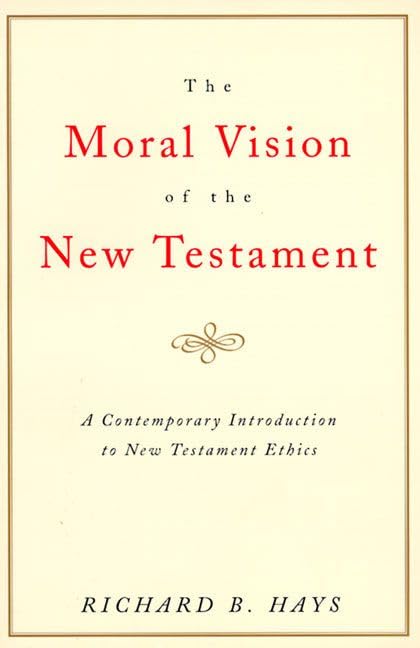 IP: The book you have co-edited marks 30 years since the publication of Richard Hays’ The Moral Vision of the New Testament. Why was that such an important book? What did it both contribute to and challenge in New Testament studies, and what did it contribute to and challenge in Christian ethical thinking?
Cherryl, Nick, and Tim: Hays’ book is a single-volume offering by a single scholar which aims to provide a blueprint for moving from Scripture to ethics. It is more about method than it is about specific issues, and its scope is impressive. Hays breaks the task of biblical ethics down into four components. The ‘descriptive task’ involves careful exegesis – what do the biblical texts say about how we should live. Secondly, the ‘synthetic task’ moves from the various texts in the Bible to discerning shared, coherent themes. For Hays, there are three key focal images: the community of God’s people, the cross as the means of redemption, and the new creation as the goal of all things.
The third task is ‘hermeneutical’, moving from what Scripture said to how this is to be interpreted and applied authoritatively today. Here Hays differentiates between rules, principles, narrative paradigms, and symbolic worlds. He argues that whereas Christians often look for clear rules and principles, in fact the greatest thing the Bible has to offer us is paradigms of the good life and symbolic worlds within which we can faithfully imagine how God is calling us to live. The fourth and final task is the ‘pragmatic task’, reaching specific positions on how Christians and the church should live in obedience to the witness of Scripture.
Along the way, Hays evaluates the ethical approaches of five theologians, gives space to the quadrilateral of Scripture, reason, tradition, and experience (the latter three only ever functioning in a supplementary fashion), provides ten proposals on reasoning scripturally about ethics, and offers a concise discussion of five live ethical issues. He chooses the five issues not on the basis of their importance in Scripture, but because they cover the full range of kinds of ethical treatment in the New Testament (from extensive to minimal, and from explicit rules to limited or no instruction). Hays does all this in about 400 readable pages. You can perhaps see why his book was included by Christianity Today among the top 100 Christian books of the twentieth century!
Hays challenged biblical scholars to do synthetic and ethical work (how does it all join up, and why and how does it matter?), and he challenged ethicists to take Scripture and biblical exegesis and hermeneutics seriously within their work.
IP: What aspects of Moral Vision does this book seek to affirm? Are there aspects that it seeks to challenge?
C, N & T: In the spirit of Hays’ book, we encouraged all contributors to write self-consciously for the church and to make sure their contributions addressed the ‘pragmatic task’. This can be uncomfortable ground for trained biblical scholars in our scholarly writing, so we are grateful to our contributors for accepting the challenge!
More specifically our volume has three sections: 1. Hermeneutics – which primarily engages with Hays’ methodology; 2. Exegesis – where contributions are orientated around particular texts; 3. Themes – where the essays are primarily shaped by ethical issues (sex and celibacy, loneliness and social isolation, ethnicity and race, the ecological crisis, and wealth).
Throughout we tried to prioritise texts and issues that received relatively little attention in Hays’ book and so both to critique but also develop and supplement his work. Some of the chapters work with Hays’ method, showing how it remains fruitful (for example, in thinking about issues that have come to the fore much more pressingly in recent years, such as loneliness or the climate crisis).
Some push further than Hays did, or point out areas that he may have missed (for example, he makes a lot of ‘metaphor-making’ in doing ethics but doesn’t engage at all with Conceptual Metaphor Theory; he prioritizes narrative but in doing so risks overlooking the contribution of letters and other reasoned, didactic texts). Others push back a little harder (for example, suggesting that Hays missed important themes such as creation, justification, or love). Many of the contributions offer both appreciation and critique.
IP: The first main section of the book is focussed on the question of hermeneutics, and chapter headings include reference to the imagination and to metaphor. Why are these so critical in thinking about the use of the New Testament in ethics? What does that tell us about the nature of the New Testament?
C, N & T: The New Testament doesn’t envisage every single ethical dilemma. Indeed, as a collection of texts inspired by God in and through human authors and human history, it cannot function as a comprehensive directory of ethical issues – nor is it supposed to. Instead, it offers a combination of clear rules (some of which may or may not apply directly, depending on the context in which they are expressed in Scripture), principles which guide decision making, and then lived paradigms of moral behaviour (in Jesus supremely; but also in other biblical characters – though as they are sinful, they are not always good examples!), and in the moral universe which it envisages and to some extent constructs for us and invites us to inhabit.
The hard work of interpretation – and with it a healthy dose of well-trained imagination – is therefore required to get from Scripture to how we live. Imagination and metaphor-making are therefore absolutely fundamental to faithful living. This is not to undermine or ignore the authority of Scripture, but it is to recognize that ethics is wider than deontology (rules) and authority is broader than a classic ‘commandment-only’ model allows.
IP: The second section is shaped by the New Testament’s own ethical priorities. Can we treat ‘love’ and ‘resurrection’ as elements of this—or should we think of them as controlling? And why is ‘endurance’ so important in NT ethics?
C, N & T: One major criticism of Hays’ book was the fact he didn’t choose ‘love’ as one of his focal images. He defended this decision in the book, and in a chapter written not long before he died. His argument centred on two main points: love is not in fact consistently emphasized across all of the New Testament (this doesn’t mean some texts oppose love, simply that they don’t focus on it in their ethical themes); and perhaps more significantly, that the concept of ‘love’ in and of itself runs the danger of being a wax nose – able to be twisted this way or that, unless it is given fixed form by other ethical focal images. Yet love is such a hugely important theme for John’s Gospel that Elizabeth Corsar’s chapter argues it does have a place, and is integrally linked with mission for John. One could integrate love into Hays’ model by recognizing that it drives redemption and new creation, and that it shapes community.
The theme of ‘resurrection’ is closely linked to Hays’ focal image of ‘new creation’, but it emphasizes an important point: God’s work of new creation has begun and will reach its completion in the person of Christ; it is not merely a creational or cosmological image but fundamentally a christological one. Andy Boakye further argues that this personal aspect of new creation implies a radical equality amongst humanity – so it has implications for community as well.
As for endurance, this surfaces particularly in Amy Peeler’s chapter on Hebrews, a text which Hays largely sidelines in his book. Endurance or perseverance is a virtue which is closely linked to both faith and hope. It is a call to courage and to patience. Like love it cuts across the focal images Hays chooses, reminding us that mutual encouragement to keep going is fundamental to community, suffering is part of carrying our cross as we follow Jesus, and the new creation is still some way off thus necessitating patient endurance in the present.
IP: The third section is more focussed on five ethical questions that dominate current discussion. Why did you pick these five? How well do they match NT concerns?
C, N & T: Hays chose five issues in order to demonstrate how to handle a range of issues where the biblical material differs in extent and clarity. We wanted to cover issues that Hays had not treated extensively, with two criteria: issues that had become more pressing in the decades since Hays wrote (sexual ethics in the church, loneliness, ethnicity, the ecological crisis), or issues on which the New Testament has a lot to say (wealth and again ethnicity).
The New Testament has very little indeed to say about care for the environment, and its authors knew nothing of the human-caused damage to our world that we have inflicted in the past couple of hundred years and are just waking up to. Much Christian reflection starts (and sometimes ends!) with the command to steward creation in Genesis 1–2. Yet Cherryl Hunt argues for the cosmic scope of community and of Christ’s redemption, and points to the positive eschatological destiny of non-human creation.
On the issue of wealth, by contrast, the New Testament has a lot to say, and it is not comfortable reading! John Barclay makes a strong case for a consistent ‘deep challenge’ throughout the New Testament: to those who have more than they need to live on (i.e., more than subsistence level, which is the vast majority of us in the modern West), wealth is a spiritual danger. It is entangled with injustice, it is an encumbrance, and the best thing to do with it is to share in God’s gift-giving by distributing it. Now, much has been written on wealth ethics and there are positive things that can be said about wealth as well as different perspectives from Barclay’s. But any reading that entirely defuses the clear challenge that recurs throughout the New Testament runs the risk of explaining away rather than explaining and faithfully applying it.
IP: There are two chapters on the question of sexual ethics, and this was clearly key given what appeared to be Hay’s own change in his position. The first chapter on this seems to view Hay’s change of mind as compatible with his earlier position—though others (including a contributor to the book in another chapter!) see a marked discontinuity here. Has Hays left us a mixed legacy on this question?
C, N & T: Originally we hadn’t planned to address these questions in this volume. But Hays’ publication of The Widening of God’s Mercy with his son (and Old Testament scholar) Christopher B. Hays in 2024 changed that. In the new book, Hays Sr does not change his view on what the key biblical texts mean, but he does change his mind to argue for the acceptance of faithful same-sex relationships as compatible with biblical ethics.
In the light of this new book, we gave all contributors the chance to engage with it and a few did so, where it was relevant to their topics. We also invited Walter Moberly to contribute a chapter comparing the hermeneutical moves in the original Moral Vision chapter and the new Widening Mercy book. That chapter is a tour de force which discerns the very different contexts, tones, and approaches of Hays Sr and Hays Jr within the later book.
It would also be fair to say that Widening Mercy poses quite a stark question to Hays’ methodology: if it can deliver opposite results on one of the touchstone ethical debates of our day, is it in fact a serviceable method at all? We would suggest that the differences remain instructive. As noted, Hays does not change his opinion on the meaning of the biblical texts which remain clear and consistent in his view. The change therefore lies in other parts of his method, namely the role of experience (he met and got to know Christians in same-sex relationships in his church) and the role of analogy and metaphor-making (Hays came to think gentile inclusion does work as an analogy, whereas he considered and rejected it in Moral Vision).
So has Hays left a mixed legacy on sexuality? In his own views, absolutely; but in his model, one can go back and evaluate the role of exegesis, experience, and analogy, and come to a reasoned conclusion as to how effectively he navigates those in the earlier chapter and in the later book.
 IP: In the final analysis, can we still make good use of Moral Vision? Or do we need to qualify its status in contemporary discussion?
C, N & T: Moral Vision is still a key point of reference, and rightly features in the bibliographies of ethics and biblical ethics courses. Indeed, our book New Testament Ethics shows and contributes to its ongoing importance. Moral Vision was not the final word in biblical ethics, but Hays never intended that it should be. (Though—as Luke Timothy Johnson notes in his foreword—Hays never really changed his mind on the basic structure of his ethical approach even when challenged or responding to critical interactions!) It was rather intended, in Hays’ words, ‘to start a conversation rather than end one’. In that respect, it should not be wheeled out as a perfect method or blueprint for doing ethics, nor should the five chapters on specific issues be taken as definitive statements. Instead, it should be used and engaged with appropriate critical care.
In the final analysis, the point of doing ethics is not to talk about it but to live it. It seems fitting to end with the final words of our introductory chapter:
The task of biblical scholarship is always hard work; yet it pales in comparison to the challenge presented by the contents of these essays. As the project of publishing this volume draws near to its end with our writing of this introductory chapter, we are deeply aware that we have only just begun the more important task of learning to live lives that faithfully reflect the moral vision of the New Testament.
IP: Thank you for this fascinating volume—and for this discussion!
Cherryl Hunt (PhD, theology, University of Exeter) teaches at Spiritus Theological College (formerly South West Ministry Training Course), which offers theological education and ministerial training programs validated by Durham University.
Nicholas J Moore (DPhil, New Testament, University of Oxford) serves as the warden of Cranmer Hall, an evangelical Anglican theological college within St John’s College, Durham University.
Timothy J Murray (PhD, New Testament, University of Nottingham) serves as pastor of Amblecote Community Church.
 Buy me a Coffee