Andrew Goddard writes: Twenty years ago, in June 2006, Archbishop Rowan Williams wrote in his significant and still-worth-reading reflection, “The Challenge and Hope of Being an Anglican Today”
There is no way in which the Anglican Communion can remain unchanged by what is happening at the moment. Neither the liberal nor the conservative can simply appeal to a historic identity that doesn’t correspond with where we now are.
So where are we now? How, as the new Archbishop of Canterbury begins her ministry in the Communion, as we look ahead to a meeting of the Anglican Consultative Council in Belfast this summer, and as we consider, as I did in Part 1, the recent actions of GAFCON, has the Communion changed further in the two decades since Rowan Williams wrote those words and what are the possible futures?
To begin to answer questions such as these it is helpful to
- identify four broad areas of deep and ongoing disagreement,
- look back over what has happened since 2006, and
- distinguish and evaluate the 3 main distinct and competing visions for global Anglicanism.
before considering what the future might look like in the light of these. What follows is a significantly shortened summary of the fuller article available as a PDF here: Goddard Communion 3 visions final
1. Four Areas of Disagreement
Although many issues could be named, four have consistently driven the Communion’s fractures: theology and faith; ecclesiology and order; membership and discipline; and colonialism and power.
The presenting issue has been human sexuality and the disputes over Lambeth I.10, but beneath this many see divergent understandings of Scripture and its authority and other theological differences.
Related to this, Anglicans now hold different views of what it means to be a “communion of churches”—how autonomy, interdependence, and mutual accountability relate within the one, holy, catholic, and apostolic Church.
These ecclesiological differences have led to disputes over whether Communion membership can or should change in response to theological divergence or unilateral provincial actions.
Finally, the Communion’s structures—notably the Instruments—are increasingly scrutinised for their colonial origins and ongoing power imbalances.
These four disagreements form the backdrop to every attempted solution since 2006.
2. The Last Quarter Century: A Compressed Overview
Rowan Williams’ Two Failed Approaches—and the Rise of GAFCON
Rowan inherited a Communion already under some strain but fractures developed much further when he was Archbishop. Two major strategies were attempted.
The Windsor Report (2004) called for repentance and restraint. Its stark warning of what would happen if these calls were ignored—“we shall have to begin to learn to walk apart” (para 157)—proved prescient.
Rowan’s preferred solution was the Anglican Communion Covenant, an “opt-in” structure that would potentially distinguish “constituent” churches from “churches in association.” But the Church of England’s dioceses rejected it, effectively ending the project.
Into this vacuum stepped GAFCON (2008), offering a confessional solution through the Jerusalem Declaration. It represented a decisive shift: if the Instruments would not discipline error, a new movement would arise.
Justin Welby’s Two Failed Approaches—and the Emergence of GSFA/GAFCON Resetting
Justin Welby inherited the failure of both Windsor and the Covenant. His 2016 Primates’ Meeting briefly gathered all provinces—including GAFCON provinces and ACNA—but the agreement reached there quickly unravelled, and the “relational consequences” were inconsistently applied.
By Lambeth 2022, Justin sought to recognise diversity explicitly, giving space both to those upholding and those rejecting Lambeth I.10. This attempt to normalise divergence catalysed the Global South Fellowship of Anglican Churches (GSFA) to call for a “reset” building on GSFA’s covenantal structure (2019, revised 2021).
The resetting gained momentum after the Church of England’s Prayers of Love and Faith (2023) led to the GSFA Ash Wednesday Statement and, as described in Part 1, the agreement between GSFA and GAFCON to work together on a reset, an agreement recently put under pressure by GAFCON’s recent announcement first from Sydney then in Abuja that it had established the Global Anglican Communion (GAC).
IASCUFO and the Nairobi-Cairo Proposals (NCP): Redefining and Restructuring
While GSFA and GAFCON pursued a reset, the Instruments developed their own response. IASCUFO’s work culminated in the NairobiCairo Proposals (December 2024) and their recent February 2026 Supplement. These proposals call (para 25) the Communion to:
- acknowledge structural developments since 1930,
- acknowledge damaged communion while affirming that “real communion remains”
- ensure leadership “looks like the Communion.”
The NCP thus represents the official attempt to redefine and restructure the Communion without changing its membership.
We now face three distinct visions:
- The NCP – redefining and restructuring the existing Communion.
- GSFA’s Covenant – a reset that involves realignment and recalibrated intensification of communion among those committed to historic faith and order.
- GAFCON’s GAC – a confessional reset realignment that requires disengagement from the Canterburyled Instruments, effectively rejecting and replacing them.
3. Examining the three current options
In the light of (1) the four areas of disagreement identified above and (2) the shared history of previous attempts to address those disagreements, what are we to make of these 3 options as to how to proceed?
The NCP: Redefining and Restructuring
The NCP arises out of making the following assessments on the four issues identified above:
- Theological plurality has increased, many now believe Canterbury itself has departed from the Communion’s consensus, and simply accepting such diversity with no rethinking about what it means to be a communion is not an option.
- The Communion can no longer claim what it once did about shared faith and order: a new definition is needed which recognises various degrees of communion now exist.
- Membership cannot, we have learned, be changed through discipline or covenantal recommitment.
- The Instruments must be restructured to address colonial legacies and new power realities.
The NCP proposes a significant shift: member churches no longer (as declared in 1930) uphold and propagate the Catholic and Apostolic faith and order, they now seek to uphold and propagate it.
Because many provinces no longer view themselves as “in communion with the See of Canterbury” in the fullest, historic sense, the NCP replaces that definition with reference to there being “historic connection with the See of Canterbury.” This also effectively acknowledges there are “degrees of communion” rather than a binary in/out choice. Other Primates should, it is proposed, be invited to share aspects of Canterbury’s ministry in a more collegial way.
The NCP preserves breadth but by recognising there is less depth to our communion. Hoping that “in time…a renewed, visible, catholic consensus” may emerge, in the meantime it recasts the Communion so that it in some ways is more like a quasi-ecumenical body. It also explicitly welcomes GSFA’s covenant as a constructive contribution.
GSFA’s Covenant: Realigning and Recalibrating Intensification
GSFA position is broadly that:
- greater theological plurality in the historic Communion requires renewed commitment to historic faith by those who still share such a commitment,
- the Instruments have failed to uphold that faith,
- new structures are therefore needed for those who wish to maintain the historic Anglican vision of faith and order,
- these structures must be post-colonial and address power imbalances.
GSFA’s conciliar, covenantal structure includes both “doctrinal foundations” (though not the Jerusalem Declaration) and (unlike GAFCON) explicit “relational commitments.” It has taken up the earlier language of covenant but given it new content. It commits churches “to work for the well-being of our Anglican Communion as we see ourselves as an intrinsic part of the Communion” (para 3) which it defines (Section 3.6) simply as the family of churches historically rooted in the Church of England’s missionary expansion.
Most GSFA bishops attended Lambeth 2022 but many did not share in Communion there and in 2023 after Prayers of Love and Faith were introduced, GSFA declared it could no longer recognise Justin Welby as “first among equals.” Yet GSFA has remained engaged with IASCUFO and the NCP process. This raises key questions including:
- Can GSFA welcome the NCP as compatible with its own identity?
- Can GSFA’s approach to the Instruments be “remain and reset” rather than “remove and replace”?
- Will a post-NCP Communion take GSFA more seriously?
It is possible to imagine two levels of communion developing:
- A wider, quasi-ecumenical Communion (NCP),
- A deeper communion of shared faith and order (GSFA covenant).
GSFA could remain engaged with the wider body while cultivating deeper communion among those committed to historic Anglican faith.
GAFCON and the GAC: Rejecting and Replacing
GAFCON’s perception is that:
- Theological plurality is evidence of failure and departure from historic Anglican faith with those embracing false teaching not being true Anglicans.
- The Instruments are now totally compromised by relativism while true Anglicanism is confessional as represented by the Jerusalem Declaration and Statement.
- The Communion should have insisted on “repentance and restraint” and taken action against those who did not repent
- Canterbury’s role and Western financial dominance perpetuate colonial power and new nonCanterbury structures are now required.
Although this stance has much in common with that of GSFA there are some distinctives and differences particularly it seems in recent developments. GSFA and GAFCON both resist what they see as false teaching but how are those who have embraced such teaching to be viewed? Are they no longer Christian or are they Christians in error but with whom we are still, to some extent, in communion? If the latter, what forms of communion and partnership might still be possible?
The Abuja Affirmation draws a stark contrast between “confessional” and “institutional” understandings of communion. Yet GAFCON provinces and GAFCON itself have institutions (and GAFCON has recently restructured them, creating a new Global Anglican Council with a smaller number of Primates and some non-Primates). By focussing simply on confession there is the danger of institutional confusion especially if new requirements are added (as they have recently been) in addition to simply a shared confession.
The most significant addition has been that GAFCON now requires its leaders to disengage from all Canterbury-led Instruments. Yet it simultaneously allows leaders who remain within “revisionist or mixed” provinces (e.g., Sydney diocese). This creates a major, largely unacknowledged, tension:
- Why is attending meetings of the Instruments forbidden, but participating in a revisionist or mixed province’s synod permissible?
- Why is disengagement now required at the Communion level but still left to conscience at the provincial level?
This inconsistency raises questions about whether the new stance is, as it claims, a principled theological one or a more political one.
GAFCON claims the GAC is “not a new Communion” but the historic Communion “reordered from within.” Yet the theological and historical justification for this remains unclear. To many, the move looks more like a “reject and replace” strategy.
Conclusion: Where Are We Now?
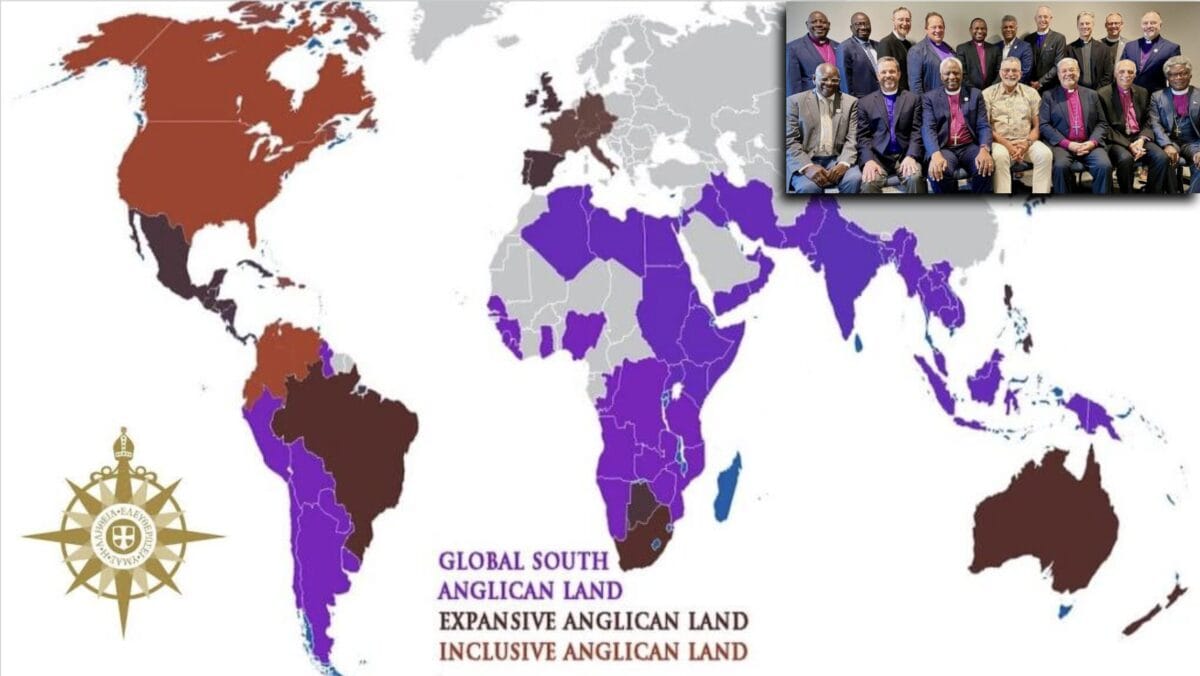
Archbishop Rowan Williams was right in 2006 that “There is no way in which the Anglican Communion can remain unchanged by what is happening at the moment”. Twenty years on it is now necessary to acknowledge that what once constituted the Anglican Communion is no longer to be found in any existing pattern of relationships among Anglicans across the world. The reality is that there is a spectrum in which there are (at least) 5 distinguishable groups of provinces that can lay the claim to being “Anglican” in some sense:
- Historic provinces which have to varying degrees become “revisionist” in relation to sexuality ranging from those accepting same-sex marriage (eg TEC and Scotland) through those currently having services of blessing for same-sex couples (eg Wales) to the CofE with its Prayers of Love and Faith.
- Historic provinces that have not embraced such developments and remain committed to Lambeth I.10 and are not clearly seeking differentiation from those within Group 1 within the life of the Communion (various provinces including some of the broader historic Global South).
- Historic provinces that are seeking differentiation from those within Group 1 within the life of the Communion but seeking to remain engaged with integrity with Group 2 and, where possible, Group 1 (this would be broadly the current GSFA covenant stance).
- Historic provinces that have differentiated by disengagement and are now becoming part of GAFCON/GAC in which Group 3 provinces can be members but not now leaders (Nigeria, Uganda and Rwanda and, surprisingly, as it only joined the historic Communion as a distinct province in 2018, Chile).
- Anglican provinces that have never been part of the historic Communion structures and show no signs of wishing to enter them (eg ACNA, the new province in Brazil, REACH)
Although it is hard to work out the numbers, even of churches let alone worshipping Anglicans, in each of these 5 groups, in such circumstances a strong case can be made, (especially in the light of the history and 3 visions currently on offer discussed above) that there is little value in fighting over the “Anglican Communion” brand name. It would be far better to abandon crude in/out binaries in relation to ecclesial communion among Anglicans and to recognise that within and across all these 5 groupings there are varying degrees of ecclesial communion. Serious consideration as to how, across them, the highest degrees of communion can continue to be nurtured and even take shape institutionally is the real challenge as is how each of these share in the wider building of ecumenical relationships.
The historic Instruments will likely continue to successfully gather together more provinces (across groups 1-3) than any other structure but those so gathered may well in future represent a much diminished, and declining, proportion of those globally who identify as Anglicans. What those gathered by the Instruments now have in common is also significantly reduced in terms of shared faith and order as the NCP recognise. There is however much that is still held in common and such gatherings, if honest about their limitations, can continue to be of value for those attending and for the wider church and world. That is why the NCP are such an important and potentially significant development.
What about the vision of life in communion with a shared faith and order which the historic Instruments previously developed and sought to articulate and to (unsuccessfully) uphold in the Windsor Report and the Anglican Communion Covenant? This is a vision which the Instruments no longer embody in the way that they did in the past. That vision—and the vision of such communion life with non-Anglicans as well—remains, however, the great goal within the NCP. It also continues to shape the development of other ecclesial networks within the Anglican scene. Elements of this vision are now to be discerned taking shape in different forms in both GSFA (currently embracing groups 3-5 and in its non-covenantal form some within group 2) and GAFCON/GAC (groups 4 and 5). What is more, as the Abuja Affirmation witnesses, those in groups 4 and 5 also recognise that there are Anglicans within even group 1 with whom they are happy to remain in full communion.
To pick up those words of Archbishop Rowan, “Where we are now”, whether we are “liberal” or “conservative” Anglicans, clearly “doesn’t correspond with” our “historic identity”. We are indeed in new and uncharted waters for us but thankfully God is the God who at the beginning hovered over the waters of a dark, formless and empty earth and brought forth light and order and, as we prepare to celebrate, the God who raised the broken body of his crucified Messiah from the dead into newness of life.

Revd Dr Andrew Goddard is Assistant Minister, St James the Less, Pimlico, (where his wife Lis Goddard is vicar) Tutor in Christian Ethics, Westminster Theological Centre (WTC) and Tutor in Ethics at Ridley Hall, Cambridge. He is a member of the Church of England Evangelical Council (CEEC).
 Buy me a Coffee
















The Church of England was by no means the only Province to reject the Covenant.
Several other provinces either formally rejected it or decided against adopting it:
Anglican Church in Aotearoa, New Zealand and Polynesia: The General Synod in 2012 resolved that it was unable to adopt the covenant, primarily due to concerns regarding Section 4.
Episcopal Church in the Philippines: Bishops formally rejected the covenant.
Anglican Church of Australia: Declined to adopt the covenant in 2014.
The Episcopal Church (USA): Decided in 2012 to neither fully accept nor reject the covenant, opting instead for a “pastoral response” that continued participation in the process without adopting it.
Canada and Scotland also rejected it, with some provinces describing it – rightly I think – as a ‘pernicious scheme’.
The only real reason it was ever proposed was because of homophobic reactions to Gene Robinson and Jeffrey John – reactions which were of course quite contrary to Lambeth 1.10
Are Gene Robinson and Jeffrey John “men of one woman” (1 Timothy 3:2)?
Is the Archbishop of Westminster?
The (theoretically) celibate Catholic priesthood is a grave unscriptural error – as history witnesses.
Jesus was celibate. Paul was celibate. Peter wasn’t. It’s irrelevant.
Nor is +Sarah the man of one woman.
And the Orthodox episcopacy?
Indeed Sarah isn’t, Penelope, which is why she shouldn’t be a (arch)bishop.
Ah, Christopher, I see the you are employing the etymological fallacy again. One would think that
a) we couldn’t read any Greek
b) we assume that words meanings are simply derived from their constituent parts
c) a culture cannot agree on the meaning of a word (even when that meaning seems, on the surface, illogical) such as ‘wicked’ meaning great or good.
The precise reverse. The whole point was an appeal to intelligence, which cuts off fallacies and inconsistencies before it voices them.
Why your position is wrong, and the angles that you missed:
(1) Other phobia words are indeed ‘fear’. So to coin/use a word where phobia means something else is confused/unintelligent or mischievous or both.
There would have to be some reason for this -phobia word to mean something other than fear. But there is no such reason.
(2) The etymological fallacy focuses on origins. But the issue here is present usage in a context where other -phobia words mean ‘fear’. So origins/etymology does not come into it. You can see that?
(3) You say ‘A culture cannot agree on the meaning of a word’. But the example you give is highly atypical, just as JL Austin’s performative theory of language gave ‘I baptise you’ as a supposedly typical but actually very atypical example.
In the case of ‘wicked’, it is precisely because the nicest thing that the speakers could imagine was the initial thrill of transgression that the new meaning for ‘wicked’ as meaning ‘great!’ came about.
(4) Couldn’t read any Greek? That is correct. Most users of the word ‘homophobia’ cannot read any Greek.
(5) Very many words have moved away from their initial etymology. But that is not the case with this one. First, it has had little time to do so, and secondly it was cobbled together in the first place to convey something basic and literal, so that altering the meaning would spoil everything.
Why has ‘fear’ been replaced by ‘hatred’ in the foreground of people’s understanding of this ‘word’? It is because woke people think that all opposition is fear or hatred (it could, of course, never be rational, let alone statistical); and of these, hatred has now become predominant in their analysis. They have obviously never moved beyond the emotional, and cannot conceive that everyone is not the same as them in this.
In Little House on the Prairie TV version there is a character called Nancy who, when she does not get what she *wants*, comes out with ‘You all hate me!’. All opposition, even that in a person’s long term good, is mere ‘hatred’. Till recently this was a recognised wheeze in some children’s scheming to get their own way, and was easily identified, nipped in the bud, and firmly educated out of them in the course of upbringing. But now we see psychological children everywhere.
Although ‘Islamophobia’ is used (and behaves as a word) in a similar way. You will notice that it is precisely the two that are buzzwords NOW, and have been deliberately invented and planted in the culture, that are so illogical, mirroring the intelligence level of their coiners, or alternatively their deviousness.
It’s clear that homophobia is a word that has been in use for 125 years.
https://www.oed.com/dictionary/homophobia_n1
It’s also clear that Lambeth 1.10 rejects it.
And also clear, which was my main point in response to Andrew, that the proposed Anglican Communion Covenant was invented as a response to Lambeth 1.10, and in particular the reaction of fear concerning rhe ordination of Gene Robinson as a bishop, and the proposed ordination of Jeffrey John as a bishop.
What is also clear is that it wasn’t just the CofE who rejected the proposed Covenant.
So every word of my original post stands without correction.
It certainly has been in circulation for 125 years. And for all that time it has been a coinage that is not only uneducated but also incoherent for each of the above reasons, not one of which you have begun to address.
Are you saying that it has been around for several years and for that reason it must be ok? Logic?
Oh Little House, such good memories. Yes Nancy was awful, largely due to her similarly awful mother. Parents eh.
Christopher I think you need to take up your arguments with the OED. I’m happy with the word as they define it and describe its etymology. I trust their expertise in this matter more than I trust yours. If you wish to have their entry modified then I can’t help you, but I’m sure they will respond to your petitions.
Nonsense.
The OED’s province is to define words, which they do perfectly correctly.
Their province is not to see which words contain an internal inconsistency (such as the word ‘reactionary’ which assumes that everything new must be good and everything old must be bad: its premise fails).
Can you agree that these are two different matters?
No I can’t. If a word has an internal inconsistency its definition is likely to be faulty.
And if you want to see people who are afraid of homosexuals then you might just look at many of those who say they oppose it but lack the emotional intelligence to describe how it makes them feels and hide behind statistics. Or look at those from some of the Provinces that were disgusted by the appointment of Gene Robinson or proposed appointment of Jeffrey John. Or those who had difficult experiences at a formative time that they felt unable to make sense of then or later in life. All those things seem to lead people to be afraid.
Either way, I’m not the person you need to take it up with.
Peter, I think you mean Nellie not Nancy there. She too was a ‘brat’ growing up, and yes the implication was that an awful mum and weak dad inevitably compromise the quality of upbringing.
Andrew writes, If a word is internally inconsistent then its definition is likely to be faulty. If anyone understands that logic, do let me know.
I certainly understand its illogic:
1. Every single word in usage is in the dictionary. By Andrew’s logic, therefore incoherent words do not or cannot exist. But obviously they easily can.
2. Take the example given. The dictionary will correctly define ‘reactionary’ as wrongly invariably harking back to the past. It will not go into the issue of how that is something that can be intrinsically wrong, which of course it can’t be.
It is once again clear that you don’t know how language works. The constituent parts of homophobia do not mean ‘fear of homosexuals’, but fear of same. Which, of course, does not make any sense. So a word has been constructed (like television) which quickly comes to mean something wider and at the same time more precise than its constituent parts. That’s how neologisms work, hence arsenokoites (which also, etymologically, does not ‘mean’ homosexual).
And, another misunderstanding: wicked wasn’t repurposed because it was transgressive (surely your life isn’t so sheltered?). It was adopted playfully, as many ‘slang’ words are. Playfulness in language has produced some great art.
I didn’t claim that everyone understood Greek, I wrote that ‘we’ did.
As for your claim to be privy to how people viscerally feel about anything, and indeed to know better than they themselves do about this, it is obvious that you do not even begin to know any such thing.
Your second claim is that the real thing is their entirely hypothetical visceral feelings, and that their appeal to statistical evidence is just a front to conceal this. Again, this is obviously pure invention, as are claims to know others’ motivations in general.
Third, how on earth could they appeal to statistics unless in fact those statistics supported their position? So it follows that the statistics they appeal to demonstrate the rightness of their position. They would not be able to appeal to them otherwise.
Fourth, since statistics support the rightness of their position, their position must be essentially correct, so why would visceral reactions (which in any case may not always be probative or demonstrate anything, unlike statistics) even need to come into play at all?
Fifth, this fact that your main point is to say ‘not rational but emotional’ perfectly encapsulates the normal liberal outlook and the level of maturity that liberal argumentation has so far reached.
6. As does the ‘aim to drag others down to the same level’ pattern.
“an awful mum and weak dad inevitably compromise the quality of upbringing.”
Ahh, I see you subscribe to the ‘spare the rod and spoil the child’ philosophy Christopher.
How troubling. Ever heard of gentle parenting?
https://sarahockwell-smith.com/2014/04/18/what-is-gentle-parenting/
Christopher: ‘JL Austin’s performative theory of language gave ‘I baptise you’ as a supposedly typical but actually very atypical example.
Could you tell us please how ‘I baptise you’ is a ‘very atypical example’ of performative language?
That is just laughable. In What Are Are They Teaching The Children? I made that precise point. That the word means ‘Fear of that which is the same’. To which I added ‘The same as what?’ Which the editor edited into, ‘The same as what, one asks?’
I took this in WATTTC? to be a further demonstration of the illiteracy of the coinage, which indeed it seems to be. This is not a word made up by the classically educated.
Could there be a greater failure to understand on your part?
I have also in the past compared ‘homophobia’ to ‘television’ as a word whose clumsy artificial deliberate construction means that the seams still show. The lack of classical education means that both words are incorrect constructions. Television (half Greek, half Latin) would be proculvision.
So far your two points have been that I do not understand or agree with two things both of which I have already emphatically asserted. Plenty of misunderstanding, then, but it is on your own part.
How could arsenokoites ‘mean’ homosexual? First, nothing can ‘mean’ an ambiguous concept; and second, nothing can ‘mean’ a later concept. (NB the said later concept overlaps strongly with earlier understanding; but its intrinsic ambiguity means one can never specify the extent to which it does so.) Arsenokoitai means the same as the modern (and also very simple and age-old) concept which is used by those more precise and accurate individuals: namely, ‘men who have sex with men (MSM)’. Once we have a concept of greater clarity, any retreat to concepts of less clarity is utterly telling.
Your fourth misunderstanding is on ‘wicked’. My point was far from being as you try to reproduce it. It was not that the repurposing was terribly naughty and transgressive, but that the actual word ‘wicked’ is equivalent to the actual word ‘transgression’, while its use to mean ‘ace!’ took hold because the most ace thing people could think of was the initial short term zing that they experienced when they transgressed.
Fifthly, the idea that I anywhere denied playfulness is based on no data. Had I considered the matter, I would have instead been with you in agreeing, NOT denying, that those who used ‘wicked’ thus considered this to be playful. Indeed, playfulness and zing overlap in delight.
But that means that not a single point was correctly understood, while the majority of points you raised evidenced a misapprehension that I had said the actual opposite of what I had really said.
I’ve deleted one of the threads on this, because, once again, it descended into trading insults.
Please all comply with the comment guidelines.
Perhaps then, you could remove the comment below.
Perhaps.
For want of a nail, the shoe was lost.
For want of a shoe, the horse was lost.
For want of a horse, the rider was lost.
For want of a rider, the battle was lost.
For want of a battle, the kingdom was lost.
And all for the loss of a horseshoe nail.
So – Gene Robinson could have just repented.
Can no-one see the big picture? What would then have been avoided? Simply colossal amounts of chatter. Simply colossal expenditure on conferences and statements. Simply colossal diversion of time from priorities. And all because Gene Robinson (and/or his facilitators and appointers) did not repent.
Large percentages of people live their Christian common life in contexts that completely and with proper impatience distance themselves from the destruction of time and progress made by such awful, selfish diversion.
I’m unsure whether this whole two part article, starts from the right place.
What is an Anglican? Are there no definitions because that is where all the divisions start. Structuralim and post structualism surely are not core Christian tenets.
And why oh why what is so precious about Anglicanism, within Christianity. While I’m not an office holder in the Anglican Church, I was converted as a adult through CoE ministry, Baptists as adult believer in an independent off-shoot from Methodism, have worshipped in various churches, including, Methodist, URC, New Frontiers and now Anglican, and have gained much from Presbyterian teaching.
Does this whole farrago revolve around, office holders, property and finance and not the ordinary folk, worshippers?
If I were to hone in on one word, in the article and it’s context it would be ‘depth.
‘
Also I see no difficulty with Sydney Angicans; wheat and tares; sheep and goats, yet separation, no fellowship, through discernment of false teaching. There is no unity of belief, no unity in Christ, in the Holy Spirit.
Am I an Anglican? Can I have communion with Anglicans anywhere around the world? It would depend on the outward office holders and their presenting beliefs, liturgies if you will.
As I explained in my comment on Part 1 (https://www.psephizo.com/life-ministry/the-future-of-the-anglican-communion-part-1/#comment-510581), GAFCON does not subscribe to the procedural-institutional rationale of Western Anglicanism. In fact, GAFCON’s contrasting doctrinal-confessional rationale (which also owes its heritage to Reformed Catholic tradition) make a clear distinction between Communion‑level structures (e.g., Canterbury‑led Instruments) and provincial structures (e.g., Sydney’s synod, Kenya’s synod, ACNA’s synod) that don’t.
Participation in Canterbury-led Instruments signals recognition of Canterbury’s spiritual authority. GAFCON believes the doctrinal consensus of the Communion was broken long before Abuja: first by TEC, and more recently by the Church of England. From that standpoint, Abuja is not the rupture, but rather the eventual formalisation of a rupture already created by others. And for a doctrinal-confessional ecclesiology, that’s why disengagement is required.
In contrast, a local synod does not confer recognition of Canterbury’s authority. And because of that, participation is a matter of internal governance (or, as you put it “left to conscience”), rather Anglican identity. That’s not inconsistent at all. As intended, the Affirmation redefines the centre of Anglican identity without policing it provincially.
I’ll repeat what I stated in my recent Evangelicals Now article: “In the West, Anglican identity has long been shaped by the idea that the communion is held together not by administrative authority, but by “bonds of affection”. The Western view is that communion across the Anglican world is maintained through patient consensus-building, shared provisional discernment, participation in the Instruments of Communion, and a willingness to “walk together”, despite profound disagreement.”
“This model assumes that autonomy is constrained primarily by relationship. Provinces remain recognisably Anglican by staying in the room, continuing the conversation, and deferring, at least symbolically, to the Archbishop of Canterbury’s traditional role as “focus of unity.””
“From this perspective, Gafcon’s withdrawal from Canterbury-led structures looks like a repudiation of Anglican identity. If communion is relational, then stepping back from the Instruments appears to be stepping out of the Communion.
This is why some Western Anglicans read Abuja as schismatic or usurping Canterbury. If the Instruments form the golden thread of Anglican Communion, then refusal to participate feels like tearing its fabric.”
“By contrast, the Global South [apart from GSFA] operates with a different ecclesial mindset, whereby the Anglican Communion is held together not by process but by a baseline of confessional unity, encapsulated in the Scriptures, the creeds, the Thirty Nine Articles, and the 1662 Book of Common Prayer.”
I do hope that Andrew Goddard will be able to provide a timely response to this critique of his analysis.
There is an underlying assumption in the piece, and in most pieces, that there has been a genuine disagreement in the time period in question.
This means we should consider that the period of genuine disagreement was
(a) sudden and time-specific and valid, even though it was based on biological matters which were just the same in the preceding millennia
(b) a genuine analysed position, as opposed to being down to lobby groups, radicals and activists who wanted sexual activities recognised and affirmed.
Thank you for this – very detailed and informative. I have an observation:
“GSFA and GAFCON both resist what they see as false teaching but how are those who have embraced such teaching to be viewed? Are they no longer Christian or are they Christians in error but with whom we are still, to some extent, in communion?”
I think this is a really important question – surely a view one way or another invokes very different parts of scripture. How we treat fellow members of the Body of Christ is hugely consequential. How we treat those in error, likewise. And so on…
Two things strike me:
The first is that people who believe themselves to be fighting for a scriptural understanding of what is and is not sinful behaviour appear to pay so little attention to the scriptural exhortations around the question above. Is the lack of clarity evidence of an ironic inattentiveness to foundational biblical texts?
The second is how unpleasant people are prepared to be to others on this topic in ways that are hard to justify in any situation, regardless of the answer to the question.
Are we allowing disagreement on one matter of theology to blind us to other – largely undisputed – matters of plain biblical teaching and sinful behaviour?
David, if people are outraged at facts and realities, that is easily misinterpreted (by those who operate as though everything is about people and nothing about facts/realities, when they should know that plenty of things are about each) as being unpleasant. Those poor people are actually trying to communicate (as a warning) the unpleasantness of the facts and realities. The more they care, the more emphatically they will do so. And then ironically they are held to be the guilty party because they care and want to protect others for the future.
Christopher – It seems to me that one can be right on a theological issue and entirely wrong in how we conduct ourselves – and so guilty in that sense without irony. Our conduct in treatment of others in this context is just as much a matter of sin as any other, and so it would indeed be a bitter irony if we ignored our conduct in one aspect for the sake of another.
…and for avoidance of doubt, I’m sure I’ve condemned when I should have built up, I’m sure I have scorned when I should have loved. I don’t claim to understand these issues with anywhere near the depth others will have. But that is precisely why I think the question matters — and why I posed it initially, with hopeful expectation of learning.
The fundamental underpinning of this is my observation – also set out in the blog – that people often appear either confused or coy about how they see a disagreement. This has consequences that should not be ignored. Are we debating a disputable matter? In genuine theological disagreement with a brother or sister? Admonishing someone under our authority who is less mature in faith? Or condemning a deceiver sent to subvert?
I can certainly see that care for the truth can produce urgency, and that urgency can be mistaken for hostility. But that reframes the question as one of perception — whether observers are misreading tone — when the prior question remains unanswered: what kind of disagreement do we believe ourselves to be in? Caring too much may be a reason for failing in treatment of others, but it’s not an excuse. And using language of condemnation when we are vague about the necessity or otherwise of that condemnation is not an act located in maturity of faith.
Hi David
This is highly complicated, because perceptions are very liable to be wrong.
If someone is merely appropriately emphatic in proportion to the importance of an issue, they will therefore often be very emphatic, given that we talk about the most important issues the most.
To be less than emphatic is to give the impression one does not care, or to give a falsely light weight to the issues.
This is so preliminary and basic, and a diversion from debates actually progressing.
There is plenty of non-debate time, in which we can be as personal as we like. That is not mingled with debate. So why should our debate time be mingled with emotional connection and thereby be in danger of compromising truth? Love is not the same thing as mildness. Real love very frequently demands urgency, as any parent knows. This is basic, and we could spend all our lives making the same points, while no debates advanced at all, and while we remained extremely friendly and loving.
Also, a lot of the points made on this interminable topic are patronising. It should be taken for granted that people have heard them and considered them before, and drawn their own conclusions. Many, many times.
“Also, a lot of the points made on this interminable topic are patronising. It should be taken for granted that people have heard them and considered them before, and drawn their own conclusions. Many, many times.”
I think David might be gently pointing out that particular irony Christopher. You don’t ever seem willing to acknowledge that we have heard all the points you make – often in the most patronising way possible – and have considered them and drawn our own conclusions. Many many times. And those conclusions are different to your own.
There are a few who *state* very different ‘conclusions’ to mine on a given topic (stated conclusions are mere assertions, and therefore are wrongly termed ‘conclusions’); but they tend to consist of yourself and PCD, and the worth of conclusions is in proportion to study of the topic. It is not remotely possible to generalise, since the disagreements in question are generally all on one topic out of tens of thousands: i.e. on less than one percent of what might be discussed. But, for sure, asserting disagreement is worthless, and only showing working is of worth.
Hi Christopher,
I appreciate the reply. I myself think it more likely that debates are advanced through mild, friendly and loving discourse. However, it’s not my view that matters.
The question posed in the blog, that I’ve expanded slightly, remains unanswered: Are we debating a disputable matter? In genuine theological disagreement with a brother or sister? Admonishing someone under our authority who is less mature in faith? Or condemning a deceiver sent to subvert?
Ian – if you’re reading this, and the above is a tedious and well-worn question then I do apologise, do feel free to say so and point me to the canonical answer 🙂
If someone were ‘mild’ when talking of human killings for example, I would find it hard to trust them. In addition , I would question whether they had any feelings. The lack of feelings on such topics would put them actually at the bottom of the list of people who were trustworthy and understood of what they were speaking.
If you speak in a winsome manner, people inevitably are more likely to think that they agree with you. Unfortunately, you are no more likely to be right. So this method can be employed as a psychological con trick. But even if it is not, tone of voice has zero correlation with, or relation to, quality of content.
On the main point:
-It is suspicious that the prevailing issue never arose in earlier centuries and millennia…
-…and yet is now somehow treated as the most central matter since sliced bread..
-It is suspicious that church opinion runs so much in parallel with general opinion, given that that is often the case and that people are influenced by cultural norms.
-It would be fine if this were a debate between people who knew the scientific and social scientific literature. But it is not. That is the most shameful aspect, given the timewasting. It is a democratic debate putting all levels of expertise on the same level.
-Given that, for example, the ‘other’ side has still no knowledge that ‘born gay’ is largely untrue (this being the most basic point), then decades lead to almost no progress. No-one can call that a debate. Those who know what they want to think, and never study evidence, could never be regarded as proper participants.
Hi Christopher – I can’t help but feel that you’re not engaging with the question I’m posing. But no matter…
I’m struggling to find coherence in what you’re setting out. You suggest tone doesn’t matter, but you also say that a mild tone suggests a lack of trustworthiness. The corollary is that an intemperate tone on matters of import implies trustworthiness..?
In any case, this is a logic puzzle not a theological point, because the biblical exhortations are to humility, gentleness and patience, bearing with one another in love. We are tasked with making every effort to maintain the unity of the Spirit through the bond of peace. These requirements are no less optional than other matters, are they? It’s not a question of efficacy in debate, but obedience, isn’t it?
“and only showing working is of worth.”
Of course Christopher, and that’s why in two occasions I have posed ten very specific questions to you about the matter. Your reply each time is that such things have not been studied so there is no data for them. Crucial questions. And that is why I am very suspicious of the generalised waffle that you offer instead. Not to mention the frequent inability to actually answer a question and follow the thread of the argument.
I notice the same is happening again with your inability to address the issues that David is quite specifically putting to you.
I admire you for persevering David….
I cannot speak for Andrew, but in the mildest way may I point out that I have done a very great deal of work on this subject; it was at the core of my PhD research. Perhaps the trouble may be that our research (thorough for us both, I am sure) has a tendency to operate in rather different areas. I do not think that science or medical statistics can tell us anything about the morality of sexual relationships. There, I think, we differ.
We- Far from being ‘crucial questions’, what they mostly had in common (other than salaciousness) which you entirely failed to mention to your reading public, was that they necessitated being a fly on a wall in someone else’s (or rather thousands of people’s) house/room. I was then castigated for negligently not being that fly.
Christopher they were questions on which you continually pontificated and asserted knowledge but clearly had none.
Acquiring such knowledge does not at all require being a fly on the wall – a ridiculous idea. It simply involves an anonymous survey.
Until you have such information you should refrain from commenting on the deeply private lives of those you castigate.
Thieves are also ‘deeply’ private in their activities, for reasons that escape me.
Large-scale statistics exist on enormous numbers of matters, including matters extremely similar in nature to those you sought; and though there will always be some unmeasurables, those things that are measurable combine to give us the general understanding and big picture that we need.
PCD’s position that science and statistics can tell us nothing about the morality of different kinds of sexual relationships is an impossible position.
Science and statistics are what tell us which particular types of sexual congress are correlated to what degree with spreading disease to others, and with earlier death.
Therefore for PCD’s position to hold, she must maintain that spreading disease to others and being associated with earlier death are morality-free matters.
When in reality nothing could be more morally white-hot.
This is what I mean by the sexual revolution being the embodiment of not caring.
I see that you will not do me the courtesy of replying to me directly, but I will endeavour to be polite. Social sciences and statistics may indicate that people who are sexually promiscuous are more likely to contract venereal diseases and to be harmed by them. But we do not, I think, as Christians, hold that sexual immorality is wrong because of the likelihood of contracting and spreading diseases. Sinfulness has been connected to disease certainly, such as the belief that leprosy was an outcome of sexual incontinence, but no one thought that infidelity was immoral because it caused leprosy.
As I have observed before, science and the social sciences are a red herring in this debate. What the Church is seeking is an answer to the question of whether same-sex relationships should be honoured in the way that other-sex relationships are. There are, as you know, many other issues which are discussed in this debate, such as the importance of procreation in marriage/relationships, which are based on the telos of marriage itself. The reason why promiscuity, infidelity and disease are red herrings is that, in Christian marriage, the couple vows fidelity and commitment. This sometimes fails, in both other-sex and same-sex relationships, but the possibility of failing has never been a bar to other-sex marriage, nor should it be to same-sex marriage. The Church should support couples through the joys, difficulties, and grief of married life.
Penny, science and social science are far from red herrings, since they can point both to corroborating evidence or (in the case you cite) provide an evidential corrective.
Social science does in fact confirm that men who are sexually attracted to men are far more promiscuous than men who are attracted to women. Just look at the published stats on the spread of STDs in the States: the group ‘men who have sex with men’ are massive, disproportionate, and the main growth of STDs. And studies also show that male same-sex partnerships have much higher level incidences of inter-partner violence.
Neither of these ‘prove’ that such relationships are sinful or immoral. But they do provide corroborating evidence that something has gone seriously wrong.
Not ‘may indicate’: ‘does indicate’. Not ‘does indicate’: ‘does indicate in spades’. The starkness and definiteness of this finding you seem to be inaccurately portraying as the opposite: something vague. But the idea that it is vague or ambiguous is not something that you could have obtained anywhere, so where does it come from?
Your second point: You hold that there can be only one reason why sexual immorality is wrong. Since that is clearly not true, and there can be more, it looks like the point can’t stand.
Your third point dismisses both ‘science’, in its entirety, and the social sciences with a wave of a hand. As minor matters of insignificance?
It does not justify this, however. It just asserts that they are red herrings, and leaves things at that. After which, people disagree that these absolutely huge and central bodies of evidence are nothing but ‘red herrings’. (The theory is: ‘science: schmience’?)
The point on fidelity and commitment I am at one with. It is a non sequitur to think that the rightness of this point makes other independent and complementary points cease to exist.
(I affirm fidelity and commitment among the one-flesh, as who could not; but I don’t get how two of the same sex can have a bond qualitatively different with one another than they can potentially have with other people.)
Ian
I would argue that statistics are still a red herring. They show that men are more promiscuous than women and some use the (rather unpleasant) argument that other-sex relationships are better because women mitigate men’s worse instincts. Male promiscuity has an evolutionary advantage in that men can father many offspring, women relatively few. Culturally, it has been easier in most societies for men to be promiscuous than for women whose sexual purity was guarded and for whom extra marital sex was shameful and dangerous.
Most couples who marry – whether secular or religious – commit to fidelity (a few are cynical). We do not and should not deny couples marriage because we think that they might be unfaithful or that they might divorce.
‘Statistics’ about *what* are a red herring? There are statistics on many millions of matters, but it is necessary to set aside all this painstaking research, which was in aid of showing whether mantras and initial instincts were right or not, in favour of researched assertions.
That is convenient to any for whom the facts are inconvenient. They then decide that others should not have access to the said inconvenient facts either.
You then use the word ‘unpleasant’ as though being subjectively unpleasant, or unpleasant to you, somehow makes things any less likely to be true. How does that work?
‘In favour of unresearched assertions’
David,
I think it is always important to try and separate a person’s views and arguments from the person themselves.
Unfortunately, it does not always happen.
Chris – Indeed. It’s not easy is it.
Thanks David,
This question is also a two-way street. Some of our brothers in Africa have been happy to toss out Lambeth 1.10 and advocate for jailing and executing gay people. One of the remarkable aspects of this debate has been to see people who froth and foam in anger that they must break communion with CofE bishops who commend the LLF prayers, take a very different tack when it comes to bishops who want to see us killed: far from breaking communion, there’s not a word of criticism directed at, say, the Church of Uganda or its bishops, and instead we hear a mild-mannered desire to reflect, engage privately, and seek to learn from each other in our diverse cultures.
The second is how unpleasant people are prepared to be to others on this topic in ways that are hard to justify in any situation
One of the more curious aspects is the degree to which people are trying to make this specific topic a litmus test of faith. Not sexual ethics in general of course (there are too many divorcees around I imagine), not complementarian views of the sexes (can’t do that if Jill Duff and Lis Goddard are amongst your leading lights), not even what you think gay people should do to order their lives, but very specifically whether you agree that same-sex marriage is forbidden.
Why do people want to do something so bizarre? My theory is because you get to burnish your credentials as a proper conservative evangelical without it really impinging on you and your life very much. If you’re not gay (or bisexual) yourself, being denied same-sex marriage is no great burden. But you get to have all the cachet of saying you have broken with modern worldly ideas, and if you can keep the conversation there no one will ask you awkward questions about divorce, contraception, usury, etc. etc..
‘The greater the departure from the faith, the greater talking-point’ is what explains this. You are saying it is about getting transient kudos from a peer group?
Thanks for the reply Adam – only just come to it. I too find it odd that this specific topic has become such a litmus test. I don’t know who has or has not condemned what, but if you’re proposing to break with people over same-sex marriage then it would be hard to justify not doing likewise with those calling for executions.
I also think that how you approach disagreement is as important as the issue on which you disagree. I don’t think’s vague conjecture; I think it’s a direct read of biblical texts (although, not a theologian!). I think it’s simple, that our practices matter. That’s not a complicated or contested issue is it?
This specific topic has not become a litmus test – just, the amount of discussion will be directly proportional to any stance’s degree of deviation from the Christian norm.
The said discussion was initiated by the conformists to secular norms; anything else is just a reaction to that.
These points have been made numerous times.
Executions – I agree. Although a case could be made that the biblical witness is more ambivalent in this case.
How you approach disagreement is as important as the issue? This presupposes that it is somehow a contest between them. Since it is not, and both angles exist in their own right, then the point fails.
‘Our practices matter’ – doing things in a Christian way matters; whereas seeing the facts on the ground and following where they lead is a bad move, since the facts on the ground could be absolutely anything, good or bad.
Biblical texts are best read by biblical scholars who sometimes overlap with theologians but regularly do not.
The Church of England existed post Reformation for 300 years before the Anglican Communion came into being in the 19th century. The Archbishop of Canterbury has no power outside the Church of England nor does Synod, even her position as primus inter pares is just symbolic. She is not an Anglican Pope where what the Pope and Vatican says goes for Roman Catholics worldwide.
Indeed to survive the Anglican Communion needs to respect there will be differences in interpretation of doctrine amongst provinces, especially on same sex relationships and female ordination and bishops. While maintaining the unity of churches that are Catholic and Reformed based on a BCP heritage. It may even be sensible to alternative the spiritual leadership of the Anglican Communion amongst its provincial Archbishops, not just leave it always to the Archbishop of Canterbury. Much as Prince William has sensibly said when he becomes King he might not be permanently head of the Commonwealth but revolve the position instead around Commonwealth heads of state