The gospel lectionary reading for Trinity 7 in this Year B (though not in every Year B!) is Mark 6.14–29—and it feels distinctly odd by any measure. If you are a good Anglican, and ensure you read not only from the NT and the Psalms but also from the Old Testament every week, it will have been less of a surprise. By contrast, if you are into popular culture and have become a fan of the TV series Game of Thrones, or perhaps play the latest generation of video games, then it will not seem strange at all. But what is the passage doing here, as part of the ‘good news’ that Mark offers us of Jesus, and why does he give so much time to it in his shortest of gospels—much more time than he gives to his description of the resurrection, even despite the efforts of later editors of the end of the gospel?
You might well have heard a well-structured, engaging exposition of the human actors here, as I did a few years ago in the church we were visiting. It is not so much Game of Thrones as a game of consequences, which each stage of the drama unfolding tragically but with some inevitability into the next. What happens if you are born into a family whose patriarch is a ruthless but insecure tyrant (Herod the Great) who forged a regime from nothing and was a monumental builder, but achieved this by having his own wife and two sons executed? What happens when you live with bitter rivalry, having inherited both your father’s ambitious and his insecurity, which leads you into war and ultimate defeat? What happens when your sexual interests lead you to fall in love with your own relation (Herodias was Herod the Great’s grand-daughter by Mariamne)? What happens when you are at the same time disturbed and fascinated by a prophetic voice of criticism and cannot resolve this conflict in yourself? What happens when you blurt out impulsive promises which make you vulnerable to the scheming of others close to you? None of this ended well for Herod Antipas, who finally lost his power and his throne—but it ended worse for those around, including John the Baptist, who lost his head.
We are left with a poignant moral tale, full of dynamism and pathos, told in a such a way as to inspire many a Hollywood film script. The moment of hubris comes as Herod declares, repeatedly and with growing emphasis, his delight in his daughter:
The king said to the girl, “Ask me for anything you want, and I’ll give it to you.” And he promised her with an oath, “Whatever you ask I will give you, up to half my kingdom.” (Mark 6.22–23)
And this is almost immediately followed by his nemesis, his downfall, made the more stinging by his daughter asking not just for the head of John the Baptist, as her mother had directed her, but asking for it ‘right now’ and ‘on a platter’. The dishes on which Herod had served his guests the choicest foods as a demonstration of his lavish generosity and wealth would now serve up to him his folly and his pride in front of those very same guests—in the most gruesome way possible.
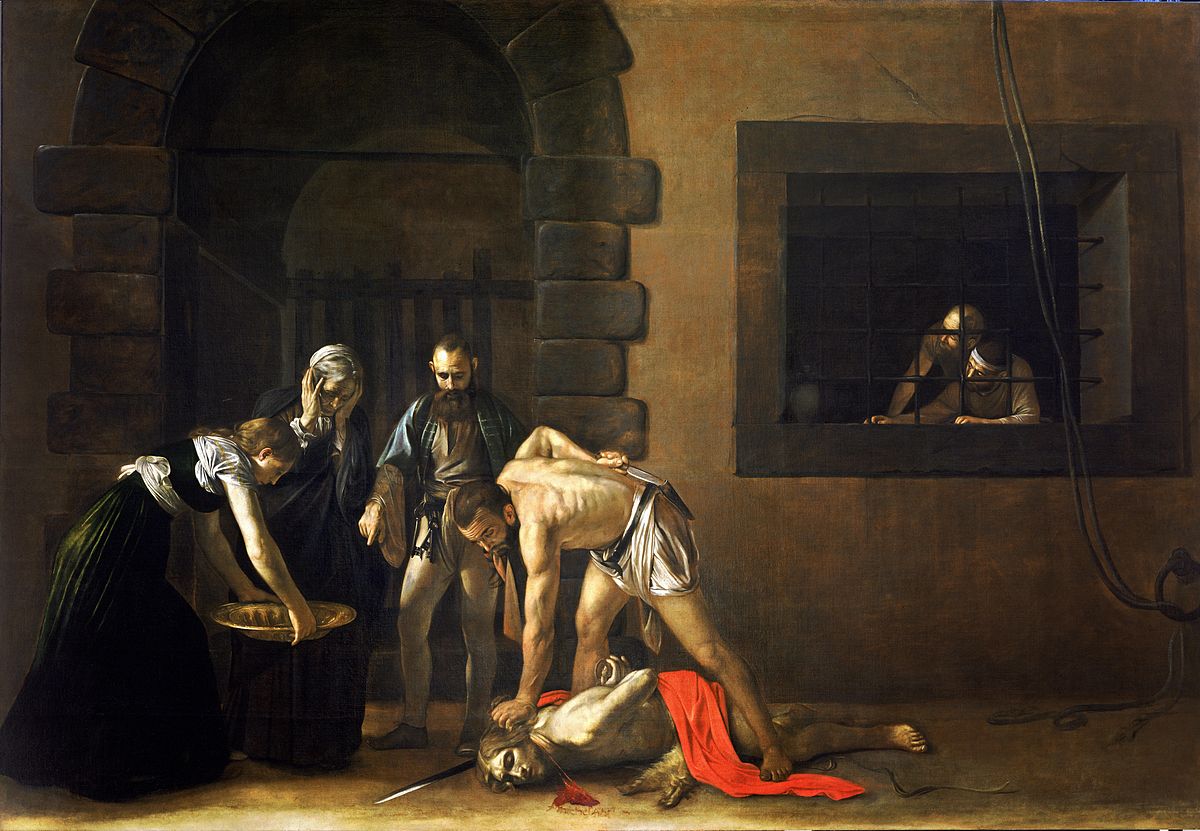
No wonder, then, that Caravaggio, the impulsive and conflicted genius of Renaissance art, chose to indulge his obsession with gruesome beheadings by painting this scene (now hanging in the St John’s Co-Cathedral in Valletta, Malta, where we saw it on holiday). His picture is startling in all sorts of ways, and not just because of his characteristic use of tenebrism by which the light and dark elements of the painting are in such striking contrast, with the human figures often illuminated from the side so that their features stand out in sharp relief. Caravaggio has chosen to depict the very moment of execution, with the jailer holding the knife behind his back having drawn it across John’s throat, and the blood is pouring from his neck as the jailor grasps his hair.
Perhaps we are unsettled by the contrasting reactions of the other figures—the horror of the old woman contrasting with the bored disinterest of the male figure next to her, the other prisoners straining to see the gore from their cell window on the right, and the girl with the platter eager just to get the job done. We might be disturbed by the off-centre composition of the picture, which breaks the rules of painting organisation even as the whole incident breaks the rules of moral respectability.
But the most shocking element of the painting is one we might not have noticed unless we look close up: that Caravaggio uses the blood flowing from John the Baptist’s neck to form his own signature. He might not see himself as a wicked tyrant like Herod, but does he in his moral dilemmas at least see himself as also playing a deadly game of consequences, just as those by-standers and minor characters do?
Where does that leave us as we read the passage? Are we being offered a stern warning of the consequences of unchecked impulses? Not many of us will have the chance to be tyrants, but the same impulses of insecurity, pride, shame and failure are present in us all. Or are we being offered a sober warning, in the example of John the Baptist, of the cost of integrity and faithfulness? Where does that all leave us, and does it offer us any ‘good news’?
We can now see that there is a basic problem with this kind of approach to the passage. All these readings are focussed on the human characters—they are taking an anthropocentric view—when the question I have asked in the title of this piece suggests something else. All these observations about what the human agents are doing are interesting, insightful, perhaps even entertaining in a strange way—but surely Mark is more concerned about what God is doing—and inviting us to take a theocentric view. This is the most important thing to do in our reading and especially in our preaching. The real question we need to ask is: What is God doing in this story?
To help us in this theological shift, we need to make two observations—one about the text itself in its canonical shape, and the other about the historical context of the gospel.
If you have only read the passage in isolation, either by its projection on a screen, or by reading it on your phone, instead of having an actual print Bible open, then you will have missed the most important thing Mark tells us about this passage—what comes before and what comes after it. (This shows how important it is that we all have printed Bibles and read from them in church.) We should be alert to this, as we have seen it before.
Mark carefully interweaves (in chapter 5) the story of a named and important man, Jairus, whose 12-year-old daughter is at death’s door, with the story of an unnamed and almost unnoticed woman, a figure fading into the crowd, who for 12 years has suffered from bleeding which has moved her to the margins of society. And we will see Mark’s technique again, in chapter 8, where he has to remind the disciples again of his provision in a feeding miracle done again just as he must touch the eyes of a blind man again before he can see more than people ‘as trees walking’.
So what do we learn when we look at the outer layers of Mark’s narrative sandwich? Immediately before the Herod/John the Baptist narrative, we read a slightly abbreviated version (compared with Luke 9.1–6) of Jesus’ commissioning the Twelve to go, in pairs, and take the good news to the villages.
Calling the Twelve to him, he began to send them out two by two and gave them authority over evil spirits. These were his instructions: “Take nothing for the journey except a staff—no bread, no bag, no money in your belts. Wear sandals but not an extra shirt. Whenever you enter a house, stay there until you leave that town. And if any place will not welcome you or listen to you, shake the dust off your feet when you leave, as a testimony against them.” They went out and preached that people should repent. They drove out many demons and anointed many sick people with oil and healed them. (Mark 6.7–13)
And immediately following the Herod narrative, we read of the return of the Twelve.
The apostles gathered around Jesus and reported to him all they had done and taught. Then, because so many people were coming and going that they did not even have a chance to eat, he said to them, “Come with me by yourselves to a quiet place and get some rest.” (Mark 6.30–31)
So how does Mark answer the question: ‘What was God doing?’ In this: God was continuing to be at work, by his Spirit, through his people called by Jesus to proclaim and enact the kingdom of God, so that others might be drawn to know him.
Decapitation is a dreadful thing, and has a powerful propaganda effect—as was apparent in the kidnapping and filmed beheading of the 20 Christian Copts by ISIL in 2015. But decapitation (in a literal or figurative sense) of organisations and even whole countries is also terrifying. The Western powers’ strategy in combating terror organisations is primarily one of ‘decapitation’, of targeting and removing (by seizure or more commonly killing) the leaders of such movements. In the Second World War, three million Jews in Poland were executed in the German death camps—but a further two million non-Jewish Poles were also killed in an attempt at national decapitation. The occupying Germans arrested and executed anyone on positions of leadership—in government, business and education—with the aim of eliminating any resistance to the occupation and turning Poland into a ‘slave nation’ that would not have the initiative to resist.
The most poignant verse in the whole narrative in Mark 6 isn’t to do with Herod at all, but comes at the end of the story:
On hearing of this, John’s disciples came and took his body and laid it in a tomb. (Mark 6.29)
Here is a body without a head, and here were disciples without a rabbi, and followers without a leader. It was not just John, but his whole movement which had been decapitated, and you can feel the poignancy in the brevity and simplicity of this verse.
And Mark is most likely writing his gospel to followers of Jesus in just such a situation. The Christians in Rome have already witnessed the expulsion of all Jews under Claudius, and this would have included important Jewish leaders in the fledgling Christian communities (as we see in Acts 18.2). They were soon to face a greater challenge—the blaming by Nero of the fire in Rome on Christians, and the torture and death of many of them, including leaders like Peter and (most likely) Paul.
What should they do and think? Amidst this calamity for such a small movement still in its early days, what was God doing? The answer, Mark tells us through this narrative, is that God was still at work, bringing healing, deliverance, and spreading the good news of the kingdom.
The friends and family of the Copts beheaded by ISIL discovered this for themselves. It is reported that their mothers thanked ISIL for releasing the video of their execution, because it meant they could hear their sons’ last words: ‘Jesus is Lord’. And one who was present with them was also convicted by the manner of their death:
After the beheadings, the Coptic Orthodox church released their names, but there were only 20 names. In the video, the leader’s victim was of black African descent, in contrast to the others, who were ethnic Copts. It was later learned that this 21st martyr was named Matthew Ayariga and that he was from Ghana. (A few sources say he was from Chad, but most say he was from Ghana.)
According to some sources, he was not originally a Christian, but he saw the immense faith of the others, and when the terrorists asked him if he rejected Jesus, he reportedly said, “Their God is my God”, knowing that he would be martyred.
Can we imagine a time when the church in the UK might be ‘decapitated’, with our leaders removed and our institutional influence gone? That is the reality for many Christians around the world. If it does happen, we might find ourselves reading this passage again with renewed interest. And perhaps being like those who travelled everywhere, and in all the places they went proclaimed the good news of the kingdom to all they met, might not seem such a silly thing to do after all.
Come and join Ian and James as they discuss these issues and the details of the text:
 Buy me a Coffee











Herodias demanded the head of John.
It is perhaps better that sinners persecute ministers now for faithfulness, than curse them eternally for unfaithfulness.
We often treat ministers kindly, and hear them gladly, while we are still unwilling to do the thing which is demanded of us- to repent and believe the gospel.
When Herod conceived his sin with Herodias it brought forth death ,even his own,
it is the universal law of God.
Reading the description of Herod reminded me of a performance of the “Scottish Play” I saw a number of years ago at the Orange Tree Theatre in Richmond. It is a ‘theatre in the round’, with just two rows of seats in a square around the stage area. You are very close to the action. At the end, one of those I was with asked me if I had enjoyed it. That was not the right word for a reaction to the stunning performance. I had witness the disintegration of the two main protagonists. It is truly a tragedy.
Aristotle described the elements of (Greek) tragedy. The first is the hero’s fatal flaw; the aspect of the character which leads to their downfall. The word used for this is harmartia. We are familar with that word from the New Testament. It is the word translated ‘sin’.
We all have that fatal flaw in one form or another. It is said, all power corrupts. Perhaps, rather than the power corrupting, it is power which particularly enables the flaw to emerge and result in tragedy.
I was struck last week that the Woman Jesus healed and the daughter of Jairus were probably mother and daughter as they both had 12 years in common. Jesus healed both and thus restored Jairus’ family.
In this episode Herod hears John gladly but his wife contaminates and destroyes him.
I wonder if Joanna Chuza and her husband were anywhere nearby? In the kitchen working, oblivious to events taking place in the banqueting hall? Busy packing up the leftovers to be sent off to Jesus and his disciples? Hot and bothered, but blissfully unaware of what was going on in the ‘world’ upstairs.
The title of the piece poses a great question ‘Where is God at the beheading of John?’, which could easily be generalised, ‘Where is God in the war in the Ukraine?’ or ‘Where is God in the conflict in Gaza?’, but I felt, by the end of the piece that the question posed at the beginning hadn’t been answered.
Ian’s answer that he thinks was Mark’s answer is that God was doing great things through the disciples.
You might not like that answer, but if Ian Paul is understanding the inspired theologian Mark correctly – and I think he is – then this is one of God’s answers.
What is God doing when I am suffering? Doing great acts of goodness elsewhere fully deserving of my praise.
Kyle – well, Mark doesn’t pose it in these terms. I didn’t (and still don’t) see the question being tackled directly. To be honest (with apologies) I think your last paragraph comes across as superficial and sanctimonious. Think (for example) of the children’s hospital in the Ukraine which received a direct hit from a missile (resulting in a number of deaths and a number of life-changing injuries); it is very difficult to say ‘oh that’s all right then, because God is doing great acts of goodness elsewhere that are fully deserving of my praise.’ I can’t imagine that anybody on the scene, dealing with the aftermath, will be saying, or even thinking, anything like this – at least I very much hope that they wouldn’t.
John the Baptist was an extraordinary character, who had a large following – and was martyred for standing up for the Word. He was a man of faith, who knew that there was a better world to come and was faithful to his calling – so calling out Herod for his immoral behaviour was an act of faith (it’s difficult to imagine that John the Baptist was completely unaware of the likely consequences of this). If Anonymous Harry the Chartered Accountant had said exactly the same thing, I imagine he would have been considered a figure of fun – and he wouldn’t have been martyred. Herod’s daughter would not have requested his head on a plate.
In fact, John the Baptist’s departure from this world and moving on to the next, brutal though it was, seems much more humane to me than other situations that I have seen (e.g. dementia).
it seems to me God rarely prevents evil acts from happening. Even with my own sin, I know it is my choice and God respects that. Human free will is real. So God allows wars, and beheadings. He always has. Disease is a different issue, but again it seems to me it is only sometimes healed directly. We can but hope all will be well in due course. But when youre going through it, I know it all seems rather theoretical.
PC1 – to the question of ‘where is God?’ I think (following Moltmann – of all people – I don’t consider him a fine Christian commentator, but I found that he did have some good and powerful insights) that we have to go back to the Creation. There is a difference between ‘begetting’ (which takes place within the God-head) and ‘creating’. If you take the starting point that the first creative act was, in an act of self-humiliation, to create a God-forsaken space into which to put the creation (following some stupid philosophy – which nevertheless might have some merit – that a perfect God is omnipresent – so where does He put the creation?). You then see darkness over the face of the deep. Since the light gets separated from the darkness, we can assume that before the separation it is all mixed together – and I think that this is what Paul is telling us in Romans 7 about the ‘wretched man’ – you have the ‘innermost being’ and the carnal nature, sold unto sin, inhabiting the same body – and the separation of light from darkness is eschatological, in the sense that when we finally pass from this life to the next, the ‘darkness’ (sinful nature) is finally separated and we see the ‘innermost being’.
The point is that Creation, to have any value at all, has to be external to God (hence the God-forsaken space) and people (the created beings) have to willingly come to Him. Where is God? He is right in the midst of the struggle so that the ‘innermost being’ can ultimately escape the ‘sinful nature’ – i.e. the crucifixion. So the answer to ‘Where is God?’ is that he is right there in the midst of the suffering – in the Crucifixion.
With apologies – this probably sounds a bit like havering – I think the ‘Where is God?’ question when one sees real suffering, either through illness (e.g victim of dementia), or depravity (e.g. victim of a missile that lands on a children’s hospital), is a very good one and also a very difficult one – at least to explain properly, although as Christians we understand it at some intuitive level.
Yes Jock a familiar feature alas.
Ian and James posed the question but did not discuss it.
Where was God in all this,Where was God in all the martyredoms
of the Prophets and Apostles?
Maybe only those such martyrs can say.
Suffice to say that there is only one prayer mentioned in Revelations;
6:9 And when he had opened the fifth seal, I saw under the altar the souls of them that were slain for the word of God, and for the testimony which they held:
Ch.6:10 And they cried with a loud voice, saying, How long, O Lord, holy and true, dost thou not judge and avenge our blood on them that dwell on the earth?
6:11 And white robes were given unto every one of them; and it was said unto them, that they should rest yet for a little season, until their fellowservants also and their brethren, that should be killed as they were, should be fulfilled.
All heaven hears their cry!
This passage is similar to the book of Enoch
En. xcvii. 3–5 the prayer of the righteous for vengeance overtakes their persecutors on the day of judgment with woeful issues (xxix. 3, 16). “Persist in your cry for judgment, and it shall appear unto you; for all your tribulation will be visited on the rulers, and on all their helpers, and on those who plundered you” (civ. 3, cf. xxii. 6, 7,
A very useful commentary. I was also thinking of the various decapitations we have heard of in the last few years, including the Coptic martyrs.
During the Cold War there were various discussions about whether a “decapitation strike” against he enemy (USSR in this case) was a good or bad way to bring war to an end: yes, it could leave a centralised opponenet directionless; but on the other hand who could you then talk to in order to end the conflict?
You mention one side’s actions in Poland during WW2: however you omit to mention the Soviet Union’s deliberate policy of decapitation by murdering leaders in Katyn forest shortly after the USSR invaded in 1939 in league with Germany; a policy the USSR continued after the war, enabling it to continue its occupation and suppression of Poland for another 50yrs.
FWIW here’s an excerpt from my sermon for tomorrow:
The death of John the baptist is told in a “flashback” episode, almost as an aside.
It’s a standalone story within the story.
First, a note about the three principle characters: King Herod, his wife Herodias and her daughter.
King Herod is the son of the King Herod we meet in the Christmas story (Herod Senior and Junior, if you like.)
And the Herod dynasty are an extremely dysfunctional family, to put it mildly.
Confusingly, the woman at the heart of this story is called Herodias – the feminine version of Herod (like Paul / Pauline or Stephen / Stephanie).
And then her daughter (called Salome by the Jewish historian Josephus but unnamed in the Bible).
More about all of them later.
There is one character notable for his absence, though.
God.
God is never mentioned once.
Why?
Where is he?
What, if anything, is he up to?
And where is God today when things like this happen, when bad people do bad things to good people?
Absent?
Silent?
Or watching and waiting?
(Here I’m reminded of George Bebawi’s comment: “Two things you need to know about God: first, he is always late; second, he doesn’t care about his reputation.” Obliquely rabbinic and not entirely true – but not entirely untrue, either.)
Too late for this year, but here’s something I spotted when I preached on this a few years ago, and I’m sure it’s deliberate on Mark’s part…
Herod is introduced as ‘King Herod’.
But then he becomes just plan ‘Herod’: verse 16, ‘Herod’, verse 17, ‘Herod’, and there’s his wife, ‘Herodias’, verse 18, ‘Herod’, verse 19, ‘Herodias’ again, verse 20, ‘Herod’, verse 21, ‘Herod’, verse 22, ‘Herodias’, and ‘Herod’.
But then it changes, and we don’t hear the word ‘Herod’ or ‘Herodias’ again.
Now he’s, ‘the king’: verse 22 ‘the king’, verse 23, ‘my kingdom’, verse 25, ‘the king’, verse 26, ‘the king’, verse 27, ‘the king’.
I think Mark wants us to ask the question: Who is the king? Is Herod the king? Normally, the king is the person who’s in charge. But is Herod really in charge here?
Great observations…