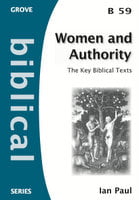
 I have just finished writing a Grove Biblical booklet on ‘Women and authority: key biblical texts’ which aims to explore all the key texts in 32 pages, due out in the next week or so. I am aiming to cover Gen 1, 2 and 3, Luke 24, John 20, Acts 18, Romans 16, 1 Cor 11, 1 Cor 14, Eph 5 and 1 Tim 2.
Having wrestled with these texts for the last two years, this is my considered summary:
1. The creation accounts offer no evidence of hierarchy in male-female relationships as part of the original created order. In fact, this is a surprising absence given the patriarchal context in which these texts were written and read. The notion of a husband ruling over the wife (Gen 3.16) is not part of the created order but is a result of the breakdown of a shared relationship.
2. The gospel accounts appear to show no embarrassment about the commissioning of women to roles that would normally be restricted to men in relation to witnessing the resurrection, communicating this witness to others, and offering reliable testimony that others should trust (though they often do not). The gospel accounts on their own do not appear to be a systematic establishing of women in these roles in a permanent or ‘institutional’ way, but even here it is a striking statement of women’s roles given both the theological and cultural barriers to this having happened in the normal course of events. There are no parallels to this kind of commissioning and trustworthy testifying in Jewish literature of the time; in fact, there is strong evidence of the contrary. Moreover, the women here are frequently offered (more or less explicitly) as models of testimony or discipleship, and are often presented in sharp contrast to the main group of (male) apostles.
3. The evidence from Acts and Paul goes further. As God gifted them, women appeared to occupy the roles of deacon, leaders, teachers, church planters and even apostles. Although men feature in leadership roles more frequently than women in the Scriptures, there is no uniform limitation of certain roles or positions along gender-defined lines.
4. The critical texts in 1 Corinthians, Ephesians and 1 Timothy are best understood as offering a corrective in particular contexts in the light of the outpouring of the Spirit, in several cases seeking to re-establish mutual interdependence in creation in response to suggestions that women are superior to or independent of men.
5. There is no textual evidence that the New Testament envisages any permanent prohibition on women exercising authority or a teaching role on the grounds of their gender. It is true that, in the history of the church, some texts have been read in this way, but such readings do not have strong exegetical foundations.
6. The nature of the texts on women’s roles sets this issue at some distance from current debates on same-sex relations. There is no positive recognition of same-sex sexual relations to parallel the positive texts on women’s examples and leadership, even if these are set alongside the texts which are disputed or which have been read negatively in the past.
 Buy me a Coffee















Ian,
A good summary of the evidence. Good work!
What do you think of Philip Payne’s work: MAN WOMAN ONE IN CHRIST? Your summary seems to be consistent with his conclusions.
Great stuff! Have you thought about compiling your posts into a PDF so we can have them all together? (Or maybe that will kill the sales of the booklet!)
When will the booklet be available to buy? and where can we buy it?
Dear TL, it will be available in about 2 weeks from http://www.grovebooks.co.uk
Hey guys,
I recognise that this is a disputed issue, and I am probably falling down on the other side of the debate to the one outlined above. I’m just interested as to what makes the “critical passages” only “corrective in particular contexts.”
Those passages largely seem to me to be referring to a basic reality that is being subverted, and thus must be restored to orthodoxy. I’m just interested to see if there is any actual evidence to suggest that the churches had special contextual circumstances that would have been appropriately addressed by the response Paul gives.
Thank you, dear brother, for your struggle and study over these issues. I appreciate it so deeply.
Hello,
I know this comes YEARS later; however, I didn’t understand the last point (6). I don’t understand the mixing of the two topics: same-sex relations and women in leadership (particularly in the church).
That’s because they are often linked together, and a good proportion of those who argue that women should exercise leadership in ministry also argue for same-sex marriage.
See this article here: https://www.psephizo.com/sexuality-2/unhitching-women-from-gays/