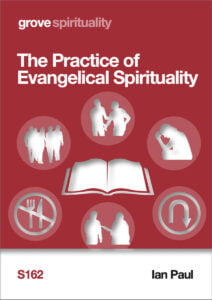
Ian Silk has written a Grove booklet on the vital subject of encouragement. I interviewed him about it, and include the video below. Here is the start of the chapter of the booklet, to give you a flavour. You can buy from the Grove website here.
What is encouragement in common experience, and where is it needed? I asked some friends: ‘heartfelt, sincere words to build up,’ ‘a word ministry to the church that addresses discouragement, meeting a need or solving a problem,’ ‘deeds of kindness.’ So is it words, or actions, or both? Is there a difference between giving encouragement and showing mercy? Someone said encouragement does it with words while mercy rolls up its sleeves and gets its hands dirty. Someone else said education and encouragement go naturally together, the one lovingly drawing out and building with what is within and the other putting in what is needed to confront our fears.
Encouragement is an intentional ministry of word and action that aims to make a difference to people in body, mind and spirit. ‘Encourage’ is ‘in-courage’— giving support, confidence or hope to a person or a group of people. ‘Without this gift of encouragement we die. Bereft of it life becomes unbearable and full of misery’ (Russ Parker, The Wild Spirit (London: Triangle, 1997) p 62).
I wonder, is encouragement a home thing or an away thing? In order to encourage others should we stay where we are or do we go somewhere else? People came to visit John Newton in his home and were encouraged and he also wrote to them from his home—although letter writing could also be understood as a form of visiting. Elizabeth Fry went to visit people nobody else visited, in prison; she was an away encourager and yet it seems her own home was often full of people who needed encouragement—family members, friends, church members. Home or away? Perhaps the answer to ‘where’ is ‘everywhere!’
People who are great encouragers may more often be known for something else; their public role is an outward expression of a ministry of encouragement that is more behind the scenes. It is only when we hear more of their life story that we realize just how much God has used them in other ways too. One of my favourite examples of this is Billy Graham, who as well as being the voice of the Lord on stage in Harringay in Britain in 1954 was also known in India as ‘Angel of Mercy’ because of his practical help for those affected by a tidal wave in 1977.
The enigma of encouragement—is it a quiet gift or does it make a sound? Yes! Is it private or public? Is it a home thing or an away thing? Yes! Is it words or is it deeds? Yes! Is it for a moment or is it for a lifetime? Yes, it can be all of these things. ‘When we encourage, we’re quite like God’ (Jeff Lucas, There are No Ordinary People (Farnham: CWR, 2015) p 41).
Barnabas, the Son of Encouragement
I wonder who first encouraged Barnabas, such that he became such an encourager himself? We are not told. Like so many encouragers, Barnabas seems to appear with gifts of encouragement to give, gives them, and then melts back into the background leaving a trail of encouragement in his wake. Encouragers are towers of strength who build other towers of strength—patiently, deliberately, consistently: comforters who comfort others with the comfort they themselves have first received; investors in people whom they perhaps will never actually see with their own eyes; releasing the gift of encouragement to spread unseen through communities. Barnabas is a bridge-builder, whose bridges stretch far further than he could ever have imagined. Because of this son of encouragement we have Paul who himself became an encourager, we have John Mark who wrote a gospel that has travelled through space and time, and we have a church full of Gentiles, possibly you and me.
Barnabas has the gift of alongsideness. He comes alongside the new church in Antioch; seeing evidence of the grace of God at work he rejoices at the new and slightly scary thing that is happening, encouraging them to remain true to the Lord with all their hearts (Acts 11.23). But he does not stop there, because encouragement is an active ministry that takes initiatives. Barnabas’ world- changing act is to get Paul alongside the Antioch Christians and they both pour in the teaching at just the right moment; ministers are gifts of encouragement. In Antioch, we are told, the disciples were first called Christians. Something came together there—encouragement was on the loose! And a moment, or rather a season, became an unstoppable movement that continues to this day all over the world.
We all have the ability to encourage others and so let loose a flood of blessed consequences in and through those we encourage. Barnabas is a great example of this and of the cost we sometimes have to pay. The results ripple out across the world though we may never know it. So then, whether it is by word or dynamic action, whether by offering a listening ear or hospitality, or by visiting the needy or supporting those who fail, let us be encouragers who by so doing learn to build the kingdom and grow the church (Russ Parker, The Wild Spirit, p 69).
Paraklēsis
The word for encouragement in the Greek text of the New Testament is paraklēsis and an encourager is a paraklētos. The Holy Spirit is by centuries-old Christian tradition the paraclete, so it may be helpful to think of God the Holy Spirit as God the encourager. But what sort of encourager? One study of the role of paracletes in Greek writings prior to John’s gospel points out something surprising:
The paracletes are not portrayed as advocates in the court but as persons striving to use their connections…to persuade the jurors to decide in favour of their client before the trial has even commenced.’ (T Gates Brown, Spirit in the Writings of John).
I wonder then if Barnabas, that son of paraklēsis, was not in fact exercising a ministry of ‘holy brokerage’ that reflected particularly clearly an important aspect of the Holy Spirit’s own powerful ministry of connection and mediation among God’s people? This sort of encouragement from God through others can really make a difference!
We can read the parts of Scripture which talk about the paraclete with a number of aspects of encouragement in mind: ‘Do not let your hearts be troubled,’ says Jesus.
Trust in God, trust also in me…I will ask the Father, and he will give you another Encourager to be with you for ever—the Spirit of truth…All this I have spoken while still with you, says Jesus. But the encourager, the Holy Spirit, will teach you all things and will remind you of everything I have said to you…My peace I give you’ (John 14, my translation).
Translators and interpreters need to make choices. Paraklēsis cannnot be translated into one single English word. Encouraging, counselling, exhorting and comforting are some of the options, but which one should we use in particular context? In Luke 2.25 it is often translated ‘consolation’ but it is much more than that. Simeon, along with so many others, has been waiting for encouragement, which he now discerns to be embodied in the child Jesus that he cradles in his arms:
Now there was a man in Jerusalem called Simeon, who was righteous and devout. He was waiting for the paraklēsis of Israel, and the Holy Spirit was upon him… (Luke 2.25).
This word paraklētos has a background in the Old Testament: ‘Encourage, encourage my people, says your God’ (Isaiah 40, my translation). The Hebrew equivalent is Menachēm: One who comforts, encourages. ‘Your rod and staff encourage me’ (Psalm 23, my translation). You comfort, console, guide, strengthen, restore, shepherd me.
Praise be to the God and Father of our Lord Jesus Christ, the Father of compassion and the God of all encouragement, our Encourager in all our afflictions, causing us to be able to encourage other afflicted ones by passing on the encouragement with which we have been encouraged (2 Cor 1.3–5, my paraphrase).
We hear of the gift of encouragement in Paul’s Letter to the Romans:
We have different gifts, according to the grace given to each of us. If your gift is prophesying, then prophesy in accordance with your faith; if it is serving, then serve; if it is teaching, then teach; if it is to encourage, then give encouragement; if it is giving, then give generously; if it is to lead, do it diligently; if it is to show mercy, do it cheerfully (Rom 12.6–8).
 Prophesying, serving, teaching, encouraging, giving, leadership, showing mercy…a perfect seven and a rainbow spectrum of gifts in ministry. And encouragement is right at the heart of the seven. It is a facilitating gift in relation to all the others. So if someone’s gift is to encourage, let them encourage! Release the encouragers in the church and in the world, for where there is encouragement all the other gifts and ministries will be enhanced. I think it is interesting too that in the list in Romans 12 encouraging sits neatly between teaching and giving and there is surely an overlap! Certainly, when we begin to think about why encouragement works in practice, we find we cannot dissect this rainbow spectrum—in Jesus Christ prophetic action, words of teaching, deeds of giving and alongside compassion are not separated. Encouragement reaches out in both directions. It embraces a whole ministry of wholeness and hope.
Does encouragement have anything to do with personality? There is good news for those of us who perhaps feel we are more introvert: we can be encouragers. Eugene Peterson sees paraklēsis as something that happens quietly, in conversations, informally; less noticed perhaps than pulpit preaching or classroom teaching. He links the gift of encouragement with the gift of discernment (Eugene Peterson, Practise Resurrection (London: Hodder, 2010) pp 171–176). There is good news too for those of us who are more extrovert: some of the greatest out-front leaders have been encouragers.
The booklet is £4.95 post-free in the UK, or you can buy a PDF for immediate download, from the Grove website.
Come and join Ian and me in conversation about the booklet—and about the ministry of encouragement:
 Buy me a Coffee




















Thank you so much for this article. Having worked in international / multicultural mission for years, it strikes me just how bad the English are in encouragement and simple ‘thank yous’. I mean something more than a bried nod and a ‘ta everso’ but considered responsiveness. It’s why I try to drop a note to those who took part in our Sunday services with a specific word as to what was so great about their respecitive ministry whether the music, reading, prayer, speaking and, yes, the flowers.
Yes – encouragement is so important! A good friend of mine used to say if Christians can do nothing else, they can be kind. And it is kind to encourage. You nearly always remember somebody who has encouraged you.
But despite all our means of communication now it seems remarkably absent. I do not engage in social media, and this is the only blog I am on — and one based in the USA. The USA blog is full of encouragers — and people keen to learn from others.
Is that just an American thing?
“Is that just an American thing?”
Not sure which American blog you are referring to. I’ve known three over the years. Stand Firm was anything but encouraging and ended up dividing. Anglican Ink and VirtueOnline are ‘tabloid’ in terms of journalism, so by nature not very encouraging. They used to allow comments but no longer seem to – and the only comments allowed were those that agreed with their rather conservative stance.
This blog can actually be encouraging at its best and at least allows comments from every perspective – for which we must be very grateful.
“Do not forsake gathering together… but encouraging one another” – Hebrews 10:25.
Thre is an increasing phenomenon of Christians forsaking gathering together, because they find those gatherings *discouraging*. Some gatherings might be, but is it perhaps something about the Christians who give it up?
What or who do we take encouragement from and encouraged in which direction?
Does it include opposition? 360degree assessment that is critical, that seeks renunciation of attitude, beliefs, behaviour for change.
Yesterday driving in the car and trying out various radio stations, I came across Ian Paul being interviewed, on Premier Radio, asked and answering biblical questions and was greatly encouraged by his knowledge and enthusiasm, much more so than the some of the written articles on this site and the comments, which represent social media, mostly engaged for airing personal views
My personal view is that Ian’s blog would benefit from disabling all comments. Unless our host is encouraged by having responses, rather than posting into a seeming ciberspace,void, though I think ‘footfall’ to the site can be measured without comments being permitted.
Thanks, Ian.
Ian – thank you – spot on. Could say more, but you’ve said it already. Excellent.
I have always found that encouragement delights so many people
in so many ways, giving someone thanks often surprises, it
makes people feel better for having met the Spirit of God.
We all need encouragement but we would prefer validation.