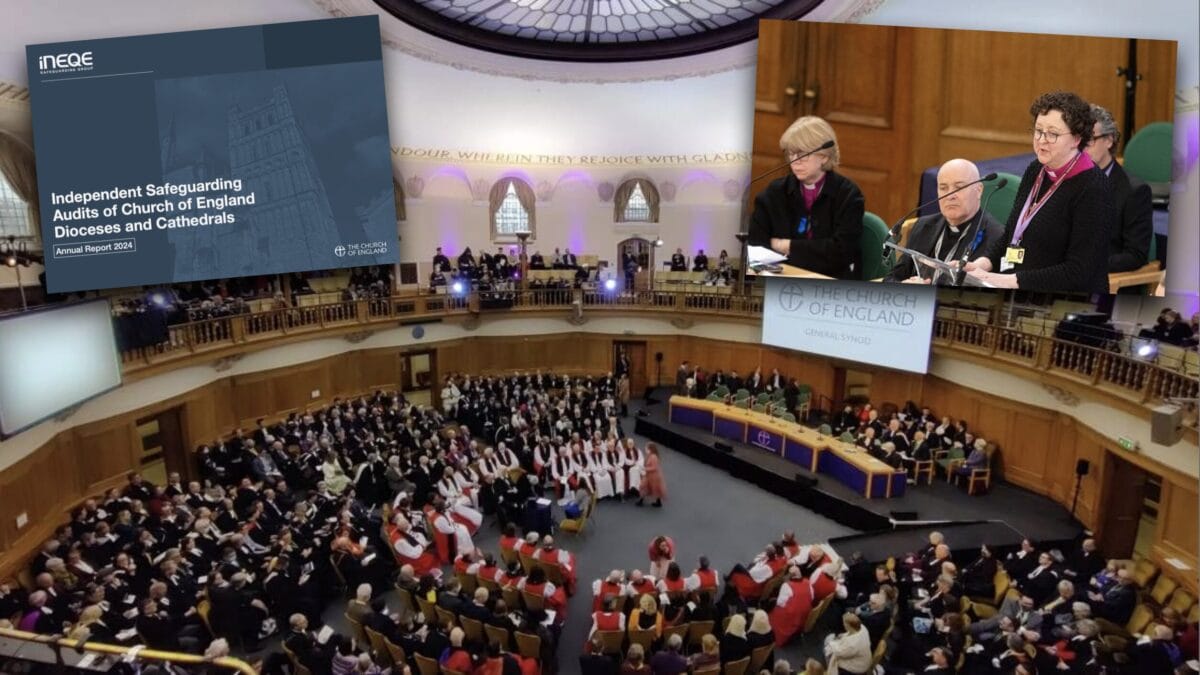
Unless you have been living under a rock, you will be aware that safeguarding has been a deeply contentious issue in the Church of England for several years, and has come to a head over the last few months and weeks. Justin Welby resigned as Archbishop of Canterbury because of his failure to take action in relation to the past abuse of John Smyth, and Stephen Cottrell continues to face criticism in relation to his handling of David Tudor, who was banned from ministry because of past abuse.
This has created an atmosphere of intense pressure and scrutiny for any discussion about safeguarding, with different parties making strong and often conflicting demands, and that in turn has created a challenging context for fruitful discussion about the way forward for the Church. Nevertheless, much work has been done, and this week in Synod we have had several major discussions about safeguarding leading to key decisions—though I believe the main one has been badly misreported in the press and on social media.
On Monday afternoon, we had a debate about the response to the Makin report, which had documented the abuse of John Smyth mostly in the 1980s, and the failure of church leaders to deal with and prevent it. The complexity around Makin was that it was commissioned (by the Archbishops’ Council) five years ago, and should have report after nine months. I think a major failure of us on the Council was not to ask more questions about progress—and the final report, whilst leading to action, also contained errors of fact. In the debate, we heard testimony from Smyth victims, read by Julie Conalty, the deputy lead bishop for safeguarding, and in this and other debates we also heard from abuse survivors who are members of Synod. There was little to decide, and the debate finished early.
The main debate, though, run from Tuesday mid-morning to later in the afternoon; I estimated that we spent around four and three-quarters hours in the debate in total. The specific issue around independence itself has a complex background:
a. The IICSA report in 2020 raised the need for independence of scrutiny of safeguarding.
b. The Archbishops’ Council set up an interim ‘Independent Safeguarding Board’ in 2020, but the Wilkinson report on this noted its establishment was rushed and ill-thought-through, primarily because of pressure from Justin Welby.
c. The termination of the interim ISB because it was failure to deliver what was asked because very contentious at Synod in July 2023—not least because both Justin and Stephen delayed its termination out of a concern for the optics, which meant that it ran into Synod instead of being terminated earlier with a chance to put better plans in place.
d. Following this, the archbishops (through the Archbishops’ Council) commissioned Alexis Jay to report specifically on the options for independence of safeguarding in the Church of England. However, the brief as reported to the AC was for Jay to look at the options for independence, but when the report came out and was debated in February 2024, Jay was adamant that she had only considered the options for fully independent operation and scrutiny of safeguarding, and not the whole range of options.
This all meant that a tension was already created between some survivors and their advocates who expected full independence of operation and scrutiny, in line with Jay, and others, including other survivors and independent safeguarding experts, who believed that independent operation of safeguarding was unwise and unworkable—whilst independent scrutiny was essential. This tension was reflected in the lobbying beforehand and the response after the debate and decision.
The debate itself felt very different from previous discussion. There was a good deal of space, listening, and respect, and the voices of survivors, with their different views, were heard well. It did feel like we were in a much better place to explore the issues carefully and respectfully. John Bavington, who is a vicar in Bradford and a member of Synod, offered this excellent summary of the debate on Facebook, and I quote it with permission:
1. The people on General Synod are not stupid or evil or cowardly or self-interested or any of the other perjorative things which will likely be said about us. We met yesterday to discuss how to ensure that church is a safe community to be part of. The background is a series of scandals and subsequent reports and recommendations as to how to move forward. There is unanimous grief and repentance over the failings of the institution in the past. The voices of survivors and victims were heard and contributed to the discussion.
2. In front of us were two main options, known as “model 3” and “model 4”. To summarise them briefly:
Model 3 would mean that the Church of England continue to employ safeguarding staff in dioceses, cathedrals, and the national team, but would create a separate, totally independent organisation to have oversight of church safeguarding. Perhaps a good analogy would be the way that Ofsted oversees education.
Model 4 would mean that a new, totally independent organisation would be set up to employ all safeguarding professionals in the Church of England. This would be in addition to the new totally independent organisation which would be set up to provide oversight as in model 3.
3. The bishop with responsibility for safeguarding is Joanne Grenfell, an extremely capable person, who introduced the motion which would have committed us to model 4.
4. There were several proposed amendments and each was debated carefully and thoughtfully. For example there was an amendment proposed which would change the language of the motion from “greater independence” in safeguarding to “total independence”. While this sort of totalising language is attractive at one level, in the end it is unhelpful. For one thing, it is philosophically undesirable to describe safeguarding as something other people do, something independent of us, when all our language should be about how safeguarding is something we all do, something we are all responsible for. Secondly, it is utterly impossible to have totally independent safeguarding. The work begins in the parish, where our brilliant safeguarding officers are volunteers and members of our church, and how could they be “totally independent”?
5. One amendment proposed committing ourselves to model 3 (instead of model 4) and this gave us the opportunity to debate the pros and cons of both models. As far as I could see, the main reasons for choosing model 4 were (a) this was the model the majority of survivors of church abuse wanted us to choose; and (b) It would make a statement to the world (and the media) that we were holding nothing back in our desire to be transparent and accountable and humble. However, I was aware that the survivors and victims were not unanimous in their views, and I was very concerned that we should choose the best, safest option, not just the one which we were under pressure to choose because of the way it would look to others.
6. There seemed to me to be a number of good reasons for us to choose model 3 instead of model 4.
(a) No-one else anywhere has ever tried anything like model 4. It is untested, unknown, and unwieldy. The Bishop of Blackburn described it as “safeguarding done to us, rather than safeguarding done by us.” as such, I fear that it might in fact be unsafe.
(b) The vast majority of safeguarding professionals in the church recommended model 3. This was not self-interest (as someone unkindly suggested in a speech). Rather, it was the considered position of hard-working, experienced, committed professionals who actually manage the current system. And the current system is a million miles from what was (or wasn’t) in place when the scandals mentioned earlier took place.
(c) Legal advice from VWV solicitors warned that church charities (Diocesan Boards of Finance, Cathedral Chapters, etc) might find it extremely difficult to show that they they were meeting legal obligations as charities if we adopted model 4.
(d) This was reinforced by a letter from the Charity Commission reminding us all that charity trustees must consider safeguarding an essential part of their responsibility—not something which can be delegated to others.
(e) An opinion from Jim Gamble of the INEQE safeguarding audit group (who have been auditing church safeguarding for a year and a half), recommended model 3 rather than model 4.
(f) there are currently 85 charities in the C of E which employ safeguarding professionals (dioceses, cathedrals, nation church), and the task of transferring their employment, etc, to a new organisation is extremely complex with matters such as TUPE, variable terms of service, etc, to be considered. The new national organisation would have to create a new culture and identity, structures of management, etc, which would be complex and possibly opaque and introducing new, as yet unknown conflicts of interest. I am not sure it can be done well. I’m not convinced it would give us a safer outcome than we currently have.
7. The bishop of Blackburn proposed an amendment which gave us “model 3.5”. This was a good solution in my opinion. It involved adopting model 3, but not ruling out model 4 in the future. This would commit us to begin to do the due diligence on whether model 4 was doable and how it would work, whilst getting on with setting up the independent oversight which both models envisaged. We aren’t ready for model 4. We might never be ready for it, because it might not be the right model, but we won’t really know without a lot more dispassionate research and planning.
Summary: I think we have ended in the right place. So do the majority of Synod members, who voted for model 3.5. This includes the majority of the bishops. Before you launch into an online tirade, please respect the hours that have gone into the thoughtful consideration of these matters, the vast amount of reading we have all had to do, the careful prayer. May the Lord bless us all, and may the church be a safe place for all.
Not ONE person should come to harm through being part of the church community.
Following the vote, others also affirmed the wisdom of this decision. Justin Humphreys, leader of the independent safeguarding organization ThirtyOne:Eight, commented on Facebook (writing in a personal capacity):
Despite this not being perfect and with a real need for much further work, this was the best way forward from among the options presented. I have always advocated strongly for independent scrutiny and support. I gave evidence to this effect in my evidence to IICSA. We should not underestimate the difference that can be made through robust, clear and supportive oversight. Hopefully, we will begin to see the benefits of this before too long.
The other elements of independent operational safeguarding have always troubled me. It is unproven, risky and would have been disproportionately costly and time consuming to achieve. Let’s not also forget that the likely slowness of this would have slowed implementation of the scrutiny body, which has largely had unanimous support and is a proven improvement model.
Having led performance improvement and quality assurance functions in children’s social care and been the LA lead and liaison for regulatory inspections, I know this to be true. I have seen it and been involved from both sides of the fence.
And Mike Harrison, newly appointed as bishop of Exeter, offered a similar positive assessment.
As Bishop of Exeter, I am committed to the highest standards of safeguarding and enabling the voices and experiences of abuse survivors to help shape our safeguarding culture. I welcome the General Synod’s decision to transfer the National Safeguarding Team to an independent body (Model 3) and thus move to independent scrutiny, together with the amendment to call for further work as to the legal and practical requirements necessary to implement Model 4. You can read more about the changes here.
The benefits of Model 3 include enabling the safeguarding team to remain embedded in the Diocese of Exeter, where they feel they can best support parishes and influence diocesan culture. Work is already underway for the Diocesan Safeguarding Advisor, Costa Nassaris, to transition to becoming the Diocesan Safeguarding Officer, which will strengthen his autonomy in making safeguarding decisions.
And it is worth actually reading the INEQE report, an independent assessment of where safeguarding on the ground actually is in the Church of England.
For many years, the Church and its community were profoundly let down. Individuals in positions of authority failed those who worked and worshipped within it, prioritising the institution’s reputation over the well-being of its members and the wider community. They hid behind, or failed to challenge, outdated and arcane church laws – rules that baffle ordinary people who possess a simple understanding of right and wrong. Over time, insult was added to injury as the Church appeared incapable of change…
However, the Church of yesterday is not the Church of today. Moral outrage and public exposure have driven significant change. This does not mean that non-recent cases will not surface – indeed, we must hope that they do. Nor does it mean that offending in a contemporary sense will cease entirely. But it does mean that, when it does occur, it is now more likely to be challenged and addressed with the victim and survivor’s best interests at the forefront…
I believe the 2024 Independent Safeguarding Audits provide compelling evidence of the Church’s rapid improvement and that the alternative operational model outlined in this report offers an appropriate balance between internal operational independence and existing governance arrangements.
The question then remains: why was the press coverage almost uniformly negative? Why were the repeated headlines ‘Church rejects full independence‘ or ‘Church kicks survivors in the gut‘?
Why did Joanne Grenfell—who has up till now been really excellent in the media—offer a negative assessment of what so many think is the best way forward?
The Church of England’s failure to adopt a fully independent safeguarding model was a missed opportunity to make clear it has listened to victims, the bishop tasked with leading on the issue has said.
Why are we confusing listening to people with doing what they demand? And why repeat the false claim that all survivors think the same thing?
Why did Sarah Mullaly, bishop of London, express her disappointment in the decision? And why did Stephen Cottrell do the same on Facebook, leading to a string of angry criticism in comments?
Why was there no bishop or other spokesperson setting out the positive change of culture, the value of the decision, and the encouraging conclusions of the independent audit by INEQE?
Are we still in a position that we are playing internal political games by currying favour with different groups of critics? I think the business of safeguarding, and the people who have been wounded by the past failures of church leaders, deserve better.
 Buy me a Coffee










I think the answer for the negative response is that there is a widespread lack of confidence in those who lead the Church of England to deliver anything – least of all safeguarding – effectively and not allow their vested interest in the institution to distort the official aim of structural changes, however clear and well thought out these changes might seem. Those with experience of this therefore want something that gives as little control and responsibility to these people as possible – hence the instinctive feeling that (whatever the question marks against it) Option 4 was best. It was in reality a vote of no confidence in those who lead the church who don’t appear to have it in them to do anything well, let alone the totally crucial area of safeguarding.
The biggest issue – as was said many times in the debate – is the culture of the Church of England. And this is not just at a national level but within dioceses and parishes where often dealing with anything difficult is avoided for as long as possible in the hope that it will simply go away. Its dangerous to claim that it is all brilliant in the parishes and thee only real problems are nationally. My book ‘Safeguarding the Institution: How the Culture of the Church of England facilitates abuse’ is out soon.
https://safeguardingtheinstitution.com/home/
Very helpful; thanks.
That’s a helpful analysis from Stephen. A ‘vote of no confidence’ may well at times be the right response to institutional leadership but it should be seen for what it is – essentially a negative statement. The problem with it in any context is that it can tend to simplify and polarise discussion around ‘so what next?’ – as it seeks to be going in this context. Also, in an essentially democratic model, it can, and usually should, lead to the departure of those who no longer ‘have the votes’. But the CoE is not such an institution , neither theologically nor structurally. Hence a lot of sound and fury – external and internal – but little light as to what next.
For what it’s worth, 3.5 feels right to me.
Another very helpful analysis, Paul – and the summary from John Bavington is as encouraging as it is gracious. Sadly, I believe that the current environment regarding our senior clergy has not contributed to the otherwise generally positive milieu following the Synod’s decision to move to Model 3.5. I am afraid that ++Stephen Cotterell in his criticism is thinking more about protecting his already damaged reputation by seeming to side with the media view of survivors. Other Bishops, whilst also siding with this populist but largely incorrect view, seem to be jockeying for position within the selection process for higher roles within any new hierarchical episcopal responsibilities, if not for the role of Archbishop of Canterbury itself.
It really pains me to feel this way towards people who hold such honoured positions, but the evidence to date and the behaviour of those in these positions give me no great confidence in attributing much weight to their words or to their intentions.
“Root and branch” is a phrase that is increasingly coming to mind with regard to changes in the Church of England.
Thanks for this helpful summary of the Synod decision; it does look like the best option was chosen. The media can run with agendas and they undoubtedly have a go to list of people to phone to get good quotes from that will highlight (ande ven create?) divisions and conflict. We need to be very cautious when claiming to know the inner motives of others and appearing to require others to change.
There’s a helpful letter by the Bishop of Warrington on the Diocese of Liverpool website which relates to this at: https://liverpoolcofe.org/a-pastoral-letter-from-bishop-bev-to-the-general-synod-of-the-church-of-england/
Finally an insight into the reason for the mutually agreed period of study leave for Bishop Mason and the timing of her disclose against Bishop JP. If only it had come sooner:
One step further back, the question is: How can the church (or any organisation) detect and keep out persons who have a private interest in in sexually abusing the young and the vulnerable? People often get intangible feelings about others, and these should be taken seriously – but they are not always right, and they cannot be shared without running the risk of actionable slander. I’m sure that children can tell who is creepy much more easily.
Then there is the question of what training anybody is required to take. If I had done the flower arranging for a church for decades and was then asked to devote several hours to a largely tickbox course, I’d retire.
The church should pay for any DBS. I once made it clear that if I had to pay for my own DBS – especially given that I had recently been DBS-cleared by a local school in order to give talks there – then I should refuse my assistance. But there is also the problem that anybody suggesting online that we could do with a little less immigration runs the risk of having a “non-crime hate incident” recorded against them that would presumably appear on DBS. Our government is calling for an expansion of the recording of such non-crimes. I sometimes wonder if I should write to the Home Secretary to inform her that I didn’t break the speed limit.
Anton, you ask a very good question: “How can the church (or any organisation) detect and keep out persons who have a private interest in in sexually abusing the young and the vulnerable?”
There’s also another and more difficult set of issues: How can the church ensure a person is psycho-sexually ready and prepared for the challenges he (it’s mainly men) will face in ministry? It is my experience that men don’t enter the priesthood with the intention of grooming and abusing young girls/boys or crossing boundaries with women/men. Some do, of course, as they do in all walks of life. Rather, there are men who face temptations they are unprepared for and ill-equipped to deal with. This area has now become a focus of assessment and formation for the priesthood.
In my opinion, and its no more than speculation, David Tudor illustrates the need for this. He was a young, single and, by all accounts, an attractive and charismatic man, born and raised in Barbados. From what we I CAN glean, in his teens/early adulthood there is evidence of a lack of control of his sexual impulses. This carried over to his early years as a minister in Southwark when he abused a number of pubescent schools girls. During his 5 year suspension, following a 6 month spell in prison in 1988, he married in 1991 and went on and have 3 sons. Thereafter, there is no evidence he offended again or was unfaithful to his marriage or ordination vows.
Jack, you are confusing John Perumbalath with David Tudor and unintentionally libelling the former. I suggest you make this clear and ask Ian Paul to delete or amend your post.
Thanks for pointing that out, Anton, Yes, I was referring to David Tudor.
Ian, is it possible to edit my comment? The relevant opening line in the third paragraph should read: In my opinion, and its no more than speculation, David Tudor illustrates the need for this.
Thank you, Ian.
Re what you say about D Tudor, it is clear that this is another case where it is taken for granted that we must all rush around like headless chickens about something that happened around 40 years ago (in Smyth’s case, 30-50), with nothing major happening since in either case.
The C of E should be rejoicing that it needs to go back so far as that in order to find cases of such import.
If the supposition is that D Tudor is irreformable (as opposed to our rightly thinking that any sin once indulged in will be a stronger temptation thereafter), then that is a newly fashionable goodies-and-baddies presupposition, unthinkingly adopted, that does not fall within the Christian pattern.
The third case, that of John Perumbalath, can coherently be understood (perhaps accurately?) from his own long account. In which case, it is something that mostly would not have caused anyone to bat an eyelid.
The voice of sanity. Thank you.
PS The church is also visible to the world, and should not appoint someone who has done time as a leader. A man who were truly reformed would understand this.
Smyth was still abusing in 2015.
That will certainly be the case if you restrict yourself to one verb at the extreme end of the spectrum in order to describe 50 different activities of significantly different import to one another.
OK, Smyth was still beating black boys in 2015. Which you will concede is not 30 to 50 years ago.
I think beating boys is major, don’t you?
Look at PCD’s modus operandi.
‘I think beating boys is major, don’t you’ is the thing you say to someone who said it was not.
She has an active imagination that invents things that it is quite obvious were never remotely said, and it would have been outrageous if they were. That is why I use the word libel, and in fact it applies to many of her comments.
So, I will repeat. The timescale I said for Smyth beating was 30-50 years. According to the timeline known to me, that is correct. Anyone can correct me if there is any new information.
Penelope’s exaggerating imagination has concocted some pure fiction about beatings in 2015.
Graystone and Channel 4 (whose revelations were mostly not new at all) agree that in S Africa (2001-) there are no attested beatings; the objectionable thing amid changing times was that he co-showered and counselled, on the basis that he saw shame (shame about your body, not shame about bad things you had done!) as a bad thing not a good thing.
This kind of error is what happens if you classify everything in one class called ‘abuse’. The more concepts, the more accuracy; the fewer, the fewer.
For ’30-35 years’ read ’30-50 years ago’.
Christopher
You said, Smyth’s beatings were 30-50 years ago. And that nothing major had happened since then.
On the contrary, Smyth was still abusing boys in 2015 and his beatings in south Africa were most definitely major.
This is another of those occasions when one has to repeat things that have already been said without a shred of new material:
-I think you are confusing South Africa with southern Africa. There were beatings in Zimbabwe, largely public and as part of the ethos of the camps, and these stopped over 30 years ago as I gather, as already said.
What is this you are saying about beatings in South Africa? There is no evidence of such. You have evidence that no-one else has?
Abuse – yes, because you use that same word for widely different things, more and less major, so no wonder you find it in so many places. It follows. You would maybe classify a rebuffed kiss or embrace as ‘abuse’. You would expect everyone to ask permission before they hugged anyone – otherwise it would be abuse? A landlord looks an oddball, so is associated with abuse for that reason? And so on.
What actually happened in S Africa has already been said.
You get that what you said about beatings in 2015 was wrong by fully two decades, right?
These are insights the churches and society has learned through bitter experience, Anton.
Some sexual predilections are so hard-wired and addictive they may be controlled but will never leave. People deceive themselves and others. Whether David Tudor fell into that category is an open question. The evidence since his post-1988 conviction and return to ministry on Canvey Island so far suggests not.
Was he a “paedophile”? Clinically, probably not. The term applies to pre-pubescent children, not pubescent or post-pubescent minors. “Ephebophilia” is a sexual interest in mid-to-late adolescents, generally ages 15 to 19 years.
If these events happened today instead of 1988 would he receive a 5 year suspension from his post, remain in ministry, and be transferred to another diocese with instructions not to work with children? No; the risk of any reoccurrence would be avoided. Is it right and just? Who am I to judge?
The potential harm to a child remains possible and this would and should be the preeminent consideration. In fact, today, following changes to the law under the Labour government, his conviction would have stood, he would have received more than 6 months in prison because of the aggravating factor of “abuse of trust,” and he would have been placed on the Sex Abusers Register.
The mistakes made, his and others, in the 1980s was a failure to recognise the nature of the temptations of the “flesh” he might face, prepare him for these and ensure he was capable of managing these.
Christopher, I would compare Smyth’s case with Tudor’s. They’re on a different level entirely.
An attraction to older teenagers is above being viewed as slightly niche but in fact:
1. Worldwide and through history this age has been seen (because of the completion of biological maturity) as part of the period when people reach their most attractive and get married.
2. We are talking of a time when D Tudor was not all that much older than that age himself. Temptation in that direction is not surprising or unusual; obviously his succumbing to it was an awful thing in terms of lives deeply affected.
3. 3. The seventies and eighties were times when the lowering standards of the secular sexual revolution really kicked in. This did not have any special truth among Christians – it was just society wide. Most of the people who are rightly shocked at what happened then are still in favour of the sexual revolution, so are part of the problem. This time period is a common denominator, and the initiative was secularist.
2.
Jack: I was talking generally, as a follow-up to my original (also general) comment, not about Tudor or any other specific individual.
Christopher
You never stop do you?
Is it some internal compulsion to find excuses for abuse? Especially when you think you can link it to the so-called sexual revolution?
Sexual abuse was/is rife in ‘traditional’, buttoned up, ‘respectable’ societies. But that’s a reality you’ll never admit because it clashes with your fantasy culture of cosy family innocence. Which never existed.
On PCD’s 4 points:
(1) ‘Internal compulsion to find excuses for abuse’.
This again is libel, because excuse makers are liars and secondly the things they find excuses for are the things they want to continue, the things they prize. Eeugh.
(2) Quite the contrary, I have said very many times that the word is far too vague to be used, and that when it is used this is what ends up happening – someone questions whether accounts or perceptions were necessarily all that they seemed and that is translated into ‘you support a****’ without further ado. Champing at the bit to reach that ‘conclusion’ every time in the fewest possible moves and with the least possible thought and analysis. Which is called being a vulture or a shark. Picking carcases is one’s delight?
(3) Linked to the sexual revolution?
It is not I but the statistics that link it to the sexual revolution, which saw, as detailed, at least 400% rises in most interrelated things: promiscuity, por*********, obscenity in the media, abortion, divorce, homosexual-skewed disease, STIs, and many more. This is the secular-imposed backdrop against which we understand the processes set in train in the 1970s-80s.
(4) ‘Sexual abuse is fire in respectable societies’?
a: Er – yes, as the statistics show. (?)
b: This unsupported assertion should be immediately believed. Which is the way of unsupported assertions. They carry such authority.
c: ‘You’ll never admit’ – slow down – I and everyone else were never given cause to believe it in the first place. The statistics gave them cause to disbelieve it strongly, but I can scarcely admit what I neither believe nor have been given cause to believe.
(5) ‘Family innocence’?
Something never mentioned by me above.
To sneer at things that are pure is always a red flag.
It is clear that the reason PCD pretends it was mentioned is that she sees things in stereotypes and cliches rather than reading what is before her.
However, family innocence, like the other available options, is an option people can reach out and take. And if they are smart, they will. Life in all its fullness.
I attended a safeguarding training for our diocese which didn’t assume that we could detect potential abusers (other than those who had already been caught of course). The principle the trainer talked about was that there needed to be a series of hurdles to make it difficult for an abuser to actually carry out abuse. The first hurdle is the persons own conscience, but when the person has decided to ignore that, then there are institutional hurdles which can be put in place. One that I remember is that in children’s work we need to have a rule that no adult is alone with a child. This is quite a nuisance in practice of course, but has to be achieved if we want to keep the hurdle in place for the potential abuser who may volunteer.
A well thought out protocol for those who merely have a creepy feeling about someone else is also an important part of the system. In a situation that I knew about, this involved advice to keep a detailed log of observed behaviours (with dates). This log gradually made it apparent that the creepy feeling was based on some genuinely concerning grooming behaviours, and the person involved was taken out of children’s work. Also, one or two relevant people had to be warned. It was all very awkward of course but potentially protected some vulnerable children. I know that nothing can be 100%, if someone has decided that their abusive behaviour (whether child sexual abuse or something else) is acceptable, but abuse can certainly be made much less likely. This is in spite of that fact that we won’t ever be able to “detect and keep out” everyone who is a safeguarding risk.
The reason for negative responses is simple: people don’t trust organisations that mark their own homework.
The CoE has no exemption from the criminal law of England (nor has had for nearly 200 years – see Benefit of Clergy).
“Unless you have been living under a rock………………”
As I see it most Synod members and ministers are living under a rock, unaware that there is a paramount issue more important even than safeguarding, important though that is.
I refer to the paramount need for us all to hear, believe and obey two vital messages:
The terrible warnings, some from Christ’s own lips, to flee from the eternal retribution from God which the unsaved will face on the Day of Judgment; and the wonderful and sincere invitations and promises to all, some from Christ’s own lips, to repent and submit to Christ in his atoning death and life-giving resurrection, and to obey him for the rest of their lives.
Phil Almond
Excellent. At last God gets a mention in the C of E!
As Peter says, the reason for the negative response is primarily lack of trust. The synod debate came on the back of a long history of managerial failures in this area. The cock-up over the ISB; the Makin Report, delivered five years late; the ongoing lack of a redress scheme; the chaotic state of the NST; the lack of pastoral care for survivors and complainants, the wholesale madness of the CDM….and now the failure of the Response Group to provide a single, coherent, legally sound way forward.
The message from survivors was ‘We no longer trust you to sort this out.’ If your friend crashes your car, then offers to fix it, you might let them have a go. Ten years later, if they have only made it worse, you might be forgiven for taking it to a qualified mechanic.
This fails to deal with the actual points made piecemeal by Ian Paul and Andrew Brown.
Also survivors (anonymous and unclear in number) are too often treated as infallible and as uniform. They are neither. Yet one cannot find easily opinions that fail to treat them as both.
The elision of ‘survivors’ with ‘the survivors with whom I myself am in regular contact’ has been a feature. More precision is needed on that.
I didn’t of course see your comment.
But once again, Christopher is an abuse apologist. He cites Andrew Brown’s piece which has been described as insulting to survivors. Sadly, the CoE still doesn’t get it.
How can Andrew Brown’s entire piece, which has many separate aspects to it, be ‘an insult…’?
Even if there were bits of it that were – and I did not see any – it would clearly be the more unarguable aspects of what he said that I would be supporting. You seem to think that there are authors re whom one should support absolutely nothing they say. If they said ‘Hello’, would you say ‘J’accuse!’?
The real world always will be the one where each person is liable to do and say both some good and some bad things. Goodies and baddies – not so much.
Think back and you will see that it was not his whole piece but only aspects of it that were taken exception to. Why am I not allowed to agree with the OTHER aspects?
It is very puzzling, but it is all caused by not being specific. Trying to damn a person for supporting point A when the maker of point A also made an unallowable point B, which the person did NOT support.
Quote, and then we can proceed.
Christopher
Once again you deny the agency of survivors. You may not find Brown’s piece objectionable. They do. They are the ones suffering trauma. Not you. Have some humility and empathy.
No they don’t. They find bits of it objectionable. Which bits are quite different bits to the bits I am commending. Baby/bathwater and Trojan Horse. Once again you were not specific; once again your failure to be specific led directly to error.
I need to be clear and very much hope this comment is not also subject to being censored.
I repudiate the obvious inference that my comment was somehow “inappropriate” which clearly insinuates the use of improper or otherwise reprehensible language.
The denial of the voice of victims is an utter disgrace. If Ian Paul wishes to censor those of us who seek to change the culture of victim-blaming he must do so knowingly
It depends what they say.
If the Makin Report was 5 years late, that was not based on knowledge of the amount of material that would need to be dealt with, nothing like. You or I try to produce it in such a short time frame?
The underlying agenda is to say that the C of E is an undifferentiated/amorphous mass. Which it is, to those who know little about it. Cathy Newman’s programme is all about relegating the church below (and subservient to) the secular, i.e. below its direct enemy to whose agenda it is opposed. (Comparable to putting the church out of the Lords but leaving the urban, legal, metropolitan bias of the House firmly in place.) It is not possible for an entire institution to be collectively less competent than other institutions, simply because each individual within it has different degrees of competence, and generalisations are made only by those who know less, who are therefore the ones we listen to less.
What does independent even mean? Outside bodies will have less initial knowledge of culture and minutiae, not more. And also, they will as A Brown says have their own agendas. Does anyone think they will be neutral? There is the danger of out of the frying pan into the fire.
Christopher, this also applies to those heading “independent enquiries.”
Yes, it does.
The tag ‘independent’ (never mind whether they actually live up to it, and never mind the coherence of the concept) puts people 6 feet above suspicion.
You say “Cathy Newman’s programme is all about relegating the church below and subservient to the secular”.
Reading comments on this blog is like entering another world. A world in which everything is reversed. A world in which the people who are corrected and censored and those who speak in defence of the voice of victims.
Why is it not possible for Cathy Newman to do good things AND bad things?
In the real world, people have long lives and do several good things and several bad in the space of any single day.
I am puzzled. You are surely not saying that the world is divided into infallibles and irredeemables? None of us has ever seen such a world.
Enlighten me.
If you do not understand the implications and impact of the journalism of Cathy Newman you need to get down on your knees and pray that you will be moved to deep repentance.
No doubt Ian Paul will censor this comment as “inappropriate”
Peter
Thank you for this.
Thank you very much for your comments both here and other places. You have been extremely courageous
The journalism of Cathy Newman is one undifferentiated thing, is it? She seems to be on TV a lot, so surely she must be doing several different differentiated things.
I already pointed out that she like all of us does good things and bad things. Your view by contrast is that she is perfect? Or what is your view? Clarify.
The Church and the secular are not implacable enemies. This is a foolish dichotomy.
Correct. They are not. But ‘secular’ does mean that the passing of time is all that there is. No wider horizons.
Nor did I say they were, if I was saying what I usually say.
I said that secularIST and Christian are direct implacable enemies.
Still risible
Still without a grain of specificity.
What is risible?
And why?
And is everyone obliged to agree with that assessment, if indeed it is an assessment and not an autopilot reflex reaction, a bit like someone who says ‘Shut up’ any time a particular individual opens their mouth?
Your lordly put downs are without content, almost without any words at all, leading anyone to doubt your ability to provide content – is it that you just prefer to devote all your energies to putting down and not to thinking? Effortless claimed-superiority? Give them content and there would be something to assess.
And in any case, contributions to debate are obviously assessed on their cogency not on whether anyone laughs. People laugh for all kinds of reasons – embarrassment, to cover up lack of understanding, to bully or mock (for what, is not clear), because a person is going against the mainstream and we all know how intelligent the mainstream is after all….
This was a terrible decision by Synod and undermines confidence of survivors and the public at large in their established church. The Bishop of London and Archbishop of York were right on that. A fully independent safeguarding body should have been set up as recommended by Jay and the responsibility for blocking that lies with the Bishop of Blackburn and his amendment, unfortunately it seems backed by Ian Paul
Hopefully if the next Archbishop of Canterbury is, as is very possible, the Bishop of Chelmsford or London they will tell Synod that is to accept Jay’s model in full with a full independent safeguarding body. Otherwise the government could just legislate for such a body for the C of E’s safeguarding anyway
Why should the government get involved in operational safeguarding decisions? Do they do that for any other charities? Do any other charities completly outsource their operational safeguarding?
Other charities are responsible for their own safeguarding. The C of E is a Christian charity and must have committed Christians responsible for any safeguarding.
Thomas
The CofE is still technically the responsibility of government because it’s the established church.
Yes we have seen government take an interest in individual charities in the past where there has been scandal or abuse. A good deal of the abuse in the cofe has not just been immoral, but criminal
Simon T1 you don’t appear to have read the article.
I did read the article and you were entitled to vote the way you did but I disagree with the decision. The C of E needs a sea change in safeguarding to regain public trust. That can’t include marking its own homework, even if it would not be easy to transfer all safeguarding staff over to an independent body that would still enhance transparency. Volunteers within the C of E can still be trained in safeguarding
But option 3 rejects ‘marking our own homework’. did you not understand it?
Thank you Ian, for a very balanced piece. I think where we have landed is about right: I am very skeptical of handing over what is essentially church discipline (in a specific field) to external and presumably secular organisations, it doesn’t seem to be the model that Jesus or Paul commend for the church. However, having external checking of our processes is fair enough, and probably essential: we want to be robustly challenged and helped to improve, an ‘ofsted for safeguarding’ would seem sensible. Maybe also a whistleblowing hotline or something?
One serious concern I have is that if we do have an entirely independant safeguarding structure, who is appointed to run it, and who appoints them? What happens if they decide, for example, that the church’s teaching on gay marriage and the sinfulness of sexually active gay relationships is, itself, a safeguarding risk? Jayne Ozanne is on record campaigning for this. They could essentially change doctrine by fiat.
I think that the point about the possibility of the ”weaponizing” of safeguarding if safeguarding in the Church of England is handed to an entirely independent body is a valid one. Another point that I haven’t seen anyone yet raise is that the High Court has decided that police officers cannot be sacked because their safeguarding clearance has been removed. Presumably this also applies to other bodies, including the Church of England. An independent safeguarding body would be as much under the law as is the Church of England. For what its worth, I would say that 3.5 was the best option under the circumstances
Tom Kitten, that decision by the High Court is predicated on the ability of such police officers being redeployed into other areas of work. Plus, it doesn’t rule out dismissal on the gross misconduct ground of “bring the organisation into disrepute.”
I should have added that Martine Oborne’s contribution to the debate is a perfect (shameful?) example of the attempted weaponizing of Safeguarding. But to come to the High Court decision. Haven’t clergy who have been banned from access to schools continued in office – Canon Hindley at Blackburn and Canon Tudor at Canvey Island? They might well have said that they were simply redeployed into other areas of cathedral or parochial work. And as for gross misconduct – this leads to the important question of the relationship between clergy discipline and Safeguarding. The alleged misconduct of Bishop Perumbalath seems to have related to conduct unbecoming, in that it didn’t concern children or vulnerable adults. But how easy is it to prove conduct unbecoming/gross misconduct where there has been no criminal conviction? No easier, I would suspect, that it is to dismiss an employee (or office holder) who has been assessed as being a serious Safeguarding risk. And now it will surely be more difficult
Tom Kitten, there seems to be little in the way of tangible evidence against Bishop JP, at least not in the public domain. We’ve heard no more from the woman from Essex and Bishop M’s case has been dismissed by the Deputy President of Tribunals. Personally, I believe he should have held his ground, though one accepts he stood down for the good of the Church (though one asks, was it?) and for his own sanity and his family.
I’m not sure one can keep a man in active ministry in a parish once a case of sexual exploitation or succumbing to an adulterous affair with a parishioner has been proven. Redeployment is an option to some administrative – as is entrance to a monastery.
St Paul’s advice on the selection of bishops (and their dismissal?) is wise, though not definitive for all times in respect of marriage and children (1 Tim. 3:2-4). St Paul is talking the need for a man to be of impeccable character. Surely this applies to all clergy?
Thomas
An abuse victim I have some contact with was forced to undergo a damaging exorcism as a very young adult on the promise of being allowed to keep his volunteer role as a youth worker. He was then removed from the role anyway.
The theology that being attracted to the same sex is wrong, a difficult affliction or just inconvenient does indeed increase the risk of abuse. It creates secrets and shame, which allow abusers to get away with it and it allows abuse to be hidden as “prayer ministry” or some other benign Christian practice.
I also think, and this is just my opinion, that had Mike Pilivachi been allowed some form of relationship then he wouldn’t have felt the desire to wrestle with young men and wouldn’t have felt the intense emotional jealousy that seems to have fuelled his bullying of both young men and women working for his ministry.
Conservatives really do need to do the work to square the circle of denying gay people rea relationship or family. Even if it causes no direct abuse, it leaves all these people without any real support and makes it close to impossible for gay people to be fully part of the church.
The problem is the media thinks the C of E has a command structure ( like the RC Church) or is an organisation like M&S with the CEO and branches led by a branch manager. They dont understand how dispersed it is or that it is really thousands of individual charities. As I read the Charity Commission letter it was reminding the C of E had to take responsibility for its safeguarding. Would it have approved of outsourcing it under option 4? Should it not go public on whether they feel potion 3.5 is sufficient for their concerns
Peter B, actually the local bishop of a dioceses remains responsible for the oversight and response to day to day safeguarding issues within his area. It’s no more “command and control” than the Church of England.
Each Diocese has a local Safeguarding Adviser and Diocesan Safeguarding Advisory Group. This group is composed of people from , police, social work, health, representatives vulnerable groups, education, law, youth ministry, etc. There is also a Independent Review Group Risk Assessment Management Group, with membership including clergy and representatives with expertise in canon law, police, law, health, and social work. At parish level there are Safeguarding Coordinators who have contacts with other agencies.
Above this there is a National Independent Review Group, chaired by Baroness Helen Liddell. It’s responsible for setting the strategic direction of policy (with the agreement of the Bishops’ Conference) and monitoring compliance to ensure that child protection standards are met and policies implemented. It consists primarily of independent experts in safeguarding, child protection, and legal fields.
Well, HJ completely agrees Option 3 was a sensible decision and in his opinion the one most likely to ensure ownership of safeguarding practices within and by all members of the Church of England- including laity. And he speaks with 35+ years experience in safeguarding as a practitioner, senior manager and also having participated in church safeguarding processes and training.
There was a popular meme a few years ago amongst secular agencies working with children and families: “It’s Everybody’s Job to make sure I’m Alright.” This duty extends to all: community groups, health, police, churches, social services, families, neighbours, and individuals. The task is to create a culture and systems to promote this ambition.
The risk of ‘outsourcing’ safeguarding is that it gives the impression the duty belongs to someone else, some other body, not “us,” It also creates distance at the local level between those who hold suspicions of abuse and those presenting allegations – a distinctions that’s easily lost. Outsourcing encourages “hand-washing.”
You ask: “Why was the press coverage almost uniformly negative?” Ask instead: What might be the motives of Joanne Grenfell, Sarah Mullaly, Stephen Cottrell and others for publicly opposing the decision?
Most disappointing of all – but not totally unsurprising – was Prof Alexis Jay’s assessment of the decision as “deeply disappointing” and “devastating for victims and survivors.” HJ has worked with both Alexis Jay and Keith Makin during his 25 years in Scotland’s child protection services. If you want a clue to their views read Appendix 4 of the ‘Making Review.’ (On a more personal note, Keith Makin, as my one time Director of Social Work, informed on more than one occasion the New Testament was sexist, homophobic and anti-Semitic.)
And the answer to your rhetorical question: “Are we still in a position that we are playing internal political games by currying favour with different groups of critics?” is, of course, Yes. Safeguarding has become “weaponised” in a wider war both within the Church of England and by those outside her.
Wise words Jack, as ever on this subject. Thank you.
Happy Jack’s words are wise on all subjects, Anton. Not always right, but always wise. You will realise this one day, either in this life or the next. If in the next, we can discuss our difference then.
“Humility is the greatest of my attributes”?
Well. one has to first become a fool that he may become wise!
At the moment there is much “vanity and a striving after wind” amongst some in the Church of England.
Jack, Appendix 4 of Makin is a psychological analysis of Smyth by a Dr Elly Hanson.
presumably there wont be a difference in the next life as both will know reality.
“In my Father’s House there are many mansions.” Maybe the different denominations will be housed in separate quarters!
Cressie, I’m confident St Peter will handle your request with empathy.
Anton, yes, Appendix Four is an analysis of Smyth and “explores” the beliefs cultural and organisational factors that enabled his specific pathologies to be flourish and be minimised/ignored.
These are contained in: Organisational and cultural factors that may have assisted or contributed to John Smyth’s abuse. It states:
I’ll leave the reader to take it from there.
Here are some key take-aways:
– Hierarchical structure;
– Authoritarian culture;
– Obedience and deference;
– Personal sinfulness, defectiveness, submission and indebtedness to God;
– A ‘Muscular Christianity’ of endurance;
– A theology of a journey towards greater holiness via self-sacrifice;
– “Feminine” qualities like empathy, kindness, and collaboration devalued;
– Election, some are “chosen” and have God’s approval;
– Misogyny and patriarchy;
– A sexual moral code not tied to principles of fairness and harm;
– Repentance and believe placed over the morality of behaviour;
– Loyalty to leaders;
– A priority given to converting people over protection and justice; and
– Neglect of safeguarding and an ignorance about abuse and its dynamics.
These “entrapping dynamics” seemingly belong to and are fostered by the conservative evangelical community.
Makin’ it up?!
“In my father’s house there are many mansions” Well that may be the case but I have lived unsuccessfully with two Protestants here on earth so if I make it past the pearly gates I am going to request that I don’t have to share a mansion with them:)
Anton, not entirely. There is some truth in the analysis. What is missing is an informed, balanced theological and scriptural perspectives from across different Christian traditions.
In the introduction to her report she states:
Dr Hanson’s specialist area is working with children and young people. She has specialist knowledge on the harm caused by online pornography involving children. She is also the Research Director of ‘Fully Human’, an initiative of the PSHE Association.
Dr Hanson won a libel claim against the Mail in 2019, relating to her involvement in Operations Midland and Conifer. She received £65,000 in damages and her legal costs were covered. The offending article related to the role allegedly played by “psychotherapists” in “fuelling” the fantasies of Carl Beech, whose false allegations of historic child sexual abuse by Ted Heath and others were investigated by the police. Beech had fabricated allegations against Heath and other prominent politicians and civil servants. The police operation was closed in March 2017, having cost a reported £1.5 million over two years. No corroborating evidence of ritual murder or sexual abuse had been found in any of the 42 allegations made by 40 individuals.
In September 2017 the Independent Inquiry into Child Sexual Abuse reviewed the police investigation into Heath. In his summary report to it, Chief Constable Mike Veale confirmed that Heath, were he still alive, would have been interviewed under caution in relation to seven out of the 42 allegations. However, “no further corroborative evidence was found” to support the satanic abuse claims made.
Dr Rachel Hoskins, an expert in ritual sacrifice in African ritualistic abuse, claimed that the evidence used against Heath, including allegations of satanic ritual abuse, was “preposterous”, “fantastical” and gained through the “controversial” practice of recovered-memory therapy … “In 15 years of working as an independent police expert, I have never seen anything like it.”
The Mails publisher apology read:
One thing about Hanson’s report is that it unfailingly mirrors the buzzwords and frameworks of the day, and 100% gives the content that survivors would most wish.
At some points it exaggerates, e.g. (I paraphrase) JS considered himself of supreme importance, and this belief was one of his key beliefs. He may well have acted in that way – many humans do by their nature – but it is stretching things to say that if he wrote down his systematic theology he himself would have a major role in the hierarchy. Which is what she implies or says.
In manhy ways it is a good report, and of course it is not my area.
Re Makin on the New Testament, some here consider those things to be true of the Old Testament.
Scripture judges the reader rather than vice-versa.
Yes, and it also causes some leaders in secular settings to prejudge the advice of those holding orthodox beliefs and unafraid to express and live by them.
As a former chair of a fostering and adoption panel, and then agency decision maker, I know this to be true. As someone who managed and made decisions on children in care over requests to gender transition, contraception and abortion, I know this to be true. And, as a person overseeing end-of-life care to those under local authority legal guardianship, I also know this to be true. Increasingly one had to recuse oneself, or was recused, from certain decisions because of the widening gap and incompatibility between secular worldviews and Christian worldviews.
Today, recognising the interaction between the “world, the flesh and the devil” is an outdated and reactionary ideology.
Some of the reasons I voted for option 4.
It is correct that it is philosophically undesirable to describe safeguarding as something other people do, something independent of us. it is also a delusion to believe the Church is expert on safeguarding. Not letting go,
Is the reason we are in this mess.
For good practice it is necessary to separate management from policy.
System changes (outsourcing) has successfully taken place in bigger organisations than the C of E.
The problem with option 3.5 is it is not clear what is the end in
Mind. It will now be more confused what we are doing. More expensive and critically there is no
Measure as to whether option 3 is successful and whether or not it will be necessary to
Move to option 4.
Denis Tully, claims “System changes (outsourcing) has successfully taken place in bigger organisations than the C of E.”
I’m not sure it has. Besides, the duty of care owed to children cannot be legally or spiritually delegated. Regardless of who provides the services, legal liability for any negligence or failure to protect will remain with the Church of England. On a broader note, can you really separate the day to day culture of an institution from the investigation of child protection referrals of disclosures and the awareness of indicators of suspicions, by passing the duty to an outside body?
Ian,
Thanks for this… just one point:
You say the Makin review “contained errors of fact”. That’s understandable given its scope and timeframe.
Has anyone produced a list of (alleged) errors? And has anyone contacted Keith Makin to discuss these? If errors are proven, I am sure he would be happy to revise his review.
The Makin Review has received widespread attention and caused the unprecedented resignation of the ABC. It can’t be right to say it has unspecified factual errors (which could be seen as an attempt to discredit it) but not do anything further.
I think they have somewhere…
Thank you for this article, balanced explanation Ian. Three points.
1. This may be a slight aside.
As we trained and were approved for Local Authority foster caring of children with disabilities, it was hammered home that adults who worked with children, were ‘ vulnerable adults’ and as such would seek to ensure they were were ‘safe’. And at the same time it also ensures as best as possible the child is safe.
That face to face safeguarding can not be delegated nor outsourced
2. It beggars belief that the terms of reference for Jay, were not explicit, clear and unambiguous.
3 Confidentiality: as an independent, lay, advocate employed by a charity working into secondary mental health services at the outset it was always made clear that the relationship was confidential, unless there was a risk of harm to the the client or others when it would have to be disclosed.
Thanks HJ.
Your point about Makin is interesting. Hardly a pre-supposition free, disinterested, starting point. Maybe he ought to have disclosed that at the outset.
Your observation about motives, in voting and subsequent comments from senior figures maybe in self-serving, seems to be apt, perceptive.
In totality, does all of this increase trust or distrust in CoE hierarchy?
Entrusting.
While not minimising safeguarding, a bigger question relating to trust a one of eternal moment, can the CoE be entrusted with God’s judgement, the fear of the Lord and the Gospel, new life, transforming, redirecting. ?
Geoff, but for the laws of libel, I would have expressed a great deal more on my personal opinion on his actual knowledge of and management approach to child protection, and maybe even my views on his personal integrity.
HJ,
For me as a Christian, it was sufficient and an important omission from what has been written and reported, though what I’ve read is very far from comprehensive.
Penelope Cowell Doe, I would never libel a person. My professional opinions were all shared openly in my Master’s dissertation back in 2003 on safeguarding and local authority management. It covered the time I was the child protection and children’s services lead officer for the region in Scotland in question.
Anton, Jack’s too old, frail, and poor now to wage battles from long ago. Now, if you agree to fund any future civil suit …
So, if there wasn’t a danger that he might sue you, you would be happy to libel him?
Are you aware that truth is no defence against libel?
Whaaat?
I always thought that lawyers inhabited a parallel universe of pure convenience, but that takes the biscuit.
I hope that is not true because if it is there is no point in a legal system at all ! Didn’t Cranmer close his blog because of accusation of libel ?
Cressie, his ashes were certainly shaken by threats of libel concerning Percy-Gate events in Oxford Cathedral.
I think the bishops need ‘safeguarding done to them rather than by them’ to pick up the Bishop of Blackburn’s phrase. They have demonstrated that they are not able/willing to do it themselves in numerous cases over the last decade. The fudge synod voted for does not deal with one of the main problems and that is precisely the lack of scrutiny, accountability and penalty where wrong has been done for the bishops. Elsewhere in the church safeguarding is improving. One does wonder if avoiding this was the Bishop of Blackburn’s main intention. Safeguarding is always complex and the church needs to get to grips with it rather than duck it. I thought it quite extraordinary that synod was persuaded by the arguments of people who are amateurs when it comes to safeguarding rather than by the Chair of ICCSA, the bishops who are currently at the forefront of church safeguarding, the Second Estates Commissioner representing parliament’s interests, the Bishop of London who has experience of safeguarding in another, larger national organisation and many survivors. I understand from Maria de Cordova that the laity did not vote for the amendment which rather reinforces the impression the clergy and bishops were voting to avoid scrutiny of themselves, even if they were not. I’m surprised you even need to ask why the reaction in the wider world has been negative. What people see is the church once more saying ‘we know best’ when, patently they don’t on this issue!
Thank you so much Janet for this clear and sensible comment. Why on earth people can’t see what you say is beyond me.
It is interesting that the movement has gone from 3, to 3.5, towards 4, but there is no mention of it perhaps traveling the other way. Was ti mentioned at all? For my part, I wished it had been to start at 4, and then to move in time towards 3.5, if not ultimately to 3 again.
As others have said, the key dynamic here is trust as opposed to good practice. I would like to believe the CofE capable of keeping it’s house in order on this, and in recent years it certainly seems to be making huge strides in that direction. But, it remains the case that many people still do not trust the established church to do this, the wounds still raw, and taking the responsibility out of the hands of the leadership of the institution for a time would have seemed the most practical way to demonstrate this.
But it would have had to be temporary, needing to come back within eventually. As a point of principle, while ‘independence’ sounds perfect, Happy Jack is right to point out the value of making both people and institutions take responsibility for their own practice, and this can’t be imposed from outside.
It is good that a tone of optimism pervades this piece, and I am glad there seemed to be consensus for a change.
Clearly, you have never suffered abuse or to the same level as those who are calling for justice and repentance in the Church of England Steven.
You seem also have little or no idea of how abusers operate.
@Steven Robinson below
Ah, that makes more sense. 😉
In my judgement there is little that is Christian in all the talk about ‘abuse’, about ‘victims’ and ‘survivors’, as if the abuse was on a par with the horrors of Japan’s concentration camps.
“At the local level churches are working their socks off to make sure that safe-guarding is their priority, that the church is a safe place. If you come to my church you can find out immediately on the board who the safeguarding officer is. There’s [even] a phone number in the toilets. We’re working really hard.” Go to any church’s website and the chances are that its safeguarding procedures are prominently outlined on the home page, offering reassurance as a major selling point.
That’s not good; it’s catastrophic. The impression is now being given, across the denominations, that the Church would not be a safe place but for such measures, that predators and perverts are lurking everywhere, that the Church attracts them more than other institutions, that they are especially to be encountered at leadership level, and that these measures are the way to deal with the perceived problem.
The answer is not adding more Pharisaic laws and regulations to the vast number of laws already attempting to curb human sinfulness, outside the Church and inside. The answer is to seek Christian maturity, to seek intimate fellowship with the Father and the Son, to emphasie that we must all put to death in us what is earthly and carnal (Rom 6:6, 8:13, Col 3:5, Gal 2:20, 5:24) . This is the work of the Holy Spirit. Where is the Holy Spirit in all that has been discussed and all that is going on? The answer to sin is recognising the holiness of God our Creator and his demand that we be holy. Holiness and righteousness ultimately come as a gift from him. Only his Spirit can make us holy and righteous.
If one has suffered abuse, it is the Holy Spirit that most effectively heals and makes whole again. The challenge for the victim – hard though it is – is to forgive, remembering the example of Christ when he was ‘abused’, and believing that he offers water which both cleanses and refreshes. Instead we get the message that if you have been abused, you are a victim and you will never recover. Even Mark Stibbe – former vicar of a church that claimed to have rediscovered a Spirit-empowered, New Testament model of church – says, “The trauma stays with you. My fellow survivors have had years and years of counselling, yet we’re still suffering.” The whole Church has been implicitly assenting to this message the past few months. No healing. Just the affirmation of victimhood.
It’s the same spirit as was heard before Worcester City’s legislature the other day.
https://twitter.com/i/status/1889676432470643077
Steven,
You need to read your New Testament with a little more care and diligence.
The healing work of the Spirit in the life of those who have suffered abuse is the basis of hope and confidence for those who have suffered.
That work of the Holy Spirit is absolutely nothing whatsoever to do you with you. Your work is to honour the law of the land, to safeguard the vulnerable, and to see judgement done in this life to the extent that is possible.
Your attempt to obligate the victim is a travesty of the New testament ethic. Your dismissal of “abuse” as not on a par with what happened to adult men in the second world war is grotesque.
Women and children molested by clergy ? How dare you diminish and disdain the wickedness and horror in such actions and the terror and harm inflicted.
Rather better put than my slightly later comment. Jesus wept.
I take note of your comment about the term pharisaic. I have used the term myself.
Can you elaborate on the reasons to avoid using it in the “popular” sense to mean a religious rule keeper. I would like to understand your point better.
Hi Peter
The Pharisees were one of many sects on late second Temple Judaism. They were not of the priestly castle, like the Sadducees, and had no political power. They placed great emphasis on holiness and the sacred on everyday life, practicing ritual purity in ways that.were usually confined to Temple worship. In this they were like the Essenes, though they did not isolate themselves from the rest of Judaism and abandon the Temple.
A few scholars think that Jesus may have been a Pharisee, but this is not a popular belief.
They are the forerunners of the rabbinic Judaism which emerged after the destruction of the Temple, when ritual began to be centred on Synagogue and Torah. The Synoptic gospels, probably written after that destruction, tend to give them a bad rap. And so early gentile Christians began to view them as legalistic and to see them as the typical Jew. Hence the anti semitism. In practice they seem to have been pious and charitable, a little like the Jesus movement, although the latter may have sat a little more loosely to some aspects of the Law.
Sorry, every time I type in or of I get on!
Please don’t minimise sexual, physical and spiritual abuse in the church. And don’t compel victims to forgive their unrepentant abusers who have caused them lifelong trauma; a trauma reinforced by the inaction and cruelty of church authorities. You cannot mandate healing, you cannot instrumentalise the Holy Spirit.
And don’t use Pharisaic as an insult. It’s historically ignorant and anti semitic.
Steven,
Sorry to add to the criticism, but you clearly do not understand abuse.
Yes, the abuse we are talking about is not in the same category as a concentration camp, but for _some_ people the effects can actually be worse. There is often a betrayal of trust, which is totally different to being imprisoned in brutal conditions.
It is also well-known that abusers go to where they can find victims, so yes, teachers, scout leaders, and indeed clergy have all been popular professions for those seeking to harm others for their own gratification. There is a particular problem in the CofE in that a PCC does not have authority over their clergy (unlike every other charity) so it is easy for a problematic vicar to evade accountability (look what happened at Emmanuel Wimbledon and Soul Survivor).
I know three people who suffered bullying and psychological abuse in the church, and all of them have been devastated and are still affected. They are all devout Christians who have attended many healing retreats, prayer sessions, etc, but find that recovery is a very slow process. I am sure it must be far harder for those who were sexually abused.
Abuse victims do not want to suffer forever, but perhaps it is the case that mental scars are just as long-lasting as physical ones.
And one thing that continues to hurt victims is when the systems and attitudes that enabled their abuse remain in place. As an example, Welby and Cottrell accepted that Sentamu had cause great distress to abuse victims, but they wanted him to get his PTO back. Who are these people?
I could say a lot more but need to go to bed now.
Replying to all. It’s basically the same difference of view as informs the debate as to whether ‘conversion therapy’ is a good thing. Some, those who, as the creed says, believe in the Holy Spirit, maintain that it is possible to change if with God himself you desire change. You don’t have to be plagued with homosexual passions all your life. You don’t have to be a ‘victim’ all your life, a ‘survivor’ from an unspeakable trauma that leaves you permanently incapacitated. Others say, “We feel deeply for you. We share your anguish/outrage. But there is nothing we can do for you except campaign for your human rights as a permanently disadvantaged person, to campaign for the unchangeableness of your condition to be part of Christian theology and of the law of the land, and to campaign for conversion therapy to be outlawed.”
The basic problem with Pharisaism in the New Testament is that the Pharisees believed they could deal with the problem of human sin by a multiplicity of external laws. Our own post-Christian society, abetted by many Christians, has gone down the same route. Consequently it rejects the gospel, insofar as the Church still faithfully understands it and makes it known.
In his letters to the Romans and Galatians Paul, a former Pharisee, was insistent that Pharisaism was not the way. There was, he said, a continual war between the mind and the flesh, leaving man enslaved to the flesh. The only way out was to let the flesh be crucified through Jesus and his Spirit, to live as a new creation, in the Spirit. One might have to contend with persistent thorns in the flesh, but Christ’s power was made perfect through our weaknesses, and it was still possible to overcome. Rom 6:6, 8:13, Col 3:5, Gal 2:20, 5:24.
That is the Christian way. That is the nobility of the calling to follow Jesus: he gives us power to overcome. I am sorry, but not surprised, that so few seem to understand.
One mystery this side of the eschaton is that some people are helped/healed through their belief and others aren’t. Some alcoholics, for example, believe that Christ has healed their addiction, others (who are believers) don’t.
Conversion ‘therapy’ is an evil thing. Especially for those delighted to be plagued with homosexual passions.
And the Pharisees didn’t believe that you could deal with the problem of human ain with a multiplicity of laws. That’s just an anti semitic and ignorant misrepresentation of Pharisaism. Paul neve ceased to be a Pharisee, he simply became one who followed Christ.
I do not believe that the healing of God’s Spirit ( which I do believe in) causes abused people to be healed in such a way that they completely forget about it or, better, have no scars. In that they are no different from prison camp victims whom have known, who have shared their experiences.
My involvement teaches me that all these wounds are deep, real and flare up decades later. They *may* be able to forgive but that’s not cheap or easy, it’s a long journey, not to be demanded or cheaply taught.
But..big but,… forgiving is not the same as turning the clock back. That cannot be done. “See my hands…my side..” . It happened and had /still has effects.
The other side of “glory” is another thing.
Im sure quite a few have hostility towards God who knowingly allowed it to happen. That never seems to be mentioned.
Jesus made His views absolutely clear:
“If anyone causes one of these little ones—those who believe in me—to stumble, it would be better for them to have a large millstone hung around their neck and to be drowned in the depths of the sea (Matthew 18:6).
Damaging a child or adult’s conscience and causing them to question their faith in God’s love, is a grave and scandalous offence. Abuse by a priest is heinous. It is an evil in itself, but also a violation of a sacred trust. Scurrilous attempts at covering up abuse or minimising its impact add to the righteous anger many people feel.
The scandal not only effects the sufferer of the abuse but Christ’s body, the Church. Scandals of this sort are widely reported in the media. The Church remains a bulwark against the insidious sexual revolution. This is galling to the secular media who seem to pay little attention to God’s moral law that deal with sexual activity. Stories about sexual sins and not dealing them within the Church will always receive attention. They are usually followed by snide commentary on the impracticality of expecting “ordinary people” to adhere to the Church’s teaching on sexuality.
Hi Andrew (Godsall) and Penelope,
Thank you for what I took to be a word of encouragement to me above.
I have not lost confidence in my convictions. I hold to the historic understanding and of marriage.
My confidence in the “leaders” of “orthodoxy” has been incinerated.
How these men have the nerve to claim authority is beyond belief. Those who parrot their platitudes are no better.
I will never listen to them or respect a word they say until I have seen them on their knees in remorse and repentance,
They are the Pharisees of today.
Ian how do you know that all the safeguarding people that signed the letter are ‘hard-working, experienced, committed professionals’? Or is it just politically correct to say so? In any organisataion employees range from the very good to the very bad, the church is no different. Many lead safeguarding advisers/officers are not externally accredited and are not accountable to any professional body. If the DSA/DSO is ex-police then there is no regulating authority to complain to. If these DSA’s feel themselves unfettered by their positions then all the past, and current, really bad safeguarding decisions must be laid firmly at their feet.
Just as worrying is that these good, bad or indifferent safeguarding advisers are often line managed by Diocesan Secretaries who usually have a skill set in business and finance, not anything to do with safeguarding.
Model 3 would have been far more acceptable to me as a survivor if the ammendment that dioceses could be put into special measures had been passed but of course it wasn’t because heaven forbid the model actually operated like Ofsted or the CQC.
Totally agree with this comment. Some Diocesan Safeguarding Officers/Advisors are great and others are abysmal, being just as committed to safeguarding the institution that employs them and not prepared to bite the hand that feeds them. Some can be utterly vicious when they or their friends in the profession are challenged. Its really important that we don’t balance the rightful critique of the hopelessness of many of our bishops with the idea all DSOs/DSAs are wonderful. Likewise in many parishes, the role of Parish Safeguarding Officer usually goes to whoever most wants to do the post. This is sometimes because they like, rather too much the authority and status the role brings and, linked to this ‘being in the know’ about things’. An indication of when this is a problem is you hear more than once that they have told people in the church that there are ‘important things going on, they aren’t allowed to share but would value prayer etc’. So, as I have said already on this thread, there are cultural problems everywhere in Church of England safeguarding and we mustn’t kid ourselves that greater process and procedures will fix it. Being honest about the depth and breadth of the problem is essential – not reassuring ourselves that, in some areas of safeguarding, all is well.
This is why a church wide educational initiative is necessary – a compulsory course for both staff and congregations – alerting people to the pattern of abusive behaviours and personality types. Of course, that would lead to a very large number of seemingly “well liked and popular” people scrambling to sabotage the process as the common thread in all abuse cases is a highly manipulative person who will prey on a small number of vulnerable individuals at the same time as charming the socks off of everyone else.
A compulsory course for congregations? That is adding another step to conversion, and is therefore counter-scriptural.
Nor must the little old ladies who do the flower arranging in rural parish churches be told to take a tickbox course or else retire.
I couldn’t think of a better way to hasten decline.
Scripture has lot to say about protecting the flock from ravenous wolves and those who “speak in the tongues of men and of angels, but have not love”.
Alerting people to the ruses of manipulative individuals (evangelical grifters) would be the first step to revival.
I’d be all for that. Revival and decline have many causes. But you spoke of a compulsory course for congregants. NO.
Thomas Pelham has made such an important point against option (4) above that it is worth repeating: that a totally independent organisation overseeing CoE safeguarding may be taken over by (for instance) active campaigners for gay weddings in church, (etc), and ‘consequently’ that advocates of it are at ‘risk’ from opponents of it. For me that would far outweigh any possible advantages of (4).
After that comment, Happy Jack’s popcorn at the ready ….
[This kind of politically correct takeover would require a redefinition of abuse, adding “spiritual abuse” as a category with an agreed definition]
In response to the criticism of those members of General Synod (58.7%) who voted for the Bishop of Blackburn’s amendment, effectively ‘Model 3+’, including criticism by Alexis Jay in her Channel 4 News interview on 11 February by Cathy Newman, in which she referred to the report by IICSA, which she chaired, on The Anglican Church, published in October 2020, it is worth noting the Chair and Panel’s recommendation in relating to the Church of England at page 116:
“The Church of England should create the role of a diocesan safeguarding officer to replace the diocesan safeguarding adviser. Diocesan safeguarding officers should have the authority to make decisions independently of the diocesan bishop in respect of key safeguarding tasks, including:
(i) escalating incidents to the National Safeguarding Team, statutory authorities and the Charity Commission;
(ii) advising on the suspension of clergy in safeguarding matters;
(iii) investigating and/or commissioning investigations into safeguarding incidents;
(iv) risk assessments and associated plans for church officers and members of the congregation; and
(v)supporting complainants in safeguarding-related issues.
Diocesan safeguarding officers should be employed locally, by the Diocese Board of Finance. “The diocesan safeguarding officer’s work should be professionally supervised and quality assured by the National Safeguarding Team. The National Safeguarding Team should set the broad requirements for anyone applying to be a diocesan safeguarding officer (adapting as required the existing requirements in respect of diocesan safeguarding advisers).
“It should be enshrined in policy that those who are volunteers and who do not follow the directions of diocesan safeguarding officers should be removed from responsibility of working with children.”
So no outsourcing of the role of the DSOs, with the IICSA report recommending specifically that they should be “employed locally, by the Diocese Board of Finance” – as proposed by Model 3!
Thanks David. Exactly so! Jay in her criticism is contradicting what Jay said in IICSA! What a mess!
An instance of not properly marking own work, perhaps? Necessitating correction, publically.
It makes one wonder who orchestrated the leaks to Channel 4 and, given the timing, what the motivation might have been. Any Christian ought to be aware of the capacity of a few people, motivated by self interest and a spirit of vengeance, are able to manipulate the public and create a climate where leaders feel compelled to comply with their demands. We should know too the power of a cocktail of truth mixed with inaccuracies and exaggeration.
The prevailing consensus is simplistic. The “cause” to men not held to account because it suited the institution. These men (Fletcher being the archetype) were successful and well-connected and the Church was institutionally incapable and unwilling to stop them. Survivors of abuse and whistle-blowers are treated badly because they challenge this status quo. Both abusers and the male dominated institution are invested in preserving power to maintain a lifestyle of privilege.
Another simplistic assessment attributes “cause” to the trappings of institutional comfort. The love of titles, flowing robes, fancy dinners, books, status, and outward ‘success’, once entrenched, needs protecting by ignoring or silencing those who threaten the way things are. This breeds deceitfulness and pomp of status. The “conclusion”: the Church of England, like the Pharisees, is a rotten barrel in urgent need of cleansing.
Add these to the final piece of the puzzle: it’s the culture of conservative evangelicalism. This inevitably leads to hierarchical and authoritarian leadership because it emphases obedience and loyalty, Not only that, it’s an inherently “muscular” Christianity that calls for godliness through self-sacrifice and self-discipline, and adherence to the morals and norms of the heteronormative patriarchy.
There’s some truth in all the above – some. The whole truth is somewhat more complicated.
Why is there this reprehensible impulse to insist on “yes, but” by commentators on this site.
You do not, to be fair, take it to deplorable depths of some who comment. However, you still reach for the caveat.
The fact is there is no “but”.
There is not “some truth” in the observations that you make. They are simply true.
Peter – all conservative evangelicals are abuse enablers and facilitators because of systemic cultural and theological beliefs engrained in the Church hierarchy? Really?
I stand by my assessment that it is a cocktail of some truth mixed in with inaccuracies and exaggeration. Furthermore, in my judgement, this is being deliberately used to manipulate and stir-up the public in order to pressurise Church leaders to comply with the demands of those promoting these half-truths.
I shared my reasoning on here. What’s yours? And do try to make it evidence-based.
I hold to the historic understanding of marriage. I believe it is a grave error for christian leaders to promote a different understanding of marriage.
I have not and will not abandon my convictions in regard to God’s clear purposes for humanity, sexuality and marriage.
I will also gladly stand shoulder-to-shoulder with anybody, of any theological view, in the defence of the dignity and humanity of women, children and men.
Church leaders are an entirely different matter. I owe them nothing when they betray their obligations. I find your characterisation of their wickedness to be wholly inadequate.
I think the idea that what is going on is the manipulation of public opinion by “those promoting these half-truths” is simply preposterous.
On your specific point of ecclesiology.
The people of God – of whom I am one – are responsible for the actions of their leaders.
We are not mindless sheep. We (the laity) will be called to account for how we held our leaders to account.
A lot of what you say is:
You have found some church leaders who have fallen short.
I thought everyone fell short every day.
You then say that because of those who fell short, all the others are just as bad.
Can you help ppl follow the logic?
Are there voices, voices of healing, restoration, of body, mind, will, emotions. spirit?
Of brokenness, repaired?
Are there none?
Is that beyond Christ, beyond his body, the church?
At least Synod make one big improvement this week when it voted that Parish ministry should again be at the top of funding priorities for the C of E. Even if safeguarding divisions remain
https://x.com/WalkerMarcus/status/1890098070974788050
Yes.
Christopher,
Your comment of 3.27 pm above is a travesty of what I have said.
The people of God are accountable for the actions of their leaders.
It is really not that difficult to understand.
It’s very difficult to understand indeed in that version. We are the people of God. If our leaders do anything bad, *we are to be held accountable for *their actions? Why can’t *they be accountable for *their actions? How do we define leader, anyway? After all, different people lead in different things and ways.
What is the force of the word ‘really’? Patronising?
Peter, I do agree with you that the People of God share responsibility with their leaders and should hold them to account for their behaviour.
Thank you, Happy Jack.
I wish you every blessing
Peter
Et cum spiritu tuo, Peter.
is that not like saying, per Jesus’ statement, the sheep are responsible for the wolves? That didnt seem to be how he saw things.
Every now and then I come back to this site in the hope that the culture on the site might have caught up with what is happening around us.
I am always disappointed by the unchanging and rock hard mentality of the general sentiment of the site.
Peter, please don’t smear me with accusations about the comments.
‘The site’ is my articles. The comments are outside my control, including yours.
I wish they were better; I have tried; the most frequent commenters ignore.
that is a fair point, Ian.
I should have made it clear I was referring to the comments section. For what it is worth I think you articles on theology are excellent
If you wish to, delete my comment which is poorly judged in its scope.
From having some limited contact with people dealing with abuse by the Church of England I would say that choosing Model 3 means, almost by definition, safeguarding above the local level will continue to mean protecting the church’s reputation, minimizing abuse and misleading the press. Having an independent safeguarding system would have allowed it to mean protecting the public from abuse, scrutinizing allegations of abuse and telling the truth.
Another argument for full independence would be that the church of England bishops have repeatedly failed to run safeguarding with any competence at all. I don’t have any confidence that anything will get any better by continuing to put the same people in charge when many bishops still don’t really seem to understand what the Big Deal is.
I don’t see why you have any grounds to make that claim.
Ian
You don’t think the handling of Smyth, Fletcher, Pilavachi, Tudor and others has seen the bishops deliberately downplay the impact of abuse and mislead the press about it?
You think the bishops are genuinely competent and trusted to oversee safeguarding at the diocesan level?
Peter J, no, I don’t think the bishops are all competent. That’s why I think some should step down. Did you not notice that?
I do think that Model 3 creates an independence from bishops because process are subject to external scrutiny.
I think few people would suggest I naively trust bishops…!!
Ian
I think a problem with having external oversight of largely the same system is that the external team will get the same response that victims have experienced- delay, subtefuge and lies
And isnt that similar to something they already tried and then scrapped? The independent oversight people claimed they weren’t being allowed to do theor job and ultimately resigned or were fired.
It seems to me that almost nobody in the church understands the meaning of the word “independent”.
Note that over 7 years ‘the survivors’ or ‘the victims’ have sometimes been thought to speak with a single voice in the Smyth case. There has been reams of copy giving this impression.
Belatedly 7 years on, and after the Makin report which sidelines their voice, generally with no documentation in so doing, we hear that there are ‘many’ victims in this case who want to distance themselves from the more vociferous and litigious (whose core group is about 5-6 in number).
Of course, the more vociferous and litigious repeatedly exerted pressure on Keith Makin, expressed impatience with the length of the process, and in one case withdrew evidence because of this.
We should also remember that the category of those more vociferous and litigious overlaps strongly with those who had more reason to be so. There is a sharp divide in Ruston’s report between those who suffered more and less, with also a medium category (in broad terms).
It is incredible that with all the talk of victims and survivors in the Smyth case, we now after 7 years hear that there is one group of ‘many’ who are represented in the statement below of Survivor 3, who are not outnumbered by, and perhaps outnumber, the totality of those normally referred to as the Smyth survivors/victims. But they do not remotely outnumber their beatings. Quite the reverse. Nor the use made of them by Graystone and by Makin. Quite the reverse.
Till now, then, we have, after so many reports, still had apparently a very biased (not inaccurate so far as it goes, but partial) picture – if the reference to ‘many’ is accurate.
It was already obvious in Feb 2017 that an ‘official’ narrative was being promulgated, which had numerous oft-noted inconsistencies.
‘Those who did not come forward are the unheard’ is a line in the statement below. In one way that sounds like a tautology, though it is very understandable that people would not come forward.
This is the relevant part of survivor 3’s statement, read out by Bp Conalty on Mon 10 February:
‘Not all victims came forward to Makin. Those who did not come forward are the unheard. The Makin Report has prioritised, often uncritically, the voices of the most vociferous and litigious. We dispute absolutely Makin’s speculative and untested allegations that some were deputed to silence victims. We contest Makin’s conclusions that the detail and extent of Smyth’s abuse were as widely known as he suggests. Many who did know something had only a small piece of the jigsaw. It appears to us that these individuals are now being vilified as if they knew the whole. Many of the unheard victims wish to express publicly their profound gratitude to Mark Ruston and others, who sought to protect our anonymity in an age where standards of victims’ protection and understanding of recidivism were entirely different to today. Their actions sought to protect victims from further shame, abuse, and psychological damage. We have been ashamed and horrified at the behaviour of those who have more recently sought to ‘out’ some victims and further abused them on social media. We are disappointed at Makin’s failure to discredit publicly those who engage in such activity. We consider it a matter of further disgrace to the C of E that bishops and archbishops who have failed in their safeguarding responsibilities both since 2013 and in the most recent revelations refuse to step back from public ministry.’
Neither broad grouping is at all specific about their total numbers. I would guess from the available evidence that neither is particularly small.
8 years not 7.
What on earth are you talking about.
Makin and Ruston describe and evidence the systematic abuse of dozens of young men. Mark Ruston specifically referenced the fact that at the time of his report it was obvious that criminality had been involved.
Your attempt to muddy the waters and imply that some kind of biased “official narrative” has been deliberately promulgated and that “the facts” are far more complex and ambiguous is preposterous.
Were you there?
That is the only way you can sit in judgment over the facts.
What on earth is the relevance of your para 2?
What you say is the reverse of the truth. What I write above is ‘not inaccurate as far as it goes, but partial’. Namely, the faults do not consist in lies but in omission, partiality, and only telling some of the truth.
You are surely not rubbishing the perspective of ‘many’ survivors, are you?
You would think that after the other group (not necessarily any larger or smaller as a group) has had the airwaves to themselves for 8 years, the thing to do would be to redress the balance. Then we hear all sides. Sounds good.
Your proposal is not only to gag and censor, but to do this precisely to the group that has not previously been heard, who are exactly the ones most deserving now to be listened to for that reason.
Were you there at the crucifixion?
Were you there at the sack of Rome?
Were you there when Cranmer was burned at the stake?
Were you there at the Indian Mutiny?
Were you there at the Somme?
Were you there at Auschwitz?
Then how can you sit in judgement over facts?
I don’t. I was not talking about what happened at all. What I was doing was taking exception to Peter saying things that he could not say if he was not there. How does that imply that any other random person like me WAS there?
The topic under discussion -which you did not correctly identify- was the perspective of ‘many’ that WERE there (in the words of survivor 3) who disagree diametrically with the dominant narrative. He refers to these as the unheard, though whether the unheard were unheard by design is unclear.
Christopher
It’s easy to speak from the “enlightened” 2020s, and of course there should be some allowance made for changes in societal expectations, *but* Ruston was a vicar – a position of moral leadership, not someone who was without authority or responsibility. I think this trend to excuse actions of leaders that we wouldn’t excuse from followers is just straight up anti Biblical.
The Bible says leaders are to be held to higher standards, not no standards at all.
Peter,
The period in question is 1980 not 1880. It is a myth some people seek to attach to the Iwerne/Smyth catastrophe that society had a different view of beating young boys “back then”.
You may have read the Makin report. If not, please do read it.
There was never any ambiguity about what had been going on. It was obvious criminality.
Christopher Shell cannot be allowed to introduce “yes, but” into the matter.
How is any of that relevant. I was noting that the victims have previously been univocal but survivor 3 said there were many who had a different perspective and resented the dominance of the vociferous and litigious because they appreciated the anonymity at the time and could not have done without it. Etc..
Your beef is with the survivors represented by survivor 3 not with me.
Plus, you have not remotely listened to what was said and have started saying that JS was a monster, as though people were disagreeing with that.
Then you raise the question of different standards at different times, which the survivors raised but I didn’t.
It is almost like you did not read a word I said.
What I did say was quite important, namely that amid all the discussion and chatter for 8 long years there has been an equally popular perspective that has never gained a voice, prominence or traction. Till it was voiced by survivor 3.
Christopher
I don’t really understand what you think is that different from survivor 3 than the rest of the survivors other than wanting more anonymity?
What is different is many things:
-They stand in opposition to the stance of the more vociferous and litigious survivors – i.e. the one whose voices we invariably hear.
-They appreciate the anonymity they were allowed for 30 years. And with that, they speak positively of the contribution of Mark Ruston, whom the mainstream media (who side with Makin, who himself sided with the vociferous survivors) often oppose.
-They criticise Makin as often uncritical.
-They say that ‘many’ Smyth survivors hold to a different narrative than the one that is constantly jammed on us.
Peter
I partly agree, but as I was alive back then, there was a very different attitude to abuse, a lot more deferrence to posh people and a huge societal fear of homosexuality
I was there as well, Peter.
Beating young boys was not ok in 1980
Which may be why he did not do it. He beat young adults and a small handful of near adults.
However, in many schools, precisely that was indeed legal in 1980.
Christopher
He beat young boys in Africa.
And I don’t think it was ‘legal’ to beat young men for 12 hours, or until they had to wear nappies, or tried to commit suicide.
Well – yes. All of those fall into the category of the obvious, but whoever said they did not?
I was just correcting your errors. Which, without fail, up the salaciousness level, which would be great for the tabloids if they were true, which they are not.
Notice the maximum suggestion of the salacious.
‘Young boys’ could most naturally make people think of primary, when what we are talking is secondary. They are older boys. Within the category of boys they are not at the younger end but at the older end. But some have an insatiable urge to make everything as sensational as possible at the expense of the facts.
I owe Ian Paul an apology for my poorly worded deprecation regarding the sentiment of the site.
His published articles on the site are excellent.
I was articulating my disappointment with the comments and commentators, not with Ian Paul or his published material.
Thank you. And be assured that very, very few people will ever bother to read 149 comments on a blog post…
Quite.
The equivocation over Makin is pretty grevious even to one reader.
Smyth was a monster and the clergy who covered up his crimes brought shame on themselves and the church
Peter, I’ve ploughed through much of the Makin report and its appendices. So far as a “cover-up” by the Church of England from 2013, in particular by Archbishop Welby, it is weak. In my opinion, it lacks substance, evidence, is speculative, and riddled with assumptions. Any suggestion that Welby “knew” anything tangible about the nature of Smyth’s abuse has no basis in fact. There’s no evidence he knew the police had not been contacted, in fact they had, and, it seems, his failure was not being “curious” about how this was progressing.
As Carl Trueman has wryly observes on ‘First Things’, Welby has fallen for allegedly assisting in the covering-up of abuse, but should “have fallen much earlier for covering up of orthodoxy.”
The cover up took place in 1982 and the years following.
Cover up and protection from media attention and from any prolongation of suffering (as the thinking was) were 2 sides of the same coin.
Indeed, Peter. The Ruston Report was written in 1982 and shown to a “small group” of people. This is the real scandal; the wilful cover-up. There is no excuse for Winchester College’s failure or the Trustees of the Iwerne camps to notify the authorities in the 1980s, or for this group’s determined effort to keep this behaviour secret. It was clearly criminal, spiritually damaging, and anti-Gospel – and they knew this. Instead of action Symth was shuttled off to Africa.
Welby wasn’t one of the small circle who covered this up, yet Makin concludes it was “unlikely” he would have been unaware of rumours surrounding Smyth and had “a level of knowledge” that John Smyth was of “some concern.” This assertion seems to me unsubstantiated, even on the “balance of probabilities.” The inference is this may have been a factor in his alleged lack of diligence and a alleged lack of interest in 2013. The criticism of Welby’s promises and then failure to meet with survivors after 2017 when the scandal became public news, is well placed.
What I don’t accept at face value is the hypothesis made on ‘Surviving Church’, that: “Preachers/pastors who work within the culture of conservative evangelicalism, where the infallibility of the biblical text is claimed, are particularly vulnerable to the grandiose claims and hubris which allows them to ‘know’ the truth in a complex pastoral scenario such, as the Smyth saga. Is this what we are witnessing in and around Cambridge in 1982 and later in Lambeth Palace after 2013?”
No. What happened in1982 was a deliberate and calculated cover-up to protect the reputation of powerful individuals and organisations who were aware Symth’s behaviour was illegal and damaging. At its worst, post-2013 was more about a lack of persistence and diligence in following up a referral to the police – a referral, one of a series, incidentally, the police did receive and accept they failed to act on. There’s no evidence either either Stephen Conway or Welby were involved in any cover up.
HJ
Even if he wasn’t an Archbishop and actually responsible for leading the church, it would still be wierd for anyone to find out someone they ran a Christian camp with and were at least an acquaintance of was accussed of serious serial abuse of children and then take no interest at all in the case. But this is the *leader* of the institution. Not just that, he’s the guy who is supposed to be a moral leader for the whole country.
It’s the lack of empathy as much as anything. And even after he resigned he still didn’t take it seriously
HJ and PJ
Read the Church Times letter from 3 police officers re 2013. 27.11.24. Reports were made to the police, but did not reach their threshold. The media does not allow them not to reach their threshold (because they judge everything by the measure of its scandal value) so they try to pressurise everyone to ignore the police and think that they the media know much more about law and crime than police officers know.
Just as with the Bishop of Loverpool. THe police were not interested, and the media cried foul purely because of the tittletattle value, even when they did not know what the facts were.
Peter J – your post is a good example of how truth is lost when rumour and prejudice replaces detail and fact.
In 2013, when the referral was received in Ely by the safeguarding officer, and Welby notified, Smyth was not? being accused, I repeat not being accused of “serious serial abuse of children.” It was one referral concerning an adult male, and was deemed non-criminal behaviour by the police officer with whom it was discussed.
Do you seriously believe that had Welby known in 2013 of the gravity of the abuse as documented in the Ruston report, he would have done nothing?
The Smyth/Iwerne business would have been much higher profile had not Simon Doggart, a presumed victim of Smyth whom Smyth recruited to beat others, died of cancer aged 56 in July 2017. That was five months after Cathy Newman exposed Smyth on Channel 4 TV. Doggart, who was then headmaster of a prep school, would clearly have been put on trial with attendant huge publicity.
HJ
We know Welby did nothing either in 2013 or in 2021…other than make jokes about it
HJ
To be tolerated as an attendee in conservative churches I would have to keep quiet about being gay and not enter into or even think about entering into a relationship.
But to be a church leader the only moral grounds is that I don’t create enough evidence for the police to charge me with a crime?
This is not a Biblical approach to leadership even aside from all the harm these policies are causing
Thanks HJ.
What an astonishing quotation. It is a misplaced extrapolation and transfer of one category to another and seemingly without evidence, from the doctrine of scripture to the discernment, testing of truth, weighing evidence in matters of conduct, behaviour.
What are the drivers of cover-up, inside and outside the church? Similar?
Geoff, it’s clear Smyth was a homosexual sadomasochist hiding behand cultish practices that were a perversion of scripture, and used the control and manipulation to silence his victims, many of whom were young adults. These were groomed as boys, being vulnerable because of their attendance at boarding school and separation from their parents. The ‘drivers’ of the cover up were not theological. They were the vested interests of a small group of powerful people in their organisations, principally Winchester College, the Iwerne Trust, and the Scriptural Union. And, as uncomfortable as it is to say it, many of the parents of these young men and their parents wanted protection from the shame of this being made public.
I found this quote in the Makin report astonishing: “Our conclusion is that members of the Church did know of the abuse [what specific members?]. The wider Church organisation [which is what?] could have and should have known of the abuse [how and by what means?], furthermore, a sufficiently large number of prominent people within the Church did know of it [knew what and who were they?]. Significant enough to say that the Church of England “knew” in the most general sense, of the abuse [what on earth does this mean?].
I believe Richard Tice MP, the Deputy Leader of Reform UK, has also said he attended Smyth’s camps
https://www.facebook.com/TalkTVUK/videos/richard-tice-reveals-he-attended-christian-camp-run-by-serial-abuser-john-smyth/2049914635450960/
T1 – so would it be fair to say that Tice, and by implication, the Conservative Party and the Reform Party ““knew” in the most general sense, of the abuse.”?
HJ
Attending the camp is not the same thing as knowing there was abuse, especially if you were a child at the time.
I went to multiple soul survivor events and I didn’t know. I thought Pilivachis repeated public takedowns of the worship team were good natured roasting, not actual bullying. I never saw or heard anything of him wrestling anyone and I never heard anything of his higher tier intern program for attractive young men (probably because I wasn’t attractive enough?!)
No, he never said he saw it in person. I don’t think he has ever been elected as a Tory either, only for Reform
What was Pilavachi’s criticism of the worship group, please?
PJ writes ‘attending the camp is not the same thing as knowing there was abuse.’ It sounds like Richard Tice may have attended the prep school camps, in which case 1977 is the latest possible date. By which time any abuse was scarcely under way, and certainly nothing to do with the camps and nowhere near camp premises. It never was, apart from on one occasion one year in camp time and one dreadful occasion one year shortly after camp.
Anton
Oh just personal remarks. I don’t remember much specifically- calling the drummer thick etc
What’s the difference between a drummer and a drum machine?
You only punch the instructions once into the machine.
T1 – Tice was a long-term donor and influential member of the Conservative Party until 2019, when he financed the founding of the Brexit Party, later renamed Reform UK
Peter J – so extend the same latitude to Justin Welby.
HJ
I do. I don’t think there’s any evidence Welby knew about Smyth when he was part of the camps.
The problem is that he did know by 2013 when he was archbishop and he decided to ignore it, minimize its impact on the victims and mislead the media about it.
Peter J – you concede there’s no evidence Welby knew about Smyth when he was part of the camps. How about the years up to 2013? The ‘finding’ of Makin is different – depending what the report means by “knew” in the most general sense.”
Yes, he “knew” in 2013 of a referral against Smyth that was shared with the police and deemed non-criminal by them – but it was not submitted in writing. There’s no evidence he ignored or minimise its impact on victims. Yes, he failed to be “curious” about it. Post 2017, he did break promises to survivors and, to put it charitably, showed poor recollection during media interviews.
In media interviews, (a) you don’t know what you are going to be asked; (b) if you are a figure of power, the interviewer will be hard on you; (c) very few of us are both good off the cuff and have facts at our fingertips, yet we criticise figures of power for not being good at those two things; (d) any figure of power will have many irons in the fire and a lot of things in their head, and also a lot of interviews they are asked to do, and on a lot of topics. They are expected to do and know everything: the opposite situation of that of those who merely criticise them.
This kind of anti authoritarianism, dating from TW3 in the sixties, is a kind of rebellion and wanting not to have anyone above oneself. Human nature, immaturity.
HJ
I don’t think there’s much evidence Welby knew anything before 2013. From memory I think he was perhaps warned once about Smyth but in fairly oblique terms.
There will always be suspicions about Welby because of his connections to multiple abusers, his lack of accountability and, above all, his dishonesty.
A bigger problem is that these camps did not craft Christian Christians, but people interested in gaining and keeping power for their tribe, regardless of the human cost
No, Simon, that is not right. He gave a location that was the prep school version of the camps. Secondly, he remembered pretty much nothing about it.
I don’t suppose anyone is confusing him with Rico Tice in this respect, though there is that possibility. Both are called Richard Tice, and the evidence for his attendance was that someone had seen his name on the list. But it is not at all unlikely that Richard attended in a minor way some camp[s] connected to the overall organisation.
I too was wondering whether it was a reference to Rico Tice, who seems to have been substantially besmirched, as being linked, without evidence, to a cohort of conservative evangelicals involved a knowing reprehensible and accountable cover-up who, it seems, has now left the CoE.
No, it is definitely Richard Tice of ReformUK, who (for those like me who don’t have a Facebook account) speaks about it here:
https://www.youtube.com/watch?v=ja-SyadpUJs
Yes, I know, Anton. And when he speaks about it he says that he hardly remembers it. And (more or less) that if his name is on the list it must be true. (But of course, the name could be Rico’s, though I think that theory unlikely.) And shows by what he says that it was a more coastal camp, not Iwerne, but Iwerne’s prep school arm.
Geoff
Rico Tice (not the politician) has admitted being told about Smyth in 1987. He resigned from the Church of England in April 2024 ostensibly due to theological disagreements over sexuality. I thought it an odd time to resign because there hadn’t been much movement on the issue for several months before that. It wasn’t like synod had recently done something he disagreed with.
Makin was published in November that year. It’s quite natural to suspect a link between being questioned by Makin and resigning from the church. However suspicions aren’t evidence and evidence isnt proof. All we can reasonably say is that Tice knew about it for a long time.
There is an eye witness allegation of a conversation in 1978 implying that Welby knew by then:
https://anglican.ink/2025/01/01/what-welby-knew-and-when-he-knew-it-a-personal-observation-on-john-smyth-and-justin-welby/
Anton, yes, this was shared with the Makin enquiry some 40 years later. Not much to build a case against Welby on, nor, shall we say, without prejudice.
I fully agree, but nor should it be ignored because it does not met legal standards. There is more to life than legal proceedings.
Anton, regarding your questions to Christopher S.
If you read the Makin Report (not an easy report to follow (it’s all over the place), Section 11, the first two recorded assaults are reported as taking place in 1977 (a “slippering,” and a more fierce caning). Around this time, Winchester College were developing concerns about John Smyth’s growing influence over the boys and their parents and he was challenged about this.
Section 11.3.47 then states:
No further details of this “contributor’s” account is given.
The report then documents how the physical assaults and concerns escalated from 1979 (i.e., after this “grave conversation”). The review did not establish that there was knowledge of the nature and extent of the abuse prior to 1982 – let alone 1978 – but that concerns centred on Smyth’s activity and relationship with young men and his influence over them.
Sections 11.3.88 to 11.3.90, consider Welby’s further contacts with Smyth – nothing of note.
It implies nothing of the sort, nor was there much to know by 1978! Rather, it means that in Iwerne circles Smyth was often spoken about (well – yes) and that he might sometimes be behaving controversially and therefore need to be spoken about in private (which would also be in character).
Some victims take this evidence with a pinch of salt, therefore. I do not know of any victims who think it to be good evidence. However, it is a sharply observed and very useful piece.
Christopher, when I write that the allegation implies Welby knew in 1978, I mean if the allegation is true. That will be obvious to all readers.
What I am interested in is your view of what you believe should have happened in order to stop Smyth and hold him to account for what he did. The answers to those questions differ at different times, of course, i.e. what do you think should have been done in 1980? In 1990? In 2013? And so on. To my knowledge you have simply responded to some sharp questions here, but I’d welcome your views on what *should* have happened.
It doesn’t imply it at all. There was (if the recollection is 100% accurate (a reference to ‘the Smyth affair’. Since JS was a prickly character, there will have been many such. The only reason people link any reference to ‘the Smyth affair’ with the beatings uncovered in 1982 is that that is all they know about, and people are encouraged by the media to know one main thing about each person and make that define their whole life.
So once again the question is ‘knew *what?’. It is not as though there has only ever been one thing to know.
In 1982 the thinking was that he should continue using his gifts in Christian ministry (he was always the one who brought most boys to profess faith, more than any other, adn that remains the same even when we cut out those who later lost faith. He should not by any means work with the young. He should not be near those he groomed and later beat. Since the grooming had been a long process, it should be possible to stop it at an earlier stage next time. And Michael Cassidy should have been filled in in more detail about the magnitude of what JS had done. So should anyone who at any stage was sponsoring him or (perish the thought) in charge of him. As for the 1990s, what was done was to call him to trial. It is not as though people were doing nothing to stop him. They travelled continents and made endless representations to stop him. The stereotype keeps getting in the way of the truth.
Christopher,
Assuming that Hudghton reported accurately, what do you think Ruston was asking Welby about with the words “Anything more on the Smyth affair?”, being something important enough that Welby reckoned Hudghton must not know about? I know the argot of the time and place, and if it it were a minor matter it would have been ‘Smyth thing’ or (one up from that) ‘Smyth business’. ‘Affair’ is not a word for a minor matter. Nor would Welby have been so concerned to keep it from Hudghton, who was obvously unlikely to encounter Smyth personally.
Christopher S, not all those who knew about this abuse were acting on noble principles in 1982!
Let’s be clear, even with hindsight there can be no doubt that Smyth ought to have been reported to the police in 1982, parents and children/young men informed, a proper investigation undertaken by the statutory bodies, evidence presented to a court and, if convicted, sentenced to imprisonment and barred from any form of Christian ministry. He should have been publicly disgraced – not quite a millstone being put about his neck and him being drowned in the depth of the sea, but sufficient. By his own theological reasoning, such suffering would help bring him to repentance.
Furthermore, all those boys and young men subjected to his barbarity and twisted “evangelism” should have been offered help to overcome the harm – physical, emotional and spiritual – they experienced.
Anton, I addressed your questions to Christopher S above – in the wrong place.
Yes, Anton, the chances of the reference being to his nascent beating of (say) 4 sixth formers are perfectly decent. Especially given that this was a new departure for him and a significant ramping up.
-However, we first have to be sure at this distance that the word ‘affair’ was used.
-Second, JS for example flounced out of an entire camp for not being made adjutant for that camp, and his general disruptiveness was well known – so there is no reason to think he did only one thing that could be called an ‘affair’. Your idea that JS did only *one* absurd thing, accelerating from zero to 100 in no time at all, is unlikely. And particularly so when the prevalent temptation will be to see things through the very limited and therefore not-knowledgeable lens that WE have in knowing only one main thing about Smyth.
-Third, the victims in general, with their detailed knowledge, have not taken this report seriously, and they will certainly have their reasons for that.
-Fourth, the writer has a working class chip on his shoulder which he advertises at every opportunity; this may be so large as to skew his judgment, since his testimony has little nuance and does not characteristically consider rival possibilities. I repeat that his testimony is of great worth as a window.
HJ, you have been presented a picture by the media coverage and the report, but the thing is to see all angles not to have a limited lens. The former has more dimensions, the latter fewer. So we prefer the option with more.
I have 7 questions.
(1) Had that happened, what would the tabloids have done? Would what they would have done have been appreciated by the poor victims?
(2) *Most* large well known churches were led by people who had been at Iwerne – they were people who really bore fruit in leadership. Unlike the moaners and complainers about them, who have borne practically none. So given that the media would have tarred everyone with the same brush, would the media have been remotely accurate in doing that, and how would this have been for the advance of the gospel?
(3) Why should people force the very many victims who desperately wanted anonymity into the merciless hands of the reporter sharks?
(4) Why ignore the extremely strong point that for 30 years neither even one victim nor even one parent did go to the police, and therefore clearly did not want to (so that the young men could get on with their lives unhampered)? Are you denying that each single one of them could have done so over a very long period of time, and the number of them
who did so was zero?
(5) Or that the time they did so was immediately post Savile?
(6) Or that the police were generally not interested even when approached? This can be seen from 27.11.24 Church Times letter from 3 police officers, from Anne Atkins’s daughter’s experience of going to a police station, and so on.
(7) Or that there was not even remotely a cover up? What have you to say about firstly Thorn’s book, secondly the Coltart report, thirdly Olonga’s book?
Can you appreciate how many angles have simply been left out? We should henceforth not give regard to presentations that pretend that one out of 8 angles is all that matters, when the other 7 can easily be factored in. What have people to hide in brushing aside 80-90% of the angles?
Christopher,
I have never said that Hudghton’s statement is *decisive* evidence, but evidence it certainly is, in that it tilts the probabilities rather than leaving them unchanged. You don’t address the fact that it was ssomething important enough to be kept from Hudghton; and if you want to hint – in Iweren argot – that he is a liar for being an oick, go ahead and tell him so.
But *any significant troubleseome behaviour from JS would have been equally treated as secret, so that factor changes the probabilities 0%. My theory has always been (above) that JS had done something worthy of discussion, and this may have been a variety of things, and further that people only think it is the now-notorious thing because that is the only thing they knew about JS in the first place. One of the several possibilities, as I said, is that it concerns the now-notorious thing in its initial stages. After a secret talk and analysis, *that* would be something JW would not be likely to have forgotten later.
But *any significant troubleseome behaviour from JS would have been equally treated as secret, so that factor changes the probabilities 0%.
False. We simply disagree about how much.
It’s not false, it’s true. When I said it changed the probabilities 0%, I meant that as my previously stated position still stood 100%, the probabilities regarding that position could not, by definition, have changed from what they were before. Therefore they were 100% the same as what they were before.
Whereas if you are using ‘the probabilities’ in the same sense you used it in your exchange with HJ, then the probabilities of JW’s earlier but then forgotten knowledge of JS’s beatings are changed appreciably by Hudghton’s testimony. It is like all things – his testimony of not remembering the occasion and also secondly not having knowledge nearly so early as this is the key datum.
You are talking incoherent nonsense. I research into probability theory, so let’s go back a bit. Exactly what binary proposition are you asserting that Hudghton’s statement, if true, would not alter the probability of?
But I already said in my previous comment that it altered it considerably.
Albeit (US election) even one percent can be considerable, and this would be more than one percent.
My previous comment distinguished the effect on the probability of the case of Hudghton’s testimony from the before/after probability changes in my own position as a result of Hudghton. Since I had already factored in Hudghton, the latter was zero.
When you say incoherent, what you mean is you didn’t yet understand my point, whereas that is simply solved by asking me to clarify.
Christopher,
I’m glad of the clarification. It was necessary and it emerged because I asked you what proposition you meant.
Anton, yes. The question is: how much weight should one to attach to it in constructing a credible case against Welby? It wasn’t ignored by Makin. Was it given more significance than it warranted? I don’t think a whispered conversation and a closed study door amount to much. This was three/four years before Ruston took it upon himself to undertake his private investigations; so before anything tangible was known.
You are still talking legal proceedings i.e. ‘constructing a credible case’. Others may wish to see Welby sued or put in a criminal court; I simply want to know what he knew when and what Hudghton says is first-person and significant.
Anton, here’s what the Makin Report said about this:
No further details of this “contributor’s” account is given in the report. No inference can be drawn and without evidence to the contrary, one has to take Welby word for this.
Later, the report states:
Very ill-defined. Then is adds:
Again, sloppy …. and what follows means one can speculate about this, and only speculate. Earlier in the report it warned against “confirmation! and “group think.”
That should read “confirmation bias”.
HJ
A credible case of *what* specifically against Welby?
At the very least he repeatedly promised to meet the victims and did not and lied to ch4 about what he knew when and minimized the impact (“Im not resigning over this”).
It’s possible he may have known more for longer, but we have no evidence of that. It’s possible he may have known about Mike Pilivachi and Jonathan Fletcher, but we have no evidence of that either.
Jack,
I most certainly don’t have to “take Welby’s word about this”. The rules of evidence would constrain me to do so in a court case, but this is a discussion – and not a flippant one – rather than a court case. May I remind you that “evidence” does not mean “decisive evidence” (i.e. something that shifts the probability overwhelmingly near to zero or one), just something that tilts the probability rather than leaving it unchanged. Hudghton’s statement is such.
Anton, this isn’t about the “rules of evidence.” It’s about the credibility and accuracy of the recollections of a 68 year old, somewhat aggrieved, vicar recalling a half-heard, whispered conversion from 40 years ago.
He starts off with: “My intent is to have a game of footie with the decapitated head of an Archbishop,” Based on his recall, he concludes: “I am absolutely sure Welby, as a student, knew in 1978 that there was a problem with Smyth.” He then proceeds to assassinate Welby’s character to lend added gravitas to his “evidence.”
It’s a classic case of “post hoc ergo propter hoc.” Ruston had suspicions about Smyth in 1978 (of a developing cult-like following). Houghton remembers hearing mention of Smyth’s name to Welby around about this time (Is this in the Makin report?). We now know Symth was an abuser (this knowledge being acquired by Ruston post-1978). Therefore, Welby must have been one of those in the know (although it was a closely guarded secret).
A “prejudicial memory” of a witness is a distorted or biased recall caused by factors like post-event information, or a witness’s own expectations and emotions. It results in inaccurate or unreliable testimony. This altering of memory of the original event will be unintentional.
His blog statement, somewhat more embellished than that reported in the Makin report, carries no weigh one way or the other. It certainly doesn’t “tilt the probability rather than leaving it unchanged.”
Jack,
You misunderstand what I had already explained. Hudghton’s statement *proves* nothing, i.e. it does not shift the probability that Welby knew Smyth was a thrasher to value one (certainty). But it certainly shifts it to some extent. As this blog is not required to give an all-or-nothing Guilty or Not Guilty verdict that Welby knew, we may entertain the notion of probability, and to say that Hudghton’s statement doesn’t shift the probability at all is to say his statement is *definitely* untrue. Which you are unable to do. All we are discussing/disputing is the extent to which this statement alters the probability that Welby knew – which of course is dependent on (among other things) the reliability of that statement. I never disputed that.
Anton, all I’m actually saying, for reasons I’ve given, is that I’d give no more or no less weight to his “memory” than I would to Welby’s recall. In that sense, it fails to shift the probability neither one way nor the other. Indeed, given what was going on in Welby’s personal life at the time, I’d be more inclined to accept his account – i.e., he has no recollection of this specific conversation and that he did not know of Ruston’s eemerging concerns about Smyth.
Jack,
Hudghton’s statement shifts the probability we assign, of Welby knowing before 2013 that Smyth was a thrasher, one way; Welby’s statement shifts it the other way. How much they shift it is open for discussion, but each statement does shift it. To deny this is to be ignorant of the basics of inductive logic.
Yes Geoff, whoever wrote that is simply having a dig at one particular theology, almost certainly from another, and it says more about the author. That specific comment can safely be ignored. It disparages the view that Jesus Christ took of the scriptures of his day.
And is it not broader and deeper, where all, ill defined, evangelicals, conservatives, can be, or are, denounced and tarred with the same brush, Anton, with the intransigent doctrinal absolutes of heterodoxy and liberal preservation of status quo in combination with revisionism?
I am orthodox.
I condemn conservative evangelical culture for what it has allowed in its leaders.
I condemn apologists for abuse who want to insist it’s all more complex than the “general narrative” claims.
Your neat tribalism is a myth.
Is that what your tribal denunciation of “conservative, evangelical” is: a neat tribal myth?
Or is it evidence of reality in which you partake.
It seems that a more careful reading of Happy Jack’s later comments may be beneficial.
Revisionism and liberalism can be theologically and historically traced.
It is far from neat. It is multi-facetted. It is not myth, undefined, nor all orthodox, undefined.
Peter – one particular conservative evangelical culture and a small group of individuals who covered up a perverted, cult-like figure within it.
And child and adult safeguarding is more complex – by individuals on the ground and by organisations – than that represented by much of the popular narrative.
Just take a trip over to ‘Thinking Anglicans’. Have a read of the letter sent by members of diocesan and cathedral safeguarding staff from 90 per cent of dioceses. Then read Martin Sewell’s ill-considered, personalised and intemperate disparagement of them. Then consider the legal advice available to synod which was clear the Church of England could not ‘outsource’ its legal responsibility for safeguarding.
Martin Sewell’s simplistic assessment pre-Synod: “The battle lines are simply delineated. Option 3 is the preferred choice of the supplier class. Option 4 is the preferred choice of the consumers.”
And as reminder, IICSA Recommendation 1:
HJ
Maybe not your main point, but it’s at least two conservative evangelical cultures – the public school (Fletcher/Smyth) set and the charismatic set (Pilavachi) with a lot of overlap between them and there are less well known cases of abuse in every wing of the church. In Fletcher, Smyth and Pilavachi’s cases theology and spirituality was used to manipulate the victims into compliance.
The Times reports that a daytime life drawing class at Hampstead Community Centre has been told by the trust running the centre to either cover up its models or relocate. Tony Swann, who runs the class, said, “The class has been running for 30 years and in that time no children have been outraged, no parents have been outraged. It strikes me as almost like the Taliban coming in saying you can’t run a class. I wasn’t aware that it was a dangerous thing to be doing.”
As with churches today, most of the people who attend the class are retired people. The life model quoted in the report is 63.
That’s what ‘safeguarding’ does. Like today’s ‘health and safety’ culture generally, it just sucks the lifeblood out of community life. As I said above, for the Church to be going down this road – playing the role of the Trust in the story and the obsequious churches blindly following – is catastrophic. One can blame Welby for some of the decline in C of E Sunday attendance, but what is going on now will only accelerate the decline, which was already rapid.
In the culture we have today the public will not tolerate any institution, whether a church, school, hospital, Scouts group, community club, youth football team etc not having an extensive safeguarding policy. The Church is not alone on that.
The fact Synod voted for extra funds for Parishes to be a priority for the Church Commissioners is more important in supporting local churches
A final few words from Happy Jack on this topic.
The Makin review cost £1.5m and took 5 years to complete. If I were grading it, I’d give it a C+ 0f B -.
It is strong on collecting and documenting the experiences of those who suffered under Symth and the trauma this abuse, compounded as it was by the negligent responses of those in the know. It documented what was known about this in 1982. Reading it, there were times I wondered if it lost focus and played more of a ‘pastoral’ role in affording (some) victims/survivors a cathartic opportunity to share their experiences and receive a sympathetic/empathetic response. The review cannot be criticised for this, but it had implications for the quality of its final recommendations. Exposure to these horrors may well have had a profound personal impact on the reviewers too. As a result, in my opinion, the final report lacks a dispassionate, forensic and organisational perspective and has no cohesive or well ordered set of recommendations. Perhaps it was never intended to. It was a review of “lessons learned.”
Where it is weak is in its understanding of the ‘network’ that is the Church of England as an institution, the myriad different organisations and trusts it is ‘aligned’ with, and the overlapping of ordained and lay personnel in these. It has a confusing ‘command and control’ structures and obligations to different overseers and stakeholders. It is weak in its understanding of the ‘alliance’ of competing theologies that comprise Anglicanism and the internal struggles between these. Rather than give in-depth thought to this, it calls for “independence” in safeguarding, failing to recognise that ‘out sourcing’ is a simplistic solution that simply avoids this organisational and legal complexity.
It also fails to assess the challenges facing an ordained minister who personally receives a disclosure of abuse, yet is constrained to act by that person’s request/expectation/right of confidentiality in a spiritual context. Should a minister caution a person before they meet with with them that “anything you say may be reported to the authorities?” Mandatory reporting will not resolve this dilemma. Nor did Makin distinguish between levels of suspicion and direct allegation, and differential responses to these. It is similarly naive in addressing situations of ordained clergy, or those presenting for ordination, who have experienced or witnessed abuse. Should they be obligated to disclose this or not? Should they be “outed” – as some have?
In conclusion, Synod really had no other option but to vote for Option 3.5 – anything less would have resulted in one almighty guddle, as the Scots say.
Happy Jack
If you don’t want to be placed in moral dilemmas such as permitting abuse to continue or reporting a confidential conversation to the police then my advice is dont become a priest. It’s not a mandatory profession. I dont think we should treat priests badly, but I also don’t think we should allow them to shirk responsibility. In almost every parish the vicar or rector has a much easier life than the average resident. I think mandatory reporting would be a great thing for three reasons
1 it means there can be no manipulating the victim into silence (as in the Hillsong situation – take this bundle of cash and then tell us you dont want us to say anything)
2 there almost certainly are other victims who need rescuing
3 the victim is likely to have some regret later on that they delayed getting help. Telling the vicar that you dont want the issue dealt with is a delay.
Peter J – you do know that no-one is obliged to make give statements to the police or to answer their questions? Should they be compelled to do so and go to court to give evidence? One has to gain the trust of children and vulnerable adults, act with truthfulness and integrity, go at their pace and not bully them. To do otherwise, simply compounds their suffering.
HJ
Yes, and although I would lean towards a mandatory reporting law for certain professions – minister of religion, social worker, teacher, doctor etc, I was really talking about CofE policy, not the law.
Is it crazy of me to think that church leaders ought to want to stop abuse from happening?
Peter J
>>Is it crazy of me to think that church leaders ought to want to stop abuse from happening?<<
No. It would be immoral of you to think otherwise.
HJ
It’s precisely due to bullying (and worse!) by church leaders against children and vulnerable adults that the CofE is in crisis. For 90% of people not in church leadership it’s completely obvious that this is abominable and should never happen. The implication that reporting abuse is bullying a victim is bizarre when you consider how the church leadership has repeatedly tried to bully victims into silence
Peter J,
>>The implication that reporting abuse is bullying a victim is bizarre<<
This, of course, is not what I said or suggested. Do read the comment again and then comment.
Children and vulnerable adults (and their parent/carers) need to be prepared if they are to cooperate and if the process is not to be abusive. Simply rushing into a 'tick-box' mandatory referral to police/social services will not prove fruitful in terms of outcomes. The whole process needs to be victim focussed.
And in the case we're discussing, there were young men and parents willing to have their assaults by Smyth passed to the police.
HJ
I agree with victim focus, but that’s never going to happen without strict rules in place.
I think it’s almost never in the victims long term interest to keep crimes hidden from the police, even if in the moment the victim says they don’t want it investigated. And there will likely be more victims who also need intervention
Hence the need for a sensitive and pastoral approach informed by best practice and evidence based research on communicating with victims of abuse and enabling them to recount their experiences. The duel aims of helping victims and holding abusers to account need not be in conflict.
Do send Makin your report on his. I’m sure he’ll be glad to hear from you again!
Happy Jack,
You entirely fail to grasp the significance of Makin.
The Leaders who are the subject of the review have been at the centre of one of the most influential movements within the Church of England for the last three generations.
Conservative Evangelism has transformed Christianity in this Country.
We have learned of wickedness and depravity in the hearts of some of those at heart of that movement.
Makin is not a university thesis. It is an account of how the serpent infiltrated and corrupted the Church.
Peter – you have a perspective that interests me greatly. Could you drop me a one-liner at
[email protected]
I have one or two minor observations – but I prefer not to get involved in the discussion here.
Peter, hence my comment: “It [Makin] is weak in its understanding of the ‘alliance’ of competing theologies that comprise Anglicanism and the internal struggles between these.”
And I do agree the Makin report is an attempt to describe how “the serpent infiltrated and corrupted the Church.” Did he succeed in showing this to be universally the case? Did the strategy of Eric Nash gain widespread traction and achieve its aims?
You see, I don’t know what ‘Conservative Evangelism’ (or ‘conservative evangelism’?) is! You’re repeating the unsubstantiated claims that the strategy and theology of Iwerne has taken over the Church of England with Evangelical Anglicans at its head.
My estimate is that the Church of England is in the throes of an open and very public civil war.
It’s worth reading T S Elliot’s “Thoughts After Lambeth” following the 1930 Lambeth Conference. Elliot explores what he sees as the strengths of Anglicanism (“that oddest of institutions”) against Roman and Eastern Orthodox approaches. It can be downloaded here:
https://www.fadedpage.com/showbook.php?pid=20220744
He argues the Church of England’s strength is that each “party” in this Church can defend its own doctrine in the conviction that its doctrine is the “true doctrine” of the Church of England. I’m not sure this really is a strength.
I became a christian through people who had come to faith through Iwerne.
Some of the finest leaders I have known were shaped by Iwerne. (I am incidentally from a background of poverty in the working classes of the North of England. I became a believer in my later twenties, years after leaving school and university).
I am not “anti Iwerne” as a matter of reflex.
The fact is that something truly dark and terrible happened in the midst of a particular culture. It has to be faced.
That is all I am saying. There can be no cavilling and sophistry about what happened. It was wicked. It was covered up. It was associated with a particular culture.
Not really sure what you mean by that particular ‘culture’.
Not knowing anything about Nash that Happy Jack mentioned, there are some articles on line, one of which criticises the founding principle of targetting a ‘class’ for national leadership inside and outside the CoE, it being contrary it scripture.
Is it that class system that can foster cover-up, outwith theology.
Was it an informal network system that ran alongside the formal appointments system?
It seems to me that nothing much has changed. Appointments are from with a certain class, professional, organisational,, manergerial. It is a systemic perpetuation.
I, for one, although from a working class family,state educated, and accepted into the legal profession, and not converted till late 40’s, would fall outside that CoE class system/structure at the time of Nash and now, particluarly with subscribing to the Articles.
What are the drivers of cover- ups insode and putside the church, I ask again? Similar?
Particularly when evil has been removed from the church:s dictionary and dishonesty, downgraded, integrity irrelevant, and self interest supreme?
Geoff, you seem to be saying here that ‘particluarly [sic] with subscribing to the Articles’ would put you outside the ‘particular culture’ represented by Nash and ‘the camps’.
Why would you say that?
Peter – if that’s your position, then there’s no disagreement between us.
The issue is whether the “truly dark and terrible” events that happened within, or was associated with, “a particular culture” is representative of all conservative evangelism, then and now, or was a perverse mutation. A mutation, like cancer, that was not immediately noticed and was allowed to cause harm.
That’s my point.
I suspect unintentionally, you claimed “Conservative Evangelism has transformed Christianity in this Country,” through the “wickedness and depravity in the hearts of some of those at heart of that movement … [and has] corrupted the Church.”
This is too big a leap.
My objection to Nash, aside from his unnuanced theology, is his somewhat deceitful strategy of infiltration aimed at placing the levers of power in the Church of England in the hands of a rich and wealthy elite corps. He did this to counteract more traditional and liturgical Anglo-Catholicism, and also nominal, cultural Christianity in Anglicanism.
The influence of Nash, with its dismissal of the richness, beauty, and holiness of some of the traditions of the Church of England is strong. In that sense, it has “corrupted” the Church of England. The tragedy is that his influence may have actually opened the door to the growing success of a liberal-modernist reaction to basic Christian truths.
I meant conservative evangelicals have transformed the church for the better as a matter of general impact.
On Nash and his social engineering ambitions, he almost entirely failed.
He changed the Church of England. His impact on the “National elite” was inconsequential.
Peter, glad you clarified that. We’ve been talking at cross purposes due to my failure to properly understand. Apologies. Whether conservative evangelism is a positive force, is another topic. It has certainly helped hold back the tide of modernism.
Do read that essay by T S Elliot. I thought his observations about the Conference decision on contraception a wonderfully witty and insightful. He identified as Anglo-Catholic who believed in in orthodox Christian doctrine. with a Catholic cast of mind, a Calvinist heritage, and a Puritanical temperament.
Elliot saw merit in this outward disorder of Anglicanism! However, he saw unity in dogma as crucial, paradoxically even when differences are fundamental and permanent. He liked the fluidity when division is itself divided, and the lines of sectional division are unclear. He believed:
Sadly, the ordination of women has scuppered his hope of reunion with the Catholic Church and Eastern Orthodoxy and a Universal Church!
He concluded (this was 1930):
The problem today is many parts of the World Church are aiding this experiment.
‘He changed the Church of England’.
Anyone here done anything even a hundredth as great as that?
Jack,
If Eliot believed that “Christianity, in spite of certain local appearances, is not, and cannot be within measurable time, “official” ” then what was he doing in the Established church? Those words express the archetypal sentiment of nonconformism.
Anton, Elliot’s thought is nuanced and offers no direct answers!
Like him, I believe an established church has many benefits in maintaining a visible presence and awareness of Christianity in a culture heading for collapse. Although Anglo-Catholic, he seems to be arguing that the essential message of the church is the core dogmas of our faith, these ought not to be enforced, and should permit a wide variety of views and debate – a “wide=tent,” so to speak.
The weakness he describes in the Lambeth Conference resolution on contraception is illustrative. Not that it resolved to condoned it in limited circumstances, but that it failed to outline what these might be. It left this to individual conscience without formulation of this conscience via discussion with a local minister. He saw this as an abdication of responsibility. He then adds a somewhat contradictory observation that a person could shop around to find a vicar most likely to agree with you! It compares this to the Vatican approach of not permitting exceptions to a definitive rule. The approach he advocated being more in-tune with what he saw as a common-sense and pragmatic Anglo-Saxon mind.
But do read him. My interpretation may be wrong. If I’m correct, I think he exposes the inherent weakness of Anglicanism, as well as a rigid Catholic approach, in complex situations needing pastoral and spiritual discernment.
Jack, I have just read Eliot’s Reflections on Lambeth 1930, having found a slightly edited version online. I was shocked by how poor his prose style was. That isn’t what you were commenting on, but, given what the man is known for, it startled me.
Jack,
I am deeply impressed that Nash managed to convert fron atheism or nominal Christianity many public school men. He was clearly called to that mission field and he was blessed with success. I am unimpressed that he seemed to wish to fill the upper ranks of the Church of England with such people. The working class had a gutful of being bawled at by public school men during 1939-45 and voted Attlee in by a landslide partly for that reason. The leadership of a denomination ought to consist of men from all walks of life who are holy and who have powers of leadership. Anything less, or anything else, is going to led to trouble and/or decline.
How could he fill the upper echelons with any other sort of people given that:
(1) he was not working with any other sort of people;
(2) no-one else was working with that sort of people;
(3) it was taken for granted that these were the leaders of the future;
(4) that presupposition was for quite a while accurate.
Christopher: He should not have vbeen thinking about filling the upper echelons of the Church of England at all. If he genuinely had a mission to public schoolboys then he should simply have been trying and praying to convert as many of them as possible. It seems he met with success and I honour him for that. Anything beyond that isn’t his business but God’s.
Then he should not have been doing strategic thinking, and should have cut himself off from the praxis of Paul and all the great missionary strategists?
Actually most who came on the camps were already converted, often through his school talks. The camps were more about discipling people on the next stages.
Strategic thinking is for God. Otherwise you get Popes keeping quiet in the face of Nazi evil because Hitler might worsen persecution if the Catholic church openly antagonised him. On the other hand he might back off. Our job is to convert people and speak against evil wherever it confronts you directly, be willing to be persecuted – and then leave the consequences to God.
In the case of Nash, young men from major public schools are obviously going to be fairly influential in society, and the more Christians of influence in the world the better. Just convert them and then watch them do good and stand fast against evil in high places. Notice, please, that I spoke of the world, not the church. A church led by public school men will inevitably reflect their subculture, which is highly unrepresentative of the people of Britain. The idea that the British people respect and want to be led by public schoolboys is absurd. It’s an active turnoff.
I am not criticising Nash for converting such people – the more converts, the better, and if God called Nash to that particular mission field then he did a fine job. But I am speaking about something else.
‘A particular culture’.
This is without context so it is preferable to have context.
John Eddison wrote how nonplussed he was at the Smyth affair because he had been there for the whole 50 years of Iwerne (note: 50 years) and had never seen anything comparable.
But if it had been part of the culture, he would have seen somewhat comparable things a few times. He hadn’t. So…
John Smyth was different from the other camp leaders in ways that constitute the largest 5 or 6 differences it is possible to have in that setting:
1. He was not from a major public school, but all of them were;
2. He was not a Brit (it was very British) but a Canadian.
3. He was not a schoolteacher nor ordained. But they all were.
4. He had status in the world outside public schools and camps.
5. He was not Anglican but Brethren by background.
6. He was an infiltrator of a public school where all the others by virtue of being chaplain or teacher were there by right.
His actions were so ‘outside the camp’, to use a biblical phrase, that he was, it was felt, not fit even to be within the same shores as those he had so badly harmed.
If you consider that he was, nevertheless, with all the above digested, more likely to gravitate to Iwerne than to any other Christian camps or organisations, you would still be right (though it was a case of: you Nash chose me, I did not choose you).
It has been in the sense that the Church of England has included a broad range from Anglo Catholics to conservative evangelicals. If it didn’t the former could cross the Tiber and become Roman Catholic and the latter Baptists or Pentecostals and the Church of England would end up looking somewhat like the US Episcopal church, probably with full same sex marriages in church too alongside the women priests and bishops it now has but with all churches accepting female ministry without the opt outs needed for conservatives as now
T1 – Anglo-Catholicism now has two/three separate camps!
There’s a more orthodox Anglo-Catholicism that seeks to maintain tradition and to keep Anglican doctrine in line with that of the Roman Catholic and Eastern Orthodox churches. They often ally themselves with conservative evangelical Anglicans to defend traditional teachings on sexual morality and women’s roles in the Church.
Then there’s a liberal Anglo-Catholicism. These Anglo-Catholics have accepted the ordination of women and progressive attitudes towards homosexuality, abortion, divorce, euthanasia, transsexuality and changing liturgical language to remove its ‘patriarchal’ roots.
As for ‘Evangelical,’ I won’t even attempt to describe its variants!
Yes and if the orthodox Anglo Catholics and conservative evangelicals left the Church of England, the C of E would be left with a big liberal Catholic majority with a few ‘open’ evangelicals alongside. Though on womens’ ordination the liberal Anglo Catholics and ‘open evangelicals’ effectively have won anyway after Synod voted for ordination of women and women bishops by 2/3 majority (hence some of the conservative Forward in Faith Anglo Catholics have already left for Rome).
Conservative evangelicals would probably leave too if the C of E ever approved full same sex marriage, which LLF still falls well short of, for now they still have a blocking majority on that in Synod
Then stay and fight … aim to reverse certain decisions that irreparably separate Christianity, and should you loose then Rome or Constantinople awaits!
Jack,
The present century has seen the numerical collapse of the Anglo-Catholic wing. Subdividing that wing is hardly worth it.
The Church of England now comprises almost exclusively liberals and evangelicals. They might have rubbed along for a long time, but a bone of contention has come from secular culture, namely same-sex weddings, and neither side is willing to compromise. So it’s a fight to the death, spiritually speaking. The sooner evangelicals grasp this fact the better.
Cover-up.
To close a circle, does the CoE in the inception, in selection, at ordination, when a public vow is not a vow, but misleads and covers-up subjective personal beliefs and plural doctrines, and is open to sophistry and denial, condone, even facilitate a church culture of cover-up and self – protection, individually and institutionally?
Answers on a flannel will be disqualified.
On a related matter, Sir Stephen Males, President of Clergy Discipline Tribunals, has given a written response to a request to make available to the Archbishop’s Council the decision
refusing permission to progress Bishop M’s complaint against Bishop JP.
https://www.churchofengland.org/sites/default/files/2025-02/decision-on-publication-liverpool-3.2.25.pdf
Put briefly, he replied, these matters are private and confidential unless both parties agree to them made available to the Archbishops’ Council. Adding, “it would be preferable for any further public comment on this matter to be properly informed.”
So, we really should stop gossiping and speculating from a position of ignorance based on sensational reporting in the mass media.
Sir Stephen Males also noted: “The complaint against the respondent has received considerable publicity,” and “She [i.e. the complainant) also expressed concern that the confidentiality of the process would not be respected.”
One might ask, who put it into the public domain in the first place?
And how may public comment be ‘properly informed’ if processes are not properly ‘disclosed’ ( a legal term) even to those with a vested interest such as the Archbishop’s Council? Processes are independent of people and, it is suggested, not subject to confidentiality nor the decision, if it is a Tribunal of Public Record.
Geoff, the rules are in place to prevent “public comment” from prejudicing either complainant’s or respondent’s position prior to a CDM.
As there is to be no CDM in respect of her complaint *sexual harassment) against Bishop JP, there appears to be nothing now preventing Bishop M from making this public.
The decision thus rested of the Deputy President rested on an assessment of whether or not Bishop M was a “vulnerable adult” at the time of the alleged sexual abuse”
For further clarity:
Meaning of “child” and “vulnerable adult”
(1) In this Measure, “child” means a person aged under 18.
(2) In this Measure, “vulnerable adult” means a person aged 18 or over whose ability to protect himself or herself from violence, abuse, neglect or exploitation is significantly impaired through physical or mental disability or illness, old age, emotional fragility or distress, or otherwise; and for that purpose, the reference to being impaired is to being temporarily or indefinitely impaired.
(3) The Archbishops’ Council may by order amend this section so as to amend the definition of “vulnerable adult” [and, in consequence of an amendment to that definition, amend any other provision of this Measure]
https://www.legislation.gov.uk/ukcm/2016/1/section/6
Oh, and one further issue. The Church of England’s definition of “sexual abuse” of adults is all encompassing and includes “sexual harassment.”
Sexual abuse (adults)
Rape, indecent exposure, sexual harassment, inappropriate looking or touching, sexual teasing or innuendo, sexual photography or filming, “revenge porn”, subjection to pornography or witnessing sexual acts, sexual assault, sexual acts to which the adult has not consented or was pressured into consenting
HJ,
It doesn’t seem that the sexual abuse, as defined, is limited to ‘vulnerable adults’.
The tribunal has misdirected itself in its decision, in not considering and applying all relevant ‘legislation’ of the CoE.
Geoff, I disagree. It will have taken all the requirements into account.
Sexual abuse, as defined, is clearly is not limited to “vulnerable adults.” It covers “sexual harassment,” a somewhat broad and subjective category. Also “inappropriate looking or touching,” and “sexual teasing or innuendo.”
A common definition of sexual harassment is:
“Unwanted behaviour that either violates someone’s dignity, or creates an intimidating, hostile, degrading, humiliating or offensive environment for someone, whether intended or not. It is any unwanted sexual behaviour that makes someone feel upset, scared, offended, or humiliated, or is meant to make them feel that way.”
Taken all this together means any complainant who leaves it more than 12 months to submit an allegations must show that s/he was a “vulnerable adult,” (i.e., unable to protect her/himself from the alleged abuse), at the time, due to emotional fragility or distress or, presumably, during the intervening period.
Whether the time period should be longer is another matter. Perhaps all subordinates in a hierarchy are “vulnerable adults;” perhaps all adults under spiritual guidance or authority are “vulnerable adults;” perhaps all women under the authority of a male are “vulnerable adult.” These are questions for Synod.
However, as it stands, judging if the delay satisfies existing conditions is the basis for the President or Deputy President of Tribunal to make a judgement.
‘Sexual abuse’ is almost anything, then. You are in a corridor, and happen to turn 1cm towards a man, meaning that his side accidentally comes into contact with the part of your clothing which covers some bodypart (which he, not being you, would not be able to calculate).
Why is it that I repeatedly say ‘Define and be precise’ and ”’abuse” is used as a catch-all term’?
Other things are abuse because the claimant had second thoughts. Or found later that something was not as they’d hoped or expected. But how can a hope or expectation be accurate anyway, given that it refers to the unreal future?
Other things are abuse because someone wants to get someone in trouble. Maybe they are scorned.
Other things are called abuse because no-one can test waters except by first advanding – those who do so unwelcomely will be 50% say, but no-one can know whether they will be in the unwelcome or welcome 50% in advance. The unweelcome can then be labelled as having abused.
Others are called abuseive because of some very new rule that you cannot kiss or hug anyone without asking them first.
Others are labelled so because of what they said. But how often is anyone 100% accurate in interpreting what someone has said and meant by it?
It would therefore be difficult to find anyone who was not guilty of abuse, by such definitions as this. But not many of them would have done anything every significant.
‘advancing’, ‘unwelcome’, ‘abusive’
HJ Is the time limit dependant on whether the complainant falls within the category of vulnerable adult? That is, the claim may be considered, outside 12 months, if it is by a vulnerable adult, if not it is an absolute, non discretionary time barred claim?
From the quotations it is not clear how the provisions relate to each other.
A time limit is understandable. At civil law for personal injuries claims it is 3 years from the time the petitioner was aware they could have a claim (eg legal avice 1 year after the event extends the period to 4 years) A civil tort of assault
could include a kiss, touching.
The reasons for time limits include, reliability of evidence.
For someone who is not ‘vulnerable’ evidence may be reliable outside 12 months. A vulnerable adult may have difficulties making a claim within 12 months.
From what has been provided and the circumstances the judicial shutters seem to have been brought down without the arguments over time, vulnerability, having been given a hearing, audience.
That information is absent.
Geoff, in answer to your points:
>>HJ Is the time limit dependant on whether the complainant falls within the category of vulnerable adult?<>From what has been provided and the circumstances the judicial shutters seem to have been brought down without the arguments over time, vulnerability, having been given a hearing, audience.<>That information is absent.>>
That the Deputy President ruled on the matter is not now absent. However, his decision, the evidence he considered, and his reasoning for it, is private and confidential, being restricted to the parties involved.
>>A time limit is understandable. At civil law for personal injuries claims it is 3 years from the time the petitioner was aware they could have a claim (eg legal avice 1 year after the event extends the period to 4 years). A civil tort of assault could include a kiss, touching.>>
Synod can amend the time limit to bring in more in line with civil law.
Well that post didn’t work for some reason!
Let’s try again:
Geoff – a time limit does not apply to those judged to be “venerable adults.” Synod, can of course, review and extend the time limit, and/or redefine the criteria for “adult vulnerability.”
The Deputy President of the Tribunal, an independent KC, has reviewed the complaint and her reasons for the delay. His judgement and her explanation for the delay, remain private and confidential.
Thanks HJ for clarification.
It is suggested that the principles, factors, underpinning the ratio decidendi are not confidential as they are important in determining case law precedent.
The CNC has snnounced that the person they were going to nominate for Bishop of Durham has now withdrawn. It looks very likely that this was Perumbalath.
I couldn’t think of anything less likely.
Is it just HJ or does anyone else see some parallel between the 2022 ‘HairGate in the Belfry’ incident and the gossip and speculation following media “revelations” by the complainant and the treatment received by Bishop JP?
The parallel is obvious.
It is that the complaint made by the female complainant was utterly trivial, and could only result in people feeling they were walking on eggshells to avoid some kind of offence (heads I win, tails you lose).
And just at a time when anything but anything is coming to be lumped together as ‘sexual assault’, this muddying the waters for those cases which actually are.
The difference indeed between a culture that is healthily touchy feely and one which is, just, touchy as in prickly. One is warm and generous nd the other is rebarbative. Opposites. The former goes together with close families and a family culture, the latter with the sexual revolution and the way it damages people.
Christopher, you say: “the complaint made by the female complainant was utterly trivial.”
I disagree.
The possible parallels I see is: the absence of witnesses to the alleged sexual advance(s), the claim made by her that she was in a vulnerable position having been “groomed” by the respondent, media interviews once her case was dismissed by the President of the Tribunal (a High Court Judge) presenting a one-sided (some say dishonest) version of events, and, finally, the weaponisation of safeguarding in a wider conflict.
Check out how many cultures use that kind of language and main concepts. Ours is in a small minority there. Basically your comment is full of buzzwords specific to our culture and day.
Perhaps so, but based on a growing and more sophisticated body of knowledge and understanding of child abuse, and now the abuse of vulnerable and elderly people.
Pre the Maria Colwell inquiry in 1974, there was scant understanding of child abuse. Pre the John Jay Report in 2002, there was limited understanding of how widespread abuse in an institution persists.
Personally, I’m not so sure “sexual discrimination” (especially given its lack of definition and subjective nature) should be classified as a safeguarding matter. That said, I understand how the spiritual authority of ministers can be misused for salacious and predatory purposes even when a person is neither a child nor a vulnerable adult.
I could go on, but hopefully you get my point.