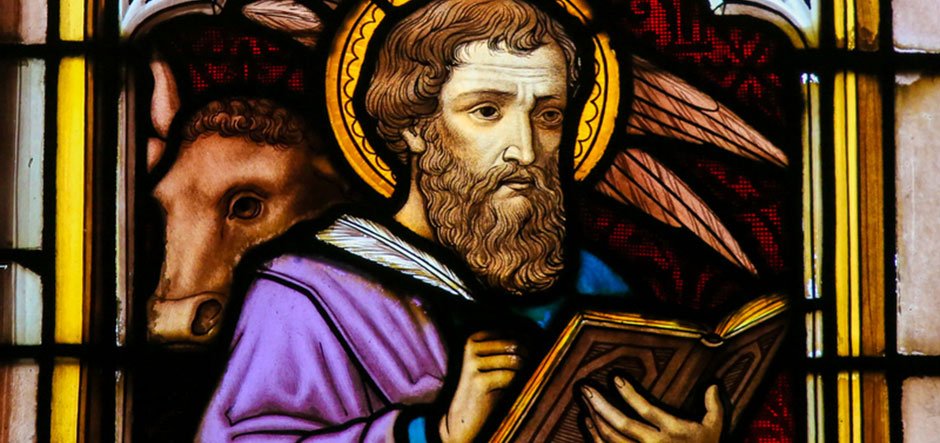
Richard Bauckham writes: This is the text of a sermon I preached originally in Christ Church, Chelsea, in order to introduce the congregation to the Gospel of Luke near the beginning of a year C in the Lectionary (year of Luke).
There is one difference between the Gospels that anyone can see quite easily without even reading very much of them: each of them starts in a quite different way. You can tell quite a lot about a Gospel by thinking a bit about how it begins. In Luke’s case, the Gospel starts with a dedication and a preface. That immediately makes it look a lot more like a work of Greek literature than the other Gospels do. And that, I’m sure, was Luke’s intention. He’s a man who knows, not just Jewish literature, but the wider cultural world of his day, and he wants to place his work on a higher literary level than, say, Mark’s Gospel. Of the four Gospel writers, Luke writes much the most accomplished Greek. He dedicates his work to a man called Theophilus, evidently a man of some social importance, and probably his idea is that Theophilus will not just read it himself, but promote it. Theophilus would probably hold a book launch: he would invite some of his friends to dinner and give the Gospel a first reading.
History and eyewitness
Luke’s preface is the sort of preface a historian in Luke’s day would have written. It talks about his sources and how he went about using them. Like other ancient historians, the sources he really valued were eyewitnesses: those, he says, who were ‘eyewitnesses from the beginning’, people who had been disciples of Jesus from early on in his ministry. He claims to have investigated everything carefully—which suggests he may have actually interviewed disciples of Jesus—and he compiled his sources into what he calls an ‘orderly account’ of the events. This is what a good historian was supposed to do.
So he was clearly not a disciple of Jesus himself, but someone who had good access to eyewitness sources. Traditionally he has been identified with the Luke who was a companion of Paul and I think there’s a lot to be said for that view. It would mean he would have travelled around the eastern Mediterranean with Paul, spent quite a lot of time in Jerusalem, and accompanied Paul to Rome, at a time when lots of people who had known Jesus were around. If Luke was already planning to write a Gospel he would have had a lot of opportunities to gather material. He did use at least one, very important written source, which was Mark’s Gospel. Whenever you find that Luke tells a story you can also read in Mark, that’s because he got it from Mark, though he has often abbreviated Mark’s version and rewritten it a bit. About a third of Luke’s content has come from Mark.
Framework and sources
Luke, I’m sure, knew that Mark’s Gospel embodied Peter’s accounts of Jesus and he would have valued it highly for that reason. But Mark’s Gospel was also particularly useful to Luke for another reason. It was probably the only source from which he could get an overall narrative framework, a consecutive story running from the preaching of John the Baptist through the course of Jesus’ ministry up to his death and then his resurrection. His other sources gave him parables of Jesus, other sayings of Jesus, stories about Jesus, quite probably a passion narrative, but they didn’t give him a connected story. So what Luke has done is: he’s taken over Mark’s narrative as an overall framework for his Gospel story and placed the rest of his material, 70% of his Gospel, at appropriate places in Mark’s narrative framework.
Where did the rest of Luke’s material come from? I suspect it came from a number of different sources (not just two, as a lot of scholars suggest). These may well have included some of the women disciples of Jesus; Luke is the only Gospel writer to make it clear that Jesus had women disciples who travelled around with him all the time and two of those he names are only in Luke. In general what Luke is trying to do is to write a much more comprehensive Gospel than Mark’s, a considerably longer work than Mark’s, drawing together material from written and oral sources, and especially including a whole lot more of Jesus’ teaching than Mark had done.
So, for example, it’s to Luke that we owe many of the most memorable parables of Jesus: the Prodigal Son is only in Luke’s Gospel, the Good Samaritan is only in Luke, the Pharisee and the Tax-collector is only in Luke, the Rich Man and Lazarus is only in Luke, the Rich Fool is only in Luke, and there are quite a few others.
God is visiting his (Jewish) people
I’ve said that Luke presented his work as history and went about it in the way that historians of his time would have done, but of course it is very special history: it’s Gospel. It’s the story (to put it in a Lukan way) of how God visited his people Israel, fulfilling what the prophets had hoped for, providing for them a Saviour who was also the Saviour for all the nations. People have often thought of Luke’s Gospel as a Gentile Gospel, in contrast to, say, Matthew’s much more Jewish Gospel. It’s probably true that Luke is the only major New Testament author who was not himself Jewish. But if Luke was not born Jewish, he had certainly immersed himself deeply in the Hebrew Bible and the traditions of Judaism.
His story starts in the Temple in Jerusalem and the story he tells in the Gospel also ends in the Temple in Jerusalem, though of course, in his second volume, the Acts, he tells how early Christianity spread from Jerusalem to the rest of the Roman world. In Luke’s story of Jesus he makes it very clear that Jesus lives out the plan of God for him that God had already set out in the Jewish scriptures. The continuity of Jesus with the Old Testament is very important for Luke, but of course that is not at all in contradiction to the fact that Luke’s Gospel, his good news, is for non-Jews as well as for Jews, because that is what the prophets of Israel themselves had expected. As aged Simeon, who’s been waiting all his life for the Messiah to come, says when Joseph and Mary bring Jesus to the Temple: Jesus is ‘a light for revelation to the Gentiles and for glory to your people Israel.’
Cast of characters
Something people don’t often notice about Luke is this: he has an enormous cast of characters. There are over a hundred individuals who appear in Luke’s Gospel – and I’m not counting indefinite groups of people like ‘some Pharisees’ or ‘the chief priests’ or ‘all the tax collectors’ and I’m not counting the seventy disciples of Jesus who appear as a group only in Luke. None of the other Gospels have as many characters as Luke. In Luke Jesus is always surrounded by crowds of disciples (far more than just the Twelve) and crowds of people who come for healing or to hear him. But he’s also constantly meeting individuals: he heals them or they become his disciples or they ask him questions or give him hospitality or become his enemies.
They include top people like the Herods (it’s only in Luke that Jesus actually meets Herod the tetrarch), the high priests, aristocrats like Joanna, Pharisees (not all of them hostile), and Roman centurions. The crowds and Jesus’ disciples are mostly of the common people: farmers and fishermen. But disproportionately numerous among the individuals who meet Jesus are two sorts of people who would never figure at all in stories that were not about Jesus. One of these categories are the people the Gospels call ‘the poor’ – which doesn’t mean ordinary people living at subsistence level; it means the destitute, people with no secure means of support. Disabled people usually had to live by begging. Widows often had few means of support. And as well as the poor there were the outcasts: people excluded from society, like the lepers and the demon-possessed, people who were regarded as notorious sinners, like the taxcollectors and the prostitutes, and people despised by the Jews, like Samaritans.
Good news for the poor
So Luke’s Jesus mixes with everybody, right across the social world of his day, women as well as men, but he seems to go out of his way to reach out to those who were left aside, who for one reason or another found themselves on the margins of society, and even in many cases were excluded from the presence of God in the Temple. This is the case in all the Gospels, but it’s especially clear in Luke, and that’s partly because Luke draws attention to it at the beginning of his account of Jesus’s ministry (Luke 4:16-20). Jesus goes back to the synagogue in Nazareth, and it’s only Luke who makes this the first story he tells about Jesus’s ministry. For Luke this is programmatic for what Jesus is about in his ministry. He reads from the prophet Isaiah:
the Spirit of the Lord has anointed me
(that means: God has appointed me as the Messiah)
to bring good news (Gospel) to the poor.
He has sent me to bring release to the captives
and recovery of sight to the blind,
and to let the oppressed go free,
to proclaim the year of the Lord’s favour.
Jesus reads that passage, and he says: “This is being fulfilled now before you as I speak. That’s what I’m doing, that’s my mission.”
So Jesus’s Gospel, Luke’s Gospel is good news for the poor and the outcasts. It’s good news for everyone, of course, but it’s only good news for everyone else if they really take on board that it’s good news for the poor and the outcasts. Pharisees who complain that Jesus mixes with tax-collectors and sinners cannot hear the good news for themselves until they hear it for tax-collectors and sinners.
The gospel of joy
Finally, there’s something else that Luke makes a special point of saying about the Gospel. You’ll remember it, I’m sure, because it’s in Luke’s Christmas story. When the angel announces the birth of Jesus to the shepherds, he says: “I am bringing you good news (Gospel) of great joy for all the people.” There is more joy in Luke’s Gospel than in any of the others. The Gospel brings joy especially because, to put it in a way that Luke is very fond of, the Son of man came to seek and to save the lost. Luke has that set of three lovely parables about the finding of the lost: the shepherd who goes in search of the lost sheep, the woman who searches for her lost coin, and the father whose lost son returns. In each case the story ends with a party. The shepherd asks everyone to come and rejoice with him. So does the woman when she finds her coin. And the father says they must celebrate and rejoice, because the son he had lost has been found.
All that joy in the parables represents, says Jesus, not only joy on earth but joy in heaven. God and his angels rejoice more over one sinner who repents than over ninety-nine who do not need to repent. There’s also a lot of pain in Luke’s Gospel: not only must Jesus die but his disciples, he tells them, have to take up their cross daily and follow him on his way to the cross. I haven’t time to take up that theme. But in the end, beyond the pain, it’s a Gospel of joy. Luke’s last sentence portrays the disciples after Jesus has ascended to heaven: they ‘returned to Jerusalem with great joy and they were continually in the Temple blessing God.’
 Richard Bauckham is a biblical scholar and theologian. He is Emeritus Professor of New Testament Studies at St Andrews University, Scotland, but now lives in Cambridge. This article was previously published in 2021.
 Buy me a Coffee




















That’s a great analysis and very enlightening summary. But how is it a sermon?
There’s no persuasion, no appeal, no gospel offer, application to neither saints nor sinners. Just a thought.
I agree that it reads more like a lecture. But informative and stimulating nonetheless.
And better than most sermons I’ve heard! The church is somewhat schozophrenic about the point of sermons – they are supposed to be evangelistic, but what is the point of an evangelistic talk *inside* the church?
It is not what I would normally give as a sermon. But I was asked to use the sermon slot to introduce people to Luke’s Gospel at the beginning of a lectionary year of Luke. I felt the key thing was to give people an overview of Luke as background to the year’s gospel readings. After all, many people treat these readings as though they all came from a single gospel and have no idea at of the distinctiveness of each gospel
Interesting insights.
Luke writing to a Greek noble man is both unique and significant.
Why would Theophilus be interested in “the man” Christ Jesus?
We know that Luke wrote his gospel and the book of the Acts to his friend, Theophilus, a Roman representative, a Greek, and that his object in writing to that representative Greek in high office was to meet the great Greek demand, and more than meet it: to overwhelm it.
But the Greek ideal was what was governing with Luke.
It was a great power, a great order, a far-reaching influence, and with it went this Greek ideal which was the perfect man, the perfect humanity, what we today would call the superman.
{ Think of the artists competing in the Renaissance to produce the statue or painting of the perfect human form: da Vinci and Michelangelo or later Augustus Rodin.}
That was the Greek ideal, that was worshipped by the Greeks.
They were always out to find the perfect man.
When they found a man of great stature according to their ideal, they represented him in their halls of arts by a bust or statue, and when they found another better than he,
that was pushed a little aside, and the new one put in its place.
They had gone on like that till they had halls full of men representing their ideal man.
Theophilus was an outstanding representative of that world in quest of that man, and so Luke’s writing was with the intention of saying in effect to his friend, “Here is a Man who will break all your methods, who will make all your giants small – mere puppets!”
So he wrote the life of the Lord Jesus as he wrote it, and his great title for Christ is Son of Man, and he writes the life of Christ with a view to keeping Christ in view in the magnificence of His human character,
His human life, His human nature, and he heads Him right up to the Mount of Transfiguration and presents Him glorified, and in effect says to Theophilus, “Find anything like that if you can, match that if you can.” He simply spoiled everything for the Greeks in his presentation of that glorified, transfigured Man. [You are Witnesses Tom Austin~Sparks}
This is further worked out along with what it means to be “a witness”@www.austin-sparks.net/english/005386.html
“And you shall be witnesses unto me.”
This comment is as deep as the post itself. Learnt a lot from it.
Love you Alan Kempson
I do see it as sermon, painted with a broad brush, but with the focal point on Jesus fulfilling the scriptures, in space, time nd place, in history, as joyous Good News for everyone. That is the aplication!
So Mark was not good enough to impress the elite and had to be re-written for a free, rich, intellectual? Still, it’s nice to know Jesus loves everyone.
it seems social class hasnt changed much since then.
Hi Richard
One of the criticisms I hear from atheists is that Luke doesnt name any of his sources, and so we dont really have much of a clue as to the possible reliability of said sources. Why would Luke not name any sources in a letter to his patron? If he had named names would that not have reassured his readers of his writing’s reliability? Or was it very common then not to explicitly name sources.
Peter
Yes, I would like to know why also. Do we know very much about who Theophilus was? Are their any contemporary sources for him?
I am not aware of any other information about his identity.
What do you think of the idea that Theophilus wasn’t an individual, but anyone – especially any non-Jewish person – who wanted to find out more about Jesus. After all, the name means “lover of God”. So was Luke addressing, in a personal way, anyone who fitted that description, much as Victorian writers used to include “Dear reader” in some of their narratives?
This seems to be to me more in keeping with the Gospel as a whole than the idea that Theophilus was some high-ranking individual or patron – along with the fact that anything suggested about him – if he was an individual – is conjecture.
After posting this I saw that Richard Gutteridge had asked the same question. I’m still interested in exploring it though.
Which sources and their qualifications would satisfy atheists?
Eyewitnesses are eyewitnesses in a court of law regardless their status. The numerical weight of their testimonies and commonality corroborates reliability, where truth is an underpinning cultural, ethical and religious factor.
Earwitnesses, in that mainly oral tradition culture may be one and the same as eyewitnesses. Eyewitnesses also testify as to what they hear, as spoken
Somebody historians named some of their sources, others didn’t. There wasn’t the sort of obligation to do so that modern academic historians have. In Luke’s case, I think the preface sets up a presumption that the sources are people named I. The Gospel.
Sorry
That should be: named in the Gospel.
Everyone here seems to refer to Theophilus as a person but I’ve heard it suggested that it is general Theo (God) philus (lover). Reactions please
pseudonym possibly to protect the real “Theo’? otherwise Luke would be writing a letter to whom?
Theophilus may have been Jewish, because Jews liked Greek name formed with Theo-, seeing them as equivalent to Hebrew names that include the divine Name or El.
I think he was most likely Luke’s patron who would launch the book by inviting friends to dinner where it would be read to them. That was the nearest thing to publication in that world.
Thanks.
What do you think, Richard, of the hypothesis that Theophilus was Paul’s defence council at his trial in Rome, and that with his gospel and Acts Luke was briefing the man? I’d never say it was proven but it makes good sense to me.
How do you rech the conclusion that Mark preceded Luke and was consequently one of Luke’s sources, please? I’ve always been impressed by Robert Lindsey’s suggestion that Luke was first of the synoptics, based on looking at the minor agreements (between two of the three synoptics) and the major agreements (between all three).
He (Lindsey) is in a tiny minority but many have studied this intensely. On Luke using Mark see RH Stein, the Synoptic Problem. I think he used all the other 3 (here I differ from Richard), and that they are those referred to in the preface.
Thanks, Christopher. My answer to Anton is that it’s complicated! The main reason I am completely convinced of Marian priority is the detailed relationship between the texts of Mark and Luke. If you compare parallel texts in a synopsis and ask at every point, Does it make more sense that Luke is editing Mark or vice versa, I always find the former. Working closely with the texts of the gospels for decades, I have found Marian priority consistently explains the differences between Mark and Luke and also between Mark and Matthew.
A particular exploration of that is Mark Goodacre’s idea of ‘editorial fatigue’, where he points out that where Luke runs parallel to Mark, the detail of the story in Luke often tails off in comparison with the narrative being sustained in Mark.
Thank you, Richard.
I’m really not sure what is being proposed here.
If Luke is relying on Mark, is he relying not on eyewitnesses, but on ‘second-hand hearsay’?
And he is not a ‘reporter on the ground’ checking out reports for accuracy and reliability? As a historian within a time frame of ‘living memory’ within the cultural context of that time?
And if it is not evidence based, ahistorical, it becomes subject to the view that continues to pertain today, that it is a contruct of a believing community, that is, a Jesus of faith who is not one and the same as Jesus of history.
I think Luke would have regarded Marks Gospel as closeLy based on the testimony of Peter and therefore as a very valuable source. I think most of his other material Luke would have got from interviewing eyewitnesses himself. This was the practice of other historians. In addition, because Jesus was a teacher whose sayings were memorized, he may have got sayings of Jesus from authoritative teachers who preserved the sayings.
One obvious response to this is the very opening:
“Inasmuch as many have undertaken to compile a narrative of the things that ahave been accomplished among us,…”
Does not this mean that when Luke wrote this, others had already written accounts? So, if not Mark, or Matthew, then whom?
Herr Professor Doktor Quelle.
I have no difficulty receiving this as a sermon, though I understand others’ comments.
“So Jesus’s Gospel, Luke’s Gospel is good news for the poor and the outcasts. It’s good news for everyone, of course, but it’s only good news for everyone else if they really take on board that it’s good news for the poor and the outcasts” is the most powerful and thought-provoking statement I’ve heard for a long time! I had to stop and read it three times, and am still reflecting on it.
Put it with the recent post asking why the church is so middle class and you have enough challenge to be going on with for a very long time…….
Very helpful – any chance of a similar summary of the other gospels?
Another small point. Luke 1:3-4:
“…it seemed good to me also, having followed all things closely for some time past, to write an orderly account for you, most excellent Theophilus, that you may have certainty concerning the things you have been taught.”
This Theophilus was not ignorant of Jesus. There were “things” which he had been taught. His aim is to add “certainty” to these things. Perhaps this is the reason for the emphases which Richard has drawn out.
Do there exist any ancient extra-biblical sources either/or in the traditions as to who Theophilus was?
I think he may have been made a bishop at a time when all sorts of NT people got recruited into lists of episcopal succession.
There was a high priest Theophilus, but the name was popular with Jews who wanted to Greek name.
Interesting insights
Luke writing to a Greek noble man is both unique and significant.
Why would Theophilus be interested in “the man” Christ Jesus?
We know that Luke wrote his gospel and the book of the Acts to his friend, Theophilus, a Roman representative, a Greek, and that his object in writing to that representative Greek in high office was to meet the great Greek demand, and more than meet it: to overwhelm it.
But the Greek ideal was what was governing with Luke.
It was a great power, a great order, a far-reaching influence, and with it went this Greek ideal which was the perfect man, the perfect humanity, what we today would call the superman.
{ Think of the artists competing in the Renaissance to produce the statue or painting of the perfect human form: da Vinci and Michelangelo or later Augustus Rodin.}
That was the Greek ideal, that was worshipped by the Greeks.
They were always out to find the perfect man.
When they found a man of great stature according to their ideal, they represented him in their halls of arts by a bust or statue, and when they found another better than he,
that was pushed a little aside, and the new one put in its place.
They had gone on like that till they had halls full of men representing their ideal man.
Theophilus was an outstanding representative of that world in quest of that man, and so Luke’s writing was with the intention of saying in effect to his friend, “Here is a Man who will break all your methods, who will make all your giants small – mere puppets!”
So he wrote the life of the Lord Jesus as he wrote it, and his great title for Christ is Son of Man, and he writes the life of Christ with a view to keeping Christ in view in the magnificence of His human character,
His human life, His human nature, and he heads Him right up to the Mount of Transfiguration and presents Him glorified, and in effect says to Theophilus, “Find anything like that if you can, match that if you can.” He simply spoiled everything for the Greeks in his presentation of that glorified, transfigured Man. [You are Witnesses Tom Austin~Sparks}
This is further worked out along with what it means to be “a witness”@www.austin-sparks.net/english/005386.html
“And you shall be witnesses unto me.”
Luke being a physician was a man who was an observer, interested in people.
This is reflected in the way he tells the stories of individuals who experienced Jesus [witnesses] which are not recorded in other Gospels.
Jesus walked through Luke’s gospel illustrating His deep and abiding care for people, regardless of what they have done or their status in society.
“For the Son of Man has come to seek and to save that which was lost” (Luke 19:10).
Luke portrayed Jesus as God’s ideal Man, who offers salvation to all humanity—Jew and Gentile alike.
In Luke 2:32 the old prophet Simeon predicts that Jesus will not only bring glory to Israel, but will also be “a light for revelation to the Gentiles.”
Simeon knew his scriptures – Isa.49 v 6
“For this is what the Lord has commanded us: ‘I have made you a light for the Gentiles, that you may bring salvation to the ends of the earth.”
Mark L. Strauss has a good reply to the Question of Luke’s distinctiveness
@ bibleproject.com/articles/luke-gospels-savior-lost-people/
If Luke is editing Mark, why does the account of Herod being confused about John the Baptist being raised from the dead sounds more edited in Mark vs. Luke? Mark records Herod as being confused but decides to conclude the narration by recording Herod is convinced John is raised from the dead. Luke’s account says Herod is confused and says nothing about Herod’s conclusion. This is one of the more interesting observation that Dr Lindsey made (it was actually the proverbial lightbulb in the head) that persuaded him that Luke was first.
Do you think that is a persuasive argument?
How do we balance that with parallel texts which look the other way around…?