
Whilst everyone is recovering from Christmas, and bracing for the coming of the New Year, I have not merely leftovers but a feast of resources for preaching this coming Sunday!
The gospel reading is from John 1, either the first 18 verses, or verses 10 to 18. The written commentary is here, and the video discussion is here.
The epistle for the day is the longest sentence in the New Testament, at 202 words, Ephesians 1.3–14 (though it is worth starting reading from verse 1). Video discussion can be found here.
Epiphany comes on Tuesday January 6th, but I suspect that many will celebrate it this coming Sunday. So I am reposting here my annual collection of resources on the Epiphany, the visit of the magi to the young Jesus, as recorded in Matthew 2. The article is in three sections, plus a link to our video discussion.
First, a general exploration of the role it plays in the nativity story in Matthew, and the question of the relation of Matthew with Luke. Secondly, a more detailed engagement with a sceptical view about the narrative and its features. Within this I consider the importance of the various elements of the story. Finally, there is a historical appendix supplied by John Hudghton which he wrote in response to reading previous versions of this article, which offers a convincing context in which to read it. You might even like to start there! (John has written on the historical context of Jesus birth here.)
At the end, I have included the link to the weekly video discussion of this text. I hope you find them enlightening and useful!
The Feast of the Epiphany in the church’s liturgical calendar is based on the events of Matt 2.1–12, the visit of the ‘wise men’ from the East to the infant Jesus. There are plenty of things about the story which might make us instinctively treat it as just another part of the constellation of Christmas traditions, which does not have very much connection with reality—and these questions are raised each year at this feast.
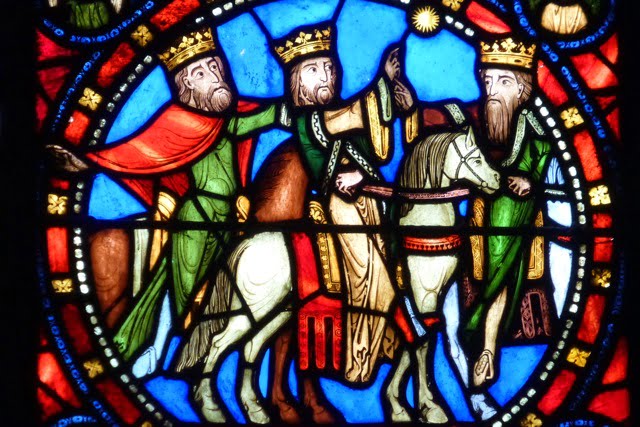
The first is the sparseness of the story. As with other parts of the gospels, the details are given to us in bare outline compared with what we are used to in modern literature. We are told little of the historical reality that might interest us, and the temptation is to fill in details for ourselves. This leads to the second issue—the development of sometimes quite elaborate traditions which do the work of filling in for us. So these ‘magoi’ (which gives us our word ‘magic’) became ‘three’ (because of the number of their gifts), then ‘wise men’ and then ‘kings’ (probably under the influence of Ps 72.10. By the time of this Roman mosaic from the church in Ravenna built in 547, they have even acquired names. Christopher Howse comments:
[T]hink how deeply these three men have entered our imagination as part of the Christmas story. “A cold coming they had of it at this time of the year, just the worst time of the year to take a journey, and specially a long journey, in. The ways deep, the weather sharp, the days short, the sun farthest off, in solstitio brumali, the very dead of winter.”
Those words, in a tremendous sermon by Lancelot Andrewes that King James I heard on Christmas Day 1622, were brilliantly stolen by TS Eliot and incorporated into his poem The Journey of the Magi. And we can see it all: the camels’ breath steaming in the night air as the kings, in their gorgeous robes of silk and cloth-of-gold and clutching their precious gifts, kneel to adore the baby in the manger.
Yet, that is not entirely what the Gospel says…
But for any careful readers of the gospels, there is a third question: how does the visit of the magi fit in with the overall birth narrative, and in particular can Matthew’s account be reconciled with Luke’s? Andreas Köstenberger and Alexander Stewart address this question in The First Days of Jesus pp 164–167, in dialogue with Raymond Brown’s The Birth of the Messiah (1993). Brown notes the points that Matthew and Luke share in common:
- The parents are named as Mary and Joseph, who are legally engaged or married but have not yet come to live together or have sexual relations (Matt 1.18, Luke 1.27, 34)
- Joseph is of Davidic descent (Matt 1.16, 20, Luke 1.27, 32, 2.4)
- An angel announces the forthcoming birth of the child (Matt 1.20–23 Luke 1.30–35)
- The conception of the child is not through intercourse with her husband (Matt 1.20, 23, 25, Luke 1.34)
- The conception is through the Holy Spirit (Matt 1.18, 20, Luke 1.35)
- The angel directs them to name the child Jesus (Matt 1.21, Luke 2.11)
- An angel states that Jesus is to be Saviour (Matt 1.21, Luke 2.11)
- The birth of the child takes place after the parents have come to live together (Matt 1.24–25, Luke 2.5–6)
- The birth takes place in Bethlehem (Matt 2.1, Luke 2.4–6).
This is a surprisingly long list, and Brown’s careful examination produces a longer list of points of agreement than is usual noted. But even a cursory reading highlights the differences, not just in style and concern in the narrative, but in material content. Luke includes the angelic announcements to Zechariah and Mary, Mary’s visit to Elizabeth and the ‘Magnificat’, the birth of John the Baptist, Zechariah’s song (the ‘Benedictus’), the journey from Nazareth to Bethlehem, Jesus being laid in the food-trough, the lack of space in the guest room, the angelic announcement to the shepherds, and the presentation in the temple with Simeon and Anna—all omitted from Matthew. On the other hand, Matthew includes the visit of the magi, Herod’s plot, the escape to Egypt, the slaughter of the ‘innocents’, and Joseph’s decision about where to settle—all omitted from Luke. As Richard Bauckham notes, Luke’s is a largely ‘gynocentric’ narrative, focussing on the experiences, decisions and faithfulness of the women, whilst Matthew’s is largely an ‘androcentric’ narrative, focussing much more on the roles, decisions and actions of the men involved.
Brown sees these differences as fatal to the possible harmony of the two accounts, stating that they are irreconcilable at several points. But Köstenberger and Stewart disagree:
Nothing that Matthew says actually contradicts Luke’s account about Mary and Joseph being in Nazareth prior to the birth. Matthew is silent on the matter…[which] simply indicates his ignorance of or lack of interest in these details for the purpose of his narrative…Narrators commonly compress time and omit details (either from ignorance or conscious choice). Luke’s reference to the family’s return to Nazareth after the presentation of the temple does not contradict the events recorded in Matthew 2; he just doesn’t comment on them. Again, silence does not equal contradiction (pp 166–167).
Luke’s conclusion, in Luke 2.39, is sometimes seen as creating a difficulty; the most natural way to read the English ‘When Joseph and Mary had done everything required by the Law of the Lord, they returned to Galilee to their own town of Nazareth’ (TNIV) is as a temporal marker, suggesting an immediate return. But the Greek phrase kai hos can have a range of meanings; the emphasis for Luke here is that, since they had done everything, they were able to leave, contributing to Luke’s consistent theme throughout the early chapters that Joseph and Mary, along with other characters in the story, are obedient, Torah-observant, pious Jews.
What is interesting here is that we have two quite different accounts, working from different sources, with different aims—and yet in agreement on all the main details. Normally in scholarly discussion, this double testimony would be counted as evidence of reliability and historicity, rather than a contradiction to it.
In response to this, critical scholarship has moved in the other direction, and by and large has pulled apart Matthew’s story and confidently decided that none of it actually happened—in part because of the supposed contradictions with Luke, but in even larger part because of Matthew’s use of Old Testament citations. Thus it is read as having been constructed by Matthew out of a series of OT texts in order to tell us the real significance of Jesus. So Marcus Borg and Dominic Crossan, in The First Christmas: what the gospels really teach about Jesus’ birth, come to this conclusion:
In our judgement, there was no special star, no wise men and no plot by Herod to kill Jesus. So is the story factually true? No. But as a parable, is it true? For us as Christians, the answer is a robust affirmative. Is Jesus light shining in the darkness? Yes. Do the Herods of this world seek to extinguish the light? Yes. Does Jesus still shine in the darkness? Yes (p 184).
The approach presents problems of its own. For one, the stories are not presented as parables, but in continuity with the events Matthew relates in Jesus’ life later in the gospel. For another, if God in Jesus did not outwit Herod, on what grounds might we think he can outwit ‘the Herods of this world’? More fundamentally, Matthew and his first readers appeared to believe that the claims about Jesus were ‘parabolically true’ because these things actually happened. If none of them did, what grounds do we now have? Even if the events we read about are heavily interpreted, there is an irreducible facticity in testimony; if this has gone, we ought to question the value of the testimony itself.
A good working example of this approach is found in Paul Davidson’s blog. Davidson is a professional translator, rather than a biblical studies academic, but he offers a good outline of what critical scholarship has to say about Matthew’s nativity.
His basic assumption is that Matthew is a ‘multi-layered’ document—Matthew is writing from the basis of other, differing sources. He takes over large parts of Mark’s gospel, as does Luke, and Matthew and Luke never agree in contradiction to Mark, a key piece of the argument of ‘Marcan priority’, that Mark was earlier than either of the other two. Whether or not you believe in the existence of the so-called Q, another early written source (and with Mark Goodacre, I don’t), Matthew is clearly dealing with some pre-existing material, oral or written. It is striking, for example, that Joseph is a central character in Matthew’s account before and after the story of the magi, and is the key actor in contrast to Luke’s nativity, where the women are central. Yet in this section (Matt 2.1–12) the focus is on ‘the child’ or ‘the child and his mother Mary’ (Matt 2.9, 2.11; see also Matt 2.14, 20 and 21). Some scholars therefore argue that this story comes from a different source, and so might be unhistorical.
This is where we need to start being critical of criticism. Handling texts in this way requires the making of some bold assumptions, not least that of author invariants. If a change of style indicates a change of source, then this can only be seen if the writer is absolutely consistent in his (or her) own writing, and fails to make the source material his or her own. In other words, we (at 20 centuries distant) need to be a lot smarter than the writer him- or herself. Even a basic appreciation of writing suggests that authors are just not that consistent.
Davidson goes on in his exploration to explain the story of the star in terms of OT source texts.
The basis for the star and the magi comes from Numbers 22–24, a story in which Balaam, a soothsayer from the east (and a magus in Jewish tradition) foretells the coming of a great ruler “out of Jacob”. Significantly, the Greek version of this passage has messianic overtones, as it replaces “sceptre” in 24:17 with “man.”
He is quite right to identify the connections here; any good commentary will point out these allusions, and it would be surprising if Matthew, writing what most would regard as a ‘Jewish’ gospel, was not aware of this. But if he is using these texts as a ‘source’, he is not doing a very good job. The star points to Jesus, but Jesus is not described as a ‘star’, and no gospels make use of this as a title. In fact, this is the only place where the word ‘star’ occurs in the gospel. (It does occur as a title in Rev 22.16, and possibly in 2 Peter 1.19, but neither text makes any connection with this passage.)
Next, Davidson looks at the citation in Matt 2.5–6, which for many critical scholars provides the rationale for a passage explaining that Jesus was born in Bethlehem when he is otherwise universally known as ‘Jesus of Nazareth’ (19 times in all four gospels and Acts). But, as Davidson points out, Matthew has to work hard to get these texts to help him. For one, he has to bolt together two texts which are otherwise completely unconnected, from Micah 5.2 and 2 Sam 5.2. Secondly, he has to change the text of Micah 5.2 so that:
- Bethlehem, the ‘least’ of the cities of Judah, now becomes ‘by no means the least’;
- the well-known epithet ‘Ephrathah’ becomes ‘Judah’ to make the geography clear; and
- the ‘clans’ becomes ‘clan leader’ i.e. ‘ruler’ to make the text relevant.
Moreover, Matthew is making use of a text which was not known as ‘messianic’; in the first century, the idea that messiah had to come from Bethlehem as a son of David was known but not very widespread.
All this is rather bad news for those who would argue that Jesus’ birth was carefully planned to be a literal fulfilment of OT prophecy. But it is equally bad news for those who argue that Matthew made the story up to fit such texts, and for exactly the same reason. Of course, Matthew is working in a context where midrashic reading of texts means that they are a good deal more flexible than we would consider them. But he is needing to make maximum use of this flexibility, and the logical conclusion of this would be that he was constrained by the other sources he is using—by the account he has of what actually happened.
 Davidson now turns to consider the magi and the star. He notes a certain coherence up to the point where the magi arrive in Jerusalem.
So far, the story makes logical sense despite its theological problems (e.g. the fact that it encourages people to believe in the “deceptive science of astrology”, as Strauss noted). The star is just that: a star.
Then everything changes. The star is transformed into an atmospheric light that guides the magi right from Jerusalem to Bethlehem, where it hovers over a single house—the one where the child is. We are no longer dealing with a distant celestial body, but something else entirely, like a pixie or will-o’-the-wisp.
Here again critical assumptions need some critical reflection. Matthew’s inclusion of magi is theologically very problematic indeed. Simon Magus and Elymas (Acts 8.9, 13.8) hardly get a good press, not surprising in light of OT prohibitions on sorcery, magic and astrology. Western romanticism has embraced the Epiphany as a suggestive mystery, but earlier readings (like that of Irenaeus) saw the point as the humiliation of paganism; the giving of the gifts was an act of submission and capitulation to a greater power. For Matthew the Jew, they are an unlikely and risky feature to include, especially when Jesus is clear he has come to the ‘lost sheep of the house of Israel’ (Matt 10.6, 15.24).
There have been many attempts to explain the appearance of the star scientifically. The best contenders are a comet (for which there is no independent evidence), a supernova (observed by the Chinese in 4 BC) or the conjunction of Jupiter with Saturn in the constellation Pisces—something that recently recurred to headline coverage. I think the latter is the best candidate; Jupiter signified ‘leader’, Saturn denoted ‘the Westland’, and Pisces stood for ‘the end of the age’. So this conjunction would communicate to astrologers ‘A leader in the Westland [Palestine] in the end days.’ This highlights a key problem with Davidson’s criticism; the issue is not whether a star could in fact indicate a particular house in our, modern scientific terms. This is clearly impossible. The real issue is whether Matthew thought it could—or even whether Matthew thought the magi thought it could. As Dick France highlights in his NICNT commentary, this was actually a common understanding for which we have documentary evidence. And any naturalistic explanations miss Matthew’s central point: this was something miraculous provided by God. If you don’t think the miraculous is possible, you are bound to disbelieve Matthew’s story—but on the basis of your own assumptions, not on any criteria of historical reliability or the nature of Matthew’s text.
Davidson cites the 19th-century rationalist critic David Friedrich Strauss in his objection to the plausibility of Herod’s action:
With regard to Herod’s instructions to report back to him, Strauss notes that surely the magi would have seen through his plan at once. There were also less clumsy methods Herod might have used to find out where the child was; why did he not, for example, send companions along with the magi to Bethlehem?
In fact, we know from Josephus that Herod had a fondness for using secret spies. And in terms of the story, the magi are unaware of Herod’s motives; we are deploying our prior knowledge of the outcome to decide what we think Herod ought to have done, which is hardly a good basis for questioning Matthew’s credibility.
 Finally, we come to the arrival of the magi at the home of the family. Interestingly, Matthew talks of their ‘house’ (Matt 2.11) which supports the idea that Jesus was not born in a stable—though from the age of children Herod has executed (less than two years) we should think of the magi arriving some time after the birth. No shepherds and magi together here! (It is worth noting, though, that forming a ‘tableau’ of different elements of a narrative, all compressed together, is a common feature of artistic depictions of stories. We just need to be aware of what is going in here in the compression of narrative time.)
Davidson again sees (with critical scholars) this event constructed from OT texts:
According to Brown, Goulder (2004), and others, the Old Testament provided the inspiration for the gifts of the magi. This passage is an implicit citation of Isaiah 60.3, 6 and Psalm 72.10, 15, which describe the bringing of gifts in homage to the king, God’s royal son.
But again, the problem here is that Matthew’s account just doesn’t fit very well. Given that these OT texts uniformly mention kings, not magi, if Matthew was constructing his account from these, why choose the embarrassing astrologers? And why three gifts rather than two? Where has the myrrh come from? Again, it is Irenaeus who first interprets the gifts as indicators of kingship, priesthood and sacrificial death respectively, but Matthew does not appear to do so. In the narrative, they are simply extravagant gifts fit for the true ‘king of the Jews’. Subsequent tradition has to do the work that Matthew has here failed to do, and make the story fit the prophecies rather better than Matthew has managed to.
Davidson closes his analysis of this section with a final observation from Strauss:
If the magi can receive divine guidance in dreams, why are they not told in a dream to avoid Jerusalem and go straight to Bethlehem in the first place? Many innocent lives would have been saved that way.
Clearly, God could have done a much better job of the whole business. But it rather appears as though Matthew felt unable to improve on what happened by fitting it either to the OT texts or his sense of what ought to have happened.
The modern reader might struggle with aspects of Matthew’s story. But it seems to me you can only dismiss it by making a large number of other, unwarranted assumptions. (The main parts of this post were first published in 2015—but they clearly bear repeating.)
Additional note: when I post some of this material previously, my friend John Hudghton posted this fascinating comment offering a broader historical context:
I have to admit at one time I thought that the birth narratives, especially this one in Matthew were literary constructs which while they were metaphorically true as myth did not contain reliable historical content. Well that was what some of the scholars and commentators said. It was all a bit airy fairy, mysterious men from the East…who were they, what were they doing there? How likely was this at all – would these wandering fortune tellers have been received by Herod, his court and had an impact which would throw Jerusalem into panic? What kind of interest would THEY have had in announcing a future King of the Jews? Well I used to think that – but that was a result of very sloppy critical scholarship. Having continued in my reading and studying in the field of ancient history as well as biblical studies I have grown to understand that the story in Matthew is credible and likely and quite frankly I believe it thoroughly, from the coming of the Magi to the flight and return from Egypt. To understand the story of the Magi you need a good appreciation of the geo-politics of the time, as well as the religious situation. Without this you will flounder and make wild stabs in the dark as to the historical anchor of Matthew 2 and may well end up, like I did consigning it to the category of “myth” – a story constructed to teach truths but not necessarily being true in itself. While this may be ok in some holy literature, as far as the Gospels are concerned this sits uncomfortably with me, particularly if it is poorly done.
Let’s talk about the political situation in Israel at the time. Herod is in power as an ethnarc – ruling over the Jews. How did he get there? The Roman general, Pompey had invaded and in 63BC put an end to Jewish independence and carved up the state of Israel. Herod, the son of an advisor to Julius Ceasar was appointed governor of Galilee in 47BC and then in 41 BC promoted to tetrarch by Mark Anthony and in 39BC the senate exclusively proclaims him “King of the Jews” because his reign of terror brought in plenty of taxes to the coffers of Rome. However during this time he had to contend with the Parthians – who were in essence Persians.
The Parthian empire was second only to Rome. The Parthians ruled from 247 BC to 224 AD creating a vast empire that stretched from the Mediterranean in the west to India and China in the east. East of the Caspian Sea there emerged from the steppe of Central Asia a nomadic Scythian tribe called the Parni. Later called the Parthians and taking over the Seleucid Empire and fending off the Romans, they established themselves as a superpower in their own right. They were especially proficient in cavalry fighting using light cavalry horse archers and heavily armoured cataphracts. It was an equine culture, the Parthians only had a relatively small standing army but could call upon militia whose culture equipped them for this means of combat. Camels were used for baggage only….
The Parthians took advantage of the Roman infighting of the later years of the 1st century BC. They intervened in the region sending 500 warriors and in 40BC placed Antigonus II on the throne of Judea and made him High Priest while the unpopular Herod retreated to his fortress in Masada. However as the Romans reorganised and re-established their influence in the area they defeated the Parthians in Syria who pulled their expeditionary force back to their former borders. Herod then fought a war with the assistance of Mark Anthony to regain control of Judea, culminating with the defeat of Antigonus in 37BC and his subsequent brutal execution by Mark Antony. At various times there was peace and at other times disputes between Rome and Parthia. The Parthians were ever watchful of their borders and like the Romans persisted in trying to influence the buffer states along their borders. The traffic though was two way, as Herod attempted to influence the Jewish population within the Parthian empire by deposing the local priests and instead appointing priests to the Jerusalem temple from this Jewish diaspora.
Now what is of primary importance is the term Magi. Yes the term has been used of some individuals using supernatural powers “magic” as a means of making a living – but the primary usage and common understanding of the term Magi is related to the “tribe” of priests who acted almost like a religious civil service to the various empires of the area, from the Babylonian through to the Medo-Persian era and then to the Parthians. Josephus tells us that no one could be King in Parthia unless they knew the ways of the Magi and were supported by the Magi who some understood to operate in a not dissimilar way to a US senate. They were indeed not the Kings but they were the power behind the throne – the King makers. You may remember in the book of Daniel that Daniel is appointed chief of the Magi. They had a reputation throughout the region for being educated, wise, learned, religious priests with knowledge of religion from previous empires to that of Zoroastrianism, the prevalent religion of the Parthian empire. Conventional learning was interlaced with astrology, alchemy and other esoteric knowledge.
As Herod’s life was drawing to a close there was plenty of public debate concerning his succession – Herod had 11 Sons (and five daughters) but was subject to Roman support. In 7 BC he executed his own sons Alexander and Aristobulos because he believed they were plotting regicide and a coup and again in 4 BC he had his favourite son, his eldest, Antipater executed for the same reason causing Augustus Ceasar (who was no pussycat) to remark “Better to be Herod’s pig (hus) than his son (huios)”. Many other members of the family were also casualties including his favourite wife, Mariamne as were various members of his staff. There was much uncertainty as to his succession as Herod’s will changed more than once and on top of this the population were ready for revolt – which did in fact come to pass at Herod’s death in 4BC. Herod used secret police, spies and brutality to achieve his ends. He suffered depression and paranoia throughout his life and was now according to Josephus was suffering gangrene, severe itching, convulsions and ulcers. His feet were covered with tumours and he had constant fevers.
It is to this scenario that the Magi (king makers) came from Parthia (the neighbouring empire with a track record) seeking “he who is to be born King of the Jews” causing a huge amount of anguish to both Herod’s court and the establishment in Jerusalem. The Herodian-appointed Priests who depended on his patronage would have been as disturbed as Herod himself at the news of a new King. Had these strangers been wandering Gypsylike fortune tellers they would neither have gained access to Herod’s court or been given any credibility. However as they were the respected Magi – the Parthian religious civil service they received a hearing. We don’t know how many Magi there were, there is no record, but it is likely they arrived with an escort and would have been protected both physically and diplomatically from any action that Herod may have desired to bring against them.
It was not uncommon for astronomical events to be interpreted through astrology and significant potents such as comets or conjunctions of stars could signify a shift in the order of events on earth. This is what has alerted the Magi in Matthew’s story and they go seeking the new King of the Jews as it is in their interest to honour him as future good relations with this new King will stand them (the Parthians) in good stead. Herod (as may be expected) sees this as a threat and seeks to eliminate the new King. The Magi are warned in a dream to return by another route – and as we know from Daniel, this sort of thing was the bread and butter of Magi.
In so many modern day depictions of Magi they are riding camels. If, as I believe the extremely persuasive evidence indicates that they were Parthians, there is as much hope of them arriving on a camel as there would be of a chapter of bikers opting to travel in a van rather than on a bike. Camels were for luggage and yes they would have had some of this, but horses were for personal transport and the few depictions there are in the history of art of Magi on horseback have got it right.
So I now do believe the story of the Magi in Matthew 2 to be credible and likely. As was the flight of the Holy Family to Egypt – who in the light of the rebellion against Herod’s family in 4BC (and the subsequent brutal massacre, rape and enslavement of Jews following Varrus’ punitive recapture of the land when he sent in FOUR whole legions, laid waste to the land and crucified 2000 Galileans alone for rebellion) would have not been the only refugees fleeing the middle East in bloody and uncertain times.
Join Ian and James as they discuss these issues:
 Buy me a Coffee








What are we to make of Matthew?
Formally a tax collector, perhaps with very little of a moral compass?
Yet now, familiar with the prophetic reference’s concerning Christ’s advent
What was his source?
IF Matthew was one of the two disciples walking to Emmaus when Jesus spoke to them, was perhaps his source.
Lk.24:25 Then he said unto them, O fools, and slow of heart to believe all that the prophets have spoken:
24:26 Ought not Christ to have suffered these things, and to enter into his glory?
24:27 And beginning at Moses and all the prophets, he expounded unto them in all the scriptures the things concerning himself. Shalom.
C.S. Lewis on the subject of Myths said, that if a man claimed that
The Bible is a myth; He would ask of him “what knowledge he had of Myths”?
He had studied myths and legend and even written and published them
His great friend Tolkien had written them as well
C.S Lewis said categorily that “there are no myths in the Bible”.
Alan: C S Lewis also said this – categorically – about the bible
“My own position is not Fundamentalist, if Fundamentalism means accepting as a point of faith at the outset the proposition ‘Every statement in the Bible is completely true in the literal, historical sense’. That would break down at once on the parables. All the same commonsense and general understanding of literary kinds which would forbid anyone to take the parables as historical statements, carried a very little further, would force us to distinguish between (1.) Books like Acts or the account of David’s reign, which are everywhere dovetailed into a known history, geography, and genealogies, (2.) Books like Esther, or Jonah or Job which deal with otherwise unknown characters living in unspecified periods, and pretty well proclaim themselves to be sacred fiction.
It is Christ Himself, not the Bible, who is the true Word of God”
Myth is a much misused word. I agree with C S Lewis that there are no fairy tales in the bible. But I also agree with him that there is a lot of sacred fiction.
Hi Andrew, hope you had a good Christmas. Could you kindly tell me where that quote from Lewis is please? I don’ t recall coming across it ( l have most of his works). I know that he believed that Jonah was a kind of Jewish parable and not meant to be read literally.
Hi Chris and happy Christmas to you.
I am glad you found the quotes interesting. They are from the collected letters of C S Lewis. Written to a variety of people over several years.
Thanks Andrew. I think l have just found it. It is in Collected Letters of C.S. Lewis Vol III ed by Walter Hooper.
If Jonah was a parable, then it is surprising to find the introduction giving what is ostensibly a historical marker: ‘The word of Yahweh came to Jonah the son of Amittai.’ Cf. Gen 15:1, I Sam 15:10 etc etc.. And Jonah was definitely a historical person (II Ki 14:25 – unless Kings is also sacred fiction). Conversely, there are no markers to suggest that the book is a parable, such as one finds at Ezek 17:2, Matt 13:3 etc.
If Jonah is sacred fiction, so is Jesus’s resurrection. “For just as Jonah was three days and three nights in the belly of the great fish, so will the Son of Man be three days and three nights in the heart of the earth.”
Likewise: “The men of Nineveh will rise up at the judgment with this generation and condemn it, for they repented at the preaching of Jonah” – words that also apply to our generation. Jesus evidently did not regard the story as sacred fiction, any more than he so regarded Genesis 1-8. But I recognise that that is not a compelling argument for many people.
‘If Jonah is sacred fiction, so is Jesus’s resurrection.’ That is like saying that, since a seed does not actually die when it falls in the ground, Jesus did not actually die according to John 12.24.
So, do seeds die, or did Jesus only swoon—or was the likeness a parabolic one?
No, that’s false logic, on no less than four counts.
(1) Jesus was speaking metaphorically. Metaphors are a normal part of discourse, and not parables. Otherwise you would be saying that parables occur on every page, and not just in the Bible, but in all texts.
(2) One needs to distinguish two metaphors here: one likens the decomposition/transformation of a seed in the process of becoming a new seed-bearing plant to the death of a living body, the other likens Jesus’s actual death to the ‘death’ of such a seed. In focusing on the first you are missing Jesus’ point, which relates to the second.
(3) The book of Jonah is not sacred fiction. In referring to Jonah’s time in the belly of the whale, Jesus was saying that just as Jonah was in the belly literally and actually for 3 days and 3 nights, so would he be dead literally and actually for 3 days and 3 nights. And note the further metaphor: being in Sheol, the place of the dead, is likened to Jonah’s being in the whale’s belly. Jonah himself made the comparison (Jon 2:1).
Finally (4), Jesus expressly indicated that he regarded the book of Jonah as a true, historical account, not pious fiction. To repeat, in his view the men of Nineveh were historical persons, and at the preaching of the historical prophet Jonah they repented. His warning would lose all force if the reference were to fictional persons fictionally repenting.
1. How do you know? By discerning genre. It is on the basis of genre recognition that people believe Jonah to be ‘sacred fiction’ (if that is the right term).
2. I am not missing Jesus’ point; I am making it. It is perfectly possible to draw this kind of analogy without concluding that, because one is ‘literal’, the other has to be. That is the point.
3. Just as the seed does not actually, literally die, but Jesus draws an analogy, so there is no need to infer that Jonah happened literally for Jesus to draw the analogy. For example, I might be carrying a basket, and someone might ask ‘What is in the basket?’, and I could reply ‘I am being Little Red Riding Hood: I am taking apples to my grandmother.’ The fact that I am actually taking apples to my grandmother doesn’t imply either that the story of Little Red Riding Hood was literally, or that I think it was literal. We do this sort of thing all the time; if I say that someone ‘cried wolf’ and they really did offer a false warning, I am not thereby claiming that the story of the boy who cried wolf was a newspaper report.
4. Jesus says no such thing. But even if he did, why is that compelling for us? Did Jesus, as a first-century Jew, believe in quantum mechanics? If not, does that mean we should not?
Ian,
Let’s press the logic of your claim a little. Does Paul’s reference to Adam and Eve is 1 Tim 2.13-14 mean he understood the events of Genesis 3 to be historical or ‘parabolic’ (a myth teaching amoral lesson)? Did Paul believe Adam and Eve were real historical individuals?
As for whether Jesus ‘knew’ quantum mechanics (does anyone?), perhaps we could say that as the divine Logos he did but such knowledge was not communicated to his earthly human nature. William Lane Craig has raised the interesting question, ‘When did Jesus know he was God?’ If we are to believe John’s Gospel (and I do), there is a divine self-consciousness that clearly breaks through at certain points (e.g. John 8). Craig suggests (IIRC) a subconscious knowledge of his unique filial relationship with the Father that slowly emerged into Jesus’s human mind as he grew in years (and was present in some form when he was a child in the temple).
‘But I also agree with him that there is a lot of sacred fiction.’
Indeed. But Matthew 2 does not appear to be part of that.
Andrew
You will find that Alan Kempson has accurately summarised what CS Lewis said, and Lewis said it in his essay Fernseed And Elephants. It is here:
https://www.samizdat.qc.ca/vc/pdfs/Fernseeds.pdf
Anthony:
Thanks for the link to ‘Fernseeds and Elephants’, an essay I read many years ago. I note that Lewis read this to Westcott House in May 1959 and it concludes that ‘nowadays the layman is embarrassed to admit he believes more than his vicar.’ I wonder if that would true of Westcott House in 2025 (2026). I don’t know how Westcott House stands to liberal catholicism today, but I checked its website the other day and in its staff and student body the place seemed to be overwhelmingly female now (and we know what CSL thought about ‘priestesses’!).
I could find no details of how many full-time students for the stipendiary ministry Westcott House now has. Does anyone know? Are the older theological colleges in the C of E going through a rough time in recruiting now?
Does anyone have any figures for Wycliffe Hall or Trinity Bristol?
I know that the Baptists’ Spurgeon’s College abruptly closed in July 2025, which must have come as a shock.
It came as no surprise to me. Much of the Baptist hierarchy is pushing the view that SSM is OK.
Early in 2017 Westcott House ordinands held a service in the gay argot known as Polari. How long-suffering Jesus Christ is!
Ah yes, the Infamous Polari Evensong, for which the Principal issued a public apology. Imagine the student body of a theological college consisting mainly of femjnist women and gay men.
Spurgeon’s must have changed beyond recognition. I remember when it was very firmly evangelical.
‘feminist women’ – you mean women who have recognised their call by God to be leaders in the church.
No, by ‘feminist women’ I am using shorthand to mean women whose approach to the Bible is more humanist than revelational and who consider the history of Christianity (including apostolic Christianity) to be one of men subjugating and harming women; and therefore Christianity has to be reimagined and reconfigured, including how we think and speak about God, Jesus, the Cross, and the church and its ministry – also marriage and the nature of women.
There can be more radical and more conservative manifestations of this outlook. As a generalisation, the more one subscribes to a feminist outlook, the more critical one becomes of traditional theology, especially our language about God (‘Father’ and ‘Son’) but also traditional supernatural beliefs about incarnation, miracles and the resurrection. This doesn’t always happen, but feminism tends to be on the leading liberal edge, and in its extremes we get people like Katherine Jefferts-Schori in the United States, who was an extreme liberal regarding the Creed. Feminists today also espouse abortion, the killing of unborn children, which is a good indication of where their thinking leads.
You might want to have a look at this paper – especially if it doesn’t get too hammered by detractors over the coming year. It provides a convincing case for a possible comet that is recorded in the Chinese records and matches the bizarre behaviour of the object described in Matthew. It gives proof of possibility rather than actuality!
https://britastro.org/journal_contents_ite/the-star-that-stopped-the-star-of-bethlehem-the-comet-of-5-bce
This paper includes a reference (no.42) to Colin Humphreys’ work but underplays the fact that Humphreys identified the comet of 5BC in Chinese records, proposed it as the Star of Bethlehem, and described how accounts of cometary motion from the ancient world match Matthew’s account. Matney’s paper is little more than a filling-out more than 30 years later, which you’d be hard pressed to know if you hadn’t read Humphreys in this reference and his further paper published the next year in Tyndale Bulletin (vol. 43.1, p.31-56; 1992). The British Astronomical Association’s referees of Matney’s paper have not served Humphreys well.
I am disappointed to hear how Colin Humphreys has been treated here – I read his work in the Tyndale Bulletin about Chinese astronomy back in the 1990s and I always associated him with this line of research.
The unusual activity of a Star whether it be a known star or of a God ordained special star chimes with the Book of Joshua (Chapter 10), and Darkness in the land of Egypt.
Joshua prayed for the sun and moon to stand still, and God granted this miracle, halting their movement for nearly a full day to allow the Israelites to win a crucial battle against the Amorites. While believers see this as a literal divine intervention, some scholars suggest it might refer to an annular eclipse or be a poetic expression for a prolonged day, but the text itself describes a miraculous extension of daylight so the Israelites could finish their victory.
Another idea is that God caused light to remain in the area, similar to the plague of darkness in Egypt, without affecting the entire Earth’s rotation.
The Request: Facing an enemy army, Joshua called out to the Lord, “Sun, stand still over Gibeon, and moon, in the valley of Aijalon”.
The Miracle: The text states, “So the sun stood still, and the moon stopped, until the nation avenged itself on its enemies”.
The Result: The day was prolonged by almost a full day, providing the Israelites the daylight needed to secure victory, a unique event in history.
Some Interpret it as a
Literal Miracle: Many view this as a direct, supernatural act by God, extending the day to help His people.
Figurative/Eclipse: Some suggest the language is poetic, or that it describes an annular eclipse, an astronomical event that appeared as a “ring of fire” and occurred around the time of the conquest (October 30, 1207 BCE, according to some calculations).
Local Miracle: Another idea is that God caused light to remain in the area, similar to the plague of darkness in Egypt, without affecting the entire Earth’s rotation.
Regardless of interpretation, the core of the story within the biblical narrative is that God intervened miraculously at Joshua’s request to ensure Israel’s success and guided the Magi to Bethlehem.
Lewis, argued that the Bible is a collection of many different kinds of writing, including history, poetry, law, prophecy, and fiction, each of which must be read on its own terms. Applying a modern expectation of inerrant, literal history to every part (a “fundamentalist” approach) would be a misunderstanding of the text.
: Lewis distinguished between factual history and truth. A story could be fictional but still communicate a deep, divine truth about the human condition or God’s nature. For example, Lewis considered books like Jonah or Job to be “moral romances” or “sacred fiction” that use a narrative structure to explore theological questions (e.g., suffering, obedience).
Lewis had a high regard for myth, defining it as “at its best, a real unfocused gleam of divine truth falling on human imagination”. He believed that God guided the inclusion of “sacred myth and sacred fiction as well as sacred history” in the canon.
The crucial distinction for Lewis was that in the Gospels, the “myth became fact” in the person of Jesus Christ. While other myths echoed divine reality, the Incarnation and Resurrection were unique, historical events that grounded the Christian faith in verifiable reality, not just symbolic truth.
In Summary
Lewis’s point was that the Bible’s authority comes from its ability to convey the Word of God to the reader, a process that utilizes various literary modes. Demanding scientific or historical precision from its fictional or mythical elements is to “cut the wood against the grain” and miss the deeper spiritual message the text intends to deliver.
Regarding the biblical translations, all of which have their own indeocincratic difficulties, I think that the Holy Spirit has enough
brain cells to work around human falibilities to get His point across and
lead folks into “All truth” using any number of literary styles Shalom.
C. S. Lewis wasn’t an evangelical (he was pretty much a High Church Anglican with higher eucharistic views than any evangelical would have) and he didn’t hold to the evangelical (and ancient catholic) view of Scripture. This is clear in his ‘Reflections on the Psalms’, where he repudiates the imprecatory psalms as unworthy of a believer; I don’t recall what he may have understood about messianism in the Psalms. Lewis also entertained interesting ideas about Christianity being the ‘true myth’ that pagan mythology (dying and rising vegetation gods etc) pointed towards.
Evangelicals would most likely differ from Lewis on these points. On the other hand, Lewis strongly affirmed the historical reliability of the Gospels and the historicity of miracles against Bultmann and the form critics. He lived and died long before Richard Bauckham’s work on Jesus and the Gospel traditions and tradents appeared, but I see the non-biblical scholar Lewis anticipating these later trends. So in essentials, evangelicals have little difficulty in affirming most of what Lewis has to say about the Bible, especially his sharp criticisms of Bultmann.
On the Parthian Magoi, I recall reading in one of Martin Hengel’s books that Magoi visited the imperial court in Rome in the early 60s AD, so it does seem they travelled as ambassadors.
Alan Kempson’s summary of C.S. Lewis’s understanding of Scriptural authority as “coming from its ability to convey the word of God” provides,I believe, a succinct analysis of his(Lewis’s) theological insights on this issue.Nevertheless it falls short of of being an adequate definition of the ramifications of the term ‘authority’ in relation to theology and practice.
For example, of late , on the one hand, attempts have been made to *ignore or eliminate* scriptural passages which are deemed to be inimical to contemporary mores.And this begs the question: by what criteria do we relocate something as being the new ultimate authority; thereby superceding Biblical teaching? On the other hand, attempts have been made to *modify* Scripture to bring it in line with the beliefs and values of the age.Again, what is the epistological basis for engaging in this activity?Exegesis can become if the question of authority is overlooked!
Finally, the issue of attempting to drive a wedge between the living and the written Word i.e.between Jesus and Scripture (see above): I recommend commentaors on this blogsite to count the number of times Jesus referred to OT citations with the expression “it is written”! If in doubt as to what this means,examine the contexts !
apologies :- line 5 from bottom -” Exegesis can become vacuous if the question of authority is overlooked!
True he was not an Evangelical; C S Lewis said of himself
. ‘I am a very ordinary layman of the Church of England’, he wrote, ‘not especially “high”, nor especially “low”, nor especially anything else’.
One does wonder what he would make of evangelicals in today’s C of E?
A part of his legacy is well summarised by Peter Kreeft in an address entitled The Achievement of C. S. Lewis: A Millennial Assessment.
Kreeft is a Roman Catholic and Professor of Philosophy at Boston College.
Kreeft recalls ‘the most memorable moment of the most memorable conference I ever attended. Dozens of high-octane Roman Catholics, Anglicans, Eastern Orthodox, and Protestant Evangelicals came together …
Fr. Fessio got up and proposed that we issue a joint statement of theological agreement among all the historic, orthodox branches of Christendom saying that what united us was Scripture,
the Apostles’ Creed, the first six ecumenical councils,
and the collected works of C. S. Lewis.
The proposal was universally cheered’.
Roger Fay remarks
“It is apparent that Lewis’ writings are deemed no threat to modern ecumenism. However, it is doubtful that Lewis would have approved of ecumenism’s pragmatism.”
Kreeft aso states that Lewis’ greatest literary achievement was to focus the Western world on what it needs above all else –
the person of Jesus Christ.
This he did chiefly in Mere Christianity and through the character of Aslan, the Narnian lion.
Of which I believe was the Apostle’s Doctrine.
C. S. Lewis did not teach the true gospel. We must go to the Bible for that precious jewel.
But, today, abilities like his are sorely needed as Evangelicals seek to communicate the truth to a generation that has nearly stopped listening. [Roger Fay]
More of his legacy “warts and all” can be found in Fay’s article @
evangelical-times.org/the-legacy-of-c-s-lewis/ Shalom.
I suppose it depends what you mean by the ‘true gospel’. He was clear that one day he came to believe that Jesus was the Son of God. He also seemed to believe Jesus’ death was an atonement for the forgiveness of human sin. And he believed in the resurrection. Is that not the gospel?
Indeed, what is the true Gospel?
Each of us must or rather do plough our own furrow.
I would prefer perhaps a complete Gospel.
However having said that “Abraham was rich in faith,
and Moses was rich in meekness, and Job was rich in patience,
and Joshua was rich in courage, and David was rich in uprightness, etc.
But where will you find a saint that is rich in all these graces”?
{ Thomas Brooks, }
The scriptural expression, ‘salvation,’ is used with considerable
width and complexity of signification.
Salvation, in one aspect, is a thing past to the Christian; in another, it is a thing present; in a third, it is a thing future
.[ “Work Out Your Own Salvation” Expositions of Holy Scripture — Alexander Maclaren/biblehub]
Each of us are exhorted to “work out our own salvation
with fear and trembling, lest we should be a castaway
and come short of the grace of God; — Give head as to how
you build etc.
As we embark on a fresh new year perhaps set our goal,
what does God want; Is it what we want?
Is God’s will your determined will [pleasure] and
as Watchman Nee remarked “Do you love [delight in] the will of God?”.
It is not how we begin but how we finish the course that seems to count.
Rather than the forensic analysing to death the Jesus of History consider
[looking away from all that will distract us and] focusing our eyes on Jesus, who is the Author and Perfecter of faith [the first incentive for our belief and the One who brings our faith to maturity
Amp.Ver.
Or pray as the Psalmist
‘Perfect, O Lord, that which concerneth me; forsake not the work of Thine own hands!’ — and the prayer will evoke the merciful answer, ‘I will never leave thee, nor forsake thee “
God is faithful, who hath called you unto the Gospel of His Son; and will keep you unto His everlasting kingdom of glory.’ Shalom.
It is suggested that what Lewis wrote about myth, as summarized by Alan Kempson, can not be read in isolation, separate from what he wrote about miracles and Bultmann et al.
As for historical fact, perhaps an article on knowledge and the underpinning philosophies, doctrines, would provide some groundwork to assess history from, fable, fiction, myth, parable, allegory.
A starting point may be the anti-supernatural, closed material world system, espoused by the secular, atheist, deist, the Bultmanns and their offspring.
I’m unsure whether it is remarkable or not, that Ian and James edifying discussion on Ephesians has drawn such a loud silence, from the frequent fliers to this site and its comments.
Groan and weep.
While Colin McCormack draws attention to the question of authority, in the context of the gospel, there was nothing in today’s anodyne New Year’s address by the Bb, ABoC elect, Mullally in her place of implied Christian positional authority, that had any hint of the ‘Good News’ of Jesus.
Worship the NHS with its humanity and multi-faith chaplaincy.
Groan …. An assessment carrying a consequent deep visceral groan.
Ah, “Put not your confidence in princes” no matter how illustrious their minds.
His saints are all flawed pearls and jewels yet the City of God is founded on such.
And as in Malachi 3:16 Then they that feared the LORD spake often one to another: and the LORD hearkened, and heard it, and a book of remembrance was written before him for them that feared the LORD, and that thought upon his name.
3:17 And they shall be mine, saith the LORD of hosts, in that day when I make up my jewels; and I will spare them, as a man spareth his own son that serveth him.
3:18 Then shall ye return, and discern between the righteous and the wicked, between him that serveth God and him that serveth him not.
It would seem that God is interested in how we reflect His Son, His Mind,
His Walk, His Spirit, His Fragrance etc. and when He [Jesus] comes to be admired in all those who believe.
As He says to Jeremiah 9:23 “Thus saith the LORD, Let not the wise man glory in his wisdom, neither let the mighty man glory in his might, let not the rich man glory in his riches:
9:24 But let him that glorieth glory in this, that he understandeth and knoweth me, that I am the LORD which exercise lovingkindness, judgment, and righteousness, in the earth: for in these things I delight, saith the LORD. Shalom.
While I think that Christians will never agree as to what the Star of Bethlehem was, I find this account one of the most convincing. The important thing to my mind is to understand how the Magi would have read the sky. They are the key players here.
https://www.researchgate.net/publication/356414905_DECODING_THE_STAR_OF_BETHLEHEM
Of literary mechanics.
If we think that God is Sovereign, Faithful and True and has made His True Mind known.
If we believe that “According as His divine power hath given
unto us all things that pertain unto life and godliness,
through the knowledge of him that hath called us to
glory and virtue:
If we believe that if no human father would give his son a stone when appeal was made to him for bread, etc.; would put him off with a response which would only be a bitter disappointment.
There are two blessings which we particularly want of God our heavenly Father. – provision for our temporal well-being,
and succour for our soul. We cannot live without these.
Our bodily nature craves the one, our spiritual nature
needs the other .
. But “man cannot live on bread alone;” he needs those higher and holier gifts which nourish the soul, which feed the flame of piety
and zeal, which strengthen him for spiritual conflict, and give him the victory over his worst enemies.
For these two great blessings we may confidently ask God, and he will assuredly grant them. It is much more certain that God our Father
will provide for our real necessities, and will strengthen our souls
with all needful Divine influences
With holy boldness, then, may we go to the throne of grace, and pray for all those things that are requisite alike for the body as for the soul. But we may carry this argument with which our Lord has supplied us into other spheres, and may thus “assure our hearts” concerning him.
[The Jewish and the Christian Thought of Man W. Clarkson,]
“How much more will Our Father give the Holy Spirit to them that ask of Him”?
Yes there are doubters and disputers of Holy Scriptures which the Apostles dismissed briefly;
6:3 If any man teach otherwise, and consent not to wholesome words, even the words of our Lord Jesus Christ, and to the doctrine which is according to godliness;
6:4 He is proud, knowing nothing, but doting about questions and strife of words, whereof cometh envy, strife, railings, evil surmising,
6:5 Perverse disputings of men of corrupt minds, and destitute of the truth…. from such withdraw thyself. 1Tim.6 v3
I do appreciate that these Apostolic Paths are difficult to follow but those born of the Spirit and led of the Spirit and guided of Him
have little to fear of them. Shalom.
There seems to something of an undercurrent to some of the comments, with Albert Schweitzer, and others, seeking to separate Jesus of history from Jesus of faith, and the development of Quests for the Historical Jesus and main influence(r)s.
Cristian Myth advocates have largly been dismissed by modern
scholarship as athiests and agnostics actors, they have absorbed a lot of
time which the Apostles would not have given them.
See .wikipedia.org/wiki/Christ_myth_theory. see latter paragraphs.
Separating, making a distinction between the historical Jesus and Jesus of faith, continues in various guises and degrees of unbelief.
Can anyone recommend where I can read more about Irenaeus and the point about the humiliation of paganism? Many thanks