How can training for ministry be truly effective?

One of the perennial questions facing the church today is the effective training of its ministers. That challenge is usual thought to relate to those called to ordained ministry—but (as the recent report of Archbishops’ Council to General Synod on lay leadership highlighted) it actually applies to the whole people of God, since all are … Continue Reading


Why Pope Francis is wrong about begging

Jon Kuhrt writes: This week I was at a church in Kings Cross, central London, talking with the minister when a man came to the door asking for help.  He explained that he was not from London but his wife had just been discharged from UCH (a London hospital) following an emergency operation.  He said they … Continue Reading
Has Preaching Had its Day?

Whilst in New Zealand, mostly on holiday and visiting our son on his gap year, I was invited to give a public lecture on the subject of ‘Has preaching had its day?’ This is the introduction and the outline of what I said, which includes exploring the main objections to preaching in contemporary life and … Continue Reading
Mourning our Infidelity

Elaine Storkey writes: The passing of the measure to enable women to become bishops in the Church of England was not a victory for liberal revisionists in the church. It was the overwhelming sense amongst evangelicals, Catholics, charismatics and liberals that this was now where God was leading our church. The Women Bishops measure would not … Continue Reading
How many times did Jesus visit Jerusalem?

One of the obvious differences in chronology between John’s gospel and the ‘Synoptics’ (Matthew, Mark and Luke) is that John gives an account of Jesus in Jerusalem on four different occasions, two during a Passover (John 2.13, 12.12), one during an unnamed festival (John 5.1) and one at Hannukah (John 10.22). (The third Passover is … Continue Reading
What is the pastoral impact of eschatology?

In my new Grove booklet on eschatology, after outlining eschatological expectation in Old and New Testaments, I end my reflecting on the pastoral implications of what we have found.There are many aspects of Christian living which are affected by our understanding of eschatology, and where misunderstanding creates serious obstacles both within the church and at … Continue Reading
Why don’t we talk about the end of the world more?

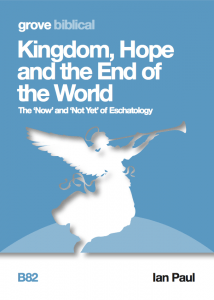
My latest Grove Booklet is now available and it offers an overview of eschatology—beliefs about the end things—starting with background ideas in the Old Testament and looking at the key issues in the Gospels, Paul and Revelation. My introduction explains why this is such an important issue. Eschatology, meaning ‘understanding of last things,’ is of … Continue Reading
Preaching on the Transfiguration

The lectionary gospel reading tomorrow, the last Sunday before Lent, is Matt 17.1–9, Matthew’s account of the Transfiguration. There some important things to note in relation to this passage as we think about preaching on it. All three Synoptic accounts place this immediately after Peter’s confession of Jesus at Caesarea Philippi, where Jesus then starts … Continue Reading
Can we Dethrone Mammon?

Ven. Dr Gordon Kuhrt reviews Justin Welby’s Lent book Dethroning Mammon: Mammon is money or possessions when they are enthroned. The author says there is nothing wrong with money in itself, but when it exercises supreme power (is enthroned) it becomes mammon: evil, destructive and dangerous. A Foreword commending the book is from Jean Vanier, founder of the L’Arche movement which now has nearly 150 … Continue Reading