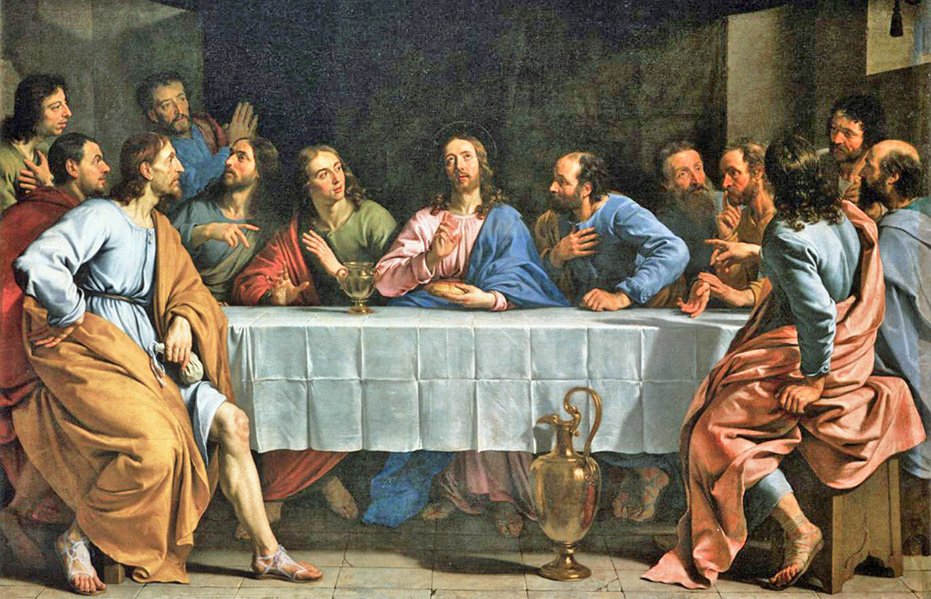
 Have you ever sat and read through the gospel accounts of Passion Week, and tried to work out chronologically what is happening? And have you done that with the four gospels? (It is easiest to do that latter using a synopsis, either in print or using this one online.) Why not do it as part of your Holy Week devotions this year? If you do, you might notice several things.
- Though there are variations in wording and in some details, there is a striking agreement between all four gospels in the order of the main events during the week.
- The events at the beginning of the week around Palm Sunday, and at the end of the week around the crucifixion seem very busy, yet the middle seems very quiet—the issue of the ‘silent Wednesday’.
- The main issue on which the gospel accounts disagree on the order of events is in relation to the denials of Peter by Jesus, which come earlier in Luke’s gospel, and are spread out in John’s gospel.
- Jesus’ trial is more detailed, with more people involved in different phases in John than in the Matthew and Mark, the latter two treating it in quite a compressed way as more or less a single event.
- The synoptics claim explicitly that the last supper was some form of Passover meal (which must happen after the lambs are sacrificed), whilst John makes no mention of this, and appears to have Jesus crucified at the moment that the Passover lambs are sacrificed.
These anomalies have made the question of the Passion Week chronology ‘the most intractable problem in the New Testament’, and it causes many readers to wonder whether the accounts are reliable at all. For some, they are happy to inhabit the narratives in each gospel as they are, and not worry about reconciling each account with the others, or any of the accounts with what might have actually happened. But I am not sure it is quite so easy to leave it there. After all, the word ‘gospel’ means ‘announcement of good news about something that has happened’; a central part of the Christian claim is that, in the death and resurrection of Jesus, God has done something, and so we cannot evade question of what exactly happened and when. Sceptics (both popular and academic) make much of these apparent inconsistencies, so there is an apologetic task to engage in. And understanding how these issues might be resolved could potentially shed new light on the meaning of the texts themselves.
Two years ago, I caught up with Sir Colin Humphreys’ book The Mystery of the Last Supper, in which he attempts to solve this problem. Humphreys is an academic, and a distinguished one at that, though in materials science. He has written on biblical questions before, though is not a biblical studies professional, but he does engage thoroughly with some key parts of the literature. He identifies the main elements of the puzzle under four headings:
- The lost day of Jesus, noticing the lull in activity in the middle of the week.
- The problem of the last supper; what kind of meal was it, when did it happen, and can we harmonise John’s account with the synoptics?
- No time for the trials of Jesus. If we include all the different elements, they cannot fit within the half night from Thursday to Friday morning.
- The legality of the trials. Here, Humphreys notes that later Jewish sources prohibit the conduct of a capital trial during the night, and require that any decision is ratified on the morning following the first trial.
The book is set out very clearly and logically (as you might expect) and includes a good number of tables. Early on Humphreys helpfully tabulates the events in the gospels, showing their relationship.
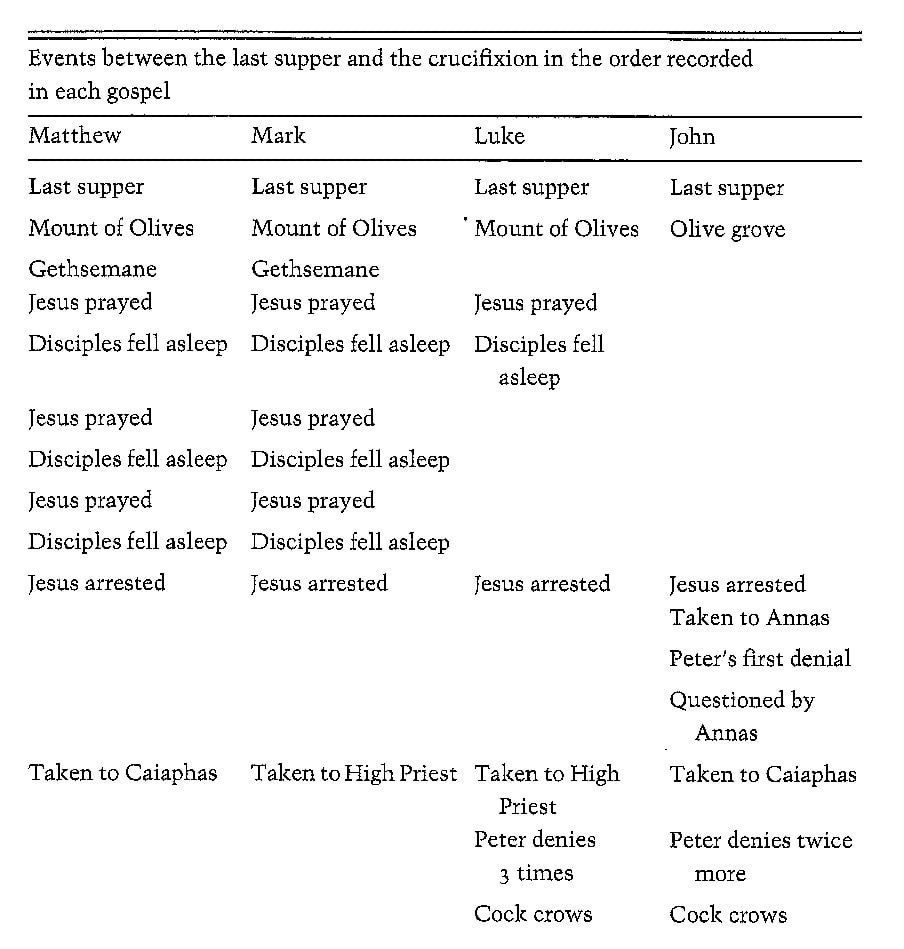
 Having started by looking at the biblical texts, in the middle of the book Humphreys goes on a long scientific exploration, delving into the astronomical issues behind the construction of Jewish calendars, and using this to argue for a particular date for the crucifixion. The key issue here is identifying the dates of the calendar from what we know of the moon phases, and then finding the years when the Passover falls on a Friday, which it will do on average only one year in seven.
Humphreys then uses other well-established data to eliminate outlying dates, and argues for Jesus’ death at 3 pm on Friday, April 3rd, AD 33. He is not alone in this, though the style of his argumentation will have lost many mainstream New Testament specialists. He assumes that the gospels are historically accurate, and takes them as his basic data, when most scholars would want him to be much more provisional. If the case was expressed more in terms of ‘were the gospels accurate, it would lead to this conclusion’ might have been more persuasive for the guild—but then Humphreys is primarily writing for a popular and not a professional audience.
I was much more interested, though, in the later chapters, where Humphreys explores the gospel texts in detail in the light of the calendrical background. Although his proposals about the different calendars in use at the time of Jesus are speculative (even if plausible), there can be no doubt that different calendars were in use, and that it is quite likely that different gospel writers are making reference to different calendar schedules which could give rise to apparent anomalies in the gospel chronologies. In particular, some calendars worked sunset to sunset (as Jewish calculation works today), others counted from sunrise to sunrise, and the Roman calendar counted from midnight to midnight, as we do now. It is not hard to see how the phrase ‘on the next day’ can now have three different possible meanings.
It is also clear that the gospel writers vary in the emphasis that they give to chronological issues. So, whilst Luke offers some very specific markers in his narrative to locate the gospel story to wider world events (which has been typical of his overall approach), and John includes frequent temporal markers in relation both to Jewish feasts and successive days of Jesus’ ministry, Matthew is happy to group Jesus’ teaching and ministry into non-chronological blocks, and Mark has long been recognised as linking events in Jesus’ ministry thematically rather than chronologically. Humphreys uses an everyday example to illustrate this: if I cut the lawn and do some weeding, and someone asks my wife what I have been doing, and she says ‘He has been doing some weeding and cut the lawn’ then we would not describe our two accounts as ‘contradictory’. Chronology just hasn’t been an important issue here.
Humphreys’ solution rests on proposing that, in celebrating the Passover with his disciples, Jesus used pre-Exile calendar which ran sunrise to sunrise and was at least a day ahead of the official Jerusalem calendar, so that there could be up to two days’ difference in calculation. This means that, if the Jerusalem Passover took place on the Friday, following the sacrifice of the lambs on Friday afternoon, it would be possible for Jesus to celebrate his own Passover (and not merely a ‘Passover-like meal’ as some scholars have suggested) as early as the Wednesday. Humphreys believes that the man carrying the water jar (in Luke 22.10 and parallels) is a signal that the Upper Room was in the Essene quarter of Jerusalem, where there would not have been any women to undertake such roles. And the calendar differences account for Mark’s statement that the lambs were sacrificed on the ‘first day of the feast of Unleavened Bread’, (Mark 14.12) which is a contradiction that scholars have in the past attributed either to Mark’s error or his careless writing.

 At some points, I think Humphreys’ case is actually slightly stronger than he claims. For example, John’s phrase ‘the Passover of the Jews’ in John 11.55 could arguably be translated as ‘the Passover of the Judeans’, thus emphasising communal and calendrical differences, and Matthew highlights the differences between the crowds of pilgrims and the local Jerusalemites in their response to Jesus. Richard Bauckham has argued that John is writing on the assumption that his readers know Mark, so there is no need for him to recount the details of the Passover meal in John 13 and following. And in the latest edition of Bauckham’s Jesus and the Eyewitnesses, he argues (in an additional chapter) that the ‘Beloved Disciple’ is the author of the gospel but is not John son of Zebedee, and so not one of the Twelve, but a Jerusalemite. This explains some of the distinctive perspectives of John’s gospel with its Judean and Jerusalem focus in contrast to Mark’s focus on Galilee—but would also account for calendrical differences.
There are some points of strain in Humphreys’ argument—for me, the most testing one was Humphreys’ account of the cock crowing three times, the first of which was (he argues) the Roman horn blown to signal the approach of dawn, the gallicinium which is Latin for ‘cock crow’. (I always struggle to be convinced by an argument that claims a repeated phrase actually means different things at different times when the phrase is identical.) But there are also some interesting ways in which his reading makes better sense of some details of the text, such as the dream of Pilate’s wife—which she could not have had time to have under the traditional chronology. Moreover, one of our earliest testimonies to the last supper, in 1 Cor 11.23, does not say (as much Anglican liturgy) ‘on the night before he died’ but ‘on the night that he was betrayed’. I will be sticking with the latter phrase in my future use of Eucharistic Prayers! And when Paul says that Christ our Passover has been sacrificed for us (1 Cor 5.7), and that he is the first fruits of those who sleep (1 Cor 15.20), Paul is reflecting his death on Passover (as per John, even though in other respects Paul’s account matches Luke, and it is largely Paul and Luke’s language we use in liturgy) and his resurrection on the celebration of First Fruits two days later.
Humphreys is certainly bold in taking on key scholars, including Dick France (with whom I would always hesitate to disagree), but in every case he gives citations and explains where the disagreement lies. When the book was first published, Mark Goodacre wrote a brief blog on why he disagrees, and the debate in comments—including from Humphreys himself—are worth reading. Goodacre’s main concern is Humphreys’ anxiety about demonstrating the reliability of the gospel accounts, and the need to eliminate contradictions.
One of Humphreys’s primary concerns is to avoid the idea that the Gospels “contradict themselves”. The concern is one that characterizes apologetic works and it is not a concern that I share.
But I wonder whether concern about this aim has led many scholars to dismiss the detail too quickly; much of academic scholarship is ideologically committed to the notion that the gospels are irredeemably contradictory. (If I were being mischievous, I would point to the irony of Mark’s resisting Humphrey’s challenging of a scholarly consensus, when that is precisely what Mark is doing himself in relation to the existence of ‘Q’, the supposed ‘sayings source’ that accounts for the shared material of Luke and Matthew…!) And we need to take seriously that fact that Humphrey’s approach resolves several key issues (including the silence of Wednesday, the lack of time for the trial, the reference in Mark 14.12, and Pilate’s wife’s dream) that are otherwise inexplicable or are put down (slightly arbitrarily) to writer error.
I think there are some further things to explore, but it seems to me that Humphreys’ case is worth taking seriously. (Published in earlier forms in 2017 and 2018.)
If you enjoyed this, do share it on social media, possibly using the buttons on the left. Follow me on Twitter @psephizo. Like my page on Facebook.
Much of my work is done on a freelance basis. If you have valued this post, would you consider donating £1.20 a month to support the production of this blog?
 Buy me a Coffee






















I think I read some time ago someone suggesting an occasional super Sabbath so that Jesus was crucified on Thursday rather than Friday as is usually understood. This dealt with “silent Wednsday” and also made more sense of the “third day”.
That’s interesting. Do you have a link? And I wonder what is the evidence for a ‘super Sabbath’?
The ‘third day’ is not really an issue because of the ‘inclusive’ way of counting days.
https://redeeminggod.com/case-for-thursday-crucifixion/
I’m not sure if this was where I originally saw it but the argument is essentially the same
Thanks–I will have a read.
http://www.friendsofsabbath.org/ABC/Saturday%20Resurrection%20Research/
I heard this from someone many years ago and it appears to make sense.
The person who told me noted that there could be a dispute about the day of new moon so that two different parties could easily be a day apart in their calendars. That could account for the Passover being at the right time for one party and a day later for another.
It doesn’t give time for a longer trial, but then I wasn’t aware that that was an issue. How long does a show trial take?
Very interesting – but somehow I don’t think we’ll be moving our Maundy Thursday communion to Wednesday night any time soon…
I was going to ask if you (or Humphreys) had interacted with John Wenham’s “Easter Enigma”, but I just had a quick look and he doesn’t really discuss the details of the crucifixion; his emphasis is on the chronology of the resurrection narratives.
So instead I’m going to ask you if you agree with Bauckham’s theory about the beloved disciple?
‘I don’t think we’ll be moving our Maundy Thursday communion to Wednesday night any time soon’. Interestingly, one of Mark Goodacre’s other objections to Humphreys is the early tradition of commemorating the last supper on Thursday in the Christian tradition, though I am not sure what to do with that as an argument.
Yes, Humphreys sticks with the pre-resurrection narratives.
I found Bauckham very persuasive, not least because, in his new additional chapter, he tackles objections head on from other notable scholars. I try now and refer to the fourth gospel as, well, the Fourth Gospel—though in commentating on texts, there is no easy way to avoid saying ‘John says…’ (unless you just go with ‘the writer’, or ‘John’). Curiously, we do in fact know the name of the author of the Book of Revelation!
Ive read Bauckham’s revised ed and too find it rather persuasive, at least his view that John’s Gospel was written not by John the apostle but John the Elder. Though some scholars have argued they are the same person. I didnt find his argument about the apostle Matthew not being the Gospel author particularly strong.
Whilst Bauckham’s thesis explains to some extent the differences in John and the synoptics, Ive long been uncomfortable with the fact there is so much in John that is not in the synoptics. I can understand why John may have chosen not to have written about a certain event or teaching if he already knew of (at least) Mark and saw no point in duplication, but the main issue is the other way round – why are many of the teachings and events in John not in the synpotics. In many of those teachings, if not all of them, the main apostles/disciples would have been present, yet Mark (who records Peter’s memories primarily if Bauckham is right) fails to mention them. I find that odd given their importance to Christian understanding of Jesus. Maybe Mark, and the others knew of them but chose to leave them out, but why?
….and thinking of those things left out by John but are in the synoptics, I have always been puzzled by the omission in John of the 3 hours of darkness, included specifically in the synoptics but not in John. Given John’s light / darkness theme throughout the gospel I would have thought that the darkness at the cross would have been significant to John. After all he is the one gospel to refer, for example, to the lanterns and lights carried by the arresting party. Of all the gospels I would have thought that his would be the one most likely to include it. Interestingly in his chapter on the ‘moon turned to blood’ Humphreys (looking at the technicalities of the blood red moon Acts 2:20) includes a small section on the 3 hours of darkness. His suggestion that the darkness was due to a dust-storm (khamsin) I found fascinating but not convincing ( mainly because as an explanation it does not seem to be the supernatural event implied in the texts). So why did John not mention the darkness? If the author of John is the beloved disciple, I have seen it suggested that it happened when he was away from the cross taking Mary to his home (19:27) and thus could give no ‘eyewitness testimony’ but I find that unconvincing. I cannot recall whether Bauckham mentions this aspect. Sorry, moved a fair bit away from the main point of the post! …but I found your post a very helpful summary of the book and issues.
I can see why John may have left out certain details if he already knew Mark etc had written of them. He may have wanted to emphasize other aspects of the story which is perfectly understandable .
As for the darkness, I think there is a tendency to ‘explain away’ nearly every aspect in natural terms. But I find that odd given that within 3 days we have THE most supernatural event ever! Of course some have argued it was ‘symbolic’ but I find that hard to accept.
I havent read Humphrey’s book but I certainly think he has a point about different calendars being used – the easy option is to assume they all used the same calendar, and therefore no more thinking is required – conclusion: the Gospels are inaccurate and therefore unreliable, the typical atheist response. But I find some of his assertions unconvincing, eg that the 3 cock crows were not all actual cock crows!
The quick one-stop answer to this would be that the author of John’s Gospel is the same person from whom we have the information (via Papias) that Mark’s content (or a good proportion of it) corresponds to Peter’s preaching, of which Mark was keen not to leave anything out.
It is also often clear (on John the Baptist, Lazarus family, interaction with Gethsemane, 5000 story and anointing story retail prices etc.) that this author knows Mark well. And presupposes Mark.
Bauckham has also written on this in The Gospels for All Christians, and subsequently as you saw.
Why are many of the teachings and events in John not in the synoptics? I think the later gospel-writers’ priority (and all of them regard Mark as foundational) was more to present OT-fulfilment-programmes.
Peter (I Pet 5:1) refers to himself as an elder. Papias refers to the apostles as elders. Revelation appears to refer to the 12 apostles as elders (along with the 12 sons of Jacob). Accordingly, when John the writer of the epistle refers to himself as ‘the’ elder, i.e. the John who is an elder, it seems to me that he is making a point of saying he is the John who is an apostle.
Apostles are all elders. Not all elders are apostles. Acts 15 makes that clear. ‘Elders’ is a very broad term indeed – referring to physically old people, council members (who will generally be actually old), disciples who are not actually apostles, etc..
If ‘The Elder’ is a standard designation for this individual, as it must be given 2-3 John, then that massively helps us in our interpretation of Papias. We would not have been sure from Papias alone that ‘the Elder John’ was the way people actually referred to this individual (the way he referred to himself, too! forsooth) rather than being some reference by Papias to his own Papian internal logic.
Humphrey’s harmonisation results in the same reductio ad absurdum as Jaubert’s similar (pontifically endorsed!) hypothesis, namely that John and the Synoptics are both wrong where they agree (Jesus’ supped on Thurs/died on Friday), in preference for a chronology which none of the gospels state. It may solve some timing difficulties (assuming that the gospels must be harmonised, whatever the cost!). In this instance, however, it is plainly Humphreys, not Goodacre, whose ideological commitments have led him to an ingenious yet false hypothesis.
Hang on…where do either the Synoptics or say that Jesus supped on Thursday evening?
A good place to start is Matt 12:40: the Son of Man would be three days and three nights in the heart of the earth. Mark 9:31, likewise, says he will rise ‘after three days’. In other places Jesus speaks of rising ‘on the third day’, but Hebrew writers – Matthew and John Mark (also a Jew) – counted non-inclusively. Luke, as a Greek, counted inclusively but in reporting the words of Jesus, who counted non-inclusively, may have stuck to his exact words. Having Christ die on Friday and rise before dawn on Sunday does not satisfy these primary data.
In AD 30, as I understand it, Nisan 14, when Jesus was crucified, fell on a Thursday. The following day was a special sabbath (Ex 12:16), the next day an ordinary sabbath.
One scenario would be for Jesus to have celebrated Passover with his disciples ‘between the two evenings’ (Ex 12:6) between Nisan 13 and Nisan 14, whereas most of the population celebrated it on the basis that ‘between the two evenings’ referred to the end of Nisan 14. But then I am puzzled by the indication in Matt 26:17 that the day Jesus celebrated the meal was the ‘first day of unleavened bread’. One could speculate that it became customary to eschew leavened bread from the day the passover meal was prepared, a day or two in advance of the obligatory 7-day Feast of Unleavened Bread itself. Alternatively, Jesus may have used a different calendar whereby Nisan 14 fell on the Wednesday instead of Thursday. What does not seem tenable is any argument that he was crucified on the Friday.
Thanks for posting Ian. We may never find a reconciliation that everyone agrees on, but we should not shy away from trying, and i for one have been helped by this article.
Thanks Ian for an absorbing and edifying read. I believe the four Gospels can be reconciled as a coherent and unified testimony to the events of that first, momentous Holy Week, and obscure details such as the way Jews and Romans counted time are significant.
At the end of the day though, however insatiable our curiosity, whether the last supper was on Wednesday or Thursday and whether the Lord died on Thursday or Friday are of course academic compared with his giving us the precious gift of Holy Communion and dying for us all.
BTW, the John of April 12, 4:02pm is not me, but another.
David Serle and I have recently brought out a new book “Three Days and Three Nights – That Changed The World” (published by Christian Publications International).
We look at Colin J Humphreys – we agree with some of his key conclusions, but not others.
Essentially Serle and I conclude that the biblical accounts are dependable , but we do need a few ‘keys’ to unlock the apparent inconsistencies. Serle and I conclude this is a Thursday crucifixion with two calendars in simultaneous use (the Humphreys conclusion, too).
There is a useful free timeline and spoiler article (!!!) on the CPI website, so folk can get a good insight as to our argument.
Praise God!
Thanks–do you have the link to this?
I am not sure Humphreys argues that the gospel accounts are not ‘dependable’—but none of them actually say which night Jesus held the Last Supper. He is working with the information set out in the accounts, and noting the implications, especially the timing of the trials, when read in cultural context.
All 4 Gospels are written from a dawn to dawn perspective; meaning each new day/date began at the finality of dawn. The daily cycle goes as such: day-evening-night-dawn-the morrow. when reading the Gospels from this perspective, there are no textual tensions.
Moreover, 3 days and 3 nights in the Heart(center) of the Land refers to Jerusalem, not the tomb. Timeline: Thurs. Day 13th / Thurs. Night 13th ; Fri. Day 14th / Fri. Night 14th ; Sat. Day 15th / Sat. Night 15th ; Sun. Day 16th / Sun. Night 16th.
(Again, no textual tensions.)
Formal Entry: Entered the City Thurs. morning. Begin 3 day/night count.
Last Supper: Thurs. Evening/Night was the last meal of the !st Born (Galilean)
Crucifixion: Fri. Afternoon/Evening, as the Lambs were being slain.
Entombed: Fri. Night, before the dawning of the weekly/High Sabbath.
Resurrection: Sometime Sat, Night, before the dawning of Sunday.
Tomb Arrival: Early Dawn, as Sabbath is dawning toward Sunday.
First Fruits: Jesus presents himself on the morrow of the Sabbath.
You idea about ‘in the heart of the land’ is interesting. But of course Jesus spends much more than three days in Jerusalem. And Jesus is in Matt 12.40 drawing a parallel with Jonah, who was in the ‘belly’ of the whale.