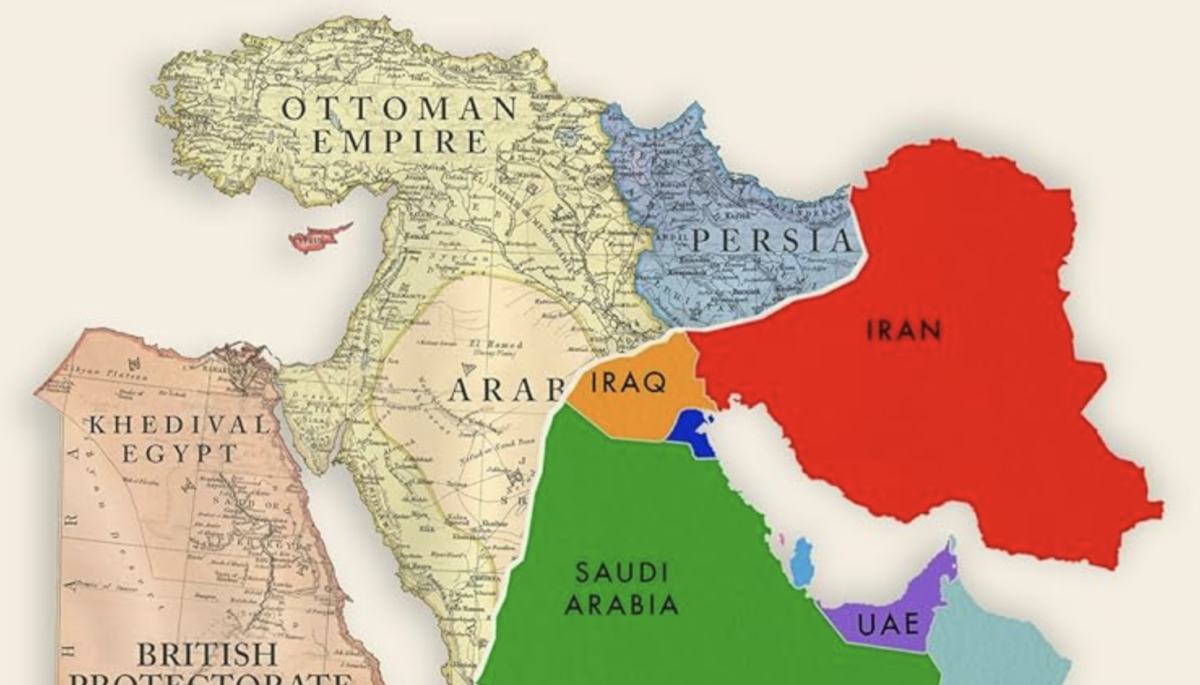
Will Briggs writes: There has rarely been a timelier book inserted into public discourse as Simon Sebag Montefiore’s The Cauldron: The Making of the Modern Middle East.
I opened its pages during the week of the third anniversary of October 7th. The news has also included an Israel-bound Emirati plane hijacked by an Omani, a group of Middle Eastern men landed from a dinghy, a UK-US Airforce base evacuated for fear of Iran, and fuel prices rising as global trade hits literal dire straits. The Cauldron is ostensibly the history of distant places, yet it lays out a landscape that is tangibly connected to the here and now.
I am not an historian, and this is not an academic review. In this article I will engage with this book as a curious Christian minister based in the UK. My instinct, shaped by providential friendships across the Middle Eastern landscape, is that this history can inform and improve our discernment and understanding of the world and also ourselves.
My advice to those who will read The Cauldron is to treat it like an impressionist painting. There is much detail to absorb, so make sure to stand back and take in the broad view. Also lean towards it; the detail emerges as themes and threads. I will engage briefly here at three points:
- A changing World Order
- Islamism and the West
- Projections onto Israel and Palestine
Standing Back from the Frame
The landscape of history is an entanglement of places, dates, and people.
The place of The Cauldron is
an arc of territory that extends from Morocco’s Atlantic coast […] to the Persian Gulf, from the lush Nilotic delta to the Straits of Bosporus and Hormuz.
It bridges continents, land and sea trade corridors, and the source locations of three world religions. It is ‘very much the epicentre of our tumultuous, rushing, interconnected world.’ (p xix).
The dates are in two ‘acts’ and ‘four key phases:’ 1840–1918 as the Ottoman Empire falls; 1918–1945 marked by the British and French mandates; 1945–1979 with postwar turmoil, independent states, pan-Arabism, the Cold War, and oil; and 1979–2026 marked by Iran’s revolutionary Islamism and ‘American unipolarity’ (pp 413-414).
The people in the picture cannot quickly be attached to nation-states and colonial borders; ethnic, tribal, and religious identities are often clearer. Sebag Montefiore focuses on leaders. Ordinary folk, as is often true in reality, are unavoidably subsumed into larger events.
Across The Cauldron’s landscape these peoples and places come into and out of focus as the scene progresses. There is, of course, the thread of Palestine and Israel, which we will consider further below. It’s also worth noting Türkiye, forged from the dust of the Ottoman empire, and now an enigmatic modern state aligned with both NATO and Islamic movements, and an occupying force in Cyprus and Syria. Lebanon’s thread is often a microcosm of the region’s turmoil foisted upon a diverse and beleaguered population—mandatory machinations, refugee displacement, invasion and occupation, the grip of a proxy army, civil war, and a useless UN. Of course, the story of Iran, especially after the revolution, is a dominant aspect:
The revolution of 1979 changed the world like those of 1789 and 1917: […] the new ideology promoted a war between God and Satan—to be waged against America, Israel, Western values and moderate Arab governments—in which resistance was a duty, suffering a test, and martyrdom a divine call (p 272).
For those of my generation, much of the picture is living memory. The post-9/11 world sees the US invasion of Iraq and the subsequent strengthening of Iran. The Arab Spring is laid out as ‘a cascade of revolutions, euphoric and spontaneous in spirit, multitudinous in their origins, fates and consequences’ (p 350). The devastation of Syria is there, including the ISIS atrocities. Iran consolidates the ‘six armies’ of Soleimani; they are the proxies that act on today’s stage. We see the arrival of Trump and the Abraham Accords as well as the folly of his Gaza Riviera ambition. There is much more; I have not even mentioned Saudia Arabia, the Gulf States, or any part of Africa.
The Cauldron is a panoramic exposition, and it invites us to lean in and engage:
A changing world order
The beginning of the twentieth century is the age of empires; the Ottomans fade, the British and French dominate the region, and Wilsonian America influences from the wings. In the present they are now largely absent. Even America wobbles in its inconsistent isolationism. The field is filled by a complexity of proxies, tentative alliances, and alignments of interest. It is a tinderbox of
new or great median powers, willing to manipulate the legacy imperial powers […] and defy or challenge the superpowers who dominated during the Cold War (p 408).
Lean into today’s part of the picture and The Cauldron shows us a dynamic of expansion and convergence.
The expansion is structural as new alliances emerge beyond the region, for example, a Greek-Cypriot-Israeli alliance could face ‘an ascendant Türkiye who may draw in other Muslim contenders’ (p 411). The convergence occurs as this draws conflicts and competing interests into collision, including ‘the Russia-Ukraine War with that of Iran-USA-Israel-Gulf’ (p. 411).
There can be no pretence that the West is insulated from it. From fuel prices and disrupted travel, to major shifts in the balance of military, technological, and financial power, the path ahead is increasingly unsettled and unpredictable.
Engage with this, and questions emerge. From my British perspective, it raises questions about our very sense of identity. What is our role and responsibility in this expansion and convergence? Does our privilege remain, or should we begin to accept, with humility, the limits of our capacity to defend, or welcome, or care, or bring peace? How do we, as Christians, speak truth into this?
It also raises matters of pastoral pragmatism. I am taking note of serious Christian leaders who have recently pondered aloud what faithful preparations for a destabilised world might look like. What pastoral leadership can be offered when the stability of institutions and infrastructure—in which we have trusted and placed our faith—can no longer be guaranteed? Perhaps there is a charism and genius from those who have lived it: ‘How do you hold to hope?’ I asked an Arabic-speaking Christian brother who lives in one of the more chaotic places. ‘Trust God. Pursue holiness. Pray for peace. Love those in front of you in wisdom,’ he said. Amen.
Islamism and the West
There is a debate, of course, between the nature of Islam in its essence and Islamism in its revolutionary form. Sebag Montefiore’s position is that
Islamism promotes itself as a restoration of ancient purities, but is very much a modern ideology (p xxvii).
For him, the contrast is between
Teheran and that of the Gulf States: a liberal Islam allied with the West versus a radical Islam in confrontation (p 414).
Islamism is part of The Cauldron’s landscape. We see Rashid Rida in the 1920s, whose book, The Caliphate, ‘adapted Islam “to […] govern every aspect of citizens’ lives”’ (p 84). There is Sayyid Qutb and the foundations of the Muslim Brotherhood. The emergence in 1947 of the Baath party ‘fused mysticism, Marxism, and fascism’ into Arab Nationism (p 166). And, there is, of course, the ideology of the Ayatollahs.
One thing this picture elucidates is the enigmatic resonance of Islamism with Western leftist extremism. It’s worth noting how some of its roots
developed in the crucible of sixties’ Beirut, combining Marx, anti-colonialism, anti-imperialism, spearheaded by a righteous vanguard, the Palestinian cause […] One could argue it was not so much Islam that was radicalised after 1979, but revolutionism was Islamised’ (p 414).
Our leaning-in must also notice the shifting demographics of the West:
Europe is now home to large, growing and increasingly politically powerful communities of Muslim immigrants and their children. While the nineteenth and early twentieth centuries were in part the story of how European imperialists and missionaries influenced the Muslim world, this may be the era when the opposite becomes true (p 420).
Treating the Middle Eastern diaspora as homogenous is nonsensical, of course. It holds the full range of religious belief, including the various forms of Islam. Its members are neighbours and fellow workers, including in the work of Christian ministry. This is a delight, a resource, and an opportunity.
Nevertheless, the Islamist component can take advantage of a kind of naiveté in the Western postcolonial identity. Sebag Montefiore refers to the father of postcolonialism, Edward Said, whose
dismantling of “Orientalism” was so powerful that it shattered the humanistic universalism that he aspired to—and instead launched a fragmented “identity” cult of victimhood which he despised … today’s Western view sometimes falls prey to a neo-Orientalism, the patronising inversion of the Victorian perspective that, perversely, respects religious extremism and anti-Western “resistance” as an authentically noble reaction to the West’s history of colonial crimes (p xxix, emphasis mine).
The response to Islamism is thus a touchstone for fraught topics in the UK—Immigration, social cohesion, the policing of speech, and the power to shape norms and shared purpose, are all fundamental matters of culture. This response has two broad directions. One is an idealism that inadequately responds to radicalisation and threats to public safety; my Middle Eastern friends are incredulous that we take this risk. In the other direction, however, is a hardened and vicious protectionism and exclusion that is, itself, a form of extremism. Christians will need to navigate this unstable equilibrium between different forms of flag-waving attempts to dominate.
Once again, I heed the charism and genius of my Middle Eastern brothers and sisters; one friend who has lived through war exhorts prayer through the laying down of flags; if we pray with a national or sectarian flag in our hands, that is the limit of our spiritual authority. Rather, our security, our discernment, our encouragement is in Christ. Amen.
Projection onto Israel and Palestine
The Cauldron is not just about Israel and Palestine, but how could it not come to the fore? It seems everyone has an opinion. Yet every slogan or tiktok falls short when weighed against the informed story.
Consider the now infamous trope of ‘Zionism is racism.’ It is an assertion that falls before the real story of its essence and origins in the ancient Jewish longing for home, and the modern rights of Jewish people for safety and self-determination. The Cauldron’s landscape takes us to the realities of the Ottoman world, Eastern European pogroms, and the opportunity to freely purchase land for moshavim and kibbutzim. Follow the thread, and the Balfour Declaration must be held alongside later restrictions on Jewish refugees and the prevarications of the British around offering the security of self-determination, let alone a state. The 1948 partition and the subsequent wars cannot be detached from the simple right to survive.
Anachronistic assertions of Western feelings cannot tell this story, nor, conversely, properly embrace the painful reality for the Palestinians. The 1948 war did involve the displacement of innocents seeking safety. The 1967 occupation has resulted in a stateless population. The Palestinians do exist, and the land is also their home. The complex story around these matters of fact is the defining shape of this part of The Cauldron’s landscape.
At the beginning of this thread he posits that a solution that
linked the two designated states to a larger federation…would have prevented the Arab-Israeli wars and forged a very different Jewish republic (p. 150).
Instead, there was the turmoil of 1948, 1967, and 1973, and everything in between. The Arab stance slowly moves from ‘no peace, no recognition, and no negotiation with Israel’ (in the 1967 Khartoum Resolution, p 225) to an official acceptance by the PLO, in the 1980s, of a two-state framework. Yet there is also the rise of Hamas and Palestinian Islamic Jihad and intifada. The temporary arrangements of Oslo in the 1990s became permanent as other deals fail. The separation barrier is built, preventing a ‘spasm of Hamas-PIJ suicide bombings that killed Israeli civilians,’ but it also ‘separated Jews and Palestinians and made Palestinian life humiliating and difficult’ (p 327). In 2008, an agreement was, in Olmert’s words, ‘“inches away,”’ (p 344) but could not survive Israel’s political uncertainty and the Palestinian Authority’s loss of control in Gaza to Hamas. And, of course, there is October 7, which Sebag Montefiore recounts with efficient precision, noting the genocidal intent of Hamas and the existential threat to Israel of Iranian proxies. He reflects on the war in Gaza:
To Palestinians, this was a ferocious war of annihilation, designed to drive out an entire population. To the Israelis, it was both a complex conflict to kill Hamas militants and demolish its tunnels so that it could never again be a threat, and a mission to liberate their hostages (p 390).
It’s a long, tortuous, painful, wearying journey. Yet he still has hope for ‘creative coexistence,’ including ‘a pathway to Palestinian self-determination’ (p 418):
It would require an Israeli leader capable of reassuring Palestinians that Israelis could envisage a peaceful Palestinian entity on their borders…Palestinian leaders would have to complete the circle by convincing a majority of Israelis that such a shared peaceful future is possible—something that seems far off with each too traumatised by the killing of October 7 and the Gaza War. Nonetheless it is essential and existential for both peoples—and still achievable (p 418).
Leaning in and engaging with this part of The Cauldron’s landscape could take myriad forms; current discourse in the West is vociferous. Of particular note, however, is an astounding level of projection onto the story from the West. So often the words ‘Palestinian’ and ‘Zionist’ or ‘Jew’ are labels for characters in some other metanarrative, most obviously one with Marxist or so-called ‘liberationist’ conceptions.
There are at least two ways in which this projection manifests.
The first is in the rhetoric of holocaust inversion; the language of ‘genocide’ is used loosely or viciously to shape the story. Sebag Montefiore offers some facts, noting, for instance, the often-misrepresented outcome of the South African ICJ case. His landscape also helps us see those events, such as the Armenian Genocide, where the level of atrocity can be grasped by that language. Where there is pain and devastation from war, it is respected by accurate portrayal. Sebag Montefiore has the weight of integrity, therefore, when he critiques the ‘bombastic and bloody’ ways of Israel’s military strategy (p 418) and settler violence aligned with ‘overmighty militias’ (p 410). On the other hand,
eliminationist rhetoric, Holocaust inversion and calumnies of cosmic evil to incite the destruction of Israel and “globalize the intifada”’ (p 402)
do not; they add to the pain. Such rhetoric has fomented significant increase in violence against Jews, including the murders in Manchester and the massacre at Bondi.
A second manifestation of Western projection is a blindness to antisemitism. A defining thread throughout The Cauldron’s landscape is the stark and persistent existential threat to the Jews. It is there in the alignment of the Grand Mufti with Hitler, the aggression against Israel in 1948 and 1967, and Arafat’s formational ‘armed struggle to demolish Israel and create in its place an Arab state of Palestine’ (p 230–231). Similar rhetoric now adheres to the policy of the Greens in England and Wales. It is not new; it is a reprise of the 1970s Soviet propaganda of ‘Zionology’ (p 233) pursuing its own ends of
decolonisation and anti-imperialism [which] played into the zeitgeist of the sixties and appealed to young Western radicals (p 233).
It is more than unfortunate that we also find this kind of projection in the ecclesiastical field. The General Synod of the Church of England recently embraced the controversial Kairos II document as a teaching resource. This document has been excellently analysed by Jason Swan Clark. It contains useful testimony but reinforces Western antisemitic projections and blindspots when it includes language of genocide, the essential illegitimacy of Israel, and a refusal to dialogue with Zionists. It’s difficult to see how this helps us pursue peace; the Synod’s decision has diminished this essential element of the Church’s calling.
Standing Back Again
Standing back again to take in the bigger picture, one exhortation remains: that those of us in the West would truly listen to actual people. Observe the trauma of October 7th in those who also know what the thud of an Iranian missile feels like. Talk to Palestinians who have buried innocents and suffered restrictions and indignities, yet turn themselves and others from radicalism. Learn from the Middle Eastern man who longs for peace to raise a family and tries to calculate which army might be the greater or lesser evil. Be curious about those who have had to flee because of the corruption and viciousness of Arab authorities.
 I have had the privilege to speak with those who have offered me the precious gift of this sort of testimony. They have broken my assumptions and given me insight into what is truly at stake. It is their voice that completes the picture that a book, no matter how good, can only approximate. Nevertheless, The Cauldron serves us well; it offers a landscape that challenges our caricatures, questions our securities and comforts, reveals our naiveties, and confronts our projections and prejudices.
In the end, the Middle East is not just about ‘interminable wars and tournaments of power’—for which ‘The Cauldron’ is aptly named—but ‘the abundant delights of its way of life and the rich multiplicity of its peoples’ (p xix).
(There is an extended interview with Simon Sebag Montefiore about the book on YouTube here.)
 Revd Will Briggs has been in ordained ministry for almost 25 years in the Anglican Church in Australia and the Church of England.
He writes from time to time at Substack as Journeyman.
 Buy me a Coffee







Islamism promotes itself as a restoration of ancient purities, but is very much a modern ideology (p xxvii).
People have said the same about the Reformation. In both cases it is partly true, partly false.
When I read the Quran and the New Testament I find myself glad that many Muslims are nominal and sorry that many Christians are.
I almost ordered The Cauldron a month ago, and on its own terms it probably deserves the praise it gets, but to start in 1900 is to leave too much out. I am not insisting on a complete history of the region, of course, but you have to know in some detail that Turkey was the ‘sick man of Europe’ by 1900, that Muslims had never forgotten the Crusades – which were no more than a response to centuries of Islamic violence against Europe as soon as its Western half had come out of the ‘Dark Ages’ (a phrase I am willing to defend), that Jews had lived in Jerusalem for centuries, that Victorian society was philosemitic and set up a protestant mission in Palestine, that Egypt defeated the Ottomans and ruled Palestine through the 1830s causing many Arabs to flee in order to avoid conscription into Egyptian armed forces, that Turkey enacted the first of its three waves of genocide against its Christians in the 1890s (less well known than the second wave against the Armenians), etc.