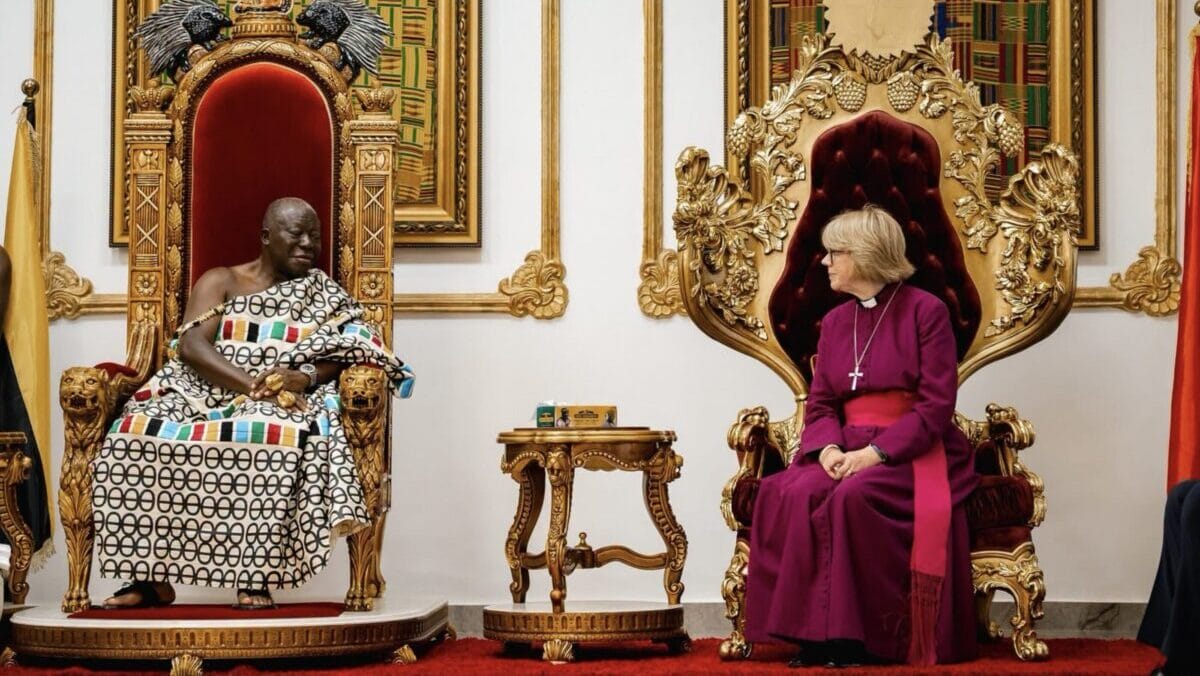
The Archbishop of Canterbury, Sarah Mullally, has been visiting west Africa, and was pictured meeting both the King of the Ashanti (above) and visiting the sites of slave trading, in particular the embarkation points for the Transatlantic slave trade, where she was clearly personally moved.
I noticed this comment from Father Richard Woods, a retired parish priest in Canterbury Diocese, which I thought worth sharing more widely:
Why I despair at the hierarchy of the Church of England.
Today in the CofE and in our Eucharist we observed the Lesser Festival of William Wilberforce, Social Reformer, Olaudah Equiano and Thomas Clarkson, Anti-Slavery Campaigners, 1833, 1797 and 1846.
These Church members worked unremittingly to call the church and country to oppose the West African trade in humans and abolish slavery. (There is much information online about all three.)
I recall reading about Thomas Clarkson as boy. In 1785 he entered a Latin essay competition at Cambridge university that was to set him on the course for most of the remainder of his life. The topic of the essay, set by the vice-chancellor, was “Anne liceat invitos in servitutem dare” (“is it lawful to make slaves of others against their will?”), and it led him to consider the question of the slave trade. He read everything he could on the subject, including first-hand accounts of the African slave trade. He also researched the topic by meeting and interviewing those who had personal experience of the slave trade and of slavery. This had such a profound effect on him that he devoted his life to abolition. His essay was translated into English and published, causing widespread interest. In the abolition cause, he supported, researched, and lectured, whilst Wm Wilberforce was working in Parliament.
Olaudah Equiano was born in (now) South Nigeria, to a father who owned many slaves. He and his sister were kidnapped and sold to slave traders when he was 11. He was taken to Barbados, thence to the colony of Virgina. One of his owners sent him England to be taught to read and write; he became a Christian and was baptised in 1759 at St Margaret Westminster. He was returned to the Caribbean and sold to a Quaker merchant, from whom he purchased his freedom for £40. He worked at sea, and as a plantation manager, eventually returning to England and becoming involved with the Abolitionist Movement. His published memoirs, “The Interesting Narrative of the Life of Olaudah Equiano, or Gustavus Vassa, the African”(1789) gained widespread international interest. He married an English woman and settled in Soham, travelling and lecturing about the slave trade. During the American War of Independence, Britain had recruited black people to fight with it by offering freedom to those who left rebel masters, it also freed women and children.
When British troops were evacuated at the end of the war, their officers also evacuated these former American slaves. They were resettled in the Caribbean, in Nova Scotia, in Sierra Leone in Africa, and in London. Britain refused to return the slaves, to United States in peace negotiations. In 1783, following the US gaining independence, Equiano became involved in helping the black poor of London, who were mostly those former African-American slaves freed during and after the American Revolution by the British. There were also some freed slaves from the Caribbean, and some who had been brought by their owners to England and freed later after the decision that Britain had no basis in Common Law for slavery. He was involved in resettling Africans in Sierra Leone.
William Wilberforce pursued a hedonistic life at university, and became independently wealthy through inheritance. He had discussed politics at university with Wm. Pitt, and became an independent MP at 21, whilst still at university. He continued his active social life, but although remaining convivial, amended his habits after conversion to a serious Christian faith. He was encouraged to remain in politics. He began to work for abolition after reading Thos. Clarksons essay and meeting him. The Act to abolish the Slave Trade was passed in 1806. He died just as the Act to abolish slavery in the British Empire was passed.
In 1808 the Preventative, or West Africa, squadron of the Royal Navy was formed to intercept slave vessels and free the enslaved. Since Portugal at the time was the largest slave trader, and allied with Britain in the Napoleonic wars progress was at first slow, but the Squadron seized approximately 1,600 ships involved in the slave trade and freed 150,000 slaves who were on board between 1807 and 1860. It has been called “the most expensive international humanitarian intervention in modern history.”
Of course slavery did not end there: across Africa the 1,000yrs of the Arab trade continued, from West Africa, and from Zanzibar. Throughout the 19thC both Christians like David Livingstone and British forces worked and fought to end the trade in human slaves. The RN intercepted slaving dhows off E Africa throughout the 1960s. But it was a foul practice in which Britain led the way in ending, at a great cost in lives and money.
Yet today Dame Sarah, Archbishop of Canterbury, stood at Cape Coast Castle, to which Africans (like Olaudah’s father) and Arabs brought slaves to sell, and placed the blame on the shoulders of English Christians, and said that the CofE had profited; which has been shown to be a misinterpretation of known facts and a lie. The church whose members had led the campaign to end slavery, and whose followers had given themselves and their lives to eradicate it, is to pay £millions to the descendants both of those who profited from it (like Benin) and of those who suffered, but who themselves have only benefitted from the vision and generosity of the only country to expend a substantial portion of its wealth in combatting slavery; out of funds generously given to share the Good News of freedom bought on the Cross.
For “There is neither Jew nor Gentile, neither slave nor free, nor is there male and female, for you are all one in Christ Jesus” (Galatians 3:28).
The irony is, in seeing the splendour of the throne of the King of Ashanti, that the wealth of his kingdom was historically built on slavery. The Ashanti Empire (also spelled Asante) became one of the wealthiest states in West Africa through a combination of gold, trade, tribute, and slavery. Slavery was central to its economy; its largest source of wealth was gold, but the use of slaves in mining that gold, and slavery as trade were vital to its economy.
From the late 17th century into the early 19th century, the Ashanti kingdom expanded through warfare against neighbouring states. These wars produced captives who were sold to European slave traders on the Gold Coast, captives retained as slaves within Ashanti society to work in agriculture, mining, households, and the royal administration, tribute from conquered peoples, which often included slaves. Tens of thousands of captives were exported from territories under Ashanti control during the height of the Atlantic slave trade.
There is no surviving Ashanti treasury account, so it is impossible to know precisely how much this was worth. A healthy enslaved adult sold on the Gold Coast in the eighteenth century might be exchanged for European goods worth roughly £20–£50 sterling in contemporary British prices. So, for example, 50,000 people were exported over several decades, the trade would have been worth around £1-2.5 million in eighteenth-century values. Measured in today’s purchasing power, that would amount to hundreds of millions of pounds, and if measured by relative economic importance or share of GDP, the equivalent would run into many billions of pounds.
I don’t expect that any of this was raised by the Archbishop in conversation.
Alistair Parker offers an outline of the situation, and the role of the British in ending slavery, on the History Reclaimed website.
The early 17th century slave trading included the Portuguese buying slaves from other parts of West Africa, particularly from Benin, and then selling them in Ghana for gold, a practice also followed by the Dutch and the Danes. In the northern region there were four main slave markets: Salaga, Yendi, Bole and Wa, with Salaga being the most famous and most important market in Ghana for both the trans-Atlantic and trans-Sahara trades. According to the German researcher Heinrich Klose in 1899, in Salaga ‘in former times, it was estimated by older travellers, there was a turnover of 15,000 slaves annually’.
The Asante empire emerged in 1696 with King (Asantehene) Osei Tutu taking the crown in his capital Kumasi. After the Asante invasion and conquest of Gonja in 1732 and Dagomba in 1744, those states were required to pay annual tribute to their overlords which they did by raiding lesser clans like the Kasena, Sisala, Kusasi, Builsa and Frafra to make the tribute of some 1000 – 1500 slaves per division or chieftainship per year.[12] The slaves were moved along four main slaving routes from the northern territories to Kumasi. These included the route from Wa and Bole to the Asante capital and then to the coast…
The 1874 Treaty of Fommanah (Fomena), ending the Third Anglo-Asante War, required the Asante to end slave tributes and human sacrifices and accept free trade. The unforeseen consequences from the collapse of the Asante regime were secession attempts by members of the Asante federation, independence declarations from conquered states like Gonja, Asante moves to regain territory, and the emergence of new warlords in the north taken to slave raiding. All this led to constant and endemic warfare and further enslavement. This period witnessed a tremendous surge in the ‘domestic’ use of slave labour as the economy transitioned from exporting slaves to exporting other commodities…
Ongoing concern was stoked by British Commissioner Reginald Firminger, resident in Salaga in 1887-89, who critically reported that ‘From the evidence given by the King and Chiefs which I verified by numerous independent inquiries, it appears that about 20,000 slaves are disposed of in one way or another annually’. The pressure to suppress slavery continued and, having been long reluctant to extend control with greater expense and no material gain, the British began to expand control outside the Colony to the Asante and the Northern Territories, partly to suppress slave raiding, partly to secure free trade to improve the Colony’s viability, and partly to keep out the French and Germans.
The Governor sent the civil servant George Ferguson to secure friendship treaties in the Northern Territories in the period 1890-95 with various rulers including the chiefs of Bole, Daboya, Yendi, Bimbilla, Wa and Gambaga but ‘he took it upon himself to persuade local communities in the Northern Territories that treaties of friendship with the British offered protection against slave-raiding, and that they should not engage in the slave trade themselves.’ By 1902, the Governor reported that ‘In the Northern Territories … slave raiding has been completely stamped out, but slave dealing is prevalent’ and the practice did not die out until after the 1928 Abolition of Slavery ordinance.
Parker also notes the historical irony of the current debate:
After 1806 British imperialism largely aimed at abolishing the African slave trade, securing free trade, and forestalling the Germans and French in Africa in general. It now stands condemned by a Ghanaian leadership whose own ancestors fought against the prevention of slavery. President Mahama blames the colonialists and refuses to join the British and other Europeans in the league of infamy he has constructed. The truth is clear, however: Mahama’s royal ancestors were slaveholders and slave traders long before, and also long after, Europeans came to the coasts to collect and transport slaves.
Justin Welby also stepped into this complexity in May 2024, when he visited Zanzibar, and in a sermon in Christ Church Cathedral criticised missionaries for treating Africans as inferior, and claimed that ‘we must repent and look at what we did in Zanzibar.’ Alexander Chula, who taught in Malawi for three years, commented:
I am curious to know who exactly the former Archbishop had in mind. [Anglican bishop John] Mackenzie’s successors gave everything they had to the region, and their graves litter Malawi, still venerated today. They committed to sharing the lives of local peoples and … approached their cultures with a curiosity and respect seldom matched by Western visitors today. The imputation that they treated Africans as inferior dishonours men who died precisely because they considered Africans as worthy of that sacrifice as anyone.
There is an even more direct link with the Church of England and abolition of slavery through Sir John Kirk, who was Consul from 1865. From the 1820s onwards, Britain sought to suppress the East African slave trade, particularly the export of enslaved people to Arabia, Persia, and elsewhere in the Indian Ocean. The Royal Navy’s East Africa Squadron intercepted slave ships, negotiated treaties with the Sultan of Zanzibar, and pressured him diplomatically. Important agreements included the 1822 Moresby Treaty, which restricted the slave trade in certain waters, the 1845 Hamerton Treaty, which tightened these restrictions, and the 1873 Anglo-Zanzibari (Frere) Treaty, which effectively prohibited the export of slaves by sea and ordered the closure of Zanzibar’s famous slave market.
Kirk continued [his predecessor Henry Adrian] Churchill’s work on the slave trade and in June 1873 he received simultaneous contradictory instructions from London on the Zanzibar slave trade, one to issue an ultimatum to Sultan Bargash, under threat of blockade that the slave trade should be stopped and the slave market closed, and the other not to enforce a blockade which might be taken as an act of war pushing Zanzibar towards French protection. Kirk only showed the first instruction to Barghash, who capitulated within two weeks.
I wonder when leaders in the Church of England will talk about the role we played in eradicating slavery with confidence? There is no doubt that Britain, like other nations, was deeply entangled in the slave trade for a period. There is also no doubt that the Church of England (in the form of the Queen Anne’s Bounty, which became incorporated into the Church Commissioners) made no investment in this, and made no profit from it; the CC assets are not ‘tainted’. And there is no doubt either that Britain played a unique role in the abolition of the slave trade around the world.
Britain’s anti-slavery campaign lasted for much of the nineteenth century and involved the Royal Navy, diplomatic missions, colonial administrations, and compensation to slave owners when slavery was abolished in the British Empire. There was (as always) a mixture of motivations in this, but a primary one was the moral repugnance at slavery.
Economic historian David Eltis has estimated that Britain spent approximately £250 million (nineteenth-century pounds) between 1807 and about 1867 on suppressing the Atlantic slave trade. In terms of consumer spending, that is around £30 billion today, but as a share of GDP, it is equivalent to perhaps £400 billion. Britain spend around 8% of its GDP on this project for much of the nineteenth century. (I wonder if we can imagine Britain spending so much on any moral cause today?)
I find it very odd when church leaders talk of the need for repentance, as if we are the first generation to be horrified by slavery. I find it even stranger when they talk of ‘atoning for the sins of the past’ as if we can do that and as if there has not already been massive ‘atoning’ action.
Gad Saad recently published Suicidal Empathy: dying to be kind. His thesis is that empathy can be enormously destructive when separated from facts. I think we are seeing just that being played out here in the Church of England.
 Buy me a Coffee










I have noted an error in what I wrote: Wm Wilberforce died just as slavery, not the trade, was abolished in the Empire.
Thanks. I will revise.
Corrected.
This issue – along with many others at this present time! – simply reinforces the old adage attributed to John Haywood in 1546:
“Who is so deaf, or so blind, as is he, that wilfully will neither hear nor see.”
We are led in the Church of England by those who fit this description perfectly in their inability – even their unwillingness! – to listen to the truth in so many areas. Slavery reparation, church decline, financial collapse, morality – and, most worryingly, the authority of Scripture.
I have yet to experience an institution that, despite its “wokeness”, has appeared less “awake” than the Church of England.
“The path of the righteous is like the morning sun, shining ever brighter till the full light of day. But the way of the wicked is like deep darkness; they do not know what makes them stumble.” (Prov 4:18-19: NIVUK)
But please note: the C of E is not monolithic. There is a good deal more than 7,000 who remain faithful—and are seeing people come to living faith in Jesus.
Very encouraging ….thank you Ian !
“Faithful” is a good word to use in this context, I think, thank you for the reassurance that there are so MANY who remain faithful.
Also, looked at in the context of history and legend, it’s always the faithful minority, fighting against wickedness unto death and lighting candle after candle in the darkness, who carry the future in their hearts. It’s never the faithless majority. No one said it would be easy or end happily for all of us in the here and now but one day I imagine there will be a grand restoration, like at the end of the Errol Flynn “Robin Hood” film, when everyone bows the knee to the rightful king and he surveys all his subjects, smiles at the ones who were faithful when it was hard and says, “All THESE have remained faithful” …
Yes but what are they going to do about it?
Of course. My comment was aimed more at many of the leaders of the institution and the setters of these woke agendas.
Thank you so much for discussing this in so much detail! Some years ago I wrote an MA dissertation on William Wilberforce and I’m so confused and frustrated every time the topic of the slavery reparation scheme comes under review because it’s so badly informed and imagined. Wilberforce and his fellow high-profile abolitionists like John Newton, Hannah Moore and Thomas Clarkson as well as John and Marianne Thornton and the rest of the Clapham Sect were Anglicans! The Church of England is thus technically responsible for producing the generation of English Christians which not only abolished the British slave trade and – in time – slavery throughout the British Empire but also changed the way the western world thinks about slavery. Personally I think it’s a tragic betrayal of their legacies. Thank you again!
Is it ‘wokeness’ or is it just pandering to the Ghanaian Church? What do they think about all this and the slavery history/issue more generally?
The irony is that despite making such a prominent show of contrition about slavery we’re oddly reticent to look at the real arguments, practices, and thinking that created it. It’s often repeated that slavery and slave trade was about denying that everyone was in the image of God. It might be that seeing everyone as an image-bearer convinces you that slavery is wrong, but that doesn’t mean that those who enslaved people, held slaves and traded slaves believed that slaves were not image-bearers. They were, after all, quite willing to go along with sentencing white Europeans to be worked to death as oarsmen in galleys, indentured servitude in the colonies, the serfdom of Scottish coal miners etc. etc.. It is perhaps no coincidence that as those institutions were done away with, the slave trade and chattal slavery in the Americas became morally intolerable. What is remarkable is that throughout the slave trade, the Europeans didn’t decide to invade West Africa and start enslaving people. They couldn’t: the whole thing was made possible by a slip of moral relativism. You weren’t allowed to enslave someone. But if someone was a slave, you weren’t obliged to free them. So as long as someone else is doing the enslaving, it was fine to have slaves and trade them.
But whilst the discussions about the 18th century slave trade, the moral arguments of the time, the historical experience of the West Africa Squadron and the Britain’s actions to abolish slavery through the lands of the Assante Empire are all quite interesting, are they the right focus for Church leaders in England and Ghana to spend their time talking about? Is this what defines Ghana? Do we really have nothing to learn from what’s going on the in the Anglican Church of Ghana or they from us?
Excellent piece. May I remark that the claim that England is “the only country to expend a substantial portion of its wealth in combatting slavery” might be a little too exclusive. The US Civil War was at root an internecine fight to end slavery. It cost 620,000 American lives (more recent estimates put the number at closer to a million), or 2-3% of the total population, which would extrapolate to 1.5-2 million UK citizens today. This sacrifice of human life in the US to free its own slaves is unprecedented in history, and added to the billions spent during the war might plausibly be characterized as an expense of a substantial portion of US wealth to end slavery.
It is one of the richest ironies of history that no culture other than the Anglo-American one ever lifted a finger to end slavery, and yet the only culture to be reviled for slavery is the Anglo-American one.
Thanks John, that is true. But that was about the status of slavery within the US.
The difference with GB is that we pursued this worldwide.
Although almost half of those American casualties were on the Confederate side – so they were sacrificing their lives to perpetuate slavery.
On the cultural point, it can be interesting to see how the arguments shift and move. A standard argument in discussing the slave trade is that it is immoral for one person to own another. But this makes things awkward when looking at history worldwide: the British Empire abolishes slavery in 1833, but it isn’t got rid of in Assante lands until the 1920s. So that basic moral argument gets dropped in favour of saying that the practice of slavery in West Africa wasn’t that bad, and slaves couldn’t be mistreated in the way they were in the Americas. And so the chattal slavery and the Transatlantic slave trade is interpreted as ‘bad’ slavery as opposed to the better and more understandable in its context ‘normal’ slavery elsewhere. And where you can’t make that argument (e.g. the castrations and extraordinarily high death toll in the East African slave trade) you just sweep it under the carpet.
Adam:
Or it may be that the prosecution of British law was a good deal more difficult and slower to implement than on the high seas, where Britannia ruled the waves.
Remember that the British Empire was largely conducted by native peoples on the ground, under the direction of District Magistrates who travelled in circuits. There was no army of occupation. India for all its vastness had comparatively very few British officers and agents on the ground and I imagine this was even more so in backward parts of Africa without roads or towns of any consequence. Progress could only ever be slow there while infrastructure was built and schools, churches and clinics (the three legged stool of missionary strategy) were gradually built. So if it took that long to change the Asante lands, it is perhaps not surprising. Rome wasn’t built in a day. Remember how long it took the British Raj to abolish suttee and to reform the thugi.
Backward parts of Africa.
You couldn’t make it up!
Have you read the interesting book ‘Prisoners of Geography’ by Tim Marshall, which has had a deserved vogue in the last 12 years? It analyses geoplitics continent by continent. Marshall points out that subsaharan Africa , with oceans on three sides and the Sahara to the north, and with non-navigable rivers (due to frequent waterfalls) and lethal diseases, has been largely cut off from the mainstream of Eurasian civilisation as the latter developed in Europe, India and China which were all linked by the silk roads across the great steppe belt that connected them. What chance that the far smaller subsaharan African population would independently invent – as they would have to – all of the innovations that went to make the great civilisations of Eurasia? Yet they still managed to create civilisations in Zimbabwe and Mali at various stages.
It isn’t about genes, as you are perhaps thinking James is thinking. It is about ‘location, location, location’.
Anthony,
That’s right – Thomas Sowell has made the same point about the lack of navigable rivers in sub-Saharan Africa (compared to the Nile – the Congo can be swift and dangerous) and the isolation, to which you can add the lack of good ports on the sub-Saharan Atlantic coast. This Africa is very different from the civilisations that grew up on the Mediterranean coast, along the Nile and on the Red Sea coast, where there were from ancient days a cross-fertilisation of civilisations, bringing metallurgy, wheels, literacy, mathematics, building in stone, pack animals etc. The extreme isolation of sub-Saharan Africa meant that roads hardly existed until European colonisation. Southern Africa was colonised centuries earlier by great migrations from west Africa – I think the Zulu and Xhosa originate from west Africa. Iron smelting did appear in west Africa in the 15th century, IIRC, and bronze smelting in Benin sometime after.
So the vast continent of Africa varied enormously in its development in the 19th century and travel even within one country could be very difficult. So we should not expect social development to be uniform or immediate.
And ‘backward’ is the right word – the same word I would use for villages in 18th century Ireland or Siberia or Puglia or the wild lawless mountains of Spain described in ‘Don Quixote’.
I could spare some blushes by euphemisms (‘undeveloped’) but ‘backward’ forcefully describes the difference between the country and the city. Our very word ‘pagan’ originally meant ‘rural’. The Athenians did the same with ‘agroikos’.
The Victorians were wont to refer to black Africans as ‘primitive savages’. I would have replied that Europeans were advanced savages.
Of course. Only advanced savages can develop high explosives to kill many people at once.
I think you’ll find that the Christian anti-slavery drive started in the free churches and spread to the Church of England, and they then worked together – the Frees at grassroots level and the CofE arm in Parliament. To my knowledge the CofE didn’t preach salvation to the Empire’s slaves whereas the Frees did – and risked persecution from slaveowners for it.
The Queen Anne’s Bounty link has been more than adequately debunked, but the Church of Englnd’s missionary arm, the Society for the Propagation of the Gospel in Foreign Parts, was bequeathed two sugar plantations in Barbados in 1710. The SPG continued to work these plantations, and various Archbishops of Canterbury were sworn in as president of the SPG, for several decades. At meetings chaired by Archbishop of Canterbury Thomas Secker in 1758 and 1760, payments were approved to reimburse accounts for the purchase of ‘new negroes’ and the hire of enslaved labour. Slaves on these plantations were branded on their chests with hot irons bearing the word ‘Society’.
https://www.theguardian.com/world/article/2024/may/25/revealed-how-church-of-englands-ties-to-chattel-slavery-went-to-top-of-hierarchy/
In August 1862, 16 months after hostilities had begun, President Abraham Lincoln stated publicly that his constitutional “object in this struggle is to save the Union, and is not either to save or to destroy slavery. If I could save the Union without freeing any slave, I would do it…”. He wrote these words in a letter to the New York Tribune in which he also made clear his personal opposition to slavery. One month later Lincoln went further and declared that slavery would be abolished throughout the United States if the North won. This emancipation proclamation headed off any possible military support for the South from its transatlantic trading partners, Britain and France, who would not support any pro-slavery party in a war of abolition (our Lancastrian cotton industry accepted financial devastation during this war for the anti-slavery cause, and Britain prevented its shipyards from fulfilling orders from the South for warships).
What an astonishing photo. What does it say?
Don’t tempt me! It would make a great caption competition.
Something from Matthew 4.8-9 comes to mind ……
“How about some apologetics, Archbishop?”
For this one by Mullally’s predecessor, I suggested (elsewhere), “Mind the step, Archbishop”:
https://www.theguardian.com/world/2019/sep/10/justin-welby-apologises-in-name-of-christ-british-massacre-amritsar#img-1
Exellent article. In the para beginning :”Of course slavery did not end there…” should the reference to RN stopping slave traders in the “1960’s” be “1860’s”?
Thanks. No! The last dhow was intercepted in 1967!
Thank you Ian for this post. I was praying you would do so. It is so good to have these facts laid out so clearly.
The C of E leadership and Commissioners are saying that the C of E funded transatlantic chattel slavery via Queen Anne’s bounty in the 18th century. Nobody is really disputing that via the likes of Wilberforce the C of E helped campaign to successfully abolish slavery in the 19th century.
So it is 18th century investments via the bounty in the South Sea Company that traded in the enslaved that are really in dispute. Plus benefactions from those who profited from slavery or the plantation economy.
https://www.churchofengland.org/media/press-releases/church-commissioners-research-identifies-historic-links-transatlantic-chattel
So any funds from Project Spire should only compensate at a level equivalent to 18th century investments from Queen Anne’s bounty linked to slavery. The level of those investments is what needs to be scrutinised. Clearly the King of Ashanti shouldn’t be a beneficiary of Project Spire funds given the Ashanti Kingdom seems to have benefited from slavery revenue, even if some projects in Ghana could
‘The C of E leadership and Commissioners are saying that the C of E funded transatlantic chattel slavery via Queen Anne’s bounty in the 18th century.’
And Richard Dale has demonstrated that this is entirely untrue, and could only be claimed by people who made basic errors in historical understanding.
‘So any funds from Project Spire should only compensate at a level equivalent to 18th century investments from Queen Anne’s bounty linked to slavery.’
Which are zero. QAB invested in government bonds, then known as South Sea Annuities.
‘Ashanti Kingdom seems to have benefited from slavery revenue’. So why is no-one demanding *they* pay reparations…??
Well if you are certain that Dale is correct and not a penny of Queen Anne’s bounty was invested in the slave trade and that no benefactions were received from slave owners or investors in slavery then you can raise that at the next Synod
There is of course now a legal case related to this matter too
https://www.theguardian.com/world/2026/jul/13/church-of-england-100m-slavery-reparative-justice-project-legal-challenge
You should read it for yourself – as have most of the commentators here. This is not recent news, we have known this for a long time and it has featured several times on this website. But the Archbishop of Canterbury seems to know nothing of it.
Simon, you can be certain of it too by reading Richard Dale’s analysis. And questions have been asked in every Synod. The result is further obfuscation and denial.
We will see what the outcome of the legal case is then