
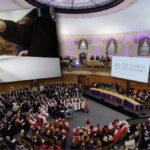
Yesterday, US President Donald Trump took part in ‘America Reads the Bible,’ a week-long event where the whole Bible is read in public, including by well-known politicians and church leaders. The aim of this movement seems laudable enough:
Just as Ezra read the Word aloud to the people of Israel (Nehemiah 8:1–3), awakening revival and repentance, inspiring them to rebuild the temple, and working with Nehemiah to mobilize the people to rebuild Jerusalem’s walls, America Reads the Bible is a sacred opportunity to call our nation back to its spiritual foundations. Through a public, continuous reading of the entire Bible in our nation’s capital by our national leaders from all spheres of influence, we believe God can spark revival in individual hearts and inspire Americans to carry the Word forward in their lives and communities into the next 250 years of our national story.
And I think if, in the UK, ‘national leaders from all spheres of influence’ committed to a public reading of Scripture here, I would be very excited!
It appeared to be no accident that Donald Trump was asked to read a passage from 2 Chronicles (probably not the best-known book of the Bible) which included this verse:
If my people, who are called by my name, will humble themselves and pray and seek my face and turn from their wicked ways, then I will hear from heaven, and I will forgive their sin and will heal their land (2 Chron 7:14)
(You can watch him read the passage here.) This verse has been central for those wanting to see America rediscover itself as a ‘Christian nation’.
Tim Stanley, the journalist and commentator who is a Roman Catholic, was asked to comment on Radio 4’s Today programme (you can listen here from 2:40 into the programme), and he chose mostly to focus on the political dimensions of the way this text has been used.
Now this verse has been used in public life in America since at least the Civil War. For example, Eisenhower, when he was inaugurated, had his Bible open to this verse, and it’s really part of the civil religion of America. And you can read the message in an almost in an almost non sectarian way, to say America is a country which is blessed by prosperity, so long as it is good. But if it ceases to be good, then the Republic and all of which it stands will be undone.
But in recent decades, the Christian right have taken the verse and really run with it, and they add a new sort of level to it, if you like, one of which is to say, this is about saying that America must be a Christian nation, because the verse ends with the explicit warning that if you worship other gods, which is what King Solomon went on to do, he allowed other gods to be worshiped in ancient Israel, that’s what will be your undoing. So some on the right say this is about about America being a particularly Christian country.
But you can also read it to say who is Solomon in this? Solomon is like the wisest King, despite what happened to him later on, and he is the man who made Israel as great as it was ever to be. And there is a reading that says that’s Trump, right, that we’re in times of great trouble, it requires a strong man to step in and save the country.
I am not saying not all, all American Christians believe this. I want to stress that, yes, but, but there is a way of reading it to a certain audience that will make sense to them.
I was asked (at short notice!) to talk to Nick Ferrari on LBC about this event, and Nick was much more interested in what the passage means theologically, rather than the way it has been used politically—which in itself is fascinating. The chance to speak about scripture and hermeneutics on national radio!
The passage this verse comes from is the high point of Solomon’s reign. I have just been reading the parallel passages in 1 Kings, and the same point is made: this is the time which is marked by splendour and wealth, the time of God’s clearest blessing of his people Israel.
The story so far has had its ups and downs. After the chaos of Judges, when (without a king) ‘everyone did what is right in their own eyes’ (Judges 21.25) the people then ask for a king of their own, to be like the other nations. This whole narrative is filled with ambiguity, and this central request exemplifies this. On the one hand, this is seen by the prophet Samuel (and God!) as a rejection of God’s reign over them (1 Sam 8.7); but on the other, the role of the king will be to keep the people faithful to God’s commands, and of course this king will become, in the person of David, the central expression of hope for God’s restoration of his people, when he will send another king like David to rule his people perfectly.
Sauls starts off well, but then becomes paranoid about defending his own power, and the kingdom is taken from him, ending in the tragedy not only of his death but also the death of his noble son Jonathan (‘How are the mighty fallen!’ grieves David in 2 Sam 1.27). David then succeeds Saul, and although he is often referred to as ‘a man after God’s own heart’ and someone who ‘kept all the commands of God,’ the narrative is very clear that he does not.
Despite many signs of faithfulness, God giving David victory in battle, establishing him in Jerusalem, and finally giving him ‘rest from all his enemies’ (2 Samuel 7.1), his reign is still beset with division, failure, and sin. Despite the apparent glory of Solomon’s reign, something similar happens, and because of Solomon’s failure, the kingdom is divided into the northern ten tribes (under Jeroboam after a rebellion) and the southern two tribes (under Solomon’s son Rehoboam). The glory of Israel is very short lived, and the narrative leads into a long decline, in both north and south, until Israel is taken into exile by the Assyrians in 722 BC, and Judah by the Babylonians in 586 BC.
What is fascinating about the verse at the centre of Trump’s reading is that it appears to anticipate all this. Despite being God’s words to Solomon at the height of his splendour, it looks to a time when the people will have turned from God and the land will be laid waste: ‘if my people…turn from their wicked ways.’ Something similar happens at the end of Deuteronomy, when Moses sets out the blessings of obedience, and the disaster that will befall the people if (when) they turn from God—as though Moses knew this was what was going to happen!
And this is explicitly anticipated in just the previous chapter:
“When they sin against you—for there is no one who does not sin—and you become angry with them and give them over to the enemy, who takes them captive to a land far away or near; and if they have a change of heart in the land where they are held captive, and repent and plead with you in the land of their captivity and say, ‘We have sinned, we have done wrong and acted wickedly’; and if they turn back to you with all their heart and soul in the land of their captivity where they were taken, and pray toward the land you gave their ancestors, toward the city you have chosen and toward the temple I have built for your Name; then from heaven, your dwelling place, hear their prayer and their pleas, and uphold their cause. And forgive your people, who have sinned against you.” (2 Chron 6.36–39).
Unfortunately, Trump’s reading only began in chapter 7.
So what does it mean to be obedient, to turn from what is wrong? There is always a challenge to our reading of narratives and understand from them what God is teaching us—not least because narratives can describe events without evaluative comment, and what they describe is not always what they prescribe. Yet the narratives around Saul, David, and Solomon are fairly clear, and the problems they face cluster around five issues: sex; violence; power; money; and worship.
Lust and sexual infidelity was a central failing of David, so much so that, in the summary of his reign in 1 Kings 15:5 (contrasting him with his successors) this is highlighted:
David had done what was right in the eyes of the LORD and had not failed to keep any of the LORD’s commands all the days of his life—except in the case of Uriah the Hittite.
This is both a hyperbolic and a selective reading of David’s reign—yet even here his failing is picked out. Solomon was the second child of David’s union with Bathsheba (the first child died), so perhaps it is not surprising that this was also a weakness for Solomon. According to 1 Kings 11:3, King Solomon had 700 wives (who were royal princesses) and 300 concubines, totalling 1,000 women—and we are told that this is specifically contrary to the command of God.
 The stories here are more ambivalent about violence than we often realise. Though God appears to have achieved his purposes through David by means of victory in warfare, the fact that David has blood on his hands means that he cannot build God’s temple (see 2 Sam 7.11–16, 1 Chronicles 22:8 and 1 Chronicles 28:3). Although God’s penultimate means was through warfare and conflict in what was a violent world, his ultimate concern is peace. And the violence that marked David’s reign was frequently problematic and destructive. Joab, King David’s ruthless nephew and army commander, was a brilliant but violent military leader who frequently defied authority, committing cold-blooded murders in peacetime to consolidate power and avenge family. Despite serving as David’s loyal soldier for 40 years, his excessive violence, including the murders of Abner, Amasa, and Absalom, forced Solomon to execute him. (On understanding the ambivalence about warfare, see the excellent Grove booklet by Philip Jenson The Problem of War in the Old Testament.)
This is closely related to issues around power. From the beginning, Samuel warns the people that a king will exploit and oppress the people (1 Sam 11.11–18), and this is seen all through the narrative. It is Rehoboam’s foolish decision to oppress the people even more than his father Solomon which leads to Jeroboam’s rebellion, the division of the kingdom, and its ultimate fall.
The narrative is similar ambivalent about money and wealth. On the one hand, the tributes paid (literally!) to Solomon by neighbouring rulers testify to the wisdom he has been given by God (see 1 Kings 4.21). And the gold which the Queen of Sheba brings adds up to 666 talents—an ominous number that we will meet again at the end of the Bible! Alongside the claim that wealth and prosperity are a sign of blessing from God, the Old Testament weaves a counter thread—that it is the poor who model trust in God, since they most clearly depend on him.
The final, and clearest, issue is worship, in the specific sense of cultic conformity to God’s will. Solomon’s final failure is to be seduced by his foreign wives into worshipping their gods, but this failure is threaded through the narrative. Saul offers sacrifice unlawfully at Gilgal in 1 Samuel 13:8–14; in 1 Kings 12:26–33 Jeroboam sets up golden calves at Bethel and Dan, appoints non-Levitical priests, creates rival festivals, and builds high places; in 1 Kings 14:22–23 Judah built high places, pillars, and Asherim under the reign of Rehoboam.
We should note, too, that care for the weak is also a theme here, though in these narratives not as prominent as the others. Space is given to the specific case of Mephibosheth, the son of Jonathan and grandson of King Saul (2 Sam 9), whom David provides for because he became lame in both feet at the age of five when his nurse dropped him while fleeing in panic after learning of the deaths of Saul and Jonathan in battle. Mephibosheth’s story is often cited as a powerful illustration of grace, representing a person unworthy of favour who is shown extreme kindness, dignity, and restoration by a king.
Reading the narrative as a whole, it is very hard indeed to ignore these issues, or see the way that the narrative interweaves them so that they are all related to one another. And, in theory at least, the America Reads the Bible project should allow for this, if indeed people are reading the text continuous.
As ever, though, the temptation is to select individual verses, and lift them out of their context so that their meaning is limited or distorted.
But here is the striking thing: the issues of sexual morality, violence, power, wealth, and care for the vulnerable are issues that are prominent in the teaching of Jesus. So it should not be difficult for Christians who know and read their Bibles to understand that these are all part and parcel of humbling ourselves, seeking God, and turning from our wicked ways. (It was clear from his stumbling reading that Donal Trump is not actually in the habit of reading the Bible himself, as his avoidance of the question ‘What is your favourite Bible verse’ makes clear.)
And it means that, if the ambition of those behind the reading scheme is to be realised, and America does indeed (in some sense) become once again a ‘Christian nation’, according to 2 Chron 7.14 this will mean changing its attitude to sex (the US is the world centre of the porn industry), renouncing its addiction to violence and guns, rejecting wealth as the measure of all things, and seeking to care for the weakest within and beyond its borders—as it does for any other nation.
To use the Bible as some kind of talisman, thinking you can recite verses from it and somehow manipulate God into blessing you, is exactly the kind of lip service that the Bible itself condemns.
“These people come near to me with their mouth and honor me with their lips, but their hearts are far from me.” (Is 29.13, quoted by Jesus in Matt 15.8)
“Not everyone who says to me, ‘Lord, Lord,’ will enter into the kingdom of heaven—only the one who does the will of my Father in heaven.” (Matt 7.21)
Reading the Bible is good; doing the will of God expressed in it is even better.
 Buy me a Coffee









I seem to recall that 2 Chronicles 7:14 was used in the ‘Come Together’ musical by Jimmy and Carol Owens back in the early days of the Charismatic movement in the early 1970s. It was out of context but made a point nonetheless.
Well, the verse does indeed make a point! But we cannot fully understand the point without the context.
My point exactly!
If My People was their 1974 musical (Come Together was 1972). The Owenses wrote worship musicals to a standard others can only aspire to.
It was indeed out of context. 2 Chronicles 7:14 applies to a covenant nation, which the USA (or UK) isn’t. Today God is running the church, a grouping of persons who are called out spiritually from their nations while living physically within them. And so the correct application of this verse is:
“If churchgoers in the USA (or UK, etc), who are called by my name, will humble themselves and pray and seek my face and turn from their wicked ways, then I will hear from heaven, and I will forgive their sin and will heal their church.”
Not sure I agree with that translation.
But the other point I would make is that, according to the NT, Jesus is now the temple of God, as are those who are in him.
I’m not advocating animal sacrifice in Trafalgar Square!
I’ll leave that to the….
See I Peter where several OT phrases from different books are used to identify Peter’s mixed-Getile-and-Jewish readers as “God’s holy nation”. And note a point obscured in English translations that Jesus describes his followers as his ‘ekklesia’, theword used in the Septuagint Greek of the ‘congregation’ of Israel. This express continuity between Israel and the Church would I think justify Anthony’s rendering of the implications of the Chronicles passage. Plus its pointing to the international Church as God’s people significantly undermines if not destroys the attempt to claim any earthly nation as God’s people in the necessary sense.
Is there evidence in his letter that his audience is mixed? It looks like an almost completely gentile audience, doesn’t it?
Ian
“Is there evidence in his letter that his audience is mixed? It looks like an almost completely gentile audience, doesn’t it?”
I’ll check; I think I was assuming that the congregation(s) would be the product of the typical Pauline practice of preaching to the local Jews first and then the Gentiles. Probably majority-Gentile by the time Peter wrote to them anyway. But Peter’s use of the concept of the ‘Diaspora’ suggests readers aware of Jewish ideas, and so I think does his use of the very Jewish phrases in the passage in question. But if anything the point is even stronger if Peter would apply those texts about Israel to an entirely Gentile readership…!?
The point is in effect that there is A ‘Christian nation’ in the new covenant. But that nation is not some secular nation which declares itself (superficially) Christianised; rather it is the international/supranational and very independent CHURCH, God’s born again people who also constitute Jesus’ kingdom ‘not of this world’. NO secular nation can or should arrogate to itself the Church’s role as God’s holy nation of the present age, and the attempt by USA Christian nationalists to claim that for their nation is thus misguided….
The Pope of course, head of a global denomination, has publicly disagreed with US Christian nationalists on immigration, climate change and the Iran War for example
Old Testament,Israel the Jewish nation, Yahweh the ONE GOD. What does any of the verses of the Old testament have to do with Christianity?
Because the Jew Jesus said that he invites anyone to follow him, Jew or Gentile, and that those who do became the multinational Israel of God to which the OT points in anticipation.
In his 1971 commentary on I Peter, Alan Stibbs argues without any evidence that ‘diaspora’ in 1:1 “was used to refer to Jews living outside ‘Palestine’ ” , citing (John 7:35). He speaks of Palestine ; a term that does not exit in that verse Nevertheless, he continues pontificating, without any further evidence that :”It is here used to describe Christans and to suggest that in this world they are not only scattered but also away from their true homeland or metropolis in heaven.”
Quite apart from these dogmatic assertions ( assertions which have not disappeared in the present age), why have the NIV, the ESV and even going back as far as the RSV translasted 1Peter 2 :25 as follows:” For you were straying like sheep but have now returned to the Shepherd and Overseer of your souls”! Given that (a) Peter’s use of ‘psychon’ is also translated as ‘souls’ in more recent versions surely indicates that Peter has not departed from his Jewish roots. Nor has he departed from his Jewish heritage.
Returning to 1Peter 2:25. How is it possible for a Gentile to *return* to the Shepherd and Overseer of his soul, if he hasn’t *turned* in the first place??
It is absolutely brilliant that any President and his entourage should take this attitude and role. We can only be grateful, particularly if it continues in the spirit of the Kirks. What often compromises it significantly is the cultural baggage of American Christianity and Americanism which is far too one dimensional and often in error, as exemplified by the President’s pastor.
There is the minor issue as well that the President himself exhibits all the worst failings of sexual immorality, and addition to power and wealth, that we see in the narrative…
…criticisms which I don’t recall people making about Bill Clinton or JFK despite them being equally applicable. One rule for the Left and one for the Right?
In JFK’s day, you didn’t say these things in public.
I think that plenty of people talked about Slick Willy’s problems with sex!
Other presidents have become wealthy—but look at what Jimmy Carter did with his. Trump flaunts his most ostentatiously.
They had different approaches to Israel. By holding the Jewish state to higher standards than its neighbours, Carter was an anti-semite.
Fortunately the US President isn’t the Supreme Governor of my church. Perhaps it behooves Anglicans to remind the Supreme Governor of the Church of England about unrepented adultery? Not to mention his own idiosyncratic take, shall we say, on Christian doctrine.
As for Americans and care for the poor, I think for a long time Americans have been the most generous people in the world when it comes to voluntary charitable giving.
The Church of England was founded by an adulterer, Henry VIII, not ideal but it has always taken a more liberal line on divorce than the Roman Catholic church. After all, if the Pope had allowed Henry to divorce Catherine of Aragon and marry Anne Boleyn the Roman Catholic church would likely still be the English national church today headed by the Pope and the Church of England would never have been created.
Americans do a lot of philanthropy but have next to no welfare state, see the numbers of homeless on US streets which is far higher than most western cities and towns. Plus the US is the only OECD nation without universal healthcare
Simon, Henry was not given permission to divorce and remarry. His marriage was annulled.
His marriage was not annulled by the Pope was it, had it been so Henry would never have set up the Church of England
No, it was declared null and void by Thomas Cranmer on the basis of Lev 20.21. The dispensation had been granted by the pope for the marriage, and Cranmer argued that the pope had no authority to override Scripture.
Cramner just spun it the way his master wanted it. Henry’s brother was dead when he married his widow. The Pope refused to annul the marriage, hence Henry and Cramner created the Church of England with the King its Supreme Governor and free of Papal and Vatican authority
Ian, I thought that the papacy never replied to King Henry’s petition but simply sat on it because it did not want to antagonise the powerful Holy Roman Emperor Charles V, who was nephew of Catharine of Aragon. Where do you get the claim that the Pope granted Henry’s dispensation for annulment, please?
We have plenty of adulterous Supreme Governors – our Book of Common Prayer is (mostly) the 1662 version promulgated under Charles II who had a notoriously loose attachment to his marriage vows. There’s also James I, James II, George I, George II, George IV, William IV, and Edward VII, who are all known to have had extra-marital affairs.
Indeed the Roman Catholic church still takes a stricter approach to divorce than most Protestant denominations and Protestant Kings
Adam Bell – yes, and the extra-marital affairs of James I and VI were with other men (Allan Massie’s book, `The Royal Stuarts’ has a good account of James VI and the Jesuit and the pot of gold, where there really is only one conclusion …..). This was very well known at the time – and didn’t stop the bishops of the C. of E. from welcoming him as king when Queen Elizabeth died.
Easier to list the ones who didn’t!
Well, at least the Church of England’s founder, Henry VIII, believed in marriage.
Being po-faced here, I think King Henry showed by his actions that he did not hold marriage in high regard. He simply needed to produce a male heir by someone whom the English aristocracy and church regarded as his wife.
The four human-response verbs in 2 Chr 7.14 (‘humble themselves’, ‘pray’, ‘seek’, ‘turn’) all denote repentance and are key words or leitmotifs in 2 Chr 10-36: these four verbs recur repeatedly in times of national danger and indicate that the promise of 7.14 is being fulfilled. The verse is actually central to the theology of the book and to its artistry. Check out a concordance and you will see what I mean.
Three quick responses to your comments on LBC (which are more about Samuel-Kings than Chronicles):
1. Chronicles says very little about Solomon’s personal failings (it omits the unseemly details of his failings, as it does for David). Why? Because, for the author, the lasting significance of the Davidic-Solomonic dynasty was not these fallible men but the Temple worship they established: David obtained peace and wealth for building, and established the Levitical choirs, Solomon built the Temple and inaugurated the worship. This was the essential mark of hope in the days of Persian (!) hegemony.
2. I can’t find ambivalence about wealth in Chronicles: among the blessings on Chronicles’ ‘faithful kings’ in 2 Chr 10-36 are buildings, large families and successful harvests that overflow to the whole population.
3. You listed many contemporary evils – but omitted any mention of abortion. Who is fighting abortion today in the world? If America isn’t going to be ‘a Christian nation’, no one else is. Or maybe Mother Russia aspires to that role today? It’s been a long time sport of the English (Happy St George’s Day, by the way) to look down on Americans without understanding them. But what has Britain got to crow about today?
Thanks. My problem is that I am reading through Samuel-Kings at the moment!
I am sure you are right about Chronicles and wealth. But you just need to read the rest of the Bible! I was going to say more about that, but the article was long enough. Each issue could do with its own study.
The only reason for not mentioning abortion *here* is that I wanted to read the verse in its narrative context, and that issue is not obviously present.
But you weren’t “reading the narrative as a whole”, or at least not the narrative of Chronicles, which doesn’t really address those evils or at least not in specificity. For the Chronicler the principal sins are: neglecting the temple cultus and the Levites; worshipping false gods; ignoring and abusing prophets sent to admonish the king; making political alliances with other powers.
Chronicles tells quite a different story from Samuel-Kings, largely passing over the history of the northern kings except where it intersects with Judah, and focusing very heavily on the temple cultus and the Levites. The Chronicler’s theology is best grasped by considering his chief interests and his ‘Sondergut’ (material not found in Sam-Kgs). It should be particularly encouraging to preachers that the Chronicler is especially interested in the preaching of the Levites, who constantly encourage Judah to return to the Law of Yahweh. Chronicles is especially interesting as the Bible’s first example of ‘the synoptic problem’.
But I think we need to read the two together, not in isolation from one another…
In developing a biblical theology, yes; but we also need to pay attention to the distinctives of each work, just as in Synoptic Gospel studies we consider the particular theology or emphases of each gospel, otherwise we miss significant notes and themes.
Chronicles is actually aware of Solomon’s failings (in 2 Chronicles 10.14 he reproduces the criticism of Solomon’s corvee from 2 Kings) but he downplays them to highlight the abiding significance of Solomon’s reign, the temple and its cultus, as the material sign of hope for the Chronicler’s post-exilic audience, a tiny community in the Achaemenid empire.
Incidentally, I was pleased to hear Jacob Rees-Mogg quote this verse (‘My father chastised you with whips, but I will chastise you with scorpions’) in his youtube programme yesterday, speculating who will replace Starmer: ‘Who will play Rehoboam to Solomon?’ (meaning that Starmer’s successor will be worse for the nation). Such a level of biblical literacy is rare among British politicians. Perhaps JRM could participate in a national Bible-athon.
I prefer Rehoboam’s comment four verses earlier, where he says that his little finger is thicker than his father’s motnayim. Ignore our bowdlerised transations and ask an Orthodox Jew what it means!
There was a read-out-the-whole-bible event in Great St Marys Church in Cambridge in 2011 to celebrate the 400th anniversary of the publication of the King James Bible. Reading took place on consecutive days during daylight hours, apart presumably from Sunday services. I had estimated being there for a good deal of Isaiah but arived late and got Jeremiah, which I probably deserved.
You are right. The experience of reading Isaiah 35 onwards word for word is almost too overwhelming to bear, not in a bad way.
Curious if the Queen took part in that reading?
The royal family avoid any kind of involvement in local events. The equivalent for us of Trump’s reading would be for the PM to do so, and politicians do indeed take part in Bible readings in church services on special occasions.
With a bit of coaching, I’m sure the King could manage a bit of the Quran.
And maybe the Established Church could remind him of the date of Easter.
The royals open enough new buildings!
Our church did a ‘read through the Bible’ some years ago. We didn’t stop at the end of the day but carried on through the night. As a result of a no-show I ended up reading the whole of Acts through from beginning to end to an empty church around 2am. It was nothing short of revelatory. As the only listener I saw the structure, the way the material is arranged and what is said and done in what order in a masterpiece of storytelling that comes alive when read out loud (something you often advocate, Ian). But most of all I have never forgotten the ending where Luke just leaves the reader hanging and you can’t dodge the unwritten question ‘So what are you called to do to advance the Kingdom now Paul no longer can?’. Reading out loud made all the difference, so we can hope that by doing it some people in the US will meet God in new and real ways.
Kensington Temple which we have long been associated with has in the last 18 months done a complete Bible-thon and an inventive Psalms-a-thon. Both were absolutely terrific for the life and vigour of the church.
Of all the books to read throughout, Acts must be one of the most rewarding. Luke ends where he does I. E. with loose ends because every date a history chapter finishes will always necessarily have many loose ends. History never comes to a. (Stellar and Yeatman.) It just gets more and more complex and involved. And Luke runs out of space.
if the ambition of those behind the reading scheme is to be realised… this will mean [America] changing its attitude to sex (the US is the world centre of the porn industry), renouncing its addiction to violence and guns, rejecting wealth as the measure of all things, and seeking to care for the weakest within and beyond its borders…
To use the Bible as some kind of talisman, thinking you can recite verses from it and somehow manipulate God into blessing you, is exactly the kind of lip service that the Bible itself condemns.
Are you accusing Donald Trump of doing that, Ian?
As for the USA, it has its problems like every nation, and I agree that its attitude to sex is a major one of these, but I do not know what you mean by its addiction to violence and I believe that we in Britain will come to regret the legal monopoly of firearms by our government. That story is not fully told yet and we cannot sum up the pros and cons while in the middle of it.
Of the many Americans I have known, I do not know any who celebrate wealth as the measure of all things. I do not think well of Wall Street, but what Americans rightly celebrate is the system by which you can get rich by introducing an innovation and marketing it with relatively low incentive-sapping taxes. That is indeed something to celebrate, because have you considered how difficult it is to start and grow a successful business in places where contract law is not enforceable because the judiciary can be bought, and wher corruption is endemic so that you have to guard your business and pay your guards more than persons who want to bring you down?
Finally, seeking to care for the weakest within and beyond its borders? US foreign policy should not seek to do deliberate economic harm to other nations, but the weakest within the nations are for the populace in those nations to assist. As for the weakest within America, who exactly do you mean?
Different generalisations could equally well be used as criticisms of European nations and of the UK.
58% of gun-related deaths in the US are suicides. I’m not at all in support of making guns freely available, and they do make massacres that much easier, but a breakdown in the figures gives us a clearer picture of what is actually happening.
The popular (European) impression of America as violent place may have a lot to do with school massacres as well as the sheer amount of violence in popular American TV and films – but no less than European entertainment, I think. Inner city Chicago is no doubt a terrible place – but rather less than South Africa and most of Latin America. Many Central Americans and Colombians flee to the US to escape violence.
America’s care of the within and beyond its borders is so bad that millions of people try to enter America illegally every year.
Thank you. I’d prefer a head of state who reads the Bible publicly (however hypocritically one might believe) than one who seems able to bring himself to make public utterances only on Eid but not Easter.
With respect to generalisations, before there was porn, which is avidly consumed world-wide (bin Laden’s laptop was full of it), there was Amsterdam’s famous district and the decadence of Weimar Germany, and best to leave the French of it. Europe has been widely regarded in the U.S. as a land of libertines for decades, and that reputation appears currently to be shared by a good part of the Muslim world. Chasing wealth is a human, not American, phenomenon. As you point out, America, not counting its massive foreign aid, is the most charitable country on earth, both to those less fortunate within its borders and without. As for violence, there is way too much of it worldwide. The principal difference with respect to guns between America and Europe/Canada/Australia is that the Founders weighed the balance differently. Violence, particularly against women, seems to be on the rise in disarmed Europe, and a disarmed populace did not make Iran noticeably less violent before the current war began. In fact, it made them vulnerable to violence. The Founders were well acquainted with gun violence but decided a people could not be truly free when only the government is armed. Aging, prosperous, and decadent cultures with cratering birth rates and shortened time horizons, of which the American Left is a part, disagree.
Thanks John. I think it is very difficult indeed to make comparative moral judgements about nations, especially from the outside.
I hope my article here was primarily about the meaning of this text.
As an American charismatic evangelical pastor, I really appreciate this article, Ian. Thank you for writing it.
We have quoted and taught 2 Chron. 7:14 within the context of the Davidic dynasties’ forthcoming decline. We most often find ourselves returning to this passage whenever a major social / political event kicks the Christian nationalist “bee’s nest” and our congregation finds itself exhorted by all kinds of vitriolic influencers / political pundits to speak with hatred and hostility, to “take a stand,” and to mistreat their neighbors in both words and deeds…
When our church approved an addendum on sexual morality to its statement of faith, due to Colorado’s public policies on issues of gender identity, our congregation gladly welcomed the statement prohibiting same-sex sin, but had an incredibly difficult time digesting its prohibition on extramarital sex and divorce / remarriage—outside the exception expressly permitted by Jesus in Matthew’s Gospel and the exception potentially allowed by Paul in 1 Corinthians. Our community humbly grew through this challenge, but it was an illustration of just how sickened and self-deluded American Evangelical culture has become.
It’s a difficult time to be a doctrinally orthodox and theologically conservative Evangelical in the United States… The nationalists are worshipping the nation, violent power and material prosperity. The theological liberals are worshipping self-identity and sexual disorder. So few churches and Christians seem fixated on the Person and Lordship of Jesus… There is still so much faithfulness and commitment to Jesus—both in American local churches and amongst individual believers—but the Evangelical tradition in the United States is profoundly sick. The Church must be revived in its commitment to its Lord.
Thank you for that very insightful reflection Dustin. We continue to pray for you—as I know you do for us!
Why would an evangelical congregation have a hard time accepting a prohibition on extramarital sex?
Because all of us are, to one degree or another, shaped by our culture.
And if you want to be welcoming and missional, you don’t put energy into telling visitors how sinful they are before they have found their seats.
Ian; in a church’s statement of faith? That sounds odd to me. How many people are presented with “a statement of faith” before sitiing down in a church? I think Dustin needs to exthis comment.
“explain this statement”
I find it odd that rules of sexual behaviour should feature in a church’s “statement of faith” which is normally about doctrine, not specific behaviour codes. But how could any half educated Christian not know about the Ten Commandments and prohibitions on adultery and fornication? Even non-Christians understand that these are inconsistent with a biblical lifestyle.
And yet among US blacks, 70% of births are extra-marital, and nationally the figure is close to 50%. Is this the cultural battle that Dustin is referring to?
I think many British evangelical leaders would find it difficult to tell couples they should not be engaged in pre-marital sex, so much have we absorbed the cultural mores.
The aforementioned Kensington Temple had always had a statement of faith that was doctrinal; and what they found was that people were clueless about proper family morality, which was not mentioned in the statement and should have been. So thereafter it was.
Not all people by any means, but enough to make it worrying.
Christopher: I don’t have a problem with that, in fact, I welcome it.
I am just surprised that anyone could be a member of an evangelical church and be surprised that fornication and adultery are no big deal. Who did they think they were – English Anglicans?
The black churches in America don’t seem to be any better.
Yes – it is eyeopening.
You rightly highlight black America, though I do not know whether it is primarily a male or female fault there – probably both. (Abortion is also rife in that demographic.) In general, as is so often said, there is no limit to what rubbish can become widely accepted once it becomes implanted in the mainstream of the body politic. Most people have only so much tolerance for deviance from (what in their narrow circumstances they think to be) normality.
People quite rightly have an inner instinct that they should be procreating or at least copulating when they are at their physical peak. This life is their one chance to do so. If the marriage system disallows this by removing early marriage (which remains easily possible, but it is drummed into people by the world system not to do it) or people asking for such, the situation ”resolves” itself in this destructive way instead.
James – perhaps because ‘evangelical’ is no longer a descriptor which necessarily means ‘Christian’? If I were a visitor at a church and I discovered, before I had found my seat, that they had a hard time accepting a prohibition on extramarital sex, then I wouldn’t take my seat in that church, but instead walk out the door and try to find a different church.
That is not true of Dustin’s church!
But in the US, ‘evangelical’ sociologically means socially conservative and probably white; many with that label don’t appear to attend church.
Indeed, Trump isn’t particularly Christian himself but he knows bible readings like this will help appease his conservative evangelical base. 82% of white evangelicals voted for Trump in 2024 compared to 50% of US voters overall. However Jimmy Carter, a genuine evangelical, probably lived a Christian life far more than the current President did. Even George W Bush, a born again evangelical, followed biblical commandments in his own life more than Trump
A great number of evangelicals in the US are Hispanics. Many blacks are notionally members of Baptist churches and AME churches (which we would think of as evangelical) they but have very high levels of births out of wedlock and abortion, and black politicians who are notionally Baptists are vociferous proponents of abortion. I don’t know what their level of church attendance is. So the reality is more complicated than Ian may be saying.
Simon Baker:
And, as you often said, Joe Biden made much of being a mass going Catholic, even though he is married to a divorced woman who wasn’t even a baptised nominal Christian when they married (and Jill Biden’s ex-husband is still alive) and Biden did everything he could while Senator, VP and President to advance abortion and the homosexual and transgender cause. Not much of a Catholic either, actually undermining central Catholic teachings on marriage, the sanctity of life and sexual conduct. I particularly appreciated your many posts pointing out Biden’s hypocrisy and use of religion for political purposes, Simon, you were spot on.
I didn’t include Biden in my posts of the most religious Presidents, Carter was probably the most Christian President of all. It was anyway under Obama the Supreme Court in the US legalised same sex marriage and under Nixon the Supreme Court legalised abortion in Roe v Wade, now left to the states under Trump
Biden’s first wife and one year old daughter were killed in a car crash it should also be noted, he only married Jill Biden several years after that
Woops, my bad! I see you never called out Biden for his hypocrisy in constantly making out that he is a mass-going Catholic while undermining Catholic teaching on the sanctity of life and sexual purity, while marrying a divorcee. Remember Dylan Mulvaney and his appearances with Biden? Or the bloke in a dress in his administration?
Sorry for attributing consistency to you, Simon!
Biden wouldn’t have got elected if he had promised rule by Vactican diktat on a Protestant plurality nation. JFK as first Roman Catholic President had to make great efforts to counter claims by some Nixon and Republican supporters that he would be taking orders from the Pope
Simon:
The United States has never followed the ‘diktats’ of the Vatican. Joe Biden used to be an opponent of abortion. Then he became an enthusiastic advocate and openly attacked Catholic teaching on the beginning of life and the sanctity of life. This was to ensure continued election. So the first President to conflict openly with the Vatican wasn’t the not-really Christian Trump but the Mass-going Biden – whom some bishops wanted to excommunicate.
Trump has clashed with the Vatican on his immigration deportations police and attacks on Iran
Dustin,
Your comment about the Davidic dynasties causes me to ask: do you take the British and their descendants in North America to be the Lost Tribes of Israel (and if so then on what evidence)?
He means ‘forthcoming in the narrative’
Good!
‘When our church approved an addendum on sexual morality to its statement of faith, due to Colorado’s public policies on issues of gender identity, our congregation gladly welcomed the statement prohibiting same-sex sin, but had an incredibly difficult time digesting its prohibition on extramarital sex and divorce / remarriage—outside the exception expressly permitted by Jesus in Matthew’s Gospel and the exception potentially allowed by Paul in 1 Corinthians. Our community humbly grew through this challenge, but it was an illustration of just how sickened and self-deluded American Evangelical culture has become.’
Yes, it’s a lot easier to condemn other people’s sins (gay people) but not your own. As for divorce/remarriage, one of the problems is that different Biblical scholars will give you different understandings on this. Is adultery the only legitimate reason for divorce? I think Ian would argue no. If divorced, are you ever free to remarry? Perhaps, perhaps not.
The Deuteronomic provisions oblige a husband to provide for his wife, and Jesus aligns himself in the debate with those who believed that this failure would allow for divorce.
In the ancient world, divorce *without* the possibility of remarriage was meaningless, since it would be almost impossible for women in particular to subsist without this.
I think you are aligning yourself with David Instone-Brewer’s view, which i am sympathetic to. It amounts to abandonment of the duty of care, and thus violence against the vow to love and cherish. Western Catholicism too an absolutist view on divorce which not even adultery could undo; but Eastern Catholicism (so I understand) allowed divorce under some narrow conditions.
Of course, every concession creates a loophole for lawyers.
The lawyers in question are beneath contempt, or rather the system that perpetuates them.
They have always promoted division and ignored peace.
They are the only example of completely innocent (in the relevant areas) people being legally condemned.
And condemned, moreover, in the worst possible way, by forfeiting the best possible thing.
Expose them for all you are worth.
One of the many hellish dimensions of this is that people are pubished for keeping a legal contract (the lawyers think nothing of sacred vows but you would think they would think something of the law – but they don’t), and others are rewarded for breaking it. Particularly if they break it for no reason, which is what the present system encourages them to do.
If you want to see hell, you just have.
One of the many hellish dimensions of this is that people are punished for keeping a legal contract (the lawyers think nothing of sacred vows but you would think they would think something of the law – but they don’t), and others are rewarded for breaking it. Particularly if they break it for no reason, which is what the present system encourages them to do.
If you want to see hell, you just have.
Just to clarify Ian, do you then understand Jesus’ recorded words as meaning the only reason for a man to divorce his wife is if she commits adultery, and for a woman to divorce her husband either adultery on his part or if he doesnt provide for her?
And once a divorce happens for the above reasons, each party is free to remarry?
But if none of the above occur, the church is not free to recognise a divorce and should not remarry such individuals if requested?
Thanks
One often finds influencers who routinely poke their rod
at others and encourage others to join them in the process.
If one hazards to engage in poking them….well..
The Psalmist said “the entrance of your word gives light” as some have ably commented here. It’s not what you get out of the Word it is what the Word gets into you.
The entrance of God’s Word, what everyman or one man in particular
makes of that word is the subject of their future examination by Him whose judgement is final.
In the mean time God is well able to make all mercy and grace abound in the working of His Spirit. Perhaps through dreams?
If only we could stand where Habakkuk stood, eventually.
YES may God Bless America!
May we all be spared from a public examination and censure of our selves. Shalom.
We Americans broke from mother England for several reasons but one of them was we didn’t want the Church of England telling us what to believe. As Quakers, Baptists, Methodists, Presbyterians, Free Thinkers, etc. we wanted the freedom to worship God (or not) as WE chose, not as some stuffy churchman in Kent, England dictated.
America is NOT a Christian nation. We are a secular nation. Just read our Constitution.
Let’s not let a bunch of science-bashing, predominantly high school educated evangelicals restore the Church back to its position power once held by our old master, the Church of England. Thousands of our ancestors shed their blood so that we might be free from the chains of organized religion. Let’s not go backwards.
And while you’re at it, get rid of ‘In God We Trust’ from your money (and your national motto adorning Congress) and abolish Christmas as a public holiday. And get rid of that ‘Declaration of Independence’ with its references to “Nature’s God”, “Creator,” “Supreme Judge of the world,” and “divine Providence”, “in the year of our Lord one thousands seven hundred and seventy-six” as the basis for your rebellion.
Yes, I would prefer that no reference had been made to deities in our founding documents. However, it is important to note that the name of the Christian god, Jesus, is never explicitly mentioned. The God in our founding documents is a generic creator.
We have never been a Christian nation.
“The year of our Lord 1776” can only refer to Our Lord Jesus Christ. All American laws make this reference. In God we trust.
The United States from the beginning was a Protestant nation, with state Protestant churches in the founding colonies, Christian prayer before legislative meetings, and the Bible, Ten Commandments and prayer in public schools. It was only action in the 20th century that tried (with some success) to efface this heritage and rewrite history. But America’s Protestant beginnings are not in doubt to any informed historian.
Ask Margaret Clitherow about the perils of a state religion.
Dear Jesus,
You were a great man. A great humanitarian. We greatly admire you. If you are still alive and do have supernatural powers as Christians claim, please save us from your followers. Many of their hearts are full of arrogance, bigotry, and hatred towards those of us who doubt and reject your divine status simply due to a lack of good evidence; not due to any personal malice against you.
Your truly,
The world’s non-supernaturalists
James
Early Americans certainly included a lot of Christians; that was part of the trouble – they came from so many different traditions that a single established church across the 13 states would have been impossible even for those who might have wanted such a thing. And many of them didn’t want such a thing anyway, they were Quakers, Baptists or others who didn’t believe in established churches anyway. And confusingly there were many who had been “non-conformists” back in Europe but in fact wanted an established church, just they hadn’t been able to get that ‘at home’ – Presbyterians often fitted that category. And yes there were assorted agnostics, atheists, freethinkers and the like who didn’t want a state religion of any kind. So they came up with a constitution rejecting an established church, but many had a rather confused idea that the USA should nevertheless be broadly Christian. It was a ‘mixum gatherum’ with no real clarity except that they saw the sense of trying to get along together despite their differences. The mix was added to further when former Spanish and French colonies became involved with a Roman Catholic contribution.
The big question therefore is not the almost random collection of people who formed America, but rather if we go back to the Bible what is taught there? And the original teaching before the Roman Empire hijacked Christianity was no national(-ist/-ised) churches at all but a international church independent of all human states….
On March 25, 1586, Margaret Clitherow was pressed to death in York, England. The day of her execution was Good Friday that year.
Mrs. Clitherow, a wife and mother, was laid supine on the ground, a small stone placed beneath her back. She was stripped naked, except for the shift placed on top of her. Her arms were outstretched like Jesus’ on the cross and tied to stakes, and the executioners placed a door on top of her. Then the executioners placed nearly 700 pounds of rocks on top of the door. She was crushed to death in about 15 minutes, speaking the name of Jesus as her ribs broke: “Jesu! Jesu! Jesu! Have mercy on me!”
What terrible evil had this woman committed to receive such an agonizing, horrific death sentence?
Clitherow was a convert to Roman Catholicism in sixteenth century Elizabethan England. After her conversion, she refused to attend Anglican services, raised her children as Catholics and hosted Catholic priests — who were considered traitors by their mere presence in England — to say Mass in her home. Catholic laymen and women who assisted priests were felons, usually punished by being hanged to death.
Were these Anglicans evil people? Did they lust for blood? Did they enjoy watching helpless people suffer? I doubt it. I will bet good money that the Anglicans of Margaret Clitherow’s day were just as “good” as most Anglicans are today. So what happened?
“With or without religion, you would have good people doing good things and evil people doing evil things. But for good people to do evil things, that takes religion.” — Steven Weinberg (1999).
Keep Church and State separate!
James, I agree that American was founded protestant, but it was to get away from the English state’s version of protestantism that the Mayflower sailed.
Steven Weinberg was one of the great physicists of the 20th century and a fine warrior in the culture wars against postmodernist folly. But he tripped up over religion. (He was a secular Jew.) He described the State of Israel as a beacon of light in a backward region of the world, for which he blamed religion. Yet the secular Jews who founded that State had only been able to hold on to their cultural identity though an exile of 1800 years because they were persecuted for their religious faith.
Your consideration of ‘religion’ is a category error. Every state has a dominant faith system. Modern secular states are in the grip of secular humanism, which is a non-supernatural faith system. By a faith system I mean that its adherents hold passionately to be true certain propositions which they cannot derive from deeper ones. In the case of secular humanism, the faith is that human nature is basically benevolent, and therefore that appropriate social engineering and the silencing of the public voice of inconvenient dissidents, will usher in utopia. It isn’t working.
Not that I advocate Christianity as a religion of state. Attempts to do that always lead to Christ’s church becoming compromised, and I put His cause first.
Was Margaret Clitherow executed for her theological beliefs (transubstantiation etc) or her support for a politicised system which sought by all means including invasion (for Spain was then building its Armada) to overthrow the English state? Please do not suppose I would have gathered round her execution cackling – I want only to raise the deeper issues.
Are you saying that if Margaret Clitherow aided and abetted traitors (Catholic priests) her execution by piling rocks on top of her until her chest cavity collapsed was just, but if she was executed for her beliefs that would be unjust?
Did the Church of England ever execute someone simply for their beliefs?
1. I did not address that question and I’m not sure whether she should have been executed for her political activities. (Certainly not for her religious ones.) The method of execution is barbarous.
2. I think not but I’m not sure; ask an Anglican historian.
I actually asked first, so what is your answer to my question?
I do not need to ask a member of the Anglican clergy to know if the Church of England executed people for their beliefs. I can ask AI:
Catholic Martyrs (Often tried as Treason, but rooted in faith):
-John Fisher (1535): Bishop of Rochester, executed for denying the Royal Supremacy.
-Thomas More (1535): Former Lord Chancellor, executed for refusing to acknowledge Henry VIII as head of the Church.
-John Houghton (1535): Carthusian monk executed for refusing to take the Oath of Supremacy.
-Margaret Pole (1541): Countess of Salisbury, executed for upholding Catholic doctrine.
Note: The definition of heresy varied depending on whether the reigning monarch was Catholic or Protestant, particularly during the turbulent times of Henry VIII (separated from Rome but not Protestant), Mary I (restored Roman Catholicism), and Elizabeth I (restored Protestantism).
Are Anglicans who kill (execute) people for their beliefs evil people?
As far for your question: For what crime was Margaret Clitherow executed? Official reason: Treason; she aided and abetted enemies of the State.
Yes Gary, 16th century England shows the horrors of Christianity as a religion of State. I am not going to answer questions like who is evil and who is not, but I conisider that the genuine believers in Jesus Christ were a minority in both the 16th century Catholic church and Church of England. The rest believed that the Bible was true but did not love him or repent and let him change them for the better.
Religion in the 16th century in England was also a form of Christian nationalism, the Protestant Church of England rallied behind brave Queen Elizabeth I against Roman Catholic Spain and France and their treacherous allies in the clergy and aristocracy in England who needed to be severely punished and even executed. Today of course we see the supporters of the likes of Tommy Robinson trying to push a similar Christian nationalism in the UK, except this time their enemy is Islam and its presence in the UK not Roman Catholicism on the continent and those who still supported it here
So you are saying that *true* Christians would never torture and kill another human being for his or her beliefs; all such deeds performed in the name of Jesus during the last 2,000 years were done by false Christians.
Interesting. How do you know who was true and who was false?
Gary – I’d be interested in your take on Genesis 34 (Dinah and the Schechemites), particularly Genesis 34:25. Jacob’s reaction (Genesis 34:30) is worthy of note – he’s not so much bothered by the moral outrage, but rather by the fact that they are now a stench in the nostrils of the Canaanites and Perezites who are bigger and stronger …..
Hi Jock,
What is my reaction to rape? To mass murder? Both wrong, of course.
How would you answer my question to Anthony: Are Anglicans who kill people for their beliefs (thought crimes) evil people?
The killing of thousands of Catholics, including Margaret Clitherow, in sixteenth and seventeenth century England was not done in isolation by a few wayward Anglican hooligans. These killings were approved by highest levels of the Church of England. Why did the Anglican Church (the Catholic Church, the Lutheran Church, the Reformed Church) murder people in the sixteenth and seventeenth century for thought crimes? Weren’t all these Christians filled with the Holy Spirit? Why did the God of Christianity allow his entire Church to commit mass murder for thought crimes?
Comparison against the New Testament. Read it for yourself or ask me a more specific question.
Gary – Genesis 34 actually reinforces one of the points you are making
– that religion can be very damaging – and in a more profound way than you have acknowledged.
How would I answer your question to Anthony? It is very disturbing. John Calvin is considered in some circles to be a fine Christian gentleman – he had Servetus burned at the stake and ordered that green wood should be used (because it burned more slowly giving Servetus a greater opportunity to feel the pain) – and this act of grotesque brutality was motivated by his religious beliefs.
I’d recommend you to read the book by Ilan Pappe ‘Lobbying for Israel on Both Sides of the Atlantic’. It gives an illuminating description of how the Christians are basically responsible for the mess we see in Palestine.
Jock,
In 1947 the Jews of Mandatory Palestine accepted the UN partition plan, a two-state solution with Jerusalem run separately as an international zone. The Arabs rejected it and started a civil war. (“The representative of the Jewish Agency told us yesterday that they were not the attackers, that the Arabs had begun the fighting. We did not deny this. We told the whole world that we were going to fight” – Palestinian Arab leader Jamal Husseini to the UN Security Council, 16th April 1948.) From 1948, then , I’d say the mess is due to Arab unwiullingness to live in peace with Jews there. Of course there would be no ‘mess’ if Britain had not enacted the Balfour Declaration, but that was made in 1917 for a tangle of reasons.
Just as it is not hard today to find Brits who hate Britain (they are called the new Left), so it is with Ilan Pappe and Israel.
Anthony – I found the autobiography of Avi Shlaim ‘Three worlds: memoirs of an Arab-Jew’ very intriguing. He is of the same opinion as Ilan Pappe. His background: a Jew from Iraq, who belonged to a community that had been there for 2500 years (from the exile to Babylon – some Jews chose to stay there and didn’t return with Ezra and Nehemiah).
He indicated that his family were coerced into moving to Israel in 1950 partly due to false flag operations by Zionist Jews as part of their `Ezra-Nehemiah’ operation to encourage Jews to move to Israel. Anyway, it was the creation of the State of Israel that made the situation for the Jews living in Iraqi (descended from people who had moved there 2500 years earlier) untenable.
The book ‘Ten Myths about Israel’ by Ilan Pappe is short and illuminating.
What makes GOOD people en masse do the most horrific things: supernatural beliefs (religion).
Keep religion (supernatural beliefs) out of our governments! Freedom of belief and your right to express that belief is the most fundamental democratic principle.
Gary – but what do you mean by ‘good people’? I think that the author of the book of Genesis pointedly tries to show us that the patriarchs are all a bunch of rotters (who nevertheless are men of God). I think it is quite pointed that Esau was actually a much more likeable character than Jacob.
One does have to choose one’s ideology carefully, because adopting the wrong ideology can have very bad consequences and lead people to great evil. I remember a discussion with a Polish friend about the battle of Falaise gap (and the contribution of the Polish division – Montgommery had told them to defend at all costs – and the cost was over 80 percent of the Polish division). He pointed out that the Germans were also fighting in a way that indicated that they were driven by a firmly and deeply held ideology – they were fighting for what they sincerely believed to be right and worth the ultimate sacrifice …..
You are (of course) correct that when politicians flaunt their belief in God as motivation for what they do then this is usually a very bad sign (c/f Tony Blair and the way he has justified the Iraq war).
The qualities of a good person transcend national and cultural borders. I don’t need to define them.
The core question is: Should human beings be punished for their beliefs?
Christianity says, yes. Secular humanism says, no.
Gary – I don’t think Jesus said yes to this.
The core question is: Should human beings be punished for their beliefs? Christianity says, yes. Secular humanism says, no.
Gary: I’m tempted to ask you where the New Testament says that, because then you’d end up educating yourself, but you won’t find any such verse. And Jesus himself said that where his message was rejected, the evangelist should shake the dust of their feet and move on. Church systems that have behaved otherwise are going against their own scriptures and those who persecuted others for their beliefs will have to answer to Jesus for that on the day of judgement.
Do you think the West is going downhill today? Let me suggest why. The religion/secularism dichotomy is too simplistic, for two reasons. The first reason is that not all religions are the same. The second reason is that Enlightenment secularism is itself a faith system, albeit a non-supernatural one. It has axioms which cannot be derived from any deeper ones, i.e. are held by faith. I’ll specify them in a moment. But the accurate comparison is always between faith systems, of which secularism is merely one. Islam is another (and is intrinsically political). Catholicism (a politicised form of Christianity) is a further one.
The principal axiom of secular humanism is that human nature is benevolent. Secularist hold to this despite human history being written in mud and blood – blood spilt in wars between rulers, and soil worked for food by their subjects, who were taxed as harshly as their rulers dare without provoking insurrection; and, if human nature is benevolent, you need only engage in enlightened social engineering in order to usher in utopia (but don’t criticise those social engineers, or you are an enemy of the state…)
I hold that Enlightened secularism is at least as bloodsoaked and bloodthirsty as Catholicism or Islam. It first won political power in as bloody a revolution as there has been, in 1790s France. Then it begat communism in Russia and China, a monstrous system that murdered millions in each country, and denied freedom of conscience and speech to the rest.
What we see in Britain and Europe in the last 150 years is not pure secular humanism, but post-institutional-Christian secular humanism. Secular humanism destroyed the authoritarian facets of institutional Christianity, bringing freedom, but something of its ethical system remained in place. It is this ethical system that is slowly eroding, in your phrase, and making things worse: the nonsense (or opportunism) of men claiming they are women, rising denial of peaceable freedom of speech, harsher jail terms for people writing nasty stuff online than beating people up, the escalating disaster of family breakdown. The endpoint of this decline is secular humanism unleavened by the Christian ethic; a secularism we see in China today, a land where secularism was imposed not on an institutionally Christian culture but a shamanistic one.
I expect you won’t agree with my analysis of why secular humanism is going downhill today in Europe/UK, but what is your explanation?
Jock – I don’t argue with testimonies, but I can question how representative they are. Most of the Jews who quit Arab lands for the new State of Israel in the years 1949-53 were persecuted out (leaving most of their wealth behind) in reprisal for the Jews of Mandatory Palestine winning the war that the Arabs started.
“He who believes in the Son has everlasting life; he who does not believe the Son shall not see life, but the wrath of God abides on him.”
“For God so loved the world that he gave his one and only Son, that whoever believes in him shall not perish but have eternal life”.
“Whoever believes in him is not condemned, but whoever does not believe stands condemned already because they have not believed in the name of God’s one and only Son”.
“Very truly I tell you, whoever hears my word and believes him who sent me has eternal life and will not be judged but has crossed over from death to life”.
–Jesus of Nazareth
Anthony: “Enlightenment secularism is itself a faith system, albeit a non-supernatural one. It has axioms which cannot be derived from any deeper ones, i.e. are held by faith. I’ll specify them in a moment. But the accurate comparison is always between faith systems, of which secularism is merely one.”
You seem to have a very expansive definition of “secular humanism” since you infer that Leninist-Stalinist communism is form of secular humanism. Although Lenin and Stalin were advocates of secularism they were most definitely not humanists.
–Secular humanism is a comprehensive, non-religious worldview emphasizing human reason, scientific inquiry, and *compassion* to solve problems and lead meaningful lives.–
The principles of secular humanism are man-made; they were not magically created by an invisible supernatural being or force. They are the product of human intellectual advances based on our experience of witnessing massive human suffering for tens of thousands of years. They are a choice based on reason and experience, not blind faith. We human secularists believe that these principles are the best guidelines for achieving human happiness and prosperity.
Anthony; “Secular humanism destroyed the authoritarian facets of institutional Christianity, bringing freedom, but something of its ethical system remained in place. It is this ethical system that is slowly eroding, in your phrase, and making things worse: the nonsense (or opportunism) of men claiming they are women, rising denial of peaceable freedom of speech, harsher jail terms for people writing nasty stuff online than beating people up, the escalating disaster of family breakdown. ”
Secular humanism supports individual freedom so we support the rights of transgender people to refer to themselves as “woman” or “man” as they please, and recommend that the public, out of *compassion*, attempt to comply with these requests when reasonable. The principles of secular humanism would not support forcing everyone to adopt a new non-standard English pronoun system. Neither do secular humanists believe that individual freedom trumps the freedoms of others. That is why you will not find a unified position among secular humanists regarding trans women participating in women’s sports.
Ultimately, the secular humanist approach centers on using critical thinking, scientific evidence, and *compassion* to determine policies, which leads to varying conclusions regarding the best balance between inclusion and competitive fairness.
I personally oppose transwomen participating in women’s sports and I oppose transwomen using women’s bathrooms, the first issue due to fairness and safety issues, the second out of safety issues for non-transgender women and girls.
Gary – in absolutely none of the verses you quoted do we see Jesus giving even the slightest sign of approval for his followers either killing people or persecuting them due to their religious beliefs.
You quoted John 3:16, but you failed to continue to John 3:17 ‘For God did not send His Son into the world to condemn the world, but to save the world through Him.’
That is the aim of Jesus and why he actually came into the world – and should therefore be the aim of those who follow Jesus. Anything else (for example – John Calvin ordering Servetus to be burned at the stake) is a perversion. I seem to recall a commandment somewhere in Scripture which says something along the lines of ‘thou shalt not kill’.
Gary, you write back to me,
You seem to have a very expansive definition of “secular humanism” since you infer that Leninist-Stalinist communism is form of secular humanism. Although Lenin and Stalin were advocates of secularism they were most definitely not humanists.
Stalin was simply a gangster who got to run a country. Lenin took it from Marx, who definitely believed in the core tenet of secular humanism as I described it concerning human nature. You can’t slide out of my critique by playing with definitions.
Secular humanism is a comprehensive, non-religious worldview emphasizing human reason, scientific inquiry, and *compassion* to solve problems and lead meaningful lives.
All of which would be great if it worked… but it doesn’t, because of man’s dark heart. I am a scientist, by the way.
Secular humanism supports individual freedom so we support the rights of transgender people to refer to themselves as “woman” or “man” as they please
The dictionary is public property, and it should not be privatised by special interest groups that comprise tiny minorities.
It is instantly obvious that virtually everybody can be categorised on sight into one of two categories (both of which are necessary for reproduction). so there need to be single simple words for them. Man and Woman served, from the start of human language to the present. I do not wish to cause distress to persons who obviously have enough problems already, but I am going to defend the traditional understanding of those words.
It’s not merely traditional (anything can be traditional, whether it is right or wrong), but correct and evidence-based. And the purest common sense.
We are only on this earth for 70-80 years and it is criminal to spend time confirming that X is obvious.
Jock: “in absolutely none of the verses you quoted do we see Jesus giving even the slightest sign of approval for his followers either killing people or persecuting them due to their religious beliefs.”
I never said that Jesus ordered his followers to kill nonbelievers. What I said is that Christianity promotes the principle that “false” beliefs deserve punishment. The Christian God punishes non-believers. Jesus’ followers took that advice and ran with it: If God punishes people for their beliefs, why shouldn’t we?
Gary – well, I personally think that that is a wrong way of looking at it.
1) The following analogy may be useful (but, of course, doesn’t explain everything).
Trump has proudly shown off a map of Greenland covered with the stars and stripes and, in so doing, has expressed his intention to get it as the 51st state of the USA by hook or by crook (either by invasion or by applying painful economic sanctions which will ‘encourage’ Denmark to sell it and encourage the Greenlanders to agree to it in an ‘amicable’ manner). I can imagine members of the Greenland parliament saying ‘we have absolutely no chance – we stand condemned’ and then the Chinese ambassador pointing out, ‘well, if you let us station some of our nuclear weapons on Greenland then we can protect you’ and the Greenlanders coming to understand that if they accept the Chinese offer they will see some sort of freedom, but if they do not accept it then they already basically stand condemned to subjugation by the USA and it’s a foregone conclusion ….
Jesus is simply stating the facts of the situation and pointing to the fact that there is salvation through (and only through) him.
2) I don’t really go on the ‘punishment’ meme – which seems to me to be something for sado-masochists. It’s all a question of whether you actually want to see the heavenly life or not. Hebrews 6:4 indicates – at least to me – that there are people who are given a taste of the heavenly kingdom – and basically decide that it is not to their taste, they don’t want it. Well – they don’t see life because they don’t want to see life.
Jesus gives a way, the only way, to those who whole-heartedly aspire to the heavenly kingdom (just as I believe that the Chinese and their nuclear arsenal present the only way for the Greenlanders to remain free and not a colony of the USA).
You personally may not believe in punishment for thought crimes, and for that I commend you, but your religion has promoted the morality of punishment for thought crimes for 2,000 years. Bottom line: Traditional Christianity teaches that some beliefs deserve punishment.
Secular Humanism teaches that human beings should have the right to believe whatever they want (including belief in resurrecting corpses) and should be free of government persecution for those beliefs.
It is *never* moral to punish a human being for what he does or does not believe. Never.
Gary – well, you get some duff secular humanists too, you know (actually – can you name some secular humanists? those whose thoughts and writings you have appreciated and which have shaped your own thinking?)
You are correct that much evil has been perpetrated in the name of religion – and that the perpetrators have somehow managed to convince themselves that they are ‘doing the right thing.’ Having said that, you probably shouldn’t put too much weight on politicians and political leaders since one has to have a pretty weird mind-set to actually want to succeed and a manipulative mind-set to be able to get to the top.
But the basic problem that Jesus outlined in the verses you quoted is basically that of radical evil – which Immanuel Kant began to see clearly – and rapidly withdrew when it became clear to him that he was coming dangerously close to Christianity.
Gary, you write: “It is *never* moral to punish a human being for what he does or does not believe.”
Yes and No! I tend to think it is never moral for a human being to punish another human being for what he does or does not believe. (Although I have a soft spot for the British officer in India who ordered the shooting on the spot of anybody found with a ‘thuggee’ scarf used for ritual strangling as a sacrifice to Kali – result: the thuggee cult was quickly eradicated in his part of India, and the people no longer went in fear.)
But it is certainly moral for God to punish a human being for what he does or does not believe after he dies if he has heard the gospel and rejected it.
“But it is certainly moral for God to punish a human being for what he does or does not believe after he dies if he has heard the gospel and rejected it.”
Why is it moral for a god to punish human beings for thought crimes when even most conservative Christians in democratic countries believe it is wrong for humans to punish other humans for thought crimes (beliefs)? Isn’t that a double moral standard? Why one moral standard for gods and another for humans?
Even if the god in question is the Creator God, why is it moral for Him to punish humans for their thoughts (beliefs) if it is immoral for humans to do so? Just because He is our maker and is all-powerful does that automatically make his behavior moral (good)?
Gary – from the verses you quoted (sayings of Jesus) – I think your basic problem with Christianity is that you don’t think that the world actually needs to be saved – or at least you don’t think the problem is so bad, deep, fundamental, that it needs some supernatural intervention. Your ‘secular humanism’ probably takes the view that human beings can sort out the problems without this. Am I right?
” I think your basic problem with Christianity is that you don’t think that the world actually needs to be saved – or at least you don’t think the problem is so bad, deep, fundamental, that it needs some supernatural intervention. ”
Oh, I very much agree with you, Jock. The world needs help. The world has very bad, very deep, fundamental problems. And I believe the core problem with our world is this: the widespread belief in superstitions. Superstitions cause sectarianism, bigotry, hatred, persecution, and wars. It causes good people to fear the advances of science.
Your God has had 2,000 years to “sort things out”. I suggest its time to let some one else give it a try.
Gary – so you agree with the words of Jesus when he points out the obvious fact that the world actually needs saving, due to fundamental radical evil. You disagree with his claim that he is a way, let alone his claim that he is the only way.
Well, you haven’t presented an alternative.
My answer to you is the same as the answer that Peter gave to Jesus at the end of John 6. This was the point where, after the miracle of the loaves and fishes, people finally understood what Jesus was saying – and, as a result, turned away in droves. Jesus asked the disciples, ‘don’t you want to leave too?’ and Peter replied, ‘to whom shall we go? You have the words of eternal life.’
There is no alternative.
Gary, those are perfectly legitimate questions you sent me from a nonbeliever to a believer, and I’ll answer them later. Thank you for replying.
Gary, in response to my assertion that it is moral for God to punish a human being for what he does or does not believe after he dies if he has heard the gospel and rejected it, you asked two questions. I’ll repost these questions now and give my answers.
Why is it moral for a god to punish human beings for thought crimes when even most conservative Christians in democratic countries believe it is wrong for humans to punish other humans for thought crimes (beliefs)? Isn’t that a double moral standard? Why one moral standard for gods and another for humans?
Because humans don’t have ultimate authority over other humans. God does, because he created the human race. Consider the authority of a playwright over his characters: he is morally free to change the script, whereas he would be outraged if his characters started ad-libbing.
Even if the god in question is the Creator God, why is it moral for Him to punish humans for their thoughts (beliefs) if it is immoral for humans to do so? Just because He is our maker and is all-powerful does that automatically make his behavior moral (good)?
Like you I don’t think it does, although I’ll leave that one for the philosophers. The answer to the first question you pose here is that it is moral for God to punish us because we deserve it. We (all) behave badly in the world he made for us and, as he did not make us bad, he is not responsible for it (although he permitted it, for we are not puppets). The passmark is 100%, just as it is with earthly codes of conduct. It is no use saying to God, “Why isn’t the passmark 50%, doing more good than bad? I reckon I did that.” If a policeman on traffic duty says to you, “I saw you breaking the law”, it is no use claiming you haven’t murdered anyone. You will still get a ticket. The differences are (1) God delays your appearance in court until after you die – which is actually a mercy, because (2) God’s laws are totally just, unlike ours, and (3) you will be horrified when it is explained to you just how bad you are. Nurses are no better than Nazis, ultimately. Our bad deeds come out of our bad characters. We all need remaking good. And, mercifully, God has given a way that we can be remade good – and has made the offer at great cost to himself. It is to believe in his son Jesus Christ and his resurrection after being crucified for what we have done wrong in his world.
Now can you see more clearly why what we believe is vital?
I am not discussing what happens to those who never get to hear the gospel. Let us discuss those who hear it and reject it first.
The process of being remade better is not political and there is nothing in the New Testament about politics. That is why, like you, I am not very fond of institutional churches. I’d go so far as to say that St Paul’s letters show this to be a contradiction in terms (between law and grace, to use theological buzzwords). The true church consists of those who believe the gospel and love Jesus Christ, and too many people do the first but not the second – which is odd, really, because if you believe it is true than what could possibly be more important?
But even the most brutal institutional churches have done the world service. When weighing up Catholicism in Latin America, remember that it rapidly stamped out the horrific huge-scale human sacrifice being practised by the Incas and Aztecs.
Jock: “There is no alternative [to Jesus].”
Jesus promised to return to establish his kingdom of peace and non-suffering. When is that going to happen, Jock? How many more thousands of years should rational people wait until they realize Jesus was a good man, but a failed prophet? Accept the facts, Jock: Jesus is not coming back.
I suggest that instead of sitting around waiting for an invisible superhero to solve all our problems, we humans roll up our sleeves and find solutions to the world’s problems ourselves.
Anthony, Thank you for your detailed explanation regarding why gods and humans are held to different moral standards. Your position explains why Christians excuse the murderous, genocidal behavior of your God in the days of the Old Testament, but condemn to death any human committing the same acts.
You said the following:
“Nurses are no better than Nazis, ultimately.”
This statement demonstrates the grave danger of supernatural belief. How can any rational human being living today believe that the nurse working in the local neonatal intensive care unit caring for newborn babies is just as evil as Adolf Hitler who slaughtered millions of innocent human beings?
Actions determine “goodness” not beliefs.
Your belief that nurses are just as evil as mass murderers is why your religion has burned thousands of women at the stake for the crime of being “witches” and why Margaret Clitherow was “pressed” to death for allowing a Catholic priest to conduct a worship service in her home.
It is madness, Anthony. I hope that one day you will see that.
Gary – Jesus wasn’t a good man – his claims to be the Son of God mean that he was either bad or mad – or indeed who he claimed to be (and the only way).
But do you seriously think that the world was spiffingly wonderful until 2000 years ago – and then Jesus came along and since then his followers have done a spectacular job of turning it into a pig sty? Do you seriously think the world would be a substantially better place if he hadn’t bothered?
But we’re not sitting around waiting for it to happen: Philippians 2:12,13 ‘continue to work out your salvation with fear and trembling,
for it is God who works in you to will and to act according to his good purpose.’ C.S. Lewis writes about this very well in his ‘Mere Christianity’; it is precisely when God is working within us that we are working – and ‘working out your salvation’ means precisely developing a social conscience and acting on it.
I don’t think that any Christian could seriously care less about whether Jesus is coming back again or not – since we won’t be around to see it, since we’ll have passed on from this life to the next when it happens. So this is a non-issue.
Gary,
I don’t recognise my religion among those who have burnt others at the stake. I recognise it in the New Testament. Please make the comparison for yourself.
Beliefs determine actions, which is why they matter.
You haven’t commented on the fact that even the unscriptural form of Christianity that is Catholicism successfully stamped out industrial-scale human saacrifice whereas your faith system, secular humanism, stand behind the Gulag and the Chinese communist party.
If you don’t think you are made of the same stuff as Hitler, and that, but for accidents of birth and upbringing you are capable of behaving like him, you have things to learn. I know I could. Before my conversion, at least.
Please specify exactly what you object to about God in the Old Testament and I’ll gladly say more.
I disagree. It is possible to be delusional and a good person. Not all delusional people are evil.
Jock: “I don’t think that any Christian could seriously care less about whether Jesus is coming back again or not – since we won’t be around to see it, since we’ll have passed on from this life to the next when it happens. So this is a non-issue.”
Jesus had many wonderful humanistic teachings, such as love your neighbor as yourself, feed and clothe the poor, etc.. The world would be a much better place if we followed these humanistic teachings. But that isn’t all that Christianity claims about Jesus. Christianity claims that Jesus is the Creator God who will one day return to restore perfection to the earth and the universe. Christianity can only be proven true when that event occurs.
How long should rational people wait for Jesus’ return before accepting the fact that Jesus is not coming back?
2,000 years?
5,000 years?
10,000 years?
If on January 1, 10,000 CE, Jesus hasn’t returned, should Christians finally accept as fact that he is not coming back. Can we agree on that, Jock?
Gary
Jesus himself claimed authority to forgive sins. Great moral teachers don’t do that. Mad people do, but mad people don’t give great moral teaching. So who was he?
You are right that Jesus coming back after dying is the necessary proof. But it has already happened. And he said he’ll be back again…
Anthony: Jesus himself claimed authority to forgive sins. Great moral teachers don’t do that. Mad people do, but mad people don’t give great moral teaching. So who was he?
Gary: Jesus *pronounced* the forgiveness of sins (Catholic priests and Lutheran pastors pronounce the forgiveness of sins). Jesus never explicitly claimed to be God anywhere in the Synoptics. (The Jesus in the Gospel of John is a completely different person; probably a fictional character, invented by the author of the fourth gospel at the end of the first century.) Look: Anyone claiming to receive special revelations from an invisible being is mad. Pure and simple. If someone made a similar claim today, I will bet my mortgage that even you would label the guy a nut job. You are giving Jesus a pass which you would not give to someone today. Why is that? Is that rational?
Anthony: You are right that Jesus coming back after dying is the necessary proof. But it has already happened. And he said he’ll be back again…
No. Jesus returning to earth in the clouds with an army of aliens (“angels”) is the necessary proof. It hasn’t happened. Why? What is taking sooooo long? How long are your personally willing to hold out, Anthony? Another two thousand years?? Is that rational?
Gary,
Catholic priests and Lutheran pastors have no authority to pronounce the forgiveness of sins following the communal recitation of a general confession. This is a hangover from the era when institutional churches were into social control and bamboozled those who did not have acess to bibles in their own language into believing they needed an ordained priesthood.
Sins have to be repented of specifically by the individual believer. Jesus, however, was able to look into the hearts of those he told that their sins were forgiven, and be aware of their repentance and faith in his word. Who gave him authority such that belief in him was sufficient?
If you know the Old Testament well then you would recognise in many of Jesus’ words very broad hints that he was the Creator in the flesh. He preferred to be enigmatic so as not to bring matters to a head with the Jewish authorities before the right time.
You write: “Anyone claiming to receive special revelations from an invisible being is mad… If someone made a similar claim today, I will bet my mortgage that even you would label the guy a nut job.” On the contrary, I claim to have received two such revelations during my own Christian life. One was about a dear friend, was implausible, and proved to be right years later. Your denial of the supernatural is a priori. One miracle would suffice to disprove it.
No. Jesus returning to earth in the clouds with an army of aliens (“angels”) is the necessary proof. It hasn’t happened. Why? What is taking sooooo long?
His resurrection was witnessed by people who it is recorded outside the bible were partyred for that belief. If they had got together and invented it then they would have recanted when individually facing mortal persecution.
But Jesus actually answered your question why it is taking so long: until the gospel has been preached to all peoples of all languages in all places. We’re getting quite close, you know.
Anthony: “His resurrection was witnessed by people who it is recorded outside the bible were [m]artyred for that belief. If they had got together and invented it then they would have recanted when individually facing mortal persecution.”
Gary: I doubt very much that the Resurrection Story was invented. I believe that the earliest Christians sincerely believed Jesus had appeared to them…in some fashion or another. The question is: What did they see? The big problem with Christianity’s evidence is this: no two post-mortem sighting stories describe the same appearance. They all describe different appearances! Therefore, there is no corroboration.
What if all the original post-mortem sightings of Jesus involved people seeing a bright light? What if the “inventing” occurred when the four Gospels were written decades later. The authors of the Gospels made up sightings of a flesh and blood body for apologetic purposes: to counter the criticism of skeptics who were probably claiming that the bereaved disciples and family of Jesus were seeing ghosts.
To skeptics, the possibility that the Resurrection Story originated from multiple sightings of bright lights is much more probable and plausible than a once in history corpse reanimation.
Is there any evidence that a devout follower of Jesus was willing to die for his belief that Jesus appeared to him as a *bright light*? Yes! That is what the author of Acts says Paul saw: a blinding bright light.
Think about this:
Why do most Protestants reject Roman Catholic Virgin Mary sighting claims, even when the claim involves multiple eyewitnesses allegedly seeing her at the same time and place? Do Protestants believe these Catholics are lying? Do Protestants believe these Catholics are inventing these stories?
No.
So what do most Protestants believe is the origin of the overwhelming majority of alleged Virgin Mary sightings?
Answer: Group hysteria!
And that is exactly what I and most skeptics believe is the origin of the Resurrected Jesus sighting claims. Very sincere, but very superstitious people seeing something in their environment (such as a bright light), and assuming it to be an appearance of a supernatural being!
Gary – the Ethiopian eunuch Acts 8:26-40 already believed (in some sense) before he was aware that the object of his belief was Jesus Christ. It is clear from his conversation with Philip that he already believed in the ‘man of sorrows’ from Isaiah – and the question he was asking was ‘who is this man?’.
From the starting point of radical evil – which you seem to accept – the only solution has to be something like the ‘man of sorrows’ of Isaiah. At least, that is the conclusion that the Ethiopian eunuch seems to have reached even before he was aware of the person of Jesus. From this starting point, he was then convinced by the proofs that Philip gave, from the Old Testament that Jesus Christ had to be that man. The signs merely confirmed what the Old Testament was pointing to.
The Sunday evening appearance is doubly corroborated in John and Luke for those who think these 2 gospels are independent of each other (not including me).
Likewise double attestation of an appearance to Simon, and also of its being a protophany.
Given that the gospels are interrelated, and given that you agree on that, then you ought to be treating this as a case where each gospel writer could have included the stories in the earlier writers had they so wished. So you are a treating it as a heads I win tales you lose.
You could also be drawing attention to the fact that there were several different appearances (not just one or two) attested, considered to be of the same object.
And finally you could be drawing attention to the total number involved in the sightings, given that that number was large. But again you leave that out.
So long as that lasts, this is just a bias towards scepticism, not proper investigation.
This is large corroboration, but it is left out of your presentation.
Gary,
You write that no two post-mortem sighting stories describe the same appearance of Jesus. But they saw him in different times and places. To make your case you need to find a *contradiction* in the accounts. Feel free to try.
You also write, “What if all the original post-mortem sightings of Jesus involved people seeing a bright light? What if the “inventing” occurred when the four Gospels were written decades later.” That is nothing more than speculation. The basis on which you make it is that you don’t believe the resurrection. What evidence could decide between your view and mine? And have you updated your scholarship on the writing of the gospels recently?
You add: “what do most Protestants believe is the origin of the overwhelming majority of alleged Virgin Mary sightings?Answer: Group hysteria!” I have never found that view to be satisfactory. I suggest a supernatural phenomenon impersonating the Virgin Mary. Over the life of the church there has been an increasing tendency to attribute unique characteristics of Jesus also to Mary – special conception, perpetual virginity, sinless life, direct assumption into heaven, cathedrals named after her, prayers addressed to her. Today in Catholicism there is a push to have her declared co-redeemer together with Jesus. I believe Satan is playing a very long game in order to take away the uniqueness of Jesus, and that he is behind the cult of Mary. And he can do miracles too.
As for your preferred way… a wise satirist once parodied arch-humanist Bertrand Russell as saying that human affairs were carried on in a highly irrational way, hence the solution is simple, that they should henceforth be carried on rationally.
Jock: “From this starting point, he was then convinced by the proofs that Philip gave, from the Old Testament that Jesus Christ had to be that man. The signs merely confirmed what the Old Testament was pointing to.”
Tens of thousands of Jewish Bible scholars say that not one single passage in their Bible has anything to do with Jesus.
Disputed evidence is not good evidence.
Christopher: The Sunday evening appearance is doubly corroborated in John and Luke for those who think these 2 gospels are independent of each other (not including me).
Gary: The author of Luke says that eleven of the Twelve were present. The author of John says that only ten of the Twelve were present. So this two accounts can’t be the same appearance no matter what semantical antics apologists may use to say it is.
Christopher: Likewise double attestation of an appearance to Simon, and also of its being a protophany.
Gary: Yes, two sources claim that the first appearance was to Peter but neither source provides a single detail of this alleged appearance. No corroboration. In addition, to have corroboration, we need to be certain the sources are independent. If the Early Creed was circulating within a few years of Jesus’ death as Christians claim, and the Gospel of Luke was written in circa 80 CE as the overwhelming majority of scholars believe, that is circa 50 years of time for the author of Luke to have heard “Jesus appeared first to Peter” story and simply copy this rumor into his gospel.
Poor evidence.
Anthony: You write that no two post-mortem sighting stories describe the same appearance of Jesus. But they saw him in different times and places. To make your case you need to find a *contradiction* in the accounts. Feel free to try.
Gary: Incorrect. Please provide appearance stories from two Gospels which detail the same post-mortem appearance without turning yourself into a pretzel trying to make “ten” witnesses be “eleven” witnesses.
You say I do not have any evidence that early Christians were making up (inventing) stories about Jesus? But I do! The pseudepigraphical gospels are proof that early Christians made up stories about Jesus.
Gary – well, you can accuse the Ethiopian eunuch of Acts 8 of accepting poor evidence if you want to – but for me his understanding of the OT makes sense – and his acceptance of the evidence that Jesus of Nazareth was indeed the ‘man of sorrows’ from Isaiah also makes sense.
The most probable explanation for the origin of the Resurrection of Jesus Story can be found by Protestant Christians honestly answering the following question:
What is the most probable explanation for the group sightings of the Virgin Mary?
1. The mother of Jesus truly is appearing to people.
2. The witnesses to these appearances are liars.
3. The witnesses are hysterical (a group of emotionally charged, superstitious people see something odd in their environment, such as a sudden bright light, and misperceive it as the appearance of a supernatural being).
Gary: John was one of the disciples, Luke wasn’t. So when Luke says eleven he was simply doing a head count, whereas John meant ten others beside himself.
Yes of course people were making up stories about Jesus. Well-meaning Christian writers for children did that sort of thing in the Victorian era, although I think they would have been wiser not to. Please should check the best scholarship for when and where the ‘gospels’ about Jesus that didn’t make it into the New Testament were written, and the best recent scholarship for the four that are in the New Testament. There is a generational gap – for some pseudepigraphical gospels, a multigenerational gap. Also at least three of the four canonical gospels were written by Jews, who had a tradition of historical accuracy, whereas the pseudepigraphical gospels came out of a culture of Greek rhetoric which freely put words into the mouths of people according to what the writers thought they *should* have said.
Jock: well, you can accuse the Ethiopian eunuch of Acts 8 of accepting poor evidence if you want to – but for me his understanding of the OT makes sense – and his acceptance of the evidence that Jesus of Nazareth was indeed the ‘man of sorrows’ from Isaiah also makes sense.
Gary: My friend, how do you know the author of Acts did not invent the story of the Ethiopian eunuch; for theological purposes? This story is not corroborated. You are placing a lot of importance on an uncorroborated tale.
Anthony, Are you aware that even evangelical scholars are divided as to the identity of the author of the Gospel of John? Evangelical scholar Richard Bauckham, author of “Jesus and the Eyewitnesses”, believes that the author of the Gospel of John was another “John”, a former priest in the Jerusalem temple. Bauckham also believes that this other John is the Beloved disciple. Since there is no mention that the Beloved disciple was present at the appearance on Sunday evening in the Gospel of Luke, your “harmonization” falls apart, if Bauckham is correct.
Anthony: “Please, [you] should check the best scholarship for when and where the ‘gospels’ about Jesus that didn’t make it into the New Testament were written, and the best recent scholarship for the four that are in the New Testament. There is a generational gap – for some pseudepigraphical gospels, a multigenerational gap. Also at least three of the four canonical gospels were written by Jews, who had a tradition of historical accuracy.”
Gary: So you are appealing to majority scholarly opinion? Excellent. The majority of NT scholars doubt the eyewitness authorship of the four canonical Gospels. In fact, even scholar NT Wright has said that “no one, including me, knows the identity of the authors of the Gospels”. If NT Wright doesn’t know their identity and Richard Bauckham believes that the author of John is someone other than the Apostle John, your position rests on very weak ground, my friend.
Bottom line: We know early Christians made up stories about Jesus. You seem to want us to assume that first century JEWISH Christians would never make up stories even though we know as a fact that second century GENTILE Christians did. This is nothing but wishful thinking. You cannot guarantee that the authors of the Gospels were not doing the same thing: inventing fictional stories about Jesus to glorify him and gain new converts to the movement.
https://lutherwasnotbornagaincom.wordpress.com/2016/11/08/majority-of-scholars-agree-the-gospels-were-not-written-by-eyewitnesses/
“what do most Protestants believe is the origin of the overwhelming majority of alleged Virgin Mary sightings? Answer: Group hysteria!” I have never found that view to be satisfactory. I suggest a supernatural phenomenon impersonating the Virgin Mary.
Gary: Oh my. I haven’t heard that one before.
The Devil is appearing to Roman Catholics in a dress.
Gary,
If I were as rude to you as you are being then you would surely grumble about the rudeness of Christians. I am neither your friend nor your enemy.
You seem to want us to assume that first century JEWISH Christians would never make up stories even though we know as a fact that second century GENTILE Christians did. This is nothing but wishful thinking.
And that is assertion, not argument. I gave reasons: the Jewish tradition of fidelity to sources (Talmud cites which rabbi said what), in contrast to the ancient Greek rhetorical tradition of putting words in others’ mouths (not least Plato). You have simply ignored that fact. How much do you know about ancient Greek and ancient Hebrew tradition? Or are you simply pitting me against AI when you have insufficient knowledge to act as referee?
You cannot guarantee that the authors of the Gospels were not doing the same thing: inventing fictional stories about Jesus to glorify him and gain new converts to the movement.
They wouldn’t dare, for they believed that Jesus was alive and watching them, and they knew that God took accuracy so seriously that the penalty for false prophets was death.
You would do well to read “He Walked Among Us” by Josh McDowell for a summary of good modern scholarship on when the canonical gospels were written. NT Wright seems to feel the need to say something different on too many subjects, which is one of the (many!) hazards of academic theology: you don’t get a Chair by saying you agree with others, you need a new angle.
You should be careful about citing Bauckham. Nearly all of what he writes is supportive of my view of when the canonical gospels were written, and he offers very good arguments against the position you take. His view that John’s gospel was written by another John is only a small part of that (although it has gained much publicity). You should read the Wikipedia articles on Bauckham’s book “Jesus and the Eyewitnesses” and also that on “John the Presbyter” to get a feel for each side of the controversy.
Dear Anthony,
If you believe that a male devil is appearing to groups of people all over the world today—dressed as a woman—no amount of rational argument is going to sway you that you are wrong regarding your supernatural worldview.
Dear Protestant Christian readers: I encourage each one of you to answer the same question: What is the most probable explanation for the group sightings of the Virgin Mary today?
1. The mother of Jesus truly is appearing to people.
2. The witnesses to these appearances are liars.
3. The witnesses are hysterical (a group of emotionally charged, superstitious people see something odd in their environment, such as a sudden bright light, and misperceive it as the appearance of a supernatural being).
These are the only rational options. If you select #3, then you have answered the question for the most probable origin of the alleged appearances of Mary’s son, Jesus, two thousand years ago.
Dear Gary,
Do put the same question with your same guidelines to Catholics too.
Gary – I believe the story about the Ethiopian eunuch from Acts 8, because it comes across as a very human story and it is easy to relate to it – someone who has understood the problem of radical evil, sees (through a glass darkly) the ‘man of sorrows’ of Isaiah as a possible solution, but is confused about it and wants to know ‘who is this man?’ …..
The apostle Paul, before his conversion on the road to Damascus was one of those Jewish theologians, of whom you write, for whom Jesus could not possibly be the Messiah foretold by the Old Testament. His main problem was that he had rather understood that the OT *did* point in this direction and his mind simply couldn’t accept this truth; his objection was a moral objection. That is why he was persecuting the Christians (rather than taking the view that it was a harmless weird and wacky sect that would die out).
You seem to have accepted the problem of radical evil, that the world does indeed need to be saved – but right now you reject out of hand the possibility that Jesus Christ is the only way. You do seem to have a social conscience – and this is a sign that God is working within you (Philippians 2:13). When you have discovered that your ‘secular humanism’ simply doesn’t work and provides no solution to the problem of radical evil, you can always try turning to Jesus.
Anthony,
It is interesting to note that just as you believe that Satan appears to Catholics as the Virgin Mary, to deceive them, and to draw them away from the true God, Jesus, some Jewish scholars believe that Satan may have appeared to the Jewish disciples of Jesus, to deceive them, and to test their faithfulness to the one true God, YHWH. In fact, Jewish theologians believe that YHWH has often used Satan to test his people, the Jews. Jews believe that Satan is an angel of God, not an adversary. Here is what AI says on this issue:
Jewish scholarship generally defines ha-satan (“the accuser”) as an angel serving God by tempting or testing humans, rather than a rebellious, independent evil entity. While not a mainstream, explicit tenet that Satan appeared to Jesus’s disciples, some Jewish interpretations view Satan as the personification of the yetzer hara (evil inclination) and an “angel of death” who leads humanity astray, roles that could be interpreted as acting as an adversary to anyone, including the disciples.
Jock,
Strange conversions do not prove a particular religion is true. Jews convert to Islam. Muslims convert to Christianity. Christians convert to Hinduism, etc., etc.. Paul’s conversion proves nothing.
If one looks at the writings of Paul with an objective mind, one sees a deeply troubled man who struggled with recurrent hallucinations. Anyone uncertain as to whether he has or has not taken an intergalactic voyage to a “third heaven”; where he overhears secret conversations between space aliens; is NOT dealing with a full deck.
Gary,
Thank you for your honesty in saying when you are posting AI-generated output. I’m not going to waste my time debating against AI with you acting as a referee, given that your resort to AI demonstrates that you don’t have the knowledge to judge competently between us. Ask those Jews if Isaiah 53 reminds them of anyone they have heard of.
“And He said unto me: ‘Thou art My [suffering] servant, Israel, in whom I will be glorified.’ ” -Isaiah 49: 3
The Jewish Bible clearly identifies, in the preceding chapters of Isaiah, the identity of the suffering servant discussed in Isaiah 53.
Gary,
Did you actually read Isaiah 53? you might just push allegory to its limits in identifying this individual as the natino of Israel, but not verse 4 which says that “he was pierced for our transgressions and wounded for our iniquities”. ‘Our’ refers to the Israelites, so the identification fails. Who was this man?
(I’ve moved this conservation to the end of all comments under this post for convenience.)
Gary,
Aren ‘t you conflating the Pilgrim Fathers with the American Revolutionaries? I have to admit that I think both had right on their side. (For the latter, the chapter in Barbara Tuchman’s book The March of Folly is excellent, the title referring to London’s treatment of the colonies.)
AIUI the Pilgrim Fathers were a case of would-be establishment which had been non-conforming in England because they coudn’t accept the Anglican establishment….
American centralising of freedom has the effect of widespread self centredness and licence.
Freedom does not play the part in the biblical narrative and worldview that it does in the American narrative and worldview. It is misleading for Americans to claim it does. Though it plays an important part in both.
Freedom of choice is an absolute for USA, whereas the Bible emphasises that there is a right way to choose and warns against choosing other ways. Quite different.
Freedom of religion is not a biblical value without strong provisoes. So why do people claim it is? Probably because they are confusing Americanism with biblical precepts.
No, Jesus told people that where the gospel was not accepted then apostles should simply shake the dust from their feet and move on. We should therefore allow people freedom to worship whatever god they wish, and leave the eternal consequnces to God. What we should not tolerate are religiously fuelled attempts to take over politics.
But shaking the dust from your feet and rejecting the rejecters of the message heaps burning coals on the hearers’ heads (to potential long-term benefit) in the instance that the hearers’ conscience already knew that they should have accepted the message not rejected it. The freedom involved, the lack of points-scoring, can convict them.
In the instance that the message was poorly explained, by contrast – something which must frequently be the case – the disciples would have no business shaking the dust.
Christopher
It is not so much that “freedom of religion is a biblical value”, as that in the NT our faith is not compulsory, not to be forced or bribed by the state/world. God wants truly born again individuals, persons who are friends, not mere superficial conformity. The best way to achieve that is to have ‘maximum practical freedom of belief’ in the state. But even that Christians are not supposed to enforce; more a case of whatever the state’s rules are, Christians will have faith in Jesus and obey God’s rules. Our commission is to call people out of the world into the Church, not to superficially Christianise the worldly states. Which is why Anglicanism and other forms of “Christian state” are wrong. The only “Christian nation” recognised in the NT is actually the very much international Church itself.
In your Baptist view, Roman Catholics of course believe they are the only international church and the Pope is a direct descendant of St Peter who was appointed by Jesus to lead the church. Anglicans are a Catholic but Reformed church, indeed only in England is the C of E still established church, in the US the Anglican church is now dominated by liberal Catholics with most evangelicals there Baptist, Pentecostal, Methodist, Presbyterian etc
Simon
As originally founded during the 4th century the Roman Catholics were national (as the Roman Imperial church) rather than international. Their internationalism grew out of their ‘holding together’ the various barbarian states that came out of the collapse of the Western Empire.
Since the actual Peter in his first epistle clearly portrays a very different Church/state relationship, the RC claim for the Pope as a direct descendant of Peter is really rather meaningless – what’s the point of a formal institutional ‘descent’ or succession that doesn’t lead to following Peter’s teaching? Plus it’s far from clear why somehow it is only the bishop of Rome who ‘magically’ has that special position.
Anglican English nationalism is if anything an argument against them being a fully valid representative of the rather different NT church. Plus the entanglement of Church and state led to a decidedly impure church and in turn to the present internal disputes of both the English church and the wider ‘Communion’.
Jesus anointed St Peter to build a church on a rock. The Church of England is if anything the middle ground on same sex issues for instance via PLF. The Episcopal church in the USA and Canada, non established, now performs full same sex marriages, the Nigerian Anglican church, also non established, refuses to have any recognition of same sex couples at all
Very many back room tactics concern shifting of the boundaries of perception with the aim of making something outrageous the middle ground. See the Anglican so called via media site, E.g..
The whole Overton window is subject to this. It is called framing. Be in a position to tell other people what the two sides are, and you have won the battle of perception. Never mention evidence or quote studies. Never ferret out fallacies and self contradictions. Be in thrall to the word on the streets, which you yourself planted there. Create perceptions by media reports and then discover in polls that people are being influenced by those perceptions.
Rather condescending. I would imagine many if not most members of evangelical and particularly charismatic evangelical churches are university educated. Is that more acceptable?
Approximately 29% of American evangelical Protestants hold a four-year college degree, a figure slightly below the 35% national average. While educational attainment among evangelicals has increased from roughly 8% in 1972, this group remains less likely to have a degree compared to other religious groups, particularly mainline Protestants.
Source: https://www.pewresearch.org/short-reads/2026/02/19/which-us-religious-groups-are-most-highly-educated/
A national Bible reading is a nice initiative but it’s not being done by national leaders from all spheres of influence. As far as I can tell there are no Democrats or liberals involved, and only one Catholic the comic actress Patricia Heaton (although she did get the first reading and had an excellent story about reading the end of the John’s Gospel).
…which is a shame.
I find Luke 4:6 very useful for understanding national governments. The temptations of Jesus were real temptations and there is truth in the words of Satan that all this authority and glory has been delivered to him and it is his to give to whom he wills (Job 1 and 2 tell us about the interaction between God and Satan). This gives good understanding of how Trump became president of the U.S. of A.. Furthermore, in the temptations of Christ, we see that Satan uses Scripture and uses it quite effectively (although it didn’t work when he tried it on Jesus). So I’d put Trump doing a bible reading into the same category (except that nobody is fooled).
However, as Habakkuk had his eyes opened to see the complete Sovereignty of God; that he did and does raise up godless people to chastise, what for him, was a “righteous people”.
Regardless of what this judgement might mean for himself and the devastation of the land, he worshiped God who had raised him up to the highplaces to dance like a goat “in the heavenly places” which is the heritage of all His saints, who “Stand in the evil day ”as Overcomers who hear what the Spirit says to the Churches which are God’s Ways of purging and restoring the people to righteous Life in Him. Shalom
P.S. Under God America has experienced monumental great Awakenings
God raised up His Warrior Saints and revived the declining churches ,that “seed”is still patent even if the weeds predominate.
The latter rains will energize and the seed will flourish.
God Bless America,there are many who are with us that Trust in God.
Shalom.
Interesting to see the history of how this section of 2 Chronicles has been used in US politics, and therefore what may have been in the minds of the aides and officials who picked this out for President Trump – although I imagine he was just as enamoured that the context for this passage is Solomon finishing his major building project (the temple and palace in Jerusalem).
Made me wonder what I’d choose (if I had a choice) if I were participating in something like this. Aside from a “greatest hits” part of Scripture like Matthew 5-7, I think I’d want something from Ecclesiastes. It’s always been fascinating to me, and so different. If you’re prone to a depressive outlook it’s a wonderful book to discover.
Ecclesiastes is wonderfully exegeted by David Pawson in his line-by-line bible studies of 1/3 of the Old Testament and all of the New; he was at his best for this book, and you can hear the talks for free at the website maintained of his teachings. (Google for it as I’m having trouble posting the link.) They have also been turned into a book.
David Gibson has a commentary on Ecclesiastes, ‘Living Life Backwards’ which is well regarded. 3 or so years ago, he taught a week’s series of seminars, at the Keswick Convention, on the book.
As something of a taster, here is a link to quotations from the book:
https://withallwisdom.org/2026/04/22/27-great-quotes-from-david-gibsons-living-life-backward/
Thanks Geoff
I would have been very happy to read Job 28, in which Job muses on wisdom, with a stunning description of mining for metallic ore and gemstones in the ancient world, followed by mention of wisdom and a statement that the finest gold and gems cannot buy wisdom – which is therefore more valuable.
I offer an open goal to those who dislike Donald Trump: what verse would you like to see him given to read?
Let him who is without sin, cast the first stone!
Matthew 27:5 And he went out and hanged himself.
Luke 10:37(b) Go thou and do likewise.
(taken from a Peter Sellers movie – can’t remember which one)
John 13:27 That which thou doest, do quickly.
This completes the joke, but does not complete any fate I would at all wish on Donald Trump or on anyone else.
Well, when I started listening to David Pawson on Ecclesiastes 3-4 he started out by reading Psalm 73. A sign? There’s something appropriate about such a firm rebuke of prosperity gospel thinking.
Anthony,
The invitation to “an open goal” can end up with some people wrapped up in the netting!
When was this last done in England and Wales, even by a national, Constitutionally embedded church, even it’s supreme governor?
When last was there a national call for a day of prayer through the same system?
Last National Day of Prayer? Probably 2022 when Ukraine was invaded.
(Unless you’re counting the Thy Kingdom Come initiative which happens every year, but is wider than England and Wales: https://www.churchofengland.org/resources/thy-kingdom-come)
Thanks Adam.
In my thoughts was the call to the nation by the King during WW2;
national call for the nation.
Well, the WW2 ones were called by King and Parliament. They were calls well beyond the Church of England.
Here was the Ukraine National Day of Prayer:
https://www.churchofengland.org/media/press-releases/churches-prepare-national-day-prayer-ukraine
Anthony Williamson: You should be careful about citing [Richard] Bauckham. Nearly all of what he writes is supportive of my view of when the canonical gospels were written, and he offers very good arguments against the position you take. His view that John’s gospel was written by another John is only a small part of that (although it has gained much publicity). You should read the Wikipedia articles on Bauckham’s book “Jesus and the Eyewitnesses” and also that on “John the Presbyter” to get a feel for each side of the controversy.
Gary: I’ve read the book (“Jesus and the Eyewitnesses”). I’ve read the entire book, not just snippets on someone’s website.
https://lutherwasnotbornagaincom.wordpress.com/2016/11/27/review-of-richard-bauckhams-the-gospels-as-eyewitness-testimony-discussion-with-lutheran-theologian-adam-francisco-part-1/
Not only does Bauckham doubt that the Apostle John wrote the Gospel of John, he doubts that the Apostle Matthew wrote the Gospel of Matthew. Bauckham is probably the preeminent evangelical NT scholar of our day. Yet, he doubts that any of the four canonical Gospels were written by one of the Twelve disciples of Jesus.
But he doubts your timing of when the gospels were written and accepts that they were written from eyewitness accounts, which are far more important.
He is entitled to his opinion as to their authorship. Please note, as I said above, that you become a prominent academic theologian by coming up with something original – right or wrong – rather than by strengthening the consensus. Neither you nor I is qualified to say whether he is right.
I agree. Neither you nor I are qualified to question evangelical scholar Richard Bauckham’s research that none of the four canonical Gospels were written by even one of the original twelve disciples of Jesus (“the apostles”).
But it does bring up an interesting quandary: If none of the four canonical Gospels were written by one of the Twelve (apostles), how can anyone claim that the canonical Gospels have apostolic authority? How can we know these four ancient texts are divinely inspired texts, even if their authors claim to be eyewitnesses to the events they describe? The last passages in Matthew could be interpreted as Jesus handing on divine powers to the eleven apostles, but we have no statement of Jesus handing over divine powers to John Mark, Luke the physician, and the non-apostle authors of Matthew and John.
Stop twisting my words.
Are you a former Christian?
I did not twist anything.
My belief status is irrelevant. It doesn’t change the validity or non validity of my arguments.
But Gary – I don’t see that you have actually given any arguments for anything. All you have said is that there are many incredibly brainy theologians who don’t seem to agree with the identification of the ‘man of sorrows’ with Jesus Christ. You have also pointed to the fact that many followers of Christ seem to be a bunch of head-cases (and you give the Apostle Paul as an example – in the context of a theologian who saw clearly that Jesus Christ was the ‘man of sorrows’).
The apostle Paul’s difficulty (before his conversion) is the same as your difficulty – it is the moral issue. A pharisee of the pharisees, he was unable to accept that he personally actually needed a redeemer – and that the world needed saving – that the ‘man of sorrows’ fit the description and that Jesus Christ was that man.
Holy Scripture makes it clear to us that we should expect that the vast majority won’t accept this. So you haven’t really given any arguments and you haven’t really pointed to anything that should be strange or startling to those of us versed in the Holy Scriptures.
‘Identifying’ Jesus with the Servant is not a simple matter.
Anybody who speaks of this identifications is behaving as though these four questions are the same question, which they are clearly not:
(1) Did the prophet have a future Jesus (whom he had foreseen) in mind?
(2) Was Jesus the true meaning/object of the prophetic writing, even though the prophet did not know it at the time?
(3) Did Jesus deliberately take upon himself to fulfil the prophecies?
(4) Did Jesus just fulfil the prophecies without intending to?
No wonder there is confusion when four questions are treated as though they were one question.
But the answers are fairly clear:
1. No
2. Yes
3 & 4: some but not all
Gary, you are giving a presentation that majors on hoped-for discrepancies and minors on hoped-against harmonies. Real life has plenty of both, and we aim to live it unbiased and without majoring and minoring.
Of course the servant is identified as ‘Israel’…
just as the servant is also spoken of in the third person by the writer who is part of Israel… And just as the servant is spoken of as an individual…
And just as, fourthly, plural Jews benefit from the work of that servant and are not themselves that servant.
You should be taking a comprehensive view like that, when what you are doing is looking out one sole factor, leaving out the rest of the picture, and in addition being biased towards choosing factors that are maximally disruptive. Thus, sub-scholarly in two ways, whereas in some other ways you are estimably scientific.
Tom Wright’s thesis was ‘The Messiah and the People of God’. Clearly kings and Messiahs had representative roles.
However, it could well be that the Israel (a singular individual) is Jacob, who comprised the people and territories of Israel, and was called by name Israel.
Jesus’s picking 12 male disciples is one of the most certain things about him – the new Jacob, in a context where other (however, later!) messianic claimants tried to be the new Moses or Joshua.
Of these, the Boanerges may plausibly be seen as Jesus’s new Simeon and Levi who (Gen 49) ‘are brothers’ and are hot headed and quick on the draw. While (David Mitchell, Messiah ben Joseph) the Rock/Shepherd of Joseph in Gen 49 was regularly predicated of some successor of Joseph rather than of God, and Peter is commissioned by Jesus as both of these. It would be unlikely that Jesus should make new-Israel or restoration of Israel (cf. Riches, Sanders) his project and not have particular roles/identities for members of the 12.
I mentioned that the choice of the 12 males was bedrock historical Jesus material, which automatically makes Jesus into Jacob/Israel. Which is partly a representative role, as also is Messiah.
But if one were to seek anything that was equally bedrock, the name Peter attributed to Simon, clearly for a reason, and the name ‘Boanerges’ (ancient material because Aramaic) would be two top contenders.
Meaning that Jesus saw himself as the Servant. Which was the only and longest OT programme for what a Messiah should be.
Tens of thousands of Jewish Bible scholars, for two thousand years, say you are wrong, my friend. Who should neutral observers believe best understands the Jewish Scriptures? Jews or Christians?
Imagine a new religious sect comes into existence which claims that their charismatic leader has received a new revelation from God. This leader claims that this new revelation reveals that HE is the final fulfillment of the prophecies and teachings in the Christian New Testament.
Who should we believe better understands the interpretation of the Christian Scriptures: Christians or this upstart new religious sect?
Wrong about what? Your comment connects with mine in practically no way. Plus it speaks at so general a level that one wonders if it is capable of specifics.
I apologize if I misunderstood you.
You said, “Meaning that Jesus saw himself as the Servant. Which was the only and longest OT programme for what a Messiah should be.”
I assumed you to be saying that Jesus met the requirements for the prophecies in the Jewish Scriptures regarding the Messiah and that you see Isaiah 53 as one of those messianic texts which Jesus fulfilled. Maybe you only intended to say that Jesus believed he fulfilled these prophecies. You were not expressing an opinion on these texts yourself.
Sorry.
I don’t know where I said that. I didn’t, but it is a caution to yourself that you expect predictable things to be being said rather than reading what is actually said, which last is what a scholar would do. Jesus seeing himself as the Servant means that he considers the OT writer has taken the initiative to predict him or record a prophecy that would later be fulfilled in him (it does not mean that you or I believe that). And/or it means that Jesus took upon himself to play this role, which in fact we repeatedly see him doing in Mark the earliest gospel, which is actually even structured according to the 4 servant songs, in the wake of the letter of Peter (Mark’s mentor) asserting that the Servant was Jesus’s main identity- this was the understanding of Jesus’s closest companion and friend.
We have seen in my earlier remarks about Jacob/Israel and the Twelve that Jesus himself likely understood himself as representative and as Israel. Passion week also shows he understood himself as king and as one whose single body could continue its existence in the 12 bodies of the 12.
In addition, the Markan fulfilments of Isa 42-53 are often things regarded as intrinsically having a good chance of historical authenticity, e.g. the Messianic Secret, the pattern of first Jews and then expansion to gentiles, the interest in Isa 49.5, setting his face for Jerusalem, giving no answer and submitting to death, focus on Ps 22.
49.6 not 49.5.
It is immensely fascinating once one has an open mind.
So you believe that the world’s 16 million Jews, who reject Jesus as God, have closed minds, and that is why they do not interpret the Jewish Scriptures as you and other Christians do. Is it possible the opposite is true?
Gary, you can see that I never mentioned either the topic of interpretation or what I thought the original OT texts meant. Your comment is a cliche and a stereotype which does not see what is actually written. You can see that I was writing about Jesus’s beliefs and Jesus’s aims.
But Gary – you are not a neutral observer (none of us are). You are a man who hungers and thirsts for righteousness – and you personally have chosen a path of ‘secular humanism’. When it all goes horribly wrong, when you discover that it doesn’t make you ‘morally good’ in any satisfactory way, let alone solve the problems of ‘the world’ – which is under the yoke of radical evil – then you will discover that Jesus is waiting for you.
I think he is an ex-Christian – he read Bauckham through and ducked my question asking if he was – in which case he might have gone so far that he will never get back, according to our scriptures. Keep that in mind in your dealings with him.
Anthony – could be – in which case, it may be a sad case of Hebrews 6:4 – but best to give the benefit of the doubt. It doesn’t fit into my model, though – if he really is an ex-Christian in this way you suggest, I would expect him to be more settled in his rejection (and not waste his time pumping out stupid ‘arguments’ that clearly won’t convince anybody).
‘Eight out of ten cat owners said that their cats preferred it; ninety nine point nine nine percent of people who have read the apostle Paul think that his exegesis of Isaiah just doesn’t add up’, etc …..
I readily admit that for somebody who thinks that the whole thing is a load of rubbish in the way that he does, to put lots of energy into reading Baukham of all things, is more than a little bit very weird.
Psalm 22:16 (17) in the Jewish Bible: For dogs have surrounded me; a band of evildoers has encompassed me, like a lion, my hands and feet.
Psalm 22:16 in the Christian Bible: For dogs have compassed me: the assembly of the wicked have enclosed me: they pierced my hands and my feet.
Who correctly translated the original Hebrew text? How did “surrounded me like a lion” turn into “they pierced my hands and feet”? Is someone tampering with the text to force it to comply with their point of view?
You’re doing the same exact thing you did last time. There are two options, you prefer the more scandalous one, and are completely unscholarly in giving no evidence for your ideological choice.
MS evidence leaves us having to choose between ‘like a lion’ and ‘they have pierced’. Some go for the latter because of the disturbing lack of both continuity and sense in the former, both of which are restored once one makes one small change.
I am not a scholar therefore my opinion regarding the correct English translation of these ancient Hebrew texts is irrelevant. I am only pointing out that the interpretation of all texts in the Jewish Scriptures which Christians believe point to Jesus are contested by the overwhelming majority of Jewish Bible scholars who say that a correct understanding of these ancient Jewish texts demonstrates that not one single passage in the Jewish Bible refers to Jesus.
I believe it is safe to assume that most neutral parties viewing this debate between Jews and Christians will assume that Jews know their religious texts (and their language) better than Gentiles.
This principle also holds true when Muslims and Mormons try to claim that they understand and interpret the Christian Scriptures better than Christians. It is preposterous. Who would understand the meaning of the Christian Scriptures better than Christians??
Imagine someone with extreme dementia unable to recognise any of their history in family photographs. Those who have never met him try to make sense of his past from a random pile of information that might be relevant. Suddenly he comes to himself , remembers everything and sees himself in all the piles of information.
This is partly what it’s like becoming born again ; the scriptures make sense. Christ in me highlights His story in scripture. Everything in scripture becomes more and more prophetic, slowly developing a picture of Christ and then ourselves in the story.
Isaiah 53 makes no sense to non Christians , there is a veil covering their eyes. Therefore they try to translate it in a way that suits their taste. Making it as obscure as possible having already dismissed Christianity, is the motivation for the way it’s translated (I contend).
Jesus said “all of scripture is about me”. Therefore we are ever looking out for Him in all of scripture.
So you are saying that the world’s Jews have a “veil” over their eyes which blinds them to the correct understanding of Jewish Scripture?
Did you know that Jews believe the same to be true about Christians? Some Jewish scholars believe that YHWH sent Jesus to earth to test the faithfulness of his chosen people, the Jews; just as YHWH had centuries earlier sent Satan to tempt his servant, Job. YHWH sent a man to earth claiming to be God (YHWH) to test if Jews would remember when God had told them that YYWH is not man; that He is spirit; and to never worship ANYTHING or ANYONE but him.
Jews are pleased to report that the overwhelming majority of Jews, for the last two thousand years, have remained faithful to YHWH. They rejected the false prophets. They rejected the false messiahs. And they most definitely rejected Jesus of Nazareth, a man, who claimed to be YHWH in the flesh.
So how would neutral parties find out whether it is Jews or Christians who have been “blinded” by false teachings and false interpretations of the Jewish Scriptures?
Well Gary,
I know nothing about the things of which you write. This is the first time I’ve heard of them. But, again, what you say seems to be covered by what I’ve said already; it’s a counter argument thrown back after the first has been aired. “Go and wash”, mum would say. “Only dirty people wash”, grandma would retort.
But I like your style. Finding ways to not put on a life jacket by complaining of its colour etc is amusing.
I have no need for a lifejacket, Steve.