I am reposting again this year the article I post most years in Easter, on the question of whether the gospel accounts contradict each other in their schedule of the first Holy Week. I think it is worth meditating on each year…
Have you ever sat and read through the gospel accounts of Passion Week, and tried to work out chronologically what is happening? And have you done that with the four gospels? (It is easiest to do that latter using a synopsis, either in print or using this one online.) Why not do it as part of your Holy Week devotions this year? If you do, you might notice several things.
- Though there are variations in wording and in some details, there is a striking agreement between all four gospels in the order of the main events during the week.
- The events at the beginning of the week around Palm Sunday, and at the end of the week around the crucifixion seem very busy, yet the middle seems very quiet—the issue of the ‘silent Wednesday’.
- The main issue on which the gospel accounts disagree on the order of events is in relation to the denials of Peter by Jesus, which come earlier in Luke’s gospel, and are spread out in John’s gospel.
- Jesus’ trial is more detailed, with more people involved in different phases in John than in the Matthew and Mark, the latter two treating it in quite a compressed way as more or less a single event.
- The synoptics claim explicitly that the last supper was some form of Passover meal (which must happen after the lambs are sacrificed), whilst John makes no mention of this, and appears to have Jesus crucified at the moment that the Passover lambs are sacrificed.
These anomalies have made the question of the Passion Week chronology ‘the most intractable problem in the New Testament’, and it causes many readers to wonder whether the accounts are reliable at all. For some, they are happy to inhabit the narratives in each gospel as they are, and not worry about reconciling each account with the others, or any of the accounts with what might have actually happened.
But I am not sure it is quite so easy to leave it there. After all, the word ‘gospel’ means ‘announcement of good news about something that has happened’; a central part of the Christian claim is that, in the death and resurrection of Jesus, God has done something, and so we cannot evade question of what exactly happened and when. Sceptics (both popular and academic) make much of these apparent inconsistencies, so there is an apologetic task to engage in. And understanding how these issues might be resolved could potentially shed new light on the meaning of the texts themselves.
A few years ago, I caught up with Sir Colin Humphreys’ book The Mystery of the Last Supper, in which he attempts to solve this problem. Humphreys is an academic, and a distinguished one at that, though in materials science. He has written on biblical questions before, though is not a biblical studies professional, but he does engage thoroughly with some key parts of the literature. He identifies the main elements of the puzzle under four headings:
- The lost day of Jesus, noticing the lull in activity in the middle of the week.
- The problem of the last supper; what kind of meal was it, when did it happen, and can we harmonise John’s account with the synoptics?
- No time for the trials of Jesus. If we include all the different elements, they cannot fit within the half night from Thursday to Friday morning.
- The legality of the trials. Here, Humphreys notes that later Jewish sources prohibit the conduct of a capital trial during the night, and require that any decision is ratified on the morning following the first trial.
The book is set out very clearly and logically (as you might expect) and includes a good number of tables. Early on Humphreys helpfully tabulates the events in the gospels, showing their relationship.
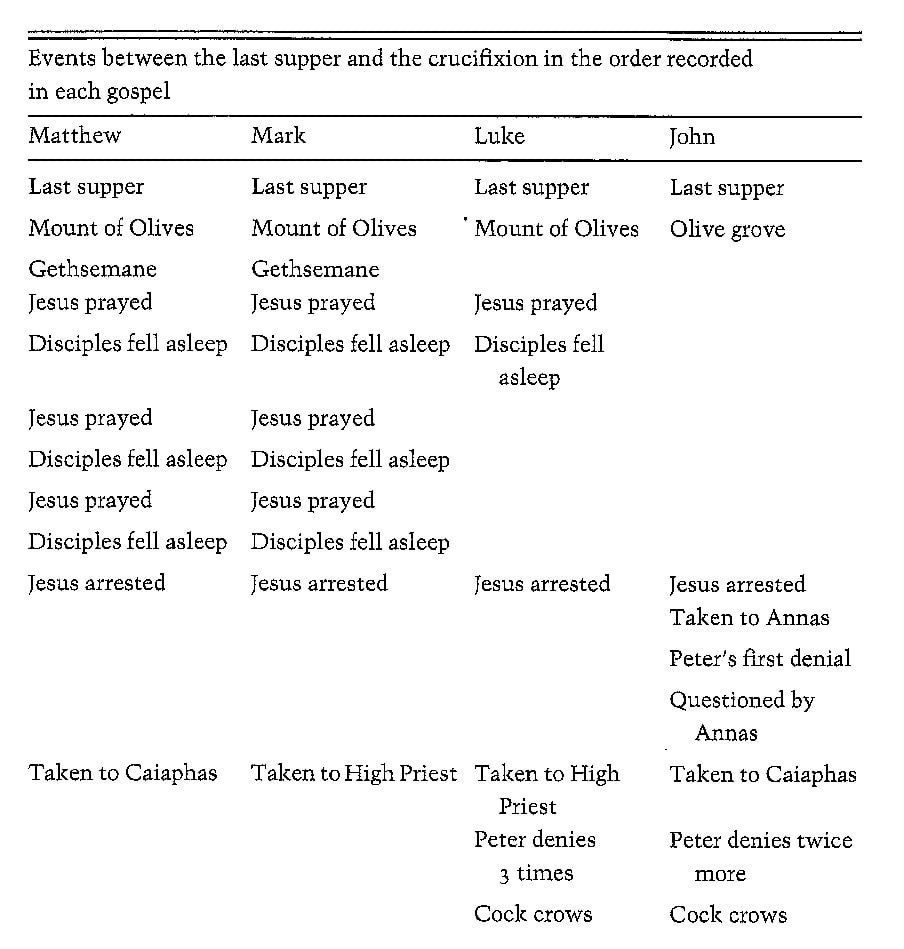

What is striking here—and the challenge to sceptics—is that, despite the various omissions, there is no actual contradiction in the order of events. (Something similar happens when you look at the events of Jesus’ birth; there are no real contradictions when you put the accounts side by side.)
Having started by looking at the biblical texts, in the middle of the book Humphreys goes on a long scientific exploration, delving into the astronomical issues behind the construction of Jewish calendars, and using this to argue for a particular date for the crucifixion. The key issue here is identifying the dates of the calendar from what we know of the moon phases, and then finding the years when the Passover falls on a Friday, which it will do on average only one year in seven.
Humphreys then uses other well-established data to eliminate outlying dates, and argues for Jesus’ death at 3 pm on Friday, April 3rd, AD 33. He is not alone in this, though the style of his argumentation will have lost many mainstream New Testament specialists (there is quite a nice, clear argument working through the data at this Catholic site). He assumes that the gospels are historically accurate, and takes them as his basic data, when most scholars would want him to be much more provisional. If the case was expressed more in terms of ‘were the gospels accurate, it would lead to this conclusion’ might have been more persuasive for the guild—but then Humphreys is primarily writing for a popular and not a professional audience. There is no particular problem in asking the question Humphreys does in fact ask: are the narratives we have capable of coherent reading, and if we taken them seriously, what do we find?
I was much more interested, though, in the later chapters, where Humphreys explores the gospel texts in detail in the light of the calendrical background. Although his proposals about the different calendars in use at the time of Jesus are speculative (even if plausible), there can be no doubt that different calendars were in use, and that it is quite likely that different gospel writers are making reference to different calendar schedules which could give rise to apparent anomalies in the gospel chronologies. In particular, some calendars worked sunset to sunset (as Jewish calculation works today), others counted from sunrise to sunrise, and the Roman calendar counted from midnight to midnight, as we do now. It is not hard to see how the phrase ‘on the next day’ can now have three different possible meanings.
It is also clear that the gospel writers vary in the emphasis that they give to chronological issues. So, whilst Luke offers some very specific markers in his narrative to locate the gospel story to wider world events (which has been typical of his overall approach), and John includes frequent temporal markers in relation both to Jewish feasts and successive days of Jesus’ ministry, Matthew is happy to group Jesus’ teaching and ministry into non-chronological blocks, and Mark has long been recognised as linking events in Jesus’ ministry thematically rather than chronologically. Humphreys uses an everyday example to illustrate this: if I cut the lawn and do some weeding, and someone asks my wife what I have been doing, and she says ‘He has been doing some weeding and cut the lawn’ then we would not describe our two accounts as ‘contradictory’. Chronology just hasn’t been an important issue here.
Humphreys’ solution rests on proposing that, in celebrating the Passover with his disciples, Jesus used the pre-Exile calendar which ran sunrise to sunrise and was at least a day ahead of the official Jerusalem calendar, so that there could be up to two days’ difference in calculation. (It is worth noting here in passing that first century Judaism was far from monolithic, and serious differences in belief, including about dates and calendars, was part of the diversity.) This means that, if the Jerusalem Passover took place on the Friday, following the sacrifice of the lambs on Friday afternoon, it would be possible for Jesus to celebrate his own Passover (and not merely a ‘Passover-like meal’ as some scholars have suggested) as early as the Wednesday. Humphreys believes that the man carrying the water jar (in Luke 22.10 and parallels) is a signal that the Upper Room was in the Essene quarter of Jerusalem, where there would not have been any women to undertake such roles. And the calendar differences account for Mark’s statement that the lambs were sacrificed on the ‘first day of the feast of Unleavened Bread’, (Mark 14.12) which is a contradiction that scholars have in the past attributed either to Mark’s error or his careless writing.

 At some points, I think Humphreys’ case is actually slightly stronger than he claims. For example, John’s phrase ‘the Passover of the Jews’ in John 11.55 could arguably be translated as ‘the Passover of the Judeans’, thus emphasising communal and calendrical differences, and Matthew highlights the differences between the crowds of pilgrims and the local Jerusalemites in their response to Jesus. Richard Bauckham has argued that John is writing on the assumption that his readers know Mark, so there is no need for him to recount the details of the Passover meal in John 13 and following. And in the latest edition of Bauckham’s Jesus and the Eyewitnesses, he argues (in an additional chapter) that the ‘Beloved Disciple’ is the author of the gospel but is not John son of Zebedee, and so not one of the Twelve, but a Jerusalemite. This explains some of the distinctive perspectives of John’s gospel with its Judean and Jerusalem focus in contrast to Mark’s focus on Galilee—but would also account for calendrical differences.
There are some points of strain in Humphreys’ argument—for me, the most testing one was Humphreys’ account of the cock crowing three times, the first of which was (he argues) the Roman horn blown to signal the approach of dawn, the gallicinium which is Latin for ‘cock crow’. (I always struggle to be convinced by an argument that claims a repeated phrase actually means different things at different times when the phrase is identical.) But there are also some interesting ways in which his reading makes better sense of some details of the text, such as the dream of Pilate’s wife—which she could not have had time to have under the traditional chronology. Moreover, one of our earliest testimonies to the last supper, in 1 Cor 11.23, does not say (as much Anglican liturgy) ‘on the night before he died’ but ‘on the night that he was betrayed’. I will be sticking with the latter phrase in my future use of Eucharistic Prayers! And when Paul says that Christ our Passover has been sacrificed for us (1 Cor 5.7), and that he is the first fruits of those who sleep (1 Cor 15.20), Paul is reflecting his death on Passover (as per John, even though in other respects Paul’s account matches Luke, and it is largely Paul and Luke’s language we use in liturgy) and his resurrection on the celebration of First Fruits two days later.
Humphreys is certainly bold in taking on key scholars, including Dick France (with whom I would always hesitate to disagree), but in every case he gives citations and explains where the disagreement lies. When the book was first published, Mark Goodacre wrote a brief blog on why he disagrees, and the debate in comments—including from Humphreys himself—are worth reading. Goodacre’s main concern is Humphreys’ anxiety about demonstrating the reliability of the gospel accounts, and the need to eliminate contradictions.
One of Humphreys’s primary concerns is to avoid the idea that the Gospels “contradict themselves”. The concern is one that characterizes apologetic works and it is not a concern that I share.
But I wonder whether concern about this aim has led many scholars to dismiss the detail too quickly; much of academic scholarship is ideologically committed to the notion that the gospels are irredeemably contradictory. (If I were being mischievous, I would point to the irony of Mark’s resisting Humphrey’s challenging of a scholarly consensus, when that is precisely what Mark is doing himself in relation to the existence of ‘Q’, the supposed ‘sayings source’ that accounts for the shared material of Luke and Matthew…!) And we need to take seriously that fact that Humphrey’s approach resolves several key issues (including the silence of Wednesday, the lack of time for the trial, the reference in Mark 14.12, and Pilate’s wife’s dream) that are otherwise inexplicable or are put down (slightly arbitrarily) to writer error.
Another serious challenge (which Mark highlighted to me) is the consistent tradition of the early church of celebrating the last supper on Thursday. But the early church established other early traditions, particularly in relation to ministry, which I think are discontinuous with the New Testament—so this cannot be decisive.
I think there are some further things to explore, but it seems to me that Humphreys’ case is worth taking seriously.
 Buy me a Coffee











For a wider reconciliation of the various Easter accounts in the Bible – and one perhaps less academic but more suitable for myself and my declining number of little grey cells! – John Wenham’s “The Easter Enigma” (Paternoster Press 1984) is one of my regular reads. Wenham looks at harmonising the chronology of the events as well as including character identities and the latter appearances of the risen Jesus.
Thank you! Yes, I first read that when a young Christian! But I have not gone back and compared his timetable with that of Humphreys. Have you?
A quick flick through my copy of Wenham shows him locating the Last Supper on the Maunday Thursday evening, thus conflating the Garden scenes, the arrest, the trials and the crucifixion into the relatively short period between late Thursday night and mid Friday afternoon. Although not going into anywhere near the detail, Wenham’s timetable – which only addresses some of the events – does seem to match the longer timetable of Humphreys. Wenham spends a lot more time in identifying individuals and their relationships with one another than in the chronology, but it remains a favourite Easter read for me – almost a devotional!
A challenge is to see if the sequence of necessary toings and froings, rousing at least a quorum for a trial at an unearthly hour (unless they were pre-warned, as is possible)…can fit into the shorter time-frame.
Doesn’t Wenham suggest a double sabbath as a way around silent Wednesday and three days to the resurrection? I read that somewhere
I also read somewhere – memory fails me! – that rabbis would have celebrated Passover a day early to leave them free to minister on the day itself. Was that Wenham, too?
I guess the issue of whether the Last Supper was actually a Seder meal or not also has an impact on the chronology. If it was not, then John’s record of Jesus’ crucifixion at the time the lambs were being slaughtered fits easier. But how long would it have taken for all those lambs to be duly “processed”? So many “what ifs” – I am just glad to believe that Christ has died – Christ is risen – Christ will come again! But it is all interesting!
Humphreys’s treatment has many virtues:
-Long gestation, including more than one period of intense analysis;
-A brilliant mind, who knows about what counts as good evidence, and can see things in the round;
-Good primary evidence.
I am secretly hoping George van Kooten’s 11.4.27 is correct for the Crucifixion as it is my birthday (it relies on the John 2 dating of the start of the temple project) – but what must certainly be said is that of the three dates 27, 30, 33, the date 27 has, surprisingly, received not nearly enough analysis hitherto.
If it were correct, the 2000th anniversary would be in a year’s time. But Nicky Gumbel’s worldwide mailshoot relies on 33.
How could a crucifixion in AD 27 be reconciled with the beginning of Jesus ministry in ‘the fifteenth year of the reign of Tiberius’ (Luke 3.1, presumably AD 29) or the temple cleansing 46 years after rebuilding began (presumably in 18 or 17 BC; John 2.20)?
I expect this may get dealt with in the book (Reverberations of Good News) – I will check. I believe the date refers to the beginning of John’s ministry not of Jesus’s, which exacerbates the issue. The discussion of different start-dates in different aspects of the temple project – for John’s ’46 years’ has led to various chronologies – is also good therein, and the dating proposed runs from several years earlier than 18/17. See too what is said about Lysanias on the basis of Steve Mason’s article.
I don’t think it can. I am much more open to 30 or (better) 33 as the date.
Yes, that is certainly also my view, and 33 in particular works well. However, I am keen to digest the arguments, birthday considerations aside. If a compelling argument is made on Tiberius’s 15th year (others employ a co-regency) I will notify.
Van Kooten, Reverberations of Good News, agrees that the 15th year of Tiberius is 2(8-)9, as would be natural, but disagrees that Luke, being late, is our best chronological evidence (E.g., 1.5, 2.2, 3.23 imply three different birthdates for Jesus), and reverts to the evidence of Matthew. The dating of the star of Bethlehem, the 2 year cutoff point for the Holy Innocents, the cleansing of the Emporium, and the 11.4.27 crucifixion are all of a piece here. My present position is that Humphreys’s 33 position and conclusion is satisfying in its comprehensiveness, especially when you think of how many chronological complications there can potentially be in such investigations.
I have Humphreys’ book. Although I enjoyed reading it and have kept it on my shelves (plenty of books depart my house after being read), I am unhappy about Humphreys’ timing in view of Matthew 12:40, “… the Son of Man will be three days and three nights in the heart of the earth.”
There is no way the number of full days could be the same as the number of full nights when someone is buried at sundown and rises from the dead at dawn. So we are talking fractions even before the all-important Jonah typology is factored in.
Moreover, there is not a single gospel that does not give the impression that the only full ‘day’ (in our own sense of midnight to midnight) that Jesus was in the tomb was Saturday.
Yes I accept that it is not all of three nights dusk to dawn and all of three days dawn to dusk, but it is parts at least of three nights and parts at least of three days. That is still incompatible with Humphreys.
You say ‘it is’, yet is that not incompatible with the initial impression given by all four gospels?
Are you saying that there is a contradiction in scripture?
What is and is not Scripture has historically been an of the nature of an emerging consensus. If a claim is made that there are two sharply divided and distinct categories of writing, then that claim could be the subject of appropriate study, yet most who jump to the conclusion (never a good sign) do so almost entirely sans study of this particular point.
Further, if your point is a presupposition, to claim it is in any way wonderful is entirely circular. Whereas those who presuppose nothing may potentially be privy to all kinds of wonders.
What on earth are you on about? Keep it concrete, please.
It all makes sense, in plain vocabulary, just needs to be read slowly.
The category of Eyewitness material is a proper subject of scientific study, whereas the category scripture is not, since one can study and measure what has been treated as scripture but not what ‘is’ scripture. That is in the realm of shibboleth not of scholarship, and the two are poles apart in terms of their relative worth.
The NT documents seem to comprise those with an eyewitness or first generation element. If anything so extraordinary as an experience of inspiration were undergone by any of the writers, you would think this would rank as one of the main things for them to mention, and clearly there are times when a few of them do, almost all connected with vision and prophecy. If one were to generalise, one would say that the inhabiting of this initial empowerment phase of the church associated with the direct presence of Jesus makes the earliest writings qualitatively distinct from those that follow. Does that equate in 100 percent of instances to a simple and sharp bifurcation of all writings into the categories scriptural and non scriptural, so that it is perfectly obvious that every writing belongs in one of these two polar categories? They are certainly categories not clear enough to be much mentioned in scholarly discussion. It is simplicity you value, and likewise I am insisting that if the category scripture is to be used, and to have worth in debate, then it needs to be a simple and measurable matter what does and does not belong in it.
The other issue was presupposition. Presupposition is not of worth in debate, only evidence is.
Don’t patronise me. Are you saying that Matthew 12:40 is incompatible with the gospel accounts of Holy Week? Please include a clear Yes or No in any anser. If yes, what does this say ab out the sciptures and the Holy Spirit? If No, why all the high-flown verbiage?
Your own scenario is unclear. It involves portions of days, which are not the full days mentioned in Mt 12.40.
The point is that all our language is to some degree inexact because reality is infinitely complex. Imagine drawing a shoreline. it just depends whether you are accurate to the metre, the centimetre, the micrometre – the regress is infinite. Nothing is ever completely accurate. Language itself is not accurate – it struggles to replicate the realities that it strains towards, and to some degree fails and generalises. To be completely accurate one would need to say what each microparticle was doing at each microinstant. And even that would be affected by the observer.
So the best we can do is a comprehensive analysis that takes into account the maximum number of factors. For example, if I factor in Jonah typology and you do not, then to that degree my analysis is better.
We can discuss my scenario later. I asked you a simple binary question, Do you believe that Matthew 12:40 is incompatible with the gospel accounts of Holy Week, together with a clear request that you include a Yes or No in your answer. You preferred more verbiage than to give one. This conversation can serve no purpose.
What I said, maybe unclearly: It would be incompatible if language were an exact thing, but the vast majority of language is not.
The historian will prioritise the crucifixion accounts and their agreement on this point without traces of a suggestion of a 2nd 24-hour day in the tomb – and no-one argues with that. To ignore something as central as that would itself be ‘unscriptural’. While the literary scholar will point to intertextuality in the citation of Jonah and to the fact that ‘after three days’ was a blueprint even before the resurrection (Mark 8.31 &c) and ‘on the third day’ was part of the kerygma after it (1 Cor 15) – which all naturally attracted reflection on (assuming it was not already bound in with) every possible scriptural reference to three days, whether Joseph, Hosea or Jonah. As a rule of thumb, the more factors seen, the truer the discussion. Hope this begins to make sense.
In your discussion with Anthony below you appear to deny that truth is effable or, consequently, knowable. That standpoint contradicts the basic revelation and fundamental tenets of Christianity.
I know truth as a person – Jesus Christ, God who cannot lie, whose Spirit guides us into all truth. He would not have said he would be three days and nights in the grave if it were not true.
Scripture clearly claims to be infallibly and absolutely true. The only starting point for comprehending God’s revelation is “Let God be true and every man a liar.”
Here you confuse Jesus being the Truth that makes sense of reality with his being the truth (small t) in every situation. One can imagine the following exchange:
Policeman: I saw chocolate crumbs in the vestibule and a brown haired man legging it. What is the truth that is the answer to this mystery?
Mr Heal: Jesus is the Truth, Officer. In every circumstance, He is the Truth.
Mr Godsall: the answer is love, Officer. The answer to every question is love. It is only a deficit of emotional intelligence that prevents some from seeing that.
Policeman: Thank you, gentlemen. No further questions. Case solved.
I looked up Dick France’s NICNT commentary. He points out that the “third day” of Matt 16:21, 17:23, 20:19 and 27:64, and the “after three days” of Matt 27:63 is:
“due to the LXX wording, but in Semitic inclusive time-reckoning these do not denote different periods as a pedatic Western reading would suppose.”
In a footnote he references 1 Sam 30:12 where the phrase “three days and three nights” (in Hebrew and LXX), which is then linked in the next verse to “the day before yesterday”.
Whatever one might say, Matt 12:40 is the outlier in the description of the time between Jesus’ death and resurrection.
Perhaps more interestingly, France also raises this question: was Jonah’s deliverance from drowning “a sign to the Ninevites”? It occurs to me that Luke’s account of the episode makes more sense. The sign of/from Jonah to the Ninevites was his preaching of the forthcoming destruction of the city.
Those are good points. The whole discussion can be short-circuited, without even any textual analysis, by observing that purely literally (pedantically) all harmonising must treat ‘on the third day’ as equivalent to ‘three days and three nights’, which, as they as literalists would normally be the first to point out, are not equivalents in English.
There is no need to insist 3 days and 3 nights is a literal time period. There is at least one OT reference where a similar time period is used but it is clearly not to be understood literally. And I understand in Jewish thought part of a day could be counted as a whole. End of perceived problem.
But how to find the third night? There is perhaps one minute of the first day and one minute of the third – if any of that counts. But only two nights.
‘Literally’ and ‘metaphorically’ are words that are used as a cliche, without much thought often. As an attempt to solve something in one step, as though that were likely to be possible. Because it is not explained how this functions ((it seems to function by magic, and also by complimenting inexactitude) the solution attempt fails.
This is not what ‘literally’ and ‘metaphorically’ mean anyway. They have precise meanings, not vague ones.
Further, while a sun and a shield can be metaphors for God, numbers cannot stand for one another, and even if they did, the process would not be metaphorical, and would fall well below the bar of cleverness to which writers aspire, as well as lacking all point or rationale. 1000 cannot be metaphorical for 6 nor 2 for 8. If a text says 3 where 2 might have been expected, this looks closer to our ‘2 or 3’ or fashionably ‘6, 7’.’On the third day’ is spot on for what actually happened; it cannot be denied that ‘in 3 days’ means the same; while ‘3 days and 3 nights’ is equivalent enough in a context where the topic is a non numerical one.
I think most people would understand what I meant by literal.
Yes, the same thought occurred to me (unlike for ‘metaphorical’, a word which many splash around liberally with a zeal that is not according to knowledge); but a literal daytime or nighttime is 6-6, and reality is rarely that neat, let alone on several occasions in succession. So any reference to quantities of days or nights is liable to be non literal to a degree. Which does not matter a bit.
In general, when ‘most people (think they) understand’ something, that is because that thing is part of common parlance. (For example, it is often said that ‘most people understand ‘ what is meant by ‘fundamentalist’: a word which is both a cliche *and* internally incoherent. Such words actually come to be regarded as respectable precisely because they are so oft-repeated, frequent repetition being the sole chance of survival on which weak arguments must needs rely.) But common parlance is merely according to prescribed conventional channels, so it is perfectly possible for it to contain incoherences; and as for inexactitudes, they can never be avoided.
‘So any reference to quantities of days or nights is liable to be non literal to a degree. Which does not matter a bit.’
Im glad you agree. Hope that is the end of the discussion, or do you need to further comment on other words?
Only to say (a) that some phrases are more literal or precise to the case than others; (b) any discussion should be in the context of how such terminology was used in the cultural context; (c) (b) is diverse and made more so by the confluence of Mesopotamian, Jewish, Greek and Roman cultures and usages. A good book is Finegan, Handbook of Biblical Chronology.
Reliable?
Let’s settle on redactors, periscopes and constructed by a communities of faith before being committed to writing. That should be comprehensive enough even, or particularly, for the deconstructionist liberals, as long as eyewitnesses and ear witness accounts are removed, and God is removed it all.
So in our human hubris we can contradict the Gospels
Jesus is/as the Lamb of God would answer for lamb being absent from the meal.
Off to a Maundy Thursday communion service.
Ah yes, we need periscopes, not periscopes.
Auto correct!
Ill correct for you, pericopes.
Presumably periscopes are used to analyse sub texts?
Love it!
We’re getting into deep water here.
Up pericope!
wasnt that a Kelsey Grammer film?!
Reminds me of a joke by Bobbie Ball about submarine Christians, who only come to the surface on a Sunday! And disappear from view the rest of the week.
And having return from an all age God Friday service, with a passage read from Mark 15:21-41, read by a youngster, there is much depth of reality to ponder on the cross of Christ.
Part of testimony of coming to Christ, last week at Church, included a mention of the enormity and difficulty of driving around the Arch de Triumph!
Today there is wrath, foretold in the Old Testament, darkness over the world- judgement, substitution, curtain in the Temple, into the Holy of Holies, into the Presence of God torn from top to bottom, the Triumph of the Cross, finished.
But God Friday is not what it once was, lots of shopping and holiday traffic, and seemingly little made of it within the church.
Even as a new convert nearly 30 years ago, I can recall much being made of it in the local CoE, with two morning services and a 3:00 pm service!
Sure, much may made of Easter/Resurrection Day, but the Cross of God Friday comes before: it can not be by-passed, driven around!
Can anybody link a good balanced account that gives the arguments for crucifixion in AD 33?
I’ve usually assumed (without investigation) that AD 30 was the date but arguments for 33 would be appreciated.
On the lateness or earliness of Luke, I recently re-read David Seccombe’s Tyndale Bulletin article from 2020 who argued that anti-Jewish feeling was strong in the empire in the 70s and 80s in the fallout from the Jewish War, but this is not the feeling you get from Luke-Acts, when Christianity had not separated yet from Judaism and there is no state persecution of either religion – or any perception of difference by the Romans, which clearly you do have with the Great Fire of Rome in July 64. I can’t see any slam dunk case for dating Acts after c. 63, which has implications for the dating of Mark.
I doubt it would satisfy good balanced scholarship criteria but I recall reading years ago that AD 33 could be attributed to the year of death.
Here is a short overview:
https://www.gotquestions.org/what-year-did-Jesus-die.html
I think matters turn on Passover being on Friday April 3rd (today!) in AD 33 – and Father Jack says that would be an astro-ecumenical question.
Was Passover on a Friday in AD 30?
Hi James
Would this be helpful: https://www.asa3.org/ASA/PSCF/1985/JASA3-85Humphreys.html
Interestingly AD33 may also separately correlate with when Daniel was told Messiah would come and die (depending on how one calculates the period).
Re Luke/Mark, I think Mark may very well have been written in the 40s or early 50s when the influence of the High Priest Annas and his family continued, hence Mark’s odd non-naming of Caiaphas as the High Priest under whom the Messiah was executed. Dont bring on unnecessary persecution from the Jewish authorities if you can avoid it! Luke’s non mention of Paul’s or Peter’s deaths in Acts I find odd if they had already happened, given Luke’s willingness to report other martyrdoms such as Stephen’s and James’. I find it odd Luke ends his Gospel with Paul’s house arrest, a bit of a damp squib. Of course there may be other reasons why Luke doesn mention their deaths, but if they had not been killed by the time of Luke’s writing, this would date Acts/Gospel to probably early 60s, thus meaning Mark was written before this.
I dont have a problem with later dates (ie post 70), Im just not convinced of it. It is interesting that Bauckham is rethinking the dating.
Dating should always be on the basis of the maximum number of factors and interrelationships. I don’t know what it is about dating Acts immediately after its final event (which was the point Luke had so far reached when he ran out of space) but it seems like every such discussion cites 2-3 factors, does not trouble to see any others and then says ‘QED?’. Whoa! By the quantity of factors considered, a theory will be ranked.
What are the other factors, then? No mention of the Great Fire of Rome, no mention of the Judean War, let alone the fall of Jerusalem, are pretty big obstacles.
Isn’t most NT dating guesswork based on presuppositions?
It’s the reverse: it’s based primarily on the study of interrelationships of documents, having previously ranked priority-criteria for non reversibility.
But external historical considerations are also extremely important.
One cannot generalise about the NT as a whole. It is remarkably unlikely to have 27 different documents all of which have no compelling chronological grounding. Thus there is strong agreement about the dating of some of the books.
To give an idea of the sheer quantity of factors involved, one could read van Kooten 2007 on Revelation, Jewett on Paul, or Hengel on Mark. And then resolve to be as maximal as possible in how many factors get considered, or else rely on the fullest discussions.
Can you be more specific, please, Chris. I mean of course the dating of the Gospels because these are our primary witnesses to the actual words and actions of Jesus.
I am not sure what you mean by your first paragraph.
What prevents Mark from dating from the 50s, for example? Didn’t Carsten Thiede suggest something like this? I think there is more circular reasoning and question begging than some scholars are willing to admit. If there is no textual or material reason to date Acts after 62/63, only an assumption about how things “must” have been, then we are back in the realm of guesswork.
It’s a matter best treated by hundreds of pages of discussion. The matter is ‘When does Mark probably date?’ rather than ‘What is preventing date X for Mark?’ – the latter biases the issue before we start.
Intertextually there is an association between the sixth seal and Mark 13 which is in the direction of Rev’s priority. The associations with the point in time of the accession of Vespasian are several – the flight of a naked man, the cutting off of the ear of a servant of the high priest, the informing of someone that they are now king at the very point when their great journey to the capital begins, a triumphal entry like no other, palm branches being associated with Sukkoth which was the time of year that Vespasian arrived, the issue of the temple’s destruction and which king it was that really caused it, healing of a blind man with spittle. And in Schmidt’s presentation, a point by point correspondence if the Via Dolorosa elements with the incomparable triumph over the Jews described in the final part of Josephus, Jewish War. This in the context of a work whose argument is that Jesus is the real king/ Christ and Son of God (imperial title), who is enthroned on the cross after being dressed for enthronement. Others point to the wording of the coin scene and of the tenants parable re reallocation of land. Vespasian as general in Galilee had (67) had two especially spectacular local triumphs, one involving mass deaths at a precipice and one involving a sea victory on what Mark calls the Sea of Galilee.
How do you know Mark’s Gospel has anything to do with Vespasian? Passover is not Sukkoth.
Why should we read the Jewish War into Mark’s Gospel?
Are you saying it’s not really about events in April 33 (or 30) but really a coded account of c. AD 68? How is this not eisegesis?
You’ve 5 questions here.
(1) The connection with Vespasian’s accession at Vitellius’s expense (the sign of the Gallus or rooster/Frenchman connected with Vitellius’s death was one I omitted, and possibly the homosexual Vitellius’s tendency to kiss the men, cf Judas, which would perhaps have been uppermost in the public perception) is just something that comes to the surface because of (a) the quantity and (b) the extreme specificity of motifs. The fact that Mark’s writing is generally associated in scholarship with the same time that Vespasian acceded to the throne is a separate point, and by being separate and independent adds a lot of weight. Vespasian was made king by *acclamation* (the claim on his behalf dates to the start of July 69), and acclamations of Jesus as Son of God play a/the key part in the most basic structuring of the gospel: Baptism-CaesareaPhilippi-Transfiguration-Roman Centurion at cross. During Vespasian’s Triumph-procession ceremony celebrating his (family’s) victory over the Jews, he was flanked, in his kingly position, by two brothers (his sons) on his right and left. What I would strongly emphasise is the clustering of the said motifs at the precise point of Jesus’s coming to be in a position to have an ‘accession’ (kingly robing): the cusp of Mark 14-15 and take up a flanked central position, crowned, on an edifice whose title proclaims a king.
When you say ‘How do you know?’, the only way we know anything at all is by evidence. But by this stage the conglomeration of evidence had already been cited in my previous comment.
The fall of Jerusalem (achieved around 1 year before Mark’s Gospel) is front and centre in the way Mark 13 is laid out. Levelling of the city was fairly comprehensive, as he says; but obviously at the time of writing quarters for the soldiery were kept as an exception while the levelling was being carried out. Hence the Western wall area is still there, having not been levelled to this day. Mark is in Rome and is highly Rome-centred in his perspective (besides the Vitellius/Vespasian material, Jesus also outdoes Nero, year 58, in the figtree death-and-resurrection stakes); perceptions of how things are in Judea are more general, headlines.
Is the overall unifying feature ‘These signs shall attend the accession of the new Saviour King’? In a world that set great store by auguries and ornithomancy, Mark is pointing out that the much-vaunted signs that attended Vespasian’s coming as eagerly-awaited Saviour from the unparalleled chaos that preceded had already been fulfilled in 33, and that Jesus, not Vespasian, is the Saviour King in question, even to the extent that he, not Vespasian and the Flavians, was the true destroyer and resurrecter of the Temple. Note that this is a time when the world crown was to an unprecedented extent up for grabs, and even the popular Vespasian had no birthright/inherited claim to the throne. Mark can be forgiven (nay, affirmed) for thinking Jesus’s claims to the world crown outweigh Vespasian’s.
(2) Passover is not Sukkoth. Palm-branch waving was associated with Sukkoth not Passover. Not surprisingly: as it, unlike Passover, was a harvest festival. (Note, however, that the Hallel including Ps 118 was indeed part of Passover – cf the Mark 14.26 hymn.) Mark never says anything about the Triumphal Entry, nor this entire immediate sequence of events, having any connection with Passover, nor about how long a time Jesus spends in Jerusalem. He recapitulates the annual cycle of festivals in his gospel, and Sukkoth (Transfiguration) appears to go on till the Triumphal Entry (it is appropriate that Mark treats Sukkoth as a journey-to-promised-land-destination matter), with the temple cleansing/renewal/restoration (Enkainia, which equals Hanukkah) following, and the Anointing echoing the Purim-inauguration story in numerous ways. That being a ‘two-day’ period shortly before Passover, the remainder of the gospel is indeed Passover.
(3-5) Why should we read the Jewish War into Mark’s gospel?
On that way of looking at things:
(a) no-one should even mention or test out background historical contexts when seeking to understand a written work;
(b) everyone who does so is performing eisegesis, rather than doing historical study. Bang goes a high proportion of what commentaries are meant to do.
(a) and (b) obviously do not stand.
(4) It’s a coded account of 69-71 rather than of 33? No. 69-71, astonishing events (69: year of 4 emperors, ending with Vitellius’s spectacular humiliation and a great fire in Rome; 70: destruction of Jerusalem; 71: Triumph procession) which Mark and friends were fresh from witnessing, and which coloured their every perception, were necessarily a lens through which they viewed things and which Mark necessarily fell back on since he had not been there as a witness in 33.
These 69-71 impressions affect the way the story is told, not least its structuring, rather than the story itself. As for the story itself, it is common knowledge to students of this gospel that Mark tells his narrative logically and in detail, meaning that he includes very much, well over 100 pieces of data, which both Matt and Luke (who were not speaking to apostolic eyewitnesses at their times of writing) can easily exclude, and agree on excluding, as not being essential to the bare bones of the story. Besides all the similarly circumstantial details of the same nature which one or both of them do still include. Mark writes with the perspective of one who was there (Peter). And of course there is the issue of the Petrine plurals when he gives away that he is telling the story from Peter’s point of view.
It cannot too often be stressed that Papias, our earliest witness other than the evangelists to the process of gospel writing, speaks of a highly specific combination of circumstances in Mark’s writing. Mark was careful to include all that Peter had said that he (Mark) remembered. He also quite naturally did not always know what sequence it had all taken place in. All of this is not only exactly what we’d expect, but also what we see in reading the gospel, with its wealth of circumstantial realistic detail and stories that would have been very hard to invent (and had someone invented them, they would have been called out by eyewitnesses or their friends).
Because Mark did not know the sequence, he had to obtain a sequence if he was to write at all, and the next best thing to do – Hobson’s choice – was to impose a template to enable himself to organise his material. This template was threefold: the Isaiah servant songs in sequence; the annual cycle of feasts Passover to Passover in sequence, with appropriate themes; and the career of Vespasian in sequence (though the coronation is brought later to make an appropriate climax).
The date you propose for Mark is impossible if Papias was right about Mark not knowing the sequence. For, had Peter been still alive, Mark could have checked with Peter about the sequence. But as he was unable to do this, it follows that Peter was not alive at the time of writing, which must therefore be post-68 (on my dating of the death of Peter) or at least post-64. Papias is so specific and believable in this fragment. Peter told about the Lord in a selective way according to the needs of the hearers, not in a chronological way. Mark did not necessarily include everything he had ever heard Peter say, but (it says twice) he included that which he remembered. Papias also writes that Mark made no mistake (either in terms of being error free or in terms of choosing the procedure he did choose); that he was meticulous in including everything he remembered; and that he took care to avoid any fabrication or fiction.
On Acts, my linguistic analysis of the parallels with 1 Clement (e.g., boundaries for nations; David as man after God’s own heart) puts 1 Clement earlier. Luke will have written it not earlier than his latter 60s. This also avoids the period of the 70s-80s (a time period that was raised above).
Christopher – are you saying that the alleged parallels with Vespasian in Mark actually happened in AD 33 (the Passion week) or that at the time of writing Mark was aware of these details iro Vespasian and wrote them into his Gospel to make a point? If the latter, this would seem to contradict Papias’ understanding of Mark’s writing as he makes it clear Mark was careful to only include that which Peter related, which to me indicates if Mark did include any additional details he only did so based on other eyewitness testimony, rather than adding such details from his own mind to make a point.
Also regarding Papias’ words, Bauckham maintains probably the best understanding is that Mark wrote as Peter remembered, not as Mark remembered what Peter had said – pgs 211 – 214 of his Eyewitnesses 2nd ed refer. He makes a persuasive case for this, and he clearly believes Peter was alive when Mark was writing down. I also dont find your point to be strong that if Peter was still around, he would have automatically ensured chronology was 100% correct. He may have been content with Mark’s writing based on his own teaching about Jesus which would not itself be chronological in nature. But it is obvious that Mark gets the basic chronology correct, even if it’s not quite in the same league as John which Papias was likely comparing it to. I would also question the ability in most people to remember the precise sequence of various events over a 3 year period. So I dont accept it was ‘impossible’ that Peter was still alive.
As we are slightly off topic here, though of course the dating of the gospels is intrinsically relevant and depends to a degree on the dating of the earliest gospel, I’ll aim to make this my last comment on this subtopic.
The trouble is that the Mark parallels, even though they cluster at the ‘coronation’ portion of the narrative and are generally sequential (Vespasian in Galilee – Alexandria – on way to great city – in great city) in the same 4 parts already demarcated by the 4 servant songs and 4 main feasts, all have ample reason to be attested in their own right even sans Vitellius/Vespasian:
-The naked man has now become (thanks to Vitellius’s death generating the Rev 16 oracle which appears there in Vitellius context) a Christian trope within the overwhelming message of not missing out on the parousia (10 virgins; disciples slumbering, fleeing, denying; etc). To mention nothing of its fairly probable status as a hidden signature, given Mark’s age and the general practice of leaving these hidden signatures, a role for which no other example suggests itself in Mark. The criterion of embarrassment provides further strengthening. This story like those below was still told even though it was potentially embarrassing to the Christians including their esteemed leaders.
-As of course it does in the case of Peter and the cockcrow – and cockcrows cannot fail to happen daily in both trumpet form wherever there is a Roman watch and in animal form wherever there are roosters.
-The ear (an awkward event which Luke’s presentation shows was one that people sought to rationalise) is another candidate for that criterion. It clearly happened as John has inside knowledge of the victim’s name and family. Ears are prime candidates for severing in skirmishes. Thousands of different things happened in the 20.12.69 Rome melee. Vitellius was only secondarily the High Priest (Pontifex Maximus).
-Spittle in healing is something more widespread and came to be seen as an authenticating sign of the Messiah (Pliny the Elder, NH; Talmud). Vespasian was seen as something of a Messiah.
-The Via Dolorosa narrative can be *shaped* to bring out certain parallels, but that is another thing to saying the parallels are intrinsically particularly close or remarkable (e.g. the king being flanked by brothers).
-It is not remarkable that Galilee narratives mention a precipice or the Sea of Galilee.
-Mark 13 is *shaped* to emphasise the levelling of Jerusalem. But that is a huge and eminently foreseeable fact in its own right, so why would it not be? (Remember that Jesus will have said, in his ministry, hundreds of times more words than we have.)
So it is all a matter of *shaping*. Stories can be told from numerous angles, particularly by those with inside historical/geographical knowledge.
Sorry! I missed the all-important point about Peter’s memories, not Mark’s, perhaps being referred to. Without having Bauckham to hand…:
The difficulty with Papias (who of course may be sometimes cited in oratio obliqua anyway) is that he does not phrase things sufficiently precisely, forcing a very precise analysis of his logic which in fact is in peril of ending up being more precise than his own thinking (or expression)!
(1) I do not think it is likely that the references to remembering ([ap]emneemoneusen, using double e for long e) are one to Peter and then one to Mark. At least one of the two is Mark; both may well be.
(2) The *time* of writing-down, from what Papias says, could well be during Peter’s preaching. This would also make sense practically. But it is impossible to make this more than a real possibility. Why speak of remembering rather than hearing?
(3) Mark’s meticulousness in his modus operandi is spoken of repeatedly but without reference to interaction in this with Peter. Peter is mentioned as initial preacher only.
(4) ‘Accurately’ (akriboos) might seem to be more economically a reference to accurate reproduction from speech rather than from memory-of-speech. However, the end of the fragment emphasises Mark’s meticulousness, and thereby makes that very uncertain.
(5) ‘not to omit anything that he heard’ – we might have expected pluperfect if Peter were dead, but in fact that is rare in (esp Koine) Greek.
(6) It is not unreasonable to think, from Papias and 1 Peter, that Mark was as close a companion to Peter as there was. Gospel writing is a long process. He could hardly have been absent from a living Peter throughout that process.
(7) Terminus post quem is determined by the unusual number of 69-71 parallels in the narrative as it stands. The alternative would be to say that the demise of Vitellius and accession of Vespasian just so happened to involve prominent & prophetic motifs just the same as the prominent and prophetic motifs on the cusp of the already-existing Gospel of Mark’s chapters 14-15, and elsewhere. Therefore the alternative is very unlikely and would need to have supporting argument.
(8) The presentation of your perspective above is intended to establish a scenario as possible. There are three points there. First, many scenarii are possible, precisely because possible is a low bar. Second, every time we emphasise one possibility above others, we are guilty of bias. Third, we are in the business of identifying probabilities (not possibilities) first and foremost. To say something ranks as possible is to say it does not rank as probable, and therefore to raise the question of why those things that *do* rank as probable are not being primarily spoken of.
(For ‘remembering rather than hearing’ read ‘remembering twice and hearing once, when hearing applies either way but remembering applies only if Peter is absent’.
For ‘Alexandria’, read ‘Caesarea Maritima [marshalling of troops at mealtime in hundreds/centuries and fifties: Mark 6.40] and Alexandria’).
The gospel accounts imply at least 3 years of ministry of Jesus Christ – but note the ‘at least’; and of course there is the matter of the year of His birth as well as Luke 3:23.
It’s at least two and a bit. Unless we suspect Luke 13.6-9 is making a subtle point.
And another, persuaded to the same conclusion (updated March 2026) which may provide some scholarship balance :
https://www.christianity.com/wiki/jesus-christ/on-what-day-did-jesus-die.html
‘around’ does not necessarily mean more than 30 years, nor full years. It is a rough, imprecise figure that may represent counting in the nearest decade of life. Who knows? And for what ultimate end? But it is precise enough to be reliably and sufficiently historically accurate.
I am about x minus n years old. Not reliable or accurate at all , but nearer one decade than the other.
But there were certain age requirements for offices in the Bible, such as Numbers 4:3 the age for beginning of service in the tabernacle was 30 a maturity for the sacred duties of the priesthood in the tent of meeting.
So ‘about 30’ would meet the scriptural criteria for commencing public ministry of Jesus, the High Priest.
Ruminations on God Friday, on Easter Saturday.
1. Mark 15:35-39
( following on from Isaiah 13:9-13
And,
Amos 8:7-10)
take this passage out of the realms of reading this through the primary lens of Roman history.
2. The curtain was heavy and thick, almost as substantial as a wall.
It separated the Holy of Holies, where God’s shekinah glory dwelled, from the rest of the temple- separated the people from the presence of God.
3. Only the holiest man, the high priest, from the holiest nation, could enter the holy of holies, and only in the holiest day of the year, Yom Kippur, and he had to bring a blood sacrifice, an atonement for sins. The curtain said loud and clear that it is impossible for anyone sinful- anyone in spiritual darkness- to come into God’s presence.
4. At the moment Jesus Christ died this massive curtain was ripped from top to bottom, to make clear who did it.
5. This was the sacrifice to end all sacrifices. The way to approach God, into his presence is now opened up. The barrier is now gone.
6. Jesus has paid the sacrifice, price for our sin. Anyone who believes can now go in.
7. To make sure we get the point Mark shows that the first person to ‘go in’ was the centurion.
8. His confession, “Surely this man was the Son of God,” is momentous.
9. Why?
10. The first line in the first chapter of Mark refers to “Jesus Christ, the Son of God”.
11. Up to this point in Mark, no human being had figured that out.
12. Disciples had called him Christ.
13. In the prevailing culture the Christ was not considered to be divine.
14. Jesus’s teaching and acts of power and even his testimony in front of the Chief Priests had been pointing to the fact that he was divine. And the people had been asking ‘who is this’
15. But this first person to get it was the centurion who presided over his death.
16. This was unlikely because he was Roman.
17. Every Roman coin of the time was inscribed, ‘Tiberius Caesar, son of the divine Augustus’ . This was the only person, an enlisted man, risen through the ranks to Centurion would ever call Son of God.
17. But here a hardened man, became the first person to confess the deity of Jesus.
The death of Jesus had penetrated his darkness.
(Taken from, Kings Cross – the Story of The World in the Life of Jesus’ by Timothy Keller, Hodder and Staughton, 2011)
Nobody was expecting the resurrection.
As we continue in Mark, even though Jesus said three times that he would rise, (chapter 8, 9 10) nobody was expecting it; it was inconceivable for the first disciples….
The crucifixion took place in AD 30, on the Thursday – see my book for the detailed argument, though quite a lot of the ground was covered in relation to the same post this time last year. Anthony is right to insist that Matthew 12:40 rules out a Friday. Only AD 30 satisfies Ezekiel’s prophecy.
One more link, to a scholarly contribution, is here:
https://www.thegospelcoalition.org/article/when-did-jesus-die/
Thanks, Geoff. Some new information for me here from extra-biblical sources.