The gospel lectionary reading for Trinity 5 in this Year B is Mark 5.21–43, the intercalated stories of the raising of Jairus’ daughter and the healing of the woman with a flow of blood. (For some reason, the lectionary jumps over the previous episode, the deliverance of the Gerasene demoniac; I assume that one of the parallel accounts from Matt 8 or Luke 8 are covered elsewhere in the lectionary, though I have not spotted where.)
Some time ago, I wrote reflections on these passages for Scripture Union’s Encounter with God Bible reading notes. I reproduce them here, and then offer further reflection on the question of purity and the significance of Jesus’ actions in this pair of stories.
The early chapters of Mark’s gospel took us on a breath-taking, roller-coaster ride through the early stages of Jesus’ ministry. We were offered summary accounts of a typical day in Jesus’ life, showing his dynamic power in preaching and healing, and the impact that he made. This included drawing crowds who longed to hear his teaching and receive his healing touch, but along with that the political and religious leaders who, feeling threatening by this new popular interest, began to plot against Jesus.
This next stage of the story continues with some of the same themes, and builds on Mark’s first chapters. Once more we see Jesus acting with dynamic power; once more we see his teaching ‘with authority’ have its double effect; once more we see opposition growing even whilst the crowds swell. But the pace slows here; Mark offers us stories of particular individuals in some depth—and usually in much more detail than the parallel accounts in Matthew and Luke. He is at his masterful best in telling these stories—including vital eye-witness detail (usually thought to have come from his source, Peter), structuring his stories with careful craft, and always focussing on Jesus’ compassionate attention to individuals. We are given a picture of someone who is unflustered by the most disturbing of encounters, someone who responds with equal compassion to the rich and the poor, the powerful and the destitute, someone who will not rush by but will attend to the needs of those before him, and someone who freely shares his power and his mission with those who join him.
But the cross casts its long shadow even in this first half of the gospel. John the Baptist’s fate foreshadows Jesus’ own destiny, and Jesus knows it. As we head towards the crucial turning-point of the gospel in chapter 8, Jesus is already aware of the bittersweet nature of the kingdom he proclaims—a kingdom which brings profound liberty to all who encounter it, but only at the cost of his own life.
Mark 5:1–20
Despite being the shortest of the gospels, this is one of several stories that Mark tells us in great detail—longer than Luke, and much longer than Matthew’s summary version. It is full of vivid action and striking detail as it communicates Jesus’ mastery over the forces of chaos in this man’s life.
There is some debate about exactly where the ‘Gerasenes’ are located—but the end of the story refers to the Decapolis, ten towns to the north-east of Galilee that were largely Gentile. As Jesus steps out of the boat, this wild man ‘immediately’ comes from the tombs—a word characteristic of this part of Mark. There has clearly been a lot of shouting going on; the man shouts at Jesus (verse 7) because Jesus has already been commanding the spirit to come out of him (verse 8). Mark paints a nightmarish picture of someone on the very edges of human existence. He lives in the tombs, a place of fear on the (physical and metaphorical) edge of society. He has a supernatural strength, and with his animal howling and self-harming, he must have barely looked human at all.
In striking contrast to this wild, inhuman spectacle, Jesus appears to be in complete control. The man uses his name, perhaps as an attempt to wrest power from him, but Jesus demands to know the name of the spirit in return—Legion, suggesting the unwelcome occupation by an invading force. The spirit(s) recognise not only Jesus’ authority, but also their own status, epitomised by the unclean pigs. Jesus uses his power not as a demonstration, but for restoration—restoring the man to dignity (‘clothed’, verse 15), sanity (‘in his right mind’) and community (‘to your own people’ verse 19). Yet the response is fear; the people are not prepared to accept Jesus’ reordering of their world.
Reflection
Are there areas of your life which need this restoring power of Jesus? Are there areas of the life of your community which need Jesus’ reordering?
Mark 5:21–34
Jesus once again ‘crosses’ the lake—not diagonally, as we might think, but across its northern section. Mark has a particular interest in boats, fishing and lake crossings, perhaps reflecting Peter’s perspective as a local fisherman.
Of all the gospels, Mark does his theology primarily through telling his story. Here he interlocks two encounters with Jesus, and they have important points of connection. Both characters are desperate for Jesus’ help, and both share ’12 years’—the age of Jairus’ daughter (verse 42; note how Mark postpones telling us this information as part of his storytelling technique, to create an ‘aha’ moment for the reader) and the time the woman had suffered (verse 25). But they mostly offer a study of contrasts. Jairus, a named man, is a person of means and influence. As synagogue leader, he had probably contributed financially to the community and was looked to for leadership. By contrast, the woman’s bleeding would have made her unclean and unable to participate in the life of the religious community. She has exhausted her financial resources, and Jesus is her last hope.
The act of healing is not an exercise of magic, but of humanity. As the woman reaches out to touch Jesus, he senses the power leaving him. Healing was as costly for Jesus as it can be for us—it takes time, attention and energy, and he is willing to give all three to the woman. By commending her ‘faith’ (verse 34) he was not praising her for some attribute which qualified her to receive healing, but for her attitude of trust and willingness to receive what only he could give. Recognising her own poverty allowed her to receive her inheritance of healing (compare Matt 5.3).
The final contrast is not with Jairus, but with the disciples and (as Luke 8.45 tells us, though Mark disguises this) with Peter. They are sceptical about his insight, and slow to see his power to heal.
Reflection
How might we better offer the hope of Jesus’ healing to the full range of people around us—the resourceful and the exhausted? Are you living within this hope today?
Mark 5:35–43
The delay in Jesus’ journey is reminiscent of his delay in John 11 in going to the home of his friend Lazarus. The story continues with its sharp contrasts between faith and unbelief.
Messengers come ‘from the synagogue ruler’, but since Jairus is with Jesus and is addressed by them, this must mean they have come from his house. Jesus is referred to as ‘the teacher’, a translation of ‘Rabbi’ (compare John 1.38); by this point in Mark his status is now widely recognised. He either ‘overhears’ what they say (it is not addressed to him) or he ‘overlooks’ ie ignores it. Trusting Jesus, even in the face of death, offers an alternative to the stark reality of the news that has been brought.
Jesus not only encourages faith, he also clears away anything that would reduce faith. So he goes on only with the inner circle of his disciples—Peter, James and John. By the time they arrive at Jairus’ house, there is already quite a crowd. As an important figure in the community, Jairus’ misfortune will have drawn many people from the town, and that would include a sizeable entourage of professional mourners, paid to wail and grieve with friends and family. Jesus’ reordering of the world has previously provoked fear, but now it draws mocking laughter of unbelief—so Jesus puts them away too. Neither questioning doubt nor mocking cynicism can be allowed to puncture faith.
Mark alone records Jesus’ actual words in Aramaic to her. There is no drama or fanfare—simply clear evidence of Jesus’ miraculous power. Whilst even the inner circle are astonished at what they have seen, Jesus’ concern is with the girl. She is to be given something to eat, and no-one is to be told. The family are recipients of a gift of grace, not performers in a miracle show.
Reflection
What are the things that have, over time, sapped or undermined your faith? How might you leave those things behind and focus on God’s promises to you?
 David Garland offers a fascinating insight into the question of Jewish purity laws and the significance of Jesus’ action in both parts of this intertwined narrative, in chapter 7 of the volume Reading Mark in Context (ed Ben Blackwell, John Goodrich and Jason Maston). It is often noted that the woman with the flow of blood would have been ritually unclean; Mark uses the two phrases ‘discharge of blood’ and ‘flow of blood’ (ἐν ῥύσει αἵματος, Mark 5.25 and ἡ πηγὴ τοῦ αἵματος, Mark 5.29) which match the phrases found in the Greek version of Lev 15.25 and 12.7 respectively. We can see why this would have left her ‘destitute’ (Mark 5.26): according to OT purity laws, she had to abstain from sexual relations (Lev 20.18), been cut off from her religious community (Ezek 36.17), and banished from the city (Num 5.2). Garland comments:
Because of her condition, the woman knows only shame. She does not dare ask Jesus directly for healing but creeps up from behind to touch his garment, hoping then to steal away unnoticed.
But he also notes that impurity comes from touching a corpse (Num 5.1–4, 19.11–22, 31.19–24), though what is not often noted is that even entering a house where there is a corpse makes a person unclean (Num 19.14). We might find the connection between menstrual bleeding and death odd, but within the OT law bleeding is symbolically connected with death because ‘life is in the blood’.
These two stories are therefore not only connected by the time period of 12 years, nor merely by the stark contrast between the two scenarios (a wealthy, respectable, named man, and a destitute, outcast, unnamed woman). They are also connected by the theme of impurity, and Jesus’ transgression of purity laws—or, rather, his transformation of them.
Mark’s narrative repeated emphasises the question of ‘touching’. Jairus pleads with Jesus to ‘lay hands on’ his daughter (Mark 5.23); when he comes he does indeed ‘take her by the hand’ (Mark 5.41); the woman is determine to ‘touch’ Jesus’ garment (Mark 5.27, 28); Jesus announces that he has been ‘touched’ (Mark 5.30) and the disciples marvel that he knows someone ‘touched’ him (Mark 5.31). Any Jew aware of the laws of purity would be alert to this language.
Jesus is not depicted here as cavalier or careless about questions of purity (and note that he is nowhere in the gospels depicted as anything other than Torah-observant). Yet he changes the fundamental dynamic about purity. An impure person would normally make another person impure by contact, so that both would be put at a distance from the holy presence of God, and thus require purification. But in Jesus, the holy presence of God has already come, and this holiness makes the impure pure. Thus the woman does not need to go through any purification rites; her contact with Jesus has both healed her and made her clean, and this is the significance of Jesus command to her simply to ‘go’. Garland expresses this transformation graphically:

(I think though we need to be careful not to contrast ‘Jewish’ with ‘Jesus’ since Jesus was Jewish!)
He is not here doing away with the requirement for purity, but fulfilling it by means of his holy presence. Garland cites Dean Deppe’s observation from his study of the theological intentions of Mark’s narrative devices:
‘The new Israel can discern that cleanliness comes from Jesus and not in maintaining the Jewish rituals’…Mark wants to help his audience properly ‘read the Old Testament in the age of the kingdom’. For those with faith in Jesus, the regulations about uncleanness from genital discharges and from corpses have been superseded by Jesus’ holy power to cleanse impurity. The woman’s faith [not only heals her, but] is sufficient to save her (p 90).
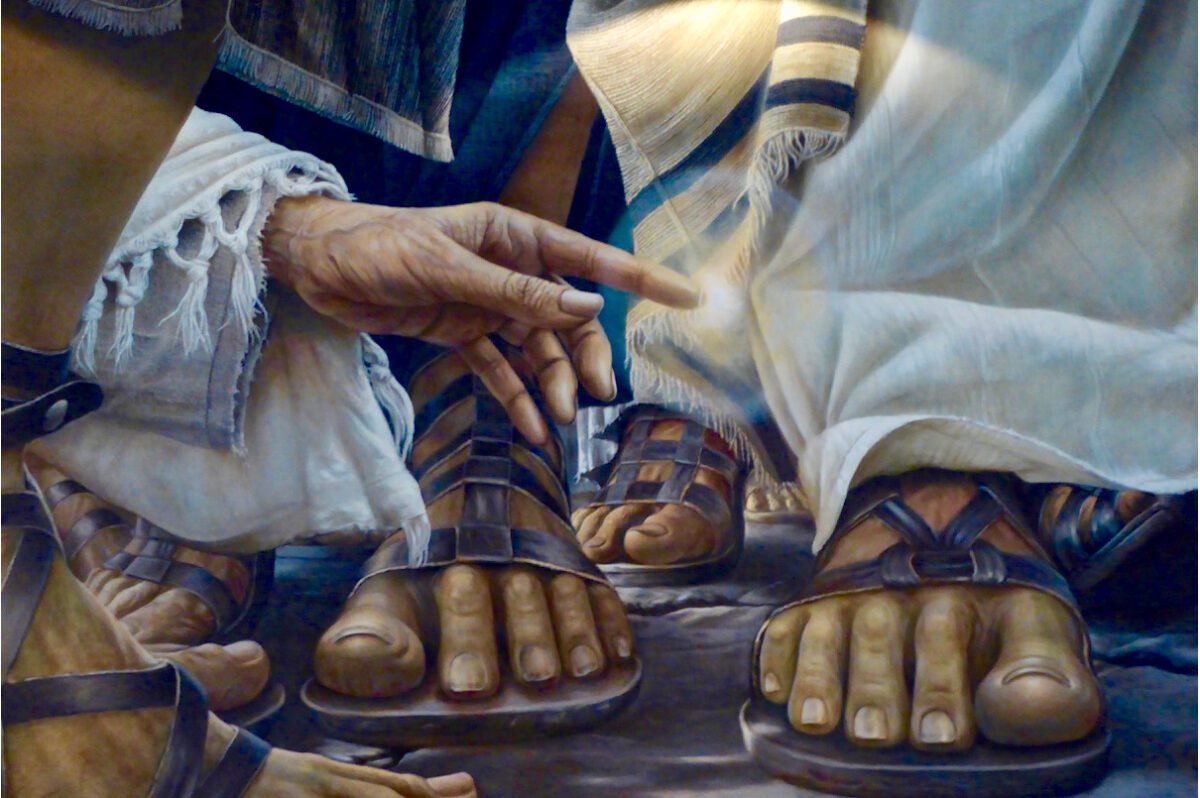
The picture at the top is from my own photograph of the extraordinary painting that forms the back wall of the ‘Encounter’ chapel at the church of Duc in Altum at Magdala on the shores of Galilee. The website includes this fascinating comment:
The Magdala Synagogue inspired this chapel’s present structure. Colour pigments identified by a lab in Germany from the original synagogue frescoes were reproduced and used to decorate the walls. The chapel evokes encounter reminding pilgrims and visitors of the first generation of Jesus disciples who mingled without divisions among themselves nor separations from the Jewish community when they gathered in the synagogue.
Come and join James and Ian as they discuss all these issues and their implications.
 Buy me a Coffee






















Thanks Ian, Just a thought,
Could it be that the woman with the flow of blood was Jairus’ wife and the mother of the girl?
It could be that she was self-exiled to maintain her husband’s position and to protect her daughter. This could explain why she is unnamed- to protect the family.
I wrote a short story about the storm and the demoniac, combining the two into one. Jairus’ family restoration seems to me to be the untold climax.
On Saturday I did a morning giving out tracts but didn’t get anyone to engage in conversation so I sat on a bench and said in prayer “ I’ve stepped out of my comfort zone, please meet me half way.” Immediately a man sat down next to me and we had a chat. He was Jewish. The chat only lasted 5 minutes. But, it really felt like it was an answer to prayer. A small seed.
Engaging in the real world is in contrast to my whimsical story writing. When all the hubbub was over and the mourners paid off I like to think the woman was restored to her family and her daughter.
My observation on Mark 5, to complete what has already been said so well, is that the chapter is about Jesus driving out demons, driving out disease, and driving out death. Unclean spirits sent away and a man made whole; woman with flow of blood – unclean – so, as already stated, Jesus touches her and makes her whole, reversing the rule that you got unclean by touching someone unclean, and dealing with death, touching the dead body of Jairus’ daughter and bringing her back to life. One commentator I read mentioned that the woman had her affliction for twelve years, and Jairus’ daughter was twelve years old – was there a connection as mentioned above?
Thanks–yes that is a good summary. I think Stephen Langton’s chapter divisions serve us well in this case!
Thank you, Ian, for this fascinating piece.
One observation is that Jairus, as the synagogue leader, may well have been the person to ensure that the woman be excluded from the worshipping community, and that Jesus, for having had physical contact with her and then having entered the house of a dead person and touched her, would similarly be ‘unclean’ and excluded at least until he had gone through the prescribed rites.
We can but muse on how all this may have changed Jairus.
And for those of us preaching on Sunday, there is that ever-present pastoral need to be aware that in our congregation there may be those who may have lost children or grandchildren, together with those women whose gynaecological health is poor.
The Gospels aren’t diaries. They’re not a week by week, blow by blow account of Jesus’ ministry or life. What’s in them is a curated account of what the authors (and Peter?) thought was important for the Church to have and understand.
It’s struck me for a while that whilst the modern debate is about the veracity of the miracles and looking on them as some proof of divinity, this seems to be quite detached from what’s going on in the Gospels themselves. Peter’s always around – here he is one of the small number who go with Jesus into Jairus’s house and witnesses the daughter being brought back to life. However, Peter doesn’t seem to get that Jesus is God until the resurrection. Despite witnessing all the miracles, he still denies Jesus before the crucifixion.
So if Peter doesn’t view the miracles as proof of divinity, is it likely he expected us to take his telling of them as proof of divinity? If not, then what are the miracle accounts about? I’d suggest they’re there to tell us something about Jesus purpose and sin. In the West we have (thanks to Pelagius and Augustine) a tendency to look on sin in a legalistic fashion: here are the rules, if you break them you’ll be punished (eternally). In the Orthodox tradition there’s a tendency to look on sin as a wound or a sickness – something we need to be healed from. That casts an interesting light on the healing miracles.
The woman who is haemorrhaging/bleeding in Mark 5 may be one of the most fascinating miracles because of what it can tell us about grace, faith and redemption. Jesus does not go to her, or really decide to heal her. Rather, she comes up behind him and touches his cloak and he is “immediately aware that power had gone forth from him”. Grace is the beginning: Jesus steps into the crowd. If he’s not there, there’s no cloak to touch. Faith is her decision: she reaches out, and is not called to do so. God’s grace is on offer to all. We only need to reach for the hem.
AJ Bell – it’s clear that miracles do not create faith; they give faith a reason for the hope that it has. John 6 establishes this quite clearly; the multitudes are impressed with the miracle of the loaves and the fishes (first half of John 6), but by the end of John 6, after the ‘bread of life’ discourse where he explains to them what it is really all about, they all abandon him – except for a tiny ‘elite group’ of followers (which includes Peter). Maybe Peter didn’t get the point in real time, but he sure got the point – and understood the significance of the miracles as pointers to the fact that Jesus really was who he said he was – in light of the crucifixion.
The joy of Peter in the Gospels is that if he’s mentioned by name there’s a pretty good chance he’s about to get something wrong. It’s very reassuring that when we misunderstand things we can know that Peter stood next to Jesus for 3 years and misunderstood things endlessly, and was still the rock that Jesus chose to build the Church upon.
Thanks for pointing me back to John 6 – there we start with the loaves of bread (and fishes) to feed the people, and by the end Jesus is saying that he is the living bread which you eat to live forever. And why might we need some living bread? Because we are in sin, and the wages of sin are death.
Hi Jock, I disagree that miracles do not create faith. I think they can create both temporary faith and long-term faith (did we have this discussion before?).
It seems to me one of the key reasons why the original disciples continued with Jesus was precisely because of the outstanding miracles he did before them. Do you really think they would have stayed so devoted during those 3 years just based on his teaching? I dont. Not only did they witness Jesus’ miracles, he then empowered them to do the same, at least part of the time during his ministry.
Faith is about putting your trust in Jesus. When he spoke to the woman at the well, she was taken aback that he knew personal things about her which he clearly would not have known through natural means (a prophetic or word of knowledge). That was the main reason she ‘believed’, and went on to tell others so.
I remember watching a few years ago a Bruce Parry documentary about a small island population (cant quite remember where exactly). He was surprised to find that many there were Christians, given that was not their native belief and that they were relatively isolated. It transpired that years ago some missionaries had visited the community, and through them many people were healed of physical disease. That seemed to be the main reason they believed, as it backed up their words.
As Paul said, “My message and my preaching were not with wise and persuasive words, but with a demonstration of the Spirit’s power,”
I recently heard a street preacher say he’d been quickly chatting to a guy, an atheist, and the evangelist asked him, what do you need God to do in order for you to believe in him? The young man said, I want my mom to call me and apologise (his mom had left them when he was 8 (he was now a college student and there’d been no contact since, but he’d recently gotten her phone number but hadnt had the courage to speak to her)). He prayed with the guy, that God would do that. Just as he said ‘amen’ the guy’s phone rang, and yes, it was his mom. He answered it and she said ‘Baby, Im so sorry’. He gave his life to Jesus then and there. And when he spoke to his mom on the phone, it turned out she’d ‘met’ Jesus 4 days earlier.
Peter
Peter – I’m not sure that there is any substantial point of disagreement here. The disciples were looking for the one that was foretold (particularly Isaiah) – and his reply to the disciples of John the Baptist (Matthew 11:4,5) show that the miracles he was performing were precisely to give his followers a reason for the hope that they had. If he hadn’t been performing these miracles, then they would quite reasonably have said, ‘well – this doesn’t correspond to what was foretold in Isaiah – we had better look elsewhere’. At the same time, his miracles didn’t create faith when they were witnessed by the Pharisees and priests (well, perhaps they did eventually and indirectly – in the case of Paul it required a road-to-Damascus intervention to stop him opposing all the evidence).
I think this is the basic pattern I see in Scripture (which doesn’t contradict any of the examples you gave): miracles can give people a reason for the hope that they have (confirming faith if the at least the embryo of hope is already there), but I don’t see examples where they create faith out of nothing,
Here is rich fare indeed,
Here is a wonderful progressive teaching on
the Lordship of Christ & Faith
[which faith the disciples had realized that they didn’t have.]
There is a world of difference between belief and faith.
The disciples had recently had some belief in God but no faith.
4:40 And he said unto them,” Why are ye so fearful?
how is it that ye have no faith?
4:41 And they feared exceedingly,
and said one to another, “What manner of man is this,
that even the wind and the sea obey him”?
All the subsequent miracles continue from this
Lordship of Jesus over Creation.
To lordship over the spirit world, hence
5:7 And cried with a loud voice, and said, “What have I to do with thee, Jesus, thou Son of the most high God? I adjure thee by God, that thou torment me not.”
5:8 For he said unto him, Come out of the man, thou unclean spirit. Cf.
Matthew 8:29
And, behold, they cried out, saying, “What have we to do with thee, Jesus, thou Son of God? art thou come hither to torment us before the time?
Luke 4:34
Saying, “Let us alone; what have we to do with thee, thou Jesus of Nazareth? art thou come to destroy us? I know thee who thou art; the Holy One of God.”
James 2:19 “Thou believest that there is one God; thou doest well: the devils also believe, and tremble.
A great deal of belief here!!
The ruler = Lord of life and death. The man had a perhaps a final hope that Jesus could help him, on news of her death perhaps hope died, Jesus said “Only believe” [ rely on me, which is the most commonly used Greek word for belief in the NT]
The woman = in fact He is the source of all power.
Belief may only be mental assent knowledge; faith requires an action.
For example, one may believe that on can safely jump out of a plane with a parachute.
Faith is proving it by doing the jump oneself.
As with the parables of the kingdom the miracles of Jesus
teach us about faith as reliance,
leaning on God, resting in God.
Song of Solomon 8:5
Perhaps here is a lesson for the Church today;
we may have all kinds of belief[s] about God
and his word[s] but what is the measure of our Faith?
What is the visible fruit of our faith?
Rom 15:13 Now the God of hope fill you with all joy and peace in believing, that ye may abound in hope, through the power of the Holy Ghost.
Miracles certainly drew the crowds to hear Jesus’ teaching;
Much to the chagrin of the religious teachers.
Miracles have their uses in increasing faith,
and are symbolic representations of deeper spiritual truths.
They served a dual purpose: to alleviate human suffering
and to prove the reality of God’s Kingdom on Earth.
They were illustrative of His message and a call to faith.
His miracles were not just signs and wonders in and of themselves, but were imbued with lessons about faith and understanding.
To the delivered man Jesus said Mark 5:19
“Go home to thy friends,
and tell them how great things the Lord
hath done for thee, and hath had compassion on thee”.
This passage has significant meaning for me.
My 6 yr old sister on being told the story of the little girl from Scripture reading notes realized that Jesus loved little girls
A little while later she developed an inoperable slow progressing brain tumor, from which she subsequently died.
During her illness she had a profound faith in Jesus which had a great impact on my life, never to be forgotten.
Even though she lost her sight and speech she never once opined,
But was always calm and at peace.
Her final words to me when I asked
“Have you mentioned all this to Jesus”?
She said “yes. I know he can make me better
but if not, he will give me something better”
I asked her to sing to me
In her darkness she sang
“Jesus bids us shine with a pure clear light
In this world of darkness so we must shine”
You in your small corner
and I in mine”
In my own case I was diagnosed with Atrial fibrillation
A rapid irregular heartbeat,
my heart felt like a swinging brick trying to burst out of my chest.
AF is a known precursor of strokes and cardiac and pulmonary infarcts.
I had two attempts at Defibrillator shock therapy,
Doctors will only attempt these on two separate occasions.
On my third admission to hospital, I was told
“You will have to live with it, we can do no more for you”.
I prayed “Lord, You are the strength of my heart” Psalm 27:1
My racing heart began to slow and ceased altogether
[now over 5 yrs.]
Strangely a few months after my prayer, my cardiac consultant phoned to see how I was coping.
I told him of my prayer and the results.
He did not comment but promptly discharged me from his care!
Thank you Alan, ‘Jesus bids us shine’ brings back memories!
Doesn’t that also open the Cliff Richard song “Why should the devil have all the good music”?
Alan – I’m very sorry to hear about your sister; this sounds horrible. Her faith did make her whole in an eschatological sense – she is now in glory, with all that this entails – but I think that the Good Lord sometimes deals with His own people in ways that look incredibly cruel.
I think more should be made of the fact that when Jesus says ‘your faith has made you whole’ he’s actually referring to the ‘innermost being’ (of Romans 7) and what we will be when we are raised incorruptible.
I confess that right now I’m taking an extremely jaundiced view of miraculous healing. God miraculously heals some people – but others have to endure the worst cruelty. My own mother is in hospital with very advanced dementia (and not strong enough to get out of bed) – and it isn’t very nice. In fact, it looks (from my point of view) like one of the cruelest ways to go. Since the brain is going, it’s difficult to imagine any Spiritual words of wisdom coming from her; she is now completely incapable of that. Occasionally there may be some pearls of wisdom. A few days ago, two of our church friends – a retired missionary (91 years old) and his wife, let’s call them Harry and Mary came to the hospital to visit. My mother seemed completely out of it during their visit, but after they had gone, she urged me to come closer and she whispered to me (that’s the best she can do now), ‘you know, Harry and Mary will soon be going to Thailand for missionary work. They’re putting their children to boarding school. That will be a disaster for the family.’ That is what she said a couple of days ago – and this is (more or less) exactly what she said back in 1977, just before they actually went out to Thailand – and yes – it did turn out to be a disaster for the family (e.g. the oldest son had a nervous breakdown, became a drop-out and now lives in his parents’ basement and earns money driving taxis).
Ian, do you think Jairus might have already heard about the loss of the pigs and the healing of the man with the unclean spirit by the time he met Jesus?
“Those tending the pigs ran off and reported this in the town and countryside, and the people went out to see what had happened.” Mark 4:14
News travelled fast and the loss of 2,000 pigs was a huge economic shock.
As you point out, it seems that the re-crossing of the Lake was across perhaps the North-East (?) corner, so not a huge distance.
If Jairus didn’t know so quickly, one would imagine that he would have heard soon afterwards. I like to imagine that one day he might have met the healed man, perhaps even sought him out, and the two of them exchanged their stories of that memorable time when they each met the Saviour.
Yes, I think you are right. Quite often Mark comments about the reports that people have heard.