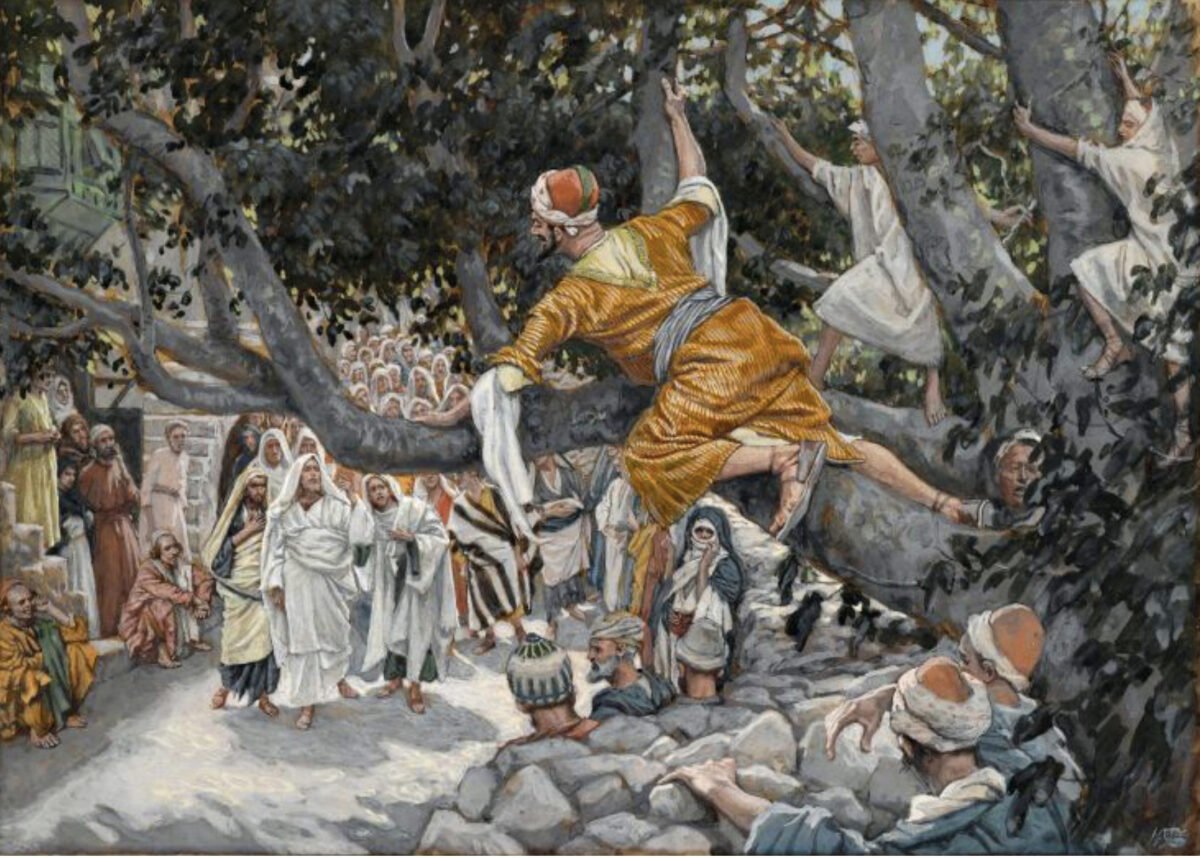
The lectionary reading for the Fourth Sunday before Advent in Year C is the story of Zacchaeus’ encounter with Jesus in Luke 19.1–10, a story found only in this gospel. Video discussion of the passage can be found here, and is posted at the end.
The epistle for this week is the challenging passage of Paul in 2 Thess 1. Video discussion of that passage can be found here, and is also posted at the end.
This short narrative account of Jesus meeting Zacchaeus has all the elements that make it a perfect Sunday-school story—the witty irony of the ‘big’ man who is too small to see over the crowds; the visual humour of his climbing the tree to see Jesus; the personal touch of Jesus inviting himself to Zacchaeus’ house ‘for tea’ (in the words of the song); and the dramatic change as Zacchaeus offers to give away his ill-gotten gains. So, we might conclude, they all lived happily ever after.
But the story also contains both practical and theological questions. Is Zacchaeus portrayed here as an insider or an outsider? Will he really pay back ‘four times over’ those he has cheated, and why? And (where) do we see the moment of repentance?
Luke is now reaching the end of his ‘journey‘ narrative of Jesus’ ministry that began in Luke 9.51. As he does so, details of location become more specific and realistic; in Luke 18.35 he is ‘approaching Jericho’ and in this episode he has now entered Jericho and is passing through. In contrast to some previous references to location, this is quite realistic; Jesus has travelled South along the Jordan valley, and will now turn West and climbs into the hills of Judea to reach Jerusalem. This means that the sense of divine imperative is increasing (see Luke 18.31); Jesus alludes to this in his response to Zacchaeus ‘I must stay at your house today’. But it also gives a strengthening sense of the connection between successive narrative episodes. The character of Zacchaeus has much in common with the rich (young) ruler (ἄρχων) in Luke 18.18—he is rich (balsam was a product of Jericho, and trade on it would be taxed), he is a ‘ruler’ (ἀρχιτελώνης, ruling tax collector), and the description of Zacchaeus as ‘short’ could suggest youth (compare Matt 19.20). There are significant differences too, in that the ‘ruler’ has kept the commandments, whereas Zacchaeus is perceived to be a ‘sinner’.
There are also important narrative connections with the healing of the blind beggar immediately before (who we know from Mark 10.46 is called Bartimaeus, and from Matt 20.30 that he is not alone). The man cannot see Jesus, but hears the commotion; he asks to see again; and once he can see he follows Jesus. The theme of sight is emphasised all through the Zacchaeus narrative: he wants to see Jesus, but he cannot see him because of the crowd; so he climbs a tree to see him; Jesus looks up at him; and the people see this and are unhappy. Zacchaeus would have been well-hidden in the leaves of the sycamore-fig tree (rather contrary to the illustration above), and coming down would have made him visible.
But more than just being adjacent to each other, the two stories of the blind man and Zacchaeus form a pair, as Kenneth Bailey points out in his study of the gospels. On his way into the city, Jesus meets the oppressed; on his way out, he meets the oppressor. We tend to think of Luke’s gospel as focussing on this first aspect of Jesus’ ministry, but in fact this gospel also consistently deals with the second. This has been the case from the very beginning, where it is the religious leaders, soldiers, and tax collectors who come to John the Baptist asking about what repentance means for them in Luke 3.12–14.
And Bailey also notes an important detail about the tree: because of their size and spread, the Mishnah notes that they were only allowed to grow outside a town, at a distance of at least 75 feet away (Jesus through Middle Eastern Eyes p 178). This means that Zacchaeus has gone some way ahead, and really did not want to be seen; that Jesus, ‘going through the town’ has left and is on the road to Jerusalem by the time he encounters Zacchaeus; and that he then returns back to Jericho to receive hospitality from Zacchaeus, hospitality that he did not receive from the other citizens. No wonder they were offended!
The description of Zacchaeus himself is full of ironic significance. His name is probably a diminutive of Zechariah, so there is no doubt that he is Jewish. But as a tax collector he is working on behalf of Rome, and so supporting those who are oppressing God’s people and colluding with the ‘enemies’ who are preventing God’s people worshipping ‘without fear’ (Luke 1.74). And the name is derived from the Hebrew zchi meaning ‘pure’—but of course his profession is anything but pure! The title of ἀρχιτελώνης does not match any job description we know of from other literature, but does serve to emphasise his influence and power, and Luke adds to this that he is wealthy. If we have followed Luke’s narrative so far, we know that this will not end well. Though Luke does include both the influential and the marginalised amongst those who receive the good news about Jesus, those who are wealthy and powerful are consistently characterised negatively. The coming of Jesus will mean that the ‘mighty are scattered in the imagination of their hearts’ (Luke 1.51); whilst the poor are blessed, the rich will face ‘woe’ (Luke 6.24); and we have just heard that it is hard, or rather impossible, for the rich to enter the kingdom of God (Luke 18.24).
On the other hand, he is a ‘tax collector’, and these, along with sinners, are the very ones that Jesus has come to seek; his final comment in the narrative, that he has come to ‘seek that which was lost’ repeats something that we have heard earlier in the narrative (in Luke 5.29–32). And he is certainly marginalised; though he cannot see over the crowd, there is a strong implication that the crowd will not let him through. He has to dispense with dignity by running, something no self-respecting man in the first-century world would do—just as the Prodigal’s father has done in Luke 15.20. And like a child he climbs the tree to see Jesus. So even within Luke’s establishing characterisation, Zacchaeus is something of a paradox.
What, then, are we to make of someone who is all of these things? In his characterisation of Zacchaeus, Luke pulls the rug from under every cliché, every formula by which people’s status before God might be calculated. (Joel Green, NICNT, pp 667–668)
Added to that is the term ἡλικίᾳ μικρὸς ‘of little span’. The term ‘span’ can refer both to length of life as well as length of body, and we see the ambiguity in translations of the term in Matt 6.27 = Luke 12.25. It is likely to refer to Zacchaeus’ small stature, because of his inability to see Jesus over the crowd—and if so, then gives the narrative a sort of vertical dimension, since he has to climb the tree and get up high to compensate for his small height.
Mikael Parsons notes the response this might well evoke in Luke’s readers. Ancient physiognomy interpreted physical features as indicative of inner dispositions; notice that Luke describes both Jesus and John the Baptist as those who grew ‘in stature’ before God and people (ἡλικίᾳ, Luke 2.52). Someone who was small like Zacchaeus must have been small-minded (mikropsychia) as well as small bodied, meaning that he was petty, greedy and with low expectations. This is expressed not only in Greek sources (Pseudo-Aristotle and Aristotle) but finds its way into the observations of patristic commentators on this passage, Chrysostom and Cyril of Alexandria.
Zacchaeus has been conditioned to have low expectations of himself, and Zacchaeus, the short man, ‘sells himself short’ in terms of living up to his name. (Parsons, Paideia, p 278).
We might say that he has shortchanged himself in terms of his own expectations and what he expects from God! And if that is how Luke’s readers view others, then within the narrative they are identified with the crowd who, through their own prejudice, prevent this man from coming close to Jesus. In previous episodes, Luke has differentiated between the negative reactions of the Pharisees and others, and the more positive attitudes of his own disciples; here, he makes no such distinction, and it appears, in their grumbling, that few have yet really understood Jesus’ message.
When he reaches the tree, Jesus looks up and sees Zacchaeus, and this becomes part of Jesus’ own mission of ‘seeking’ that which is lost (verse 10). Although at first it appears that Zacchaeus has been seeking Jesus, it turns out that Jesus has actually been seeking Zacchaeus. There is a sense of divine imperative in the demand to ‘stay at your house’, and there is no doubt that this is an invitation by Jesus for Zacchaeus to offer hospitality which Jesus accepts, with all the cultural significance of personal association that that carries. Zacchaeus’ immediate response follows the example of those open to God, beginning with Mary’s response to Gabriel, and contrasts with the hesitation and qualification found in both Zachariah and the rich ruler.
There is also here an ironic connection between the movement of Zacchaeus and the movement of the proud in the Magnificat. There, the powerful are lifted up in the ‘imagination of their hearts’ because of their pride and arrogance, and are brought low because of God’s justice. But in this story, Zacchaeus has been lifted up (in the branches of the tree is he climbed) because of his shame, and is brought low (back to the ground) because of the gracious invitation of Jesus to repentance and faith.
Zacchaeus’ financial response in giving half his possessions and paying back fourfold are expressed in the present tense rather than the future. Green notes that this could suggest that this was already Zacchaeus’ habit, and that his castigation as a sinner by the crowd sprang from ignorance of Zacchaeus’ true nature. Thus the story becomes one of recognition by Jesus rather than repentance by Zacchaeus. On the other hand, Parsons notes that the present tense can have a future sense to it (just as in English we say ‘I am seeing my friend tomorrow’ when tomorrow is clearly in the future and ‘seeing’ is clearly in the present) and so repentance is the key note here—and most English translations follow this (‘I will give…’ NRSV; ‘Here and now I give…’ NIV).
The rhetorical effect of Zacchaeus’ negative characterisation confirms the traditional view: Luke’s audience would have heard the story of Zacchaeus as a conversion narrative. (Parsons p 280).
This view is supported by several features of Zacchaeus’ statement. First, he addresses Jesus as ‘Lord’, which is Luke’s own characteristic description of Jesus (though not used in verse 9). Second, although within the events of the narrative, Zacchaeus is responding to Jesus’ grace to him, within the narrative itself his declaration is a response to the grumbling of the crowd. (Note, once again, the actual scene of his declaration is unclear: is it in his own house, so few can hear? or is it in public, so all can hear?). In declaring his repentance, he is absolving Jesus from misconduct in his association with sinners—and this is entirely in line with Luke’s expression of Jesus’ intent, that he associates with the sick to heal them, with sinners to bring them to repentance (Luke 5.31–32). The term συκοφαντέω ‘those I have wronged‘ occurs only here and in Luke 3.14 with reference to soldiers who collude in the exploitation of tax collectors—again making the link of the challenge of the gospel to the oppressors, and not just the oppressed . (It has come circuitously into English in our word ‘sycophant‘!) And it is not clear whether ‘paying back fourfold’ is realistic—but it is the penalty for those who have stolen animals (Ex 22.1, 2 Sam 12.6) and so it signifies Zacchaeus’ admission of guilt (Marshall, NIGTC, p 698). As everywhere else in the NT, inner change (in responding to the challenge and grace of Jesus) is expressed in outer, visible action.
Jesus’ declaration that salvation has come ‘today’ is characteristic of his action in Luke. When reading in the synagogue in Capernaum, he declares that ‘Today, this has been fulfilled in your hearing’; and the thief on the cross is saved ‘today’. There is enormous Christological significance to this claim; ‘Jesus’ (Yeshua) means ‘God saves’, and God’s salvation comes when Jesus visits the house. The promised salvation of God for his people is embodied and effective by the presence of Jesus himself, in fulfilment of the anticipation of salvation at the beginning of the gospel (Luke 1.69, 71, 77). And with that, the walls of prejudice in Jericho come tumbling down.
The image of a traitorous, small-minded, greedy, physically deformed tax collector sprinting in an ungainly manner ahead of the crowd and claiming a sycamore tree is derisive and mocking. But as much as Luke exploits these conventional tropes, his intention is to reverse them in the conclusion to his story. With Jesus’ pronouncement of salvation, the stranglehold of physiognomic determinacy is broken, and the ridicule is turned against itself. Just because Zacchaeus is small in stature does not mean that he must be small in spirit. Just because he is pathologically short does not mean he is to be excluded from the family of God. (Parsons p 280).
(If you wanted to preach on this in a creative, dialogical way, one possibility would be for the preacher to conduct an interview with Zacchaeus, asking about his parents, his name, their hopes for him, his work, the attitude of the crowds to him, why he sought Jesus, his exit from the town to climb the tree, what Jesus said, and how he responded. Many of the points above could be included in such a dialogue.)
(The picture at top is another of James Tissot’s illustrations of the life and ministry of Jesus.)
For a discussion of all these issues between James and Ian, watch our YouTube video here, and the discussion of the epistle, 2 Thess 1, below it:
 Buy me a Coffee










Repentance is receiving Jesus. Z’s resulting heart and life change, from the text was a complete change in direction, a turn-around: sinning no more.
A friend at Church last Sunday said he’d been reading on holiday a recent Dane Ortlund book, which contained a quotation I’d heard by Tim Keller, which fits with this exposition. The Gospel message of Jesus is something of an inversion of society’s so that in Jesus, those who think they are ‘in’ are ‘out’ and those who are considered to be ‘out’ are ‘in’.
Z. did what the law abiding rich young ruler would not do.
He gave away his money to rely [believe] entirely on Christ for his wellbeing.
This is a great example of what is the essence of the Gospel – Repentance and Faith.
It was once written that if you were taken to a Court of Law what evidence would you give that might determine that you are a Christian,
mere ritualism would not satisfy the Judge of all men’s character.
Being baptized into a church or being blessed one time by a Bishop, no less,
would not cut it.
Jesus said that Z. was a true son of Abraham who left all “not knowing wither he was going”, what it might entail.
Paul fleshes out what it means to be a true son of Abraham in Colossians Ch 3
Ask “If you consider yourself a Christian what changed
when you received Christ as your Saviour and Master/Lord?
When you were baptized did you die?
And were you raised to newness of life ?
This is far more important than just giving your accent to all a Church’s doctrines and theology.
If you are depending on being a rules keeper
You are under a curse says Paul and not a citizen of the Kingdom of God.
The publicans and harlots will go before you into the Kingdom having repented and believed and been transformed.
Preach the Gospel as if their very life and souls depends on it
because it does.
Shalom.
Now is the perfect time to hear your testimony
Here’s a thought: that Oscar Wilde’s tale ‘The Selfish Giant’ is an imaginative retelling of Jesus meeting Zacchaeus. Work it through… it makes an interesting contrast.
God saved two people out of Jericho that we know of: Rahab the harlot and Zacchaeus the publican. “The publicans and harlots will enter into the kingdom before you.” Jericho was always an obstacle: firstly to the conquest of the promised land, then secondly by its attitude of worldiness, which it represents in the time of Jesus. Residing and trafficking in such a condition makes one of small spiritual stature. Jesus will pass by, though he has no specific message for or ministry in that city. He is going to Jerusalem, where we should all be residing. Maybe those who are stuck in such a condition, but who recognise that this opportunity is come to them, can find us as a sycamore trees into which they can climb in order to be put in front of the truth, and follow Jesus to Jerusalem in turn.