The ‘triumphal’ entry on Palm Sunday in Matthew 21
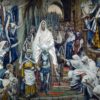
It is always a relief when we celebrate Palm Sunday from Matthew (as we do in this Year A in the lectionary) or Mark’s account (next year). Luke 19.36 in his account talks only about the garments, and does not mention palm branches, so in those years we have to call it Garment Sunday (which doesn’t have the same ring about it). In fact it is only John, the supposed ‘spiritual’ gospel, who specifies the palms.

(The lectionary epistle is the very fitting Phil 2.5–11; see the video discussion of that here and linked at the end.)

But if you are reading or preaching from Matthew’s account, what stands out?

Matthew’s account of the events leading to the entry into Jerusalem is slightly briefer than Mark’s or Luke’s; the inclusion of the fulfilment of prophecy in Matt 21.4–5 replaces the narrative detail about the collection of the donkey(s). Matthew, and to a lesser extent Luke, omit some of the ‘eye-witness’ details found in Mark’s account—the exact question the disciples will be asked (Mark 11.3), the asking of it (Mark 11.5), the fact that the branches were ‘leafy’ (Mark 11.8; Mark uses the word stibas suggesting leafy palms, rather than Matthew’s more general klados). Matthew’s account is more ‘stream-lined’ in order to make the points that he thinks are significant.
Peace, Hope, and Suffering in Romans 5 video discussion

The lectionary readings in this Year C for Trinity Sunday are John 16.12–15 and Romans 5.1–5, both quite short readings. Western eyes often read Romans 5 in individual terms, but the honour/shame/glory motif needs to be understood corporately. The surprising combination of hope and suffering shows that Paul’s eschatology stands behind this—the future has broken … Continue Reading

Jesus calming the storm in Mark 4

The lectionary reading for Trinity 4 in Year B is Mark 4.35–41, (the reading for Trinity 3 in other Years B) the account of Jesus calming the storm. It is a fabulous story both full of little eye-witness details, and yet at the same time impossible to read without feeling its symbolic significance. Unlike Matthew, … Continue Reading

How should we read the psalms of conflict?

I write a quarterly column for Preach magazine, in which I explore a significant word or phrase in the Bible, or a theme or section of Scripture, and the ideas that it expresses. I have written for them on: the phrase ‘Word of God’ the theme of ‘Mission’ the meaning of ‘Apocalypse‘ the ministry of ‘Healing’, … Continue Reading

Jesus calms the storm in Mark 4

The lectionary reading for Trinity 3 in Year B is Mark 4.35–41, the account of Jesus calming the storm. It is a fabulous story both full of little eye-witness details, and yet at the same time impossible to read without feeling its symbolic significance. Unlike Matthew, Mark does not bridge the literal story to its … Continue Reading