Peterโ€™s account of Cornelius and the Spirit in Acts 11

Once again the Sunday lectionary points us towards the reading from Acts as an important point of focus in the post-Easter narrative. The reading โ€˜which must be used as either the first or the second readingโ€™ is Acts 11.1โ€“18, the final episode in the โ€˜Petrine narrativeโ€™ which began with Peter healing Aeneas and raising Tabitha … Continue Reading

Inclusion and exclusion in Luke 13

Sunday’s lectionary reading from the gospels is Luke 13.31โ€“35, and once again the lectionary does us something of a disservice by cutting this short passage off from its surrounding narrative. That is not such a problem in relation to what follows, since Luke begins chapter 14 with a clear narrative break, ‘And it happened, he … Continue Reading
Did the Syrophoenician woman teach Jesus to be Jesus?

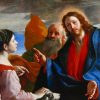
The episode of Jesus’ encounter with the Syrophoenician woman in Mark 7.24โ€“30 often brings readers up short, containing as it does what appears to be a rather shocking insult. Jesus is seeking to withdraw from public attention, needing some time for rest and recuperation, but (as characteristic of his portayal in Mark’s gospel) he is … Continue Reading
Christian doctrine and Schrรถdinger’s Cat

Erwinย Schrรถdinger was one of the pioneers of quantum theory in the early 20th century, andย Schrรถdinger’s Cat was a thought experiment designed to explain the paradoxical principle of ‘quantum superposition’ in one particular theory of quantum physics. This theory suggested that sub-atomic particles could be thought to be in two contradictory states at the same time, … Continue Reading
Is it true that ‘God is love’?

It seems to be increasingly common in a range of ethical debates in the public sphere for one protagonist or other to reach for the formula ‘God is love’ as a quick resolution to disagreement. But this is usually done in a particular way, in the form of a progressive from God to us and … Continue Reading
Is ‘inclusion’ a Christian virtue?

Most people reading the title above will wonder what the debate is aboutโ€”but in different directions. Some will say ‘of course is it’ and others ‘of course it isn’t’. The latest title in the Grove Ethics series explores thisย vexed question andย is a powerful and important study by Dr Edward Dowler, formerlyย Vice Principal of St Stephenโ€™s … Continue Reading