
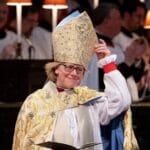
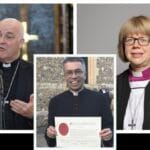
Sarah Mullally, current bishop of London and Archbishop of Canterbury elect, gave a new year’s address yesterday in which she set out some priorities for the Church of England. (It was quite widely reported, in The Times, BBC, LBC and elsewhere, though I could not find the text anywhere on her own website or that of the Archbishop.)
In it, she connected her new role in the Church with her experience of having been in the NHS, including her time as Chief Nurse.
Good healthcare is incredibly important to me. It goes hand in hand with my Christian faith, inspired by Jesus’ call for us to love and care deeply for one another.
At St Thomas’ Hospital, where I first trained, the chapel is a place of sanctuary for staff and patients, away from the busy wards. The multi-faith chaplaincy team is on hand to listen, pray or simply sit with those going through life’s most difficult and painful moments.
Sarah makes multiple important points here. The most obvious is that those who seek to follow the example of Jesus as their Lord are called to serve others as he has served us.
When he had finished washing their feet, he put on his clothes and returned to his place. “Do you understand what I have done for you?” he asked them. “You call me ‘Teacher’ and ‘Lord,’ and rightly so, for that is what I am. Now that I, your Lord and Teacher, have washed your feet, you also should wash one another’s feet. I have set you an example that you should do as I have done for you. (John 13.13–15).
This is the reason why, historically, Christian proclamation of the good news of Jesus, to repent and believe, has always gone hand in hand with practical caring action, such as the establishment of hospitals and other structures of care and provision.
And there is a growing body of research which shows that holistic care is key to clinical recovery; we are body-soul unities (as Scripture consistently teaches), and our bodies can only heal well in the context of communal care and even spiritual restoration. In fact, attending church is good for you! People who attend church and have an active faith also have improved health outcomes in all sorts of ways.
This has been significant historically, and proclamation of faith and practical care have been intertwined at key moments. In a fascinating analysis in his book The Rise of Christianity, the late Rodney Stark noted that the Christian faith grew significantly during periods of plague in the Roman Empire. Whilst many people fled cities during plagues, abandoning family and friends to their fate to save themselves, Christians tended to stay and care for the sick. This both led to a higher recovery rate for those suffering, meaning that the Christian community has a lower mortality rate—and onlookers were drawn to this community, impressed by both the courage and the care that they witnessed.
Sarah then goes on to cite one specific example in a local church.
Churches like SAINT in Hackney hold regular lunches, understanding that for many of us, a place to go where food is provided and there are people to talk to, can be as important as medical intervention for our physical and mental health.
Here, people from all over the world, from many different backgrounds, experience a warm welcome, a health check-up if they need it – and importantly, the love of Jesus Christ, who showed us how to wash the feet of others.
This must be very encouraging for that church to be mentioned! And it is a fascinating example to cite. If you look at their website, you can get a feel for what they are like—quite informal, with no dog collars evident for the clergy. And this is what they say about themselves:
Our vision is to bring hope to the people of East London. We aim to play our part in seeing a renaissance: restoring lives, revitalising churches and renewing culture.
We are a diverse, dynamic and fast-growing church formed of multiple East London parishes. We have been commissioned as a resource church to serve young people, train diverse leaders and plant churches in partnership with a network of friends.
It doesn’t say so anywhere on the website, but I suspect they are connected either with the HTB network, possibly through the Revitalise Trust. And what is striking is that they see social engagement and explicit evangelism as sitting side by side in what they do—so you can find out about their Lighthouse work with the vulnerable, or come and join an Alpha course to explore the Christian faith.
Contrary to much negative comment in the C of E, this is typical of most evangelical churches. In my city, the biggest work with the homeless is run from Trent Vineyard, the largest church in Nottingham.
And of course there is another connection between church growth and practical service: growing churches can do more. The one thing that Sarah does not mention in her New Year message (and why would she?) is that the trend in church attendance for the C of E continues downwards (allowing from some small continued recovery from Covid lockdowns). A denomination that is growing smaller, and in which the age profile is weighted towards the elderly, is going to have less energy and ability to offer care and support. (Note that this decline is not true of the church in England…)
In our communication with the wider world, saying that ‘Our main goal is to see people repent and come to living faith in Jesus’ is unlikely to be received particularly well, whilst saying ‘We are here to serve people’ is. But in fact the first can be done, if done carefully and well (and I did say this when interviewed about this story by LBC Radio)—and it certainly needs to be top of our list in our internal conversations.
Sarah then goes on to extend the metaphor of healing to wider society:
In my calling now, I strive to carry the care and compassion that shaped my vocation as a nurse into everything that I do.
The role of the Church should be a healing presence in our nation, bringing people together at times of often intense division, caring deeply for those who need our help.
This is surely vitally true—but for me it raises four essential follow-on points.
First, the idea that we need less division and more ‘coming together’ in our society is hardly controversial. Is anyone going to disagree with this? Is anyone going to argue that we need a more divided country? No, of course not—but that raises the question of what this idea then means. If I say ‘I think it is important that everyone continues to breathe today’, because it is nonsensical to disagree with this, my statement is actually empty of content. What do I mean, and why am I saying it?
The danger here is that we state these truisms not for their content, but for their effect—making the Church sound positive and inoffensive. The difficult with this is that, without some filling in of content, it lacks credibility, and it follows a strategy of wanting people to think well of us. This was not a trap that Jesus fell into! He was prepared to say difficult and controversial things which caused offence—and in fact warned us of seeking appeasement.
Woe to you when everyone speaks well of you, for that is how their ancestors treated the false prophets. (Luke 6.26)
This is from Luke’s account of the Beatitudes, which we find in Matthew 5, and is part of the complementary list there, where we are blessed when people speak ill of us and revile us. There is a serious tension here for the church established by law; how can we both be part of the structures of the country on the one hand, but spoken ill of by many on the other? Jesus is clear, though: unless that is the case, we are not being true to him.
Secondly, we need to reflect on what it means to ‘bring healing’. A simplistic approach here will be that it is no more than drawing alongside people, and binding the wounds that they experience. Like first aid, that might be an essential first step—but true healing goes a lot further. As Sarah will know from her nursing days, and my GP wife has known all through her medical career, an essential part of bringing healing is presenting people with the bad news of their diagnosis. Unless sick people are told their diagnosis, and unless they are willing to listen to it and act on it, healing can never happen.
This is precisely the metaphor Jesus uses for his ministry of calling sinners to repentance—and he does so in the context of a challenge to the way he spends time with those outside or on the edges of the community of faith.
Then Levi held a great banquet for Jesus at his house, and a large crowd of tax collectors and others were eating with them. But the Pharisees and the teachers of the law who belonged to their sect complained to his disciples, “Why do you eat and drink with tax collectors and sinners?” Jesus answered them, “It is not the healthy who need a doctor, but the sick. I have not come to call the righteous, but sinners to repentance.” (Luke 5.29–32)
At first, this might look like a recipe for ‘finding the truth on the margins’ as I often hear. But we need to note three things in this episode. First, Jesus is not claiming that the ‘sinners’ he is spending time with have the truth which he needs to learn from them; quite the opposite! They are the ones who need to hear the truth of the coming of the kingdom in the person of Jesus himself. Secondly, this is not a flattering depiction of the ‘sinners’; they are spiritually sick, and they need a divine doctor who is bring them healing and life. Thirdly (and related), the aim of Jesus spending time with them is not to ‘affirm who they are’, but graciously to bring them to a change of life and direction. (I find it fascinating that Luke, writing to a mostly gentile audience, needs to make this call to repentance explicit, where in the parallel texts in Matt 9.13 and Mark 2.17 leave it as implicit.)
Thirdly, healing division must surely mean being ready to speak the truth to a situation, rather than simply trying to keep everyone happy, ready to ‘agree to disagree’. Sarah already has a good track record on this in her contributions to the assisted dying debate. But are we ready to do the same on other controversial issues, including the Church of England’s own stated opposition to abortion, it’s belief that marriage is between one man and one woman, ‘according to the teaching of our Lord’ and reflecting God’s intention in creation, on contested issues around sex identity, and so on?
The problem with a bland claim to want to bring healing to division is that the easy path is to say that the issues themselves that are causing the differences are not things that matter. In many cases, that is not true—issues around differences of value and action often matter intensely—and it belittles both the groups who hold these views as well as the issues themselves.
Lastly, I don’t see how the Church of England can claim to be an agent of healing of divisions whilst its own divisions continue to be open wounds that are unresolved. Not just on the debates about sexuality and marriage, but also on questions of race, of historic slavery reparations, on a narrow approach to net zero and climate change, and (dare I say it) on agree what the local church is for, and how it might be best resources to be effective in sharing the good news of Jesus, we seem to be deeply divided still.
Specifically, it means that at the House of Bishops meeting this month, Sarah needs to take a lead in drawing a clear line under the LLF process, and enabling us to move on from our divisive obsession with this issue.
These divisions cannot be papered over by ‘agreeing to disagree’, not least because, on many of these issues, it is simply logically impossible. You cannot both believe that the Church is ‘institutionally racist’ and that it is not at the same time—and in fact such claims have been pushed on the wider Church in an almost totalitarian fashion, closing down honest debate and damning any critical thinking on the issue.
So I welcome Sarah’s comments for the new year and a new term as Archbishop of Canterbury. If we are to taking this call seriously, we need to face into the necessary issues that need resolving if we are to fulfil this vocation.
 Buy me a Coffee
















Thanks Ian – very helpful.
It’s going to be necessarily tumultuous year – but hopefully in a good way!
My impression – which could probably be demonstrated with a high degree of probability – is that those who have an addict’s quota of gossip and chatter without which they pine are all too glad to create the impression of ubiquitous scandal, and indeed most of their church-related activity is related to fostering this impression. One of the ways this would be demonstrated would be to see how often the following combination appears:
-interest in safeguarding at a time when structures have never been better or even remotely as good;
-also, interest in same-sex issues;
-lack of interest in anything else…
(i.e., a combination that amounts to worldliness).
The dire state of the institution (institutions are not agents) is easily demonstrated to their own satisfaction by cherrypicking data that could scarcely not be present somewhere in so large an organisation. The fact that the leaders have a mea culpa spirit (and/or weakness) does not help; now that the media have them under their toe, any pushback against this would result (by editorial policy) in an even greater push against the Church of England. Moral: do not be weak in the first place – it is probably too late now.
Some very good observations here Ian.
In “The Bruised Reed” Richard Sibbes said “The Church is Christ’s Hospital”
The definition that Oswald Chamber gave of good health was
“the forces on the inside successfully combating the forces from the outside”.
By the same token ill health would be the opposite.
As a trained Nurse the AB Might be well equipped for such an establishment as this.
Is the nurse reasonably trained and equipped to recognise
dis-ease signs and symptoms?
Is the nurse familiar with measures that can mitigate or reverse the said dis-ease?
Is the nurse equipped to transmit the Physicians Diagnosis and Prognosis and willing to tell the patient the “bad” news?
With her chief nursing officer credentials could she set the Procedures and Protocols for the functioning of a healthy transformative health care facility along with the aim of establishing Good Community health?
Alas, over that last few decades the decline of the understanding of the general dis- ease [Sin]
And the sure remedy [The Cross] have lapsed somewhat.
In their place is a ministry of “coming alongside” the dis-eased soul and encouraging them to “think” themselves better:
Fined the good in themselves and live their best selves
because they are worth it, etc.
Alas this has not had a great impact on Community Mental Health outcomes.
.There is a growing pressure and demands for a fully funded
National Mental Health Service for the dis – eased minds.
If as AB she hopes to turn this particular ship round she will need
Understanding of the malady [Sin] and wisdom to promote
good health,[The Cross] and a great deal of help from
the Divine Physician and a willingness to work with him.
For we are “workers together with Him”.
2 COR.5:20 Now then we are ambassadors for Christ, as though God
did beseech you by us: we pray you in Christ’s stead, be ye reconciled to God.
5:21 For he hath made him to be sin for us, who knew no sin;
that we might be made the righteousness of God in him.
6:1 We then, as workers together with him, beseech you also
that ye receive not *the grace of God* in vain.
We pray that she will not fail of the Grace of God nor fall from the
Grace of God to a self- help doctrine. Shalom.
Good points there; total agreement.
Ian Paul writes
“Lastly, I don’t see how the Church of England can claim to be an agent of healing of divisions whilst its own divisions continue to be open wounds that are unresolved. Not just on the debates about sexuality and marriage, but also on questions of race, of historic slavery reparations, on a narrow approach to net zero and climate change, and (dare I say it) on agree what the local church is for, and how it might be best resources to be effective in sharing the good news of Jesus, we seem to be deeply divided still.”
By far the most important ‘open wound’ is the disagreement about what happens at the Day of Judgement to those who are not saved. Do they face eternal retribution from God, which is what I believe , because that is what the Bible says , or not.
Philip Almond
That’s hardly an open wound. If the unsaved, and if you and me are not amongst them it is only by grace, end in ever lasting torment or actual death, that is God’s decision. Ect makes little sense to me.
Yes peter i’m with you on that
Reply to Peter Parker and John Tater
When we preach the gospel what should we say about what happens on the Day of Judgement to those who are not saved?
Surely we have to say something. What do you say?
Phil Almond
That there is judgement which may entail a death sentence.
Along side the AB the agents of the ship might resolve this coming New Year
To Explain What Sin Is [not sinS, a half-trained monkey can recognize sins, especial in other people, less those in themselves!]
Why does God Hate Sin? Because it deceives, robs, cripples, dis-eases and kills the folk who He created to share in His Fulness and have Fellowship with Himself.
The Cross, not as an historic event only but a continual active reality that kills our self-will, self-aggrandisement, self -gratification, self -help, self-pleasing, self-pity , and egregious independence of God and refusal of His Grace.
And How to work out our own Salvation with fear and trembling, to die daily.
To put on Christ, to have his same mind, and walk as He walked.
Such a Gospel pleases God and those that thus honour Him will be honoured
Shalom.
PS . Sin the essence and root of all sinning @
desiringgod.org/messages/what-is-sin-the-essence-and-root-of-all-sinning
Where are the gifts of healing which Paul said were a normal part of the church?
Both Jesus’ and Paul’s ministries were characterised by power. Where is it today?
Silver and gold have I plenty, but healing?
“But are we ready to do the same on other controversial issues, including the Church of England’s own stated opposition to abortion..”
Thanks Ian, very helpful. I appreciate this is not the main thrust of your article, but I would be interested in your opinion why this recent petition has only achieved 6k votes so far, when there must surely be at least ten times this number who oppose abortion in principle even within the CoE, and perhaps a hundred times or more from other denominations. If the problem is in the wording of this specific petition, then what might a CoE approved petition look like?
https://petition.parliament.uk/petitions/733380
I didn’t know about this petition. Even SPUC, who email me regularly, never seem to have mentioned it. That’s very odd.
Thanks Richard, yes it is odd. Christian Concern promoted it on X and on Facebook a few times early on, but not on their website as far as I can tell. Anglican Mainstream gave the link when the petition launched. Glen Scrivener also promoted it on X when it launched. But it has now gone very quiet and as a result the numbers have levelled out.
These two sites seem to be linked to the petition:
https://heartbeatbill.co.uk
https://www.cbruk.org
I’m struggling to understand why it hasn’t yet received broader support, especially from other organisations such as SPUC as you say.
Yes, the new Archbishop was right to highlight the good work being done by churches in providing food for the needy and in hospitals to listen and pray with the sick. Those are the types of things the people of England will want their established church to be doing and so in her broadcast to the nation Sarah Mullally was right to highlight them.
Most of the people of England do not want their established church to be spending half its time attacking abortion, same sex relationships and ignoring net zero and climate change however. Now the Mullally can make her contribution raising concerns about assisted dying, in terms of the bill going through parliament in relation to that. However the C of E long accepted abortion in line with the 24 week time limit in UK law as better than a return to backstreet abortions, so while it recognises the fetus as a human being it does see limited conditions where abortion is valid. It has never been a firmly anti abortion in all circumstances denomination like the Roman Catholic church or the Baptists for example. The Church is also committed to supporting net zero, not investing in oil or gas companies for instance and supporting renewable energy and solar power in its churches. In terms of historic slavery reparations where church assets have been identified as coming specifically from investments in and income from the slave trade centuries ago the Commissioners are committed to invest in projects benefiting communities historically affected by the slave trade.
Finally, Synod of course has voted by majority for LLF in all 3 houses, so it stands. The fact same sex marriages in church have still not got the required 2/3 majority of Synod does not mean there will be any going back on LLF, LLF is here to stay
‘Better than a return to backstreet abortions?’
Is that comment for real? Firstly, the number of backstreet abortions has greatly multiplied since COVID, having been almost zero for decades.
Home/domestic abortions where both pills are taken at home are 61%, i.e. 150,000 in England and Wales p.a.. In addition, there are plenty of others where one pill is taken at home. No medical supervision – backstreet in other words.
And this is all promoted by the people who claimed to think backstreet abortions were a dreadful thing.
If anyone were even half well brought up, or lived in a half civilised society, the idea of killing any baby, let alone their own, would be so far outside the reaches of anything one would think of that they would not think of it (at most, they would think of it as a disgusting fictional possibility).
Abortion was legalised in the 1960s, so in your own words backstreet abortions were near zero for decades until Covid when many clinics were closed.
Taking pills for an abortion is still illegal after 24 weeks of pregnancy and those who supplied such pills can still be prosecuted.
However the fact remains the Church of England is established church of a nation where 87% think abortion should remain illegal and just 6% say abortion should not be allowed. So the C of E is never going to outright oppose abortion, even if the non established Roman Catholic and Baptist churches still outright oppose abortion and think it should not be legal. At most it could support a reduction in the 24 week limit, 25% of UK voters back that while only 6% think it is too early. Voters are split 42% to 42% on allowing abortion pills at home or only at a clinic, so they could also push for the latter
https://yougov.co.uk/politics/articles/47568-where-does-the-british-public-stand-on-abortion-in-2023
Sorry, ‘However the fact remains the Church of England is established church of a nation where 87% think abortion should remain legal and just 6% say abortion should not be allowed.’
Lol – just as in Aristophanes’s Clouds the latest thing is that ‘Vortex rules instead of Zeus’ (I always imagine VorTEX with a stetson), now you ascribe authority to the UK populace at some random snapshot point of history, whether or not they have done the slightest amount of thinking or are blindly following what they assume to be the norm of today.
Does it not occur to you that people will just follow whatever seems normal or legal in their own culture without thinking too hard about it?
Just as at other points you hold that the new god ‘Synod’ has usurped Jesus, all the while claiming to follow Jesus.
It makes sense.
Right?
The Church of England is established church of England so every person living in England is a parishioner of a church of England church, so of course their views have to be taken into account. Synod of course has been the governing body of the Church of England for over 100 years since an Act of Parliament gave its predecessor the C of E Assembly power of governance over the C of E
The Church of England is established church of England so every person living in England is a parishioner of a church of England church, so of course their views have to be taken into account.
Including Muslims? Witches? Satanists?
Yes, literally every resident of a C of E Parish in England is a parishioner of it, even if they don’t ever attend church even for Christmas and Easter, weddings, baptisms and funerals. That is why it is established church. Now that also includes Muslims who wouldn’t have been in C of E Parishes centuries ago, and a handful of witches and satanists who would but the principle of the C of E Parish system still applies. Church of England churches are open to all parishioners all year round and are available for weddings and funerals and baptisms of their children for any parishioners who want them
So how should the Church of England take the views of witches into account?
It doesn’t need to, as most English Parish residents are not witches. Though even witches can get married or have a funeral in their local C of E Parish church if they wish and are willing to accept the Christian element in that service
SB, you constantly ‘explain’ how things work in the C of E and the UK, which is dishonest of you, because you knew very well before your explanations that (a) we already knew how things work and (b) that was nothing to do with the question we were raisings anyway – we were not asking how things work, or anything close to that.
We were raising the question of whether the way things currently work is a good Christian way of working, or a bad unChristian way of working.
It is a correct Christian way of working for the established Christian church of a nation to be open to everyone in that nation who wants to worship, get married or have a funeral there
I wonder if you could all desist now from these fruitless one to one exchanges which don’t engage with original post. They are outwith my guidelines.
But what do *you* think about abortion, Simon? And what do you think Jesus thinks?
I would not ban it, I might back reducing the time limit to 22 weeks. Jesus never mentioned abortion, in fact nowhere in the Bible specifically mentions or prohibits abortion. Psalm 139 mentions God knitting people in the womb but that is it
You don’t believe in love or in Christianity or in humanity, or that babies are of more worth than a sweetwrapper. However, you do believe in magic. You believe that suddenly at 22 weeks, a miraculous change takes place, for there is no continuum of development.
(You also believe that a factor relevant to premature babies – viability outside the womb – is somehow relevant, rather than totally irrelevant, to babies who are presently snug in the womb. This not only shows a callous and murderous spirit, but it also shows that you are not at the level of independent thought to see through the lies that the mantras of popular culture have fed you. So you should defer to those who are capable of independent thought.)
24 weeks is set as that is the time babies are likely to have been first able to survive outside the womb, though there is some evidence that babies might be able to survive at 22 weeks. Of course you may disagree and oppose all abortion, fair enough but there is nothing Christian about that.
As I said there is not a word in the Bible whether from Christ or any other passage specifically opposing abortion. So it is perfectly possible to be a Christian who backs abortion with a time limit and also perfectly possible to be an atheist who opposes all abortion as a personal view based on life begins at conception rather than at fetal viability
Simon Baker talks anti-scientific nonsense. John the Baptist in St Elizabeth’s womb leapt in the presence of the Messiah in utero.
Unborn children do not magically become human after so many weeks. Life is a continuum from conception.
Western society (as well as communist society) is under a curse for conniving in the culture of death.
‘John the Baptist in St Elizabeth’s womb leapt in the presence of the Messiah in utero’ So? That is still not a bible passage prohibiting abortion outright.
Simon Baker:
If John the Baptist in utero recognised the Mesiah in utero, that means their personal identities as John and the Messiah preceded their birth, and to have killed them by abortion would have been homicide. What is hard to understand about that?
And why do you imagine that a social policy decision by figures in the Church of England at some particular time must be holy and true? Your worship of Englishness is strange.
No as murder only begins if inflicted on a life born human being, otherwise at most it is infanticide and only after the abortion time limit. As I said, not passage in the bible expressly forbids abortion.
Luke 41 states ‘When Elizabeth heard Mary’s greeting, the baby leaped in her womb, and Elizabeth was filled with the Holy Spirit’, so she was already likely well past 24 weeks of pregnancy with her baby and past the abortion time limit anyway
One would have to be sick and damaged inside to kill one’s own child. Modern secularism (which is spectacularly evil, while going under most people’s radar in being so) by seeking out the largest pool of sleeping partners creates a production line of such damaged conscience-seared poor individuals, victims of the system.
What is needed most is to clean out the Augean stables that are the liberal-dominated theological colleges.
I thought most of them shrivelled and died, as is inevitable. However, the reduced-hours options now are often evangelical-lite.
How are the theological colleges doing? I cannot get figures of how many fulltime students they have, the colleges are not publishing these.
Westcott House looks like it is mainly female now.
I don’t know how Wycliffe or Trinity are doing, or Oak Hill.
I think half the ordinands in England are doing part time coursed with St Mellitus College.
Does anybody have figures of students in training?
I know of one Oak Hill graduate, who will be leading a new plant this year.
And a church fairly local to me, led by two Oak Hill graduates. All are married family men with children.
Another church in the City is led by a former CoE Minister. It has moved into a former Methodist, church, and has planted, with a male Minister, in another part of the city.
One of the churches has more children and youngsters than the whole of the CoE diocese.
Just a couple of days ago, I was deeply shocked when looking at the web site of the local CoE church, where my wife and I were converted, that there is no Minister, but two retired people, we know. But astonishingly, to me, two people who were prominently presented, were ‘safeguarding’ officers, one from the church, the other from the diosces. Astonishing, why?: it is such a small church?
Wake up CoE. The tendrills remain, but grow outside of the CoE.
The voice of Jesus Vine and branches, comes to mind.
Every C of E church has to have a safeguarding officer, from the most conservative evangelical church to the most liberal Catholic one to protect young men, children and women. After Smyth and Ball and Pilavachi to not do so would be a PR disaster, pounced on by the media and also unacceptable to the government as well who expect strong safeguarding from the nation’s established church now
Luke 17.2
Yes indeed, the homoerotic antics of John Smyth, Peter Ball and Mike Pilavachi have been a disgrace.
Two of them were a disgrace 33-45 years ago that would not be replicated today. The other was not of a level to interest the police.
At what date will people stop talking about them as though they were features of today’s church. The media hypnotises people to think that anything gossipworthy has to be front and centre even if it is in the distant past and not especially relevant to the present state of affairs. Because the gossipworthy is their stock in trade. Many fall for it.
I’ve clearly and seriously missed something.
I thought this was an address to the nation not an in house rally.
As such, from the leader elect of a national Christian organization, and she spoke for no other reason, it said nothing of its Christian commission, that is unique: its commission as with all believers, from Jesus, to make disciples. So little about the person of Jesus. Yes washing feet, but feet of disciples on the way to the cross for their salvation.
At one place, she mentioned that hospital chaplains were part of a multi faith discipline; nothing different there. Elsewhere there was nothing different offered than can be and is provided by many secular charities, who can -and some- do a better job.
Therapeutic moralistic deism, the acceptable face of churchyanity.
Talking of care and healing on its own—yes, there is a serious danger of that.
Interestingly, next Sunday’s ‘epistle’ is Acts 10.34–43. Peter describes Jesus’ acts of healing as ‘deliverance from Satan’. There is always a spiritual dimension to healing…
…but could you please give you full name when commenting? Thanks.
That is a standard reading of the New Testament healing, do we believe that is what the bishop thinks? And fixed name.
You say that “this is typical of most evangelical churches”: which is demonstrably true nowadays.
My own Catholic background and tradition in the CE was, in its heyday, the place where faith and action were seen, sacrificial action by “slum priests” bringing hope and faith in action to deprived areas, resulting in a vibrant growth of faith resulting preaching in action as well as in words. Something which inspired me in my youth and was seen in the sort of parish churches my father described from his youth in London. Yet, all too oten, that became an obsession with ritual and the minutiae (some say I am still! Tomorrow I am presiding and preaching at the Eucharist in Ss Peter & Paul, where incense is seen in action, not just talked about)
The same link between the Good News and good acts was to be seen in my mother’s tradition, the Brethren; and would read Echoes of Service as well.
This is what revitalises the Church: preaching the Good News of Jesus, God among us – verbum caro factus est, crucified, risen and ascended; and letting that be seen in humble, servant action.
It occurs to me that although Abortion per se is not mentioned ,
However, God does have something to say concerning killing children
Leviticus 18:21 states: “You shall not give any of your children to offer them to Molech, and so profane the name of your God: I am the Lord”.
Leviticus 20:2-5 prescribes the death penalty (stoning) for any Israelite who sacrifices a child to the god Molech.
Deuteronomy 12:29-31 warns the Israelites not to imitate the customs of the nations
they were dispossessing, specifically mentioning that these nations
“burn their sons and their daughters in the fire to their gods” as a
“every abominable act which the Lord hates”.
“For the Judahites have done evil in my sight”—an oracle of Yahweh—
“they have set their abominations in the House over which my Name is invoked, defiling it.
They build the shrines of the Topheth, which is in the Valley of the Son of Hinnom,
to burn their sons and their daughters in the fire
—which I did not command, nor did it arise in my mind.” (Jeremiah 7:30–31)
Else ware God says that “their blood cries out to me from the Ground”
The very blood soaked ground is a pollution of the land, He will not leave us guiltless.
He will visit the iniquity of the “parents” upon their children unto the fourth generation.
I think that our children today are paying a price.
Alas the Dog that did not bark.
Two safeguarding positions, one church, one from the diocese, were prominent on the website,visited a couple of days ago, of my local CoE, where my wife and I were converted more than 25 years ago.
There was no Minister, only a well retired honorary, formerly locally ordained Minister along with another well over 70 retired Minister.
What is astonishing is the prominence given to safeguarding people in a church with so few in attendance, let alone children and vulnerable people. If this is an example of the today’s parish system, it is a broken cistern beyond repair . Who cares and why? Certainly not those who live within the parish boundaries. The long-time leaking liberal Diosece?
After Smyth, Ball, Pilavachi and Tudor, the idea the C of E does not need safeguarding officers in each of its Parishes is dangerous and absurd
Straw man argument. There is nothing to safeguard, if the Gospel is not first safeguarded.
The parishioners don’t care don’t get involved in the parish I cited.
You are living in a ‘parish’ bubble of your own construction, Simon.
No, it is you who are living in a bubble Geoff. No organisation operating in the UK which has women, children or young men attending its functions or activities can operate under UK law without adequate safeguarding officers and procedures in place. Legislation like the Safeguarding Vulnerable Groups Act 2006 and the Working Together to Safeguard Children 2023 make that clear
Conservative evangelical churches also have to have safeguarding officers and safeguarding procedures in place and enforced under UK law as any other church does
You cannot therefore have any children or vulnerable adults attending any church services or function without full background checks being done and safeguarding procedures put in place on and in relation to all adults who will or might work with them. Otherwise you have broken UK law and could face a police investigation
Simon, the fact that you cite 4 names of whom 3 behaved so badly 45 years ago and the other has not done things that interest the police – these from a huge organisation that has 10 times better structures now than then – says it all. All you do is repeat what you read in the press.
You then think it is telling to relay the way things are, as though we did not already know that!
I don’t know how you deduce (inaccurately) that the police is the bar by which I measure sexual abuse. Nor secondly do I know why you think there is only one bar. (Nor thirdly do I fail to notice your dragooning people to accept that what we are talking about is always simplistically categorised as mainstream sexual abuse rather than sometimes also other categories, as in Pilavachi’s case and to some extent with the public school category). I mentioned the attitude of the police and law as one significant indicator and perspective-provider, because it is.
It is sooo obvious that the public narrative is- the more gossip-worthy, the more serious and significant. They know there is no logic to that, but they are not bothered, because they have had their desired fix of recycled gossip, which was the end in view.
You haven’t read what I wrote, Simon but bang on about what isn’t disputed on safeguarding.
There is no one to afeguard, no reason to attend the parish church.
Safeguarding at front and centre prioity not ministers of the gospel.
None of my neighbours and people I know within the parish would give a thought to safeguarding as reason to attend or no. There are no children to safeguard, no vulnerable adults. And women are in charge.
It is greivous to see the change in less than a handful of years.
It doesn’t matter whether safeguarding makes any difference or not to peoples’ intention to attend church. Safeguarding front and centre is the law of the land and any church which fails to have safeguarding officers and safeguarding front and centre is breaking the law. Even if a child or vulnerable adult only attended once a month or even once a year that church failing to have safeguarding measures in place at the church could lead to a police investigation and arrest of the Vicar and wardens and diocesan officials responsible for safeguarding potentially
Christopher
Is not interesting the police the bar by which you judge sexual abuse? A rather secular take, I feel.
You just don’t get it do you Simon. Having been a solicitor and accepted by a local authority for short term respite care for children with disabilities I do understand safeguarding and law there are simple measures that could be effected to cover any of the situations you describe and any historical allegations would automatically referred upwards to the diocese.
In another handful of years there will be no one there, the doors shut in a former centuries old, urban parish. Get it? The evidence is that you don’t as you continue to bang on with your closed, dead end view of parishes.
The people in the parish church, who I know, know enough of safeguarding protocol to pass it on. Again those in charge in the parish, and the diosece relating to safeguarding are all women.
The most reliable way to safeguard is to close down in the management of rapid decline.
What is the CoE going to do about it? And your answer Simon to this reality cited is…?
Safeguarding is required in all churches, whether they have congregations of thousands, hundreds, fifty or just ten. Whether they have children and vulnerable adults attending regularly or only occasionally. Safeguarding procedures to be complied with as required by law are set out on the C of E website and safeguarding officers must be appointed by each C of E church to comply with them.
PCD
See above for my reply.
Why would you think that I think secularism cannot be right about anything at all? That is sweeping – as you know, there are millions of things that one can be right or wrong about.
Christopher
I think secularism has provided much that is beneficial. It’s you who always treat it as demonic.
Which proves you have not read what I have written. Given that it has millions of aspects, it indeed follows (to repeat myself) that it has provided much that is beneficial. And it clearly is demonic too, as all can see: it actively puts children one button away from their life being messed up, often irrevocably; it promotes and recommends some of the most lethally harmful things like adultery (open advertisement of sites on public transport was scarcely commented on) and being supported on all sides if you decide to kick out your spouse for no reason regardless of unending consequences to all family members.
These things arouse no antipathy or righteous fury in you??
Christopher
Since the introduction of no fault divorce female suicide rates have fallen by 20%
Please quote your source, unless it is fictional.
NFD came in in 2022. People take time to react to it (though one would expect a spike of reactions fairly soon to match the spike of ds), and occasionally but not normally a death registration will be at a significantly different date to the death.
The Office of National Statistics says that the England/Wales female rate for 2024 (and the same for 2023) was 5.7 females per 100,000.
The previous two years (2021, 2022) were 5.4. So the rate rose.
The two years before that were lower still (2020 was 4.8, 2019 was 5.2).
Women are more often either the aggressors or the prime aggressors in d, and that spirit never ends well.
Men’s d rate peaks age 50-54.
Why seek out the d rate for one selected sex in particular as though that sex were somehow more important than the other, and the other unworthy of mention? The aim would be to reduce numbers on all sides, as is the case in civilised family-centred non-fractured cultures.
But what is the source of your statistic? ONS statistics are accurate to the nearest unit.
Christopher
Divorce Reform Act 1969.
Came into force in 1971.
‘No fault divorce’ is the name given to the 2022 change rather than to the 1969-71 change.
However, the 1969-71 change was amoral in the same way. NFD has effectively been with us for years, almost throughout the sexual revolution.
The trends are not as you say:
1861-1964 was a period of steady rise in female (and male) suicide rates, but a period of no rise in the difficulty of d accessibility.
The fall you mentioned was already pronounced post the 1964 peak, whereas your model of causation would have expected a peak circa 1970. By the time this law came in, rates had already been falling for some time to a notable degree.
The whole period 1950-80 saw a halving of the male rate, so I do not know why you are highlighting a 20 percent drop for females. Any drop is part of a larger sex-blind trend.
The gender gap percentage ‘trough’ on the graph is 1966. To any sensible person, neither a large nor a small discrepancy between genders in suicide is good news – the only good news would be a sex-blind reduction overall. However, any time women take a smaller proportion, it follows that men take a higher proportion – and vice versa. Good news is nowhere to be found in that.
Obviously any model that highlights one single cause only is wrong (let alone a cause not supported by the chronological evidence). There will always be several factors/graphs at work. But the most notable cause seems to be poverty – look at the 1930s Depression rates.
Christopher
Difficult access to divorce has been much more harmful for women than for men, who, historically, have been financially secure and have had sole custody of the children. Divorce with public ‘faults’ is messy and shaming.
Divorce based on breakdown of marriage is compassionate.
‘Breakdown of marriage’ is not something identifiable or measurable but something subjective, on which there is therefore disagreement. Consequently it is not ‘a thing’ at all.
Usually, in these unutterably depressed and depressing circles, people are (er -logically) all ears for those who give that doomed and negative assessment and gag normal people who are not affected by the negative virus (for example, who say that even a millisecond’s hug would return the status quo).
Christopher
Of course marriage breakdown is depressing. But the concept of irretrievable breakdown (no fault) liberated those whose spouses had witheld the possibility of divorce. And, although the end of a marriage is always sad, it is often liberating and healing for those who have been abused or betrayed. No one should be forced, or advised, to remain in an abusive or unfaithful marriage.
Christopher
And I find your panacea of a millisecond’s hug both trite and cheap. No amount of hugs can heal abuse and repeated infidelities.
Sexual infidelity is indeed an objective and also a serious marker, as Jesus said (of course, modern secularism trashes fidelity in the first place, and is often not spoken against for this fundamental feature). But what on earth has that to do with gender? The number of UK men and UK women involved are almost exactly equal. Another ‘women’s issue’ that isn’t.
Any sentence that involves ‘abuse’, no-one knows what is being talked about, so it is never possible to agree or disagree because of the (often deliberate, baby/bathwater) vagueness.
For example, if physical violence is referred to, all will agree. So say that, to enable agreement. Do you honestly think that all the things referred to by this word can be meaningfully clumped together? For accuracy, everyone will look to precision and be suspicious of imprecision.
Thus for the second time in the thread you are aiming to make the subjective objective
X slept with Y, X (as will naturally happen) regretted it later, therefore Y committed ”abuse”.
??
X spoke firmly to Y (protectively, to indicate the seriousness-level) when Y would have otherwise been in danger, so X ”abused” Y.
??
It is easy to say precisely what you mean, so why do people use vague words?
A rural church with a tiny congregation which I used to attend had services led by a long retired priest who is now in prison for historic sex offences. Quaint village churches are not immune from the effects of abuse.
And you may recollect (re your other comment) that Rosemary West and Myra Hindley were women.
Indeed, all churches whether large city or small village churches must have safeguarding procedures in place and safeguarding officers to protect the congregation from abuse and abusers committing abuse regardless of gender
No answer then Simon. True to form. You definitely have avoidance issue, in denial. When in a hole, stop digging.
It is not me in denial, it is you, completely ignoring the safeguarding obligations every church in England is obliged by law to comply with
SB, your reply makes no sense. It is perfectly possible for two people BOTH to be in denial. For some reason you are saying that the only possible number of people to be in denial is one person. Obviously untrue.
If I remember correctly, it’s a basic requirement that your safeguarding policy and contact details for your safeguarding officer are one click away from your homepage.
Thanks Adam. That is helpful.
I think it naïve to imagine that elderly people are not capable of being abused.
There are multiple versions of abuse; indeed, it is endemic in all areas of society;
especially so on most social media sites.
The Scriptures have many incidents referencing how to deal with it.
Perhaps start with Christ?
Heb 12:3 G357
….” consider him that endured such contradiction of sinners
against himself, lest ye be wearied and faint in your minds.
Who, when he was reviled, reviled not again; when he suffered, he threatened not; but committed himself to him that judges righteously:
Isaiah 53:7
He was oppressed, and he was afflicted, yet he opened not his mouth:
he is brought as a lamb to the slaughter, and as a sheep before her shearers is dumb, so he opened not his mouth .etc Shalom.
Some good points, her, Ian but Sarah could begin by doing some urgent healing and caring for a friend who was the victim of clergy abuse and who has been very badly handled by her and several other bishops I could name. This is now all over the press.
Yes, it is, but the facts of the case are unclear—at least to me.
One other comment – I fear that +Sarah’s understanding of ‘healing and caring for the nation’ is in fact a euphemism for more large dollops of Leftist ‘progressive’ responses to problems that they allowed to develop in the first place. The healing that society needs requires surgery and chemotherapy – not homeopathy or conversations and chocolates in the patients’ day room.
I would agree. Great analogy!
That isn’t really true, hospital chaplains do a very important role, especially supporting and chatting to and praying with those facing terminal illnesses or life threatening illnesses and their families and the bereaved
What has that got to do with the point that was being made. The point that was being made was that a lot of the ailments were caused by the secular outlook which then tries to be all touchy-feely in solving and healing them.
Mental health problems also need someone to chat with to help
You have not addressed the point. The same secularists promote the very things that cause so many mental health problems and without which so many mental health problems would be absent (as well as muddying the waters with the term ‘mental health’ which presents these as endemic conditions that are unavoidable) – e.g. promiscuity, pre/extramarital intercourse, cannabis, divorce that takes fathers from their yearning children.
Russell, you wrote that compassionate, wise and well-informed page about suicide which is still on the Christian Medical Fellowship website. I have known people (believers and nonbelievers, and not myself by grace of God) who have been tempted by suicide. Thank you for it.
Thirdly, healing division must surely mean being ready to speak the truth to a situation, rather than simply trying to keep everyone happy, ready to ‘agree to disagree’.
There’s probably more (and dare I say better) choices than just ‘agree to disagree’ or everyone else gives up and says you were right all along.
In C of E governance terms, once 2/3 of all houses of Synod vote for something that effectively ends the division, that is C of E law on that issue. As in women priests and bishops, hence we now have a C of E female Archbishop. Agreement to disagree can still be allowed in terms of flying bishops for those churches which still oppose female ordination but there can be no overturning of the will of Synod. Otherwise you could walk to another denomination, Roman Catholic, Orthodox, Baptist or a few Pentecostal churches which don’t recognise female clergy
Truth is the key.