 Mark continues to tell his story about Jesus and his ministry, doing his theology in and through his narrative. As with the previous chapter, we see how Mark offers us a carefully crafted, yet compact, account of the impact of Jesus on those around him, and it is striking how Mark’s narrative theology makes connections with other parts of the NT, particularly the theological statements of John’s gospel.
Mark 6:1–6a
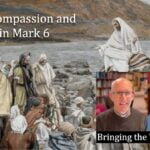
Jesus now returns to his ‘home’, which Luke 4.16 explains was Nazareth. He teaches in the synagogue, as would be customary for any visiting notable with something interesting to say. As elsewhere, his teaching makes an impact, not just in what he says, but what accompanies it—this is teaching ‘with authority’ (Mark 1.27), that is, with acts of power which demonstrate what he is saying is true. The kingdom of God really has come upon them.
But the surprise quickly turns to sarcasm. How can the kingdom of God be present through someone ordinary, someone we know, whose family we still have with us? Jesus worked just as we do; the term tekton does not mean a ‘carpenter’, but a general builder. The point is not that the trade was ‘humble’—it might have been the equivalent of our middle class—but that they knew what he had done before, his human circumstances. If a celebrity had come from somewhere else, perhaps he might have been received more favourably. But what the people of Nazareth, at the time a small and unexceptional village, cannot cope with is the idea that God would make himself known through one of their own, someone as apparently ordinary as they were, with mother, brothers and sisters just like them. (Joseph appears to have left the scene by now). ‘He came to his own, but his own did not receive him’ (John 1.11).
In reply, Jesus cites a proverb that was well known in a variety of forms. But the remarkable thing is that their response inhibits what he can do—Jesus’ power is constrained by their lack of belief. In God’s humility, he invites us to be co-workers with him by responding in faith—and where that response is lacking, God is held back from his work.
Reflection
What are the ordinary ways, and the ordinary people, through whom God will speak to you today? How can you keep an eye out for them and be ready to respond in faith?
Mark 6:6b–13
The twelve have been called from their previous work, have spent time with Jesus, enjoying private teaching (4.11), and have witnessed his public ministry of word and power. Now they, too, are to exercise that authoritative ministry; Jewish legal practice counted someone sent as a representative as if he was the one doing the sending, so the ministry continues to be that of Jesus. They go ‘two by two’ not just for mutual support, but to be true witnesses to what they have seen and heard (Deut 17.6).
In commissioning the Twelve, Jesus prohibits them from making any provision for their own welfare. They must take no food or money, and will need to depend on those they are ministering to for overnight hospitality—a second tunic would have allowed them to sleep outdoors and not be so dependent. The logic appears to be that ‘those who proclaim the gospel should get their living by the gospel’ (1 Cor 9.14); as the disciples share good news with their hosts, the hosts in return share their material provision with the disciples. And the disciples should accept whatever they are offered (verse 10), and not shop around for the best offers. What matters is the spontaneous generosity of the offer, not the quality of the provision.
The Twelve are at this stage only sent to the ‘lost sheep of the house of Israel’ (see Matt 10.6). Yet if anyone does not accept their message, they are to be counted as Gentiles. Whenever Jews went to another country, as they returned and crossed back into the promised land, they were to shake the dust of the Gentile country from their feet, lest it pollute the land. The boundary around God’s people is now being redrawn according to their response to Jesus and to those he sends.
Reflection
Why does being vulnerable allow us to share our faith more easily? Where are the places where you are vulnerable and dependent on others?
Mark 6:14–29
At first sight, it seems odd for Mark to have included this long account of John the Baptist’s death here—Matthew and Luke are again much shorter. But it tells us some important things about both John and Jesus.
The ‘Herod’ in this story is Herod Antipas, one of the three sons of Herod the Great who slaughtered the ‘innocents’. He has heard of Jesus, not just from popular acclaim, but from his own servants; Luke 8.3 tells us that his household steward’s wife was a follower of Jesus, and Matt 14.2 tells us that he talked to his servants about him. John had preached about the kingdom of God, and called for repentance in the light of it, but he had not performed the miracles (‘signs’, John 10.41) which were so characteristic of Jesus’ ministry. Herod expresses the common understanding of bodily resurrection from the dead as the hope of the righteous—a resurrected John would be recognisable, but now have supernatural powers.
John’s ministry and imprisonment were clearly significant for his cousin Jesus. Mark has already told us that Jesus’ public ministry began ‘after John’s handing over’, that is, imprisonment (Mark 1.14), and that even in the early stages of this ministry, he has provoked the Pharisees (seeking a religious reformation) and Herodians (seeking political power) to plot against him. He threatens both religious and political vested interests enough to drive these natural enemies into an alliance against him. As John’s imprisonment has anticipated opposition to Jesus, so John’s death anticipates what Jesus will go through—unjust confinement, a failure of justice, and summary execution. As the Twelve return from their mission, Jesus is confronted with the paradox of his ministry: triumph and blessing for others, but at the ultimate cost to himself. No wonder he sought solitude (6.31).
Reflection
Where do you see this paradox of the cost and yet the triumph of discipleship in your own life? How well do you hold these two things together?
These studies were written for Scripture Union’s Bible-reading notes Encounter with God. You can order them online from the Scripture Union website. Are you encouraging regular Bible reading in your congregation?
Follow me on Twitter @psephizo. Like my page on Facebook.
Much of my work is done on a freelance basis. If you have valued this post, would you consider donating £1.20 a month to support the production of this blog?
 Buy me a Coffee

















I preached on part of this yesterday morning. What most struck me – and was the dominant theme for the sermon – was the fact that we can oh-so-easily allow the details of food, accommodation and an exit strategy to become an interesting, but academic, diversion whilst missing the contextually uncomfortable challenge. It’s ‘safer’ and within our comfort zone!
In the previous 5 chapters Jesus has been speaking to people about the government of God and calling them to respond. He has been delivering people from the harassment of evil spirits. He has been healing their illnesses and infirmities. And now he sends the Twelve off to do the same things, and they do so.
The commission to “go and make disciples of all nations …teaching them to obey everything I have commanded you” covers so much – the whole length, breadth and depth of discipleship. But therefore it certainly does include the business of speaking the message, bringing healing, and liberating from evil spirits.
And yet I wonder… will our children see us doing these same things that Jesus did? Or will we limit ourselves to simply discussing the nuances while neglecting the dynamic life of the Kingdom of God?
Hi Ian,
In terms of your reflection on Mark 6:1 – 6, I’m reminded of God’s call for Samuel to anoint Saul’s successor.
It’s as easy for us as it was for Samuel to be deceived by outward appearances. Stature (whether physical or professional), personal charisma, prodigious intellect, family heritage and eloquence are often interpreted as the unmistakeable signs of spiritual leadership potential.
The Church of England has never quite known what to do with people, who, apart from their maturing spiritual insight, zeal to grow in grace and serve God, are otherwise considered unexceptional.
That’s why people like me eventually leave. After 6 years of being passed over by my Anglican vicar, it took just a year and a half to be asked to spearhead the evangelism of a nearby Pentecostal church.