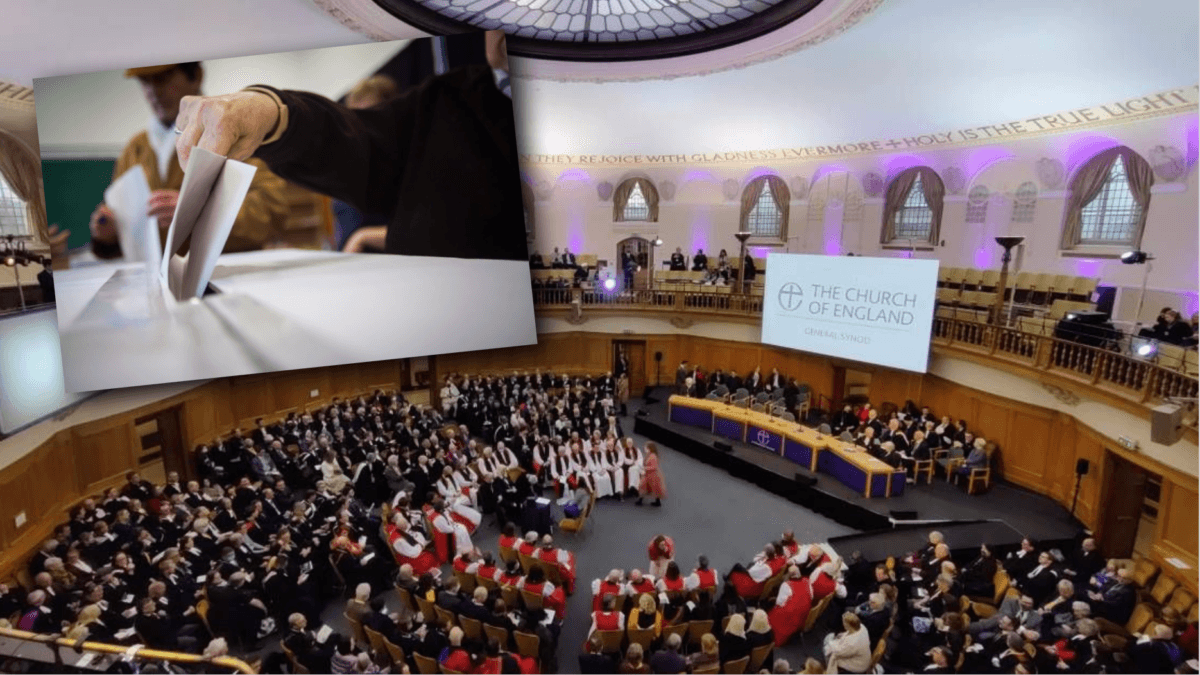
Andrew Goddard writes: The election process for the new General Synod of the Church of England is now well underway with the voting period having opened just over a week ago on Monday 21st September and closing on Monday 12th (postal) or Tuesday 13th October (online). Results will be declared over the rest of that week so that all are declared by Monday 19th. The Church of England website has further details.
The particular features of General Synod elections
Just as elections to the House of Commons are in one sense multiple individual elections in 650 constituencies so elections to General Synod are really multiple individual elections. There are, however, significant differences compared with parliamentary elections.
- Each of the 42 dioceses has 2 distinct elections running (one involving clergy, one involving laity) as does the Channel Islands.
- There are other constituencies and their electorate may be
- in the distinct provinces of York and Canterbury (as with suffragan bishops for 9 seats in the House of Bishops and the election of 5 cathedral deans totalling across both provinces and 3 forces chaplains in Canterbury) or
- nationally across both provinces (as with 4 representing universities and theological education institutions (TEIs) where only for House of Clergy, 3 lay members of the armed forces, and 2 clergy and 2 lay members from religious communities)
- With the exception of the diocese of Sodor and Man all these elect more than one representative with all other dioceses having at least 3 clergy and 3 lay people being elected. Some have many more with largest being 12 clergy and 13 laity in London. The complex process for determining the number of seats is set out in GS 2431 along with figures for each constituency’s number which also appear here in a table which contains other statistical data and can be searched and filtered by various features and links to a table giving all the addresses for each constituency.
- Each diocese also regulates its own election processes and so there is considerable variety.
- Some dioceses will have hustings (in person or on Zoom) where the electorate can ask questions of the candidates, many no longer hold these.
- Some dioceses ask all candidates to submit written answers to a set of questions, most do not.
- Most dioceses permit, some strongly encourage, candidates to use a video to introduce themselves, at least one diocese prohibits this.
- The election is by the Single Transferable Vote. As its name shows this means each voter has a single vote (even though multiple candidates will be elected) which can be transferred to a new candidate when the preferred candidate no longer needs it. It is transferred at its full current value if the preferred candidate has been eliminated and at a reduced value if it has already gone towards electing a candidate. Voters therefore should rank candidates in order of preference to maximise their vote’s power (but to do that they need to know quite a lot about the candidates).
- There is no party system. In a general election each candidate has, although only since 1969, (it was actually explicitly forbidden by law in 1948) been able to describe themselves in up to six words on a ballot paper. For many people this is usually their primary guide faced with a ballot paper and of course in most UK elections they will simply have to express a first preference with “X” not number perhaps dozens of candidates in order of preference. For Synod elections, increasingly there are many elements of a party system developing. In groupings such as The Alliance, Together for the Church of England/Inclusive Church and Save the Parish (and in various sub-groups within each of the first two of these) people are acting collectively in an organised manner to varying degrees in relation these elections in unprecedented ways. However, there is no signalling of these groups and when people come to vote they simply vote for a name. This changing pattern in church politics may well need significant review and perhaps reform in future and could impact the voting dynamics in the new Synod even more than it did in the outgoing Synod.
The lack of any single, national co-ordinated election process also means that it is very difficult to get an overview of the whole. Peter Owen has for years provided excellent resources in relation to General Synod and has produced a helpful guide to the multiple sources (with various layouts and level of detail about the candidates) relating to the various current elections. He has already begun to map out the makeup of the new Synod as he has done in the past (here for the Synod just finished and with earlier similar lists for 2000, 2005, 2010 and 2015). There is, however, nowhere I have found that collates these to give a sense of the national picture and so I have attempted to create this and offer some analysis of it in what follows. The process is explained in an appendix at the end of the article. There will inevitably be errors of judgment and of fact and I am happy to be informed of these and to receive any other comments by email (go*******@***il.com).
General Overview
There are just over 1000 candidates standing across the multiple elections to all 3 Houses. The candidate dataset which can be accessed and searched and filtered here only has 995 candidates (574 male and 421 female) in it as it has not been possible to find information about the elections for the 6 elected seats for the armed forces or the 3 seats for the Channel Islands.
- In relation to numbers of candidates (and their sex/gender) the figures for each House are
- Bishops – 17 (12 male and 5 female)
- Clergy – 412 (262 male and 150 female)
- Laity – 566 (300 male and 266 female)
- This overall male/female imbalance especially among clergy is replicated in most constituencies. Some are particularly stark and very low:
- no women stood among northern deans,
- 5 dioceses (including the unopposed candidate in Sodor and Man) where only 1 clergywoman is standing,
- no lay women standing in Lincoln
- Of these 995 it has not been possible to find election addresses for 13 of the candidates in the data (the 4 elected unopposed from religious communities, 1 elected unopposed dean and 8 (2 clergy and 6 lay) diocesan candidate) so the data relating to addresses only covers 982 candidates. These addresses are collated (with individual bookmarks searchable by name and diocese) in this (exceedingly large) PDF as well as being available for each candidate in the dataset above.
- The previous Synodical experience of the candidates is
- 252 were serving at the end of the last quinquennium in July
- 44 were not on at the end of this Synod but have served previously either (a) before 2021 and/or (b) by being elected in 2021 but not still being a member in July 2026.
- 7 have served in the previous Synod as a (non-voting) co-opted member
- 692 have never served on General Synod (those not submitting an address and not on the current Synod are assumed never to have stood)
- 10 candidates have already been elected as 5 elections (for deans in both northern and southern provinces, clergy in Sodor and Man, and for religious communities in both Houses) were uncontested because the number of candidates nominated equalled the number of seats.
- Many of the other constituencies are being heavily contested but with great variety between dioceses and also between houses across and within dioceses. Given the number of seats varies across constituencies the number of candidates standing is not a guide as to how contested the seat is (unsurprisingly the largest ballot papers are in London with 35 clergy and 38 lay candidates). The best measure for the level of competition is to divide the number of candidates by the number of seats. Here there proves to be quite a range in relation to both clergy and laity with the following as the highest and lowest figures:
| House | Most Candidates per Seat | Lowest Candidates per Seat |
| Bishops | Northern (2.0) | Southern (1.8) |
| Clergy | Europe (4.3) | Canterbury (1.3) |
| Laity | Winchester (4.5) | Lincoln (1.5) |
What are the candidates’ concerns and beliefs?
Address format and length
For individual voters (particularly in some larger dioceses) there is enough of a challenge reading all the material simply for the candidates they are being asked to rank in order of preference. To get a bigger picture nationally is even more challenging.
The addresses themselves are required to be 1 or 2 pages in length but are otherwise very varied in format (some just plain text, most including a photo of the candidate and some being very fully designed) and length. In total there are over 750,000 words with individual addresses ranging in length from 35 words to 2,077 words. The mean is 786.6 and the median in 798.5. Almost a third (305, 31%) fall into the 800-999 range and over half (566, 58%) into the 600-999 range. Just under a fifth (184, 19%) are 1000 words or more and 6 exceed 1500 words.
Selecting key words and phrases
To try and get an overview, once all the addresses were collected they were made into text files which enabled them to be more easily searched and analysed on the basis of the occurrence of particular words and phrases (see the appendix for more details as to how this was done).
In the end, 367 words and phrases were identified, grouped into 10 areas (3 words were included in 2 groups), and used to analyse the addresses. The terms and associated groups with links to sentences using them are here.
The 10 areas with the number of words and phrases used in each and how many of the 982 addresses used words in this category were:
- Theological tradition & network affiliation (41 terms used in 669 addresses)
- Sexuality, marriage and LLF/PLF (31 terms used by 568)
- Safeguarding (25 terms used by 523)
- Evangelism, Mission and Church Growth (33 used by 855)
- Doctrine & Formularies (22 used by 642)
- Society, Justice & Inclusion (75 used by 727)
- Clergy Concerns (36 used by 619)
- Church Structures & Policy (53 used by 896)
- Other Churches and Other Faiths (33 used by 335)
- Youth & Next Generation (21 used by 515)
Sentences using these words and phrases were then identified and extracted from each address. The sentence results are able to be explored here with multiple filters that can be applied.
The top twenty words used among the 367 chosen words in terms of the number of candidates including them in their address (out of 982 addresses) were
- mission (688 candidates and 1666 sentences)
- safeguarding (497 candidates and 1073 sentences)
- gospel (389 candidates and 654 sentences)
- sexuality (324 candidates and 408 sentences)
- prayer (311 candidates and 465 sentences)
- young people (309 candidates and 586 sentences)
- pcc (301 candidates and 381 sentences)
- youth (265 candidates and 465 sentences)
- ordination (238 candidates and 313 sentences)
- inclusive (235 candidates and 379 sentences)
- marriage (232 candidates and 294 sentences)
- justice (230 candidates and 420 sentences)
- tradition (215 candidates and 278 sentences)
- disability (214 candidates and 268 sentences)
- dioceses (212 candidates and 311 sentences)
- mental health (205 candidates and 249 sentences)
- catholic (200 candidates and 284 sentences)
- evangelical (200 candidates and 240 sentences)
- vocations (191 candidates and 289 sentences)
- scripture (189 candidates and 289 sentences)
There are clearly a range of limitations in such basic analysis on the basis of use of particular words but organised in this way it is possible to get more of a flavour of the views of different candidates standing and their concerns.
An initial attempt to see how well AI could go beyond this by, for example, identifying clearly people’s “theological tradition and network affiliation” from their statements showed just how difficult the task can be and in reality probably is for many of the electors. This is compounded by the fact that many addresses give little or nothing concrete and explicit and rely on wider knowledge.
Conclusion
From among these 1000 candidates will shortly emerge the body of people who will together share in the governance of the Church of England over the next five years. I hope to draw on the data presented here to offer some reflections on the outcome when it becomes clear just over three weeks from now. In the meantime, it is vital that all those who have a vote cast it after careful and prayerful consideration of the candidates standing in their election and that all of us who care for the future of the Church of England pray for a good election process and all those who have offered themselves for election.
Appendix: Overview summary of data collection process
Each of the candidate lists online on diocesan or CofE pages were individually downloaded using a Python scraping script written for the page’s particular layout along with their addresses where they exist. As noted, it has not been possible to get information about elections relating to the armed forces or the Channel Islands but all other elections have been included.
These documents (most PDF but some in other formats) were then made into text files which were searchable (a number were identified as badly corrupted in this process and had to be cleaned up by Python/AI, doubtless there remain some problems with others impacting the data). This text is also available to read and search in the database. A Python script then produced a frequency chart for all words and phrases (of 2 words to 5 words) across the addresses. Starting with a seed list of likely key terms to appear in addresses (gradually grouped into 10 broad topic categories) this was refined in conversation with AI. AI was used to check frequency data to see how helpful the word/phrase was to include, suggest additional terms to consider, comment on further suggestions I had, signal the risk of false positives etc. Single sentences were then extracted from the 982 texts on the basis of the presence in them of the chosen words or phrases (370 grouped into 10 broad categories). There are obvious challenges with this method (e.g. as will be clear there are some false positives, some words were not chosen because they risked generating results with too much noise compared to signal, some discussions of a topic may be missed simply because they do not use one of the listed words or phrases). Nevertheless, the results give some sense of the content of each address in relation to key issues and of the different concerns of candidates. The method also has the advantage of being based entirely on their own words rather than being a human or AI evaluation.
In relation to candidates’ affiliation to networks or self-identification within CofE parties and traditions this not only worked with the extracted sentences for that category but with a read-through of each address ascertaining evidence for the particular position of the candidate. AI provided a categorisation, the exact verbal evidence from the address for that categorisation, and the level of confidence it had in that categorisation for each candidate with an address. A similar exercise was also undertaken to identify each candidate’s history in relation to membership of Synod and their sex/gender.
Additional data sources used were:
- GS 2431 for information on number of seats per diocese, ER totals and number of licensed clergy
- The list of candidates supported by Together/Inclusive Church (minus one candidate listed who does not appear to have stood).

Revd Dr Andrew Goddard is Assistant Minister, St James the Less, Pimlico, (where his wife Lis Goddard is vicar) Tutor in Christian Ethics, Westminster Theological Centre (WTC) and Tutor in Ethics at Ridley Hall, Cambridge. He is a member of the Church of England Evangelical Council (CEEC).
 Buy me a Coffee





Thank you Andrew for a helpful overview. I may have missed it but is there any provision for retired clergy?
It would be fascinating to know as to how many candidates and how many references there are to God, His Glory or Sovereignty. Of Christ, His walk and having His mind.Of the Spirit and His mighty workings, the power that works within his saints.
“The people who know their God shall be strong and carry out great exploits”. (Daniel 11:32)
I am currently exploring Mordecai the Overcomer whose ministry led through conflict to Light filling all the houses of of the chosen people, And the book of Esther predicated upon the Books of Samuel and Hannah’s Overcoming hymn of exultation
Samuel has a motif of the rise and catastrophic fall of many folks;
Much the same as Simeon’s prophetic depiction of Jesus
He is set for the rise and fall of many in Israel. Luke 2:34.
“• The Division: Jesus acts as a turning point where no one stays neutral. People either accept Him and rise or reject Him and fall.
• The Falling: Proud, self-righteous, or corrupt religious leaders stumble over Jesus because He challenges their power and exposes their hidden sins. AI.
O n the other hand given the circumstances you may be encouraged to be bold, to accept the consequences as Mordecai encouraged Esther.
“And who knows but that you have come to your royal position for such a time as this?” EST. 4 : 14.
It may require some purification and fasting preparation but you may well become an overcomer.
And as one prophet remarked “If so be the Lord may leave a blessing behind Him. Joel 2:14.
Shalom.
Hi Alan
“It would be fascinating to know ”
They are all online and accessible…. the link is in the article. Or look on Chester Diocesan website for a smaller snapshot.
https://596a5c06-ad24-45ff-8e6b-4b2ec57ddeae.usrfiles.com/ugd/f8dcd6_7fcfd1ff78ac4daabd2b918c47ed07d8.pdf
By way of en – couragement to the candidates,
Consider ; Mordecai: The Profile Of An Overcomer
By Helen Calder @ .enlivenpublishing.com/2011/10/31/profile-of-an-overcomer/
For a scholarly glance at the book of Esther ;
Raised up from the Dust: An Exploration of Hannah’s Reversal Motif in the Book of Esther as Evidence of Divine Sovereignty.
@ thegospelcoalition.org/themelios/article/raised-up-from-the-dust/ Shalom.
Thankyou Andrew, a fascinating insight. I remain concerned that the sexuality issue will crowd out other concerns when it comes to who gets elected, and pray that we will still have a Synod that can capably deal with all the other challenges the CofE faces.
I may have missed it, but for context how many seats are there in the houses of clergy/laity that the 995 candidates are standing for? And how many co-options are there on top of that?
The largely Conservative Evangelical Alliance vote and Liberal Catholic Together/Inclusive Church elected candidates though will largely cancel each other out. Will also be interesting to see if Save the Parish elect more candidates
So no-one in an *executive* body has even risen to the most basic required level of being able to think for themselves?
Not only are they (you say) all captive to groupthink, but (worse) we should take it as read that they and everyone else cannot rise above groupthink. There Is No Alternative.
(- according to what you say, anyway).
No, they just subscribe to the manifesto of the block they have aligned to when standing for Synod. Much like party candidates sign up to their party’s manifesto when standing for election to the House of Commons at a general election
I thought so! You are continuing to think that Christianity has nothing better to offer than, of all things, politics! And secondly, you are assuming that politics leads and Christianity merely follows.
There are different interpretations of the Bible on issues from female ordination to same sex relationships to divorce between denominations and even within denominations like the C of E. Those divisions can only be resolved by those elected to Synod
Synod isn’t an executive body. It’s a legislative one.
The people in Save the Parish or CEEC aren’t able to think for themselves? Where did you get that from? They are communicating their stance to the electors mostly on specific issues – e.g. being a supporter of Inclusive Church says nothing about how you might vote on clergy pensions, and being in Save the Parish says nothing about how you might vote on sexuality questions.
The group closest to acting like a party is probably EGGS (the evangelical group) who produce briefing papers, recommend slates of candidates, have a constitution and internal elections, and coordinates voting of its members. Even they, however, deny they actually run a whipping operation. Perhaps Ian can explain more, including how being in a group like EGGS does not mean he has failed to reach “the most basic required level of being able to think for themselves”.
Yes it is more a manifesto for these groups on the particular issues they are campaigning on, especially stance on PLF and same sex marriage or more funding for Parishes
By my count:
For the bishops – the 42 diocesan bishops (when we have them) are all ex officio on Synod. That leaves 7 to be elected from amongst the suffragan bishops.
For the clergy – the 4 principal Anglican chaplains (Army, Navy, Air Force, and Prisons) are ex officio. Another 194 are elected (182 from dioceses, 7 deans, 4 colleges and universities, and 2 religious communities).
For the laity 250 are elected, and then there’s a number of ex officio: the 3 Church Estate Commissioners, the Vicars-General for Canterbury and York, the Chairman of the Central Board of Finance, the Chairman of the Pensions Board, the Dean of the Arches (judge of the ecclesiastical court), and any members of the Archbishops Council who are CofE communicants.
Ian Hobbs
September 30, 2026 at 11:03 am
Hi Ian
Thanks for the info, Being a lazy sort I perhaps hoped that
Andrew might be able to extrapolate them,
My aim was to encourage prospective candidates willing to enter
The “colosseum “ of battles and games. The survival of the fittest.
As Nehemiah discovered when you actually start to Build the House;Temporal and Malign spirits will arise to halt the work.
God desires a “house” in which He can manifest His Glory just as His glory filled the Tabernacle and Solomon’s Temple and Pentecost Church,
Haggai and his fellows encouraged the Church folks to Build, build !
With God’s promise “I AM with you” [ “always” says Christ] and “not by might nor by power but by My Spirit {Power”}
Some of those ancient builders lamented that it was not as grand as the former Temple, but were told “not to despise the day of small things “
Because” the glory of this house would be greater”.
It occurred to me that some folks want another Pentecost to take the church back 2000 years or to the founding fathers of their particular church; but the same seems to apply, that this corporate and now individual temple will have a greater glory than those, as it will have passed through the fires, have been tried and tested and been found unto praise and honour and glory.
Others are pinning their hopes on more conservatives being appointed in all her houses ! more useful builders?
God does not Overcome anything with More of anything, always with fewer smaller remnants and Overcomers.
The Whole-bible synthesis demonstrates this.
Shalom
I’m sure some things would be revealed by analysis…. it’s a vast set of data though….
but from knowledge of some candidates it wouldn’t necessarily reveal the complete picture of a person’s theological or spirituality .