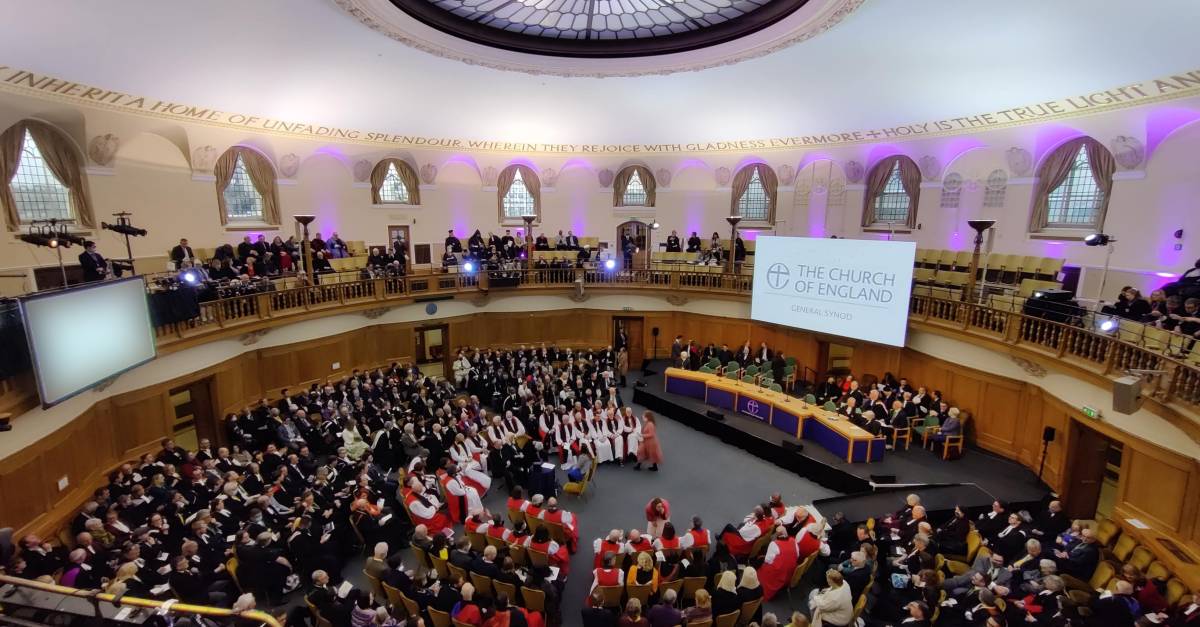
Elections are now taking place for the next quinquennium (five year term) for the General Synod in the Church of England. This is my ‘address’ (manifesto) as I stand for election.
If you are clergy in my diocese (Southwell and Nottingham) I would love you to give me a high preference in the STV voting system. If you are not, do please comment on what you think Synod needs, and whether I am offering it!
Candidate for General Synod Revd Dr Ian Paul
I would like to offer myself to serve the Diocese of Southwell and Nottingham—and the wider Church—in standing for election to General Synod. I believe that, over the last 35 years, I have been fortunate enough to gain a wide range of experience in parochial ministry, theological education, and diocesan and national roles which could be of service to the Church. I understand how the church works, and I am not afraid to ask questions.
We are still in a very challenging moment as a Church. On the one hand, there are some real signs of growth, and God doing something new, on the ground, and we see that in our diocese and in other churches in the area. Yet, at a national level, we appear to be out of step with that, and are getting drawn into more needless controversy. As someone once said ‘The local church—when it stewards the message of Christ—is the hope for the world.’ This is what Synod needs to be focussing on, supporting and enabling—learning from what is fruitful rather than making controversial proclamations ‘from on high’.
I would be grateful for your support in the election—and if I am not your first choice candidate I would ask you to consider giving me your 2nd or 3rd vote.
Who Am I?
- Originally from London, I studied Maths at Oxford and Southampton and worked in business before training for ordination in Nottingham.
- I completed a PhD on metaphor in the Book of Revelation, and was then in church ministry for 10 years in Dorset before returning to Nottingham to teach at St John’s theological college for nearly 10 years.
- Since 2013 I have worked as a freelance theologian and Managing Editor of Grove Books Ltd. I am Associate Minister at St Nic’s, Nottingham, and engage in ministry, teaching and writing in a wide range of contexts, including supporting churches in vacancy.
- I am married to Maggie, a GP in Ilkeston, and we have three grown-up children and a dog called Barney. We share our house in Chilwell with Maggie’s mum as well as offering hospitality to others.
What are the Issues facing Synod?
- Clergy wellbeing continues to be the most important challenge, and I have been frustrated that most in national leadership still don’t make this a priority. On Archbishops’ Council, I repeatedly challenged the decisions being made about stipends and pensions, and in the end decided the only way to change this was through a Private Members’ Motion in Synod. This was unanimously supported, and has led to an increase in the national stipend of 10% and a restoration of 40% of the value of clergy pensions—which I hope you are aware of! But there is more to be done, and if re-elected I will be contributing to a fuller review of the pension package, as well as other issues connected with clergy wellbeing. We cannot be a healthy church without flourishing, confident and well-supported local clergy and congregations.
- Church Growth continues to generate controversy! Some question whether we should be thinking about this at all—but numbers are people, and surely we want to see more people encounter the love of God in Christ for themselves? I have some sympathy with the ‘Save the Parish’ concerns, and I am delighted that in this diocese we are committed to maintaining our stipendiary numbers. Much of the debate has taken the form of false dichotomies; whatever their form, churches are always ‘local’ in some sense, and parishes need to engage in new initiatives if they are to thrive, not just survive. We need a both/and approach: we need to treasure our inheritance; but we also need to listen carefully to the experiences of those, within the C of E and elsewhere, who are seeing healthy growth. Synod can encourage and give permission, though leadership most often needs to come from dioceses and parishes.
- Theological Training continues to be a vital but neglected issue in national debate. Another review is being undertaken; it needs to avoid the serious mistakes of past reviews, and ensure that depth theological training is available for all. In a culture and a church which has less and less grasp of Scripture and Christian theology, we need seriously to invest in training our future leaders.
- Structural change is still urgently needed. It makes no sense to be a church where congregations and clergy numbers have declined—but we still have the same number of senior leaders. And we are still in need of much greater transparency in senior leadership and the rebuilding of trust.
- Safeguarding now rightly has a high profile in all local churches. I am concerned that some practice has become overly bureaucratic and burdensome, and that historic failures push us into overcompensation. It is vital that clergy are protected from vexatious complaints which undermine genuine best practice in safeguarding.
- Participation and responsibility. The debate about race and ethnicity in the Church is vital—but it needs to be rooted in a theological vision of the multicultural people of God that we find in scripture. There are some great examples of multicultural church in this diocese which we could learn from—including at St Nics, where we use four languages in our services. I regret that this debate has somewhat eclipsed the concern for full participation of those with disabilities; I was delighted in my last meeting of AC to support a major initiative in this area. And the biggest group currently excluded from the C of E is the working class. Our approach to the environment also needs to be rooted in a proper theological understanding of creation before anything else.
- Marriage and Sexuality. The House of Bishops made clear that there is going to be no change in the doctrine of marriage ‘according to the teaching of our Lord’ as part of drawing line under the damaging and divisive LLF process. We now need to work within that as we continue to listen to each other. We need to ensure we are a church which is welcoming to all—and shares with all the good news of God’s design for human flourishing that we find in Scripture.
How could I help?
1. I have previous experience on Synod from 2000 to 2005 (with Salisbury Diocese) and from 2015 to 2026. As a member of the Archbishops’ Council and the Audit Committee for ten years I have been very active in engaging with and contributing to debates at every level. I have also sought to consult and communicate as widely as possible, in local churches, in deaneries and through my blog.
2. I bring significant experience of ministry. During my 10 years in Dorset, 8 were on the staff of St Mary’s, Longfleet, where we saw significant numerical growth. This doesn’t mean I have all the answers, but does mean I have learnt some important insights into mission and ministry in our current cultural context. I continued to be actively involved in local church ministry during my time in theological education, and as Associate Minister at St Nic’s I also support other churches, especially those in vacancy. I seek to serve the local church through my blog, including offering commentary on Sunday lectionary readings, and through the ministry of Grove Books.
3. I also bring significant experience of the ‘real world’ to ministry and Synod processes. I have been a Personnel Manager and worked in production planning and market forecasting, and have managed a small publishing company (Grove Books) for a number of years.
4. One of my central concerns is to engage issues of ministry with issues of theology. The temptation in our current situation is either to focus on the pragmatic or retreat into the academic. But renewal of the Church and mission must involve renewal both of our encounter with God—our spirituality—and our thinking about and understanding of God—our theology. Through my speaking, writing, and my blog www.psephizo.com my aim is to make use of the best of theology and scholarship to serve, equip and renew approaches to ministry.
Want to know more?
You can find out more about me at my blog http://www.psephizo.com/about/ Please also feel free to be in touch by email if you have any further questions.
You can see this as a PDF here: Ian Paul- address for Synod 2026
 Buy me a Coffee








brilliant – I’d vote for you!
BTW we should be voting for ‘overseers’ too!
Thanks. That is an interesting idea, but only if the voting college was fair.
We vote for our MPs at the lowest level: adults. We mostly don’t know the candidates just the issues of their parties from their statements (believed or not).
Just thinking about GS elections, the electorate (750) are the Deanery Synod reps and most probably know none of the candidates, so have to rely of their statements (‘discrete’ to various degrees).
There is no reason why they should not be the college and prospective bishops submit statements to be voted upon.
BTW in our diocese the bigger the ER the less votes per ER member. This is due to a formula that seeks to get enough reps as ER numbers differentials between largest and smallest churches increase (small get smaller, larger get larger).
The result is that the biggest churches (usually evangelical) are hugely under represented, and so less votes to elect ‘orthodox’ laity (or bishops).
Ian, how would you fix this point if elected?
Matthew 25:23
May you live long and prosper!
Thank you!
If I was in your patch – I’d vote for you Ian! Great pitch.
Thanks!!
Don’t know if this will be seen as a positive or negative. You have been a guest on Premier Radio programmes taking part in theological and scripturalatterd and questions.
You have regularly been a guest on other radio stations when ‘hot potato’ topics have garnered outside, public interest and have spoken clearly with authoritative weight.
You are a good public communicator, drawing out the relevant and making the complex simply understandable, with the necessary wide-ranging background knowledge. A good and faithful asset to the Church of England. Yet, at once speaking without fear nor favour, sprinkled with an understanding of the human condition.
And I see this as a confirmed member of CoE, but now as an outsider and view the CoE as something of a ‘curates egg’.
Agreed – Ian is an excellent communicator.
I have no vote, but will pray God’s will and blessings
Feels like London has more candidates than ever: 38 laity, and 36 clergy (by my quick count) standing to fill 11 seats each.
Some interesting candidates amongst them: Rev Nicky Gumbel, now a curate again, has thrown his hat into the ring, with a heavy emphasis on training ordinands; and Debbie Buggs is standing again, perhaps surprising given she’s from St Helen’s Bishopsgate where the rector argues no-one should have anything to do with the church structures (and in particular the House of Bishops).
I am not Sure that that is an increase, actually.
I tried to check, but we don’t keep the candidates list and election addresses from the last election so it’s tricky to know definitively. I also don’t remember the Anglo-Catholics being quite so prominent (or the BCP churches for that matter). Sounds like there’s a worry about what’s planned for confessionals in this Synod. But maybe that says more about my ability to remember 5 years back…
Marcus Walker has managed to get quite a good slate of mainly traditional Anglo Catholics to stand as Save the Parish candidates in both the House of Clergy and House of Laity.
I think there’s more to it than that – there’s a concern that the seal of the confessional is under threat.
A fine statement, Ian, and I will be praying for your success.
I echo your statement about safeguarding: that in places it is becoming burdensome and veering into overcompensation. Some of the criticisms made by the Makin report were excessive.
On the other hand, the troubles run through the Church of England, with the Bishop of Lincoln resigning and another bishop under financial investigation. (Why do these things take so long?)
Quite a lot of sees are vacant right now, and the Archbishop of Canterbury faces the mire of her ill-starred attempt to court a Pakistani imam. A very difficult time for the C of E.
Instead of courting imams, maybe we should be praying for their conversion. Do the prayers of the people ever remember the essential spiritual need of our Muslim brothers and sisters? Or do we settle for a comfortable, risk-free pretension of ecumenical equality between Christianity and Islam (and Hinduism and Buddhism and…)? Do we believe in our own Gospel?
There are indeed converts from Islam to Chritianity in Britain. But how do they distribute by denomination – and why?
Yes but the C of E as established church has to work with Britain’s Muslim community not try and convert it. Converts are welcome if they wish in the UK but the C of E won’t try and proactively convert
Can’t even pray for their souls, eh? Wouldn’t want to explain that to St. Peter
I’m joining the line of people who would love to be able to vote for you but, sadly, live in the wrong place!
On balance I would vote for Ian to get one of my preferences as well (were I in the clergy in his diocese). Although we disagree vehemently on some things, Ian should be an important voice to hear from, and in any case I suspect ordinand training is going to rocket up the agenda in this Synod.
Safeguarding-
It is wonderful that the infrastructure which is now in place, is in place.
The line between charging the innocent and letting off the guilty is fiendishly difficult at the best of times, the more so when it comes to intrinsically secretive activity (or what is secretive if it exists at all).
Those (i.e., most of us) who get outraged at the innocent getting charged or suspended are, ironically, the same as those who get outraged at the guilty having been allowed to continue unchecked.
But it is only a sexual revolution culture that makes family structures looser, families smaller on average, community interaction more dissipated, norms of behaviour laxer, in the first place. With a SR culture one is always (a) fighting a losing battle, (b) showing neglect, to the level of abuse, to the populace as they are growing up.
Hence the spike of crimes in and from the 1970s, when live-in boyfriends and the like, and looser, more anonymous, more minimal family structures, began to proliferate.
The trend should therefore be to reject the SR culture utterly, and explicitly, so that people can see the big picture and operate in the big story. My only point is that things need to be put in those terms more often, so as to treat the cause and not the symptom.
As things are, the C of E succumbs to, and even gives preferential treatment to, toxic secular presuppositions – e.g., that the saintly grandmother who runs the church office, and whose norms were formed before 1963, must fill in forms because they are potentially a safeguarding danger. Yuk!
What I was alluding to was the specific criticism in the Makin report of Canon Andrew Cornes.
In 1982, when Cornes was a curate at All Souls, one of John Smyth’s victims told Cornes he had been beaten by Smyth.
Cornes took no action because, as the report concedes, he believed in good faith that the abuse had stopped and that senior people had been informed. Furthermore, there were no safeguarding rules in those days.
Nevertheless, the report goes out of its way to name and censure Cornes for this. In other words, for not being wiser than his elders – and failing to act according to rules which didn’t exist. At the time of this criticism, Cornes was on the CNC, which he stood down from.
Someone on another site has called the criticism of Cornes as going for some low-hanging fruit because he was a young man (but not the rector) in a prominent church, while bishops like Stephen Croft and John Sentamu were accused of safeguarding failures over which they *were responsible and obstructing any resolution.
All parents and all boys could at any time have gone to the police if they so wished.
There were loads of them. But not one did.
If they had, they would not have been consulting their peers, very many of whom would obviously prefer anonymity, and to be able to live their lives (in this case, the entirety of their professional lives is what would otherwise have been hijacked; in the event, none of it was; but psychologically it already was, police or no police).
It is a given that people should be allowed privacy if that is what they wish. The monitoring of JS could be done simultaneously while still enabling this vital privacy. Or so they hoped….
The last time this came up at Synod, the message was that 50% have always seen things this way (and 100% of what I say is accurate) but the less vocal 50%.
AC, a very good Christian, did nothing but pastoral care, and not stirring the pot. But they felt that they had to have some censures to show.
I say ‘boys’ but even I am falling into the sensationalising media trap. ‘Young men.’
The complainant to AC was 18 when Smyth beat him and this disclosure was some time after. He didn’t go to the police as he could have.
Makin was looking for someone to blame in a time when no training and no safeguarding rules existed.
Makin should have ruled otherwise.
Yes, any non-adults were one and the same as the long-term victims by and large. They are relatively few, are a separate category, and deserve far the most sympathy.
This is, of course, utter nonsense. The prolific abuser, John Smyth, was not a product of any sexual revolution but a fighter (along with Mary Whitehouse and Cliff Richard) against increasing permissiveness. I will refrain from cod psychology on that point.
It would be nonsense if that were what was being said. JS was indeed fighting permissiveness which at that time was making frightening inroads at the very heart of government, CCL and media, and emphasising the importance of personal discipline and detailed attention to one’s living. But he also quite separately was already damaged by his schooling and uninvited trauma, and was working that off on people who did not deserve to be involved. A very specific combination in his case. It is a non starter to view him as culturally typical, yet he is constantly being viewed that way.
It’s the fact that people like you aren’t bishops, and probably would run screaming if offered the job, that reveals a problem of the CofE; its top leadership are mostly from the part that has only experienced decline and refuses to accept that growth is actually possible and on the whole should be expected.
So how do we sign you up?!
On the other hand Justin Welby came from the HTB network…
Rather, he ended up at it, up till and including ordination – via the Round Church Cambridge, St Matthew’s Cambridge, and St Michael’s Anglican Church in Paris.
But note that Justin saw little or no growth in his parish when he was in parish ministry. He moved on to diocese posts.
Beautifully phrased!
One of several reasons why I am not a bishop is that God has never told me to consider it.
You’ve never asked me… 😉
If Ian became an Archdeacon or Dean of a Cathedral or head of a Theological College he would certainly move into contention to be a Suffrage Bishop. From there he would then become a contender for Diocesan Bishop. Assuming he is re elected to Synod perhaps he will consider that as his next career move
Your limpid, rational and Theologically sound commentary on contemporary issues is much valued.
Thank you for your kind words.
Well done
I’d vote for you because of your manifesto, history, experience and ability.
But I can’t… wrong diocese…. and only PTO…. no actual influence anywhere…
(PTO can feel like filling a rota hole for but little more. )
I remember having a retired cleric as a member of our deanery synod as their representative, and so able to vote in the elections. By contrast retired BISHOPS have no say in synodical structure…
I am not in favour of eugenics but I might support cloning you so that we can have an “Ian Paul” in every diocese! (Kidding!)
Seriously, all eligible voters need to look at who is standing in their diocese and carefully consider for whom they should vote. Those that largely agree with Ian’s general points should receive their first preference vote! Fortunately in Newcastle Diocese we have at least one candidate who meets the mark!
I’d vote for you if I could but I’m in the wrong diocese and I can only vote for candidates for the House of Laity (which I’ve done). But one thing which is missing from your ‘pitch’, and indeed from all the others I’ve read this past week, is the C of E’s ultimate in virtue signalling; namely, to achieve net zero by 2030 (while the UK government is happy with 2050 for their target). Of course, it is utterly unachievable, but nevertheless along the way numerous poorly resourced congregations (usually the rural ones) will go cold this winter if their boiler, be it gas or oil fired, has failed and can’t be replaced because of the Doctrine of Net Zero. But that’s OK, because that’s how it was in medieval times. Let them bring blankets. Meanwhile, well resourced urban congregations in the same predicament will buy their way out of the problem and will be snug and warm this winter (Rev’d Marcus Walker at St. Bartholomew the Great excepted, unless they’ve fixed their problem). In case you’re wondering, our church gas boilers are fine for the moment, so it’s not a case of me being bitter. Still, someone needs to be brave enough in General Synod to call for another hard look at this troublesome doctrine.
Agreed – this ideological fixation is causing great hardship to hard up churches with old boilers. Im3osing a burden on people ill equipped to bear it is a fundamentally non-Christian thing to do and carries the condemnation of the Lord in Matthew 23.4 .
I think one thing you miss Ian is the burden our ancient grade I & II listed buildings have on clergy and parishes. The CofE is sitting on billions in reserves and local congregations are expected to maintain difficult, money consuming buildings, that local communities would be in uproar if they went into neglect but don’t want to support financially. So much time is taken applying for grants (often unsuccessfully), raising money and completing faculties (with Chancellors who have very specific ideas and regulations) that the actual business of telling people about Jesus becomes lost. If central money was released clergy would also be released to do what we’ve actually been trained to do. I lets not even start on heating them! Our buildings though beautiful are a burden and impact growth.
Part of the role of the C of E is maintaining its grade listed churches. Yes I agree more central funds could go to that but we have raised hundreds of thousands of pounds from community events to repair our church’s roof etc
Our boiler died in 2025 and we went through last winter unable to worship in church. However, we were eventually allowed to buy a new gas boiler this year, so the heat pump rule isn’t rock solid.
Yay! What diocese?
“The Lord answer thee in the day of trouble; the name of the God of Jacob set thee up on high; send thee help from the sanctuary, and strengthen thee out of Zion” (Ps. 20:1-2). Ian.