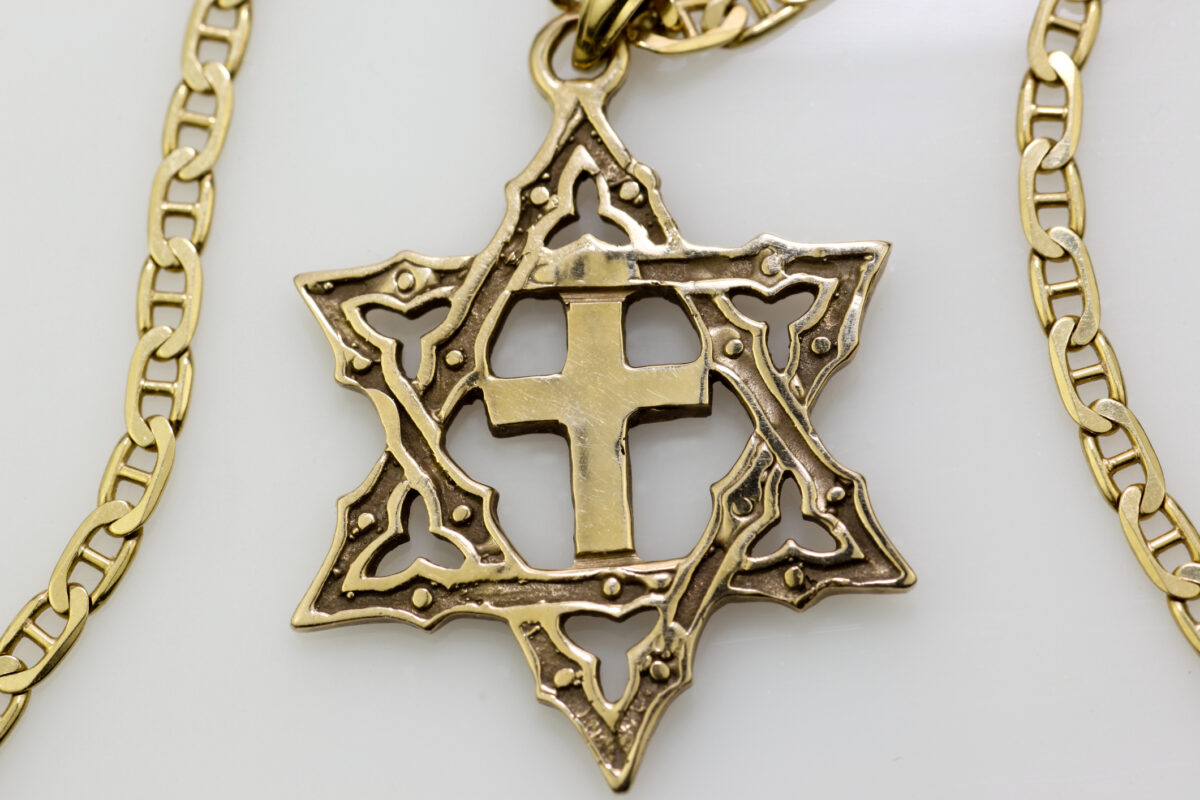
The Church of England’s motion on Kairos Palestine II has dismayed many of Jewish heritage, including Jewish Christians in the UK. If the Church of England wishes to hear Palestinian Christians—which it should—then it must also hear Jewish believers, Messianic Jews, Israeli Christians, Arab Christians and others whose lives reflect the profound complexity of the land we all love and pray for.
Alison Davies writes: Ten days have passed since the General Synod voted to hear the voices of Palestinian Christians by undertaking a careful study of four documents, including Kairos Palestine II (2025). The motion was carried by substantial majorities in all three Houses of Synod.
Since then, news of the decision has travelled rapidly around the world, prompting a wide range of reactions within Christian and Jewish communities, as well as across social media and the wider press. Among many within the Jewish community, the decision has caused genuine concern. At a time when antisemitism has risen dramatically across the world following the atrocities of 7 October 2023, many have questioned why the Church of England has chosen to engage so closely with documents whose historical claims and theological conclusions are widely contested and which advocate excluding certain voices from meaningful dialogue.
Several people have asked me how I personally feel about the Synod’s decision.
Was I shocked? Sadly, not particularly.
The history of the Church contains too many examples of misunderstanding Judaism, overlooking the continuing place of the Jewish people within God’s redemptive purposes, and using language that has contributed—whether intentionally or unintentionally—to Jewish alienation.
Was I disappointed? Very much so.
As someone who has spent many years serving within the Church of England, I find the outcome deeply saddening.
Together with Rodney and Elisheva Mechanic, I have the privilege of co-leading CMJ Asaph, an initiative of CMJ UK (Church’s Ministry Among Jewish People), one of the Church of England’s recognised mission agencies. Asaph exists to encourage and pastor Jewish and Jewish-background disciples of Yeshua (Jesus), helping them to flourish within the wider Body of Christ while remaining faithful to their Jewish identity.
When we established Asaph two years ago, we quickly discovered how great the need was for such a ministry. Following the atrocities of 7 October 2023, the ensuing war between Hamas and Israel, and the alarming rise in antisemitism across the world, that need became even more apparent.
Week after week we have listened to Jewish believers who increasingly feel isolated within their own churches. Some have experienced insensitive or deeply hurtful comments from fellow Christians. Others have spoken of the loneliness of hearing complex events in Israel and the Palestinian Territories reduced to simplistic political narratives, sometimes accompanied by theological assumptions that leave little room for recognising the continuing identity, history and concerns of the Jewish people.
Rodney, Elisheva and I have witnessed first-hand how these experiences affect faithful Jewish disciples of Jesus. We have also shared in many of those experiences ourselves. Increasingly, we find ourselves asking whether the voices of Jewish believers are being heard with the same attentiveness as others.
Asaph has deliberately avoided becoming a political forum. Our purpose has always been to strengthen Jewish believers in their identity in the Messiah and to help them contribute confidently to the life of the Church. Our monthly online gatherings have explored subjects including:
• the biblical meaning of blessing and its significance in Jewish life;
• the Intertestamental Literature and its importance for understanding the New Testament;
• the biblical festivals and the ways in which they continue to illuminate the life of disciples of Yeshua today.
Our aim is not to separate Jewish believers from the wider Church but to help them enrich it by bringing the treasures of their biblical heritage into the life of Christian fellowship.
Yet Asaph is much more than a monthly Bible study. It is a pastoral family.
When Hatzolah ambulances were destroyed in an arson attack in Golders Green, one of our members was deeply distressed because her sister had to be evacuated from her home. Another member, joining us regularly from Australia, witnessed the aftermath of the Hanukkah attack near Bondi Beach. Others have children, parents, siblings and close friends living in Israel who endure the daily uncertainty of missile attacks, terrorism and war.
These are not distant political debates. They are the lived experiences of members of our Christian family.
Immediately after the attacks of 7 October 2023, I contacted many of my closest Jewish friends simply to ask how they were coping. Around half personally knew someone who had been murdered, kidnapped or seriously injured.
Rodney, Elisheva and I have often reflected that many Jewish believers quietly wonder whether the Church has shown the same pastoral concern towards them that it has rightly shown towards others affected by this conflict.
At the same time, we also have close Arab Christian friends living in Israel, within the Palestinian Authority and in Gaza. Their suffering grieves us deeply. They too are our brothers and sisters in the Messiah, and we pray for them, support them and long for peace, justice and security for their communities.
Our concern is not that one group should be heard instead of another. Our concern is that every voice should be heard.
Faithfulness to Yeshua calls us beyond simplistic partisanship. The Gospel invites us to pursue justice with mercy, truth with humility, and reconciliation without excluding those whose experiences differ from our own.
It is therefore painful to read in Kairos Palestine II an explicit rejection of Zionism together with a call to boycott dialogue with Zionist voices. The document describes Zionism as a “supremacist settler-colonial movement” and calls for its repudiation.
For many Jewish believers, whatever their individual political views concerning the modern State of Israel or any particular government, such language dismisses an important aspect of contemporary Jewish identity and risks excluding Jewish perspectives from the conversation before they have even been heard.
This brings us to an important question: what does it actually mean for the General Synod to hear Palestinian Christian voices?
The Hebrew word closest to our English word “hear” is shema. It means far more than simply listening. It carries the sense of attentive listening, understanding, taking seriously, weighing carefully, allowing what is heard to shape our thinking, and responding appropriately. It is the word used in Israel’s great confession of faith:
Hear, O Israel: The Lord our God, the Lord is one. (Deut 6.4)
To hear in the biblical sense is to listen with humility and openness.
If the Church of England wishes to hear Palestinian Christians—and we believe it should—then it must also hear Jewish believers, Messianic Jews, Israeli Christians, Arab Christians and others whose lives reflect the profound complexity of the land we all love and pray for.
Only by listening to the whole Body of Christ can the Church hope to become a credible instrument of reconciliation.
Rodney, Elisheva and I remain deeply committed to the Church of England and to its calling to bear faithful witness to Jesus Christ. Yet we cannot ignore the growing number of Jewish believers who tell us that they feel increasingly hurt, overlooked and, at times, alienated by what they perceive to be a one-sided approach to the Israel–Palestinian conflict.
Our prayer is not that one narrative should replace another, but that the Church should become a place where every member of Christ’s Body is listened to with equal care, where difficult conversations can take place with grace and truth, and where Jewish and Arab believers alike know that they are valued, loved and heard.
Surely this reflects the reconciling ministry entrusted to us by the Messiah, who “is our peace” and who has broken down every dividing wall of hostility, creating “one new humanity” in himself (Ephesians 2:14–16).
That is the vision to which we remain committed, and which we long to see reflected in the life of the Church.

Alison Davies is a retired GP who has long association with CMJ. She is now a trustee, and leads the Asaph: The Gathering initiative, enabling fellowship amongst Jewish heritage believers and helping them make sense of being both Christian and Jewish. This article was first published at Anglican Mainstream.
 Buy me a Coffee










Thank you for this- numbs 6:24-26 has just arisen I offer the same in love.
Dear Alison Davies,
If you are ‘deeply committed to the Church of England’ then fight the good fight within it and bless you. Personally I believe that our energies are best reserved for spiritual battle against the unbelieving world rather than other Christians, and my advice to Jewish believers in Jesus – as a gentile Zionist Christian on grounds I hold to be scriptural – is to worship Yeshua in a suitable non-Anglican congregation.
It’s dismaying (but not surprising) to see ‘Anglican Down Under’, the New Zealand of Peter Carroll, Bishop of Christchurch, join in the Israel-bashing with an incredible lack of awareness of Hamas or the situation of Christians in Gaza.
No awareness either of the warfare that Iran’s proxies Hamas and Hezbollah have been waging against Israel, or any understanding of Radical Islam’s intentions.
Carroll’s blog has gone increasingly anti-evangelical and liberal since he embraced the LGBT+ movement – which was the price he had to pay in order to become Bishop of Christchurch. Most of the evangelical parishes left the diocese. Attacking Israel and becoming ignorant of Hamas (and the sufferings of Christians under Islam) are the price he is paying for abandoning a scriptural outlook for liberalism.
James, once again, who is Peter Carroll? If you can’t copy +Peter’s name rightly how can we trust that you understand his blog rightly?
I don’t think his name is spelled “÷Peter”, Bruce. Copy it correctly.
You can read his blog for yourself, that’s the wonder of the internet. Have you read the attacks on Israel he makes, along with his ignorance of Hamas and Hezbollah?
The strange itony in what Carroll writes is that the only place homosexuals are safe from judicial murder in the Middle East is in the evil apartheid colonialist State of Israel. Those plucky Hamas Gazans who bravely fought against an imperialist pop festival on 7 October 2023 and defended themselves against vicious Zionist babies and old men are well known for giving flying lessons to the gays of Gaza.
Carroll, who has seen his own diocese lose its biggest churches over his pro-SSM advocacy, seems to be blissfully unaware of this.
James, do you mean Peter Carrell the bishop of Christchurch among the three Tikanga of the ACANZP? And among the churches lost in ‘his own diocese’ ‘over his pro-SSM advocacy’ do you count the (old) cathedral? Just wondering…
Have you read his blog, Bruce? Do you see how he has become anti-Israel and blind to Hamas and Hezbollah?
Do you see how this is linked to joining the ‘progressive left’ with his pro-SSM sentiments – even though Hamas murders homosexuals?
Are you not concerned about this? More than about spelling?
(He hasn’t lost the cathedral congregation, just the use of the old Victorian building. The ‘transitional cathedral’ stands on the site of St John’s Latimer Square, a large evangelical church which was destroyed in the earthquakes. The congregation of St John’s has left the Anglican diocese and is now called Latimer Church.)
You are not ‘just wondering’, Bruce, you are pretending not to understand to avoid answering the painful questions I am asking about Peter Carrell and his pro-gay and pro-Hamas advocacy.
The diocese of Christchurch was founded in the 1850s, IIRC, and it always had a strong evangelical presence concentrated in a dozen or so parishes (NZ CMS and Latimer House are also based in the city); but the liberals had more political power because of the Synodal representation by parishes (not electoral role), as well as the Cathedral and the influential Anglo-Catholic St Michael’s and All Angels, which drew numerous gay Anglicans. Father Ron Smith, who used to comment here, was an outspoken gay advocate from that church, but more important was their gay vicar in the 1990s, Jonathan Kilpatrick, who went on to become a Dean in Dunedin. Father Kilpatrick is now in prison for sexual assaults on a teenage boy while he was Vicar of St Michael’s. Christchurch Cathedral also had a woman Dean in a lesbian relationship (although this was only acknowledged at her funeral), so the LGB movement was pretty firmly ensconced in liberal Anglican circles there.
When Carrell was offered the job of Bishop, it was made a condition that he supported homosexual blessings and SSM, which he was glad to do. That’s when most of the strong evangelical parishes decided to leave.
Did you know all this background, Bruce? I think you did.
James, can you offer evidence for your penultimate paragraph?
Can you also point to statements in +Peter’s last blog post that suggest (or better) indicate he is ‘blind to Hamas and Hezbollah’ and an advocate(!) for Hamas?
My question to you was not actually about spelling — it was about referencing. How can we trust what you have inferred from the blog post as representing what +Peter thinks when you don’t copy his name accurately? And (seriously) how do your gossipy bits about two vicars and a dean help us to read what he wrote *in that blog*?
“James, can you offer evidence for your penultimate paragraph?”
Because he said so himself. When he was offered the job, it was on condition that he allowed ‘gay blessings’ in Anglican churches, which he said he would – and he actually went along to one, of a friends of his.
Send him an email and ask him if you think I am making this up. Like you, I don’t keep a reference for 90% or more of the knowledge in my head.
If you don’t believe me, do your own homework. Email is free.
As for Dean Jonathan Kilpatrick and his current prison sentence for sexually assaulting a teenage boy he got drunk in the vicarage of St Michael and All Angels’ Church, you might think that crime is ‘gossipy’, to me it’s a major scandal and a terrible crime against a boy – especially as Kilpatrick went on to other criminal scandals, and lied about his own life when the Dunedin Cathedral was rocked by its sexual scandal in their choir.
Anyway, email the bishop if you don’t believe me.
Gents, I think the rhetorical tone of the comments in this exchange is not helping communication.
Despite that, I think James T is making some serious points.
I used to have very healthy and interesting exchanges with Peter, and met him when he was over for the last Lambeth Conference, which I attended.
But since then I feel he has truly sold his evangelical birthright for a mess of episcopal porridge.
And the Anglican Church in New Zealand, like other western churches which have shifted their doctrine of marriage, appears to be in terminal decline. It really is tragic.
Bruce. I have corresponded with Bishop Peter on the issue of inclusion and marriage and I do not recognise his portrayal or motives here. He gave me permission to post his blog on the Inclusive Evangelicals website – where he explains his reasoning and approach. https://www.inclusiveevangelicals.com/post/how-a-bishop-supports-those-offering-blessing-while-not-personally-agreeing-with-blessing. I will be offering no further comment here.
Thank you David for this comment from +Peter.
It’s very much a mark of the contemporary political Left to support Islam against Israel and the Jews. Has anyone, I wonder, looked to see if there is any correlation with the document’s supporters’ political views?
I dont think it’s supporting Islam as such, but rather supporting a certain group of people.
It’s about having a common enemy: Western Civ, the Civ that has given people freedom to criticise and choose their leaders while raising the standard of living of its poor above that of mediaeval kings, thanks to electricity, sanitation and powered transport.
“You don’t know what you’ve got till it’s gone” – Joni Mitchell.
And yet the enemies of western civilisation still want to retain sanitation, electricity and powered transport, even as they battle to restore tribalism and the subjection of women, the central planks of Islamism.
Put simply, the contemporary political Left, although it is composed of atheists and has a high proportion of homosexuals within its ranks, needs the brown vote as well as the black vote, and both constituencies depend heavily on state support, through the benefits system, schooling and NHS funding. Before the Gaza war, 70%+ of Muslims in Britain voted Labour, and there are many more Muslims than Jews. The contemporary political Left needs brown immigration to hold on to power because the white working class is no longer reliable. So the atheist pro-gay left has to form an alliance with anti-gay Muslim immigrants. That gives us the Pakistani Khan in London and the Indian Mamdani in New York.
That is true today. But why was Islam so popular with the Left when Islam didn’t have large numbers of votes? Because both hated Western Civ, albeit for different reasons – Islam because of the West’s Judaeo-Christian root, the Left because of Western capitalism. So the Left imported Islam as a solvent. They presumably believe they can switch it off when it has done their job for them. But at some point the gays and the feminists in the Left will wake up to the consequences.
I don’t think Islam was popular with the Left in the 1960s. Back in those days the New Left supported Israel because modern Zionism was traditionally socialist and secular. The New Left in the 1960s didn’t like Islam but there weren’t yet so many Muslims or Pakistanis in the west. The ‘race question’ in the 1960s was about black people – Caribbeans and Africans – not brown people. All the leftist focus then was on Rhodesia and South Africa.
But then Rhodesia became Zimbabwe in 1980 (and went down the toilet) and Mandela was released in 1990, so the Left lost interest (especially as South Africa turned into a violent semi-failure). Meanwhile, Muslims kept piling into the west and became overwhelmingly the dependent class in European cities – the natural material for the redistributionist left.
While Israel became more religious through the birth rate of Haredis.
And thus was made a marriage in hell between South Asian immigrant Muslims and western leftists.
It is by ‘black Power’ that the headlines are caught… Yet it is more truly when he looks into the eyes of Asia that the Englishman comes face to face with those who will dispute with him the possession of his native land – Enoch Powell, 4th November 1971.
Anthony
Someone as, allegedly, intelligent as Powell might have reflected on when the white man possessed the brown man’s land and on what the effects of that might be.
The effects of that were Pax Britannica, foreclosing for two centuries the longest and bloodiest jihad in history – fought between Muslim and Hindu, and which broke out again the instant of our departure.
I don’t think the white man ever possessed the brown man’s land in British India. The British had political power but this was largely exercised through locsl Indians. Of course the Indians will never forgive the British for that fact – it is an honour/shame society after all- but theg were glad to accept Westminster style government, British style courts, English medium universal education, British railways and English cricket. And as Anthony notes, the chief concern of the British was to return of religious warfare between Muslim and Hindu. Personally I have always regretted the creation of Pakistan, but it was forced on the British.
“was to prevent the return”
Will anybody be politically incorrect enough to do a version of the Monty Python “What have the Romans ever done for us?” scene in which ‘British’ is substituted for ‘Romans’?
Thank you for sharing. My experience is that it’s always been difficult being a Jewish believer in Jesus but since 7th October it’s got harder. Jewish believers are more or less excluded from the Jewish community for our faith in Jesus. Increasingly, however, it feels that we are also being excluded from the Christian community for our Jewishness. If people on both sides of our faith and heritage don’t want us or welcome us then where are we to turn?
My faith in Jesus has been nurtured and shaped by the Church of England throughout my life and it’s difficult not to take Synod’s decision about Kairos II personally. It feels like a rejection of who I am (my Jewishness) AND a denial of what I believe (my faith in Jesus). It also puts me in the awkward (and untenable for much of history) position of believing in a Messiah whose Church is now actively embracing and teaching antisemitism in His name again.
I’m sorry if this sounds a bit “woe is me” but it’s exhausting and isolating at the best of times and frightening at the worst of times. Thank you again for sharing – and also to Ian for publishing. I appreciate feeling a little bit less alone.
Jews for Jesus (UK) can surely recommend some decent congregations around the country.
Sadly predictable. The senior bishops, namely Caterbury and York, seem alarmingly distant from the lives of ordinary laity. There seems to be a rump of people in the elite who hold a range of topics to be sacrosanct: Palestine, The Climate Crisis, LGBTQ+. These are the sacred cows for this group.
The paper Synod accepted is a paper to study. But it is one sided as this article points out. How can we study a one sided, partisan and plainly inaccurate paper ? Israel is a democracy, it is the only Jewish state and it abides by the rule of law. I just don’t see that with Kairos II. The language will inflame and alienate.
Mullalley’s visit in July to the W.Bank was a car crash. Posing with a fellow cleric and a picture of Yassir Arafat on the wall took the biscuit. What a ridiculous group to dialogue with when there are so many groups in Israel and the W.Bank they could’ve spoken with. Mullalley has failed and so has the C of E on this one.
House of Laity member Prof. RG Faulkner returned from General Synod and published a letter in the Daily Telegraph stating that
…I am convinced that the Church of England is becoming a far-Left organisation.
We held a shameful debate on the Kairos II document, which deems Israel a “colonial, settler and exclusionary entity”…
We approved a report that gave full support to spending £190m over nine years on pursuing Net Zero, which will have no effect whatsoever on the climate.
We continue to support Project Spire, which will involve spending at least £100m on slavery reparations.
All this is set against a background of severely declining church attendance…
Well the Synod elections are this year, Deanery Synod members can elect more conservative delegates to General Synod for the House of Laity and House of Clergy if they wish
‘A far left organisation ‘ – a rather extreme statement which reveals a very poor understanding of what far left groups actually think and advocate. And it plays straight into the Daily Telegraph’s agenda of attacking the C of E and exaggerating the negative stories.
Fish don’t see water.
Could you explain this rather cryptic and opaque comment please. Thanks.
Tim,
Your question reveals the very truth of the well-known adage that Anthony cites.
I am reminded of the words of a New York Times journalist in 1968:
“I don’t know how Nixon won. Nobody I know voted for him.’
James, (re comment below) can I suggest that you leave Anthony to respond to me for himself rather than speaking for him? You seem to have made a rather personal comment about me.
Tim,
You know what the expression means. Because a fish inhabits water all the time (just as we live in air), it becomes oblivious to the water and never notices it (until it goes bad). It is the same with the default leftism among Anglican prelates, who are very different in outlook from those who actually go to church.
You will know, for example, that 66% of Anglicans voted for Brexit – but only one bishop out of 104.
This happens because Anglican bishops replicate their own sort.
That is why Canterbury ended with suffragan Rose Hudson (appointed by Welby) – who is so far left in her views that four dioceses refused her attempts to get appointed as their diocesan.
Even Anglican cathedrals find her too wacky.
Fairly recently I saw a letter written by someone who described himself as a Conservative in the 1960’s. He said that he broadly supported the Conservative policies of the MacMillan government. He was alarmed by the way these same policies were being described as “far-left” by some. That is, what was “centre-right” in the 1960’s seems to have drifted a long way left.
Or is it that those on the “right” have drifted even further to the right, being unaware of the change since their surrounding world has drifted that way.
Tim, in the context where politics has become polarised, and I think the ‘left’ and ‘right’ labels are less and less helpful, nevertheless just about every motion in Synod and every episcopal statement appears to sit at the left of the political spectrum.
This has been widely commented on elsewhere in the media.
Dave, you wrote: “The senior bishops, namely Canterbury and York, seem alarmingly distant from the lives of ordinary laity,” by which I take it to mean that they are distant from your views.
But in the Synod, only 27 lay members voted against the Motion on Kairos II, as opposed to 113 in favour. And among clergy, only 20 voted against, as opposed to 115 who voted in favour. Clearly there was a large and clear majority of people who felt Kairos II deserved to be heard.
Why would that be? Are the priests and lay members all captured by Marxist left-wing philosophy and hatred of Jewish people? I don’t think so. For a start, significant numbers of the evangelical membership of Synod voted in favour of the Motion, and on other issues they are not left-wing Marxists.
I ask myself why so many people in Synod felt moved to vote as they did. I conclude that there is strength of feeling that, although the terrorism on October 7th was horrific and appalling, the reaction of the government of Israel over these past 2 years has been punitive and disproportionate in its slaughter of 50 times as many people in Gaza.
As Christians we may feel that presents us with an imperative to at least ‘hear’ what has been carried out and the suffering involved. Nor does that make these Christians anti-semitic, because they can abhor the government of Netanyahu and the frankly thuggish Ben-Gvir without having any hatred for ordinary Israeli citizens or Jewish people in general.
In short, to imply that the Synod members who voted 253 to 47 in favour of the Motion are anti-semitic and Marxist may be a very questionable charge. It may just be that they are compassionate and feel, in the light of Netanyahu’s vastly disproportionate slaughter and destruction, that as good Christians the pitiful plight of Palestinians merits urgent prayers and deep concern.
I suspect that’s why Christians from all traditions in the Church of England were among the supporters of this Motion. It wasn’t enough to just see it all unfold and say nothing. Most people are appalled by the disproportionate terror unleashed by the Israeli state in response to the October 7th attack. It is possible to have compassion for suffering on both sides (I do, in my daily prayers) and yet still believe the scale of response was a cruel political decision by a government gone rogue.
I speak as someone involved in prayer for CMJ over many years: they first introduced me to Hebrew and at one stage considered employing me as Head of the Anglican School in Jerusalem (until sick parents curtailed that path). I have had close relationships with Jewish people, some of whom I have dearly loved. I am not anti-semitic. I doubt any but a tiny handful of Synod members are either. It’s about compassion for the Palestinian people as well.
We should all call out anti-semitism. As a member of a minority facing violence and abuse at the moment as well, I feel deeply sorry for Jewish people and their insecurity in this country. I feel deeply sorry for Palestinians as well and the wreckage of so many lives.
Dear S Clark (do you have a first name…?)
You ask why people voted the way they did:
Actually, it is a little more complicated than that. We are living in an age which is deeply affected by both critical theory and affective individualism. Thus when someone says ‘I am being oppressed!’ our instinct is to side with them. After all, was Jesus not on the side of the oppressed?
Add to that the collapse of critical thinking, and us having our opinions formed by social media, and we are in deep trouble. (Add to that too ignorance of history and theology more generally.)
The reason why I am convinced of this is that when, on social media, I set out basic facts, I find people incredulous, going into denial, and even (several times today online) repeatedly refused to even read a factual account of what is going on because it will challenge their views. And once people have staked their reputation on siding with the innocent Palestinians against evil Israel, there is a huge cost to change their mind.
Here are some facts that I often share:
(From https://x.com/SpencerGuard/status/1948010761957052628 )
Not only do most people commenting on the ‘genocide in Gaza’ have no idea of these facts—they feel qualified to make a declaration of ‘genocide’ without even having bothered asking basic questions which might lead them to these facts.
The same kind of thing happens about the ‘settlements’ (actually just buildings in the most part). I ask people: ‘Do you know where the building is happening, in zone A, B or C of the Oslo accord areas? And do you know how many Palestinians live in each of those zones?’
No-one I have asked knows; some don’t even know about zones A, B, and C; and some haven’t even heard of the Oslo accords.
They have no idea why the separation wall was built, or why there are checkpoints, or about the current build up of weapon and growth of Hamas in the West Bank, or that Hamas leaders have said they will repeat October 7th again, and again, and again until the Jews are driven out.
So, no, not simply in the grip of Marxism. But in the grip of a culture where Marxist theories flourish in the soil of ignorance, emotionalism, and social media stupidity.
(I could add here what I have found to be almost complete ignorance of what almost any of the phrases in Kairos P II actually mean, or their implications amongst people advocating we ‘hear’ it.)
Does that sound at all persuasive?
Thank you for the courtesy of your patient explaining.
For me it’s not a matter of persuasion, but of sorrow and prayer for the never-ending suffering.
I am not indifferent. A close friend of mine, Mary Gardner, a Wycliffe Bible translator in Togo for many years, was killed by a bomb at a bus stop in Jerusalem. She was such a faithful Christian, in Jerusalem to improve her Hebrew. It was heartbreaking though I know she will be in glory.
Equally, it is heartbreaking to see the extent of suffering in Gaza. The problems are intractable, and it’s impossible for Israel to do nothing. I feel that Netanyahu needed aggressive right-wing political support to save his own political career and keep a coalition together, but I wish there had been more limited action, because now I fear there is so much more anger generated.
That in turn leads to more bitter hatred, more deaths, more broken lives.
Jesus taught ‘Blessed are the peacemakers’ and I feel there needs to be efforts to counter the belligerence. I understand why many people in UK side against Israel, because they see what seems to be such a vast destruction and suffering in Gaza. The extent of actions have lost the support of most of the world.
I just pray, because that’s one thing I can do.
Yes, praying is one thing we can do. But working for peace is another—and that cannot happen without understanding.
All the evidence tells me that most in Synod, and many in the C of E, including our archbishops, have hardly any understanding at all.
How else can they pose in front of people known for their anti-Jewish terrorism, and then allow those photos to be plastered all over social media?
Such things push peace further away.
Dear S Clark, what do you consider would have been a proportionate Israeli response to October 7th?
I don’t have the answers, Anthony, because the problems are intractable. But I believe the scale of response to Oct 7th has lost Israel so much support around the world. I’m not a military expert. I can’t offer methodology. We all know hatred breeds hatred, and violence breeds violence. I guess I wish the actions could have been restrained by leaders beyond a certain point. I’m honest enough, I hope, to concede that the state of Israel faces an existential threat to its existence from multiple opponents.
You look at the large vote for the motion in Synod. People like simplicities. This conflict is not simple. But where huge suffering on such a scale occurs, any compassionate person may feel they owe it to Palestinians to listen to their pleas for help, and not walk by on the other side.
The suffering (for all people) is so pitiful.
I pray every day about this.
But if you don’t know what Israel should have done, how can you criticise what they did do?
The aim is to make sure that October 7th can never happen again. The Israelis never try to kill non-Hamas Arabs, but on this occasion they are prioritising their own security over collateral damage. They send text messages to Gazans to evacuate 15 minutes ahead of a strike on a hospital or school where Hamas is storing weapons or launching rockets from. Who shows more concern for those residents – the IDF or Hamas?
The real problem is the inability of Arab communities in the Holy Land to arrange that they are led by men of peace.
The great majority of the deaths in Gaza probably wouldn’t have happened if Hamas had immediately released the hostages – in fact, all of the deaths would have been prevented if Hamas had never launched these attacks with the help of Islam.
This is not to deny there are bad and excessive actors on the Israeli side. But the fundamental problem has been that, from the beginning, the Palestinians have played a zero-sum game and their fanatical leaders have dragged then into a martyr complex. Meanwhile, many Christian Palestinians have quietly departed for Sydney and beyond.
Time and time again, the Palestinians could have had a peace agreement – and time and again they have thrown it away.
‘with the help of Iran’, I meant to say – the bad agent people keep ignoring.
Thanks.
‘I don’t have the answers, Anthony, because the problems are intractable.’
But which problems precisely? Israel has repeatedly proposed and accepted a two-state solution, but each time this has been met with terrorism? So where is the problem?
‘But I believe the scale of response to Oct 7th has lost Israel so much support around the world.’
What has Israel done other than seek to eliminate Hamas? Should it not do that? Hamas has committed to repeat October 7th again and again. What will prevent that?
‘I’m not a military expert. I can’t offer methodology.’ That is why I quoted someone who is…
Anthony wrote: ‘They send text messages to Gazans to evacuate 15 minutes ahead of a strike on a *hospital* or school’. (emphasis added).
Wow!
@Bruce Are you aware that Hamas use *hospitals* and schools as military bases, to store arms and weapons, and as active firing positions? Are you aware that in this case, where they are militarised, international war law specifically strips those places of the usual protection, The moral responsibility for the resulting civilian harm therefore falls on the side that militarised them?
Otherwise Hamas could just sit pretty in a school playground, firing whatever they like at Israel and Israel couldn’t respond. Is that just? Would any country in the world allow that? Are you, just possibly, applying standards to Israel that you don’t hold for other countries?
Bruce,
I wrote (of the IDF),
“They send text messages to Gazans to evacuate 15 minutes ahead of a strike on a hospital or school where Hamas is storing weapons or launching rockets from.”
You quoted only:
“They send text messages to Gazans to evacuate 15 minutes ahead of a strike on a hospital or school”
and you emphasised the word ‘hospital’. This makes it appear as if the IDF are specifically targeting the sick, when they are specifically targeting Hamas assets and telling the sick that they may preserve their lives by getting clear.
I simply point out the discrepancy. Ian’s readers may form their own conclusions.
Anthony:
That’s Bruce Symons for you.
He doesn’t understand how human beings use language in communication.
If Bruce understood linguistics, he would know that you have to read the whole sentence to get the meaning. Quite basic, really.
James, I dislike the tone of this comment. Please play the ball, not the person.
You are kind about his motives, James.
OK, Ian, I can restate it as follows (but it is hard to avoid a rejounder of ‘tu quoque’):
Bruce regularly complains here that commentators fail to “understand how human beings use language to communicate’ (usually with refernce to pragmatics). But when Anthony comments about Israel’s military response to Hamas’s criminal use of schools and hospitals as cover for attacks on Israel, Bruce entirely distorts the meaning of Anthony’s comment by selective quotation omitting any reference to Hamas’s criminal conduct and making it look as if Israel is wantonly attacking schoolchildren and hospital patients snd staff. This is not at all what Anthony was saying, and someone who cares about truthfulness in communication should not be writing thus.
Yes, Anthony, I was focussing on the word ‘hospital’ and what you were saying about it.
This is probably idiosyncratic but my ‘picture’ (or if you prefer the Relevance Theory technical term, my ‘encyclopaedic entry’) for ‘hospital’
includes the following:
multistory building with lifts or lots of stairs where you walk along numerous corridors following the blue line until you get to the lift and then after the lift to the outside doors (this is the idiosyncratic part (maybe)). [You might use five minutes of your 15 waiting for the lift!];
people who might be completely bed-ridden or in traction or in a coma
staff-patient ratio which is far too low for even treating people, let alone for evacuating them (in 15 minutes);
doctors who might want to ask the texting army major to give them a few more minutes because they have just isolated this lady’s brain tumour and need a ‘bit more time’ to remove it and put her head back together again.
So your 15 minute warning and your ‘telling the sick that they may preserve their lives by getting clear’ seem rather unrealistic — and deserving a ‘Wow!’
Thomas, interestingly, my encyclopaedic entry for ‘policing crime’ might include ‘bombing the house’ but that seems a bit extreme in most instances. But I do understand that ‘war’ does nasty things to people.
Thank you, James, for bringing up language and communication. If you are willing you might read up about pragmatics some time and its place in understanding utterances.
James, I hadn’t seen your latest comment before I wrote mine. But I was noting that 15 minutes was not realistic. In our own situation here a 15 minute warning for evacuating before an imminent bushfire is a warning to go nowhere but to find the best shelter you can in situ.
Bruce, if that was your intention and not an ex post facto justification, you obviously didn’t explain it at all, given your highly selective quotation omitting any reference to Hamas war crimes in using hospitals and schools as bases for attacking Israel. You should read up on illocution. “Wow” is not a paragraph on hospital evacuation procedures in a war zone.
Of course Hamas has form in such tactics, including attacks from mosques and churches, such as the Church of the Nativity in Bethlehem in 2002.
As for evacuation times, modern hospitals work on the principle that emergency evacuation to adjoining areas in the event of fire shall take under three minutes. Would you like the Hamas war criminals to be given two hours’ notice to safely pack up their guns, ammunition and missiles? Here’s a better solution: keep Hamas out of hospitals and schools.
Underlying all this is the deep cynicism of the Islamic mind which somehow combines the cheapness of human lives with a fanatical ‘martyr’ complex. Taking civilians hostages and using them as human shields or bargaining chips is what Saddam Hussein tried in 1990, following the invasion of Kuwait, and Iran continues it today, including through its proxies Hamas and Hezbollah.
Did Hamas ring up the kibbutzim in Israel to say, ‘We are coming in fifteen minutes to murder you and kidnap old people and behead your babies?’ I don’t think they did. We have a clash of two civilisations here – the modern IDF approach which has been shaped to a large degree by the Christian just war tradition; and the old Muslim Arab tribalism, imbued by Shia Shahid mysticism about gaining paradise by losing your own life while shedding infidel blood.
Alongside this is the terrible blow to Arab pride, being subordinate to Jews.
Bruce,
Any longer than 15 minutes and Hamas has time to move its rockets and launcher. Israel is seeking to minimise killings but is prioritising its own security. If Israel simply wanted to kill people then it wouldn’t send any warning at all, would it?
It is deceitful of you to truncate my sentence where you did and effectively invert its meaning.
Poor Aristotle and Cicero, not having degrees in linguistics! How impoverished their rhetoric was.
James,
‘Just war’ has two meanings, and each side in this conflict adopts a different one.
Hamas says they will win because they love death whereas Israel loves life (L’Chaim!). In fact that is why Hamas will lose.
Anthony,
It is a while since I read the IDF code of practice, but I seem to recall it is based on traditional western just war understanding, which is largely Christian in origin, since for most of history Jews didn’t have states or armies.
There was a time when Palestinian nationalism was much more influenced by Christian intellectuals, because Christian Arabs were better educated than their Muslim brethren and many of them drank from Francophone and Anglophone wells of wisdom. Arab nationalism generally had a strong Christian input, in Syria and Iraq as well as Lebanon.
But radical Islam and Shia mysticism have sidelined those voices. Muslims don’t think of human rights in the same way that westerners do. Tribalism and the supremacy of the Ummah are primary values, not abstract western individualism.
No James, IIRC the first reaction I had to Anthony’s ’15 minute warning’ statement about evacuating a hospital came from our bushfire preparedness plans in our location. Context is (almost) everything. So how is your ‘modern hospitals work on the principle that emergency evacuation to adjoining areas in the event of fire shall take under three minutes’ RELEVANT (!) in this context. Moving from a ward to another ward is a bit different from a whole building being evacuated before it is completely destroyed.
And, Anthony, sorry, I am not being deceitful nor misquoting. I am simply pointing out that ’15 minutes’ (part of your utterance) is not sufficient warning in the real world, so IN CONTEXT, in fact, no warning at all! (And here I am not saying anything about the actions of Hamas, which are abhorrent).
I am getting at my usual beef that our understanding of context in communication has to be considerably enriched. It shows both here in this ‘discussion’ and also in places like talking about Ephesians and ‘headship’. This has been pointed out by a number of biblical scholars (often seemingly ignored) who have come to discuss more about how language works from general linguistics and pragmatics (even as late as today from Joel Green on his Substack). So the asides about linguistics and pragmatics are really unnecessary. Please stop them.
Thanks Bruce. I am happy for people to disagree, but it needs to be without denigration.
Bruce, you claim to understand verbal communication better than other mortals who spend their time and brainpower on other things than ‘Relevance Theory’ or some current trend in linguistics. You don’t. In this case, you communicated poorly because three intelligent and highly informed commentators here understood you to be saying something quite different from what you say was actually in your mind but certainly wasn’t in your words.
Anthony was quite right to complain about thr way you distorted his meaning by very selective quotation.
As for what you claim was your real, unexpressed concern, the insufficiency of fifteen minutes to evacuate a building of patients and personnel prior to an attack on an illegal Hamas firing base, I leave that technical question to the experts to quarrel over. I am not an expert on urban warfare (or any kind) and cannot comment on your belief that a missile attack on a Hamas base in an urban hospital or school is equivalent to a bushfire engulfing the French countryside. Perhaps you are a specialist in this area.
I had imagined you might engage with the moral and legal question of Hamas attacking Isarelis by using the human shield of their own Palestinian children, patients and medical staff, but this question has escaped your attention entirely.
If you have actual views and knowledge of the Israeli-Palestinian conflict and how Christians should think of these (rather than incidental opinions about IDF field strategy in kinetic urban warfare), then let us hear of them.
Bruce,
When I meet someone in the pub who is talking nonsense about popular science I don’t begin by saying I have a doctorate in theoretical physics, I explain gently where and why they are wrong. Similarly, if you really are better at rhetoric because of your knowledge of linguistics, you will deploy it to win the argument rather than assert an argument from authority.
Perhaps you believe you *have* won but I am not conceding. This isn’t a boxing match in whcih one side ends up unable to continue. In that case the only thing to do is to address the reader rather than the opponent and say that you rest your case. That is what I am doing in poining out that where you terminated the sentence of mine, when you quoted it, reversed its meaning. I believe you were well aware of that when you did it.
Ian, to your 8:12 am comment on 29 July I apologise if my comments have been outside your guidelines.
And Anthony, I have no interest in ‘winning’. Only that commenters here on Ian’s blog might be willing to learn from what people have thought about how language seems to work. Not necessarily from me. But at least from people like the Sims, Stephen Pattemore, Ernst-August Gutt to whom I referred James in a previous ‘exchange’. Yes, these all have PhDs related to linguistics. That doesn’t mean they have learned a number of languages or that they use that knowledge in rhetoric. They also have multiple years of experience in Bible translation consulting with the Bible Society and SIL/Wycliffe. So they might, just maybe, have some understanding how languages seem to work. And, James, their interest includes pragmatics, even Relevance Theory. So if you don’t believe me about the importance of pragmatics in translation (and so, also, interpretation) at least trust them.
And James, no, I am not an expert on the French bushfires. But since the Black Saturday bushfires in Australia in 2009 when 120 people died about 30Km away from our location, I might have some understanding of our evacuation policy for people living on our campus.
Bruce,
I’ve never been very interested in discussions about discussions, but you no more need to be informed about linguistics in order to construct a rhetorical argument than you need to know about the physics of trajectories and biomechanics in order to catch a cricket ball.
Do you believe that the standard of rhetoric has increased massively in the 20th century, as a result of the development of linguistics, compared to Gladstone and Disraeli in the 19th, the satirists of the 18th century, Shakespeare, and further back Cicero and Aristotle?
Anthony there is a danger in your wanting to avoid ‘discussions about discussions’. We just might *demonstrate our *lack of interest in those discussions if they involve language and interpretation and we make statements about language/interpretation itself that are just plain wrong (or, silly?) even when we come to interpret texts, like the Bible. Don Carson did write a book called *Exegetical Fallacies. Shouldn’t we think about those and try to avoid them?
I read your statement about IDF’s 15 minute warning before bombing a hospital as implying that 15 minutes was enough for all ‘innocent’ people to be out of danger. Is this not an obvious inference from what you said? James would seem to be saying that 3 minutes is enough and, ironically, he wants technical people(!) to answer this simple practical question.
Bruce,
You are deflecting. The main point to which I object is that, whereas I wrote (of the IDF),
“They send text messages to Gazans to evacuate 15 minutes ahead of a strike on a hospital or school where Hamas is storing weapons or launching rockets from.”
You quoted only:
“They send text messages to Gazans to evacuate 15 minutes ahead of a strike on a hospital or school”
This makes it appear as if the IDF are specifically targeting the sick, when they are specifically targeting Hamas assets and telling the sick that they may preserve their lives by getting clear. That inverts the moral point I was making, and I reckon that such an eminent linguist as yourself was well aware of it.
Any longer than 15 minutes and Hamas has time to shift its rockets and launchers. If Israel didn’t give a damn about civilian casualties then it wouldn’t give any warning at all, would it? I didn’t notice the Allies giving German civilians 15-minute warnings during urban fighting late in World War 2. And if Hamas cares about the people it claims to represent then it wouldn’t place its rocket launchers next to schools and hospitals, would it?
I see Archbishop Mullally has welcomed the Chief Rabbi to Lambeth Palace today to discuss his concerns
https://x.com/ArchbishopSarah/status/2080677135371375045?s=20
Mullally tweets:
Following the recent General Synod motion, I am deeply saddened by the hurt and distress that so many in the Jewish community are feeling…
The Church of England’s vocation is to value and protect every faith in our shared national life… It is my duty and privilege to extend the hand of friendship and partnership to every faith community. I will always stand in solidarity with the Jewish community in this country…
The reply immediately beneath her tweet addresses the first paragraph I have quoted:
[Re] “deeply saddened” it is your fault and the rest of the idiots on General Synod
In the second paragraph I have quoted, why does Mullally see herself as valuing every faith in our national life instead of advocating (non-coercively) for the Christian faith? We already have a king who is tweaking his Coronation Oath in that regard. Does Mullally value antisemitic religions which are rising in this country?
Judaism isn’t Christian either, indeed Jews don’t even view Jesus as the Messiah and a prophet as Muslims do. Jesus was a Jew who established Christianity. In a UK which is now 54% non Christian on the last census, inevitably its head of state will protect those of other faiths and no faith as well as Christians. While the head of the established church will also work with leaders from other faiths
The Head of State ought to protect all peaceable persons regardless of their faith.
Why ought the head of the established church work with leaders from other faiths? Satanism?
‘The Head of State ought to protect all peaceable persons regardless of their faith’ so including non Christians and atheists too then.
The Archbishop of Canterbury will work with leaders of other faiths as long as they don’t directly contradict all Christian values like Satanism
In what ways can and should the Archbishop work with leaders from other faiths? What have they in common? Is secular humanism a faith?
“indeed Jews don’t even view Jesus as the Messiah and a prophet as Muslims do.”
In sincerity I’d suggest some study of Islam. Mentioning him, by name, in the Koran isn’t accepting Christian understanding or the biblical account /revelation.
Indeed, Ian; Christians (and Jews) are known as ahl-al-kitab, People of the Book, distinct from pagans (and, latterly, atheists). We Christians may merely pay a penal tax and not proselytise Muslims, and thereby preserve our lives under Islamic rule, whereas pagans are to be converted by force – or else.
The trouble is that we worship Jesus; and Muslims, following the Quran, deny that he is divine in the sense of the Creator. To worship something created is paganism, so are we pagans or not? This is a quranic contradiction (raising the question of how it can be the revelation of an omniscient divinity). Consequently, how we get treated depends on the whim of the ruler.
Jesus is deeply respected as a prophet in Islam. He is even reckoned to be coming back – hinted at in the Quran, explicit in Hadith – but to use the title Messiah because of this is to wrench the term from its Judaistic context and make it meaningless.
Yes, Anthony, and when ‘Issa’ comes back, he will testify to the veracity of Muhammad’s revelation, repudiate belief in his own divinity and break all the crosses on earth, among other jollities for us Christians.
It is known that in negotiations and discussions that there an advantage in them taking place on your own premises, territory rather than anywhere neutral where they are able to be more robust, without breaching hospitality conventions.
I find it rephensible that media outlets like the BBC consistently avoid reporting on the tactics that Hamas employs against the IDF as evidenced by IP in the references quoted.
Balanced coverage it is not.
The General Synod of the Church of England has propagated a blood libel against the ancient people of God.
They, and those who approve of their decision, can dress it up in therapeutic moralism or the politics of a student union. It makes no difference.
The fact is that they have “heard” and therefore promulgated a pack of lies and not just trivial lies.
The General Synod will be condemned by history. To imagine otherwise is delusional