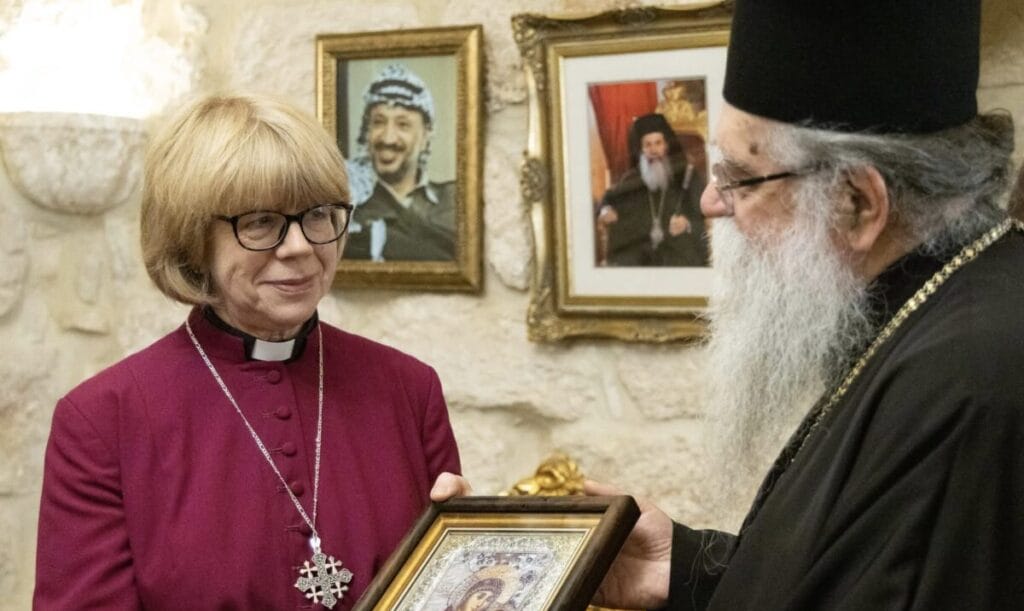
This week, the Archbishop of Canterbury is visiting Israel/Palestine and meeting with Palestinian Christians there, who have made a plea for churches in the West to support them and campaign for peace in the region. For reasons I will explain below, I think this visit, like the earlier one by Rachel Treweek, Graham Usher, and Guli Francis-Dehqani (bishops of Gloucester, Norwich, and Chelmsford) are disastrous for the Church of England, for Jews in Britain, and for our relationship with the Jewish community.
The Archbishop, Sarah Mullally, has been posting daily on Facebook about her meetings in Israel/Palestine. Like the three bishops before her, she went to the home of Layan Nasir, who was detained without trial in the Israeli Government, and appears to have become the representative of such people.
The presentation of this on social media and in articles is that here is someone who is experiencing unjust oppression; we must stand with the unjust; and therefore we must stand with Layan. What very few people ever do in these situations is asked why she was detained.
The reason is that she was in the leadership of a student organisation, Democratic Progressive Student Pole (DPSP), which (it is claimed) was welcoming new students to Birzeit University. This Arabic human rights website argues that the proscribing of DPSP is oppressive, against free expression, and the maintenance of an ‘apartheid’ regime:
The intention of maintaining the apartheid regime is a core element of the definition of the crime of apartheid under the Rome Statute of the International Criminal Court. Israel spearheads a protracted campaign of silencing, intimidation, smears, and de-legitimization in pursuit of this goal imposed through various policies including mass arbitrary detention, systematic torture, and other forms of ill-treatment against individuals or groups seeking to challenge its apartheid regime.
This is language designed to appeal to liberals in the West, in order to recruit their support, which it appears to have done very effectively. (There is no mention here, of course, of human rights in Arab countries.)
But what the website won’t tell you is that DPSP is the student arm of the Popular Front for the Liberation of Palestine (PFLP) at Birzeit University.
The Popular Front for the Liberation of Palestine (PFLP; Arabic: الجبهة الشعبية لتحرير فلسطين, romanized: al-Jabha ash-Shaʿbiyya li-Taḥrīr Filasṭīn)[4] is a Palestinian Marxist–Leninist[5] organization founded in 1967 by George Habash. It has consistently been the second-largest of the groups forming the Palestine Liberation Organization (PLO), the largest being Fatah.
A secular organization, the PFLP has generally taken a hard line on Palestinian national aspirations, opposing the more moderate stance of Fatah. It does not recognize Israel and promotes a one-state solution to the Israeli–Palestinian conflict. The military wing of the PFLP is called the Abu Ali Mustafa Brigades.
The PFLP pioneered armed aircraft-hijackings in the late 1960s and early 1970s.[6] More recently, the group has participated in the ongoing Gaza war alongside Hamas and other allied Palestinian factions.[7][8][9][10] It has been designated a terrorist organization by the United States,[11] Japan,[12] Canada[13] and the European Union.[14]
In particular, the PFLP was involved in the atrocities of 7th October 2023.
The controversy about Layan Nasir was the lack of due process in relation to her detention. But we need to put it in context, that she was in leadership of the student wing of an organisation in an active terrorist war, involving torturing and slaughtering Israelis. A comparison would be someone who was leading a student wing of the IRA at the height of the troubles in Northern Ireland.

In the photos posted on social media, Sarah Mullally is seen in their living room, and prominent on the wall is a painting of a man; when they are standing and praying, Sarah is standing right in front of him.
This man is Layan’s great uncle, the brother of her paternal grandfather, Kamal Nasser. Nasser was born in 1924, and became a celebrated political leader, writer, and poet. In 1967, he joined the leadership of the Palestine Liberation Organisation (PLO), led by Yasser Arafat, who has invented the term ‘Palestinian’ to refer to those who wanted to destroy Israel and return to their land (prior to that, ‘Palestinian’ has been a regional term that described modern Israel, Jordan, and Syria). Nasser was also a ‘Palestinian Christian’—and this is the point where we need to recognise that, in this context, the term ‘Christian’ really functions as a tribal and ethnic identifier, more than the sense of someone who has made a personal commitment to Jesus as we might use it.
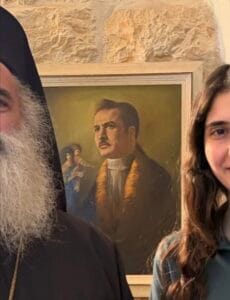 Nasser had joined the PLO just at the point where it made the Khartoum Resolution, in response to the defeat of the Arab armies by Israel in the Six-Day War of 1967. This was known for its three ‘Nos’: no peace agreement; no negotiation; no recognition of the State of Israel. This led inevitably into more warfare, culminating in the Yom Kippur War of 1973.
Part of the violence of the PLO, which (with Russian help) developed into the foremost global terror organisation, was the 1972 Munich massacre, when Palestinian terrorists infiltrated the Olympic village, killed two Israeli athletes, took nine more hostage, and eventually killed them during a failed rescue attempt. Nasser was one of the people who masterminded this operation.
For anyone outside the situation, it is hard to understand how ‘Palestinian Christians’ could be involved with anti-Israeli and antisemitic terror. But in fact the links between the two are longstanding and well developed. Nasser’s father was Reverend Butrus Nasir, who was a leader within Palestine’s Arab Protestant community from Bir Zeit. The founder of the PFLP, a radical Marxist terror organisation, was George Habash, a ‘Palestinian Christian’.
And the Greek Orthodox Church has had long links with the PLO going back to the 1960s. Many ordinary Palestinian Orthodox Christians and clergy of Palestinian descent are sympathetic to or actively involved in Palestinian nationalist politics — many Palestinian officials across ministries, the PLC, the PNA, and the PLO are Christians. There’s also a documented history of crossover between Greek leftists and the PLO more broadly: during the late 1960s and early 1970s, many Greeks belonging to the anti-dictatorship socialist movement trained in PLO camps in Lebanon, and when the PLO was forced to leave Lebanon, Greece—under PM Andreas Papandreou, who had close ties with Arafat—became its first destination.
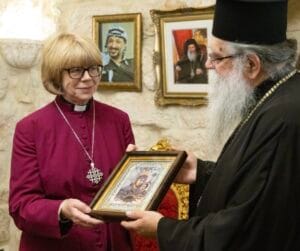
That is why we can see a picture of Yasser Arafat on the wall of the office of Archbishop Benedictus, as he is meeting Sarah Mullally. Our archbishop has managed to be photographed in front of, not one, but two notorious terrorist leaders within the space of a couple of days—quite an achievement! And you can see the intertwining of terrorist resistance with Christian devotion in the painting of Nasser: in the background of the canvas, there is a traditional iconographic depiction of the Virgin Mary holding the infant Christ.
It is worth reflecting how both Israelis and British Jews will be made to feel by seeing these images.
(For transparency: I raised these questions on Sarah’s FB feed, and I also wrote directly to Lambeth Palace. I have not had a response from either.)
Additional note: my friend Martin Davie has reminded me of the article that Giles Fraser wrote in 2024 on the deeply antisemitic nature of parts of the Palestinian Christian church, which includes details I have already noted here:
Christians in the Holy Land have long been prominent in their opposition to Jewish immigration into Palestine. The Arabic language newspaper Falastin, founded in 1911 by Arab Christians, was one of the earliest and fiercest critics of Zionism. And Palestinian Christians have often been prominent in what they understood as the armed struggle against Zionism. George Habash, for example, was a Palestinian Christian from Lod — near Ben Gurion airport — where he sang in the church choir. He went on to found the Popular Front for the Liberation of Palestine through which he masterminded the hijackings of Western aircraft. Wadie Haddad, a Palestinian Christian from Safed, led combat operations for that same terrorist organisation. And, to name another, Chris Bandak was born in Bethlehem, named after Christ, and went on to lead the Al-Aqsa Martyrs’ Brigade. He was released from prison in 2011 in exchange for Gilad Shalit, an Israeli soldier taken hostage in Gaza.
There are bad eggs in every Church. But there is no doubt that there is a radical anti-Israeli side to Palestinian Christianity, to such an extent that parts of the Church have developed something of a distaste for the Jewish underpinnings of Christianity, including even the very presence of the Hebrew scriptures within the Christian Bible. The Palestinian Anglican priest Father Naim Ateek has written: “Since the creation of the state [of Israel], some Jewish and Christian interpreters have read the Old Testament largely as a Zionist text to such an extent that it has become almost repugnant to Palestinian Christians.” In the second century, the Christian teacher Marcion argued that the Old Testament taught of a violent malevolent God, as opposed to the good God of the New Testament. He was rightly condemned by the early Church as a heretic. Elements of Marcionism continue in the Palestinian Church today.
Some years ago, while still looking for the right church to attend in the Holy Land, I went to an Anglican eucharist in a church in the southern part of Tel Aviv, not far from Jaffa. I was rather amazed that the young priest who took the service was so obviously Jewish and Israeli, which is highly unusual. He had that unmistakable Tel Aviv swagger. So over coffee after church I asked him the story of his conversion, and how he had come to be confirmed as an Anglican. “Where you ordained in the Diocese of Jerusalem?” I asked him. “Oh no”, he replied. “They wouldn’t ordain me; I’m originally Jewish Israeli.” Now, I have not been able to confirm his story. But I believed him. And if it is true, the Diocese of Jerusalem would be the only Diocese in the world that would discriminate in ordaining people on the basis of their ethnicity. I remain shocked by his story.
I have no great animus against the Palestinian Church. And were I to try to hold a congregation together in Gaza or the West Bank under present circumstances, I would inevitably want to be alongside my people in their suffering and feel great anger towards those who were harming them. But for so long as this this anger is misdirected towards those Jews who want to live free from attack in Israel, I will keep going to the extraordinary Levanda Street. I pray for my Palestinian brothers and sisters in Christ, but I won’t be joining them.
We then need to ask: why did the archbishop decide to make such a one-sided visit to the region which such a complex and contested situation? Why was not more care taken?
It might be claimed ‘Well, it is obvious that she opposes terrorism, so that does not need to be stated’. But that is clearly not the case. Just this morning on my Facebook feed I see that a once-respected evangelical ethics scholar has posted a Guardian piece containing antisemitic blood-libel lies about ‘Israel targeting children’ in the Gaza conflict, and citing the ‘genocide scholars’—that is, those Arabists who were willing to pay €50 to join the International Association of Genocide Scholars (IAGS—no qualifications required ‘We are inclusive and welcome activists…’)
Why didn’t Sarah Mullally take care to engage with all angles on this visit? If her agenda was dispassionate concern for those who have suffered, why didn’t she visit any of the families of the 1,195 slaughtered on October 7th, or of the 250 abducted? Or of the 1,010 killed and 8,341 Israelis wounded in the second Intifada? In December 2023, a survey showed that 83% of West Bank Palestinians supported the atrocities of October 7th. Did she meet any of these? It is implausible to think that this number does not include ‘Palestinian Christians.’
Additional note: one of the commentators below points out that Justin Welby visited in 2017—but there was one vital difference. He visited both sides:
Justin Welby held separate talks with the Israeli prime minister, Benjamin Netanyahu, and the Palestinian president, Mahmoud Abbas, in which both spoke positively about the possibility of reviving peace talks in the coming months. Abbas had just returned from meeting Donald Trump in Washington, and the US president is due to visit Jerusalem soon.
When we visited Israel in 2018, on a tour organised by the Anglo-Israel Association, it was carefully planned to do precisely this—to help us understand the complexities and dynamics of the situation, rather then to help us take sides. So we met former PLO negotiators, PLA politicians, settlers, those running the Keren Shalom crossing, the British Ambassador, and many others.
What we encountered was ignorance and a lack of interest in the view of ‘the other’ on all sides. Thus, when we visited settlers in the West Bank, the only comment they could make was ‘Look—the hills are empty—there is plenty of room for us all’ without demonstrating any awareness of the implications of this idea. More seriously, when we met former PLO negotiators, I asked one of them ‘How important do you think the Holocaust was to those with whom you were negotiating?’ ‘Er, it was unfortunate’ came the reply—unsurprising, since the Grand Mufti of Jerusalem in the 1940s, Amin Al-Husayni, met with Hitler to offer Arab support to his ‘final solution’ of the eradication of all Jews.
But we also encountered generosity and peace-seeking. Those running the Karen Shalom crossing into Gaza were genuinely desperate to keep aid flowing in—but were hampered by the consistent used of lorries to smuggle in arms and explosives. The children’s hospital that we visited in Tel Aviv treated Gazans for free—despite the hideous experience of treating Wafa Al Bass, who returned to kill those who had treated her.
And the hideous irony for many of the victims of October 7th is that those who lived in the kibbutzim near the border with Gaza did so because they wanted to build bridges and work for peace. They welcomed Gazans to work with them—to provide employment and build understanding. Yet those very people they had welcomed passed their detailed knowledge on to allow the terrorists to find their secure rooms and murder them.
Without engaging with these other views, the archbishop is certain to come away with a partial and a partisan understanding of the situation. I gather that she did visit the Nova exhibition in London, exploring the horrors of October 7th, and met with some of the families—but strikingly this was not reported in her feed on Facebook. I wonder why?
This raises wider questions about why bishops in the Church of England have decided to make the Palestinian cause such a focus, out of all that is happening in the world. Why are they not visiting Nigeria, and meeting Christians there suffering—not because of dispute about land , but actually because of their Christian faith? Why are not other nationalists causes in the region gaining their attention?
Why do some causes command all-consuming attention and allegiance while others are largely ignored or downplayed? Why do those who profess concern for justice, human rights, and self-determination jump in with both feet in some cases, yet remain thunderously silent in others?
The Kurds are the real victims of the Middle East, not the Palestinians. Kurdish people, denied their own state, have experienced genocide. The West doesn’t care because their oppressors aren’t Israeli.
And what about the other examples of oppression in the world? The Uygars in China? The conflict in Myanmar? Any number of other oppressive regimes? What about the violence and oppression happening in the states neighbouring Israel? What about women’s rights in Egypt, where 98% are subject to female genital mutilation?
This is not ‘whataboutism’. It is asking about priorities, and why the bishops have made this situation a key one. This is indeed a reflection of antisemitism, as Baroness Deech make clear in her letter to the Church Times last week:
The basic definition is as follows: “Antisemitism is a certain perception of Jews, which may be expressed as hatred toward Jews. Rhetorical and physical manifestations of antisemitism are directed toward Jewish or non-Jewish individuals and/or their property, toward Jewish community institutions and religious facilities. Manifestations might include the targeting of the state of Israel, conceived as a Jewish collectivity. However, criticism of Israel similar to that leveled against any other country cannot be regarded as antisemitic.”
It is then amplified by examples, of which a very pertinent one is this : “Applying double standards by requiring of it a behavior not expected or demanded of any other democratic nation.”
Double standards are evident when multiple questions are raised about Israel and no other foreign country. They are evident when the unjustified words “apartheid” and “genocidal” are applied to Israel, when those words could well be used validly of, for example, China and the Uyghurs, India and the Dalits, Myanmar and the Rohingya, and Saudi Arabia and religious minorities.
We do not hear loudly from the Church about the dead children in Yemen, Syria, Sudan, Nigeria, and Iran, or the kidnapped Ukrainian children. We do not hear protests about the checkpoints in Belfast dividing two communities. Only when Jews are involved are there such loud condemnations. The Church’s preoccupation with the Jewish state, as if it were the worst — the Jew among nations — amounts to double standards, because the ethical difference between the attitude to Israel’s conduct, its casus belli, and the conduct of other states at war is clear. Genocide and apartheid are inflammatory words designed to stir up hatred and to re-contextualise the actual genocide of the Jewish population in the Second World War.
A response the following week suggested that the motivation here is our past involvement as a nation, and our continued connections with the region. But we have connections with these other places—and we have deep connections with this conflict which are not being challenged.
The state of Qatar has been a major supporter of Hamas, fuelling (literally) the rocket attacks on Israel for years. Best estimates suggest that from 2018 to 2023, Qatar transferred roughly $30 million per month into Gaza, totalling around $1.8 billion over six years. And Britain has major economic, trade, energy, investment and defence links with Qatar—so why have no bishops spoken up about this? We have been just one small step removed from directly funding terrorism.
And through our contributions to the UN, we have been funding UNWRA, who are perpetuating Palestinian victimhood by declaring that—alone in all the people displaced around the world in the aftermath of WW2—all descendants of anyone who was displaced in 1947–48 is designated a ‘refugee’. They do not keep records of who qualifies; anyone can claim to be, and there is good evidence that UNWRA are providing funding for people across the world, who have moved away from the region, and even those who have died whom they have not removed from their register. They fund education in Gaza which teaches children to want to kill Jews, and UNWRA employees were involved in October 7th.
Where are bishops speaking up about this?
This whole approach is disastrous for the Church of England, for Jews in Britain, and for peace in the region. I do not believe that this is a disaster because of a quasi-magical use of the biblical idea that ‘I will bless those who bless you’, transferring the promise of Abraham to the modern secular state of Israel, since the Bible itself makes the transfer in a quite different direction, as I explore here. But it is a disaster.
For the Church of England, once more we have our leaders taking sides in a complex and contested issue, on the basis of poor research and understanding, and apparently riding on yet another left-liberal social cause. This demonstrates again our bishops’ inability to engage thoughtfully and responsible with complex issues, and undermines confidence in their leadership. And it offers more confirmation of the left-liberal bias of the House of Bishops as a whole:
Shortly before he died in April of this year, my father Lord Robert Skidelsky commissioned a little research into this question. He asked his invaluable assistant, Attila Mestehazy, to run through all 693 speeches delivered by the reverend Lords between 1 January 2024 and 19 September 2025, looking out especially for words and arguments associated with Christianity. The results were dismaying, if not entirely unexpected. ‘Bible’, ‘gospel’ and ‘Christianity’ each appear in somewhat under one per cent of all bishops’ speeches. ‘Jesus’ appears in three per cent. ‘God’ shows up a bit more often, at six per cent, perhaps indicating an attempt at inter-faith solidarity. ‘Sin’ appears not at all…
A deeper dive into the 693 speeches confirms the impression of overwhelming secularity. On most issues, the bishops take a position indistinguishable from the left wing of the Labour party, albeit decked out occasionally in Christian rhetoric.
I think it is extraordinary that, on visiting Bethlehem, Sarah Mullally managed to reduce the incarnation to a social cause:
From the manger, Jesus proclaims, meekly but powerfully, the beginning of a new world where the poor, the sick, the excluded and the marginalised are brought into the very heart of God.
Not a mention of the fact that he came to ‘save his people from their sins’ (that is literally the meaning of his name! Matt 1.21) or to call us to ‘repent and believe’ (Mark 1.15).
For Jews in Britain, they are once more told that the established Christian church is not on their side. Someone commented to me that, every time the General Synod has debated this issue, we have ended up deeply offending the Jewish community here. We look set to repeat this.
And for the peace process, this is a disastrously once-sided and partisan approach. As Bijan Omrani notes in the Telegraph this week:
One wonders whether her pronouncement is made out of the profoundest naïveté. Does she not realise the consequence of repeating a narrative where the Palestinian people are nothing more than the helpless victims of Israeli occupation? Of omitting to condemn the repeated refusals of the Palestinians to accept serious offers of peace over the generations, not to mention declining to excoriate the brutality of Hamas, the demand of their founding charter to eradicate Jews, their hiding behind civilians, and the complicity of ordinary Palestinians in the terror wrought by Hamas?
Mullally’s embrace of this Palestinian victimhood narrative will simply make it more difficult to combat the terrorism and totalitarianism of Hamas, which is the more fundamental cause of the misery of the people and the prolonging of the conflict – not to mention the oppressive treatment of Christians in their territory. This failure of courage, to confront the difficult truth of the situation, is hardly going to advance the cause of justice.
Sarah Mullally, at the time of her enthronement, said that she wanted to be a quiet voice for unity, and that she stood against antisemitism. In undertaking this ill-conceived and ill-advised trip, she is doing neither.
 Buy me a Coffee












Another thing these largely secular Bishops choose to ignore is the global – and growing – persecution of Christians. Because to do so would mean having to identify their persecutors who are afforded a privileged status within the liberal / Marxist hierarchy of ‘oppressed’ versus ‘oppressors’.
These church leaders are not leading the nation as their calling requires: they are not calling the nation to repentance (except for historical causes), speaking about the necessity of faith in Jesus, standing up to the multifaith deceit, bothering to turn up to vote in the abortion and assisted suicide debates, and supporting our Jewish cousins. They are the blind leading the blind and I don’t know any Christians (including anglicans) who listen to what they say anymore.
Mullally has led opposition to assisted suicide in the House of Lords debates on that bill actually
Yes—and all of her arguments were secular, none Christian.
Wrong ‘“I believe in a God who’s very being is life, and in that gift we can discover meaning, dignity and innate worth, even if we are dying.
“To speak of God is to speak of one who is never indifferent to human fragility, but who holds it and tends it.
“That is why I believe that there is always hope: hope that what looks like an ending is not the last word.
“Hope that with proper care, support and research, dignity and compassion is still possible. It is this firm belief that compels me to resist this bill.”
https://www.churchofengland.org/media/press-releases/assisted-suicide-law-would-make-country-says-some-lives-are-not-worth-living-bishop-london
Apology Ian?
Tim, no need to apologise.
‘The Catholic bishops were forthright in stating what was wrong with Leadbeater’s bill: ‘The Catholic Church teaches that it is morally wrong to intentionally take the life of another person, including at their request.’ The Coptic Orthodox bishops were similarly frank: ‘The Church does not assess the value or worth of human life as contingent upon abilities, achievements or physical health but on the inherent dignity bestowed upon all as the depiction of God.’ The Anglican bishops’ inability to say anything so definite is a mark of their captivity to a basically heathen state.’
What she said fell well short of a Christian rebuttal—though I was pleased she at least spoke up.
And what is the disctinctly christian element of that? the idea of ‘God’ is hardly ours alone, I can’t see anything here that any monotheist couldn’t affirm.
I think what Ian may have meant is that the God of whom she speaks slots nicely, in terms of selected description, qualities, attributes, into the secular grid.
indeed.
Yes but she spoke differently on abortion.
Always curious to know how a self-declared jewish European population of 15 million both pre and post war can be twisted into providing evidence for a “holocaust.”
Also how a state which specifically targets Palestinian children for murder via its IDF goons can even be considered as worthy of preservation, let alone understanding.
A recent UN report, as mentioned yesterday by RT, specifically affirms that this is what they do, and in addition, they set dogs onto detainees which are trained to rape them.
Tim, you are welcome to offered discussion and opinion here—even differing and challenging opinion.
You are not welcome to repeat antisemitic and anti-Israel lies, even when sent from the UN.
Please read the actual evidence: https://unwatch.org/un-watch-legal-rebuttal-disproving-the-pillay-commissions-charge-that-israel-deliberately-targets-palestinian-children/
Holocaust denial? Really?
Ah, Tim, you are a holocaust denier! That explains a lot.
To be fair to Mullally she and Welby do and did engage with the Chief Rabbi and British Jews especially and condemned the Hamas attacks. However, her role as leader of the Anglican Communion is to support Palestinian Anglicans and those who have faced Israeli settlements encroaching on their land or vandalism of a statue of Christ by an Israeli soldier. There were also plenty of African Anglicans present at Mullally’s enthronement and Welby also condemned attacks on Nigerian Christians from the likes of Boko Haram. However given the Church of Nigeria has rejected Mullally as Archbishop it is not that surprising she isn’t going to engage too much with them
‘her role as leader of the Anglican Communion is to support Palestinian Anglicans’…
…including those actively involved in antisemitic terrorism? And ask no questions?
None of those she met were terrorists
Layan Niser was a leading in the student wing of PFLP, which took part in 7th October massacre.
So a student not a terrorist, whereas the likes of Martin McGuinness were not only in Sinn Fein’s political wing of the IRA but actually in the IRA council organising terrorist attacks but the late Queen still met him once he had executive power in NI
Recruiting for the student wing of a terrorist organisation.
Martin McGuinness had renounced violence then. This family lauds the memory of the great uncle who organised the murder of Jews.
Curious. But then again, Benjamin Netenyahu has a prominent statuette of Ze’ev Jabotinsky on his office bookshelf for all to see.
(https://www.jns.org/feature/those-figurines-behind-netanyahu-what-do-they-mean)
Jabotinsky was the founder of the terrorist Irgun Zvai Leumi militia which was responsible for the murder of 200 odd British soldiers in Mandatory Palestine and policemen including Sergeant Clifford Martin and Sergeant Mervyn Paice who were kidnapped, tortured and eventually publicy hanged. They also, of course, murdered many more Arabs during their terrorist campaigns which included pioneering indiscriminate ‘Market Place Bombings’ in Haifa, Jaffa and Jerusalem in 1938.
But the parallels are even closer – Netenyahu’s father Benzion Netanyahu, served as personal secretary to Ze’ev Jabotinsky and his own uncle was active Irgun terrorist. Netenyahu’s own Likud party was formed by Menachem Begin, the former supreme commander of the Irgun who conceived and endorsed a plan to send five Irgun terrorist cells directly into the United Kingdom to assasinate Ernest Bevin in 1946. They also, of course, bombed the King David Hotel. An attack Netenyahu has loudly praised in the Knesset.
Now Archbishop Justin met Netenyahu in that very office in 2017, bneath that statuette of the Irgun founder, alongside the man who now leads the successor party to the Irgun.
(https://www.theguardian.com/uk-news/2017/may/09/justin-welby-moment-of-opportunity-near-in-middle-east-conflict)
But I don’t think we would say that there is any suggestion that the meeting was a vicarious endorsement of Jabotinsky, terrorism or even the modern Geneva-Convention-bound IDF.
I fear that if you scratch below the surface in that unfortunate corner of the world you will find that the distinction between legitimate politics and terrorist violence is rather mroe porous than we would like to think.
To adapt a phrase – Terorrism never prospers, Why, if it prosper, none dare call it terrorism.
Thanks William—but here is the difference, from that article:
He didn’t make the mistake of meeting one side only. That is the disaster.
There might well have been terrorists on both sides—but Sarah’s visit has been portrayed as ‘only meeting people of peace.’ I am sorry, but that is a con and a lie.
(Oh, and btw, Israel is a democracy. The PLA is not.)
She still isn’t a terrorist herself
jews define a terrorist as anybody who opposes their genocidal actions – others define them as jews who deliberately set out to murder Palestinian children and rape their detainees.
Tim, you are welcome to offered discussion and opinion here—even differing and challenging opinion.
You are not welcome to repeat antisemitic slander. Hamas says its goal is to kill all Jews, and it started its work on October 7th.
Have you read the Nova report?
And where does Israel state its policy is to kill all Palestinians? How are there 2.1m living with full democratic rights in the state of Israel?
Ian Paul – well, having read ‘The Iron Wall’ by Avi Shlaim (who describes himself as an Arab Jew), I’m not at all sure that you can dismiss Tim’s post as ‘antisemitic slander’ (although I’d agree that there is much about it which is outrageous and unjustified). I got the impression from the book by Avi Shlaim that there are basically two factions among the Jewish community in Israel, one of which would like to find a settlement with the Palestinians (on that side, very broadly speaking, look at what used to be the Israel Labour party), but there is another faction that may not be far off the picture that Tim is presenting (their version of Nigel Farage); the hard right religious Jews who believe in their divine right to the land – as evidenced by the settlements encroaching further and further into the West Bank and the huge wall that has been put up, making it impossible to see where a viable Palestinian state could actually exist.
The ‘new historians’ (Avi Shlaim, Ilan Pappe, Benny Morris) did have hard evidence of ‘dirty tricks’.
Er, can you offer me some evidence of Israel committing genocide—that is, the deliberate intention to and execution of a plan to kill all members of an ethnic group?
tried posting a reply but it got gobbled. It might be in the spam filter.
There is no ‘spam filter’ on comments.
Are you trying to comment on your phone? Don’t.
OK … second attempt … (no – I’m not using the phone).
No – not genocide – but don’t you think that is rather a low bar? Rather, serious attempts to displace the Palestinian population. It seems (if Ilan Pappe is to be believed) that there was a system (going back even to the 1930’s) of surrounding a village on three sides, leaving one side as escape route and then attacking – forcing them to escape in a certain direction. Also – although not genocide, a scant regard for human life (e.g. declaring a curfew and not telling anybody – then killing the Palestinian peasant farmers who came in late from the fields).
An interesting ‘modern historian’ is Benny Morris:
https://en.wikipedia.org/wiki/Benny_Morris
who does not deny the dirty tricks, but since 2000 (time of the second intifada) seems to have come to the conclusion that they were a necessary evil; he is a Zionist who has come to believe that a two-state solution or a bi-national state can possibly work and is critical of Ben Gurion for not having been more pro-active in expelling the Palestinian population much earlier.
One Jew even said, “let he who is without sin cast the first stone”…
Tim, I am sorry that you have stopped by just to push these antisemitic lies which do not stand up to scrutiny.
Thank you for posting this. I was astonished to see her visit reported with uncritical favour on BBC TV national news and if recalled correctly the purpose of Jesus being opposed to the oppressed.
I can’t really understand how someone in such a position could be so unaware of the ‘optics’.
The article mentions a ‘one-sided’ stance, visit. It is that, and more; ignorance, political and theological maybe, as demonstrated by the article.
But, it is but CS Lewis’s, ‘Inner Ring’ at work, being played out.
Can you say more about the ‘inner ring’?
Better still, here is PDF of his lecture:
https://ia801604.us.archive.org/10/items/1944-the-inner-ring/%281944%29%20The%20Inner%20Ring.pdf
It is applicable, not only to those in high office, but for us all to weigh carefully.
AI Overview C.S. Lewis’s “Inner Ring” refers to the universal, informal hierarchies and cliques that exist in virtually all organisations. In his 1944 essay, Lewis warned that the natural, often subconscious desire to be part of the “in-crowd” can drive people to compromise their morals and betray their true friends.Key Concepts from the Essay The Illusion of Importance: The desire to be on the inside makes us believe that being part of the “inner ring” brings power and prestige. However, Lewis argued that the “Inner Ring” is rarely where the actual, important work gets done.Exclusion as the Goal: Unlike true friendships or professional teams, the “Inner Ring” often relies on an “insider/outsider” dynamic. The value of being inside is fundamentally tied to the fact that others are kept out.The Path to Becoming a Scoundrel: Lewis warned that you do not become corrupt by directly plotting evil. Instead, you become a “scoundrel” through the gradual, trivial compromises you make simply to stay in the good graces of the ring.Rings vs. Circles: Lewis made an important distinction between the Inner Ring (a status structure built on exclusion) and legitimate groups or friendships formed around a shared craft, love, or profession (which are inherently inclusive).The Danger Lewis argued that the longing to be “in” is one of the most powerful and permanent motivators of human action. It is distinct from simple snobbery, as it applies to everyone from schoolchildren to politicians. The danger is that the desire for acceptance becomes more important than integrity.The Antidote According to Lewis, the only defense against the lure of the “Inner Ring” is to focus on doing your actual job, pursuing genuine friendships, and letting the exclusive “rings” form around you naturally if they happen to align with your principles.You can read the full text of the essay in Lewis’s collection of speeches, The Weight of Glory
This Hideous Strength is a clear example of the outworking of the inner ring.
On the other hand
An interesting polemic which for me does not end with any Christianly exhortations or responses.
Rooted primarily in biblical wisdom literature (e.g., Proverbs 24:17-18), it teaches that taking malicious pleasure in someone’s downfall is a sin of pride that displeases God.
: Gloating demonstrates an arrogant attitude. The motif reminds individuals that human beings are fundamentally equal, and that one should extend empathy and grace rather than mockery.
The wisdom text warns that celebrating an enemy’s calamity can cause God to look upon your gloating with displeasure. It implies that vengeance and judgement belong to a higher power, not to individuals.
The Book of Proverbs: Warns that a person who is “glad at calamity will not go unpunished” (Proverbs 17:5). The New Testament further develops this concept in Romans 12, where followers are instructed to bless their persecutors, avoid repaying evil with evil, and leave room for God’s wrath.
Similarly, Jesus famously instructs followers to “love your enemies and pray for those who persecute you”
When you obey Jesus and respond to your enemies with love, prayer, forgiveness, and blessing, you take yourself out of satan’s line of fire and make room for God to handle justice as only He can. You don’t have to worry about your enemies. God says He will handle them on your behalf. [Jehovah Nissi]
Rooted primarily in biblical wisdom literature (e.g., Proverbs 24:17-18), it teaches that taking malicious pleasure in someone’s downfall is a sin of pride that displeases God.
: Gloating demonstrates an arrogant attitude. The motif reminds individuals that human beings are fundamentally equal, and that one should extend empathy and grace rather than mockery.
The wisdom text warns that celebrating an enemy’s calamity can cause God to look upon your gloating with displeasure. It implies that vengeance and judgement belong to a higher power, not to individuals.
Jesus through the cross is Jehovah Jireh, Nissi and Shalom made manifest for our good and blessing to be partakers of the divine nature, Blessed be His Name.
Thank you Ian once again. Your intelligent and balanced approach to these questions , restores some hope in me regarding the CofE. But, only SOME hope…..
Sinn Fein MLAs including the First Minister continue to laud the memories of their fallen ‘comrades’ so I’m not sure there’s much difference. And of course they are in government.
George Gilder wrote an interesting secular book called “The Israel Test” in 2009. You can just about work out what it is about from its title. SDarah Mullally fails it, and it is no coincidence that she is wrong about most other things.
Nasser was also a ‘Palestinian Christian’—and this is the point where we need to recognise that, in this context, the term ‘Christian’ really functions as a tribal and ethnic identifier, more than the sense of someone who has made a personal commitment to Jesus as we might use it.
Who is ‘we’ here? This description matches also the Church of England after the Elizabethan settlement (and the Catholic church in pre-Reformation Europe, and in Spain etc afterwards). Only in the very recent era of aggressive secularism, when you have something to lose by declaring yourself a believer in Jesus Christ (as Tim Farron did), are these churches differentiating themselves from ‘the world’, i.e. from the prevailing culture at a given time and place. No doubt they contained a minority of genuine believers but they made it harder, not easier to be a Christian (by noting for instance whose lips stopped moving when prayers were addressed to Mary before 1517). And they persecuted dissenters even though those dissenters were conspicuous by their holier lives – no drunkenness, no whoring, no cheating. But Luther’s theological emphasis on justification by faith alone, while ignoring the works of faith, caused these telling differences to be set aside. Institutional protestant churches sought to maintain their ecclesiastical monopoly against Lollards, Waldenses, Anabaptists etc just as viciously as Catholicism had done. It is very obvious who the real church was by all scriptural criteria. Mainstream church historians, for all their scholarship, have it completely wrong.
Arab tribal culture is something different.
I do feel you have deflected slightly.
Anyone alighting on planet Earth for the first time might quickly be struck by human propensity for tribal loyalty. And the degree to which objectivity and logic could be readily sidelined in terms of the moral judgements and behaviours involved would be hard not to notice.
It’s long been my observation that the term ‘anti-Semitic’ amounts to ‘shut your mouth’; and few could say with a straight face that there’s anything but fear and extreme chilling applied when comment or discussion about today’s State of Israel happens in public. This tells us something about the kind of tribalism and power dynamics which have not changed since Jesus walked in Palestine: some of what he said (and what I suspect he might say today) would undoubtedly be labelled ‘anti-Semitic’!
Yet many in the Christian church still weigh in on behalf of the State of Israel no matter what. Far from teaching and living out new covenant reality and the attaching values which were radical indeed when Jesus taught them, we Christians still fall in behind a serious proportion of the tribal narratives and attitudes promoted where we live even when they ignore simple truth, let alone critical Christian judgement. The flawed teaching of ‘Christian Zionism’ has plaid a prominent part in the exceptionalism applied to the State of Israel when it comes to judging right and wrong without fear or favour by much of the Western world – and never more so than in the USA and the UK. No wonder there’s massive ill feeling and attempts at retribution.
Perhaps Sarah Mullally’s intentions with her visit to Israel / Palestine were noble; perhaps it was the simple justice which demands that truth as she understood it be heard which motivated her. She would have been naïve indeed not realise that this was going to be an eggshell situation. I’ve not been a fan, but at least I salute her courage!
My view is that we Christians need to be far less trusting and attached to our local news narratives and historical assumptions about the moral superiority of our own nation and the ‘great and good’ who, largely unseen, orchestrate our own national affairs and wield power over what ordinary people are allowed to know and think. If we truly follow Jesus, we must expect to be misfits, fools, and trouble makers for his sake. We will regularly need to be the dissenting voices on the back row. That’s pretty uncomfortable but can be strangely liberating too. When it comes to the eternal realm our ‘tribe’ is not the UK; neither is it the Western world: it’s God’s people – citizens of the Kingdom of Heaven. Talk about a radical perspective!
Of course we temporarily belong to and should seek the best interests of our country and the welfare of its people; and that means our mission is the saving of souls on the one hand and the promoting of truth, love, justice and peace here and now on the other. Over the last few years, and to my certain knowledge, the two great issues involving Ukraine and Israel have been crying out for the kind of just and intelligent intervention we would once have taken for granted on behalf of the Western world. Yet it has not been forthcoming. Christian input in both cases has been mostly tribal and offered neither prophetic warning nor serious calls for diplomacy.
Only a few years ago firing Western missiles at Moscow would have been an unthinkably reckless notion; yet here we are, unfazed, led by war mongering fools, heading for disaster. Drone technology and AI guidance systems are spinning out of control, missile delivery is ever more powerful and precise. But wise heads are nowhere to be found. This is exactly where God’s prophets would once have been crying out a warning. It’s the kind of Godless folly where power and money overrule common sense and moral discernment. I’m sure Godly Archbishops would have cause and justification for assuming a prophetic role. Whoever they may be, they need our prayers. I’m not sure the stakes could be much higher.
the term ‘anti-Semitic’ amounts to ‘shut your mouth’; and few could say with a straight face that there’s anything but fear and extreme chilling applied when comment or discussion about today’s State of Israel happens in public.
Yes indeed. Try defending its actions close to any of the Muslim hate marches that have taken place regularly in our big cities in the last two years, and see what reaction you get. Critics of Israel remind me of a poster seen at a zoo: “This animal is dangerous; if attacked, it defends itself.”
Antisemitism isn’t the same as antizionism, I accept, but there is a ready test to distinguish the two: does an antizionist criticise Israel’s Arab and Persian foes for their wrongs as zealously as he or she criticises Israel?
I disagree that Christian Zionism is a flawed viewpoint, but I’m happy to refer anybody interested to this 11-month-old Psephizo thread for that discussion:
https://www.psephizo.com/biblical-studies/does-the-state-of-israel-have-a-divine-right-to-the-land/
I would certainly agree that some Christian Zionists talk more about Zionism than about the living Lord Jesus Christ, and I regret that. But you get cranks of all opinions if you are prepared to look.
Thanks for your thoughts, Anthony. When it comes to ‘Christian Zionism’ my concern would not be to beat Christian Zionists over the head but to warn of its implications. I believe it does a disservice both to Jews and the State of Israel on one hand and also to Christian Zionists on the other. God’s New Covenant came into effect on resurrection day. Its application was no longer to the people of a chosen nation but to every individual, from all the nations, who individually would turn to Christ and receive him as his or her personal Saviour.
Christian Zionism appears to imply there’s still some kind of exceptionalism going on in regards to Jews and the State of Israel. That is a deception which is dangerous for the Jewish people in terms of their need to accept and receive Christ, and dangerous for Christian Zionists who feel good about themselves for promoting an interpretation of scripture while not realising its falsity. Is there special joy in heaven when a Jew turns to Christ? It’s not for me to say; and it’s not for us gentiles to be resentful if that were so. As St Paul makes clear, our own salvation, offered through the blood of Jesus, is so undeserved that it beggars belief that any saved soul should feel resentment concerning another saved soul. We are clay in the potter’s hands! The prodigal son parable also has something to teach us here – in terms of all 3 characters!
Quite right and well said.
It is always worth bearing in mindthat the modern secular, multi-ethnic, unitary parliamentary republic known as ‘Israel’ was originally going to be named ‘Judaea’. Ben Gurion and the Jewish National Council only picked Israel in haste and after a close split vote.
The Israel of the Bible and the Israel of Whitaker’s Almanack are -and this shouldbe obvious – clean different things.
I sometimes wonder quite how much of the more earnest and forthright aspects of Christian Zionism, particularly in its American iteration, arise from a simple, fateful, elision of these two historic entities.
Really now?
Disingenuous eisegesis to introduce thinly veiled anti-Jewish tropes.
It is above all an exegetical issue. I believe you do not make sufficient distinction in your discussion of covenants. The Letter to the Hebrews is clear that the Mosaic covenant is obsolete. No more sacrifices, because the supreme sacrifice had been made; and Mosaic law stands or falls as one. But the Abrahamic covenant is nowhere abrogated in the New Testament, and Paul actually affirms it in Romans 11. It is widened spiritually to include gentile believers in Jesus, but its original meaning is not terminated – or else God would have been playing sophistry with Abraham. So the land belongs to the Jews except when they are being disciplined by exile. We need to see the 1800-year exile that ended in the Zionist era as an exception, and Jewish occupation as the rule. That was generally understood in regard to the Babylonian exile, but only Zionist Christians understand it in regard to the 1800-year galut, which was clearly for not recognising the time they were visited (Luke 19:44).
Otherwise, you have to regard the utterly unprecedented survival of the Jews without any political hegemony for 1800 years, and their return to the land, as a grotesque coincidence. Really?
But don’t you think that peoples with strong identity markers and strong shared histories are all the more determined (far more than average) to stick together?
The celebration of Passover etc would scarcely have ended, because it was a matter of such very high communal importance.
As for the return to the land, if measures are taken to return an indigenous people to a land, then they will (all too gladly, and in predictably high numbers) return to that land.
Surely, though, the Bible clearly shows that the Abrahamic covenant was not with the Jewish people. It was with all of humanity, through the ‘Faith of Abraham’ – “And in you all the families of the earth shall be blessed” (Genesis 12:3).
Abraham was not a ‘Jew’. With all respect, that is an anachronism. The first time the word Jew is used in the Bible is during the exile (2 Kings 25:25).
Abraham was quite simply a man of true faith, chosen by God to be the ancestor of many nations – one among them the later Israelites.
Those who hope in Christ and follow him in the obedience of faith are Abraham’s descendants and heirs of his covenant promises.
…which is exactly Paul’s point in Romans 4.11: ‘So then, he is the father of all who believe but have not been circumcised, in order that righteousness might be credited to them.’
Paul precisely appeals to Abraham because
a. he was declared righteous before the law was given, and
b. the promise to him was that he would become father to ‘many nations’ and not just one nation.
This is also the conclusion of the Council in Acts 15. Gentiles with Jews who both believe in Jesus are the Israel of God in the new covenant in Jesus.
Let us look closely at the promise of the land to Abraham and his descendants in Genesis 17:8. The promise runs through Abraham’s son Isaac with his wife Sarah, not Ishmael born to his servant girl Hagar:
“Your wife Sarah will bear you a son and you will call him Isaac. I will establish my covenant with him as an everlasting covenant for his descendants after him. As for Ishmael, I have heard you, and I will surely bless him… and make him into a great nation. But my covenant I will establish with Isaac” (Genesis 17:19-21).
Then to Isaac, in Canaan:
“To you and your seed I will give all these lands and will confirm the oath I swore to your father Abraham. I will make your descendants as numerous as the stars in the sky and give them all these lands, and through your seed all nations on earth will be blessed” (Genesis 26:3-4).
And to Isaac’s son Jacob/Israel, in Canaan:
“I will give you and your seed the land on which you are lying. Your seed will be like the dust of the earth, and you will spread out” (Genesis 28:13-14).
If God denied the Holy Land to the Jews forever then he would be breaking his promise to Abraham. God does not break promises, so the Jews are still entitled – whenever God permits it – to live in and govern the Holy Land.
Anthony, Paul believes that all who put their faith in Christ are the ‘seed of Abraham’.
I am struggling to get why you find this difficult. This is the whole of his argument in Romans 1 to 5.
I don’t know how much more clearly I can put it, Ian. I am saying that the Abrahamic covenant was enlarged at the Crucifixion, consistent with Paul, but that it retains its original meaning for the Jews in relation to the promise of the land.
That is not Paul’s position. He is quite clear that is it those who are ‘Jews inwardly’ and NOT ‘Jews outwardly’ who are the seed of Abraham.
The promise was never for those who were merely ethnically or outwardly Jews, but those who experienced circumcision of the heart. That is Paul’s key point.
What you are proposing is two routes to salvation, one by faith, the other by being a Jew. Paul clearly rejects that.
Ian,
How many times have I written on Psephizo that the Abrahamic covenant does not confer salvation and that you need the Messianic covenant for that whether Jew or gentile?
prior to [Arafat], ‘Palestinian’ has been a regional term that described modern Israel, Jordan, and Syria
Are you sure of that? Syria was long known as Syria for the word comes from ‘Assyria’ which is of course ancient. The Wikipedia article on “Roman Palestine” is useful.
The Roman term was ‘Syria Palestina’ and did reach up into the southern part of what we now call Lebanon and Syria. But maps vary.
Next week I am going to the Nova exhibition in London. If I engage anybody in conversation, what might I constructively say? Shouting ‘Jesus is Lord’ to a bunch of New Age Jews isn’t going to get anywhere even though it is true. Asking them what did they expect by holding a festival featuring a 40ft statue of buddha in the Holy Land jus a few miles from Hamas’ stronghold won’t help either. Romans 11 tells Christians to get under the skin of Jews by making them jealous. How might I do that in a brief conversation in this context? I welcome all constructive replies.
I went to the Nova exhibition. Thought long and hard about it beforehand, but not sorry that I did. It does maybe over-memorialise events, but ok, not everyone can get to Tel Aviv to see the situation in the flesh. My experiences in Israel-Palestine in the past 3 years have been challenging.
I spent most time listening to the speaker who’d been at the festival. What i found most powerful was the trauma this guy had faced.. a) from events on 7.10 and some of the actions he’d taken to help others and b) the subsequent 8 months fighting in Gaza. I’ve seen expressions like this on faces elsewhere in Israel.
It underlined to me that the fightback by Israel hasn’t helped. The military option as the only option. It is part of the system. It divides, it strengthens division, it fails to accept that maybe just possibly another way is possible, please God. Israelis want peace, they’ll all say (extremists excepted obvs), and Palestinians want it too. They want it far far more than Israelis will let you believe.
The speaker at the Nova event didn’t take questions. I felt so sad for him though. And I feel so sad too for my friends on the land, both sides, and therefore I’m committing to do all I can to get this situation to change, for justice and freedom and equal rights, towards a path of reconciliation and maybe, just maybe, a peace.
It’s easy to take a polarised position. There is no Nakba exhibition for instance. But i believe my Lord can’t take pleasure in what is happening on the land and so we need to go with projects and opportunities to see beyond the hard lines. No solution will be perfect with such opposites but you gotta try.
Those Palestinian Arabs who genuinely want peace aren’t able to leverage their view into any position of political influence. That is a tragedy but it is also realpolitik.
I don’t think it’s easy to solve but it’s not complicated. Personally I’d stop arming Israel just to shock the status quo there into some sort of change, but yes, realpolitik. Hence you and I have to do what we can.
I’m sure the vast vast majority of Palestinians want genuine peace.
Israel is a fundamentally Western culture set in the heartlands of the West’s deadliest and most enduring foe. We would do well to support it.
As that foe says: First the Saturday people, then the Sunday people.
Thank you for constructively wondering what you might say to any Jews you might encounter conversationally at the Nova exhibition. My personal feeling, as an Anglican of Jewish descent, is that your best bet, if you want to be a constructive and encouraging presence at the exhibition, is to say nothing about Jesus unless directly and specifically asked. I realise this is a bit counterintuitive and I hope it doesn’t sound harsh or ungracious! I write respectfully!
The thing is, the Jewish community has been hearing Christians talk about Jesus for two thousand years, often with a Bible in one hand and a sword in the other. The memories of blood libels and forced conversions in the name of Christ are still vivid after all these years / centuries. I know those events feel long ago and far away in the church but tragically those memories are being revived in the synagogue at the moment by the political and religious climate in this country and they are very sensitive.
What Jews in Britain need at the moment is not more words about Jesus from well-meaning Christians. What they need are Christians being present, being loyal and being kind. By all means wear a (discreet) cross if you want Jews at the exhibition to know that you are Christian. You may be surprised by being approached for conversation about Jesus! Amazing, given the sensitivities of the past and present, I gather that Jews for Jesus are currently reporting an all-time high in interest in Jesus among Jews. In that case, of course, share your faith! But please don’t push it. Just be there.
I do applaud you for going to the Nova exhibition. I’ve read about it – and obviously read about the October 7th attack at length – and I can’t bring myself to go because it’s all too much. But greater awareness of the reality of the attack is vital. If Jews at the exhibition know you are Christian then your respectful presence alone will speak of solidarity with them in suffering. And that, I believe, will speak powerfully about your faith and your Lord.
Obviously this is just my perspective. Others may differ and have wisdom to share about words to say. I hope they do! Personally I guess I’d just also suggest praying ahead of time for those who will be at the exhibition at the same time as you, praying for a meaningful encounter / conversation and praying for words to say which will plant and water seeds of hope, faith and love at this difficult moment in time?
Thank you Judith for these wise and helpful words.
I’ll be praying that, for sure; thank you. I don’t look Jewish and I won’t be wearing anything that indicates my faith. I won’t even be wearing the yellow twist.
I have secular Jewish friends in London, and I know people in Jews for Jesus, so I know how to be sensitive. Pray for me briefly, please.
This sounds like very good sense.
‘As a Christian, I believe every life is sacred. I stand with you in solidarity with your grief and loss and horror.’
Thank you, Ian.
Thank you. As an Anglican of Jewish descent, with friends and family in London and in Israel, I appreciate you acknowledging this issue. Seeing a picture of the Archbishop of Canterbury beside a portrait of Yasser Arafat is disturbing. Watching the waters of antisemitism rise in this country while the Church of England says next to nothing against it – and, indeed, indulges in antisemitism in its own right – is actually slightly traumatic.
I’m probably a little bit unusual in bridging the C of E world AND the Jewish world. From this perspective, however, I can witness to a strong sense of abandonment and threat as the C of E ignores the complexities of the situation, belittles the lived experienced of Jews in Britain and goes out of its way to applaud and promote those who are threatening the existence of the Jewish community, not just in the Middle East, but in this country including those who live, work and even sometimes worship within its dioceses, parishes and churches.
Alongside that, however, there’s a strong sense of fatalism because apparently the wider church hasn’t REALLY changed since the days of blood libels and forced conversions. Again, in the name of Christ, Jews are demonised and left to look to their own defence. I wonder if any of the bishops and archbishops have paused and wondered what Jesus thinks of the Jewish people – who birthed the promise of His coming and the wonder of His incarnation – again being made to fear those who claim to love Him? I find it baffling that the C of E isn’t thinking this through.
Thank you Judith for expressing this so well. You are in an unusual situation, and your voice needs to be heard…
Judith, if you are committed to Anglicanism then have it out with your bishop. Write to him, courteously, asking the hard questions, and persist for an answer.
Alternatively, find a free church with a better attitude. Nearly as many people in England worship in free churches as in the CoE today.
Judith, my longest term friend, from when we were school mates in the same village, is Jewish. I remember meeting his grandmother who had managed to escape from Germany and was clearly scarred for life by the experience. However my mate never mentioned politics of any sort. He was a very bright lad. His first post degree employment was in Saudi Arabia! I’ve never got any impression that he feels under any kind of threat here in the UK. But I would say he was a secular Jew and not given to engaging in tribal identity and debates of any kind. Perhaps that’s common sense if you’re part of a minority group within whatever nation you live?
I don’t claim any other personal knowledge of the Jewish experience here in the UK, but here’s an AI sourced snippet which might be worth pondering:
“Edwin Montagu, the Secretary of State for India, was the only Jewish member of David Lloyd George’s cabinet and led the opposition to the creation of a Jewish national home in Palestine. He fiercely argued against the pro-Zionist Balfour Declaration in 1917, going as far as submitting an official cabinet memorandum titled “The Anti-Semitism of the Present Government”. In it, he asserted that Zionism was a “mischievous political creed” that would brand Jews in Britain and elsewhere as foreigners, warning that it would incite antisemitism globally.”
It was all very well for wealthy comfortable Jews in established democracies to grumble that Zionism would make foreigners of them. Very different was the Jewish experience in eastern Europe in the pogroms of 1881-4 and 1903-6. Theodor Herzl, the father of Zionism, took the view that although Jews were tolerated in many places they were welcomed almost nowhere, and even toleration might change on the whim of a ruler – such as Adolf Hitler. 20 years after Herzl died, Hitler proved him right. The shift from institutional Christianity to secularism was not going to end Jew-hatred.
However unpalatable the reality, Montagu’s warning was spot on. It is clearly still playing out today.
Certainly Zionism is the fashionable excuse for anti-semitism today. But this is a hatred running back to Pharaoh 3500 years ago, and both George Gilder and Douglas Murray describe it in their books as a shape-shifter.
If your friend is a secular Jew then it would be difficult for others to perceive him as Jewish. Not surprising therefore he feels no threat in the UK.
How far back in history, Biblical history do we go? How do we contend for our Triune God in the face of strident, hostile atheism of Dawkins etc al of 20 years ago which posed questions of genocide in the Old Testament scriptures.
At it’s core, aren’t the present conflicts over religious conflicts, even if religion is marshalled to serve secular purposes: land has a central role, even while it may be camouflage for religious hatred.
Well, here is a article that considers and refute the underpinning atheist argument, which can persist in weighing the conflicts. Under whose Name are they being prosecuted is a pertinent question? Ian’s article indicates how the Name of Christ has been misappropriated to serve malign and mendacious purposes of deadly conflict down the generations
It is written by Dr Andrew Wilson, with Biblical exegesis, and posted on the Keller Center for Christian Apologetics: Did God Command Genocide in Deuteronomy 7?
https://www.thegospelcoalition.org/article/did-god-command-genocide/
There is also a counterpoint to consider: Islam and its God and spread.
Dawkins is a coward and a hypocrite. He ducks debate with people who pose a genuine intellectual threat such as William Lane Craig, and he doesn’t admit as he perceives that secularism isn’t up to holding off Islam but cultural Christianity was, that he has changed his mind about the vluje of the latter. He was a controversialist in genetics before he started loudmouthing about things he knew little about.
As for Deuteronomy 7, God commanded that the Israelites drive out the Canaanites etc from within the boundaries of the Promised Land, and destroy their idols. He did not command that they pursue and kill those trying to flee, or surround rural districts in order to do so. Whether that is genocide is a matter of definition. Dawkins et al might look at Leviticus 18 to see what the Canaanites had been up to that brought this judgement upon them.
If you want full-on genocide in the Old Testament, you can find it commanded divinely in 1 Samuel 15 against the Amalekites – and the reason.
“Sarah Mullally managed to reduce the incarnation to a social cause:”
And hence the value of your repeated annual Christmas posting on themeaningifgthe manger story. I’m considered a bit of a pedant in some parts on this but too many, otherwise biblically literate people, resort to this reduced gospel at Christmas .
Promises in the Old Testament…. I’m afraid that it’s also common to high jack these or unquestioningly apply them to the state of Israel.
Yes, I agree.
In a trip to Toronto a couple of years back, I was a guest of the Jewish community. One old lady, who had numbers tattooed on her arm, leaned over to me and said quietly in my ear, “Christopher, since 1947 we have never started a war, but since 1947 we make sure we finish it” I shall just leave that there. Chris x
I was unaware that Canada had ever started a war?
If the old lady was referring to the State of Israel you could perhaps have humbly reminded her of our shameful joint-venture at Suez in 1956 when Britain, France and Israel conspired to invade Egypt under false pretences.
Nassser nationalised the Suez canal. We tried to reopen it. Eisenhower let us down.
We wanted to take it back, not mereley ‘reopen it’, friend.
The Protocol of Sèvres was made available to historians in 1980. It clearly shows that a clandestine agreement was agreed with France and Israel to invade Egypt and expropriate the canal.
The plan, which very nearly succeeded, was for Israel to invade Egypt thereby creating a surious and dishonest pretext for Britain and France to intervene as “peacemakers”.
Whether that would have been a good or a bad thing is beside the point here.
The ‘old lady’ in the anecdote seems to assert that Israel has not ‘started’ a war since 1947. We must be honest, if only for our own part, and say that is not so. We jointly invaded Egypt in 1956.
That is without ven mentioning the First Lebanon war which is perhaps defensible under a very elastic understanding of the term ‘pre-emptive’.
The Israelis had firm casus belli as the canal had been closed to their ships and Nasser was buying arms from Moscow with the aim of annihilating Israel and thereby becoming leader of the Arabic world.
As for the French, Nasser’s sudden nationalization of the Suez Canal Company threatened their economic and strategic interests in the region; France viewed Nasser’s actions as a direct threat to European energy routes.
Eden got obsessed but I’d have supported London’s actions had I been adult at the time. As Eisenhower should have done (and reportedly admitted years later). I couldn’t care less about the sophistry involved.
Not to forget that Egypt was from the beginning committed to destroying Israel, as it ended up occupying the Gaza strip in 1948 after attacking the new state and preparing to do so in 1967 (but was preempted) and then attacking again in 1973. This continued until Sadat saw he had to make peace – as Jordan also did.
James: The newly formed IDF had an Egyptian army bottled up in a hopeless position in Gaza in 1948, but was aware of the enormous number of Palestinian Arabs concentrated in a small area there, many of whom had fled the fighting. Israel was not able to separate out the Egyptian troops and was not willing to kill everybody. Israel was also aware that policing the Gaza strip after the fighting ended would have been effectively impossible for the Jewish administration. So it washed its hands of Gaza; that Egyptian army slunk home and Gaza was run from then until 1959 by a Palestinian Arab administration having close links with Egypt. (Of course there was a gap during the Suez crisis.) After 1959 Gaza was run directly by Egypt, until the 6-day war of 1967.
“Best estimates suggest that frm 2018 to 2023, Qatar transferred roughly $30 million per month into Gaza, totalling around $1.8 billion over six years. ”
One needs to balance this with something which seems never to be introduced into the discussion: the military aid which the IDF receives from the USA.
From this: https://www.cfr.org/articles/us-aid-israel-four-charts
“Since the start of Israel’s war with Hamas on October 7, 2023, the United States has enacted legislation providing at least $16.3 billion in direct military aid to Israel. The aid was authorized in three pieces of legislation: a supplemental appropriations act in April 2024 which provided $8.7 billion, and appropriations acts in 2024 and 2025 which provided $3.8 billion per year in line with the MOU. Of the total, $6.7 billion is for missile defense.”
How much of that has been spent on the missiles which have destroyed the homes of ordinary people, and killed a number of their occupants?
Hamas has used the money to turn the whole of Gaza into a terror tunnel network *one third larger than the whole London Underground* including using schools, hospitals, and private homes as tunnel entrances.
And they have fired in the region of 20,000 rockets randomly on civilian areas.
Can you offer evidence that Israel has done comparable things?
And please note that, despite the failures and offences committed by any conscript army, the IDF targets known terrorist sites, and consistently warns citizens by leaflet drops and text message where they are about to target.
Do Hamas do this?
War veterans note that, despite the devastation, no Western army has managed to limit civilian casualties in urban warfare to the same degree.
Is the USoA, stoking, funding anti-Semitism through an indirect causative effect?
David, if you are seeking to provide a balance, where is it, and where is the fulcrum, tipping point?
We are both writing from the UK, from a position of relative undisturbed, comfort. But, if we were to be targets to be ‘wiped out’ (and yes it is ac term now being used by both sides) jingoism not only for where we live, but for our Christian beliefs, it is doubtful that we would be, at a distance, so sanguine.
If ‘peace’ without wipe-out between peoples is not a common goal, it is suggested that there can not be a balance of right and wrongs.
Have we not learned any lessons from WW2. How did VE day come about?
And we, who live in a centuries old democracy, not a theocracy, have proscribed organisations.
The difference is that the war in Europe was not essentially religious, though the evil Holocaust may be considered to be religious ‘ethnic cleansing’ through the rise of a number of secular ideologies.
A couple of points relating to the letter of Baroness Deech:
It has been established in English Law that to be anti-Zionist is not to be antisemitic. I think there was a case in the 1970’s when a journalist wrote an anti-Zionist article, which was condemned by a Jewish publication as being antisemitic. He sued for libel and won. There have been more recent cases.
She wrote:
‘It is then amplified by examples, of which a very pertinent one is this : “Applying double standards by requiring of it a behavior not expected or demanded of any other democratic nation.”’
I am wondering which democratic nation in recent decades has behaved towards its neighbours in the way that the state of Israel has been behaving over the last three years?
A couple of examples:
Recently, the IDF bombed an apartment building in southern Lebanon, because “there were senior Hezbollah people in it.” Investigation revealed that of the 80 people killed, which included women and children, six were low-level Hezbollah people.
More recently, I read in an Israeli news source an IDF report that one IDF soldier had been killed and one seriously wounded by a drone attack in southern Lebanon when they were destroying homes and infrastructure in a Christian village.
Perhaps someone could point out a country of which it is reasonable to say that it is democratic which has done anything like this recently.
‘Perhaps someone could point out a country of which it is reasonable to say that it is democratic which has done anything like this recently.’
That is very easy: UK and the US. In Afghanistan and Iraq there were much higher levels of civilian casualty than there have been in either Gaza or Lebanon. UK veterans have pointed that out. Yet all the incidents there received less than a hundredth of the scrutiny that is being applied to Israel. People read these incidents as if this is a civilian peacetime operation; it is not, it is war.
That Christian village was a Hezbollah base. And Hezbollah was allowed to reestablish its bases both with the consent of the Lebanese government and with the supervision of the UN. Rockets have been fired by Hezbollah on citizens of Israel from sites right next to UN outposts.
Israel’s actions in Lebvanon ar easily explained. Hezbollah de facto runs southern Lebanon (making it no picnic for the Christians there) and repeatedly launches missiles into Israel. Israel’s attitude vis-a-vis the government of Lebanon is: If you won’t police the insurgents attacking us from your country, we shall do it our way.
There is going to have to be a buffer zone, and Israel is determined that it shall be on Lebanese territory, not Israeli. I regard that as reasonable in view of Israel’s desire to live in peace aznd Hezbollah’s not to.
As we are all well aware here in the UK, the fact of a nation being ‘democratic’ does not mean that its government and policies are supported by a majority of the people; that will depend on the voting system, the honest intention of candidates and the degree to which voters have access to objective facts and can see through propaganda. Moreover there can be no assumption that the majority of voters in a democracy are morally good and wise people!
As a matter of interest, regarding Israel:
There is one single national constituency.
Voters can only vote for a party, not individual candidates.
Each party submits a ranked list of candidates before the election; if a party wins 10 seats, the top 10 names on that list enter parliament.
Voters cannot alter the order of candidates.
Seats in the 120 seat Knesset are distributed proportionally based on the total popular vote a party receives nationwide.
A party must win at least 3.25% of the national vote to enter the Knesset. Any party falling below that threshold receives zero.
Democratic? Hmmm….
Ken Arrow’s theorem provides a list of criteria that just about everybody accepts a democratic voting system should have, and then shows that they are incompatible. Why do you single Israel’s system out?
‘Why do you single Israel’s system out?’
‘As a matter of interest’ in response to David Wilson’s raising of the democratic issue in regard to Israel in his comment.
Thanks Don—a lot more democratic than our FPTP system, which always delivers unfair sizes to parties, and also always delivers government to the left of what the population as a whole wants.
Just an aside, but the Thatcher government was to the left of what the population as a whole wanted?
I had *thought* I had read this some years ago. It doesn’t mean that every government is to one side or the other, but on average they are.
But it seems I might have completely misremembered, and it is the other way around!
https://www.cambridge.org/core/journals/british-journal-of-political-science/article/is-proportional-representation-more-favourable-to-the-left-electoral-rules-and-their-impact-on-elections-parliaments-and-the-formation-of-cabinets/AC94A781D6E641169FC0CE183B3CC938
Always? Surely not. Sometimes yes, but also sometimes governments to the right of the majority. Remember 1979, 1983, 1987, 1992, 2015, 2017, 2019 but not with right wing voting majorities in every case. The history of the past 50 years suggests mainly long periods of right wing government with a small number of left wing interludes (if one can call Blairite Labour left wing, which is debatable to say the least.) In fact there’s some evidence at the moment that parties more to the ‘left’ are winning a bigger proportion of the vote than ‘right’ parties and are voting tactically to prevent parties such as Reform winning. In Makerfield it was abut 25K for Labour, The Greens and Lib Dems, against about 20K for Reform, Restore and the Conservatives. It’s not true that the UK overall is as staunchly right as some commentators suggest.
Do you think that the terms ‘right’ and ‘left’ make sense?
They are tribal.
They assume that someone who votes a certain way on A will also vote a certain way on B. Given that ABCDEFGHIJKLMNOPQRSTUVWXYZ all exist, and more, then how is this even close to likely? Least of all in a country of floating voters.
How would you classify me, who has published on the extreme extent of the statistical harm of the sexual/sixties revolution and prioritises green issues?
The voting system in the UK is laughable. Political parties now get into power when 65% of the public have not voted for them!
20.2% of eligible voters gave Labour a landslide in 2024. The figure 33.7% refers to those who did vote, 20.2% to those who were able to. I am not sure whether the 20.2% is a percentage of registered voters or just of adults (the word eligible could mean either).
Is a coalition government put together after the election and that precisely no-one has voted for, less laughable?
at least they represented a larger proportion of the voting public.
“towards its neighbours” is an interesting caveat. I’m sure people could, and have, drawn comparisons with our wars in Afghanistan and Iraq, or the US’s recent pounding of Iran, but then they’re not neighbours…
But it rather begs the question: which democratic nation other than Israel has neighbours akin to Hamas and Hezbollah? If we want to make comparisons, who are the appropriate comparators?
‘But it rather begs the question: which democratic nation other than Israel has neighbours akin to Hamas and Hezbollah? If we want to make comparisons, who are the appropriate comparators?’
THIS
Adam – good point. I don’t recall where the following definition of ‘nation’ came from, but it looks correct: ‘A nation is a group of people united by a false understanding of their own history and who hate their neighbours.’
Thanks that made me laugh.
OK, Jock, that’s enough about Scotland.
Ian – it would help if you could stop using the word ‘antisemitic’ to mean only anti-Jewish prejudice and conduct. While I have soe sympathy with your point of that being established usage, I also see that the world has changed since that usage was established, and it is now unhelpful or worse.
Simple fact – ‘Semitic’ does not mean ‘just Jewish’; pretty much all the coutries around Israel are also populated by Semites, and I’ve seen more than a few FB posts by Gazans and other Palestinians pointing out that they too are Semitic and proud of it, and annoyed by an implication that by opposing Israel they are in effect ‘antisemitic’.
If you mean “Anti-Jewish” say it; and ‘call out’ Jews who won’t recognise the inaccuracy of using the term only about Jews.
Stephen, you are falling for the genetic fallacy. Meaning comes from usage, not from etymology. A ‘lady’ is not a woman who kneads bread.
Ian – as I said, I’ve some sympathy with that position and in many cases I would take that position myself. I’m rather deliberately NOT just “falling for the genetic fallacy” but registering that changes since the term’s invention have genuinely made it inappropriate and confusing for discussion today. Especially when, as I’ve pointed out in another reply here, the Israeli goverment seems to be deliberately ‘misusaging’ the term to confuse between real “anti-Jewish racism” and legtimate criticism of the Israeli government’s actions (which many Jews are also finding problematic). Also AIUI the relatively recent coinage was an attempt by racists to create a ‘more acceptable’ term – ie from square one it was manipulative in a bad way.
Stephen,
“Antisemitism” means “anti-Jew”. The term was coined in the 19th century as a euphemism for “Jew hatred”. Polite 19th century people didn’t like saying “Jew”. They preferred to call Jews “Hebrews” or “Israelites”. There is no such thing as “semitism” (which is why I don’t hyphenate the word); as opposed to”Semiticism”, which is a linguistic term denoting familial links in the Semitic Afro-asiatic language family that includes Arabic, Hebrew, Akkadian, Amharic etc.
I don’t like the coinage “antisemitism” and prefer the more blunt ‘Judenhass’ but this isn’t widely understood outside the land of its chief practitioners.
A theatre production of The Diary of Anne Frank toured Germany and Austria soon after the war. In Germany it play to packed audiences who wept. In Austria it was met with stony silence and closed prematurely. There is also the tale, told in Dirk Bogarde’s autobiography, of how when making The Night Porter he had to stroll through central Vienna wearing SS kit. This was to have been filmed at 5am on midsummer day before anybody was up, but it kept going wrong and he finally did it in the morning rushhour, to loud cheers. An elderly woman came up and thanked him for reminding her of the good old days.
There is some history of anti-Semitism in mainstream Christianity in the UK in the Lincoln Cathedral ‘ blood liable’ , a farrago of prejudice.
Geoff – at the time of the Lincoln episode it is “Anti-Jewish” racism ; the confusing and inaccurate ‘anti-semitism’ was a long way into the future.
Christians who worship an ethnic Jew as the incarnation of God cannot – well certainly should not – be anti-Jewish in racial terms. What we should be is “Anti-Judaic” by which I mean that if Jesus is accepted as the Messiah, followers of Jesus cannot accept a continuing Jewish religion which rejects Jesus. And given the internationalism and anti-racism implied by Jesus’ new covenant kingdom, we must also reject Jews being, as many sadly are, pro-Jewish racists.
I don’t think the CofE is seriously ‘anti-semitic’ except in the way Israel has tried to distort things by in effect insisting that objecting to Israel ‘must be’ racism and can’t be legitimate objections to questionable conduct by the Israeli government and its supporters.
The Church of England’s big problem is the one it has had since its foundation of being a national church improperly entangled with the English state which raises all kinds of issues in all kinds of areas.
No being established church ensures the C of E provides parish ministry to all the nation, not just has the King as its Governor and some bishops in the Lords
Simon: is that why Church of England vicars are always evangelising Muslims in Bradford and Hindus in Leicester? Oh wait ….
No but there are still C of E parish churches in Bradford and Leicester for Christians who wish to attend them
Simon – actually as the CofE declines it provides less and less parish ministry with many clergy looking after multiple parishes. A supposed ‘national’ church which is barely regularly attended by 2% of the population is something of a joke. And in the context of this post about ‘antisemitism’ and the problems posed by Islam, an ‘established church’ is problematic by its similarity to the religious nationalism of Islam and Israel while actually disobeying what Jesus and the apostles actually taught about the Church’s proper relationship to the surrounding world. Even Pontius Pilate understood “My kingdom is not of this world” better than the CofE does…..
Maybe you might have 4 churches per vicar in rural areas, you will still often have 1 church per vicar in cities and suburbs and some larger towns. Add in those who go to church at Easter and Christmas, for weddings, funerals and christenings etc many more than 2% attend a C of E service at some point and have the chance of a wedding in their local parish church as of right. Israel does not have an established religion, even Judaism, Islam is the official religion in Palestine but Christians can still practise their faith but not convert. There are plenty of churches for nonconformists like you in England if you really reject established Christianity
Simon
You miss the point – the 2% figure is the serious Christians who meet in fellowship regularly. People who turn up occasionally for other reasons are of course welcome but are hardly obeying the apostolic instruction to meet in fellowship; and as I understand it the number of such attendances is generally declining anyway.
Israel may not formally have an established religion but it is clearly in effect a pro-Jewish racist society. Islam is also run on an establishment-like basis with restrictions on others.
The big issue remains that the NT simply DOES NOT TEACH establishment and similar arrangements, but teaches something very different which by existing as an established church the CofE disobeys….
People who turn up occasionally even only say once a year are still equally as much Parishioners of the C of E as those who attend every Sunday as it is established church. Christians and Muslims are both equally free to worship in Israel as are Jews, it is not a racists society. Christians can also worship in most Muslim majority nations, as long as they do not try and convert Muslims.
The whole point of the C of E is to be established church, including all wings of Christianity, Catholic and Reformed. As a nonconformist Baptist you don’t get any say in what the C of E does anyway, nowhere in the Bible does Jesus expressly forbid an established church.
Jesus didn’t call us to make parishioners. He called us to make disciples.
Parishioners are disciples, to varying degrees
No, they are not.
Yes they are, the basis of the Church of England’s organisation is a parish based ministry, always has been and always will be
Wondering
In Britain we do have our own racist groups
Wales and Scotland in particular have many anti English
ideological proponents.
Imagine, if these two nations colluded
to wipe England of the map even though we are of the same blood.
If for decades they indiscriminately without warning bombarded our major cities and tunnelled into England to cause the deaths of say theatre attendee’s. What would be your response?
Would armchair diplomats claim that their church was institutionally racist or just the figure-heads?
What might be a Christianly response look like?
Would it look like Gideon’s tearing down the godless alter and building a new alter to Jehovah Shalom and offering a sin offering and peace offering? Shalom.
This comments section has turned rather grim, but a couple of quick thoughts:
This is all being done with the Anglican Archbishop in Jerusalem, Hosam Naoum, and at Archbishop Naouom’s invitation. They’ve issued a pastoral letter together: https://www.archbishopofcanterbury.org/news/pastoral-letter-archbishop-sarah-mullally-and-archbishop-hosam-naoum If this is all deeply problematic, does this mean it’s an Anglican, rather than simply CofE problem?
If we are worried about the Church of England and antisemitism in the UK, then I’m not convinced whether the Archbishop of Canterbury is planting an olive tree in the West Bank or not is the vital concern. Antisemitism has never completely gone away in the UK. There’s a reason Jewish groups had to organise the Community Safety Trust to guard their synagogues, schools etc.. The spate of antisemitic attacks in the UK are the real concern (stabbings in North London, setting ambulances on fire, people driving around chanting how they want to rape and kill Jewish women etc. amongst a soaring rise in antisemitic hate crimes). And the political shake-up is bringing to the fore people who are very comfortable expressing antisemitic views. In 2023 we saw the huge March Against Anti-Semitism take to the streets of London. I don’t think there was an official Anglican presence (though there were obviously some ordinary Anglicans, not least because I was there). And worse, some Anglicans – thankfully not the bishops – have tried to cosy up to Stephen Yaxley-Lennon (aka Tommy Robinson). As Gideon Falter, chief exec of the Campaign Against Antisemitism said of Yaxley-Lennon’s attempts to align with them: “You don’t fight prejudice with prejudice, you can’t fight racism with racism… They don’t realise how naked their attempt is to try to fool us.”
The joint letter from the Archbishops at https://www.archbishopofcanterbury.org/news/pastoral-letter-archbishop-sarah-mullally-and-archbishop-hosam-naoum says a lot of good and sorrowful and helpful things. In no way can it be construed as antisemitic. It does raise challenging questions for all sides, not least the Israeli Government, but that cannot be seen as antisemitism. I’m thankful that our Archbishop undertook this visit at such a traumatic time for all the peoples of that deeply contested region. She may have made some missteps, but that I think is almost inevitable – the divisions and suspicions are so deep that it is virtually impossible not to say or do something that one or other side will take offense at and focus on. On every side the sense of injustice is very, very deep and the emotions run high. We also need to cut her a bit of slack and not imagine that we wouldn’t make any mistakes in her position (even if different ones.)
We have to keep on making the clear distinction between antisemitism which, like any other prejudice or hatred of a group is to be unequivocally rejected, and criticisms of the political actions of a government, in this case Israel or Lebanon or the Palestinian Authority or the USA, or of a terrorist group such as Hezbollah. Nor should anyone remain silent over the behaviour of some Jewish settlers in the West Bank and the Israeli government’s support for them.
Visiting only one side in this complex issue, and being photographed not once but twice in front of renowned terrorists is not a misstep.
It is a disaster.
What should be the proportionate criticism of a democracy engaged in warfare, and a terrorist group set on killing all Jews? How should we compare them?
Well we have to disagree to some extent. Not all warfare is just even if waged by a democracy, (e.g. Bishop George Bell’s criticisms of some RAF bombing in WW 2) and so criticism of some of the government of Israel’s actions can be valid alongside criticism of Hezbollah and certainly the actions of some settlers in the West Bank can be criticised without it being in any way antisemitic. None of us would defend the settlers’ violence and illegal land grabs, just as none of us would defend Hezbollah reign of terror.
Tim,
There are a couple of problems about the way your observations typically work out in practice.
First, it seems to imply that the State of Israel and Hezbollah are equally valid entities. But Israel is a sovereign state recognised by the UK, while Hezbollah is a proscribed terrorist organisation which is nothing other than a front for the Iranian Islamic Republican Guard. Under British law, everyone in Hezbollah is literally a criminal and it exists for no ther purpose than to destroy Israel. Israel wouldn’t be in Lebanon if the latter wasn’t being used as a front to attack Israel.
Second, antisemitism antedates the state of Israel by thousands of years, and throughout history there have always been “good” reasons to hate the Jews: they were Christ-killers, greedy exploiters of poor German farmers, secret killers of Christian children, false Christians (conversos) in Spain to be sorted out and punished by the Inquisition, poisoners of Polish wells, enemies of the Prophet Muhammad (pbuh), rootless cosmopolitans, Bolshevists, capitalists, traitors to Germany etc etc. All this before they became genocidal apartheid-ists hellbent on murdering Palestinian children. No other people seems to excite murderous hatred for so many reasons – and of course, Jews outside israel, from Manchester to Buenos Aires, from Paris to Bondi Beach are “legitimate targets” in the eyes of Islamists. Now that the western left (heavily dependent on Muslims) is openly embracing antisemitism, Israel’s conflict with Iran’s proxies Hezbollah and Hamas is used to justify the world’s oldest hatred. Plus ça change, plus c’est la même chose this time with the help of useful idiots, including leftist Anglican prelates.
The output of St George’s cathedral should be ignored. Christ Church Jerusalem is a lot more faithful (and older), but the fourth Anglican bishop, George Blyth, there found it too evangelical and wanted to play at wearing weird clothing and had St Georges built so he could play high church games and waft incense around.
If you are high church Anglican you will be interested in the output of St George’s cathedral, we are not all evangelicals on here
If I want costumes and music and drama, I go to the opera or the theatre. Do you think the apostolic church, which had none of those things, was spiritually richer or poorer than 21st century high church Anglicanism ?
The opera and the theatre? And I’ll bet you know how to use a fish knife as well!
But at least the Church of England gives us pantomime Dames all year round!
I went to Christ Church Jerusalem many years ago. My impression was that CCJ was trying to convert Jews (with services in Hebrew and English), while St George’s was aimed more at Arabs. I think assertive Haredi style Jews are putting more pressure on Christians in Jerusalem now, so it is not so easy to be a Christian there now.
James,
In the face of panic about the approaching wave of Covid I chose not to renounce my ticket to what proved to be the last performance of Fidelio before Covent Garden closed for the pandemic. That was Friday 13th March 2020, and I have never seen the West End so quiet on a Friday night – but I was determined to see Beethoven’s only opera in his 250th anniversary year. I duly caught Covid. During the incubation period (and before I knew I had it) I gave our congregation’s first online short sermon, about how enhanced prospects of imminent death offered a preaching opportunity if the world was able to see that we genuinely had no fear. Jesus was not willing to let me preach that message without ensuring that I knew what I was talking about, and I duly went down with Covid just after, at a time when I suspected the government was lying that fatalities were less than we had been told. (It was lying, but the other way!) Covid wasn’t worse than a mild/medium flu, but it revved up the slowest-acting tier of my immune system two months later into a bewildering variety of non-acute but unpleasant symptoms that took several years to vanish fully.
Je ne regrette rien.
In terms of beauty of service poorer, if you wish to be low church fine stick to your low church services. We high church Anglicans like our incense and veneration of communion and receipt of the spiritual body and blood of Christ and will never abandon that
Simon, veneration of communion is specifically prohibited by the Book of Common Prayer, which remains both the liturgical and doctrinal standard for the C of E.
It also prohibits the use of wafers, and the use of the term ‘altar’ since no sacrifice is being offered.
Are you actually an Anglican at all?
Do you think the apostolic church, which had none of those things, was spiritually richer or poorer than 21st century high church Anglicanism?
Well the Apostolic church was a low church Pentecostal church which spoke in tongues. If you like that fine, personally I prefer high church services and always will
‘Apostolic church was a low church Pentecostal church which spoke in tongues’.
That is the church that we are. We confess to being part of the ‘one, apostolic…’ church!
Apostolic churchmen wrote the New Testament, regularly performed miracles of the Holy Spirit, withstood persecution, and grew like wildfire. How is high church Anglicanism faring?
The one Apostolic church also includes the very high church Roman Catholic church then given they have bishops of apostolic succession
Simon, except as you point out they don’t look much like the actual apostolic church as you described it…
St Bartholomew the Great has very healthy large congregations for its high church Anglican services as one example
Yes, they do, and I think Marcus Walker is doing a great job. But they seem to be in discontinuity with the Church’s own doctrine.
No they aren’t, they do BCP services and recognise the King as the Supreme Governor of the C of E
There is a little bit more to being Anglican!
Not in terms of what makes Anglicanism unique from any other denomination, which basically is services based in origin from the BCP. Plus for the C of E specifically having the King as its Supreme Governor
The Articles precisely do not seek to make the C of E unique. They seek to affirm that the C of E is part of the one, holy, catholic and apostolic church, so not unique.
Well the Roman Catholic and Orthodox churches and the Lutheran church also consider themselves part of the one Catholic and apostolic church, there is nothing uniquely Anglican about that. The BCP as the basis for its services is what makes Anglicanism unique as a denomination
You beat me to it Anthony! Christ Church was erected in 1849; some half a century before St George’s. I am surprised that CMJ and its long-standing (200+ years) connection with Israel has not entered the arena. Perhaps its because its Anglican roots are now firmly planted in Gafcon.
It would be a useful exercise to see how far “official” Anglicanism in the Middle East is actually immersed in the Hamas mesh given that, for example Hamas still controls the Gaza health system ; a system financially endorsed by prominent Anglican bodies through the British Isles.
Reply to James above.
I think you’ve missed the point. I didn’t equate Israel and Hezbollah, any more than I would equate the British Government and the IRA. But all are moral actors whose actions can be criticised as can those of the violent Jewish settlers in the West Bank or the USA.
On antisemitism I think you might do me the courtesy of assuming I know that it has a long and tortuous history. It is indeed a puzzle why this one specific group/ religious & ethnic identity is so often persecuted in so many places, but that doesn’t take away from the mistakes made by the state of Israel. Nor does it dispute the genuinely democratic values of the state of Israel. But, as you know, the immensely complex and disputed history of both European Jewry and the land of Israel/ Palestine since Ottoman times, needs to be taken into account when the violence of Islamist or other groups such as the Irgun are condemned. We need imagination to enter into the emotional and psychological worlds of all parties, and when we try to I think we can get some sense of the anger, bitterness and revenge expressed in those difficult Psalms of revenge. That applies to events in Ottoman times, 1917, 1947 – 48, promises made by Britain and then broken, etc and of course the attacks by Hamas. The irony is that Jewish and Christian tradition thereby has access to the resources that should help us to identify with (but not defend or legitimise) those who choose the path of violence.
Didn’t mean Jewish settlers in the USA, of course!
Forgot to mention that Begin, an Israeli PM, was a leading member of the Irgun a terrorist group that murdered many people including British servicemen.
I think you are confusing anti-Islamism with “racism”. Tommy Robinson isn’t a racist as far as I know – he has a lot of black supporters- but he is very opposed to Islam growing in Britain.
As are most British people, although they are often shamed into silence.
The left is unable to debate Robinson, so they try to bully him out of existence, as they attempted ladt week in Oxford, and the Police also try to silence him procedurally.
The Church of England is generally afraid of Islam in England because it feels very vulnerable, especially in its little toeholds in places like Birmingham. I’m not surprised- inner Birmingham is a scary place to be a vicar. I wouldn’t be very brave there.
This was meant to be a reply to Adam Bell above.
You stand with Yaxley-Lennon/Robinson if you wish James. Personally, I think Gideon Falter and the Campaign Against Antisemitism have a good understanding of what is and isn’t racism, and I’m happy to stand with them.
That’s a false dichotomy. Certainly it was a disgrace when Falter was threatened with arrest two years ago for being ‘visibly Jewish’ on street.
Adam,
That’s evasion, not an answer. I don’t “stand with Robinson”, only with the facts. I do note that Robinson’s story is a lot more complex than the official Guardian narrative is willing to admit, and given his awful personal background, limited formal education and his bad choices as a young man, he has turned out to be a good deal more intelligent and articulate about Islam and highly informed about the grooming gangs – which is why the establishment has tried to silence him. Of course it is bad form to “stand with him” – and it is a sign of one’s ideological purity to refer to him as the journalists do as “Yaxley-Lennon” (seriously, who cares?, David Paulden changed his name, so have many pop stars and nobody says “Elton John, whose real name is Reg Dwight”) – but the left is completely unable to debate him and refute his assertions.
That is why they try violence to silence him, as they tried in Oxford. The left believe in censorship, not debate. Only Jacob Rees-Mogg and Lawrence Fox were willing to engage with him and I look forward to seeing this when it is released.
I have watched Robinson before (on youtube) debate at the Oxford Union and it was remarkable that on this second occasion the Muslim student president was happy to have him speak.
I repeat that opposition to Islam and Islamism is NOT “racism” because religion is cultural and political, not biological.
Zack Polanski and Elton John have legally changed their names. Yaxley-Lennon/Robinson has not. He just has a habit of using pseudonyms: Paul Harris, Andrew McMaster, Wayne King etc.. Hence, when that awful lefty the then Attorney-General Sir Geoffrey Cox looked at whether to bring contempt of court proceedings against him in 2019 (which led to him being successfully prosecuted, again), he referred to Stephen Yaxley-Lennon.
Adam,
Talk about Stephen Yaxley-Lennon in your average pub and nobody will know who you are talking about. Talk about Tommy Robinson and everybody will know. You know, the man who bothered to help a family in Telford to move house when they were receiving mortal threats from the rape gangs and nobody else – police, social services – gave a damn.
You’ve been a gay advocate here. What is the Islamic attitude to that?
PS Pubs are the last bastion of free speech – Muslims don’t go to them. That’s why the government made landlords criminally liable for falsely so-called hate speech uttered in them.
James,
You might be disappointed in William Rees Mogg, the Etonian who ended up calling Tommy Robinson – on his own side but who left his high school in Luton at 16 – a pinko. Read the account of the debate in The Spectator.
https://spectator.com/article/we-found-the-limit-of-free-speech-at-the-oxford-union/
You mean the libellous stalker, fraudster, and Russian stooge, who tried to enter the US under a fake passport, who tried so hard to collapse the largest sex abuse gang trial in the UK he had to be jailed for contempt of court, and founder and former leader of EDL (which Yaxley-Lennon/Robinson himself said was a far-right extremist organisation)? That guy?
As for the Islamic/Muslim attitude to gay people – it’s not too dissimilar to yours if memory serves.
Anthony:
Quite so. One should also add Beyonce, ‘Sting’ and a host of others. There are many people in public life, especially women politicians, who do not use their legal or marital names – like Mrs Murrell, aka Nicola Sturgeon and lots of MPs today – and nobody ‘corrects’ them.
This ‘real name is ‘Stephen Yaxley-Lennon’ schtick is simply journalistic ‘gotcha’ and it’s pretty tired.
Of course court proceedings have to be in a person’s legal name, otherwise they would fail. The real question is, why have the British authorities been so obsessed with putting Robinson away? Why have the police so often targeted him? It’s so obviously political, whether it’s come from the Tories or Labour.
Adam,
You think Anthony supports throwing homosexuals off buildings in Gaza or hanging them from cranes in Kabul?
I think you have taken leave of the truth here.
As for Robinson, I have never defended his past hooligan behaviour – but I would point out that trying to reveal the identity of people accused (and convicted) of gang rape is not an offence in the United States, where free speech is still defended under the First Amendment. It is only because of the Establishment’s attempts to keep the people in the dark by reporting restrictions that Robinson fell foul of this law.
Anthony,
The Spectator pierce is behind a pay wall. Do you know what it actually says?
I wouldn’t be surprised if Robinson has ‘pinko’ or leftwing views, on some things at least. Most people from backgrounds of poverty do see the world differently from Rees-Mogg, and it is hard to pull yourself up by your own bootlaces when you don’t even have boots. But the subject of the debate was Islam in Britain, and I await to learn what was actually said before the small crowd that was able to get in.
I know Rees-Mogg was very condemnatory of the Thames Valley Police and their inaction in the face of mob intimidation, also their demands for money to police the event. In this he was surely correct.
Adam,
In view of your gay advocacy, would you rather spend an afternoon with Tommy Robinson or Ayatollah Khamenei?
James,
Like the Telegraph, the Spectator’s paywall only appears a second or two after the page comes up. With a little practice there is time to hit CTRL-A to highlight all of the text then CTRL-C to pick it up before the paywall appears. Then drop the text on a blank Word page using CTRL-V and you will be able to read it. Murdoch’s paywall on The Times is less generous.
James: the motion at Oxford was: “This House Believes the West is right to be suspicious of Islam.”
The last time the girls and boys of the Oxford Union had invited me [Jonathan Sacerdoti] to speak, it was about Israel, so naturally I was screamed at and abused…
This time, they invited me to debate a much calmer topic: Islam. I spoke alongside Tommy Robinson and Laurence Fox, and opposite… converts to Islam who have made a career sharing their Islamic experience on the internet. Oh, and Jacob Rees-Mogg, who I thought was a Conservative and a Catholic. What could possibly go wrong?
Though the mob outside… were shouting about fascists, and blocking the capacity audience from entering, by the end of the event Sir Jacob had called me, Tommy, and Laurence ‘pinkos’ and accused us of Marxist thinking. The two Islam-fluencers opposing us were joined by Arwa Elrayess, the Union’s first female, Arab, Palestinian, president…
Laurence Fox teased the audience by holding up an envelope with C.H. (for Charlie Hebdo) written on it, stating that it contained a caricature he wished to show later on. “My wife asked me not to show this for fear of repercussions for my family…” The opposition squirmed at the suggestion a drawing of Mohamed might be unveiled.
Arwa… jumped to her feet with an interjection that seemed intended to prevent her own death for facilitating such blasphemy. Had she not demonstrated enough commitment to freedom of speech, as a Muslim woman, she begged, by inviting him to speak in the first place?
Rees-Mogg then tried to use procedure against speakers’ props to prevent it, but failed. (Whose side was he on?)
Suddenly Rees-Mogg, Alrayes, the two converts, and even the three Muslim heavies they’d brought with them to attempt an intimidating entourage, all looked distinctly freaked out. It seems we had found the limit of free speech they had all denied existed. That limit was Islam, and if they let this pass, maybe it would come for them.
Fox then slowly opened the envelope to reveal a caricature of… Jacob Rees Mogg. But the point had been made by the reaction of the other side, just as he intended.
Rees-Mogg made two claims in his speech. His first claim was that the West had benefited from Islam, when what really happened was that ancient Greek thought re-entered Western Europe after its Dark Age from translations made in al-Andalus. In physics and mathematics at least, Islamic scholars added little; in the main, they simply preserved. Rees-Mogg has fallen for some absurd correctionism here. His second claim is that Western civilisation, because of its Catholic heritage, is so strong that it cannot be defeated. He ended by getting out what he claimed – implausibly – was a fragment of the True Cross (having previously argued against the use of props) and leading a chant of “Christus vincit! Christus regnat! Christus imperat!”
You might also look at the interview of Andrew Lownie by Rees-Mogg after Lownie published a book on Prince Andrew (another name-changer!) that subsequent events proved to be not only accurate but understated. He never let Lownie finish a point.
James,
Re Nicola Sturgeon, try this:
https://www.theguardian.com/politics/2026/may/31/nicola-sturgeon-interview-peter-murrell-snp-politics-sketch
Anthony,
Thank you. I am a complete novice where paywalls are concerned but your instructions got me through. Lawrence Fox’s joke is exactly in keeping with his character, and I am sure Sergeant Hathaway would have known how to handle tricky situations in Oxford.
As for JRM, I think he is making a name for himself on the internet, as well as not being afraid to promote his Catholic faith. I don’t think there is any politician this side of the Irish Sea remotely like him. Bigging up ‘the Islamic Golden Age’ has been a fairly regular practice in school History lessons the past twenty years (along with a highly polarised view of what school history is), but this received a robust riposte from Katharine Birbalsingh in her address to ARC (available on youtube). She herself didn’t actually attack Islamism in Britain (her school had a run-in with Islamists earlier) but I could see it very close to the surface.
Here is Birbalsingh at ARC with a long excursus of what counts as ‘History’ in English schools today (basically a story of oppressors versus oppressed with a strange focus on the American Civil Rights movement, which is largely irrelevant to Britain):
https://www.youtube.com/watch?v=Eqj_SnTIhNY
James,
I was thinking of the imams who used to go on religious affairs programmes or Newsnight and mumble about sharia being God’s perfect law, but this wasn’t a sharia country, and trying to avoid answering the question directly. Anthony’s repeatedly said we should look at Leviticus but he can’t say what he actually thinks because he believes it’ll get him arrested.
Anthony,
Is that the moral standard now? Is that where we draw the line? As long as you’re judged to be not as bad as Khamenei, you’re fine and we shouldn’t really criticise you?
Adam,
There are many penalties for all kinds of offences, not just homosexual acts, set out in Leviticus which few Christians would want to be inscribed in the criminal code of the nation – even if this has sometimes been the case. This is not because biblical Christians consider them not offences but rather for prudential and practical reasons, given the nature of the mixed world in which live; and because the spiritual nature of Christianity transcends any political implications it may have. This has been the case since the earliest days of the Church, and when the Church has forgotten this, trouble has usually followed. The Christian’s fear is not the state first of all but the judgment of God.
Today in Europe the pendulum has swung in the entirely opposite direction, and criticism of homosexuality as harmful behaviour is more likely to get a Christian in trouble with the law. The secular left has far more zealots today who are very ready to use law to inflict their vision on the world.
But Muslims will not stand for that, either. We are headed for a showdown.
You don’t deserve my views on this subject if you support the falsely so-called hate speech legislation.
the libellous stalker, fraudster, and Russian stooge, who tried to enter the US under a fake passport, who tried… to collapse the largest sex abuse gang trial in the UK he had to be jailed for contempt of court, and founder and former leader of EDL
What a CV! Tommy should feel right at home in Westminster.
“Additional note: one of the commentators below points out that Justin Welby visited in 2009—but there was one vital difference. He visited both sides:
Justin Welby held separate talks with the Israeli prime minister, Benjamin Netanyahu, and the Palestinian president, Mahmoud Abbas, in which both spoke positively about the possibility of reviving peace talks in the coming months. Abbas had just returned from meeting Donald Trump in Washington, and the US president is due to visit Jerusalem soon.”
Donald Trump was not President of the United States in 2009.
Thanks—and Welby was not ABC either! The date was 2017. Corrected.
Ian you are familiar with my past comments please forgive me for taking you up again on the Palestine comments.
I haven’t mentioned these books to you before and I’d be grateful for your comments
Have you read two of the Israeli historians of Haifa University’s books:
Ilan Pappé “Lobbying for Zionism: both sides of the Atlantic”
“The ethnic cleansing of Palestine
Avi Schlaim
“Genocide in Gaza: Israel’s long war on Palestine”
Avi Schlaim
Yes David you have.
Can you just explain for me: Israel is a multicultural multi faith society, where 2.1m Palestinians live with full democratic rights.
During and after the 1948 war, the leaders of Israel said explicitly that they welcomed all Arabs who stayed to be full citizens. That is where the 2.1m have come from. Many left because of fear, but many more left because the Arab leaders told them they would in a few weeks return once they had driven out or killed all the Jews.
But in the Arab areas, all Jews were expelled, even those who had lived there for generations. And 900,000 Jews have been cleansed from other Arab countries.
So can you explain, in light of these uncontested facts, how someone can write a book on ‘The ethnic cleansing of Palestine’?
Ian Paul – I suggest that you try reading the books suggested. If you did, then perhaps you wouldn’t be promulgating lies (at least, Ilan Pappe in ‘Lobbying for Zionism …’ addresses the points you raise and provides good arguments that these statements are lies) – or at least you would be more nuanced in the way you express it.
Ilan Pappe is rougher than Avi Shlaim; Avi Shlaim’s book ‘The Iron Wall’ is very even handed in its presentation.
Just try reading these authors for yourself – rather than getting it second hand (and filtered) in the comments section.
To fill in (slightly) more – but I am no expert and best to get it straight from those who have done the research – so I’ll restrict myself to one example.
Ilan Pappe claims that the statement ‘many more left because the Arab leaders told them they would in a few weeks return once they had driven out or killed all the Jews’ is pure fiction – and something that was invented in the early 1960’s when Ben Gurion et. al. were looking for an excuse not to allow the ‘right of return’ of the Palestinians who had been displaced (UN resolution 194).
I haven’t read Avi Shlaim’s ‘The Ethnic Cleansing of Palestine’. I have read his ‘The Iron Wall’ and it is very well researched (much of it based on documents released by the Israeli government on their 40 year rule) – and I’d expect a similar level of care and attention in ‘The Ethnic Cleansing of Palestine’.
There are better books to read than Pappe’s revisionist history.
What is the evidence? Eyewitness accounts, interviewed by other Palestinians. Here is a list.
https://jewishvirtuallibrary.org/1948-exodus-uncovered-palestinian-press-reveals-leaders-advised-departure
British police reports from Haifa recorded that Jewish authorities urged Arabs to remain, but the Arab Higher Committee and local Arab leaders organized evacuation. This is one of the strongest documented cases.
The British Haifa district report (26 April 1948) noted:
“Every effort is being made by the Jews to persuade the Arab populace to stay…”
but also that Arab leadership was facilitating evacuation.
And how could Israel have been ‘ethnically cleansed’ when there are 2.1m Palestinians living there with full democratic rights?
How many Jews were left Arab areas?
To use ‘ethnic cleansing’ of the first, when it didn’t happen, and not of the second, when it did, is the kind of inversion of language that is happening all the time in this debate.
Jock, more to ponder:
When the UN passed United Nations Partition Plan for Palestine in November 1947, the Jewish Agency accepted a state that would contain about 400,000 Arabs (roughly 45% of the proposed Jewish state’s population). This itself implies the expectation that large Arab communities would remain.
Israeli historian Benny Morris and others note that pre-state administrative planning included Arab schools, municipalities, and local governance in the proposed Jewish state.
That does not mean there was no parallel thinking about “transfer” among some Zionist leaders—but institutionally, coexistence was clearly envisaged.
And in 14 May 1948, in the Israeli Declaration of Independence, read by David Ben-Gurion, explicitly stated:
“We appeal … to the Arab inhabitants of the State of Israel to preserve peace and participate in the upbuilding of the State on the basis of full and equal citizenship and due representation…”
How is that ‘ethnic cleansing’? Can you see why I am not keen to read Pappe’s fiction?
Ian Paul – Nevertheless, I still encourage you to read Avi Shlaim ‘The Iron Wall’. The earlier parts of this book are quite good – and deal quite fairly with Ben Gurion. The book also deals with a catalogue of missed opportunities for some sort of reconciliation in the region. Right now, your perspective does seem very one-sided.
I should have mentioned
Avi Schlaim is emeritus professor of international relations and fellow of St Anthony’s College, Oxford University.
Ilan Pappé is emeritus professor of Arab and Islamic studies at Exeter University
Both are now at Haifa University in Israel
What strikes me isn’t simply the critique of this particular visit, but the wider pattern it exposes. We are dealing with an extraordinarily complex conflict, and yet too often the Church appears to approach it through a single moral lens. Compassion for those who suffer is essential, but Christian compassion is never served by partial vision. It requires us to attend carefully to reality in all its complexity, even when that resists the narratives we instinctively prefer.
I do think there has been an uncritical adoption of a largely pro-Palestinian narrative within parts of the Church, with too little willingness to examine its historical, theological and geopolitical assumptions. That is not to minimise the immense suffering of ordinary Palestinians, which is real and deserves our compassion and practical concern. But neither should it eclipse the horror of October 7th, the reality of Hamas, the lived experience of Israeli Jews, or the rise of antisemitism here in Britain.
The Church should be the last place captured by ideology, whether of the left or the right. Our calling is to seek truth before tribe, to resist reducing complex realities into simplistic moral categories, and to be known for our commitment to reality, justice, repentance and reconciliation. That requires us to listen deeply, think carefully, and refuse the temptation to baptise any political narrative uncritically.
Ultimately, our vision is not Palestine or Israel, nor any political cause, however worthy. Our vision is Christ. As Christians, we are called first to see the world through him, to have our imaginations formed by his kingdom rather than by the prevailing ideologies of our age, and to become people whose first allegiance is to the One who is himself the Truth. Only then can we hope to become genuine peacemakers.
Thanks—yes, that needs to be our focus.
Precisely Jason. Rather than dabbling our fingers in other peoples
souls we might be jealous of God’s Name who is Shalom.
Shalom.
At least two Israeli Holocaust and genocide scholars have deemed Israel’s actions in Palestine as genocide. At this point, it’s just willful blindness to ignore the genocide.
Amos Goldberg:
https://www.lemonde.fr/en/opinion/article/2024/10/29/amos-goldberg-what-is-happening-in-gaza-is-a-genocide-because-gaza-does-not-exist-anymore_6730881_23.html
Omer Bartov:
https://www.nytimes.com/2025/07/15/opinion/israel-gaza-holocaust-genocide-palestinians.html
Thanks. I cannot access the first article.
The second article, for whatever reason, bears no relation to reality. To take an early example:
So the accusation is that the IDF are denying them food and water.
In reality, 600 trucks are entering Gaza per day, and 70 to 80% of their load is food, water, medical supplies, hygiene products, and fuel. The amount exceeds the UN stated requirements for the population.
Not all of this gets to the people, since Hamas have had a long habit of hijacked truck to sell food to make money.
From photos, there are zero signs of starvation. And if you speak Arabic, you can find videos of well-stocked stores in Gaza itself.
Can I just check: did the Nazis supply hundreds of trucks of food, at their own cost, to Jews in 1944?
Worth remembering that the people the IDF are providing for are people who supported the atrocity of October 7th—and even perpetrated it.
Is that ‘genocide’? How?
A similar article by Professor Goldberg is here:
https://jewishvoiceforliberation.org.uk/article/prof-amos-goldberg-yes-it-is-genocide/
Israel’s targeting of children is also part of its genocidal intent, as the UN has recently found:
https://www.independent.co.uk/news/world/middle-east/israel-genocide-children-gaza-un-inquiry-b3001052.html
The UN definition of genocide includes intent. Israeli leaders have been voicing their intent for some time. One example here:
“Rafah, Deir al Balah, Nuseirat? Total extermination! We’ll destroy any semblance of Amalek from under the sky.” Bezalel Yoel Smotrich, 29 April 2024 (From: https://zionism.observer/quotes/genocidal-intent)
To be fair, Israel isn’t alone in this genocide. The US, the UK, Germany and other world powers also have an outsized hand in this atrocity.
The population of Gaza has actually increased since 2023. How is this the result of ‘genocide’? If intent is there, and the means is certainly at hand, how have the IDF been to inept?
The UN report offers not a single scrap of evidence. They rely on doctor’s claims about bullet wounds to infer something that is quite impossible.
And those leaders do not express policy.
To those pointing to Ilan Pappé’s books about the effect of the Arab-Jew civil war of December 1947 to May 1948 in Mandatory Palestine, followed by the invasion of the Israeli State declared in May 1948 to its victory over its invading Arab neighbours by March 1949…
+ The Jews of Mandatory Palestine acepted the UN November 1947 partition plan; the Arabs rejected it. Jamal Husseini, the Palestinian Arab leader, told the UN Security Council during the fighting on 16th April 1948: “The representative of the Jewish Agency told us yesterday that they were not the attackers, that the Arabs had begun the fighting. We did not deny this. We told the whole world that we were going to fight.” If you start a war but then lose it, what are the just consequences?
+ The later part of the Jewish campaign in the north during this civil war was conducteed under Plan D[alet]. Its stated aim was to take control of the territory assigned to the Jewish State, ensure connectedness of Jewish-controlled areas, and defend its borders and people – including Jews in Palestine beyond those borders – from attack by irregulars, and in expectation of an invasion by regular Arab armies. Under the heading ‘Consolidation of Defence Systems and Barricades’ the plan stated that, “for the fixed defensive system to be effective and the rear of this system to be protected”, operations must be mounted against “enemy population centres located inside or near our defensive system in order to prevent them from being used as bases by an active armed force”. Two types of operation were proposed: destruction of villages, and expulsion of inhabitants from villages showing armed resistance; Arab irregulars from outside had embedded themselves in many villages. No explanation has emerged of why villages were placed in one category or the other; lists were simply handed to operational commanders. It remains in dispute whether permanent expulsion of Arabs was a tacit war aim of the Jews, to be justified publicly on military grounds. Arabs who were permitted to stay in their homes – and did so – were given Israeli citizenship.
+ On 22nd September 1948, four months after neighbouring Arab countries had invaded the new Israeli State on its first day in existence, and after thousands of Jewish soldiers had died in battle, the Jews announced that all land they took control of within the former Mandatory Palestine would remain part of their State.
+ Why did so many Arabs leave their homes? A combination of reasons was at work. Wealthy Arab community leaders, together with those having roots in nearby countries, and nomadic Bedouin – a significant number – left in anticipation of war. Of village residents, some were expelled by Jewish fighters or subjected to terror propaganda, but most simply fled as fighting approached; whereas the Jews had nowhere else to go, Arabs could flee to centres of Arab population within Mandatory Palestine such as the West Bank or Gaza, or cross into neighbouring Arab nations. Palestinian Arab society suffered a collapse of morale as the Jewish forces advanced, giving rise to an atmosphere of chaos and apprehension in which panic readily spread; the Islamic convention which governed Arab expectation was that the losers of a battle might be put to death or enslaved by the victors. According to General John Glubb ‘Pasha’, the Arabophile commander of the Arab Legion (the Jordanian Army), “Arab civilians panicked and fled ignominiously. Villages were frequently abandoned before they were threatened by the progress of war” (Daily Mail, London, 12th August 1948). In Haifa, which the Jews took over in April 1948, the departing British had been a major source of Arab employment; those jobs vanished, while Time magazine (3rd May 1948) reported that Arab leaders had ordered Arabs to leave in the hope of paralysing the town. Neighbouring Arab nations sent mixed messages to the Arabs of Palestine. Early on, the message was to leave – or at least send the women and children away – so as to keep the battlefield clear. The then Prime Minister of Syria later stated: “Since 1948 we have been demanding the return of the refugees to their homes. But we ourselves are the ones who encouraged them to leave” (Mudhakkarat [Memoirs of] Khalid Al-Azm, Beirut, 1973, vol. 1, pp. 386-7). The current Palestinian Authority Prime Minister, Mahmoud Abbas, wrote that “The Arab armies entered Palestine to protect the Palestinians from the Zionist tyranny but, instead, they abandoned them, forced them to emigrate and leave their homeland, and threw them into prisons similar to the ghettos in which the Jews used to live” (Falastin a-Thaura, March 1976); too bad the Western media do not remind him of this quote. When Arab victory did not come about, many Arabs, facing life under Jewish rule and without the support of their families, left to rejoin those families beyond Palestine’s borders. And after hostilities ceased the Jews had no wish to re-admit large numbers of people who had recently been part of a civil war against them.
It is a tragedy, but the Arabs brought it upon themselves. Those two facts are both true. But you won’t learn of the latter by reading Ilan Pappé.
Anthony – I think the main take-home message from Avi Shlaim ‘The Iron Wall’ is that they lost a million and one opportunities to resolve the situation in a reasonable manner. He goes into quite a lot of detail (from the Israeli perspective) concerning the various characters in government, the options available, the paths chosen, etc …. which I don’t really want to summarise here (since those interested in a balanced understanding of the situation would be better off reading the book).
The Jews have offered plenty of opportunities for peace but the olive branch has always been spurned.
+ The Jews of Mandatory Palestine accepted the UN peace plan of November 1947 (which didn’t even assign them hegemony over Jerusalem); the Arabs rejected it.
+ After the 6-day war of 1967 the Arab nations declared that there would be no peace with Israel, no recognition of Israel, and no negotiations with Israel (the Three Noes of the Khartoum Declaration).
+ In charge of the West Bank and Gaza after 1967, Israel built modern infrastructure and let resident Arabs cross the green line to work in Jewish-controlled areas. As a result, the economy of the West Bank and Gaza grew rapidly between 1968 and 1980, by an annual average of 7% or 9% in real per capita GDP and GNP respectively. Life expectancy increased and infant mortality fell. These trends were only briefly interrupted by the Yom Kippur war in 1973. In the six years from 1980/81, growth continued more slowly; real GNP per capita rose by 12% during this period, and real GDP per capita by 5% (World Bank figures). This did not lead to reconciliation but to the first intifada in 1987. Its sporadic violence lasted six years, during which the Jewish authorities fenced off the Gaza strip and made other border closures for security. This hurt the Arab economy but it was a consequence of the Arab intifada and the Jewish determination not to be blown up. Is that determination so unreasonable?
+ At the 2000 Camp David summit, President Clinton brokered a proposal in which Israel would give Yasser Arafat a Palestinian Arab State including more than 90% of his territorial demands. Israel was prepared to offer all of the Gaza strip, a Palestinian capital in part of east Jerusalem, and 73% of the West Bank (excluding eastern Jerusalem) rising to 90-94% after 10-25 years. Clinton was astonished at how much the Israelis were willing to put on the table in search of a definitive peace agreement – for they also required a pledge from the Arabs of no further demands. Clinton was further astonished when Arafat rejected the proposal. The Saudi Arabian ambassador to Washington, Prince Bandar, who had liaised between Clinton and Arafat, had also urged Arafat to accept, or at least keep haggling – but he walked away.
+ It is perverse to lay the blame for failure on the Jews. It lies with the Arabs and with their ‘all-or-nothing’ attitude. The key to resolution would be for the many Palestinian Arabs who long for peace to displace the men of violence who dominate their community. But that could only be done by violence, so it won’t happen.
You say you don’t want to specify the missed opportunities for peace in Avi Shlaim’s book. Wouuld that be because you are unable to do so convincingly?
Anthony – 1) I’ve seen enough of your basic theology on end times, what is going to happen with Israel, etc …. that I wouldn’t trust your assessment.
2) No – it’s because I don’t see the point in doing a cut-and-paste (and cluttering the comments section of this blog) from a book that is easily available on kindle, where the author can speak for himself.
Readers may wish to form their own conclusions about why you respond to specifics with generalities that in proper argumentation would be conclusions drawn from specifics.
Anthony – quite simply, because the discussion is a waste of time. Now, a discussion between Avi Shlaim and Benny Morris (both of whom are excellent historians with opposite points of view) would be well worth reading – and if Ian Paul can successfully invite these two gentlemen here to debate the topic, it would be very useful. A discussion between Jock the math teacher (who has mugged up a few things about Israel and the situation in Palestine) and Anthony (who seems better informed – but is by no means a specialist in the subject) is something of zero value to the readers.
It’s not as if we’re discussing how people are brought to salvation through Christ – where your personal experience and my personal experience could be informative – because we’re not.
Furthermore – my only two sources are (a) the Arab-Israeli wars by Chaim Herzog and (b) The Iron Wall by Avi Shlaim. Doesn’t make me sufficiently knowledgeable to debate – just shows me that there are two sides to this very sorry picture.
Yes of courese there are two sides to this sorry picture. Arab and Jew. And I have analysed the interactions between them in the postwar era. Unlike you.
By the way – your justification does look suspiciously like an uncritical cut-and-paste from a book I read many years ago ‘The Arab-Israeli Wars’ by Chaim Hertzog (back in 1984) – a book that I soaked up and believed implicitly at the time, before I started to have serious doubts about the narrative.
I’ve never read it. Can you refue any assertion of fact in what I wrote?
Jock fails repeatedly to interact with the historical facts that Anthony has assembled. The Arabs have never lost a chance to throw away a deal because they have insisted on playing a zero-sum game, and in this they have been aided by three factors:
1. The United Nations, which kept up the fiction of ‘refugee camps’ for over nearly 80 years.
2. Islamic Iran, creating its proxies in Hezbollah and Hamas,bothe Islamist terror groups.
3. The failure of the west to lance the boil that it Hamas and impose western control over Gaza, to stop the theft and terrorism that are central to Hamas.
Jock completely fails to see these three basic facts.
My reading of the situation is that it is quite complicated. I strongly understand why the State of Israel was necessary (following the holocaust – but leading up to that there was anti-semitism throughout Europe and the U.S.A. – e.g. the M.S. Saint Louis carrying almost 1000 Jewish refugees from Germany that was turned away when it reached the U.S.A. and had to return to Europe – and many on board were subsequently killed during the holocaust). I also strongly understand that this was a land-grab, with the backing of the U.K./U.S.A., against the Palestinian population who were already there (the ‘land without a people’ is a myth). The M.S. Saint Louis story is a strong indicator of the anti-Semitic attitudes; create a Jewish state so that the U.K./U.S.A. don’t have to take in Jewish immigrants.
Ian Paul is far too one-sided in his assessment of the State of Israel and its wonderful and generous accommodation of its Arab citizens. In this situation the Jews are certainly the victims (who, because of this, needed a homeland of their own) and there is more than a grain of truth in seeing the Palestinians as the victims of the victims.
But the important point – in relation to the piece above – is that Sarah Mullally’s visit was a political visit and not connected in any way with her remit as a Christian leader – which is to lead people to repentance. I do not imagine for one minute that, when she was discussing with the spiritual big cheese in the photograph, she saw her job as calling him to repentance. Repentance means first and foremost acknowledging that *I* (the person coming to Christ) am a sinner, have sinned, am full of sin; *I* acknowledge that *I* personally need a redeemer – and then I come to trust in Christ, that He is the mediator / redeemer.
I’d say that the penitent mind-set that is supposed to characterise a Christian is the necessary starting point for some sort of reconciliation in this situation (and not only in this situation). I wouldn’t actually have a clue as to how one would go about preaching repentance – but it is pretty clear that Sarah Mullally’s visit had absolutely nothing to do with this – it seems to have been all about meeting with someone who is basically a political leader of a so-called ‘Christian’ sect – without any evidence of the transformation of the heart and mind that is supposed to come to believers in the followers of this sect.
While there seems to be little evidence that there is an opening for evangelism in the Middle East, I can’t imagine that any of the protagonists are actually happy with the situation that they find themselves in – so it might be a situation ripe for pointing to a better way.
You don’t know how to preach the gospel??
Anthony – I invite you to go to Palestine, preach the gospel, and see what effect it has. We know the gospel, we know how to preach it – but only an act of God can make it effective – and I don’t see much happening right now in that department.
You’ll pay my fare?
Nope – since the outcome could well be Terry Waite mark II – I’d rather have you alive and active and debating ….. I don’t take responsibility.
[Romans 9:1-5] ! “I speak the truth in Christ —I have great sorrow and unceasing anguish in my heart. For I could wish that I myself were cursed and cut off from Christ for the sake of *my brothers, those of my own race, the people of Israel*. Theirs is the adoption as sons, theirs the divine glory, *the covenants* , the divine law, the temple worship and *the promises*.”
[Romans 11:1-2] “I ask then: Did God reject his people? By no means! I am an Israelite myself, a descendant of Abraham, from the tribe of Benjamin. *God did not reject his people whom he foreknew.”
[Romans 11: 13- 23] I am talking to you Gentiles: “If some of the branches have broken off, and you, though a wild shoot, have been *grafted in* among the others and now share in the nourishing sap from the olive root, *do not boast over these branches. If you do consider this: *You do not support the root but the root supports you*. —- *And if they do not persist in unbelief, they will be grafted in, for God is able to graft them in again*.”
This post has done us all a great service by highlighting issues that have been masked in a cloud of political, ecclesiastical and media duplicity. However, it has also exposed a widespread lack of understanding of Hamas’s ultimate goals. How many have actually even browsed over its charters of 1988 and its revised version of 2017?
Finally, I quote the above Pauline passages in order to challenge on the one hand the desire to write the nation of Israel out of the script, or on the other, to rewrite the script to re-define “Israel” thereby playing fast and loose with God’s salvation history.
Colin – I seem to recall (somewhere in Isaiah) that the in-gathering is supposed to be accompanied by ‘swords into plough shares and spears into pruning hooks’ – which doesn’t seem to describe the current situation.
Also – interesting to wonder where the present day Palestinians, Syrians, Lebenese, etc …. all came from – and my conjecture would be that they were originally of the seed of Abraham, many of the 12 tribes of Israel, who simply stayed there, stopped taking their own religion too seriously and ended up converting to the weird parody of Christianity that we see in Lebanon (the one that Sarah Mullally expressed solidarity with) and to the Muslim religion. They are just as much descendants of Israel (after the flesh) as those of the diaspora who returned to the promised land.
So – basically – if the re-constitution of the State of Israel back in the 1940’s really does herald the fulfillment of a prophesy (some sort of ingathering of Abraham after the flesh), then they all have to reach some sort of settlement and start living together in peace and harmony – something that really doesn’t look very likely right now and which needs a miracle similar to the great revivals.
I think confusion arises because Paul appears to use ‘Israel’ in different ways. Sometimes, per your quotes above it is ethnic Israel, ie those born Jewish due to their parents. At other times he seems to refer to ‘Israel’ as all those, Jew and Gentile combined, who have come to believe in Messiah Jesus. That is all those who have been circumcised ‘in the heart’ rather than physically.
But he does seem to argue that once the ‘time of the Gentiles’ has ended (whenever that will be) there will be a mass acceptance of Jesus as the Messiah by ethnic Israel. I suspect this will be just before He returns. And it is only through Jesus that anyone is saved, Jew or Gentile.
Peter you are right that he uses Israel in different ways.
‘he does seem to argue that once the ‘time of the Gentiles’ has ended (whenever that will be) there will be a mass acceptance of Jesus as the Messiah by ethnic Israel.’ No, I don’t think he does. In Romans 11.25 he mentions the fulness of the gentiles, not the ending of the time of the gentiles.
And he specifically connects that fulness with ‘in this way, all Israel will be saved.’ All Israel here is using the term in your second sense, so it must mean here Israel = Jews and gentiles who believe in Jesus.
He never states that, at a certain point, all living Jews will turn to Jesus. He cannot mean that, not least because of all the Jews who have died not believing.
“All Israel here is using the term in your second sense”. Really!
According t0 the previous verse (25) Israel has: “experienced a hardening in part until—-” So we are led to believe now that this hardening must include*believing* Gentiles? Are we to assume therefore that Isa 29:9 (see v 26) together with Isa 59:20 and Jeremiah 31:33 must now incorporate the Gentiles?
And what of vv 28 and 29? ” As far as the gospel is concerned, “they are enemies on your account; but as far as election is concerned,* they are loved on account of the patriarchs (see 9:3-5)* – for God’s gifts and his call are irrevocable!”
For those interested , I would suggest you continue reading vv 30 to the end of ch 11!
Incidentally, when I maintain that 9:6 refers to Israel (ethnic) according to the flesh, I do so on the basis that, not only the first few verses of the same chapter refer to ethnic Israel,but this process is maintained throughout chapters 9 -11. The confusion re the meaning of “Israel” lies not in its historic roots but in spurious attemtpts to create a new species that ignores historical bases.
Colin, Paul uses Israel in both senses, and sometimes in close proximity.
The point I was making is that Paul’s logic is that the hardening of the Jews has led to the ingathering of Gentiles, and, he says, ‘in this way all Israel will be saved.’
He specifically says that the ingathering of the gentiles is the way that *all* Israel will be saved. The only way to make sense of this is that the ‘all Israel’ means both Jews and gentiles in the Israel of Jesus.
The AV translates οὕτως here as ‘so’, but in 1611 ‘so’ meant ‘in this way.’ To read it temporally (‘and after that’) is a misreading of both the AV and the Greek text.
I am not aware of any examples anywhere else in the canon of scripture (LXX or NT) where οὕτως has a temporal sense. are you?
Ian, Ive quoted below the relevant section from Romans 11. I dont know Greek so Im relying on the accuracy of the NIV:
“I do not want you to be ignorant of this mystery, brothers and sisters, so that you may not be conceited: Israel has experienced a hardening in part until the full number of the Gentiles has come in, 26 and in this way[e] all Israel will be saved. As it is written:
“The deliverer will come from Zion;
he will turn godlessness away from Jacob.
27 And this is[f] my covenant with them
when I take away their sins.”[g]
28 As far as the gospel is concerned, they are enemies for your sake; but as far as election is concerned, they are loved on account of the patriarchs, 29 for God’s gifts and his call are irrevocable. 30 Just as you who were at one time disobedient to God have now received mercy as a result of their disobedience, 31 so they too have now become disobedient in order that they too may now[h] receive mercy as a result of God’s mercy to you. 32 For God has bound everyone over to disobedience so that he may have mercy on them all.”
Paul specifically says ‘until the full number of the Gentiles has come in’. That by definition is a time marker. He refers to a partial hardening, not a full one, of ethnic Jews who clearly reject Jesus as the Messiah. He also says ‘As far as the gospel (of Jesus) is concerned, they (currently hardened Israel) are enemies for your sake; but as far as election is concerned, they (currently hardened Israel) are loved on account of the patriarchs, 29 for God’s gifts and his call are irrevocable.’
How do you understand “they (currently hardened Israel) are loved on account of the patriarchs, 29 for God’s gifts and his call are irrevocable.”? It is as if Paul is saying at the moment it looks like most of Israel has rejected her Messiah, but that is only temporary whilst grace is being shown to the Gentiles, as ultimately Israel’s election and calling is irrevocable. That is why Paul views it as only a temporary situation.
But I do find it complicated.
Thanks Peter. Just a few observations.
1. Paul doesn’t believe ‘all Israel’ was saved in the past, because he believes a true Jew is ‘one inwardly’ not one outwardly. If all Jews were not saved in the past, why should we think Paul believes that all Jews will be saved in the future?
2. The composite quotation in vv 26, 27 is not about what will happen in the future. It has already happened in Jesus. So Paul appears to believe that the gentile mission is part of this.
3. Paul says God’s call is irrevocable. He doesn’t say they will respond to it. The invitation still stands.
4. The hardening is partial since Jews like him have responded.
5. Nowhere in the text does he say that the hardening will end. You have added that!
6. Nowhere does Paul say ‘until the full number of gentiles comes in’ and then Jews will turn to him. He says that ‘*in this way* all Israel will be saved. It is the inclusion of gentiles which is the means by which the whole Israel of God comes to him; it is not an antecedent to that.
Does that make it clearer?
I am sorry that I was not aware of this article until a friend drew it to my attention today.
Reading some of the comments has driven me to make some of my own, from the perspective of an Anglican who happens to be Jewish. This is not such an unusual combination as some may think. Indeed, a friend of mine and a former Director of Jews for Jesus here in the UK estimates there may be as many as 10,000 ‘Jews in the pews’, as he calls them, many of whom (sadly) do not acknowledge that they are Jewish.
In the past few years, I have had to point out to a fellow parishioner that over 2m Arabs choose to live in Israel rather than live under Abbas’ dictatorial Palestinian Authority. She was amazed that despite what she read in her daily paper (the Guardian), Israeli Arabs were Supreme Court judges, senior members of the military and doctors in hospitals that treat all Israelis (unlike the segregated hospitals of apartheid South Africa).
Similarly, when the (Women’s) World Day of Prayer was compiled by so-called Palestinian Christians, I encouraged my vicar to read its content in advance, and he, without any further prompting from me, banned the service from taking place in our Anglican church as it was so one-sided.
It is a great shame that Sarah Mullaly did not visit the oldest Anglican church in the whole of the Middle East, Christ Church, which is situated in the Old City of Jerusalem. Had she done so, she would have met a thriving Anglican community, which also allows its building to host one of the oldest congregations of Jewish believers in Jesus that meets in Israel. But this would not fit with the narrative so assiduously followed by the Jerusalem diocese that virtually makes it a dogma that only Arabs can be Christians.
However, all is not doom and gloom, even within the Church of England. Until his untimely death earlier this year, Andrew Watson, as Bishop of Guildford, was someone I corresponded with on a regular basis and not just about Jewish issues. He was the only bishop to finally curb the worst excesses of the former priest Stephen Sizer and ban him while he was still ministering in our diocese from speaking on social media about anything to do with Israel or Jews. After Sizer retired, a subsequent Clergy Discipline Measure led to Sizer being banned from priestly work for (I think) twelve years, by which time he may be dead.
However, some of the problems derive from our theological colleges. Our new associate minister, whom I guess is perhaps four years out of theological college, referred to Jesus living in Palestine. As I explained to her afterwards, Palestine was not created by the Romans until after the end of the Bar Kokhba Revolt in 136 AD as a way of removing the name Judea from one of Rome’s most troublesome provinces. Her response was telling – all the textbooks refer to Palestine! Perhaps we need better educators and a far better understanding of history to confront such lies as “Jesus was a Palesinian” when Jesus died around a century before Palestine was even invented. Even in the 20th century, until well after independence in 1948, only Jews were referred to as Palestinians, while those who spoke Arabic called themselves Arabs, NOT Palestinians. The newspaper now called the Jerusalem Post was therefore called for many decades the Palestine Post.
Indeed; the only statutory discrimination in Israel is that Arabs do not have to serve in the IDF.
I too had to correct a preacher who spoke of Jesus living in Palestine. I got nowhere until I asked him if he was aware that the word derives from ‘Philistine’. That did the trick. But the word *was* in wide use for a particular area of land before the bar-Kochba revolt; Herodotus and Josephus both use it.
Thank you John. Both fascinating and worrying.
Those westerners ready to pile on Israel and repeat wild clains of genocide should consider these facts:
– While 2 million Arabs are full citizens of Israel there are almost NO Jews at all in the Arab lands- maybe 15 000 among hundreds of millions. They have all left or have een expelled.
– The number of Christians in the Arab world is declining – very few in Gaza now.
This is what Islam does to any place it gaind ascendancy in. Parts of Britain are no exception.
The Stephen Sizer story is a warning to us all. Sizer was clear evangelical much influenced by Stott et al. But he came under the spell of an increasingly antisemitic mindset which became obsessive and coloured all his thinking,
It is bizarre that people appear to be ignorant of these basic facts.
John,
Thanks for this. I have long stated on this blog and elsewhere that it is anachronistic and misleading to refer to the Holy Land in Jesus’ day as “Palestine”. Precise terminology can be tricky because the tetrarchy of Galilee wasn’t politically part of Judaea until just after Jesus’ time (but it was part of the Hasmonean Kingdom of Judea) and the area around Jerusalem was also known as Judea, but “Palestinian” wasn’t a term anyone used in the first century. So it is very unfortunate that writers have used the word without due discrimination, such as E. P. Sanders in his “Paul and Palestinian Judaism” (1977).
Herodotus in the 5th century BC seems to have popularised the term ‘Palaistine’, derived from ‘Philistia’, for a land much larger than the historical Philistia. The name was never used officially until the Roman ‘Syria Palaestina’ in 136. To speak of ‘first century Palestine’ is a bit like referring to “fourth century England”. It was of course the British Mandate that revived the name for what is now both Israel, Gaza, the West Bank and Jordan. The Arabs of these formerly Ottoman lands didn’t have an ethnonym before the 1960s, when ‘Falastin’ was adopted (Arabic doesn’t have the letter ‘p’).
Yes! Paul has already delineated the meaning of Romans 2:28f. Nevertheless, it is clearly addressed to ethnic Jews. The late FF Bruce in hisTyndale commentary, however brings out the meaning of “true Israel”. “Not all the descendents of Israel are Israelites in the *inward sense” i.e. in the spiritual sense explained in chapter4. But he is abundantly clear that the introductions to chapters 9 and 11 refer to national Israel. Moreover, he along with other scholars maintain that the “Israel” of 11: 25 and 26 refers to national Israel . Let me quote this comment on 11:25 – 29 : “If their temporary stumbling was prophetically foretold, so was their ultimate and permanent restoration (Isa.49 : 20f and Jeremiah 31:33 are quoted to this effect). The New covenant will not be complete until it embraces the people of the Old Covenant. Temporarily alienated from the advantage of the Gentiles, *they are eternally the objects of God’s electing love because His promises, once made to the patriarchs, can never be revoked.”
“The only way to make sense of this is that the all Israel means both Jews and gentiles in the *Israel of Jesus*”?? The Israel of Jesus??? ‘The C of E’s problem with anitisemitism’? I can think of many Messianic Jews, followers of Jesus Christ, who would take exception to this rewriting of their ethnic identity. God bless our brother in Christ – John Smith!
Thank you Ian for this well researched and thoughtful piece. I am shocked by Mullalley’s one sided visit and very saddened too. Your hard work has uncovered some very concerning links with terror and atrocity. It would’ve been quite possible for Mullalley to visit Arab Christians NOT with links to terror and atrocity. Once again a thorough piece of work thank you.
Yes it would. She has either been naive, or badly advised, or both.
Badly advised by checks notes Anglican Archbishop in Jerusalem, Hosam Naoum…? Should Canterbury be ignoring him?
Just came across this article and thread, happily belatedly as it is so infuriating.
Paul, I respect your biblical knowledge and interpretation immensely (not least above on Romans 11)
But you have simply fallen into the trap of gaslighting the Palestinians. As an ex-missionary to the area, and a ex-priest in Jerusalem diocese, and one married into a Palestinian Christian family, I can say with confidence, proven by experience and study, that your original article is misleading and divisive. I am no liberal (rather orthodox) but on this issue the liberal wing is the one that is Jesus-centred. Worse, in the comments, you try to shut down legitimate comment by the charge of antisemitism. You claim to want debate with the opposing view, but in private, not on the thread.
Just for the record, my every interaction with Christian Palestinians has been one of desiring peace with the justice of return to their land in genuine equality. Your article scapegoats the one group working tirelessly for a peaceful resolution.
Of course, I could respond to your article point by point, but I know I would just be shut down.
It is shameful.
Return to their land? The land belongs to the Jews to run, although not necessarily individual plots to inhabit. How would you enable men of peace to rise to positions of influence in the Palestinian Arab community, and are you willing to dispute with Palestinian Arabs such as Mosab Hassan Yousef and Christy Anastas?
Dear John
Thank you for commenting, and thank you for your directness.
I don’t close any comments here down. What I have done is called out as ‘antisemitic’ the wild claims, without any evidence, that the IDF deliberately shoots children (btw, UNWRA now claims 360,000 children are being kept out of school, when a year ago it referred to the 325,000 children in Gaza) and the Islamist claims of ‘genocide’ and ‘apartheid.’
Please note that this article does not offer an overview of the situation, or propose solutions (!) but primarily assesses the impact of Sarah Mullally visiting only one side.
I am sure that you met many Palestinian Christians (PCs for short) who wanted peace. But we also need to look at the facts:
a. PCs have been deeply involved in the PLO, and Layan Nasir’s great uncle is one example. Another is George Habash, who founded the Marxist terrorist group PFLP. Both of these are venerated amongst PCs, the first of those having his picture with Mary and Jesus on the wall of Layan’s home.
b. As Giles Fraser notes in his article, from his own experience he has encountered antisemitism amongst PCs, and notes that it is common to claim that Jesus was not a Jew but a ‘Palestinian’. This claim is now repeated regularly at Christmas. Denying Jesus’ Jewishness is indeed antisemitic.
c. The two women that Sarah met posted on their own social media accounts their campaigning and support both for terrorist organisations, and for a particular terrorist who blew up an Israeli family, murdering their teenage daughter.
d. After October 7th 2023, a survey in the West Bank showed Palestinians there giving 83% approval of Hamas’ action. It is implausible to claim that PCs did not share these views.
e. Part of the reason why Mahmoud Abbas will not hold an election, and has not since 2006, as he knows that Hamas will win. Their goal remains the destruction of the state of Israel. Again, it would be surprising if PCs did not share that support.
I agree with you that Palestinians on the West Bank are suffering, and that we need to listen to them. But we also need to understand: the Oslo Accords were derailed by the Second Intifada, and both the 2000 and 2008 offers, which granted full autonomy in all of the 1967 territory, was rejected by the Palestinian leadership, which included many PCs.
I wonder if you have read The War of Return, by Ali Schwartz and Einat Wilf. They are two left-liberal Israelis, who had hoped repeatedly for a two state solution and lasting peace, and were very critical of their own government. They could not understand why negotiations kept failing—until they realised that Palestinians demanded complete return of all descendants as a condition of peace.
It is an eye-opening read.
Do come back to me on any of the points I have made here.