The Sunday gospel lectionary reading for Trinity 17 in this Year B is Mark 9.30–37 (the reading for Trinity 16 three years ago because of where the weekends fall). In our reading of Mark, we have leap-frogged from the confession at Ceasarea Philippi, over the Transfiguration (which is considered at other times in the lectionary) and the following deliverance episode, to a short cluster of sayings, though stopping short of ‘who is not against us is for us’.
Overall, this section in Mark feels rather uneven, without narrative flow, and the other synoptics tend to tidy the material up. But Mary Ann Beavis points out (Paideia, p 143) that this section, from Mark 9.30 to 10.52, is the third of four significant blocks of teaching material (Mark 4.1–34, 7.1–23 and 13.1–37) inserted between the other predominantly narrative sections of the gospel. The box is quite well defined; the items within it are in a bit of a jumble.
Themes are repeated and revisited. No doubt Mark might have felt that some of these were of particular interest to his readers. But we cannot be confident that there was such a things as a ‘Markan community’, since the evidence is that all the gospels were widely circulated across the Christian communities in the Empire. And, even if they are teachings of particular interest, that need not suggest either that they do not go back to Jesus, or that they are not also of interest to us.
Many commentators also note that this section appears to function like a kind of ‘community rule’ for the early followers of Jesus, addressing some key issues around power, ordering (or not) of the community, wealth and property, marriage and divorce, family, and communal boundaries. There is an interesting parallel from Qumran, to which we will return. Most of this teaching is given to the disciples in private, in contrast to the Markan crowds, but it now made known to the whole reading community.
We cannot be sure where is the ‘there‘ from which they ‘go on’ (ESV, or the ‘place’ which they ‘leave’, TNIV). If the transfiguration took place at Tabor, in southern Galilee, then they are heading east towards the Jordan, which would be the common way to head south (Mark 10.1). If at Mt Hermon, in the far north (which is less likely) the language of ‘passing by’ (translated mostly as ‘passing through’) Galilee makes more sense. Either way, it is striking within Mark’s narrative that in this region, and in his ‘home town’ of Capernaum, where he is well known, Jesus avoids the crowds and teaches the disciples in secret.
Note once more that Mark and his readers would not have been working with the ‘up = north’ and ‘down = south’ paradigm that we have developed with our use of maps. Mark’s topography is described from eye level.
The tension between the declaration that Jesus is ‘the Christ’ and yet ‘the Son of Man must suffer’ that we noted last week continues into this passage, with the second of the three Passion predictions in the second half of this gospel (the third coming at the end of this teaching section in Mark 10.32–34). Although the private teaching has been seen as part of a ‘Messianic secret’ theme which offers a post-hoc rationalisation for the failure of the majority to recognise who Jesus was, it is better interpreted as reflecting Jesus’ concern not to be misunderstood as a political leader. The theme of Jesus’ teaching, and the disciples incomprehension, is set out sharply here and through the second half of Mark.
This second Passion prediction has a distinctive wording compared with both the first in Mark 8.31 (expressed as reportage rather than quotation as here) and the third in Mark 10.33–34 (which is much more detailed). The language of ‘handed over’ (paradidomi) is elsewhere neutral or positive, for example in the idea of the paradosis or ‘tradition’ that Paul inherits and hands on in 1 Cor 15. ETs try and make it more sinister by translating as ‘delivered to’. The divine passive retains the sense that God is in control, and that this action isn’t merely the will of people alone, or that they are thereby thwarting God’s plans.
There is an issue in translating the phrase, though, because of the meaning of anthropos. The υἱός τοῦ ἀνθρώπου is now a title, and we lose something if we translated as ‘son of a human person’. But anthropos itself means ‘human being’ and not male person. The Son of man is given over into the ‘hands of men’, that is, people, but the repetition of the term highlights a double irony—first, that the ultimate human person, one without sin, is handed over into the power of sinful people, and, second, that this Son of Man who will (in Dan 7.13 and its citations in this gospel) be exalted to the Ancient of Days and receive an everlasting kingdom. Perfection is rejected, yet the one who is obedient, even to death, will be raised up so that, eventually, every knee will bow before him.
There is no unique technical term in Greek for ‘resurrection‘ as there is in English; the verb here, anistemi (also anastemi) means ‘to raise up’ and is used both of erecting statues and standing up from sitting down. This offers a grammatical explanation of why the disciples ‘did not understand’, but the deeper malaise is theological. They have not yet grasped that Jesus is the one in whom the end of the age has come; they do not yet realise that the OT hope of resurrection is to be found in him; and they have not grasped that all this will come through his role as the suffering servant. They are ‘fearful’ of displaying their ignorance, but perhaps also of receiving the same rebuke that Peter did at Caesarea Philippi.
They come to Capernaum, avoiding the crowds, and entering the house. And here they are confronted with the ultimate irony; Jesus seems aware of their debates on the road, either supernaturally or from overhearing.
While Jesus is talking of rejection and death, they are apparently thinking of a continuing movement in which leadership will be an issue. But God’s kingship will come about through defeat, not victory, and within it the world’s values are turned upside down (France, NIGTC, p 373).
The fearful silence has now turned to the silence of shame.
Although Jesus commonly sits down to teach (and following this customary practice, bishops have a kathedra as a sign of their teaching office, and universities have ‘chairs’), the combination of ‘sitting’ and ‘calling the Twelve’ signifies a series and intentional time of teaching. (Note that ‘the twelve’ is consistently used in the Synoptics as a reference to the apostolic band called by Jesus.) The lesson that greatness comes from serving is so counter intuitive and counter cultural that it needs emphasis and repetition, so the lesson will be repeated in Mark 10.42–45 in response to the request of James and John. Jesus is here preaching to the converted, or rather to the still-on-the-way-to-being-converted—and on such important lessons, we need to do the same (and have the same done to us).
Jeffrey W Aernie, in his chapter on this passage in the excellent Reading Mark in Context, compares it with the (fragmentary) Rule of the Community from Qumran in the Dead Sea Scrolls.
The stated movement from the priests to the Levites to the people emphasises the focus on rank within community. Entry into the community was voluntary, but each member had a particular status within the group in which it would be inappropriate to be deviate…
‘…The priests will sit in the first seats, the elders in the second, and then the rest of all the people will see it according to that position. In this order they will be asked for any judgement, deliberation, or matter that has to do with the money, each man offering his knowledge to the council of the community…’ 1QS 6.8–11)
Here again the hierarchical nature of the community derives from the social and communal rank of the individual members… As with other segments of Second Temple Judaism and other institutions within the Greco-Roman world, participation in the community at Qumran was dependent on the ordered status of its members. (Aernie p 147)
To which we might respond: ‘Not so with you!’ (Mark 10.43).
As part of this enacted chreia, Jesus ‘takes a child into his arms’. The verb ἐναγκαλίζομαι occurs only here and in the parallel action in Mark 10.16 within the New Testament. It draws on the term ἀγκάλη, meaning the angle formed by the crook of the arm (and from which we derive the description of ankylosing spondylitis, a painful and incurable condition in which the back is bent over). It is perhaps another sign of eye-witness testimony in the source Mark is drawing on, as we can picture Jesus’ arms around the child.
The child in this and the later episode is often taken to be a sign of innocence, immaturity, or simplicity—though I confess from my dealings with actual children, these appear to be mostly wishful thinking! In context, this must surely be read as a sign of something quite different—the complete lack of any social status.
The child represents the lowest order in the social scale, the one who is under the authority and care of others and who has not had achieve the right of self-determination. To ‘become like a child’ (Matt 8.3) is forgo status had to accept the lowest place, to be a ‘little one’ (Matt 18.6) (France, NIGTC, p 374).
To be a disciple of Jesus requires a reorientation of one’s entire existence. The community of followers that Jesus seeks to create derives its identity and ethos neither from the surrounding cultural context nor from extant religious structures. In contrast, the identity of this community is marked by the sacrificial service of Jesus and life, death, and resurrection. The order of the kingdom community is defined not by rank—1st to last or greatest to least—but by its inversion (Aernie, p 149).
Is this a community which revels in pomp, dressing up, and seats set apart for the most important I wonder?
Jesus’ concluding saying is not what we expect! It would appear more naturally to belong with the later episode, when people bring children to Jesus, but the conclusions appear to be the wrong way around. However, it is of a piece with what he has taught on several occasions elsewhere. The same principle is found in the sending out of the Twelve in Mark 6 and the parallels in Matthew 10 and Luke 9. And in that context, we find an almost identical articulation in Matt 10.40–42: ‘Whoever receives you receives me, and whoever receives me receives the one who sent me’, and this idea of representation and reward is repeated immediately in Mark 9.41. This kind of multiple attestation in different forms and contexts makes us confident that this is an early tradition going back to Jesus—and noting this offers the key to interpreting correctly the ‘parable’ of the sheep and the goats in Matt 25: we are the ‘least of these my brethren’ who have been ministered to by those who, in receiving us, have received Jesus.
Note that this radical social inclusivity in the nature of the community is not one that neglects sin or fails to call for repentance; the denunciation of sin from verse 42 onwards makes that clear. Rather, this is a community which eschews the sins of pride and status, and invites all to participate in the radical holiness which is our precious gift through the gracious giving of Jesus for us on the cross.
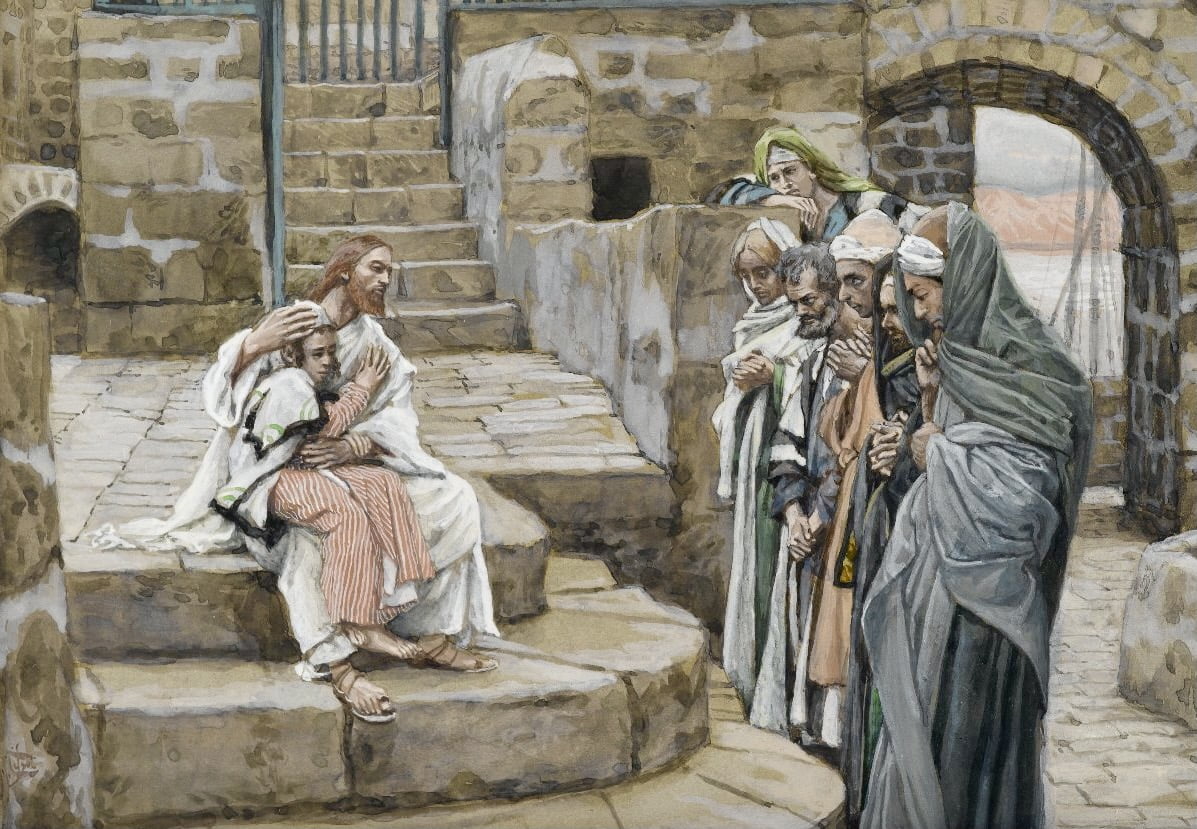
The picture at the top is James Tissot (French, 1836-1902), Jesus and the Little Child (Jésus et le petit enfant) which can be seen at the Brooklyn Museum. The expression on the disciples’ faces, and the location in a house suggest that Tissot is illustrating this passage, rather than the other example of when Jesus brings a child in chapter 10. He has subtly indicated that this is Capernaum by showing boats by the lake through the arch in the background. The courtyard house would not be untypical of buildings of this time, though I don’t personally recall seeing any with the layout in Capernaum.
Come and join the conversation, with Ian and James as thy discuss all these issues.
 Buy me a Coffee











Mark 8 and 9
Rejected by the rulers of the Temple
Misunderstood by his disciples
[they still had not understood what “Messiahship” meant even as late as the Assumption of Jesus their minds were still set on cultural [mis]understandings]
However, He must have been gratified that here there was a flowering blossom of at least recognition of the fact that He is the Messiah.
Jesus as Prophet, indeed the common people seemed to recognize the prophetic like ministry of Jesus even thinking He was “that prophet” spoken of by Moses or a “resurrected or reincarnated prophet, after all Elijah had not really died had he?
It is interesting that some thought He was Jeremias
Jesus certainly exemplified prophetic methodologies in these chapters, for example
Jeremiah 1 v 10
GOD reached out, touched my mouth, and said, “Look! I’ve just put my words in your mouth—hand-delivered! See what I’ve done? I’ve given you a job to do among nations and governments—a red-letter day! Your job is to pull up and tear down, take apart and demolish, and then start over, building and planting.”
The work at first seems one simply of destruction—to root out and ruin [The Hebrew, to destroy and rend asunder]. But beyond that there is the hope of a work of construction. He is to “build up” the fallen ruins of Israel, to “plant” in the land that had been made desolate. The whole sequel of the book is a comment on these words. It passes through terror and darkness to the glory and the blessing of the New Covenant (Jeremiah 31:31).
“The days are coming,” declares the LORD, “when I will make a new covenant with the people of Israel and with the people of Judah.
Jeremiah 31:28
And it shall come to pass, [that] like as I have watched over them, to pluck up, and to break down, and to throw down, and to destroy, and to afflict; so will I watch over them, to build, and to plant, saith the LORD.
[Interesting to note that there are 5 words of judgement to 2 words of building]
Ecclesiastes 3:2
A time to be born, and a time to die; a time to plant, and a time to pluck up [that which is] planted. God had planted a holy seed which now was corrupted and did not bring forth holiness time to pluck it up and plant a new planting.
“The days are coming,” declares the LORD, “when I will make a new covenant with the people of Israel and with the people of Judah.
See also: –
Deuteronomy 32:39 KJV:
‘Now see that I, even I, am He, and there is no God besides Me; I kill and I make alive; I wound and I heal; Nor is there any who can deliver from My hand.
1 Samuel 2:6-7 NKJV
“The Lord kills and makes alive; He brings down to the grave and brings up. The Lord makes poor and makes rich; He brings low and lifts up.
Matthew 15:13 But He replied, “Every plant that my heavenly Father has not planted will be pulled up by the roots.
A great deal needs to be pulled down before building can take place
A lot needing to be uprooted before planting can begin.
Some things need to die before life can flourish and be fruitful.
The Father is the Husbandman.