
Martin Davie writes: In a letter of 2 July this year to the signatories of a letter from the Alliance group within the Church of England to the Archbishops of Canterbury and York, the Bishop of Oxford wrote as follows:
The mind of the majority House of Bishops now seems to me to be settling on questions of pastoral reassurance after many months of uncertainty. There is a now a reluctant acceptance of the need for some regional provision of episcopal ministry to recognise divergent views on marriage and same sex relationships, supported by a House of Bishops statement, Code of Practice and Reviewer. However, the House is also clear that going beyond these arrangements to diverse jurisdictions, a third province and a church within a church undercuts the very essence of Anglican ecclesiology and represents a red line we cannot cross.
The references in the final sentence of this quotation to ‘diverse jurisdictions,’ ‘a third province’ and ‘a church within a church’ are all different ways of referring to the same idea, the idea put forward by the Alliance and the Church of England Evangelical Council (CEEC) that in the event that the House of Bishops and the General Synod continue down the path of permitting the blessing of same-sex sexual relationships and allowing those in same-sex sexual relationships to serve as ordained Church of England ministers, a third province of the Church of England should be created to provide a secure and permanent home for those who cannot in good conscience accept these developments.
The Bishop of Oxford rejects this idea on the grounds that it ‘undercuts the very essence of Anglican ecclesiology’ and therefore ‘represents a red line we cannot cross.’ What he does not explain in his letter, and what he has not explained elsewhere, is why the proposal for a third province goes against ‘the very essence of Anglican ecclesiology.’
It is very difficult to see why he thinks is the case.
It cannot be because those seeking a third province are rejecting the basic ecclesiological principle that members of the visible Church have an obligation to be in Christian fellowship with other members of the visible Church. Those seeking a third province are not doing this. They do want to remain in Christian fellowship with other members of the Church of England. However, they want to do so in a way that allows them to visibly differentiate themselves from what they believe to be very serious errors in theology and practice with regard to human sexual identity and behaviour.
(It is worth noting that the principle of differentiation because of differences of theology and practice has been an accepted part of Church of England ecumenical policy, which has always held that there can only be that degree of visible unity between churches that is permitted by their degree of agreement on matters of faith and order.)
It cannot be because a national Anglican church can only ever have two provinces. There is nothing in any statement of Anglican ecclesiological principle that states that there can only be a maximum of two provinces in a single national Anglican jurisdiction. That is why it is not seen as a problem that the Anglican Church of Canada has four provinces, that the Anglican Church of Australia has five provinces and one extra provincial diocese, and that the Anglican Church of Nigeria has fourteen provinces.
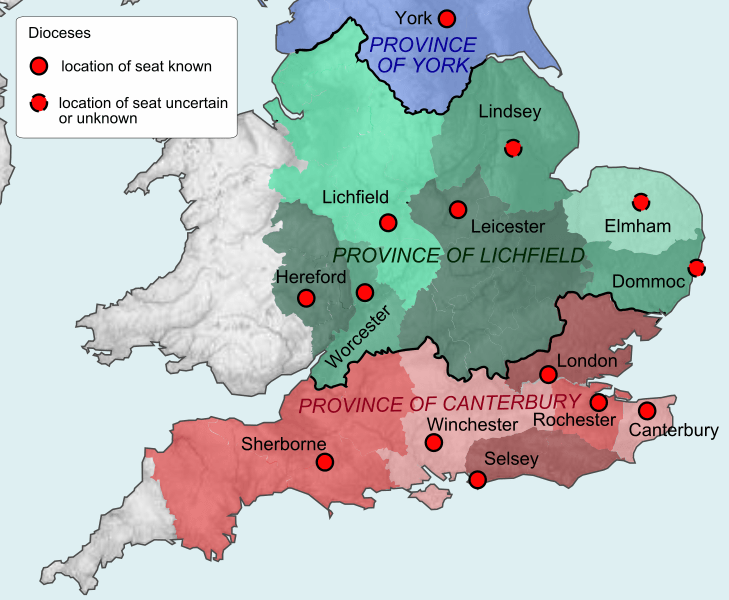 (Church historians will also be aware that between 787 and 796 the Church of England consisted of three Provinces, since Lichfield was an archdiocese, and that the United Church of England and Ireland which existed from 1800-1871 originally consisted of six provinces, Canterbury, York, Armagh, Dublin, Cashel and Tuam.)
It cannot be because the new province would be ecclesiologically different from the two existing provinces. This would not be case. Like the two existing provinces, the new province would consist of a number of dioceses under the episcopal oversight of an archbishop and a number of other bishops. The dioceses would operate in the same way as the current dioceses of the Church of England and would adhere to the Church of England’s current Canon Law.
It cannot be because, as is sometimes suggested, the new province would be a ‘non-geographical’ province. It would be geographical in the sense that, as in the case of the two existing provinces, the new province would have geographical boundaries, its dioceses would have geographical boundaries, and it would be made up of parishes each of which would have geographical boundaries.
It cannot be because a new province would create parallel episcopal jurisdictions thus violating the ancient principle reflected in the eighth canon of the Council of Nicaea that there should not be ‘two bishops in one city.’ The reason that there would not be parallel episcopal jurisdictions is that the dioceses of the new province would consist of a set of parishes that were different from the parishes remaining in Canterbury or York. It would therefore not be the case that the same parish would come under the jurisdiction of both a bishop from the new province and a bishop from Canterbury or York. Parallel jurisdiction would thus not exist.
It cannot be because the dioceses of the new province would be made up of parishes that were geographically scattered rather than being contiguous. There is nothing in Anglican ecclesiology that says that all the parishes in a diocese have to abut another parish in the same diocese. Until the Victorian period parishes that were geographically detached from other parishes in the same diocese were an accepted phenomenon. A classic example is the ancient parish of Croydon which was historically a detached part of the diocese of Canterbury (see several examples in the map at the top).
It cannot be because the creation of a new province would involve parishes ceasing to be under the ordinary jurisdiction of their existing diocesan bishop. This is not a ecclesiological problem because it has historically been accepted both that new dioceses can be created and that parishes can be transferred between existing dioceses. Both of these situations involve parishes moving out of the ordinary jurisdiction of their existing diocesan bishop and coming under the ordinary jurisdiction of a new diocesan bishop instead. Exactly the same process would take place in the case of parishes joining the dioceses of the new province.
Finally, it cannot be because the new province would differ from the other two provinces of the Church of England in parts of its theology and practice. The Church of England has already accepted the principle that parishes of the Church of England can differ from one another theologically over the issue of the ordination of women and express these differences in their practice. It is also proposed by the House of Bishops that the same will be true over the issue of human sexuality. If differences in theology and practice are thus judged to be theologically acceptable at the parochial level, then there can be no coherent objection to them also existing at the diocesan and provincial level given that diocese and provinces are ultimately just collections of parishes. To put it simply, if a parish can differ from other parishes in its theology and practice and still be part of the Church of England, why cannot a group of parishes (organised as a diocese or a province) do the same?
If we rule out these reasons for seeing a third province as ecclesiologically unacceptable then what the Bishop of Oxford (or some other members of the House of Bishops) needs to explain is why the House of Bishop refuses to entertain the idea of a third province. What, really, is their problem?
 Dr Martin Davie is a lay theologian who is a fellow of the Latimer Trust and theological consultant to the Church of England Evangelical Council.
 Buy me a Coffee









I think a major problem is that then you have to answer why can’t there be a fourth or fifth province for other groups. I’d argue there are demonstrably more anglicans in England who support SSM than who oppose blessings for gay relationships. So if there’s a third province for people who believe gay relationships are too evil(?) to be blessed then how can there be an argument against a gay inclusive fourth province?
Bring it on.
As long as we don’t have to pay for it.
After all this time, Peter, I still don’t understand why you create a straw man of the views of people you don’t agree with.
The question is not about believing people are ‘too evil’. The question is whether Jesus’ teaching on marriage is true and should be followed.
It is very odd that you still don’t appear to understand this position.
Ian
So what is the reason?
Dont just tell me Im wrong.
I dont understand how a group of Christians can be so passionately against something and so unwilling to speak openly about why they are against it.
The answer Peter as Ian and others continually point out, (and are very open about), is that SSM or blessings are contrary to the teaching of Jesus, the Bible and the doctrine of the Church of England.
Not because they are ‘too evil’.
Why is it hard for you to understand the reasons why they are against it?
So it’s just arbitrary?
to be fair, Ian, he didnt refer to individuals as ‘evil’ but to same-sex sexual relationships. Many would certainly refer to such relationships as ‘sinful’.
…which is different.
How is sin not evil?
Ian
Also, would you support the blessings if they were only for relationships where there was a presumption of no sexual activity, like CPs?
Pc1
I didn’t say sexual
you referred to same-sex marriage and gay relationships, and how some people view them as ‘too evil’. It is the sexual element in such relationships that are condemned, and you know that full well. It is clear you are not talking about friendships between 2 males or 2 females.
This analysis does not engage with the question: Can a parish secede unilaterally from its present diocese, without the agreement of its diocesan bishop, in order to join a new province?
Not that I care much. If hypocrites like +Oxford do not want their red lines crossed, they should desist from trying to cross the red lines of evangelicals, scripture, 2000 years of church tradition and the Lord Jesus Christ.
I think the answer is yes; this was the provision made for ‘alternative episcopal oversight’. The arrangements would need to be the same.
Is it possible for the CEEC to ask for, and obtain formal legal advice on this?
A parish which passes a resolution under the House of Bishops’ Declaration on the Ministry of Priests and Bishops does not “secede unilaterally from its present diocese” but does receive episcopal, pastoral and sacramental oversight from a bishop other than the diocesan bishop. In other ways – financial and adminsitrative, for instance, it remains very much a part of the diocese in which it is set. Those who are advocating for a third province appear to want a more complete separation, particularly of finances.
Yes, I think that is true at a regional level. But it would not be separate financially at a national level.
And such a parish remains part of the diocesan structures, including for the selection of ministry candidates and overseeing their training, as well as curate and incumbent training. PEVs and Diocesan/suffragan bishops work very closely and well in my experience because there is a genuine respect for one another and desire to remain in one church. As I understand it (but I may have got this wrong) the demand for a third province would include total separation from all of these, so different DDOs and selection panels, only sending candidates to approved TEIs (that would be difficult enough for residential colleges but how could regional courses work with this?) and separate curacy training programmes. And that’s without lay ministry training. It would have the massive downside that the very healthy interaction of candidates from different theological/liturgical traditions would be lost. It’s already the case that some TEIs with very strong traditions are difficult places for those who may approach things differently. We do, in fact, have much to learn together and from one another, including those we may disagree with.
Let’s not forgett that parish churches are for the parish and not just to be run by those who attend and that if a congregation is a gathered one that draws people from a wide area it may not reflect the views of those in its parish.
Paul Burr’s point below is an excellent one. Multi-parish benefices can’t be told what to do by the vicar so there may well be diversity on this. Appointments in rural areas could become a nightmare or evangelicals will decide not to go to multi-parish benefices.
I suspect the Third Province advocates intend the cut the cord with multi-parish benefices.
AJB – I suspect Justin Welby would like to close half the rural parishes in England and absorb them into larger central parishes with one or two centres. That’s always been his goal, although he will be long gone before it happens (as it will).
There would be a revolution if that happened in rural Parishes. Not least as a city, suburban or even market town Parish has very little connection to surrounding rural Parishes which are closer to each other in need and demographic, hence multi parish rural benefices
Excellent and clear article – if only most sermons were this punchy!
The answer, as we all know, is about power and control. Who are the churches most likely to sign up to such a province? Well that would be most of the resource churches revitalising other churches, the churches that are growing and seeing people – especially young people – come to faith in Jesus, that therefore have buildings that are well-used, full and able to pay their parish share and churches that have a younger demographic, and arguably more racially diverse one too, than other churches likely to remain in the other provinces. We all know that this is why the +Stephen and friends are against such a move. Who wants to preside over a diocese or province where the main task will likely be the closing of churches?
If that was 100% true Synod would never have voted for PLF in the first place as conservative evangelicals would have a comfortable majority in it!
I don’t follow your reasoning here. You seem to be doubly conflating synod with thriving parishes and conservative with orthodox.
Simon, you do realise that every clergyperson has a single vote on Synod elections, regardless of whether his or her congregation has 3 or 300 members?
Good article – clearly expressed and succinctly argued. Very helpful.
But a Third Province would leave many of us clergy (who don’t hold with same-sex marriage) even more isolated that we already are – because we serve in parishes (especially rural multi-parish benefices) where there is little likelihood of parishes voting to leave Canterbury or York.
Perhaps someone could write an article addressing that problem?
I think the whole process would in fact be a slow change over a period of time. During that, if a third province grew, there would be more ministry roles in those parishes.
In the meantime, there are support structures which are developing and which need to be developed further.
I’m in the same situation as Paul, both the churches in my parish have a range of views on sexuality and marriage, and if I tried to force the issue I’d decimate both churches, and probably myself, in the process. How many other evangelical clergy are in the same situation? Orthodox Anglicans are not concentrated only in orthodox parishes, we are spread all over the place. How can any new structure work for all of us, without saying ‘jump ship or we’ll have to leave you behind’?
David, I don’t think this new structure would ‘work for you’ in the current situation, in that I don’t think you could easily join such a new Third Province. But this is not an instant solution; no structural change ever could be.
What would happen, over the next ten years or so, is I would hope that we continue to invest in teaching the doctrine of the Church and the teaching of Jesus, so that people grow in their understanding.
At some point, those continuing to believe in this, and see it as of prime importance (which I think it is) will press for a decision.
What it does mean in the medium to longer term is the ending of such mixed parishes—which don’t really exist in other denominations in the same way.
But at the same time we will have to navigate a collapse in diocesan finances, and the collapse of much rural ministry. Those are bigger short term issues.
I am not sure if my comment is of any comfort to you though!
Jonny (at 9:48, 2 August above) is correct. A Third Province would immediately sign up the 500 largest parishes in the Church of England and would numerically be much larger than some existing Anglican provinces (SEC, the Church in Wales, Episcopal Church of Brazil etc).
Steven Croft would lose about a third of Anglican churchgoers in his diocese, and certainly the younger ones. That’s why he is determined to prevent this.
But we have to press on and create the structures. There is no time to waste in setting up the National Province of the Church of England.
Yes, I think that is right.
Not true, 56% of Anglicans under 40 in England back allowing same sex marriages in church but Anglicans over 70 oppose allowing same sex marriages in church by a 14% margin
https://d3nkl3psvxxpe9.cloudfront.net/documents/YouGov_-_Same-sex_marriages.pdf
“They do want to remain in Christian fellowship with other members of the Church of England.”
Really? I thought they were breaking communion with bishops and other members of the CofE. Not a whole lot of fellowship there.
“The Church of England has already accepted the principle that parishes of the Church of England can differ from one another theologically over the issue of the ordination of women and express these differences in their practice.”
A disingenuous sleight of hand here, and somewhat revealing. The creation of alternative episcopal oversight for this issue, was very clear that churches were not able to opt out of the diocese.
But it’s good to know you guys now want a full province. Have you considered how many diocesan bishops or thought about which cathedrals you want? Do you expect those diocesans to be entitled to sit in the House of Lords (at least until the current government reforms the chamber)? Most importantly, as you’re wanting to establish a new church founded entirely with an anti-gay litmus test when are you intending to get round to writing your own version of Issues in Human Sexuality? I think the rest of us will be very interested to see what you guys are going to want to say about (for example) the sinfulness or not of homosexual orientation and desire, whether orientation can or should be changed, whether you think gay people who are married or civil partnered are expected to divorce, whether gay people should change their sexuality, get married to people of the opposite sex anyway, consider themselves called to celibacy, live under a rule of singleness, something else, who knows? But as it’s the foundation of your province, presumably your views are well-formed.
AJB, I’m sure you know the cathedrals don’t “belong” to the dioceses, nor do the parish churches.
In any case the cathedrals are in a terrible financial state.
Did you know that Canterbury Cathedral lost £3 million because of the lockdowns? That’s why they are trying gimmicks like the Rave in the Nave.
As for your questions on homosexuality, I think you already know the answer to these questions: just look at ACNA in America and contrast that with the downward trajectory of TEC and the Anglican Church of Canada.
Now here’s a further observation: an acquaintance in Canterbury tells me that not just the Cathedral but other Anglican churches there are in an increasingly bad way. Churches which could pay their parish share before lockdown and had children’s work are now falling into the red and children’s work has largely faded. Yet the Bishop of Dover is aggressively pushing PLF and same-sex marriage. If that’s what the world wants, why aren’t they coming to church?
Bishops without cathedrals. I see.
Where have ACNA ended up? The last I heard the previous Presiding Bishop Foley Beach was writing grovelling apologies to the then-Primate of Nigeria for having the temerity to suggest there was such a thing as a gay Christian.
I didn’t realise that the point was to simply give the world what it wants. Curious that you think it is.
Putting aside James’s other comments…
Does a bishop “need” a cathedral? It’s about oversight rather than geography surely. It’s not as if Bishops are consecrated in “their” cathedral or have much in the way of rights there. They get a special seat… not that a throne is really *Gospel necessity*…
Isn’t there somewhere a parish church which functions as a cathedral? I may be mistaken but it’s in the back of my mind.
Derby Cathedral is a parish church that got promoted to a cathedral when we got a Bishop of Derby. So are the cathedrals in Chelmsford, Newcastle, Leicester, Blackburn, and Portsmouth.
Cathedral congregations are thriving and back to pre pandemic levels and they get paying tourists too as well as performing plays and concerts too. They belong to the dioceses in which they sit. There are still more members of TEC and Anglican Church of Canada than ACNA as well
https://www.churchtimes.co.uk/articles/2024/26-january/news/uk/cathedral-congregations-flock-back-to-pre-pandemic-levels-survey-finds
Leaving aside more minor matters like sexuality, is this 3rd province going to authorise lay presidency and other doctrinal innovations outwith Anglican polity? If so, it could hardly claim to be obedient to the BCP and the 39 Articles.
We don’t need to authorise “lay presidency” or lay baptism because they happen already, mainly in home groups. “Lay presidency” is a subject on which the Bible has nothing to say – or maybe it does because Acts says “they broke bread from house to house”. It very much looks as if the NT practice was that the head of the house offred the communion prayers. Do you read the NT differently? But let’s set up the National Province first.
Things which contradict the doctrine and liturgy of the CoE happening in private? Surely not?
Defending practices which contravene the teaching of the BCP and the 39 Articles? From a conservative on this site?
Not just a conservative but an Anglican priest for most of his sinful life. Where does a “lay communion” service in one’s home violate the 39 Articles? Perhaps you are thinking of your Roman Catholic upbringing, where you doubtless learned that only priests may offer the sacrifice of the Mass. That isn’t Anglican doctrine, Penny. I remember hearing Terry Waite saying he did this when a prisoner in Beirut and the Archbishop of Canterbury wasn’t bothered.
And Anglican midwives have always been authorised to baptise infants.
In an emergency anyone can baptise…
“1 In an emergency, a lay person may be the minister of baptism, and should subsequently inform those who have the pastoral responsibility for the person so baptized.”
It’s a matter of Church Order not a ministerial monopoly.
Yes. Anyone can baptise. In an emergency. Butvtye other dominical sacrament not so much.
St8ll, if you think lay Eucuarists being held in private with no authority is OK I can’t really see your problem with prayers that have been passed in all three houses of Synod. Or are you just a pick n’ mix Anglican priest?
When they are in private, they are not ‘Eucharists’ or Communion services.
You cannot have your disciplinary cake and eat it.
And I find it fascinating when people who publicly dissent from the teaching of Jesus and the doctrine of the Church on a major issue like marriage and sexual ethics suddenly become puritans on orders of service!
Ian
It’s because the dominical sacraments are of rather greater moment than a set of pastoral prayers which, in any case, have been passed by all three houses in Synod.
It’s the Alliance and the CEEC who are playing fast and loose with Catholic order and Anglican polity, not the so-called Liberals.
Order of our Services is what makes Anglicans unique, not our position on same sex relationships. Given southern Baptists, Pentecostals and Orthodox church, Free Church of Scotland and RCs generally oppose recognition, Lutherans and Methodists and Quakers and Church of Scotland back recognition via marriage or blessings
Ian, that is correct. Baptism may be administered by any Christian with the correct intention. Historically midwives had some trainjng or official recognition for baptism in the event of dealing with stillbirths. The Catholic position is the same.
But Catholics differ from Protestants in saying that lay celebration of the eucharist is ontologically impossible because non-priests don’t have the spiritual power to effect transubstantiation of the bread and wine.
As Penelope knows, this isn’t Anglican doctrine. Anglican practice restricts communion presidency in public worship to authorised ordained priests. This is good practice for public worship, but as with baptism, it doesn’t ipso facto prohibit lay celebration, in the ssme way that trained lay people also preach.
Yes it’s correct… It’s a quotation from CofE…
As to “sacraments”… Like most “evangelicals” I think Church Order is a serious matter. but that ordination is about wise ordering of church, not an ontological change in the person ordained. The (broadly) catholic Anglican holds a more ontological line.
There’s an obvious difference in the call (at ordination) for the role of the Holy Spirit in this. We’ve all lived with this different take, only now might it be seen to matter more and raised as “an objection”.
Re Penny… (sorry P, no nesting left) I think church order re sacraments is a thing that is practical and can be changed but not a matter of biblical theology.
Transubstantiation has nothing to do with it. Read the Ordinal.
Of course, in exceptional circumstances, lay communion may be valid (as would Baptism), re Terry Waite.
But home communions with lay presidency as a regular occurrence aren’t exceptional circumstances. They are non canonical. Now, lots of people wouldn’t give a gig about that. But they are not Anglicans.
“St8ll, if you think lay Eucuarists being held in private with no authority is OK I can’t really see your problem with prayers that have been passed in all three houses of Synod. Or are you just a pick n’ mix Anglican priest?”
Lex orandi lex credendi et vice versa. Andrew Goddard has exhaustively explained this matter already, several times. Prayers that contradict the doctrine of the Church have no place in our liturgy but introduce doctrinal incoherence. As one brought up as a Roman Catholic you should understand that.
Ian Hobbs is correct. The Catholic doctrine of ordination is that it effects an ontological change in the man, making an indelible mark on the soul of the priest, allowing him to consecrate the bread and wine, provided the correct words and actions are used. The Catholic priesthood is fundamentally about dispensing the seven sacraments. Lay people do not have the spiritual power to consecrate the elements (or to marry people or absolve sin etc).
This is not how we Anglicans understand ordination: it is primarily about pastoral care and evangelism/teaching. Ordination does not leave an indelible mark on our souls, as Catholics believe about Catholic priests. (That is why if an Anglican priest wants to become Catholic priest, he has to be ordained by a Catholic bishop.) Anglican clergy typically administer the sacraments of baptism and the Lord’s Supper, but this ministry is not exclusively tied to ordination. It is a question of practical order (like wearing robes in worship), not of doctrine.
Where is the canon that prohibits private lay-led communion?
James,
Canon B12 explicitly reserves the consecration and administration of the holy sacrament of the Lord’s supper to those who are episcopally ordained.
Canon C2 refers to the indelible “character” of ordination – that is, the ontological change which is part of the CofE’s pre-Reformation doctrinal inheritance.
Whatever lay people do in private is not the sacrament. It is not “valid”. But of course what validity actually adds to the breaking of bread is a matter of some debate amongst Anglicans.
Hi Bernard. I cannot find the language of ‘indelible’ in the canons; can you point me to it?
Indeed, if these people are lay, it cannot be the sacrament—in which case, why is there concern about it?
May I make a slight clarification. Holy Communion is already a lay celebration. In the Church of England’s understanding lay people always celebrate Holy Communion, but they only do so when led by a priest who is the president of the celebration. No one celebrates more than anyone else. ‘Holy Communion is celebrated by the whole people of God. ‘ The president presdies ‘over the whole service [and] must have been episcopally ordained priest …. [and] say the Eucharistic Prayer.’ (Common Worship, pp158-9.) It’s rather more than good practice but is an actual prohibition of lay presidency, but not lay celebration which is always the case. We may (or may not) wish it were different but that’s how it is. No one else is authorised for that ministry. The BCP likewise frequently refers to the ministry of the priest in the Holy Communion service and never suggests that a lay person can act in that role.
Tim
I hope I said presidency. We all celebrate. Only the priest presides.
Tim
As you said. I am agreeing with you but realised my response sounded rather curt!
Ian,
Canon C2 states that “No person who has been admitted to the order of bishop, priest, or deacon can ever be divested of the character of his order, …” This applies even someone is “deposed therefrom.”
I didn’t put “indelible” in quotation marks because the word isn’t present, but I can’t see how the meaning is anything else – nothing can divest (surely the same effective meaning as delete?) the character. And this must be theological background, mustn’t it?
Perhaps if James described it as ‘queering’ canon law, you’d think his position acceptable.
It’s not I who don’t find James’ position acceptable. It’s the Church of England.
Penelope, yes you did say presidency. I wasn’t disagreeing with you at all. But at other points in this thread lay celebration and lay presidency get a bit confused. As we both agree, lay presidency isn’t possible in the Church of England.
James
The Bible also has nothing directly to say on same sex marriage.
Again, I am baffled that you can make these claims.
If the Bible repeatedly teaches that marriage is between one man and one woman, how can that be construed as ‘The Bible has nothing directly to say on same sex marriage.’
It is such a strange claim to make…
It’s ok Penny, they’re in the gang, so they don’t need to worry about pesky things like the BCP and 39 Articles. That’s only an argument that’s allowed to be used against you and me. It’s all very simple.
If a third province was to be created, would the ‘official’ doctrine and practice of the CoE be of blessing and approving same-sex sexual relationships? Or is that too simple. Im thinking of the ordination of female priests which seems to be the accepted practice in most parishes, even if some argue the same-sex issue is on a different level?
No. It might be up to the remaining provinces to press for change—but all the current obstacles to that will remain in place.
There is a very fundamental ‘deal’ here; through the efforts of shall we say ‘gay propaganda’ way too many people believe that in effect “Being gay is like being black”. And where that is believed, any opposition to or criticism of homosexuality will be seen as a sin/crime comparable to racism and those engaging in such criticism will be seen as simply the worst kind of bigot.
Mucking around with fripperies like “Third Provinces” while failing to dent that idea is – well, you must have heard the phrase “re-arranging deckchairs on the Titanic”…. You may be able to save the CofE IF you tackle that issue – well, yesterday would have been a good idea – but if you don’t tackle that issue you WILL lose!!!!!
No, being gay isn’t like being black, any more than being straight is like being white. Black and white are colours. Gay (homosexual) and straight (heterosexual) are sexual orientations.
William
It’s not me that is making the gay/black comparison. It is gay people who then use that comparison to claim a legal position which allows them to bully and intimidate.
The point is that the differences between what is involved in being black and what is involved in ‘gay orientation’ are considerable and put the question into a completely different moral category. “Gay” is NOT about ‘just being’ – it is very much about things people DO, and CHOOSE to do, as you’ve agreed in previous responses if I remember rightly. It’s only “I had no choice” when it’s the kind of situation where they’re making an insanity defence.
Underlying the doing is not something straightforward but that people have urges/desires/appetites which cause them to do the acts. Now this category of stuff does of course go all the way from the positively saintly to the downright diabolical (and covers pretty much all of life, not just sexual issues!!); and that’s the problem. Urges/desires/appetites are not automatically OK to live out or act out; it shouldn’t take long to come up with a large list of urges and desires in all kinds of areas where itwould be very undesirable for them to be lived out. Or indeed even generally acceptable urges and desires which in a particular situation might be problematic and need to be resisted (a heterosexual attraction to someone else’s wife, for example).
And in a plural society it is perfectly proper to have a different worldview (atheism v theism for example) and have a legitimate reason to disagree about the appropriateness of certain urges and desires. One man loving another, no problem – see David and Jonathan; but is ‘sex’ an appropriate way to express that love? That is legitimately disputable. The false gay claim about ‘gay being like black’ seeks not equality but a situation where their urges and desires are improperly privileged by being put beyond question or challenge, which is a serious attack on the legal and civil rights of others.
And a failure to realise the difference between a simple ‘being’ like an ethnic difference and the complexities of something involving doing, choosing and urges/desires/appetites; that is at best horrendously careless and superficial thinking and at worst moral incompetence.
Gosh, Stephen. If you’d only mentioned this before.
Penelope
Given how often I have actually mentioned it before (though I admit not often at that length) – are you being sarcastic or just inattentive?
The point remains that
1) it seems pretty certain that the pro-ssm party are sincerely believing this mistaken categorisation of ‘gayness’ and are well-intentioned in trying to change the church – as in, they are right, IF the ‘gay/black’ comparison were valid, then opposing homosexuality would be seriously evil. So give them credit for their good intentions but understand that they will need to be put right about that. And
2) No matter what is said or argued within the church, unless that widely accepted mistaken categorisation can be seriously dented, the biblical case is not going to win in the outside world. Which for a church unbiblically ‘by law established’ means that the secular law and authorities won’t accept an evangelical win within the church, so the evangelical case will be lost just in a different way. Note by the way that what I’ve argued there is on general moral principles which should be accepted by thoughtful secularists – people don’t have to believe the Bible in order to realise that the gay/black comparison is invalid.
Stephen
Yes, William and others keep making this point.
Stephen:
No, it is not “gay people” who claim a legal position which allows them to bully and intimidate, but just SOME gay people who do so. SOME straight people behave similarly if they get the chance. Fortunately, most gay and straight people do not behave like that. The gay or lesbian ones who do seem in many cases to be people who, having been psychologically and/or spiritually bullied in the past on account of their sexuality, have now become bullies themselves. They remind me rather of what Sir Arthur Conan Doyle wrote in his novel, “A Study in Scarlet”, about the Mormons: “The victims of persecution had now turned persecutors on their own account….”
We have been over the difference between being and doing many times already. Being homosexual (“gay” or same-sex attracted), is something that people ARE, just as being heterosexual (“straight” or opposite-sex attracted) is. Homosexual behaviour, on the other hand, is something that people choose to DO, just as heterosexual behaviour is.
No sensible person disputes (1) that there are urges and desires to do things which are always morally wrong per se and which therefore should not be acted on, or (2) that there are urges or desires which are not intrinsically wrong, but which it would be wrong to act on in certain circumstances and which should then be resisted – and you have provided a very good example. I can think of others, as I’m sure that you can.
I don’t know why you have repeatedly laboured those points, as though I hadn’t understood them. I have understood them perfectly well. It is just that I disagree that homosexual desires fall into category (1) above. As far as I am concerned, they are in category (2). You are, of course, free to maintain otherwise, as you plainly do.
William Fisher
SL
First off can I say that I appreciate your contributions; they are a breath of fresh air compared to what I’ve sometimes faced on this subject with people in effect just mindlessly repeating slogans, whereas you clearly think at some depth. I’m sorry I’m failing to make my point understandable for you – I’ll try again below. You are so nearly right….
WF
No, it is not “gay people” who claim a legal position which allows them to bully and intimidate, but just SOME gay people who do so. SOME straight people behave similarly if they get the chance.
SL
Yes it is just ‘SOME’ – but it seems to be rather a big ‘SOME’ who have caused this misunderstood version of things to be very widely accepted which in turn has meant that serious discussion of the issue has been made very difficult. As I pointed out, there is one element of truth in their position, that IF their comparison held good, then opposing or criticising gays would be a serious sin/crime. And that is exactly why the misrepresentation needs to be opposed; way too many people have been harassed, sued, or prosecuted, and way too much court time and public money spent because of the misrepresentation, not to mention defendants unfairly having legal fees inflicted upon them. And on top of that the current confusion in the CofE….
WF
Fortunately, most gay and straight people do not behave like that. The gay or lesbian ones who do seem in many cases to be people who, having been psychologically and/or spiritually bullied in the past on account of their sexuality, have now become bullies themselves. They remind me rather of what Sir Arthur Conan Doyle wrote in his novel, “A Study in Scarlet”, about the Mormons: “The victims of persecution had now turned persecutors on their own account….”
SL
Agree with you about this; right now I’m trying to focus on the one point of clarifying that the gay/black comparison is wrong so that more normal discussion can take place and hopefully the church’s ‘liberals’ will stop repeating dodgy mantras and go back to Christian ideas on the issue. I will at some point be coming back to the fact that the CofE needs to face it that by being an established church that in the past bullied dissent in more than just sexual matters they have both some heavy apologising to do and some changes to make about that establishment.
WF
We have been over the difference between being and doing many times already. Being homosexual (“gay” or same-sex attracted), is something that people ARE, just as being heterosexual (“straight” or opposite-sex attracted) is. Homosexual behaviour, on the other hand, is something that people choose to DO, just as heterosexual behaviour is.
SL
I think perhaps the thing you haven’t grasped – and yes maybe I hadn’t worked out how to make it clearer – is that what people ARE in this category of “Doing and choosing because urges and desires” is a rather different and more complex quality or kind of “ARE” compared to the ‘being’ in that ‘gay/black’ comparison. And what makes it different is precisely that it can’t be glibly and automatically said that “Oh, I have the ‘natural’ urges and desires to do such-and-such – so it must be OK to act that out”. Rather more discussion is needed and it should be possible to freely have that discussion without being threatened with charges of ‘hate speech’ and the like.
There is a bit of Christian theology about this which is kind of the underlying idea of what Paul was saying in the early chapters of Romans – notoriously the place of one of the so-called ‘clobber texts’, but actually quite a closely argued exposition of ‘la condition humaine’, the problem of being human from which we need salvation. For a more detailed exposition than I’m about to give check out the book “Death in the City” by the American apologist Francis A Schaeffer, but the outline is that humans have tried to cut free from God, have tried in varying degrees to be our own god, and that not only puts us out of joint with God, it also puts us out of tune with the rest of God’s world including other humans and even within our own selves. That is why we ‘ARE’ the undesirable urges and desires and why we find them hard to resist. Ideally we should recognise those urges and desires as out of tune and realise we need God’s help to put us back ‘in joint’ even of our own selves.
WF
No sensible person disputes (1) that there are urges and desires to do things which are always morally wrong per se and which therefore should not be acted on, or (2) that there are urges or desires which are not intrinsically wrong, but which it would be wrong to act on in certain circumstances and which should then be resisted – and you have provided a very good example. I can think of others, as I’m sure that you can.
I don’t know why you have repeatedly laboured those points, as though I hadn’t understood them. I have understood them perfectly well. It is just that I disagree that homosexual desires fall into category (1) above. As far as I am concerned, they are in category (2). You are, of course, free to maintain otherwise, as you plainly do.
SL
On the first paragraph there basically I agree; on the second para you’ve understood a lot better than some but not quite made that connection that there is that different kind of ‘ARE’ involved. Also we are in territory where different presuppositions/worldviews make a difference to how certain acts will be interpreted. From a Christian viewpoint we believe that God has created sexuality as a thing for males-with-females (and preferably in a marriage), and that the desires of ‘gay sex’ are part of that ‘out of kilter because sin’ thing.
You say “You are, of course, free to maintain otherwise, as you plainly do”. It is pretty fundamental to Christianity as I read the NT that belief is voluntary; and that ideally there should be maximum practical freedom of belief in society at large.
Stephen
I agree 100%
The root cause of all the strife is that the CofE has avoided discussing fundamental questions of about gay people. You can’t really answer “is it OK to specifically prohibit blessings of certain couples” without first examining how they got into these circumstances and what better life route (if any) the church would recommend.
I used to do math tutoring and a common mistake anxious students would make would be to try to guess the answer rather than doing the work to find the answer. I strongly suspect that church leaders know fine well already these answers, but are willing to throw gay people under the bus to protect “orthodoxy”
The ‘root cause of all the strife in the CofE’ is that for years we have ordained people in all three orders who do not believe the Church’s own doctrine.
Penelope writes: “But home communions with lay presidency as a regular occurrence aren’t exceptional circumstances. They are non canonical.”
I don’t know of any canon that prohibits home communions with lay presidency.
Can anyone supply chapter and verse on this?
(BTW, I recall that in 2020 when they stopped giving the chalice at communion, the Bishops claimed that using multiple cups was “illegal” according to the Sacrament Act 1547. Six solicitors including 2 QCs wrote a paper to General Synod refuting the Bishops’ poor understanding of the law, and Andrew Atherstone wrote a piece here as well.)
Canon B12.
Penelope
Even a quite quick internet serach tells me that there are already fully lawful exceptions to the ‘ordained person only’ rule, and I assume that those exceptions would apply in a properly set up ‘Third Province’ or whatever.
Really?
That concerns Divine Service in the Church of England.
I don’t know of any canons that claim to assert authority over laypeople in home communion gatherings, using non-Anglican forms of worship. Terry Waite’s example shows that for Anglicans, it’s a matter of circumstances, not ontological impossibility (as it is for Roman Catholics).
I know of a number of house groups in my Anglican church which do this, following the practice of the apostolic church (Acts 2.40; 20.7; 1 Cor 11.20).
Strangely, Canon B40 seems to forbid Anglican clergy from celebrating Holy Communion in private homes, unless someone is too sick to go to church.
I don’t suppose Cranmer foresaw Home Communions. Or lay presidency.
If you want to follow the so-called Apostolic Church I might suggest that the CoE isn’t quite the right fit for you. Which I have long suspected.
Penelope
Anyone wanting to follow the Apostolic Church should of course join the Anabaptists.
Interestingly I’m about to lead a small group Bible study based on I Peter; that first epistle of the supposed first Pope is a favourite of Anabaptists – we wish Roman Catholics (and Anglicans!) would follow that actual apostle rather than later developments which go against the NT teaching of the apostles and indeed of Jesus himself….
Jesus himself anointed Peter to found and lead the church as first Pope, proper Anglicans believe their bishops follow in apostolic succession from him
Interesting to read in George Carey’s book ‘Know The Truth’ (2004), p. 37, that when he was in the army before ordination that he often celebrated Holy Communion according to the BCP ‘quite illegally, of course’.
A future Archbishop of Canterbury didn’t seem too bothered by this.
Penelope advises me:
“If you want to follow the so-called Apostolic Church I might suggest that the CoE isn’t quite the right fit for you. Which I have long suspected.”
Oh, I dunno. I’ve ministered for over 30 years in three dioceses in two provinces, and preached in All Souls and Canterbury Cathedral and seemed to get on OK. But thanks for your thoughts.
Why did you leave Catholicism?
Funny that you’re not at all bothered by Carey’s (Thatcher’s revenge on the CoE) illegalities, but no doubt shocked and appalled by all the bishops and archdeacons who turned a blind eye to gay partnered clergy.
The stench of hypocrisy is strong on this thread.
Penny: it was George Carey who wasn’t bothered about.
What’s a poor bloody infantryman supposed to do?
Increasingly it’s the bishops and archdeacons themselves who are the gay partnered clergy.
Justin Welby appointed two persons (one male, one female) in same-sex relationships as suffragan bishops – one of whom I knew when she was younger. He also OK’ed the appointment of the Archdeacon of the Isle of Wight who is in a civil partnership, and David Monteith, also in a civil partnership, as Dean of Canterbury.
All of this created gay and pro-gay pool in the House of Clergy.
When the Bishops and Archdeacons are in homosexual relationships, it is hard to get too sleepless about house group communions.
I think you have got camels and gnats the wrong way round.
Why did you leave the Roman Catholic Church?
As I have observed before, the sacrament of the Eucharist is of rather more moment doctrinally and theologically than a few pastoral prayers which have been agreed on all three houses of Synod and which don’t contradict doctrine.
But, as we’ve established, you don’t subscribe to Anglican polity. Despite preaching at ‘Some Souls’ and Canterbury.
I think there is now an increasing realization across the Cof E that the schism has now arrived see:
https://www.churchtimes.co.uk/articles/2024/2-august/comment/columnists/angela-tilby-schismatics-in-the-c-of-e-go-up-a-gear
What Angela Tilby fails to recognize however in her gaslighting article, is the true schismatics are the Bishops who have introduced these innovations with some publicly stating they are but a step on the road to full acceptance of SSM in the CofE, have fractured the Anglican Communion, and brought about the emergence of the Alliance as a consequence.
The schism rests squarely with them.
Illuminating comment from Angela Tilby:
“Like many others, I am grateful to Evangelicalism. It made a huge impact on me in my teenage years, teaching me to love the Bible and to pray with an intensity that often eludes me now.”
This is what typically happens when people begin to love the Church more than they love Jesus, or scholarly theories about the Bible rather than the Word itself.
And it happens when the intelligent and sensitive teenager enters adulthood and discovers that unlike the Pentecostal biographies they lapped up as a 16 year old – ‘The Cross and the Switchblade’, ‘God’s Smuggler’ et al – life proves a bit more complicated, especially where love, sexual desire and their own physical health (a special challenge for women, I think) is concerned.
‘Why hasn’t God healed me/given me husband/taken away my unwanted sexual desires?’
As if the Puritans that Tilby lambasts had never faced these questions either!
And then at university in the 1970s the young ex-evangelical learns that Christianity is misogynist and oppressive, as well as shot through with sexual hang-ups. Not very cool at all. (Later Muslim female students in their hijabs will get a total pass from terrified Marxists.)
And after university, there is the problem of getting respect in a post-Christian world.
Evangelicals have never been popular in the libertine world of the BBC or The Guardian, while the C of E at least got the invitations to the best events and dinners (royal weddings, Speaker’s Chaplain, Oxbridge chaplains and the other trappings of Establishment).
But those things look pretty faded now in a post-Christian Britain where the choice is now aggressive secularism or Islam.
So what else can Angela do but double-down on attacking ‘Puritans’?
How would life have been for her if she had been raised a Roman Catholic? Would she now be Sister Angela in some secluded convent?
What utterly creepy, ghastly, misogyny. I don’t always agree with Tilby but this is just cheap and nasty. And attempting to land risible blows on all your liberal bogeymen: the BBC, The Guardian.
Pathetic trolling.
Well, you were a Roman Catholic once, Penny. You could have entered the religious life.
There is nothing at all ‘misogynist’ in what I wrote. It’s pretty much the life story of Jayne Ozanne, except she took longer to enter into the light of liberalism and now Methodism. I think she’ll be bored with that by Christmas.
As for the BBC – they haven’t had a good week, have they?
And to think they once employed good Christian chaps like Huw.
He has five kids and he had a wife, but we can be glad that finally he can now be true to Huw.
All that secrecy must have had a terrible toll on the poor chap.
I found it weird that they relieved him of duties presenting the news when he *was* the news – and hence in a good position to provide detail and clarity on the main news story.
James
You have a very unhealthy obsession with my Roman Catholic heritage. I have no idea why. But you do have some rather odd views.
And Angela Tilby is nothing like Jayne Ozanne.
I’m no apologist for the BBC despite having worked for them, but they are not the only institution which employs paedophiles. Motes and beams
Penelope, I ask about your Roman Catholicism because you have never said why you left it for Protestantism. What did you find false about Roman Catholicism? You have never explained this or what you think is true about the niche of liberal catholicism that you occupy – a theological position which is actually in severe tension with historical Anglicanism.
Why did you join a reformed Protestant church? I really think you don’t understand Anglicanism at all. My reformed beliefs are entirely in line with the BCP and I’m actually liturgically more conservative than many Anglican clergy I know who seem to know nothing of the BCP or Patristics. There is nothing odd or unAnglican about my beliefs, they are just historic orthodoxy.
Why leave proper Catholicism for catholic-lite in Protestant church especially when you don’t like evangelicalism?
I was baptised C of E and am a liberal Catholic much like Penelope. One could equally ask why evangelicals like you aren’t Baptist or Pentecostal in answer to your question to Penelope why she is not still Roman Catholic?
Simon: because I believe Anglican doctrine.
I don’t believe Baptist or Pentecostal distinctives but fuly accept them as fellow Christians.
Liberal Catholicism is an early 20th century innovation in the Church of England, principally due to Charles Gore and quite unknown in most of Anglican history. It’s a funny mixture of liberal Protestantism and Hegelian-influenced Anglo-Catholicism that proved popular in England and the United States in the first half of the 20th century but has become increasingly incoherent as it became more radical in its biblical scepticism. Richard Holloway is the logical embodiment of liberal catholicism.
I didn’t become a Protestant. I joined the CoE. Colin Bennetts inducted me – if that is the right term; probably not.
I have just returned from Mass in Exeter, followed by the Angelus.
Good liturgy and music. Sacramental. Short sermon. The nearest thing to perfection this side of the eschaton!
The Mass and the Angelus are not services authorised by canon. So whatever you were doing, it was not Anglican.
Ian
https://www.churchofengland.org/faith-life/what-we-believe/eucharist
Clearly written by someone who does not know the doctrine of the C of E, having no authority, and without an author name no transparency or accountability.
The Mass is the title of the Roman Catholic rite, which involves the ‘sacrifice of the Mass’ offered by a sacerdotal priest. I trust you are aware that at the Reformation, Protestant churches like the C of E rejected this.
So Penelope – no more midnight Mass (redundancies of heretical bishops) in the C. of E..
Ian and Jock
Oooh, I don’t like that description becaue it doesn’t fit with my low-church ecclesiology. It must have no authority.
Er, no—it has no authority because
a. It is a page on a website
b. It is anonymous
c. It does not line up with the Articles, which are the basis of C of E doctrine (see canon A5).
It’s a page on the official Church of England website.
Most are anonymous.
Canon A5 has nothing to say about the Mass.
Canon A5 points to the Articles and BCP for our doctrine, which includes Article XXVIII, which rejects the theology of ‘The Mass’
You heard it here first! Midnight Mass at Christmas is now unAnglican!
Article XXVIII rejects a cartoonish version of transubstantiation. It affirms however that we’re talking about a sacrament where we are partaking of the body and blood of Jesus Christ.
And far from the Reformation being a rejection of the Mass, the Confession of Augsburg is adamant that reformers like Luther did not abolish the Mass, but rather retained, celebrated, and defended it.
James – in your critique, you missed the most important thing. While she said she was grateful for the impact that Evangelicism (whatever she means by that) had on her, she never once mentioned that she actually came to faith – by which is meant belief in Him (John 3:16) and hence the assurance that comes through this that she has entered into eternal life through Him. In other words, nothing to suggest that she is a Christian.
Jock, I certainly wouldn’t say that. I’m sure she did make a profession of faith as a teenager. If someone professes faith and tries to live as Christian, we should take them at their word. I ask the same charity for myself. Only God can read our hearts.
James – I’d say you are wrong about this. Note carefully the second last sentence, ‘What I found hardest to give up when I drifted away from Evangelicalism was the certainty of being right.’
Now, I’d say that in many practical out-workings of faith, I have drifted away from the certainty of being right, but there is one absolute certainty that I haven’t drifted away from. Furthermore, any Christian would have been very careful to clarify that, in terms of the ultimate goal, which is her own salvation, she hasn’t moved away from that certainty. This isn’t rocket science – it’s basic Christian profession.
You may turn around and say, ‘well that bit is obvious’, but really it isn’t – and if you think it is, then you have been in completely different circles from me. (Take a simple example – Salvation Army – on the wagon = saved, back on the bottle = lost. If you’re lost, it’s because you weren’t trying hard enough – don’t blame Jesus). There are many people masquerading as Christians, who consider that the crucifixion gives them grounds for optimism, they are quietly confident, but there is still some part of their salvation that is up to them.
A Christian would have found some way of expressing the fact that while the application to the difficulties of life may not have been as clear cut as she imagined in her teenage years, the ultimate business, of her salvation, through Christ’s work on Calvary was a clear-cut certainty.
On the last census 46% were Christian in England and Wales, 37% irreligious and just 6% Muslim
The 6% Muslim figure is projected to be 20% in 2050, almost exclusively urban. Some cities will be majority Muslim then, and probably not very gay-friendly.
T1
You said above
“Jesus himself anointed Peter to found and lead the church as first Pope, proper Anglicans believe their bishops follow in apostolic succession from him”
Which makes it rather interesting that Peter’s first epistle is a favourite text of almost the diametric opposite wing of the Church, while those who claim ‘apostolic succession’ from Peter are often opposed to his teaching….???
Indeed it does, and it needs saying to the bishops specifically. At present the evangelical line to the bishops is: “If you do *this*, we will do *that*.” The line needs to be: “Do not do this. Whatever your worldly authority within the Church of England, you have no authority from God to contravene his holy scriptures, to which we remain true. You should repent and resign. If you do not then we shall take the action we have warned you of.”
Notice how, in the written Law of Moses, God often states a law unconditionally (i.e. in an apodictic way) and later restates it as an If-statement (if you do this…) with a specified penalty (casuistic). There were logistical reasons for that, related to the dying-out of the generation that left Egypt before reaching Canaan and the need for prescribed penalties once there; but there is also a theological reason, to do with God’s authority.
Nope, as majorities in all 3 houses voted for PLF and indeed TEC, SEC already offer same sex marriages in the Anglican communion and the Canadian and New Zealand and Australian Anglicans offer similar services to PLF so even no recognition would have not stopped a divide in the Anglican communion (which is not just the African churches which were founded 300 years after the C of E). Indeed in the 16th century when the C of E was founded there were hardly any Christians at all in Africa
I think Egypt and Ethiopia count as Africa. There were plenty of Christians there in the 16th century.
Although I don’t know what your point is.
In the 16th century Egypt was part of the Muslim Ottoman Empire
I know that – and there were many Christians there. Egypt was probably majority Christian until the 13th century. And Abyssinia was a Christian kingdom for centuries – long before the kingdom of England existed. So your statement that “there were hardly any Christians at all in Africa” in the 16th century isn’t true. But I don’t know what your point is here.
The ‘Theological Vision’ of the Alliancecofe.org lacks an explicit and unambiguous commitment to believe and preach the evangelical doctrines such as original sin, penal substitution, eternal retribution from God on the unsaved on the Day of Judgement.
Phil Almond
Yes, it is remarkable how those doctrines that in an earlier age (even 40 or 50 years ago) would have been central to mainstream evangelicalism have not been included. Do you think it’s because the signatories couldn’t have agreed on them or for some other reason?
It is suggested that it’s more likely to do with the timescale, a last resort timescale for response to a situation that was not foreseen, or hoped against hope, wouldn’t happen.
The evangelicals were not an organised, planned, cohort, unlike the revisionists who played the long game.
As I look through this thread I’m struck by the way that the disagreement over LLF/sexuality seems to have become a proxy standing for a whole much wider range of issues across the whole life of the church. E.g. The role of bishops, sacraments, ordination, establishment, original sin, atonement, eternal punishment, all have somehow piled in behind the more limited topic of sexuality. So is it the case that there is widespread disagreement over all these areas (and more besides)? If that’s the case there doesn’t seem to be much that all can agree on. So rather than an additional 3rd province are we looking long term at two churches, completely separate from each other? A kind of 21 century equivalent of the C18 Church of England – Methodist split? I very much hope not since I believe that the Church of England has a unique charism to offer within the life of our country but the more I read the stronger the anti bishops, anti Church of England, anti establishment and separatist tone becomes. Perhaps we all need to row back a bit from our rather extreme views and seek a common mind.
Tim – I think you’re actually looking at 153 provinces (rather than just 2) to keep everybody happy. The song ‘the one thing which unites us all is Doctor Marten’s boots’ springs to mind.
Tim
There isn’t a common mind. Neither on sexuality nor on the infinitely more important issue of what faces those on the Day of Judgement who have not submitted to Christ in His atoning death and life-giving resurrection. This is the moment which may never occur again for those who believe such people face eternal retribution from God to unite and proclaim that terrible truth alongside the sincere invitation to all to repent and submit to Christ.
Phil Almond
Whilst this is being used a wedge issue by a good number of people who’ve never really liked the Church of England and the bishops (despite being in it), I don’t think there’s a great deal of unity amongst them in reality. Even on the issue of sexuality, they’re incredibly reluctant to spell out what the want the doctrine and teaching to actually be, what they’d replace Issues in Human Sexuality with etc.. Likewise, I don’t detect a willingness to move to something more confessional that would bring out all the differences in view – e.g. penal substitution, annihilationism, original sin etc. – especially at a time when they want to keep the congregations on board with what they’re doing.
I think the game being played is one aiming at complete separation. The third province idea is simply a way to schism and keep hold of as much money as possible whilst they do it. Hence, whenever anyone tries to suggest doing something that might foster agreement, you can be sure it will be shot down. They need to foster the division as thoroughly as possible.
Are you forgetting that division was begun, not by evangelicals, but by a hierarchy dissatisfied with the biblical view of what is right and wrong?
I believe that penal subsitution is just one facet of the atonement, and that to teach it without the other facets gives a misleading picture (not that I deny penal substitution). And I think that Augustine of Hippo’s understanding of Romans 5 is misleading, although I accept that every human being is born worse than God’s original design plan. But these are matters of exegesis of uncontested scriptures, which is not the same as outright denial of scripture.
Thanks, Anton. I considered writing something similar. Perhaps the lack of a hyper-evangelical statement is merely that it is understood that there is a range of totally orthodox exegesis in these matters – which can’t be said for any of the revisionist positions?
Indeed – some are OK with the LGB but not the T (like Lorenzo Smal). Some think the bodily Resurrection of Jesus happened, but many others – like Archbishop Peter Carnley- don’t believe in it. Many revisionists think Jesus is God incarnate, but many others don’t really believe this and are really unitarians. Most of them believe in God but some like Bishop Richard Holloway are atheists or agnostics. It simply isn’t true that revisionists share tge same beliefs.
Belief in Jesus’ bodily resurrection is a red line that is stated in the Bible itself (1 Corinthians 15).
I have no problem with unbelief outside the church. That’s God’s business on the day of judgement. But unbelief among those who receive a salary from the church to promote the faith, yet peddle the opposite, is stinking hypocrisy. They will not be forgiven.
‘I accept that every human being is born worse than God’s original design plan.’ Will we then be punished for the way we were actually created, that is to say, born? Either that or we are held responsible for the loss of this original design, which we have nothing to do with. Grim.
But if we have free will and can choose to accept the offer of help (grace), it’s not so grim, is it?
God’s grace is like medicine or food in a well stocked house. It is always there, but we have to decide to take it every day.
Some people may need help in finding the kitchen.
Lorenzo – well, I haven’t really seen ‘free will’ in Holy Scripture. I suppose that in some sense it does exist; Hebrews 6:4 tells us that there are people who have come to a state of enlightened understanding – and decide that they hate the whole game and turn their back on the prospect of the heavenly life. Even though they were enlightened, they never came to faith – they never believed (in the sense of John 3:16) that Jesus had died for their sins, basically because they didn’t want the heavenly life. But I don’t think that the comment of James is remotely helpful; it misses the mark in important ways and shows a false understanding of what grace is.
The important question is whether you personally have come to believe, in the sense of John 3:16. Nobody else knows the answer to that except you and God. If you have, then you have entered into life, eternal life, which is something that won’t be taken away from you – and there is the promise that you will be raised ‘incorruptible’ (somewhere towards the end of 1 Corinthians) – which means the ‘innermost being’ of Romans 7, freed from the down-drag of the ‘sinful nature’.
Genesis 1:4 states that God separated the light from the darkness – and I believe that this is eschatological – in the sense that we only see it fully in the next life. Romans 7:14-25 (Christians insist that this is written in the present tense, describing the inner conflict of mature Christians – as Paul was when he wrote it) describes the tension between the ‘innermost being’ and the ‘sinful nature’ – and despite our own will (and the grace of God) we continue to commit sins.
Stating that ‘every human being is born worse than God’s original design plan’ is simply another way of stating your own position on ‘Natural theology’ (which – if I remember correctly – was that it is ‘rubbish’). There is the corruption from our own sinful nature – and, very importantly, there is corruption through no fault of our own (at the moment, I see what advanced dementia has done to my mother).
If you have come to believe, then you have assurance and the Spirit as a deposit *guaranteeing* what is to come (as the Holy Scripture informs us in several places).
We all face repeated choice to sin or not and we all often sin. We remain responsible for those choices.
As for 1-day-olds who die, the Bible is silent and so am I. It is enough that nobody gets worse than they deserve from God, and some get better. Nobody has any just cause for complaint.
Jock writes: “But I don’t think that the comment of James is remotely helpful; it misses the mark in important ways and shows a false understanding of what grace is.”
Explain, please. (That’s a joke for Aussies, btw.) Is grace imposed on us willy-nilly? If I step on rotten timber I have no choice but to fall – the law of gravity is unforgiving.
But I have a choice not to step on it – or at least I *think I do.
Is my belief that I can make choices false? Or do I have real agency in my life? This is one of those debates in the philosophy of mind and materialist determinism.
I understand Scripture as saying I do have real choices.
Or was I just programmed to think that?
Because if I don’t have real choices, this is bad news for the criminal justice system. Grim.
Lorenzo
Romans 5 12-21 is key. 5:18 says “So therefore as through one offence to all men to condemnation…..”. We are all condemned and deserve punishment because of the sin of Adam.
Phil Almond
James – well, since you’re a brainy guy who has studied a lot of theology and has read all of Thomas Aquinas’s books, you can answer your own question – so that the Aussie joke isn’t on you (as it would seem from your last comment about the criminal justice system).
Clue: Apostle Paul on the road to Damascus – yes – he did have a real choice; when Jesus met him, he could have told Jesus to go and boil his head, but he didn’t. Do you think this was a likely outcome? unlikely outcome? What would have happened if he had said ‘no’?
We do have choices; these choices are real and some people, when completely enlightened about what it is all about, say ‘no’ (Hebrews 6:4), but there is a very good reason why ‘free will’ is not a term found in the Holy Writ (while our responsibility is very clearly written there).
Jock – many terms like ‘free will’, ‘Trinity’, ‘homoousion’ etc are not found in the Bible, but the question is always, ‘Does the Bible teach these ideas?’ E.g. ‘Choose this day whom you will serve.’
‘Free will’ is just another way of saying ‘you have a real choice’.
The degree to which we can choose does of course vary from person to person. Alcoholics, for example, find it harder to refuse drink than others so. But they are deemed responsible if they drink and drive.
James – it might help if you try to distinguish between a logical impossibility and a moral impossibility. The apostle Paul telling Jesus to go and boil his head on the Road to Damascus was a moral impossibility; given Paul’s state of mind at the time, it simply wasn’t going to happen.
(Logically, of course, Paul did have the choice to tell Jesus to go and boil his head – and he exercised his ‘free will’ not to do this, but instead to follow Jesus).
I do read the Bible, Phil and am quite aware of what Paul wrote in
Romans 5 12-21. But what sin of Adam? In light of modern evolutionary biology, how did it happen? And how did I inherit it? We’re back to G-d punishing us for the way we are created. Grim. Evangelical soteriology stopped making any sense ages ago but you all continue as if original sin were still a thing.
Lorenzo – I don’t know whom you mean by ‘all’ – I for one have already indicated that I consider Phil Almond’s take on ‘original sin’ to be repellent hog-wash.
I always thought that ‘original sin’ was a concept that you guys (i.e. Catholics) came up with and were fond of.
Lorenzo
You say you read the Bible but do you believe what it says – obviously you don’t believe Romans 5:18 – you are just questioning what it says.
Phil Almond
Jock
You posted
“Lorenzo – I don’t know whom you mean by ‘all’ – I for one have already indicated that I consider Phil Almond’s take on ‘original sin’ to be repellent hog-wash.
I always thought that ‘original sin’ was a concept that you guys (i.e. Catholics) came up with and were fond of.”
So how do you understand Romans 5:18?
Phil Almond
Anton
Nope.
A difference of opinion about what the Bible has to say about gay people and gay relationships. Neither side is outright rejecting scripture. Both sides use scripture to defend their beliefs
Peter: Leviticus 18 states that God regards man lying with man as with woman, i.e. for sexual gratification, as toevah; check the Hebrew. God doesn’t change his mind, does he? In the New Testament, moreover, Jesus Christ took the written laws of Moses as the word of his Father.
Anton, you should really get hold of a good rabbinical commentary on Tanakh. Many things are declared toeiva, some of which you recently argued Christians were freed from, not being moral commandments. You were arguing that G-d did indeed change his mind. Many modern orthodox rabbis do indeed regard the verses you allude to as religious offences, not moral ones, on a par with eating prawns, cheeseburgers, wearing shaatnez, or driving on the Shabbat.
Lorenzo, I think you do put your finger on a really key issue, and one which evangelicals and other have often not handled well in the past.
The historic C of E response (which I think has been shared across the Reformation) is the division into the three categories of moral, sacrificial/cerenomial, and civil. As you highlight, this is a problematic approach since this is not how the Torah actually parses itself.
Philip Jenson agrees with you! His booklet on this is very helpful: https://grovebooks.co.uk/product/b-58-how-to-interpret-old-testament-law-2010/
He notes that there is indeed a parsing—one of highest level, mid-level, and detailed application, reflected in both main types of law, epideictic, and casuistic.
In assessing these, we also need to look back at creation principles, and forwards to the teaching of Jesus and his claim to ‘fulfil’ the law. Taking all this together, we can see that same-sex sexual relations are a violation of God’s creation of humanity as male and female (looking back) and that man-woman marriage continues into the new covenant in Jesus for both Jew and Gentile (looking forwards).
This is a coherent and robust reason why male-female marriage has been the consensus teaching of the church catholic in every culture, time, place, and tradition.
I’ll stick with the rabbi rather than Jenson when it comes to Torah. Here’s the conservative teshuvah.
https://www.rabbinicalassembly.org/sites/default/files/2023-01/dorff_nevins_reisner_dignity.pdf
I did manage an MA in Oriental Studies, both Hebrew and Aramaic and I have never seen the any pasuk or place in the Talmud envisaging kiddushin as a ‘creation ordinance’ as do evangelicals. When the ‘Old Testament’, so called, conceives of marriage, it never appeals to Gn 1 or 2 or any kind of necessary complementarity between man and wife. Marriage is a contract and its underlying anthropology way more sexist than that. The nearest thing to it I’ve ever come across are cabalistic ravings among some Orthodox Jews seeing marriage of a Jewish man with a Jewish woman as a reunion of two halves of the same Soul.
I don’t know why you would dismiss Philip Jenson. He is a respected OT scholar with 40 years of teaching and writing.
I am a bit baffled by the idea that ‘the Old Testament never appeals to Gen 1 and 2’, since they are part of the OT, and if reaching their final written form at a later date, appear to have a significant reforming affect on the development of the understanding of marriage.
And of course, for Christians, the key aspect of this is the way that Jesus and Paul appeal precisely to sex differentiation in creation in their comments on marriage.
PS you would enjoy the Grove booklet. Do get hold of a copy
My apologies, this sounded haughty. I took offence at being recommended a Grove booklet and I really should not have.
There are two things you don’t say, Lorenzo.
First, not only is man lying with man as with woman, i.e. for sexual gratification, described as toevah in Leviticus 18 but, in the one time and place in which scripture has God setting the laws, it attracted the death penalty (Lev 20).
Second, the passage in Leviticus 18 describing this practice as toevah begins:
The Lord said to Moses, “Speak to the Israelites and say to them: ‘I am the Lord your God. You must not do as they do in Egypt, where you used to live, and you must not do as they do in the land of Canaan, where I am bringing you. Do not follow their practices. You must obey my laws and be careful to follow my decrees…
There follows a list of practices which the Israelites are commanded not to do. All but one are about sexual relations, including the matter at issue. (The other is a command not to offer your children for sacrifice to the pagan god Molech.) The passage then ends:
‘Do not defile yourselves in any of these ways, because this is how the nations that I am going to drive out before you became defiled… I am the LORD your God.’
In light of these passages, and Jesus’ affirmations in the New Testament of the written laws of Moses as being a faithful statement of his Father’s views, what do you believe God’s view is?
Ian
You do know that most respectable biblical scholars argue that this moral/civil/ceremonial distinction is anachronistic hogwash.
Yes, which is why I commend Philip Jenson’s analysis. Did you not read my comment?
AJ Bell
Yes exactly. And other conservative splits in the communion have run into divisions on gays and women, even despite all of them leaving on the belief that the “Bible is clear”.
Quite. At least Wesley remained a loyal Anglican.
Ah yes. He was a founding member of the Holy Club. And now is an exemplar for the Alliance as the whole world was his Parish.
Wesley was such a loyal Anglican that he, an Anglican priest, personally ordained two men to be pastors and one to be a bishop in America.
Not a lot of people know that, as Michael Caine would say.
Makes lay communion look like small potatoes.
And influenced substantially by the Moravians, Count Zinzendorf, those well established Anglicans!
Yes, there was a reason John Wesley was kicked out of Anglican churches and had to preach in the fields instead. The Anglican hierarchy hated him.
James
They hated him *because* he preached on the streets, in fields and by mine heads.
Wouldn’t it be great if we could have church with actual Christians leading?!
Peter: Wesley was excluded from preaching in Church of England churches by bishops and clergy. That’s why he took to open air preaching. You should read up on the history.
And he, though not a bishop, ordained two men to be pastors and one to be a bishop to carry on the work in America.
Penny said he was a ‘loyal Anglican’. How can a mere priest ordain others? Not very Anglican, ISTM.
James
The main problem that the establishment had with Wesley was that he was preaching in other people’s parishes (in the open air)
It seems that the Revisionists are rattled. Schemers are unsettled, yet the High Priests/ Priestesses of the CoE remain unrepentant.
There are already flying suffragen bishops offering alternative episcopal oversight for those in the C of E opposed to women priests and bishops. The Bishop of Ebbsfleet provides oversight for conservative evangelicals who don’t accept ordination of women and the Bishops of Oswestry and Fulham, Wakefield, Beverley and Blackburn provide oversight for Anglo Catholics opposed to women in ministry.
Given those opposed to prayers for same sex couples in the C of E tend to also be those opposed to women priests then most such conservative Parishes can simply stay under their current flying bishop. There is no need at all for a third province splitting up the C of E by refuting the authority of the Archbishops of York and Canterbury, who have led the 2 provinces of England for a 1000 years. The only further change that could be offered is to offer another flying bishop for evangelicals who are too liberal for the Bishop of Ebbsfleet, as they accept women priests but are still conservative in opposition to PLF. As there is a relative shortage of evangelical flying bishops compared to Anglo Catholic flying bishops I am sure another 1 or 2 can be created. You could even have a female flying bishop who rejects PLF for such evangelicals maybe?
It’s not up to you, Simon. When the National Province is established, the orthodox will join, and the liberals can get on with becoming like the Scottish Episcopal Church, with nice candles but no kids.
Which orthodox though? Those who reject women priests and PLF as well as those who accept women priests but reject PLF? The 3rd province would be itself divided. Younger Anglicans are also more supportive of PLF on average
Do you know any Anglicans under 30? Are there any children in your church?
Are you aware that children’s work has collapsed in the C of E, especially since the pandemic and shows no sign of recovery.
You’re just making it up, Simon.
Seems like the revisionists are getting rattled.
I think you are right. A quick perusal of ‘Thinking Anglicans ‘website shows them upset and hostile about the idea. The thought of a church losing 90% of its under 40s would be upsetting.
I imagine theey know what has happened to the Methodists in the USA.
56% of Anglicans under 40 in England back allowing same sex marriages in church but Anglicans over 70 oppose allowing same sex marriages in church by a 14% margin
https://d3nkl3psvxxpe9.cloudfront.net/documents/YouGov_-_Same-sex_marriages.pdf
Jayne Ozanne touted this stuff before and it was laughed out of court then. Quite meaningless until you know what definitions, sample and methodology were used.
Simon, you are on record as saying there are “26 million baptised Anglicans” in England- 25 million of whom never make it to church even at Christmas.
Simon, are there any young people in your church? Any families with young children?
You seem to think people get more religious as they age. They don’t.
What is the age profile of your church? Mainly over 60?
Even more evidence why people like you should not be in the Church of England. The Church of England is established church representing everyone who lives in its parishes, even if they rarely go to church and Anglicans are anyone baptised in the C of E even if only go to church at Christmas. If rejecting them you ain’t got no place being in our established church!
Simon, you do have a bizarre view of what a ‘church’ is. I really don’t know where you get it from.
‘representing everyone who lives in its parishes’ So the C of E represents atheists, Muslims, Hindus, and everyone else?! You seem to view the ‘church’ as some kind of social club, completely detached from the teaching of Jesus and the call to discipleship.
Have you ever read the Book of Common Prayer?
By contrast some on here have a rather bizarre view of what a C of E church is. Yes, as established church the C of E also historically represents atheists, Muslims and Hindus in its parishes too, hence it is the only faith group with presence in the Lords at the moment and hence also C of E vicars are expected to get involved in community events like fetes and town shows and remembrance sundays and with local schools and work with other religious leaders on food banks and charitable activities.
Yes part of its role is also the teachings of Jesus and his discipleship but its role as established church also includes the community work I set out. Plus providing baptisms, weddings and funerals for all residents of its Parishes who want one in their local Parish church.
The BCP also affirms the King as our Supreme Governor, as he is the nation’s head of state, another part of our role as established church leading royal events like royal weddings, funerals and coronations
T1 (Simon) writes:
“Yes, as established church the C of E also historically represents atheists, Muslims and Hindus in its parishes too…”
That will be news to them! I don’t hear of Anglican clergy going parish visiting in East Leicester and Bradford and offering to baptise the kids. Simon, you should report them for indolence and neglecting their duties!
Over 2 services on a Sunday there are around 300 in attendance multi ethnic multi-age with young families, approx, 100 children and young people and services and teaching getting youngsters ready for university and the pressures against faith.
The church supports missionary partners in Spain, and two areas in Africa.
It is Anglican, subscribing to the 39 Articles, and m+f only marriage. And is seeking to plant a church. Itself having been a plant less than a decade ago. Financial giving is substantial.
Evangelical? Bible believing? Yes, and yes thoroughly.
All well and good for that church but nothing there you have mentioned a bible believing Baptist church is not also doing. Nothing particularly Anglican about it
Are you for real? Have you actually read what I wrote?
Are you Christian? How so? When? Why?
Which God do you worship, and represent as CoE.
As an adult convert in a CoE and confirmed by a Bishop, I do not recognise anything you write in your comments as remotely Christian, as a believer, as you have said nothing in matters of Christian belief, faith.
Your worship of Anglicanism has nothing Christian about it and denies what it means to be church, which remains unknown to you, as undefined.
And if your comments represent anything remotely of a measure of the CoE, it is an empty shell. Ichabod.
Whitewashed tombs, springs to mind. Ichabod, indeed –buildings with ‘vacant possession’.
No a Christian church but also one which is an established church performing Parish ministry for all which you seem to have no interest in
That is mere unevidenced assertion, with severe avoidance issues, questions unanswered.
Have no interest in local work?, as our church works with local schools, including RC, provides a local cafe and street conversations and door knocking, and it is multi-ethnic as is the community.
You draw false conclusions from ignorance of facts, in your bigotry against the Evangel of Jesus the Christ, (which you are unable or steadfastly unwilling to articulate). Disgraceful and to me brings dishonour to the CoE, as does all the shenanigans of the Bishops detailed in the many articles of Andrew Goddard and false public declarations, ordinatation vows .
If it is a state established ‘church’ it continues established on cant and falsehood; thoroughly dishonourable, sub – Christian: integrated unholy unrighteousness.
As a former solicitor, I’d not trust you as a reliable witness even in your own cause. Nor as a witness to Christ, not that you have ever attempted a witness testimony to Him.
Ian may feel that he has some obligation to hear your tedious cracked record comments, (or played on a repeat loop) but I don’t.
If it weren’t so terminally, greivously, tragic, it would be humorous.
Goodbye.
Well good to see your church does some effective community work. However the fact you clearly have no interest in being in an established church of a nation where same sex marriage is legal and where same sex couples in C of E Parishes are entitled to recognition of their relationship as Synod has affirmed is your affair. You can try and dismiss but I will continue to press my case regardless, if you don’t want to be an Anglican in our established church, then don’t be!
Simon, what is your rationale for the Church adopting the ethics of increasingly secular society, rather than following the teaching of Jesus?
When town councils started send8ng mayor’s to open fêtes that was surely the time when the C×E could concentrate on more spiritual gatherings 🙂
No, the C of E remains established church and its priests must continue to play their role in community activities
“It is Anglican, subscribing to the 39 Articles”
Typically Baptist then….
That made me laugh! I think most Baptists score about 35 or 36 out of 39 in the Articles competition (they probably differ on nos. 21, 27, 28, 35 and maybe others), which is about 5 points higher than most liberal catholics.
Yup… LOL
In fact… I’ve known a leading Baptist (a biblical evangelical… in shorthand) who would have practiced infant baptism but couldn’t /didn’t because of denominational loyalty.
When I was an undergraduate (mid-70’s) a friend had a girlfriend who was from a Baptist family. Her father told him that when he was away on business in a place where he did not know of a good church, he would go to the local Anglican church. Even if the sermon was abysmal, he would get food for his soul from Cranmer’s liturgy, and the canticles and readings. (This was pre-ASB.)
Was on another forum a few years ago and people were asked how far they agreed with the Articles and I (not just Baptist but Anabaptist!) agreed with way more of the Articles than liberal Anglicans did. (though there were a couple of occasions when I could assent to the words but suspected Anglicans put a slightly different ‘spin’ on them). And with that particular crowd not just 5 points higher, more like 10-15 points higher….
As for Anabaptists – Article 38 ‘THE Riches and Goods of Christians are not common, as touching the right, title, and possession of the same, as certain Anabaptists do falsely boast. Notwithstanding, every man ought, of such things as he possesseth, liberally to give alms to the poor, according to his ability.’
Baptists would believe in most of the 39 Articles, apart from say 27 retaining baptism for young children or 36 including consecration of Archbishops and Bishops and ordering of priests and deacons as Baptists don’t have Bishops. A few Baptists may also be republicans and reject article 37 confirming the ‘King’s Majesty hath the chief power in this Realm of England’
Most Baptists are closer to the BCP’s theology than most liberal catholics. At least they believe in the inspiration and sufficiency of Scripture, as well as the creeds. Liberal Catholicism is a pick ‘n’ mix of Hegelianism, liberal Protestant views of the Bible (‘man’s stumbling quest for truth’), and high church ceremonial. Simon throws in his bizarre Erastianism but that isn’t really part of Liberal Catholicism, that’s just Simon’s religious English chauvinism (an English version of Japan’s State Shintoism).
T1
At a time of religious confusion with the Reformation lots of people were trying all kinds of experiments and there were people who were technically ‘Anabaptist’ in the sense that they would only baptise people old enough to do their own believing (which can be surprisingly young though obviously one should be cautious in such cases); but had not worked through other parts of the Anabaptist ‘package’ like not having state churches and believing in freedom of religion. A classic case is the tragedy of Munster; the irony of which is that they were already a minority among Anabaptist thinkers and actually had similar state-and-church views to their Protestant and Catholic opponents who logically in condemning the Munsterites were condemning their own position.
Some Anabaptists at that time did want to impose a kind of ‘communism’ in the state. The current position is that most modern and most historic Anabaptists would agree with the second part of that article. Some Anabaptists do live in VOLUNTARY common purse communities after the pattern of the early church in Acts. Precisely because we don’t believe in being established we do not coerce others into our practices, which is what that article is really concerned about.
Baptists do have bishops – just we’ve read our Bibles more carefully than the Roman imperial church and we know that biblically bishops are not regional CEO types but simply another word for the ‘presbyter/elder’.
Baptists should agree with Romans 13; but note that Paul’s word there of ‘being subject to’ the state authorities is carefully chosen to be more subtle than simple ‘obedience’. Paul would have agreed with Peter that in the last resort we must obey God rather than men; but his carefully chosen words imply that when we can’t obey the state we don’t violently rebel but remain ‘subject’ in a peaceable willingness to be martyrs. Compared to Anabaptists there has been some confusion on this among English and US Baptists going back to the ECW in the 1640s.
We are ‘subject to’ the current UK monarch; but ‘obeying God rather than men’ means we do not recognise him/her as having as monarch any authority over the Church, where Jesus is king and no secular monarch should usurp Jesus’ authority.
Yes and those Anabaptists pushing for shared property amongst the community were in clear contravention of Article 38 of the C of E. As would be those still living in voluntary communities of the same kind now. They may be able to do so but as you say only because they are not in the established church.
There are no Bishops of apostolic succession in the Baptist church as you say, no dioceses, each church and minister is independent so in reality there are no Bishops in the Baptist church. An elder is not the same anymore as it is in the Presbyterian church.
Rejection of the King’s authority over the Church of England as its Supreme Governor too clearly as you state makes such an English Protestant Christian more Baptist than Anglican C of E
“By contrast some on here have a rather bizarre view of what a C of E church is. Yes, as established church the C of E also historically represents atheists, Muslims and Hindus in its parishes too”
That is “bizarre” and backwards. The CofE is foundationally about representing Jesus to the parish, which includes other faiths and no faiths. (Good relationships, common interests notwithstanding)
Typo… For T1
In my view what’s actually going on is not a battle against “flesh and blood” but against “principalities and powers”. Orthodox evangelicals who stand for the truth of God’s word must stand firm in this fight.
Gordon
All sides believe they stand for the truth of God’s word.
It’s amazing/frustrating to me that the church has completely wasted a decade trying to get different factions to at least understand one another and yet there’s still these lazy attacks being thrown around.
What even would be the point of being in the church if you didn’t care about truth?
Again, it seems odd to me that you are not aware of the arguments of ‘your own side’.
At a popular level, people say to me all the time ‘God said one thing in the past, but he is saying a new thing by his Spirit now’. At an academic level, those liberal on sexuality are quite clear that the teaching of the Bible on marriage is wrong and at odds with other teaching in the Bible.
So, no, it is not a case of ‘standing for the truth of God’s word’ in scripture; God’s words to us are thought to come from many other places.
You keep making this point.
It’s not true.
Penny, could you point me to some reputable scholars who offer convincing arguments that the relevant sections of scripture can be read as affirming same-sex sexual relationships? Can you explain where they demonstrate that the overwhelming consensus have misread the texts?
Ian
Once again, that is not what I said.
Some scholars think the NT is wrong, as you claim
Others believe (as do I) that scripture never speaks of same-sex relationships, either to prescribe them or to support them. Covenantal SS relationships were not within the authors’ purview. Some SS acts (probably committed by what we would today deem straight married men) were very occasionally condemned and (as with other aberrant sexual behaviours) linked to idolatry.
Proscribe
Possibly just my mild autistic pedantry but this seems slightly unclear. Are you saying “God’s words to us are thought to come from many other places” or is that a position you are attributing the pro-ssm liberals?
To claim to speak for the Holy Spirit is breathtaking; but if in addition over and above that what is being attributed to ‘the Spirit’ is in defiance of the entire tenor of the workings of the Spirit is ugly and against truth. Which is normally the point where hubris, blasphemy or both get/s invoked.
To this we add Jesus on the sin against the Spirit which was to say the good Spirit was the bad spirit / vice-versa. And to that we add the perennially fulfilled expectation that the new things that the Spirit is supposedly now doing and thinking happen by coincidence to be exactly the same as are occurring in the theorist’s own strictly limited patch and era.
‘I fear some are increasingly tempted to believe that divorce is the better option.’ So wrote Christopher Landau in a very helpful article here less than a month ago; it’s worth re-reading, especially in the light of the recent commissioning of overseers/lay leaders which feels like a declaration of intent to start divorce proceedings. Christopher’s article crystalised in my mind a request (hope?) that a careful analysis could be shared here of the role that the various pressure groups have played. We’ve read a lot about the failings of our bishops in the LLF process and Synod debates, but not about how the context has been shaped by others, such as Together for the Church of England, the CEEC, Inclusive Evangelicals and the Alliance. All have their own agendas running and operate networks of power so it would be really helpful to hear a detailed analysis of how they have acted and what part they have played in bringing us to this terrible situation. (It’s not only the bishops who are responsible here.) What have been their mistakes? Have they sometimes been less than open? What might they have done differently? How have they resorted to derogatory language about others and sought to place all the blame on them (e.g. the bishops, the conservatives, the liberals) whilst exonerating themselves? That would aid some desperately needed self-examination and help perhaps to pause the increasingly negative and polarised attitudes we’ve seen lately. Such self-examination would, almost certainly, be painful for all of us but it would enable us to recognise our part in causing this situation. It would help us to avoid hiding behind the refrain of ‘we had no choice’ or ‘we were left with no alternative,’ which all suggest being helpless victims of others’ machinations. It’s very easy to blame others, (we have a lifetime’s experience at it) but so much more difficult to see our own responsibility and face up to it. Just focusing on the SSM theological debate risks us missing the deeper dynamics at work here. It wouldn’t need to rehearse the arguments in favour of the different positions but would instead analyse how people have behaved.Christopher’s article shouldn’t go unheeded.
Andrew Goddard has an encyclopedic knowledge of this area so he would be an ideal person to dig deep and share his thoughts.
Tim
Repeating what I posted earlier:
“Tim
There isn’t a common mind. Neither on sexuality nor on the infinitely more important issue of what faces those on the Day of Judgement who have not submitted to Christ in His atoning death and life-giving resurrection. This is the moment which may never occur again for those who believe such people face eternal retribution from God to unite and proclaim that terrible truth alongside the sincere invitation to all to repent and submit to Christ.”
I reject your view that “everyone is in some way to blame”. I have reached my views after a lifetime of agonised self -examination.
Phil Almond
Phil Almond
Thanks Phil. I don’t think I said ‘everyone is to blame’, only that it’s easy to blame others, especially those who are not in our group. Nor was I asking anyone to change their mind. I was suggesting that we should all ‘recognise our part in causing this situation’ because it’s ‘so much more difficult to see our own responsibility and face up to it.’ Even if we’re in the right on an argument we can still contribute to a negative situation by the way in which we conduct ourselves and speak of others. All of us, I guess, can think of times we said something that was true but was badly spoken or unloving and so made the situation worse. I think that taking responsibility in that way isn’t blaming ourselves and doesn’t involve us changing our opinion on a subject but it might enable us to see those we disagree with as brothers and sisters rather than opponents or those to be attacked.
Interesting comment on the blog ‘Anglican Down Under’ run by the Bishop of Christchurch (New Zealand) Peter Carroll.
Readers may or may nor know that there has been a split in the Anglican Church of New Zealand, and several of the larger evangelical parishes in the diocese of Christchurch and elsewhere have left to set up a separate “Confessing Anglican Church of Aotearoa New Zealand” with their own bishop consecrated by Sydney and ACNA. I think it has about 20 parishes now.
The catalyst for the split was the decision by the liberal-led national Church to do informal ‘gay blessings’ (but not write any liturgy for them) if the local bishop says yes. Dr Carroll used to be an evangelical but he has become a liberal and sided with them on this. Agreeing to allow gay blessings was a condition of his becoming Bishop of Christchurch a few years ago.
Dr Carroll links to this discussion and writes a long post on why he thinks a third province is A Bad Idea and then he includes this comment in the blog discussion:
“I know ++JW thinks we down here have cracked it and CofE should look more closely etc.”
This a very interesting remark because it shows that Justin Welby has told Bishop Carroll he actually agrees with him and thinks the NZ action is the model that the C of E should follow.
Actually I am told by a NZ priest that the NZ Anglican Church is in a very bad financially and numerically and that Christchurch diocese has now lost most of its youth and children’s work because of the departing parishes, but maybe Welby thinks that’s a price worth paying.
James – very interesting. I’m still looking for a reasonable working definition of ‘Evangelical’ (in the sense of what Peter Carroll used to be). Did he give reasons for his switch from ‘Evangelical’ to ‘Liberal’?
James, you will be aware that Carroll is a somtime contributor to comments on this blog. To me, as a layman, he was deeply adrift theologically and scripturally, succumbing to cultural sexual tidal flows and subjectivism, postmodernism.
It seems that his doctorate was awarded by a Northern English university. If so, it seems unlikely that he’d spent much time with ordinary folk in those environs outside the inner ring, the high leading echelon, of academia.
If I recall correctly there was a Sunday Times article, substantially critiquing the dominating sexual alphabet identitarian acedemic and student culture inhabiting that university, Durham, a few years ago.
Did it overlap with the brief time Welby was Bishop there and with Carroll’s time there?
It is actually Bishop ( Dr) Carrell ( not Carroll)
Geoff, with this supposition on supposition on supposition, your comments have reached a new height!!
Please reflect on Tim’s 5 Aug 4.01 comment above.
Bruce,Do you have any comment of substance to make, anywhere on this blo blog with contributions to any discussions, rather than being stuck in carping and captious mode.
Peter Carrell’s graciously answers your comment, with confirmation of their overlap at Durham.
Bye.
Actually I was at Durham 1990-93, worshipped at St. Nicks in the Marketplace, spent happy days down in Cambridge at Tyndale House as part of my studies. Funnily enough I did overlap ++JW’s time in Durham – when he was a student at Cranmer Hall. I will leave it to God to judge whether I am “adrift.”
Best,
+Peter.
Apologies,
I replied to Perry Bulter, below, before seeing this now, through scrolling upwards.
So did you engage much with the folk of former category D mining villages throughout County Durham?
Durham City has an interesting skyline, with the University, Cathedral and HM Prison, with nearby Crown Court dominating; a metaphor for the heart of darkness (sin) of humanity impinging in humanity’s highest strivings, endeavours.
It wasn’t until ’97 that I was converted to Christ from being a late middle age atheist solicitor.
I sometimes preached in mining villages for a local Methodist circuit.
Peter, thanks of contributing.
Could you comment on the claims made about the decline in attendance at ACNZ, and in particular the loss of work with children and young people? Are these true?
Hi Ian
We are a statistically/census-numbers declining church and need to work on regeneration. This was so before disaffiliations took place in 2018 and this remains so six years later. We are a patched quilt in terms of parishes very thin on numbers and parishes doing well/thriving – much the same as most Western Anglican churches as far as I can tell.
I think it fair to also say that despite waves of Pentocostalism, the current flourishing of many Catholic parishes and the resilience of evangelical churches, nothing has upwardly changed the overall numbers of people active in NZ churches through the past few decades.
Actually according to the last NZ census, the Anglican church of New Zealand was still the largest Protestant denomination there
https://en.wikipedia.org/wiki/Christianity_in_New_Zealand
The near-extinction of the Anglican Church of Canada in the past 20 years shows you where this is all headed. You want liberalism? This is what you get:
https://livingchurch.org/covenant/the-collapse-of-the-anglican-church-of-canada/
On those figures there are still over 1 million Anglicans in Canada and of course the Anglican church of Canada has not endorsed full same sex marriages in its churches anymore than the C of E does so is hardly full on liberal. Its Synod in 2019 failed to pass Canada wide same sex marriage by the required 2/3 majority, though individual dioceses can choose to do so. 10 million Canadians are Roman Catholic though, more than all other Canadian Christians combined (pushed too by the overwhelmingly non Protestant and RC Quebec) and even Pope Francis has pushed for blessings for same sex couples similar to what the C of E and Anglican church in Canada has proposed.
https://www.reuters.com/world/europe/pope-defends-same-sex-blessings-declaration-says-it-is-misunderstood-2024-01-15/
The ACC also opposes euthanasia an assisted suicide and believes the rights of the unborn have to be balanced with those of the woman, again hardly full on liberalism
It is actually Bishop ( Dr) Carrell ( not Carroll)
Thanks for the correction.
I was aware of his qualification and office.
My critique of the content ( and by implication, weight) of his comments on this blog still stand, where, if recalled correctly, he merely used his name, not office nor qualification.
Is the substance of the rest of my comment largely correct, as far as you may be aware?
Is it likely that Welby’s and Carrell’s paths may have crossed through their common links with Durham?
Again, if recalled correctly the Sunday Times article was authored by former BBC man, Rod Liddle, with his usual way with words.
From experience, as being part of a friend’s support group as he underwent ecumenical ministry training at Durham Uni, under the supervision of a Dr, his work, when it expressed Christian orthodoxy, returned with red pen denunciation.
What sort of vow or publicly pronounced affirmation would they have both made on their induction into office?
‘Red pen denunciation’ for what, Geoff? Slips in grammar or spelling? Conclusions based on incomplete or unhistorical arguments? Lack of a ‘Cover Page’? Too long/too short? Not answering the question? etc. … etc. …?
You are again asking us to draw conclusions based on assumptions that we might not share. And conclusions about someone other than the person you are talking about.
No I am not. The point is that the theological teaching training was in opposition Christian orthodoxy.
Draw whatever conclusion you want, as is your wont.
As I have experience in some course material in Methodism with its large scale swallowing of Bultman and his followers and far far more, espousal of postmodernism, and modernism, its closed material world systematics
And it continues in its intensification with cultural secularism inroads.
Geoff, I don’t know when your friend was studying at St John’s Durham, but my impression is that it is presently a bit more orthodox than it was some years ago when the rapidly pro-gay Anne Dyer was the Warden. (Anne Dyer went off to become the Bishop of Aberdeen until she was deposed for terrible bullying of clergy.) St John’s always had a reputation for being “churchy Anglican” on the liberal edge of evangelicalism. The liturgy tutor there was Michael Vasey who pushed for same-sex relationships. He himself died of Aids a few years ago. Vasey had a big impact on the faculty there and a teaching room is named after him. Another liberal liturgy tutor there is Charles Read, who frequently comments on “Thinking Anglicans”.
Liberal beliefs are usually commoner there in pastoral theology/psychology, spirituality and liturgy, less so in the more solid disciplines of biblical studies and doctrine.
Hello James,
It was in the late 90’s.
I am also aware that Dr. Alan Bartlett, who was head-hunted by Durham came from an evangelical parish, and was highly regarded in the parish.
I didn’t know him personally and don’t know anything of his theology.
A few years ago I think an article of his was put up by Ian Paul describing his ministry in some of the mining villages in County Durham and the tensions of life in between the academy and parish ministry.
Alasdair Roberts (AR)was awarded a doctorate at Durham, under, I think John Barclay.
While AR may balk at being categorised simply as an evangelical and has pursued Biblical Theology with Peter Leithard and others, he is staunchly complementarian who has written and presented much on the topic ( with a series of lectures by invitation, for New Frontiers, along with Dr Andrew Wilson.
The point? There may well be some theological, evangelical, orthodox, outliers at Durham.
An American Facebook friend recently posted a paper from a Catholic source which tries to argue from the Peter and Cornelius episode in Acts that the not calling humans unclean because of what they are (in that case Gentiles) should also be applied to not calling homosexuals unclean.
This was my response
“This is a variant on the common idea that “being gay is like being black”. Trying to say that Peter’s calling no man unclean is appropriate to how we should feel about gay people.
Problem is that ‘gay’ is not so simple a ‘being’ – it pretty necessarily involves a doing of sexual acts. But look at the whole passage
““God has shown me to call no human profane or unclean”, and shortly thereafter, he goes further, understanding that “God shows no partiality, but in every nation anyone who fears God and does what is right is acceptable to him”.”
Agreed entirely we may not call people ‘unclean’ for what they “ARE” – but note that the acceptable are those who “fear God and do what is right”. The problem is precisely that not the ‘being’ but the conduct of gay people is not ‘doing what is right’ and demonstrates that they do not ‘fear God’
It’s necessary for gay people to do sexual acts?
AJB
In order to ‘do what is right’ it is necessary that Christians do not do or approve acts of ‘gay sex’.
‘Gay People’ – you are a bit missing the point being made here. Men loving men, or women loving women, is fine and can legitimately be pretty intense – see David and Jonathan. But God has made it rather clear that acts of sex – or more accurately ‘pseudo-sex’ – are not an appropriate way to express such love; through Paul in Romans 1 He has explained that such acts are not natural or God-given but are part of the disjointedness of human life resulting from the fact that “all have sinned and come short of the glory of God”. Christians who ‘fear God’ as Peter describes will trust God on this. Really people who blatantly disregard this should have the honesty not to be in church offices such as being bishops. In Christian terms there are no ‘gay people’ as those gay people have been trying to construe it, because the problem in ‘gayness’ is not something people ‘just are’, but involves things done, chosen, and resulting from urges and desires.
In Christian terms there’s no such thing as sexual orientation? Is everyone who thinks they have a sexual orientation living under an illusion?
There are 3 problems with the idea. (1) What is called ‘orientation’ is a later development and/or acquisition, and therefore it is not an orientation (as though the whole world were older people, with no children or families!) but only a present orientation. (2) Orientations arise to different degrees depending on whether they are fed or encouraged. (3) The concept of sexual orientation has been resolutely pressed or jammed, yet only a minority of cultures have understood (or been encouraged or forced to understand) things this way.
If babies don’t do it, it isn’t real in your book? How utterly absurd.
I can’t help but notice you swerve around to avoid an important point – if you think sexual orientation is only a “present orientation”, do you think it’s something everyone can choose to change? If they don’t like their current sexual orientation, can they just switch? And if they can, how come when people really tried to do this for decades it was an abysmal failure? The experiments have been done and the data is in. Even the groups that you’re such a fan of that still swim in these waters are extremely careful to avoid saying that sexual orientation can be changed, and instead choose more careful formulas such as “leaving homosexual lifestyle” (whatever that is). Why is that? Why not tell people sexual orientation can be changed if it’s just a present condition, that can be changed, and isn’t real anyway?
AJB
What I said was ” In Christian terms there are no ‘gay people’ as those gay people have been trying to construe it, ….”
Gay people generally try to make out that their desire to have sex with others of the same sex is something ‘God-given’, something they ‘just are’ in the same sense that black Africans just are black Africans. But that doesn’t work because the Christian problem in ‘gayness’ is about what people do or want to do, and not just in sexuality but much more widely in moral issues it is clear that what people do or want to do can be wrong, and when it is wrong is clearly not God-given but very much to the contrary. People’s ‘orientation’ to things like lying and theft or murder can be so strong that Paul refers to it as a kind of captivity or slavery to their sins. Gay people are similarly ‘in bondage’ to their urges and desires.
That doesn’t make it “Oh, I’ve got these appetites it must be OK to act them out”. When people have urges and desires to do things God has forbidden, sexual or otherwise, that is not part of God’s good creation but (as Paul explains in Romans 1) part of the disorder in human life that springs from sin, and the appropriate response is repentance and seeking God’s help with things which as sinners we have lost self-control over. Christian teaching admits there is a significant “I can’t help it” aspect – but it is nowhere near the same kind of thing as the “can’t help it…” simple ‘being’ of ethnic differences and the like.
When on earth did I say that? If something is not true of babies (and the suggestion that it is is ugly, and typical of the sexual revolution which perpetually seeks to put sexual content and children in the same space – the counterprotest to the Festival of Light was called Operation Rupert – designating by this choice of name what was closest to their heart – for this same unbelievably ugly reason, in reference to the Oz trial) then it is not part of that person as they are. All kinds of things may become true of people later and nonessentially as a result of their millions of interactions and circumstances. It is, further, telling, that the sexual revolution constantly talks without reference to families, children, grandparents etc which are the stuff of most people’s lives and can scarcely have been absent from their own.
BTW +Peter,
If you subscribed to the doctrines of,
1. Scripture,
founded on the doctrines of
2. God
3. Revelation
And therefrom
4 the doctrine of anthropology, you will get more than an inkling of how God has judged, will judge, and his present day judgement.
+Peter Carrell,Further, I for one, do appreciate, your, engagement,comments, here. It is rare amongst the +, plusses, Bishops.
The revisionists position, hits the buffers as it is based on the miniscule, finite, chronological snobbery, theology of the ‘now’, of the ‘present’ and its, time-bound pragmatic, relativistic, personally subjective application.
This theology excludes the Christian theology of the infinite, the eternal, of living life, now, in the light of eternity now, and the, our, eternal Triune God of Christianity the limitless, expansive, Glory of God.
+Peter,
Yours in Christ,
Geoff
I do.
Well, it was good to see Bishop Carrell responding here about what he wrote on his website ‘Anglicans Down Under:
“I know ++JW thinks we down here have cracked it and CofE should look more closely etc.”
Archbishop Justin Welby has so far publicly claimed not to have a viewpoint on the morality of same-sex sexual acts, but Bishop Carrell now confirms that Justin has privately spoken to him and the other New Zealand bishops to express his agreement with them in their efforts to bring in same-sex marriage to NZ Anglicanism incrementally:
*first by voluntary ‘informal prayers of blessing’ not actually incorporated into the NZ Prayer Book;
* then by making them liturgical;
* then by formally changing the doctrine of marriage to make same-sex marriage canonical, as it is in The Episcopal Church. The PLF strategy is modelled on the NZ approach.
Dr Carrell had to agree to permitting these ‘informal prayers of blessing’ (in other words, a marriage in all but law) as a condition of being appointed Bishop of Christchurch, and he has attended a number of these ‘blessing services’.
It is good to have this confirmation that Archbishop Welby has in fact been communicating with the NZ Bishops to express his support for their incremental strategy even if he can’t admit this in England.
What Welby has said or not on same sex marriage in NZ is irrelevant as it needs a 2/3 majority to get it through Synod for all Anglican NZ churches
Hi James
You are reading way too much into what I wrote (which I regret because it is being misunderstood).
What we “cracked” here is a way of being to church which holds people in it who hold opposing views about same-sex marriage. That is all. That is pretty much the same thing that the CofE bishops are working on with LLF. That is all. No English bishop has expressed their personal view to me on the morality of same-sex partnerships. Please don’t read that into what has not been said by me. Please also do not talk about “incremental strategy” here in ACANZP unless you have evidence for it: where is it, if it exists? I do not know of its existence. I have been a bishop for five and a half years. I have had no conversations with any other bishop about the incremental strategy you are so assured is being followed.
How many blessing services have I attended – please enlighten me because you seem to know more about my life than I myself know? My memory tells me one = 1. But you claim more – evidence?
Does the truth matter to you?
Dear +Peter, Thanks for reminding us what you did say and what you most definitely didn’t say and for cautioning us not read too much into what others write. A very timely correction in what can easily become a heated debate instead of a gracious one.
Sensible statement
Thanks + Peter. @12:32 om
My friend was a Methodist and I did some training on a Local Preacher’s course but ultimately could not vow to preach/ teach against the theology of Methodism.
I also recall that in the late 90’s when merging with the CoE was again being discussed, a Methodist minister was set against it due to CoE doctrine.
Did you agree not to preach anything at odds with Methodism?
Atonement was a rumbling sub – terrainian controversy in Methodism , but not nearly as acute as in Wales, as detailed in the book ‘The Atonement Controversy’ by Owen Thomas recommended reading (or instrument to wrestle with) by Dr Martyn Lloyd Jones.
Was a pit village known as Little Russia on your Preaching Plan?
There was also a memorial chapel named after a local miner, who was reputed to visit miner families in their Pit Row homes, (who all left their homes unlocked back in the day) and lock himself in until he had talked to them about their salvation, eternal destiny.
One of the first places I encountered the different theologies of Pelagius and Augustine, was flipping through a book on display and for sale, ( as a new but old convert)was on a ‘tourist’ look into the ‘Church in the Market Place’, in Durham City Centre! Outside the entrance stood a sign which read ‘The Real Church is People’.
Wasn’t that where George Carey was an Anglican Minister?
George Carey was vicar there before I was there under his successor.
No restrictions were placed on what I preached.
Bishop Carrell,
Thanks for responding. My information depends on what I hear from folk in New Zealand.
Are they correct in saying that ten parishes left the diocese over gay blessings, including a number with children’s and youth work?
And that agreeing to these blessings was a condition of you becoming the Bishop of Christchurch?
That sounds like a doctrinal test to me. I don’t think this happened to happened to the Kenyan priest who was appointed Bishop of Nelson.
Is this a general requirement for the episcopacy in NZ now?
A little clarification: I didn’t say that Archbishop Welby had expressed to NZ bishops his approval of “the morality of same-sex partnerships” (we know what he thinks but refuses to say out loud) but rather his approval of what you have done, introducing informal “prayers of blessing”.
It’s very obvious that this means moral approval of same-sex partnerships, because you can’t ask God to bless something you think is wrong (and when assisted suicide becomes the law in New Zealand maybe you’ll face another interesting situation: ‘Hello, Vicar – Nana is getting her farewell injection at 6 pm, can you nip round to say a quick prayer?’)
The only logical conclusion for liturgically approving a sexual relationship is to say ‘You need to be married.’ That’s what the incremental approach means, and TEC and the ACoC understand this clearly. But one step at a time.
Hi James
You wrote this: “Archbishop Justin Welby has so far publicly claimed not to have a viewpoint on the morality of same-sex sexual acts, but Bishop Carrell now confirms that Justin has privately spoken to him and the other New Zealand bishops to express his agreement with them in their efforts to bring in same-sex marriage to NZ Anglicanism incrementally”. I am denying the “but” in that sentence because it implies that something was said that confirms what you imply in your first clause. No. Also, there was no agreement by anyone in the CofE commending our “efforts … incrementally.” Commendation was our finding a way to hold two views together. It is not at all “obvious that this means moral approval of same-sex partnerships”. What is obvious is that this means acceptance of living within a church in which different views are held, and acceptance that we will work with each other despite our different views. Something, dare I say it, that from afar, I wish more evangelicals in the CofE could consider.
You should stop “hearing” and start “checking facts.” For instance, assisted dying is already law in NZ. Why be crass about the pastoral dilemma clergy in churches (not just the Anglican church) in NZ face about how to respond pastorally to challenging situations?
10 parishes have not left the Diocese of Christchurch. Various sets of people left the Diocese, in three cases 95%-99% of congregations (along with youth and children); in other cases much smaller proportions; nine new churches were established; it is for those churches to comment on whether they are flourishing etc.
The only requirement of someone seeking to be a bishop in our church is that they will sign the required declarations and make the vows required in the ordination service. Since 2018 the import of those declarations relative to the issue at hand in this thread is that a bishop will uphold our canons which give clergy the freedom to preach on same sex marriage as they see fit; which compel no one to bless a civil marriage if they do not wish to do that; and which provide for differing policies of each diocese within that framework. Nelson Diocese does not permit blessings under any circumstance. Blessings are permitted here when I am satisfied that the occasion of the blessing will not divide the ministry unit concerned.
I am afraid I must conclude the correspondence on this thread: I have found the main incrementalism during my time as bishop is towards busyness on matters mundane!
Thanks for responding, Bishop Carrell.
So to be clear:
1. My information (from Christchurch) is correct that in order to become Bishop of Christchurch in 2018, you had to confirm that you would allow ‘same-sex blessings’ in Anglican churches – and if you had said no, you wouldn’t have become the Bishop? This was a condition of your election – and you agreed with this, going on to attend one such event?
Whereas no such condition was imposed on Steve Gaina when he was elected Bishop of Nelson? So there are different theologies of sexual morality in the NZ Anglican Church, depending on where you live?
(I’m reminded of Henri IV: ‘Paris vaut bien une messe.’)
2. You are confirming that Welby has indeed spoken to one or more of the NZ bishops to say the permissive policy is the way ahead.
3. You lost some biggish congregations over this, including the flagship parish of St John’s Latimer Square and St Stephen’s. Meanwhile the liberal catholic parish of St Luke’s has closed.
Has it all been worth it?