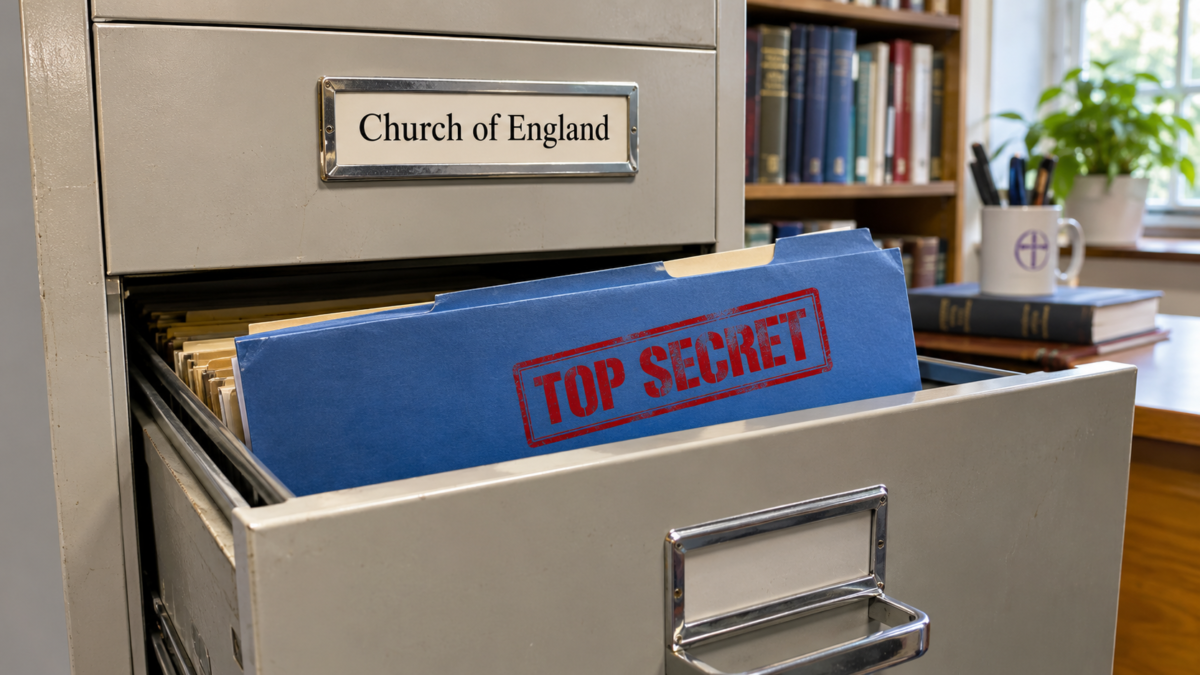
If you are ordained in the Church of England, there is a file about you. It sits in your bishop’s office, usually in a blue card folder. It will follow you from diocese to diocese for the whole of your ministry, and it will be kept for 75 years after you die.
So, if you are a cleric, a few questions for you:
- Have you ever seen your blue file?
- Do you know what is in it?
- Has anyone ever told you when something was added to it?
- Have you ever been asked for your side of the story before a note about you went in?
- Were you given a privacy notice when you arrived in your diocese, and did you read it?
- Were you asked for your views when the rules governing the file were rewritten?
I suspect that for most clergy the answer to every one of these is no. And the rules have just been rewritten. In June 2026 the House of Bishops approved a new Clergy File Policy (version 4.3), with Policy Guidance, practical guidance and ten appendices of templates. Together they run to more than 60 pages, and they are now on the Church of England website.
I have been reading it carefully. Every cleric should know what it says, because it governs what is said about them, who gets to read it, and for how long.
What is in it
The Guidance lists the “mandatory” documents, which “must be retained on the file for the life of the file and never removed”. Where they exist, these include:
- your date of birth, a copy of your birth certificate or passport, and evidence of any divorce;
- a full CV since leaving school, with explanations for any gaps;
- your selection papers and references from before ordination;
- applications, references and Clergy Current Status Letters (CCSLs) for every post you have held;
- your ministerial development reviews;
- records of sickness absence, ill health and occupational health reports;
- records of leave, including maternity, paternity and adoption leave;
- a record of any financial problems, resolved or unresolved, and any discretionary grants over £100;
- housing records, including any eviction notices;
- capability and grievance records;
- for any informal complaint, the complaint itself, witness statements, your answer “if any”, and the bishop’s decision;
- every formal complaint under the Clergy Discipline Measure, in a sealed envelope, whatever the outcome;
- safeguarding file notes, DBS details and training records;
- a summary of any settlement agreement.
On top of that, a “File Note” can be made of “any interchange or behaviour which may be relevant to the ministry, wellbeing or conduct of the cleric”. It is hard to think of anything that would fall outside that. For example, there is an explicit reference (p 4) to the care that should be taken when recording details of family members or household.
Five files in one folder
The reason the policy is so long and so complicated is that the blue file is trying to be several quite different records at once. It appears to me to be all of these (I speak with some experience as a former personnel manager, though of long ago):
- an HR personnel file, covering appointments, terms of service, capability, grievance and health;
- a pastoral record, covering wellbeing, counselling, bereavement, money and housing;
- a disciplinary court record, holding CDM papers and Return to Ministry reports;
- a safeguarding record, holding allegations, DBS checks and training;
- a canonical record of your orders, from selection to Letters of Orders to any relinquishment.
(For bishops and deans it is also a historical archive, kept permanently.)
Each of these has its own law and its own proper rules about who may see what, and for how long. Because the policy insists on a single file per cleric, it manages the differences with a system of sealed envelopes, each with different rules about who may open it. The envelopes are a sign of the problem: blue files hold together things that do not belong together.
Two features of clergy life make it more complicated still. Clergy have no employer, so each bishop is a separate data controller, and the file is the only thing that travels with you. And orders are for life, so there is no natural end date, as there is when someone leaves a job. Retention is therefore pegged to your death, and almost everything accumulates for the whole of your ministry.
Inconsistencies and errors
This is a document telling bishops how to handle the most sensitive information about people’s lives. You might expect it to be carefully checked. In several places the different parts of it contradict each other.
- Confidential references sent abroad. The Guidance says CCSLs “can be sent outside the UK without informing the data subject of any safeguards” (p 22). The model privacy notice, which goes to clergy, says they “cannot be sent outside the UK without informing the data subject of any safeguards” (p 62). One of them is wrong.
- Subject access to CDM papers. The Policy says these “must not” be included in a subject access request “unless the Data Controller chooses” (p 10). The Guidance says they should not be disclosed “without obtaining appropriate legal advice”, and admits that which exemption applies “will depend on the given circumstances” (p 5).
- Untested misconduct allegations. The Policy keeps old “Part 2” pastoral discipline records only if they contain “proven evidence of misconduct” or led to proceedings (p 11). The Guidance says “Part 2 misconduct” records must be kept “whether formal proceedings have been instigated or not”, sealed and treated like formal complaints (p 8).
- Capability records. The Policy says records of capability proceedings should be destroyed once the cleric leaves the post (Policy, p. 8). The mandatory list keeps a “record of how capability issues have arisen and been addressed” for the life of the file (Guidance, p. 13). It never says how the two relate, or what survives the destruction.
- The data protection complaints procedure. The Guidance calls a link to it “optional” in the same sentence in which it calls it “a statutory requirement” (Guidance, p 5).
There are also problems with the law as stated:
- the Policy claims CDM data is exempt from Article 5 of the UK GDPR, when the statutory exemption covers Article 5 only so far as it matches the individual rights, and does not switch off accuracy, storage limitation or security;
- the exemption relied on (Data Protection Act 2018, Schedule 2, para 14) concerns judicial proceedings, and part of it depends on likely prejudice, which is hard to show once a case is over, and impossible where nothing was ever brought;
- the privacy notice cites “contract” as a lawful basis, though most clergy are office holders without a contract of employment.
And there is a lot of simple carelessness:
- there are two paragraphs numbered 73;
- paragraph 55 refers to the capability paragraphs as 22 to 25, when they are 20 to 23;
- the Guidance gives the definitions as paragraphs “10 and 11” in one place (p 3) and “9 and 10” in another (p 20), when they are actually 12 and 13;
- file note templates are said to be in Appendices 5 and 6, though Appendix 5 is a checklist; and
- a document approved in June 2026 says that “in 2025 a pilot programme is underway” (p 20).
(There is also irritating grammatical carelessness. “This Policy is applicable to, and must be followed by, all parties who hold and are responsible for Clergy Files, for instance: archbishops and bishops.” Not “for instance” but “that is to say” as there are no others.)
None of these is a scandal on its own. But together they tell you how carefully the text was checked before the House of Bishops approved it—and how carefully users themselves have read it.
Strengths and weaknesses
It is worth saying first why a policy like this matters. The Independent Inquiry into Child Sexual Abuse heard repeatedly about clergy files that were incomplete, scattered, or quietly cleaned before being passed on. Some of the Church’s worst failures happened because one bishop did not know what another bishop knew. A consistent national policy is a good thing in principle.
Strengths
The policy does several things well:
- it aims at consistent practice across 42 dioceses, where before there was a great deal of variation;
- it says clearly that unsuccessful job applications, and criminal records that have been “filtered” under the rehabilitation rules, must not be kept;
- it marks genuine legal obligations in blue boxes, separating them from advice, which is a good idea;
- it keeps CDM papers away from auditors and independent reviewers, which protects due process;
- its practical guidance on security, file notes, cross-referencing and the safe transfer of files is sensible and usable;
- it recognises that the move between dioceses is where files go missing or get stripped, and builds checklists around it.
Weaknesses
But the weaknesses are serious:
- the alphabetical structure scatters the rules on complaints across six different headings, so the question that matters most to clergy is the hardest to answer;
- it uses “must” both for legal duties and for mere expectations, so a cleric cannot easily tell which of the bishop’s obligations are actually binding;
- it claims data protection exemptions more widely than the law appears to allow; and
- its retention rule is grossly disproportionate.
That last point needs spelling out. The retention period of 75 years begins at “permanent end of ministry”, which is defined as death, or relinquishment or lifelong prohibition where no return is practically possible. Retirement does not count. So your overdraft note, your divorce papers, your sick leave and a complaint against you that was dismissed are all carried from parish to parish for the whole of your ministry, then kept for three generations after your funeral.
The justification given is the IICSA recommendation. But that recommendation concerned records of child sexual abuse allegations, not a person’s entire employment and pastoral history. Stretching it to cover everything is hard to reconcile with the data protection principles of minimisation and storage limitation.
How it compares with an ordinary employee
The contrast with an ordinary employer is striking:
| Typical employer | Clergy File Policy | |
| Who holds the file | HR department | The bishop personally, who is also pastor, judge and referee |
| Does it move with you? | No; a new employer gets a reference | Yes; the whole file goes to the next diocese |
| Disciplinary warnings | Usually expire and are disregarded | Formal and informal complaints kept for life, whatever the outcome |
| Health records | Held separately, need to know | Held in the main file, all mandatory |
| Retention | Usually about six years after leaving | 75 years after death |
Clergy are not ordinary employees, and some portability and longer retention of safeguarding material is justified. But it is hard to see why a bishop in Carlisle needs to know about a curate’s overdraft in Truro thirty years earlier.
Complaints, information and appeal
The deepest problem with the policy is not what it keeps, but what it gives the cleric in return. The answer, in short, is almost nothing.
Vexatious complaints
The Clergy Discipline Measure has a process of preliminary scrutiny, designed to weed out complaints that are trivial, vexatious or malicious. The file policy then undoes much of that protection. Consider what happens to a complaint against you that goes nowhere:
- a formal complaint that was dismissed is kept in a sealed envelope for the life of the file (the worked example in the Guidance is an envelope labelled “Dismissed”);
- an informal complaint must be recorded, with the complaint itself and any witness statements, and kept permanently, subject only to the bishop’s judgement about “very minor” matters;
- there is no category for a complaint found to be malicious, and no provision to remove one;
- the Guidance wants everything kept together so that the bishop reviewing the file for a CCSL can “see everything in one place”.
So an unfounded allegation remains in view of every future bishop who writes a CCSL about you. And you cannot see the CCSL, because confidential references are exempt from subject access.
There is a genuine point on the other side. Safeguarding practice rightly says that concerns which are not proven should not simply vanish, since patterns matter. But other sectors have found a middle way, and the Church has not.
Information
The policy contains no requirement:
- to tell you when a file note or complaint is added to your file;
- to give you a copy of it; or
- to seek your response before it is filed.
The Guidance lists your answer to an informal complaint as something to keep “if any”, which assumes you might never have been asked, or if asked, might not have replied. The only checking the policy invites you to do is updating your contact details.
Your route to finding out what is held is a subject access request. But the material that matters most (CDM papers, “Part 2 misconduct” records, CCSLs and references) is declared exempt. Untested allegations that never went near a tribunal end up sealed alongside judicial papers, and so out of your sight.
I have asked a group of fellow clergy whether they have ever seen their file, ever been informed about it, or ever been consulted on any of its content. Not one person had done any of these. In fact, one of them pointed out that asking to see your Blue File might be interpreted as a cause for concern—and noted in your Blue File. One person requested to see their file, but was strongly discouraged from doing so, and relented.
Appeal and right of reply
There is no mechanism in the policy for you:
- to add your own statement to a note about you, so that it travels with the note;
- to have the outcome of a complaint recorded as unfounded or malicious, rather than simply “dismissed”;
- to challenge what is on your file before anyone other than the bishop who holds it.
Your data protection rights (rectification, restriction, objection) help with factual errors. They do little for a fair but one-sided record of someone else’s opinion. A complaint about how your data is handled goes first to the bishop, who is the data controller, and then to the Information Commissioner. There is nothing in between.
What schools already do
The contrast with statutory guidance for schools is telling. Paragraph 98 of the policy, on safeguarding records, closely echoes the wording of Keeping Children Safe in Education. But it leaves out the protections that guidance gives to the person accused. In schools:
- the summary of an allegation kept on file is given to the person concerned, where children’s social care or the police agree;
- allegations found to be malicious or false are removed from personnel records, unless the person consents to them being kept;
- unsubstantiated, unfounded or malicious allegations are not referred to in references.
The Church seems to have borrowed the duty to record but left behind the safeguards for the accused.
How it was made
So who decided all this, and how? The document names the House of Bishops as both the approving body and the owner of the policy. Its seven named authors appear to be a mix of national church staff and people from bishops’ offices. There is no name from the House of Bishops who has taken responsibility for this.
As far as the public record shows, the route was this:
- in March 2024 the House discussed a draft privacy notice for clergy blue files, at a confidential meeting whose summary was later published;
- in October 2024 the House received an update on the new policy, framed around safeguarding, safer recruitment and record keeping;
- the policy was then trialled from July to December 2025;
- the policy’s own revision history records amendments from the House’s May 2026 meeting;
- the House approved the final version in June 2026, and it was posted online some months later.
Notice what is missing. It never went to General Synod. It is House of Bishops policy, not legislation, and not a statutory code of the kind that governs discipline or safeguarding. Yet it says it “must be followed by” all file holders, and it shapes the rights of every cleric in the Church.
The House’s deliberations were largely private. The public summary of the May 2026 meeting does not mention clergy files at all. The agenda was published, but not the papers.
And I can find no evidence that clergy themselves were consulted. Perhaps the House of Clergy, or the clergy section of Unite, or clergy more widely were asked their views, and it simply was not published. If so, it would be good to know. The “feedback from trial period” mentioned in the revision history appears to have come from those who hold the files.
So the people who hold the files wrote the rules about the files, and approved them in private. The people the files are about appear to have had no formal voice. That goes a long way to explaining why the policy is so thorough about what bishops must keep, and so thin about what clergy may see and challenge.
There is a deep irony here. At the same May 2026 meeting, the House discussed research on “trust and trustworthiness in the Church of England” and an item on “strengthening accountability for Bishops and clergy”. Accountability is meant to run in both directions.
I think I need to add a comment of personal reflection here. When I went through this document—and took help and advice from others—I sincerely hoped I was wrong. If I have missed something here, do please, dear reader, feel free to correct me.
But what I cannot avoid concluding is that this is the product of an institution that still does not understand the primary issue of trust, which does not put the welfare of clergy at the centre of its policies, and still largely fails to have its leaders act as good shepherds to the shepherds of the flock. The primary concern here is not the well-being of clergy, but the protection of the institution.
I saw exactly the same in the campaign to restore the clergy pension and stipend; despite widespread support in Synod, not one single bishop has ever offered any help in implementing the changes. In fact one archbishop approached me candidly to say ‘Thank you for your work; I have done nothing about this.’ I simply replied ‘I know.’
I struggle to understand why this is so difficult. It is about basic pastoral care.
What needs to change
None of this requires the Church to choose between safeguarding and fairness. Schools, hospitals and employers manage both. If the House of Bishops wants a process that clergy can trust, the changes needed are clear.
- Tell clergy what is held. Every cleric should receive the privacy notice and a plain summary of what their file contains, with a standing offer to view everything that is not genuinely exempt.
- Notify and copy. Any file note about conduct, or any complaint, should be shared with the cleric within a set time, as schools already do.
- Give a right of reply. Clergy should be able to attach their own statement to any note about them, and that statement should travel with it.
- Record outcomes honestly. Allegations should be marked as substantiated, unsubstantiated, unfounded or malicious; malicious ones should be removed, and unfounded ones should not shape a CCSL.
- Make retention proportionate. Safeguarding records can follow the IICSA recommendation, but HR, financial and pastoral material should expire after a set period, as it does for everyone else.
- Stop treating untested allegations as judicial records. Data protection exemptions should be applied case by case, as the law requires, and “Part 2 misconduct” material should never be sealed from the person it concerns.
- Provide an independent route of challenge. Clergy need somewhere to contest what is on their file other than the bishop who holds it;
- Fix the errors. Above all, the contradictions in the privacy notice that has already gone out to clergy.
- Consult properly. A revised policy should be published in draft, put to the House of Clergy and to clergy representatives, and ideally brought to General Synod, with its data protection impact assessment made public.
- Align it with the Clergy Conduct Measure. The Guidance itself admits its complaints section will need revising when the new Measure comes into force, which is the obvious moment to do all of the above.
The blue file exists, rightly, so that the Church never again fails to pass on what it knows about a risk to others. But a file that a cleric cannot see, cannot answer and cannot challenge, that records every accusation whatever its outcome, and that follows them to the grave and beyond, does not build trust. It builds fear.
If you are ordained, ask your bishop’s office for a copy of the privacy notice, and consider making a subject access request for your own file—or simply asked to view it. You might be surprised at what you find. And if you are a member of General Synod, ask the House of Bishops who was consulted, and why clergy were not.
The Clergy File Policy and Guidance 2026 and its appendices can be downloaded from the Church of England website.




Somewhere in Bishop Patricks office is an extra large blue folder (or maybe multiple folders, likely a whole cabinet) containing physical printouts of every article, comment and Facebook post on Psephizo. 🙂
In all seriousness, this is very strange. I think you probably are right to be worried, and to want some clarifications.
It would frustrate me immensely if the Baptist Union’s system mirrored this, and though I strongly suspect it doesn’t (Baptists are historically the very opposite of deferential, and would likely have kicked up a huge storm if the BU wasn’t allowing right of response, and made life difficult for the associations) I have nevertheless been motivated to check. I’m interested in how we compare.
Mat – they keep a record of the number of people who fell asleep during your sermons …..