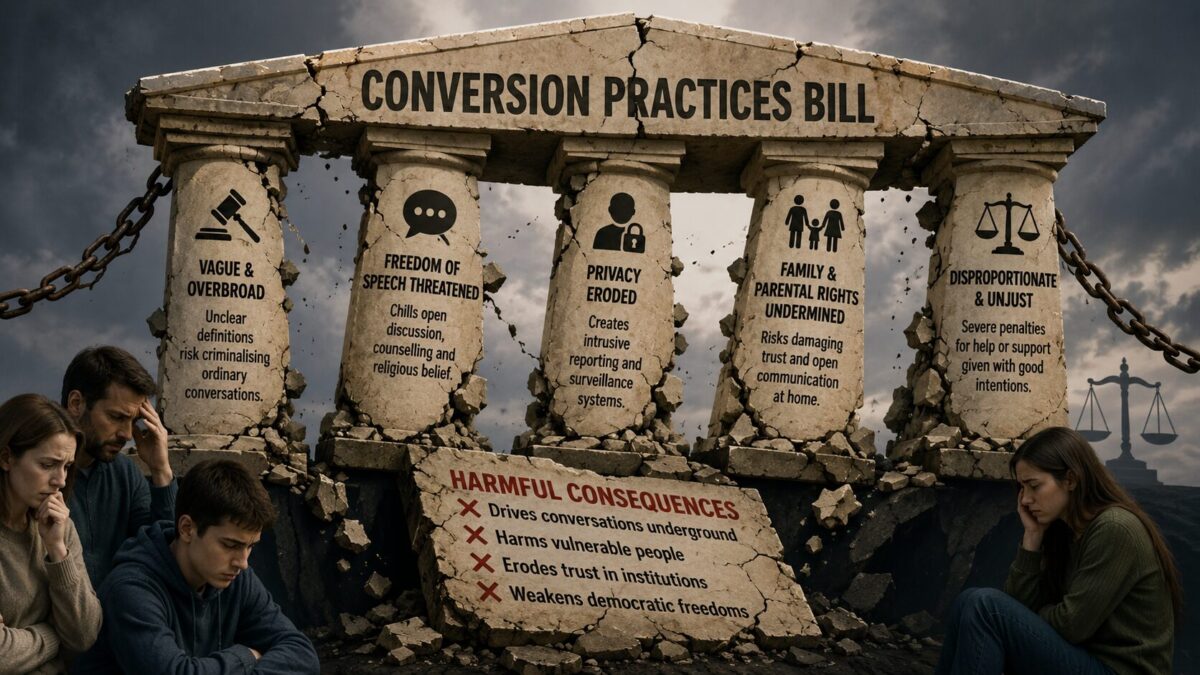
Mark Bratton writes: The long-awaited draft Bill on conversion practices (‘the draft’), recently released for pre-legislative parliamentary review, is fundamentally flawed. According to the Preamble, the draft aims, among other goals, to establish new offences related to abusive conversion practices on individuals. However, rather than preventing abuse, the draft risks reinforcing harmful conversion practices, particularly the manipulation of many children away from accepting their same-sex orientation towards a vague ‘transgender identity’ and endorsing irreversible and damaging medical interventions—such as drugs and surgeries—that fall under the so-called ‘gender-affirming care’ (GAM).
This draft legislation is poorly written, excessively broad in scope, and introduces new legal classifications that conflict with established principles in related legal fields. It risks encouraging vexatious litigation initiated by ideologically driven activists targeting individuals and public organisations that express obvious truths about sex and the best interests of gender-confused children facing developmental challenges linked to their natural growth. Additionally, it may suppress the speech and language used by parents, teachers, and youth workers who are trying to support children through their difficulties. The legislation also significantly undermines parental rights, potentially violating human rights law, particularly the right to private and family life under Article 8 of the European Convention on Human Rights (ECHR).
As outlined in the Explanatory Notes accompanying the draft, the proposed gender conversion Bill upholds the current Labour government’s manifesto pledge to implement a trans-inclusive ban on conversion practices, ostensibly aiming to address legal gaps related to such practices. However, this proposal is moot for two reasons.
Firstly, the original circumstances that prompted the proposal of such a Bill are now obsolete. The methods once condemned—aversion therapy, electric shock treatment, nausea-inducing drugs, and chemical castration used to attempt to “cure’ homosexuality—are now historical footnotes. Additionally, Malcolm Clark has convincingly argued that the evidence supporting UK conversion practices is weak, exaggerated by influential yet self-selecting surveys that broadly interpret discussions of LGBT issues in families and peer groups as part of an overly broad definition of ‘conversion practices’.
Second, as long as the targeted conversion practices persist, existing criminal laws covering sexual offences and coercive and controlling behaviours are adequate to address and penalise them. The draft states that, when assessing whether conduct constitutes criminal abuse in all circumstances (see Clause 1(5)), words or behaviour of a sexual nature, violent or threatening conduct, and controlling or coercive actions should be considered (Clauses 1(6)(a)(b)(c)). However, there is a problem: under the draft, the maximum penalty for charges of abusive conversion practices is an unlimited fine and/or up to five years of imprisonment (Clause 2(2)(a)(b)). As criminal barrister Dennis Kavanagh has noted, these penalties are woefully insufficient for certain abusive practices, such as ‘corrective rape’ of lesbians, which could otherwise attract life imprisonment under existing sexual offences laws. For these, the proposed Bill is effectively useless.
As Kavanagh observes, the draft has not received proper consideration. It originates from the Office for Equality and Opportunity, whose staff seem to have misused terminology from road traffic law (Clause 1(3), “conduct which…falls below the standards reasonably expected of a person in their position”), bribery regulations (Clause 5(2), failing “to take all reasonable steps to prevent the commission of an offence”), and family law (Clause 1(5), “whether conduct amounts to an abuse of the individual is a question of fact to be determined by reference to all the circumstances of the case”). The inconsistency and lack of review by criminal law experts only heighten suspicion that an ideological agenda underpins these legal and conceptual inconsistencies. It is hard to believe that successive governments would have delayed enacting and implementing a conversion practices Bill if the risks were as significant as activists claim. Instead, the true aim appears to be introducing a trans-inclusive Bill that would allow activists to fulfil various legal and social aims that courts and the growing public awareness of transgender issues are preventing.
This ideological bias is clear throughout the draft. It defines a ‘conversion practice’ very broadly as ‘any conduct’ (my emphasis) intended to cause an individual to acquire, reject, or believe they have or lack a particular sexual orientation or transgender identity (Clause 1(2)(a)(b)). Regarding sexual orientation, the binary opposition (have/not have) extends the concept beyond the definition in the Equality Act 2010 (EA), which regards sexual orientation as attraction toward persons of the same sex, opposite sex, or either sex. The draft’s definition would include someone not attracted to anyone (e.g., ‘asexuals’, as the Explanatory Notes make explicit), representing an expansion of identity that encompasses natural variations in human sexual interest. This raises troubling parallels, such as the recent addition of a ‘eunuch’ identity to the World Professional Association of Transgender Health’s (WPATH) Standards of Care (SOC 8).
The draft limits this broadly constructed definition of conversion practices within the context of conduct “carried out in the course of providing health care services to the individual concerned” (Clause 1(3)(b)), but only as long as the person does not act “in a way that falls far below the standards reasonably expected of a person in their position.” This sets a high threshold, arguably higher than the professional standards of care outlined in medical law. However, defining what a ” reasonable expectation ” is becomes complicated given the highly ideologically charged and divisive nature of paediatric gender medicine. The principle of GAM is to ‘follow the patient,’ whereas opponents emphasise the importance of medical judgment and exploratory therapy, as recommended by the Cass Report. This fundamental disagreement cannot be easily resolved through the application of an ‘objective test.’
Despite this therapeutic ‘carve-out’, it immediately presents a troubling dichotomy of standards. What can be said professionally without fear of repercussions may still carry severe criminal penalties if expressed outside the medical setting. For example, teachers telling children they are not “born in the wrong body”, parents refusing to fund experimental treatments like puberty blockers or cross-sex hormones or advocating for mental health treatments addressing issues such as autism, same-sex orientation, trauma, or other mental health conditions—these could be considered criminal conversion practices if spoken outside a therapeutic context, though they may not be viewed as such within it.
The implications of this draft concerning the scope of parental discretion are deeply troubling. To be considered an offence under the draft, an individual must engage in “an abusive conversion practice.” The term “abusive” is not explicitly defined but can be understood from its consequences: “serious harm to the individual’s physical or mental health” (Clause 2(1)(a)) or, more problematically, “serious alarm or distress to the individual, which has a substantial adverse effect on their usual daily activities” (Clause 2(1)(b)). As a result, a parent could face criminal liability simply for withholding testosterone if a child becomes profoundly upset over the denial.
This could also apply beyond parental contexts to situations such as a wife telling her husband to stop wearing her clothes or using funds for gender-affirming surgery, or a teacher addressing a student by reference to their sex. Furthermore, the draft indicates that such conduct may be evaluated by considering “the use of economic pressure” (Clause 1(6)(d)) and “the use of psychological or emotional pressure” (Clause 1(6)(e)), both of which are vague and legally ambiguous concepts—deficiencies rarely seen in carefully drafted legislation.
Several legal experts, including Dennis Kavanagh and Akua Reindorf KC, have observed that the restrictions on parental discretion proposed by the draft could contravene the right to private and family life protected by Article 8 of the ECHR. This article defends private conversations and family matters, such as discussions about sexuality or gender identity, which naturally fall within their scope. It is unlikely that an English court would deem it necessary or proportionate to override this right. This again underscores the draft authors’ failure to fully consider these issues.
The most contentious part of the draft is its inclusion of the concept of a ‘transgender identity’ (Clause 1(2)(b)). The draft offers an overly broad and potentially limitless definition of transgender identity: “The circumstances in which an individual has a transgender identity include (but are not limited to)(my italics) ” three categories. The first category relates to individuals claiming the protected characteristic of gender reassignment outlined in the EA because they are “undergoing, proposing to undergo, or have undergone a process of gender reassignment” (Clause 1(8)(a)). This clause effectively confers a right to be recognised as a transgender person—an identity issue—rather than simply a right to non-discrimination, as specified in the EA.
The second category references the terminology of the EA and the Gender Recognition Act 2004 (GRA) to denote individuals with the specified protected characteristic and/or those pursuing certification for a sex opposite to their natal sex, based on a diagnosis of gender dysphoria and the established recognition criteria.
The third scenario—where someone has a transgender identity—effectively incorporates gender self-declaration into English law for the first time. It explicitly states that “the individual identifies as neither male nor female or as not solely male or female” (Clause 1(8)(c)). This contradicts the longstanding common-law stance, upheld by the highest court, that the law recognises only two gender categories—male and female—based on biological criteria. This was clearly affirmed in the Supreme Court’s ruling in the For Women Scotland case last year. English law has not hitherto recognised a non-binary, let alone any other, transgender identity.
Thus, describing these three circumstances as a basis for a transgender identity is pointless, even just for illustration. The draft’s definition is entirely open-ended. This open-endedness is reflected in the inherently expandable LGBTQA+ acronym, which implies an almost limitless range of gender identities that the draft could anticipate endorsing.
Overall, the draft is a flagrant violation of a long-established principle of statute law that laws should be clear, predictable, knowable in advance and sufficiently precise that people can regulate their conduct. This is closely linked to the European human rights law requirements that laws should be accessible and foreseeable. The offences newly minted in the draft are neither of these.
The draft’s publisher, Equality Minister Olivia Bailey MP and her supporters view it as potentially progressive legislation addressing serious abuses against homosexual, bisexual, and transgender people. However, the supporting evidence for abuse is weak, and as law, it may cause gender-nonconforming and anxious children to shift from accepting their same-sex attraction to embracing diverse and subjective gender identities, which could harm them physically and psychologically. Studies related to the ‘Dutch Protocol,’ therapists from the now-closed GIDS, the Cass Report, and various international research demonstrate that many children seeking these services are actually same-sex oriented. For this reason, the draft potentially constitutes a gender conversionist charter rather than offering effective protection against abusive practices.
The draft’s promoters overlook recent legal and political developments that oppose the integration of gender identity ideology into English law. The resistance from some groups to the recent Supreme Court ruling in the For Women Scotland case and to its implementation through the Equality and Human Rights Commission’s Code of Practice demonstrates a persistent ideological refusal to distinguish between legal rights and political views. The draft appears as a ‘Trojan Horse,’ pretending to be a progressive step forward for gay rights, while secretly advancing a more radical agenda that could eradicate the concept of ‘sex’ entirely and disrupt the societal organisation based on it.
Indeed, if enacted, the draft Bill would immediately override many recent successful efforts to protect women and children from the consequences of gender identity ideology. It would also motivate trans activist groups such as the Good Law Project and Nancy Kelley’s Trans-solidarity Alliance to pursue private prosecutions against individuals and organisations they dislike (see Clause 5). The draft does not require prosecutors to seek the approval of the Director of Public Prosecutions or the Attorney General before initiating charges. This omission is both startling and, perhaps, unsurprising. As a criminal and safeguarding matter, ordinary family and professional discourse outside the therapeutic context could trigger a local authority investigation or the initiation of care proceedings. Chilling examples of such are replete in Canada and certain American states.
As Helen Joyce of Sex Matters points out, this draft embodies ‘Stonewall law’, shifting its focus from workplaces and services—areas it has struggled to influence—to homes and classrooms, where it seeks to expand its reach.
We must do all we can to prevent it from doing so.

Revd Dr Mark Bratton is the Rector of St John Baptist Berkswell and an Honorary Canon of Coventry Cathedral. Formerly a practising barrister, Mark holds a PhD in Medical Ethics and Law from the University of Warwick and is an Honorary Fellow of the Warwick Medical School, where he teaches on a sessional basis. He is a Core Member of LGB Christians, an organisation dedicated to challenging ideas which replace the biological reality of the two sexes with self-defined gender identities.
 Buy me a Coffee












There is so much in this article, but the basics of Criminal law are that a crime is an act against the state (not as opposed to a civil personal claim) and the high standard of proof applies, standard on which DPP guidance for prosecution is based, along with ‘public policy’, basics which should be guard-rails to contain and restrain, limit private prosecutions to exclude what would in effect be ‘class actions’ in criminal law, which would be contrary to the nature and purposes of criminal law.
Here is an article on the draft:
https://www.christian.org.uk/press_release/government-unveils-controversial-conversion-therapy-ban-draft-bill-amid-renewed-puberty-blocker-trial-plans/