The meaning of the Millennium

It is curious that we get more excited about the supposed events leading up to Jesus’ second coming than we do about what that coming itself will bring. It is a bit like being more excited about the fixtures and fittings on a train than where the train is actually going to take you. My … Continue Reading

Why we need feminism

A recent Grove Ethics booklet, Women, Justice, and the Church: An Apology for Feminism, is a really compelling study by Kate Kirkpatrick from St Clare’s in Oxford. She wants us to move beyond current debates about women in ministry to ask much more fundamental questions about the place of women in society—and in particular to be alert to … Continue Reading

Is baptism enough?

Anglicans often get into difficulties with baptism. On the one hand, there continues to be a difference of view between those who are happy with the Church’s policy of baptising people of any age (i.e. including infants) and a minority who would take a more Anabaptist position and associate baptism with articulated profession of faith by the … Continue Reading

Creation and sexuality

I am writing a Grove booklet on the biblical texts relating to same-sex unions. This is the first draft of my section on Genesis 1 and 2. All comments welcome; they might find their way into the final text! Genesis 1 and 2 Then God said, “Let us make human beings in our image, in … Continue Reading

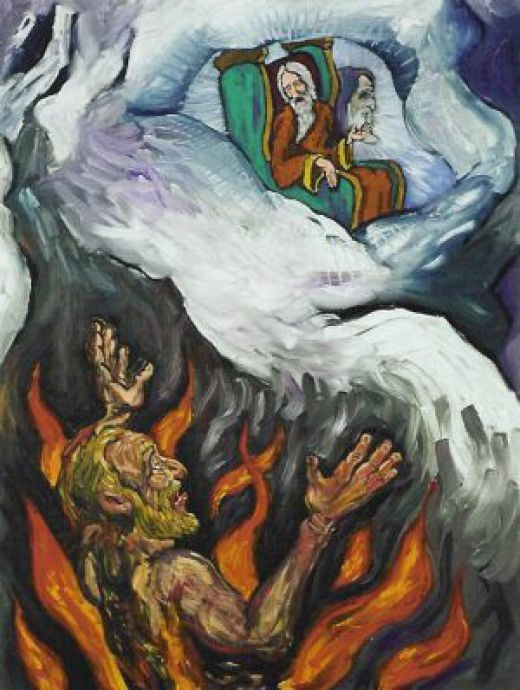
How should Luke 16.19­–31 shape our view of heaven and hell?

The story of the rich man and Lazarus appears on first reading to depict a detailed ‘map’ of ‘heaven’ and ‘hell’, but is this the right way to read it?

First, it is worth noting that the words ‘heaven’ and ‘hell’ themselves do not occur in the parable. The NT talks about post-mortem life in a range of ways, not all of them easy to reconcile with one another. Perhaps the most controlling one would be the idea of ‘sleep’ as used by Paul in, for example, 1 Cor 15. ‘Heaven’ in the NT mostly appears to refer to the realm of God’s presence, reign and reality, and the central NT hope is not that we will leave the earth to go to heaven, but that God’s realm will come down to the earth (see Rev 21). (See Tom Wright’s Grove booklet for the most accessible exposition of this.)

Continue Reading

Gender in Genesis part (ii)

I am in the process of writing a Grove Biblical booklet with the title ‘Women and authority: key biblical texts’ which aims to explore all the key texts in 28 pages! Due out later this month. I am aiming to cover Gen 1, 2 and 3, Luke 24, John 20, Acts 18, Romans 16, 1 Cor 111 Cor  14, Eph 5 and 1 Tim 2.

My colleague David Firth has kindly offered to contribute the section on Genesis 2.4–25:

It is apparent that we have a parallel creation passage here. Although there are

Continue Reading

Can women be pioneering church planters?

I am in the process of writing a Grove Biblical booklet with the title ‘Women and authority: key biblical texts’ which aims to explore all the key texts in 28 pages! Due out later this month. I am aiming to cover Gen 1, 2, 3, Luke 24, John 20, Acts 18, Romans 16, 1 Cor 111 Cor  14, Eph 5 and 1 Tim 2.

Here is the section on Acts 18.

This passage relates Paul’s first visit to Corinth and the establishment of a congregation there, followed by his first visit to Ephesus. His partners in ministry are named as Priscilla and Aquila, believing Jews with Latin names who have come from Rome following the Emperor Claudius’ edict expelling the Jews. There are some uncertainties around the dating of this edict, and whether Acts matches other contemporary accounts. But the most likely dating for the edict is 49 AD, so Paul’s visit should be dated to around 50, since Priscilla and Aquila had arrived in Corinth ‘recently’.[1] The passage is rather compressed, giving a briefer account of Paul’s 18-

Continue Reading