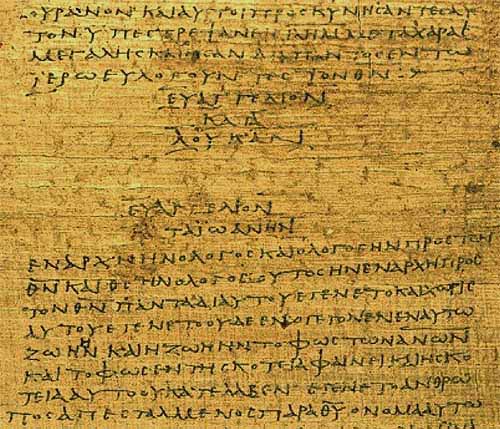
 This is a question I quite often get asked in relation to conversations with Jehovah’s Witnesses and the New World Translation (NWT). The NWT translates the end of John 1.1 as ‘the Word as a god’ in order to avoid the identification of Jesus with the God of the Old Testament, and avoid seeing Jesus as God incarnate, part of the Trinity, as does orthodox Christian belief.
As we will see, this is an incorrect translation of the Greek text. It is quite straightforward, though sounds a little technical to explain. Here goes.
The Greek of John 1.1 is as follows, transliterated into English letters:
En arche en ho logos, kai ho logos pros ton theon, kai theos en ho logos.
If you don’t read Greek, you need to know a couple of things. The first is that the word ho is called the ‘definite article’ which in English would be translated ‘the.’ The second is that Greek does not have an ‘indefinite article’ (English ‘a’), but instead simply omits the article. The term for this is ‘anarthrous’. The third is that, whereas in English we show what words are doing in a sentence by word order, in Greek this is shown by what case a word is in. Each word can be in one of four (or five) cases—the subject of a verb (often the thing doing an action) is always in the nominative case.
You can see near the end of John 1.1 that we have theos without an article, and logos throughout with the article. The reason is that, in any phrase where the main verb is ‘to be’, there will not be a subject and an object (as in ‘I pat my dog’ where ‘I’ am the subject and ‘my dog’ is the object of the action), but only subjects in ‘apposition’, that is, agreeing with one another. So when I say ‘My pet is a dog’ both ‘pet’ and ‘dog’ are subjects, and in Greek would be in the nominative case.
The question is: how can I tell the difference in Greek between the sentences ‘My pet is a dog’ and ‘My dog is a pet’ which have quite different senses. (The first is telling you which animal I have as a pet, the second is telling what kind of relationship my dog has to me.) In English, we do it by word order, but you cannot do this in Greek since, as an inflected language (ie one with different cases), it is flexible in word order. And you cannot do it by the usual trick of different cases, since both are in the nominative as subjects of the verb ‘to be’.
So Greek does it by making the word in apposition (the ‘dog’ in the first example) anarthrous, that is, without the definite article. In other words, theos en ho logos means ‘the word was God’, which tells us something about the nature of the word, whereas ho theos en logos would mean ‘God was the word’ which is telling us something about the nature of God.
In neither case does being anarthrous correspond to the English sense ‘a’, the indefinite article. So to translate this as ‘The Word was a god’ misunderstands the significance of omitting the article.
As this sounds rather technical, I always find it more fruitful to read with Jehovah’s Witness Romans 10.13, ‘Everyone who calls on the name of the Lord will be saved.’ The Greek here uses the word kurios; in the Greek Old Testament that Paul is citing here, this refers to Yahweh, the god of Israel. But Paul here clearly means ‘The Lord Jesus.’ The NWT appears to be embarrassed by this, and substitutes the word ‘Jehovah’. But it is very clear that in doing so the NWT is changing the text of Scripture.
Something similar happens in 1 Cor 10.9, where the word Christos in Greek is also substituted in the NWT by ‘Jehovah’.
 Buy me a Coffee















So how would the Greek say “the Word was a god”?
Subjects usually take the first position, if my memory serves me. Therefore, the Word being the subject, it would read, καὶ ὁ λόγος ἦν θεός (kai ho logos en theos).
It is my belief that, the main reason the NWT changed John 1:1 is because they don’t believe
in the Deity of Jesus. They are entitled to believe anything they want; but NOBODY is entitled
to change the Bible to suit their chosen beliefs! There is another change they made that disturbs
me almost as much, In John 14:10, Jesus speaks of being “IN” the Father. JWs must have thought
that simple word “IN” sounds too suggestive of the Deity of Jesus; so the changed it to say
“IN UNION WITH” (meaning they merely agree).
Michael. You have blatantly contradicted yourself so you are being dishonest with us & yourself here because you obviously have your own personal biast thoughts toward J.W’s. You say your disturbed by what you perceive how we have changed things. Well’ I’m even more disturbed that a so called educated man as yourself can blatantly tell us that Paul is referring to Kurios in Greek at Romans 10:13 which we do have it right, meaning the Hebrew name of God being Yahwey which is the english equivalent of Jehovah, then you blatantly turn around & accuse us that Paul was referring to Jesus. which you have no evidence of in that he was referring to Jesus. Thats only what you have added which the Bible does’nt say or even indicate. So where doe’s this show here where Paul was referring to Jesus? It doe’s not. If it’s written Jehovah in Greek as you agree that is Kurios at Romans 10:13, then what gives you the right to say that Paul was referring to Jesus? Wheres your evidence of that? Thats why, if your a doctor, it’s best to stick to your own profession as your not a Bible scholar, historian or a professor like me. Why is that? Because Satan, Gods adversary has made sure right down through history that inferior translaters whom he used had corrupted the essence of who Jehovah & Jesus was & if you have not had time to look into that history, especially in the time of the Pagan Emperor Constantine in 323 C.E. which is at the time of the foretold great apostasy that was foretold to appear at 2nd Thess 2:3 & 4, then you are posting false misleading information on here. Constantine summoned all his bishops to that councel at Nicaea, but only a handful, 300 turned up. After 2 months of furious shoutings & debates, he forced them against their inclinations to sign a creed
in favour that said Jesus was God. His role was crucial here in summoning the gifts of his pagan gods in gaining victory in battle for land ownership rights as an inward expression of his military victories that lay in the gift of the god of the christains that he supposedly worshipped. And the fact that like his father, he worshipped the unconquered sun says a lot to his faith when he had the gaul to be baptized on his death bed. So in the original Greek Septuagint it has Kurios in Greek & thats how Paul originally translated it, so for all of us, please explain how you as a professed doctor, can ever embolden yourself to even suggest that Paul was referring to Jesus?. Just as Juan correctly says. Jesus said not to worship him, just the same as an angel said to John. Be careful. Do not do that. (Rev 22: 8 & 9) Does’nt that just show to you why you are a doctor & not a professor, scholar & historion like me! Stick to being a doctor & not trying to pretend you are a Bible scholar unless you have a single clue to what your actually talking about o.k. pal! Joddy Kearns. Scholar, historian & Bible professor.
The evidence that kurios in Rom 10.13 refers to Jesus comes just four verses earlier, where Paul says in verse 9 ‘if you confess with your mouth that Jesus is Lord and believe in your heart that God raised him from the dead, you will be saved.’ For Paul, salvation comes from confessing that Jesus is kurios. He is quite consistent in this, and says the same (related to the work of the Spirit) in 1 Cor 12.3.
So it is very clear: for Paul, whoever calls on the name of the Lord Jesus will be saved, in fulfilment of the text in Joel that whoever calls on the name of Yahweh will be saved.
The same dynamic is present in Phil 2.9–10: at the name of Jesus every knee will bow, and every tongue confess him as Lord—which in Isiah 45.23 is a saying attributed to Yahweh—and that passage is in the context of insisting that there is no other God.
Is not Paul quoting from Joel 2:32 here at Rom 10:13?
The Byington bible at Joel 2:32 says “32And everyone who calls on Jehovah’s name will come off safe” and the American standard bible says “And it shall come to pass, that whosoever shall call on the name of Jehovah shall be delivered.”
Since Paul is quoting from another verse that uses the name Jehovah, I wonder why you have said differently?
Further, in verse 16, Paul now quotes from Isiah 53:1 which further supports the subject context “53Who believes our news? and to whom is Jehovah’s arm disclosed?” Byington.
“53Who hath believed our message? and to whom hath the arm of Jehovah been revealed?” American Standard
“53Who believed what we have heard? And the arm of Yahweh to whom was it revealed?” Rotherham
Yes, he is. In Joel 2.32 the people call on Yahweh (‘Jehovah’ is not a real name; it has been concocted from the consonants of YHWH and the vowels of Adonai, since Jews read ‘adonai’ whenever they see the letters of YHWH) and he saves them. For Paul, we now call on Jesus and he saves us.
In other words, for Paul the Jew, Jesus now is the one who fulfils that which only God can do. He remains a monotheist, but includes Jesus in the person of the one God of Israel.
He does the same in 1 Cor 8.5–6: he cites the Shemah, Deut 6.4, the central confession of Israel that ‘God is one’, but incorporates Jesus into that oneness. ‘There is one God, the Father, and one Lord [the term for God in the Greek OT], Jesus Christ’.
He does the same again in Phil 2.9–11, where he quotes Is 45.23, that to God *alone* every knee will bow and every tongue confess—but now applies this to Jesus as Lord.
Can someone explain to me why the word OTHERS appears in the NWT, Colosians 1:16-17, but in the original greek does not appear?
Thank you ! Blessed new year 2025 with the Lord!
I don’t know the whole text. But the NWT doctors and changes texts which don’t fit its belief that Jesus was a creature, not part of the godhead. So here, and in other places, it won’t be true to the Greek text of the NT.
But what you over look is that ” the God head ” doesnt mean an individual or part of God. The three times it is is in Kjv it clearly is derrived from GOD HOOD! Childhood is NOT the child! Motherhood is NOT the mother! Fatherhood is NOT the father !
All refer to those features associated with being a child, a mother and a father . Thus God Hood is not about BEING GOD ! God hood is about the features associated with God. Yes , Jesus is the Son of Almighty God, and is described as the IMAGE of his Father! Jesus is ” full ” all the features of his father , thus has god hood. The ENTIRE CONCEPT OF A TRINITARIAN GODHEAD is not supported in the Bible ! John 3:17 is clear , This means everlasting life, the taking in knowledge of You the true God AND the one you sent forth , Christ. “
Randall, how do you make sense of these consistent features of the New Testament?
In Mark 1.3, Isaiah the prophet is cited saying ‘Prepare the way of the Lord’ (ie Yahweh, the God of Israel). But he applies that to John the Baptist preparing the way for…Jesus. He appears to be saying that the coming of Jesus is the coming of God to his people
In Luke 1.76, Zechariah says the same about his son: ‘And you, my child, will be called a prophet of the Most High; for you will go on before the Lord to prepare the way for him’ John the Baptist is preparing the way for the coming of the Most High, for the Lord. But he is preparing the way for Jesus.
In Mark 2.7, Jesus’ critics say (rightly) ‘Who can forgive sins but God alone’, and then Jesus proves that his has forgiven sins.
In Romans 10.13, Paul quotes Joel 2.32 ‘Everyone who calls on the name of the Lord [Yawhweh/Jehovah] will be saved’. But Paul says that to call on God is to call on Jesus.
How do you make sense of this consistent identification, all through the NT, of Jesus’ person and ministry with the presence of God himself?
A literal rendering of the Greek text would be “all things.” (Compare Kingdom Interlinear.) The word other is used as it differentiates Jesus from Jehovah. Jehovah being Almighty God the Creator and Jesus being Gods SON, as Jesus himself stated.
Father – Creator
Son – Created
As seen in scripture: Jesus “the firstborn of all creation.” (Col 1:15; compare Re 3:14, where Jesus is called “the beginning of the creation by God.”)
Jesus is subject to Jehovah, as noted in scripture, he is therefore not the Almighty. Jehovah ALONE is Almighty the Creator
If you select only some of the verses about the relation between Father and Son, then yes you can demonstrate this. But you are simply ignoring the texts, such as Romans 10.13, where it is Jesus who offers and effects the salvation that God alone can give.
The language of ‘firstborn’ does not signify a chronological process, Jesus being created first, but importance.
The firstborn in a family stands above all his brothers and sisters, as the one who inherits. So this is being used to distinguish Jesus from the rest of creation, and not Jesus from the Father, with whom he is one.
Joddy Kearns ,what school do you have your credentials from to claim to be a scholar? Also how do you read john 20:28 ,where thomas (monotheistic jew) “says unto him” (the ressurected christ) ” my lord and my God.”? Why didn’t jesus correct this “erring “jew? Jesus didnt correct him ,he willingly and fully received the worship as”lord and God” from a monotheistic jew…… showing that he is Yahweh the son……please firward me your credentials and name of school so So can verify your claim to scholarship.
The most disturbing is that JW’s believe they are the only true Christian religion known by their fruitage. Yet, the organization finds itself in battle with many sexual abuses throughout the world that they are not even aware of. Almost in par with the sexual abuses in the Catholic church. Take for example Australia Royal Commission exposed several failures by the JWs. The inquiry found the organization maintained secret files for over 1,000 alleged abusers without reporting a single one to secular authorities, resulting in massive legal payouts, convictions (yes, proven guilty!), and ongoing civil battles. A lot of members of the organization in many countries have separated themselves upon knowing of these abuses concealed by the top figures of the organization. I myself, once a Bible student for years, I stopped the study. Not only, I had experiences like a “cult-like control” whenever I express hesitation, but I lost Jesus in replace of “Jehovah and the organization. This rings true with their oath on baptism. It changed from Jesus to the organization. They tried to wine back. Never again! I lost respect!
Notice you said allegedly, no proof. You know longer serve because you dont like that the bible condems you actions. Im sorry you weren’t humble enough to see the truth.
JW’s do believe in the divinity of Jesus, him being a divine being. They do not believe that Jesus is part of a trinity as the bible does not teach that. I’ve been a bible student for 60 years and previous Roman Catholic. The idea of tge trinity came in later. Jesus is not Almighty God and Jesus said his father was his God.
Then how do you make sense, for example, of Jesus sitting on the throne with God in Revelation? How do you make sense of Paul, in 1 Cor 8, saying that there is ‘one Lord’ and ‘one God’ (which are synonyms for each other) and including Jesus in this? How, in Romans 10, does Paul say ‘Everyone who calls on the name of the Lord [Jesus] will be saved’ when he is quoting an OT text which says ‘Everyone who calls on the name of Yahweh will be saved?’ How do you read Thomas in John 20 as exclaiming ‘My Lord and my God’ to Jesus?
I am just curious how these square with your belief?
I agree no one is entitled to change the bible , however, over 140 different translators, from the 1200 untill presently have translated jn 1 1 as ” a god”. By FAR THE NWT IS NOT THE FIRST OR ONLY TRANSLATION TO USE ” A GOD”. As far as changing scripture, trinitarians need to admit their role in changing many scriptures ! The most obvious being 1 John 5-7 . In the past century scholars and researchers are isolating many such scriptures that have been altered to support trinitarian theology. Please examine this theology . You will find that trinitarian theology is deeply faulted. Keep im mind Many scholars and theologians DO NOT EXCEPT trinity. So please refrain from singling out Jehovahs witnesse in this regard.
I dont think what you say is true at all. Who are these ‘140’ that you claim? As far as I know, this was a complete innovation by the JWs.
@Michael W. Gephart, I’m sorry but your belief/opinion, is false as Jehovah’s Witnesses do believe in Jesus and believe he was the man who set the example or path so to speak on how to properly worship Jehovah. Jesus told his Apostiles not to worship him. Jesus name means Jah/Jehovah is salvation. If God wanted to come in human form then he would not have done so through human birth. He came and spoke to Abraham in the form of a man before the Angels destroyed Soddom and Gomorrah.
We believe Jesus is our Lord and Saviour and is GIVEN (as in it was given to him by someone else) the Kingdom of Earth. John saw him coming out of the Heavens with a commanding voice of an ARCHANGEL. Strange for John to think that God would have a voice of an Angel and not of…oh you know GOD?! In the book of Hebrews, it says Jesus what God’s 1st creation, so Jesus was Jehovah God’s 1st Angel. Trinity is 4th century Christianity, Coptic texts predate the Greek text and they do have a Definite article, which matches more closely to the 1st Century Christian teachings which would be more accurate.
Thanks for responding Juan. As a matter of interesting, how do Witnesses read verses like Matt 28.9 ‘they worshipped him’ (using language Jews would only use of God himself), and Thomas’ words ‘My lord and my God!’ in John 20.28?
Even more significant is Paul’s central statement of faith in Rom 10.13 ‘Everyone who calls on the name of the Lord will be saved’. Here, the ‘lord’ (kurios in Greek) clearly refers to the Lord Jesus (from the phrase ‘Jesus is Lord’ in Rom 10.9). Yet Paul is quoting Joel 2.23, which says ‘Everyone who calls on the name of Yahweh will be saved’. So Jesus is now both the one that we call on when we call on God, and he is the one who saves us with God’s salvation. Paul is here directly identifying the person and work of Jesus with the person and work of the God of Israel.
How do Witnesses read this verse?
Worship Jesus in the bible But,’ some may counter, ‘does the Bible not indicate that we must also worship Jesus?
Did Paul not say at Hebrews 1:6: “Let all the angels of God worship him [Jesus]”?’ (King James Version) How can we understand this scripture in the light of what the Bible says about idolatry? Worship in the Bible First, we have to understand what Paul meant here by worship. He used the Greek word pro·sky·neʹo. Unger’s Bible Dictionary says that this word literally means to ‘kiss the hand of someone in token of reverence or to do homage.’ An Expository Dictionary of New Testament Words, by W. E. Vine, says that this word “denotes an act of reverence, whether paid to man . . . or to God.”
In Bible times pro·sky·neʹo often included literally bowing down before someone of high stature. Consider the parable Jesus gave of the slave who was unable to repay a substantial sum of money to his master. A form of this Greek word appears in this parable, and in translating it the King James Version says that “the servant therefore fell down, and worshipped [form of pro·sky·neʹo] him [the king], saying, Lord, have patience with me, and I will pay thee all.” (Matthew 18:26; italics ours.) Was this man committing an idolatrous act? Not at all! He was merely expressing the kind of reverence and respect due the king, his master and superior. Such acts of obeisance, or expressions of respect, were fairly common in the Orient of Bible times. Jacob bowed down seven times upon meeting his brother, Esau. (Genesis 33:3) Joseph’s brothers prostrated themselves, or did obeisance, before him in honor of his position at the Egyptian court. (Genesis 42:6) In this light we can better understand what happened when the astrologers found the young child Jesus, whom they recognized as “the one born king of the Jews.” As rendered in the King James Version, the account tells us that they “fell down, and worshipped [pro·sky·neʹo] him.”—Matthew 2:2, 11.
Clearly, then, the word pro·sky·neʹo, rendered “worship” in some Bible translations, is not reserved exclusively for the type of adoration due Jehovah God. It can also refer to the respect and honor shown to another person. In an effort to avoid any misunderstanding, some Bible translations render the word pro·sky·neʹo at Hebrews 1:6 as “pay him homage” (New Jerusalem Bible), “honour him” (The Complete Bible in Modern English), “bow down before him” (Twentieth Century New Testament), or “do obeisance to him” (New World Translation). Jesus Is Worthy of Obeisance Is Jesus worthy of such obeisance? Most decidedly, yes! In his letter to the Hebrews, the apostle Paul explains that as the “heir of all things,” Jesus has “sat down on the right hand of the Majesty in lofty places.” (Hebrews 1:2-4) Thus, “in the name of Jesus every knee should bend of those in heaven and those on earth and those under the ground, and every tongue should openly acknowledge that Jesus Christ is Lord to the glory of God the Father.”—Philippians 2:10,11.
Outstandingly, Christ will soon use this exalted position and the extensive executive powers that go with it to transform this earth into a global paradise. Under God’s direction, and as a result of the ransom sacrifice of Jesus, he will rid the world of all sadness, pain, and sorrow for the benefit of those who submit to his righteous rule. Is he therefore not worthy of our honor, respect, and obedience?—Psalm 2:12
So how do you understand 1 Cor 8.6, where Paul applies the Shemah (Deut 5.4 ‘The Lord our God is one…’) and applies it to both God-and-Jesus, over against the pagan belief in many gods?
Paul here seems to be unequivocally including Jesus *within* the identity of the one God?
And what of Rom 10.13, where Yahweh on whom we call for salvation in Joel 2.23 is now the Lord Jesus?
I’m not a Jehovah’s Witness myself, although I think they do make some very good points about the New Testament’s teaching on the deity of Jesus.
On 1 Corinthians 8:6: this text simply reinforces what is evident throughout Paul’s writings, i.e. Paul assumes a distinction between God, who is the Father and Creator, and Jesus, who is designated by the titles ‘Lord’ and ‘Christ’. Here as elsewhere it is evident that Paul only sees the Father as God, whereas Jesus is referred to by the titles ‘Lord’, ‘Christ’ or ‘Son of God’.
I have responded to your point about Romans 10:13 elsewhere. It is established beyond doubt that the New Testament writers, including Paul, did not usually consider the literal sense or reference of the Old Testament texts they quoted from. And your argument here is that Paul must have understood the word ‘Kyrios’ in the literal sense it was meant in the Old Testament text. In view of the usual pattern of New Testament’s interpretation of the Old, I do not find that convincing.
It boggles my mind that most religious people just can not think of Jesus as the son of God. Why is it so difficult to understand? You get the Father and you get the Son. Two different persons. They look alike and the think alike. Why would God say that Jesus is his son, if they are the same person? What convinced me that Jesus is not the almighty God is that Jesus died. An Almighty person can not die or he is not Almighty. If Jesus was the almighty God then his sacrifice would have meant absolutely nothing.
Yes, except for two things. First, Jesus kept saying things like ‘I and the Father are one’, ‘If you have seen me, you have seen the Father’, and ‘Before Abraham was, I AM’. Secondly, Jesus kept doing the things that God alone did, like feeding the people, being the true shepherd, and so on.
As a result, the first followers of Jesus saw in him the presence of the God of Israel in their midst, yet distinct from God. Paul expresses this in 1 Cor 8 by actually incorporating Jesus into the Jewish confession of the One God, the Shema in Deut 6.4. ‘For us there is one God…and one Lord’.
I’ll just pick up on one point here, i.e. where Jesus says ‘I and the Father are one’. I guess you take this in a sort of literal sense like ‘I and the Father are of one being’, whereas it would be perfectly natural to take it to mean: ‘I and the Father are in full agreement, closely united in purpose and love’. For example, we may consider Jesus’ prayer about his believers, ‘that they may be one, just as you and I are one’ (John 17:11). I think the vast majority would think Jesus is praying for close agreement, unity of purpose among believers. So if ‘being one’ can mean ‘close agreement’ when talking about believers, how could we be sure it means ‘unity of being’ when Jesus talks about himself and his Father being one?
I think this comes back to the same question of interpretation: how can you distinguish when Jesus is talking in a literal sense and when he is talking in a symbolic sense? In this case you take Jesus in a literal sense e.g. meaning ‘one in being’ when he could just mean ‘united in purpose etc.’, even though elsewhere he clearly uses it in the symbolic sense. From where I’m standing it looks like you take something in a literal sense if that fits with conservative teaching, rather than because it fits the context of John’s gospel.
I think that is a good question, and I think you have put your finger on a key question.
We need to read individual statements in the light of other parts of the text. Jesus says elsewhere ‘Before Abraham was, I am’. And ‘If you have seen me, you have seen the Father’. I don’t think he anywhere says something like ‘If you have seen me, you have seen Simon Peter, and you have seen Thomas’. And he repeatedly claims to do the things that only God does for Israel.
So, yes, on its own this statement is not decisive. But it is decisive in the context of the whole of the gospel narrative.
Hi Ian, many thanks for your response – yes this does seem to me to be a key issue. You’re quite right Jesus doesn’t say exactly ‘If you’ve seen me you’ve seen Peter’, however I’m not sure you’re correct that he says nothing ‘like’ that. For example, Jesus says ‘What you did for the least of these my brethren, you did it for me’ (Matt 25:40) and ‘If anyone accepts you, they accept me’ (Matt 10:40). But nobody seems to see these in terms of literal identity, or as meaning that Jesus is of one being/substance with his followers etc.
Indeed I agree that Jesus is portrayed as doing what God does, but again I think it makes perfect sense to say Jesus is an empowered representative of God, rather than that he literally is God. To me all the data seems to fit that model, and indeed it seems to give us a much more consistent interpretation.
Well the Bible disagrees with you and Jehovah witnesses. In the end brother you and all your false doctrine will be judged by God, Jesus. If you actually studied the Greek language outside if your false religion, you would discover that Christ is the God of the Bible. But see you can’t because your false religion won’t allow you to do this. John 1:1 states the fact that Jesus is God. I challenge you to go and tell your fake church that you would like to study Greek, koine. See what they say. Good luck and we’ll be seeing you bring judged by Christ.
Brian Alton, we as Witnesses of Jehovah God, we will uphold His sovereignty!
Regarding John 1:1, first we have to bear in mind that there is only one true God as what Jesus said at John 17:3, “…You, the Only True God…” Jesus did not say that he is included in that true god. And in John 20:17 after he was resurrected, Jesus said that Jehovah, is his Father and his God as Jehovah is also our Father and our God. That truth that Jesus have said should be remembered.
Was the Word “God” or “a god”? THAT question has to be considered when Bible translators handle the first verse of the Gospel of John. In the New World Translation, the verse is rendered: “In the beginning the Word was, and the Word was with God, and the Word was a god.” (John 1:1) Some other translations render the last part of the verse to convey the thought that the Word was “divine,” or something similar. (A New Translation of the Bible, by James Moffatt; The New English Bible) Many translations, however, render the last part of John 1:1: “And the Word was God.”—The Holy Bible—New International Version; The Jerusalem Bible. Greek grammar and the context strongly indicate that the New World Translation rendering is correct and that “the Word” should not be identified as the “God” referred to earlier in the verse.
Nevertheless, the fact that the Greek language of the first century did not have an indefinite article (“a” or “an”) leaves the matter open to question in some minds. It is for this reason that a Bible translation in a language that was spoken in the earliest centuries of our Common Era is very interesting. The language is the Sahidic dialect of Coptic. The Coptic language was spoken in Egypt in the centuries immediately following Jesus’ earthly ministry, and the Sahidic dialect was an early literary form of the language. Regarding the earliest Coptic translations of the Bible, The Anchor Bible Dictionary says: “Since the [Septuagint] and the [Christian Greek Scriptures] were being translated into Coptic during the 3d century C.E., the Coptic version is based on [Greek manuscripts] which are significantly older than the vast majority of extant witnesses.” The Sahidic Coptic text is especially interesting for two reasons. First, as indicated above, it reflects an understanding of Scripture dating from before the fourth century, which was when the Trinity became official doctrine. Second, Coptic grammar is relatively close to English grammar in one important aspect. The earliest translations of the Christian Greek Scriptures were into Syriac, Latin, and Coptic. Syriac and Latin, like the Greek of those days, do not have an indefinite article. Coptic, however, does.
Moreover, scholar Thomas O. Lambdin, in his work Introduction to Sahidic Coptic, says: “The use of the Coptic articles, both definite and indefinite, corresponds closely to the use of the articles in English.” Hence, the Coptic translation supplies interesting evidence as to how John 1:1 would have been understood back then. What do we find? The Sahidic Coptic translation uses an indefinite article with the word “god” in the final part of John 1:1. Thus, when rendered into modern English, the translation reads: “And the Word was a god.” Evidently, those ancient translators realized that John’s words recorded at John 1:1 did not mean that Jesus was to be identified as Almighty God. The Word was a god, not Almighty God.
Psalms 83:18 reads “May people know that you, whose name is Jehovah, You alone are the Most High over all the earth.” Jehovah is really the true God, Jesus is God’s first creation. Please read these verses Proverb 8:22-31, and take a look particularly at verse 24: Proverbs 8:24 “When there were no depths, I was brought forth; when there were no fountains abounding with water.”(KJV)
This phrase “I was brought”, clearly means that Jesus was brought forth by Jehovah God long before any other creations were made and Rev 3:14 affirms to this, “and unto the angel of the church of the Laodiceans write; These things saith the Amen, the faithful and true witness, the beginning of the creation of God.” Also, Colossians 1:15 says that Jesus Christ is the firstborn of all creation.
The time will come, and it is now that people and nations shall know that Jehovah God is only one true God and Jehovah God is one Jehovah.(Deut 6:4)
And even the One True God Jehovah, said at Ezekiel 39:7(ASV)”And my holy name will I make known in the midst of my people Israel; neither will I suffer my holy name to be profaned any more: and the nations shall know that I am Jehovah, the Holy One in Israel.”
Again, surely nations shall come to know that Jehovah is the only One True God!!!
I guess you are aware that ‘Jehovah’ is not a real word?
And what do you make of Rom 10.13 ‘Everyone who calls on the name of the Lord will be saved’, where ‘Lord’ here clearly means ‘Jesus’ (‘Jesus is Lord’ Rom 10.9), yet the verse Paul is quoting says ‘Everyone who calls on the name of Yahweh will be saved’ (Joel 2.32)?
Jehovah has long been established and used. If you don’t want to use Jehovah, then you probably shouldn’t use Jesus. We don’t know the original pronunciation of Jesus’ name. but it was probably something like Yeshua. Should we pull the name Jesus from the Bible and replace it with ‘teacher’ or ‘mediator’? Of course not! We use the name Jesus in English as it identifies God’s Son. Jehovah identifies God Almighty. No need to get hung up on whether they are the original pronunciation.
As regards Jehovah not being a real word, here’s a tool to help:
https://translate.google.com/?sl=auto&tl=en&text=%D7%99%D7%94%D7%95%D7%94&op=translate
There is no comparison between the two. ‘Jesus’ is the English version of ‘Iesous’, in turn the Greek translation of the name Yeshua, which in direct translation from Hebrew in the OT is ‘Joshua’. These are all translations of the name from one language to another.
By contrast, ‘Jehovah’ is a made up name, combining the consonants of the unpointed tetragrammaton (usually written as YHWH) with the vowels from the Hebrew word for ‘lord’ ‘adonai’. It is not the translation of an existing name, since it has been created because of a misunderstanding of the Hebrew text, which added the pointing of ‘adonai’ to the Tetragrammaton to indicate to the reader that God’s name was not to be spoken.
There is no comparison between these two names.
Absolutely, some feel Jehovah may be a ‘mistranslation’ for the reasons you mentioned. But to state it is not a word is disingenuous. The reality is, at this time, there is no way to know the original pronunciation for sure. There is evidence that the tetragrammaton was tri-syllabic originally. This along with Hebrew names that contain part of the tetragrammaton lead some to feel Jehovah is a perfectly acceptable English translation. One thing is for sure, Jehovah is the most widely known translation.
Some say they prefer the transliteration of Yahweh. If Yahweh is the preferred form by many, it’s curious why I rarely hear it used. For a name that’s written over 5x more than Jesus in the Bible, you’d assume there would be emphasis on using it. Thinking about it, I suppose freely referring to the Father by name does makes it more difficult to sell the trinity.
Another tool to help you out: https://www.dictionary.com/browse/jehovah
Luke 3:2
Its a divine ‘mystery’ I suppose that God approves of himself from heaven and refers to himself as his own son, but which is actually him, still in heaven but also currently in the water being baptized.
When a man and woman get married. They are referred to as being ‘one flesh’ But that does not mean they are actually one and the same person in a mysterious relationship where they are the same person and not the same person at the same time.
It means they are bound in a special bond. But they are still individuals.
Jesus himself stated:
John 14:28
because I said, I go unto the Father: for my Father is greater than I.
Also a divine ‘mystery’ that Jesus would refer to himself as his own father, and go back to his father (but actually go back to himself) but at the same time he is greater than himself but not, because they are the same’
Its is a confusing doctrine that ultimately detracts from worshipping the one True God – Ps 83:18
King James version:
18That men may know that thou, whose name alone is JEHOVAH, art the most high over all the earth.
American Standard:
18That they may know that thou alone, whose name is Jehovah, Art the Most High over all the earth.
Byington:
18And know it is you alone that are named Jehovah, on high over all the earth
No, it is a doctrine that is essential for making sense of the whole data of the New Testament. If you pick out selected verses, you can prove anything.
How can you make sense of Romans 10.13 without the Trinity? Or 1 Cor 8.5–6?
I’m not a Jehovah Witness, but after 44 years of study and asking the Holy Spirit for His Truth not man’s truth I’ve come to believe what you’ve stated. G-d, the Supreme Being has sent MANY revelations to man. Unfortunately, man has always turned the revelations into tradition and twisted His meaning to suit their dogma. I left mainstream religious denomination groups long ago.
Very well, Paul!
The erroneous translations and contradictions of Jehovah’s Witnesses exposed!
Another verses with worship and adoration to Lord Jesus Christ:
Mathew, 2, 8.
Luke 24, 52
John 9, 38
Hb, 1, 6.
Javier López Ureña.
It would probably look like this, Kai ho Theo’s en logos. Putting the definite article on God and and thus changing the object of the sentence to God and not the Word, Logos. After that you would have to change the whole Bible, like Jehovah witnesses did!!
And if the word order had been, kai ho logos en theos, that would have meant the word was a god (not God). That is word was a subordinate, demigod, or created one as taught by Arianism. But the biblical word order destroys Arianism. Lack of an article with theos destroys Jehovah’s witness and Jesus only cult. John produced an incredible theologically terse statement to destroy heresies.
I would question this conclusion about Matthew 28:9. The word translated ‘worship’ is proskuneo and it is well established that this word does not just refer to worship of God / gods, it can also refer to honour given to human beings of superior rank. For example in 1 Samuel 25:23, the Greek Septuagint uses the same word ‘proskuneo’ for Abigail bowing down before King David. This is one of many examples in the Septuagint, which was the Greek translation of the Bible used by Jews in Jesus’ day. I think it’s wrong to say that Jews would only use this word to speak of the worship due to God.
On John 1:1 (The Word was God) – how do you tell when the word ‘is / was’ means literal identity and when it has a more symbolic meaning? When Jesus said ‘This is my body’ I know Roman Catholics take this to mean literal identity but many other Christians don’t. Most take it to mean ‘this represents my body’ – so perhaps John 1:1 means ‘The Word was an exact representation of God’ (cf Hebrews 1:3)?
I know the word ‘Lord’ is a title very often used of Jesus, but again this is a word which is very often used of human superiors, and I find it significant that the New Testament most often refers to Jesus as ‘Lord’ rather than ‘God’. I’m not really convinced that it must carry the same sense as it did it the Old Testament quotations, there are countless examples where New Testament quotations of the Old give the verse a different sense to what it had in the Old Testament. (e.g. Matt 2:15 quotes ‘Out of Egypt I called my son’ – in the Old Testament this refers to Israel but in Matthew it means the child Jesus – again there are many other examples of this sort of thing).
Thanks Matthew. These things all need to be read in their context. For example, this Sunday we are about to read Matt 25.31; in this passage Jesus depicts himself as the king on the heavenly throne, the true shepherd, and the one who judges the nations. These are all roles which, in the OT and first-century Jewish eschatological thinking, were ascribed to God. I think Matt 28.9 needs to be read in this context.
Hi Ian, thanks for your reply. Absolutely I would agree that these roles would have been ascribed to God, and they are now ascribed to Jesus. However, to me this makes sense in terms of ‘delegated authority’ rather than ‘literal identification’. So Jesus exercises this authority in God’s name, and as God’s appointed representative – in accordance with his status as the Son of God. So I would say ‘Jesus acts for/as God’ rather than ‘Jesus is God’.
Matthew, well said!
Matthew,
brilliant comments!
It is so refreshing to see that there are still people who do not uncritically accept what is served to them. Moreover, your comments are very well reasoned.
Ian,
not saying your aim is wrong but your reasoning has quite a few faux pas.
1/ to prove your point, in your explanation of Greek sentence structure you do not hesitate to mark two words in nominative as subjects. You state: “when I say ‘My pet is a dog’ both ‘pet’ and ‘dog’ are subjects”, analogically later on you repeat: “both are in the nominative as subjects of the verb ‘to be’ “ , etc. In fact, this is not correct as the one and only subject in the sentence is ‘pet’. “Dog’ is a predicate nominative, a ‘complementum’ (lat.), if you wish, but not a subject.
2/ you explain that the Greeks differentiate the subject from ‘the word in apposition’ by leaving out the definite article of ‘the word in apposition’. Yet, if I wished to state eg. that ‘Hades and Dionysos are the same’, that is ‘Ho aytos Haides kai Dionysos’, the complementum (or the ‘word in apposition’, should I use your vocab) is the only word with the definite article here. Neither must the subject in the Greek sentence retain the definite article, eg. nomos edone (leaving out both the definite article and the verb ‘to be’ which becomes tacit).
3/ you further state that “(…) whereas ho theos en logos would mean ‘God was the word’” In fact, it would not, since you have omitted the ‘ho’ article in logos. Now, should the verse read as you’ve suggested, ie.: ‘En arche en ho logos kai ho logos (…) kai ho theos en logos’ then you clearly cannot translate last logos as THE word but A word, since HO logos is the word.
Now, Ian, I understand the point you’re trying to make, it may even be correct, but the thing is, that you cannot justify your translation of the Greek text on Greek grammar, since from the grammar perspective, it is perfectly alright to translate the text as ‘the word was a god’. The anarthrous construction itself you’re using cannot be used to draw any conclusions about the translation whatsoever.
Now there was a perfect question in the comments from Kamal, asking how the Greeks would then translate ‘the Word was a god” to which you gave no answer. The Greek text wouldn’t be any different, would it? It is the context not the grammar that makes the difference here. In my perspective, to conclude, you were close, when you wrote “In other words, theos en ho logos (…) which tells us something about the NATURE of the word.”, ie. the same nature, exactly like God, but distinct from God. The best translation in my view would be adjectival without using the adjective ‘theios’ / divine. It doesn’t belittle Jesus in any way.
Now this brings me to the point that Matthew had regarding your conclusions drawn from the word ‘kyrios’. Now, the word ‘kyrios’ can surely be used without any connotation to God – see Festus calling Caesar his ‘kyrios’ in Acts 25,26 etc. What I find interesting is Matthew’s thought on Jesus being a representation of God, rather than his literal identification. Now, such idea could be substantiated not only from John 1.1 – you can see the Word is distinct, it is ‘pros ton theon’ and it is not ‘ho theos’, but see also Hebrews 1.3 “He [Jesus] is the radiance of His [God’s] glory and the exact representation of His [God’s] nature.” Furthermore, such idea is very close to Greek philosophy that was present in Galilee and Judea in the times of Jesus – see Filon: in his works that predate the written gospels, he describes logos as god’s representative on earth, a first-born son. It is a shame it remained without your comment.
I might only add that also Aristoteles, Plato, Parmenides worked with the notion of logos. Logos becoming man vs. Aristoteles’ notion of ‘ho anthropos esti zoon logon echon’; his understanding of logos as a mean of revelation, etc.
Similar happened to your interpretation of the word “proskyneo”, where you reference to Matt 28.9 “they (…) worshiped him” and conclude that it is the “language Jews only use of God himself”. To Matthew’s comment, that the Greek word “proskyneo” can be interpreted in a different way, you’ve replied that “these things need to be read in their context”. Now, tell me, if the language can be used in one way only, as you’ve formerly stated, why would you then need a context to understand?
Now, to conclude, Ian, I believe your article should be more like an invitation to comment and not a lecture to prove others are wrong, since it is often ignorance that makes people confident of their truth. Nevertheless, I believe your intentions were right. Bona fide, RH
Hi rh,
Sorry only just seen this. Thanks very much for your appreciative comments, I think you make some great points too. The key point you rightly make is that John 1:1 is ambiguous in its meaning – it could mean ‘The Word was God’ or just ‘The Word was a god / divine…’.
On the use of ‘proskuneo’ – I thought Ian had tacitly conceded my point that the word ‘proskuneo’ does not in itself prove that Jesus was being worshipped as God – and so he supplemented his interpretation by appealing to the ‘context’. I disagreed with this, as I think the context only implies that Jesus represents God, rather than that he literally is God.
I’m interested in your comment that Ian’s ‘intentions’ are right – what do you mean by this? Do you mean Ian is right to look for evidence in the Bible that Jesus is God? My problem is that Ian starts with the orthodox position of the deity of Christ and then tries to find evidence in the Bible to support this. Whereas I think we should be doing the very opposite of this, we should start by asking what the Bible itself teaches, we shouldn’t be making the assumption that it will support the orthodox view.
Thanks again
Matthew
Hi Matthew,
I fully agree with you that we need to start from the Bible. On the other hand, the orthodox views have their important place especially today as I see too many of today’s scholars, PhDs, et al. making bold statements and new conclusions that defy the Scripture. I find a big difference between a statement and an opinion.
To your question about the intentions: that phrase was not intended to present any conclusion on the deity of Jesus but to say that I was sorry to find the arguments in the article misleading but I clearly did not wish for such assessment to be extended on the author himself.
RH
I am studying Greek syntax and this verse came up and I understand the same as you RH regarding John 1:1. In fact, the use of “ho theos” before and after it makes the anarthrous usage here seem to be purposely different. I may be wrong, but couldn’t the text have been written as as “καὶ ὁ λόγος ἦν ὁ θεὸς” if “and the word was God” was the intended understanding?
Not if God was a predication of divinity rather than an identity statement. The anarthrous most often has a qualitative nature, predicating some property, or set of properties, of something. The way you wrote it has a feeling of identity, like, and the Word and God were the same thing. kai ho logos en theos has more of the predicative feel, like, everything that God was the Word was also, or, and the Word was divine. So, it just depends on if you are going for an identity statement or a predication.
Well said RH, although will take a few reads to absorb
Can I ask, What do you think of Acts 28:6 translation from Greek to English using “a god”? Isn’t that the same construct as John 1:1 therefore, “and the word was a god”
It is a completely different grammatical construction, without a predicate as in John 1.1.
Hi TC,
As I see it, the construct corresponds to that of John 1:1 as the substantivum ‘theos/theon’ in both verses acts as a complementum with ‘eimi’. The difference is not in the construct per se but in the grammatical case of the substantivum, i.e. a predicate nominative in John 1:1 vs. a predicate accusative in Acts 28:6.
Now, to your first question about the translation – that is a very good question! Does the change in the grammatical case of the predicate affect the semantics? In my opinion, no, it is generally accepted that they are semantically synonymous.
RH
Hi. I have to admit to getting a little dismayed by all of this proper greek, etc. To my mind, it’s not human language we should be focused on but the meaning of God’s word. Do we look to humans for answers or to God’s word? With that said…
Here’s a simple point about Christ’s nature using the Bible alone as authority.
John, at 1:1, is looking back to when the Word was in heaven before coming to earth. Was he God or was he a god?
Following the Bible’s own principle of only on the basis of two or more witnesses, a question arises…
Is there a second Bible writer that agrees with “the Word was God” as many translations have it rendered? Where does that message stand according to Bible canon?
Remembering that two witnesses are needed according to John 5:31, 8:17,18 – with a single witness being false, the rendering of John 1:1, “the Word was God,” needs to be examined more closely.
At John 5:31 Jesus set the standard himself when he said, “If I alone bear witness about myself, my witness is not true…”
He invokes it again at John 8:17,18 “Also, in your own Law it is written: ‘The witness of two men is true.’ 18 I am one who bears witness about myself, and the Father who sent me bears witness about me.”
Using this guidance, “the Word was God” cannot stand if it is not backed up in Scripture by a second witness. Continuing in this direction, is there another Bible writer, speaking on the nature of “the Word,” that supports “the Word was a god” or “the Word was divine” rendering?
Isaiah 9:6 says he will be called Mighty God. This is prophetic of his being elevated to that higher level as outlined in Philippians 2:9-11. Remembering that at no time is “Mighty God” equal to “Almighty God,” a question that results is – what would a “Mighty God” be before being elevated to such a position?
John 1:1 and Isaiah 9:6 both speak on the nature of “the Word,” one prophetically, one historically. They are two witnesses that must be in agreement. If they do not agree, then you have a flawed translation. So, “a god” after being elevated becomes what? He becomes a “Mighty God,” whereas “Almighty God,” or the “Most High” over all the earth could never be elevated to a higher position.
Psalm 83:18 That men may know that thou, whose name alone is JEHOVAH, art the most high over all the earth.
(KJV)
See also John 14:28, 20:17, 17:3
Final thoughts…
In all of the Bible translations that render John 1:1 as “the Word was God” it’s only John that says it, without a supporting second witness. But in the translations that say “the Word was a god” or “the Word was divine”, the necessary supporting second witness does appear in Isaiah 9:6, thus revealing the true meaning of John 1:1.
At the time of its writing, “the Word was a god” or “was divine” yet to receive his elevated position of Mighty God. So while still a prophecy, Isaiah also reveals Christ’s nature at the time.
Those who look to human “scholars” for answers are missing this point…
Two witnesses speaking on the nature of “the Word” are key to understanding what John was actually saying, using the Bible alone as authority. After all, God is the true scholar..
Genesis 40:8 “…Do not interpretations belong to God?…”
The Bible interprets itself.
I might follow other comments but I have no interest in debatimg about language.
Thank you.
Sorry for the delay in approving. I wanted to respond to your comments, but time has eluded me.
My main response is to this: ‘ I have to admit to getting a little dismayed by all of this proper greek, etc. To my mind, it’s not human language we should be focused on but the meaning of God’s word. Do we look to humans for answers or to God’s word?’
God’s word has come to us in Scripture in human words, so there is no other way to hear it other than to attend to what the human authors wrote. And in the New Testament, they wrote in Greek and not English. English is a translation of the Greek, and all translation is interpretation.
So I am afraid we can never really escape the discussion about what the Greek terms mean, and the significance of Greek grammar and syntax. Sorry about that.
Another strong argument for the deity of Christ (and trinitarian belief) comes from the “Identity of Jesus/ I am” passages in John 7-10. Who received the criticism of Jesus more than any other? The priesthood. Jesus reminds his listeners in chapter 10:4 of part of their duty. The shepherd is to “lead them out”, and to “go before” the sheep. The priests who “have Moses” according to Luke 16:29, would certainly know the prayer Moses prayed to YHWY on Mount Abarim in Numbers 27:17 – one who will “go out before them” and “lead them” so they would not “be as sheep that have no shepherd”.
Joshua is the answer to that prayer, but what of the shepherds who would lead Israel afterward? Ezekiel has something to say about them. Below are two of numerous quotes of YHWY in chapter 34 regarding what will become of the priesthood – those who were to shepherd the spiritual well-being of YHWY’s chosen people:
10 ….”Behold, I am against the shepherds, and I will require my sheep at their hand and put a stop to their feeding the sheep. No longer shall the shepherds feed themselves. I will rescue my sheep from their mouths, that they may not be food for them.”
15 ”I myself will be the shepherd of my sheep, and I myself will make them lie down”, declares the Lord GOD. 16 ”I will seek the lost, and I will bring back the strayed, and I will bind up the injured, and I will strengthen the weak, and the fat and the strong I will destroy.[a] I will feed them in justice.”
In verse 10, YHWY states: “I will rescue my sheep”. In verse 15 God as the Father, states: “I myself will be the shepherd of my sheep”
In John 10:11 Jesus, God as the Son, states: “I am the good shepherd.” At 21:15-17, the Son directs Peter to “feed” and “tend” “my sheep”. The priesthood understood this quite clearly as evidenced in 10:33, we are going to stone you “…because, you, being a man, make yourself God”.
In Matthew 12:11-12 (withered hand) and in the parable of the lost sheep (Mt15 & Lk18) Jesus reminds his listeners what the duty of a good shepherd is – to rescue and feed the sheep, to seek the lost sheep, to lead the sheep per Num 27:17 and Ez 34:15. At Matthew 12:34, Jesus calls his listeners “a brood of vipers”, the very ones YHWY is against in Ez 34:10.
Modern translators and readers of the NWT, may be confused about the identity of Jesus and whether he ever proclaimed himself to be God, but the priesthood of Israel in the first century were confused about neither.
Interesting arguments and interesting the way you have brought the texts together. However all these arguments seem to be flawed in a similar way. Basically you argue that because the Old Testament refers to God as the shepherd or looking after his sheep, and the New Testament refers to Jesus as a shepherd in a similar way – then this means that Jesus was himself literally God. But surely, just because the same metaphor was applied to two persons (Jesus and God), that doesn’t mean they must literally be identical. Surely it just means that they carried out similar or comparable roles – guiding, leading and looking after people in their care.
For example, notice how Jesus says to Peter ‘Shepherd my sheep’ and ‘Feed my sheep’ – by your reasoning wouldn’t that mean that Peter was literally God! (John 21:16-17). And also note: 1 Peter 5:2 – ‘Be shepherds of God’s flock that is under your care, watching over them’ – these Christian leaders were also referred to as shepherds not because they were literally God but because they were responsible for looking after Christians in their spiritual care. (See also Acts 20: 28 – Keep watch over yourselves and all the flock of which the Holy Spirit has made you overseers. Be shepherds of the church of God).
So because Jesus was referred to as the Shepherd of the sheep, that doesn’t mean that he was literally God; it does mean that he was entrusted with the task of leading and caring for God’s people.
I recently searched the Septuagint to see if I could throw further light on John 1:1 and was delighted to find a definitive passage in 2 Chronicles, specifically verses 7 and 8. In verse 7 the Greek for God is used without the article in a context where it could only mean God and, surprise, surprise, the NWT translates the word as ‘God’, not ‘a god.’ This shows that the NWT translators have little or no knowledge of Greek usage and no concern for consistency. Moreover, in verse 8 the Greek has the phrase προς τον θεόν exactly as in John 1:1 but translated in the normal way as ‘to God.’ In John 1:1 it would be hard to find any translation that does not render the same phrase as ‘with God.’ Even the modern Greek translation has παρα τω Θεω. What then was John trying to tell us when he wrote προς τον θεόν ? I have some ideas but I would like to know if anyone can answer the question for certain.
Do not lie! There is no name Jesus in Romans 10:13.
You can check all World Translation. Nowhere.
The Lord is not the name of Christ! Christ’s name is Jesus.
Paul did not use the name Jesus in Romans 10:13, and you will not find it in any manuscript anywhere on the globe.
‘If you confess with your mouth that Jesus is Lord…’ Rom 10.9. In all of Paul’s writings, he uses ‘Lord’ to refer to Jesus, and ‘God’ to refer to God. He clearly believes that calling on the name of Jesus is what saves us, so Jesus now has the place that Yahweh had for Israel.
It really is quite straightforward.
***15 Questions I have that have not been answered SCRIPTURALLY by Trinitarians:***
1) Why does Jesus call his Father *”My God?”* in the flesh (John 20:17) & in heaven (Rev. 3:12)
2) Why does Jesus say “The Father is Greater than I?” (John 14:28)
3) John 4:22 – Why does Jesus say: You worship what you do not know;
*WE WORSHIP* what we know?
4) a) John 17:3 – Why does Jesus call the Father THE ONLY TRUE GOD?…
“This means everlasting life, their coming to know you, *”THE ONLY TRUE GOD,”* [and] the one whom you sent, Jesus Christ.”
(Clear Distinction Here)
b) 1 Tim. 2:5 – Why does Paul say: “There is *ONE GOD* and *ONE MEDIATOR* btwn God & men, a man Jesus Christ.
5) Why did Jesus say, “The Son can’t do anything on his own, only what he sees the Father doing.” (John 5:19)
6) What is the “official” name of the holy spirit (If the Father is Jehovah & the Son is Jesus…& “Helper” / “Comforter” /”Avocate” are “Titles”)? (Matt. 28:19)
7) If Jesus sits at the right-hand of God In heaven, where is the Holy Spirit’s Heavenly Throne? (Psalm 110:1 & Hebrews 10:12)
8) If God is a person (Heb. 1:3) & Jesus is the image of “HIS PERSON”, why is the Holy Spirit called “IT” in original KJV (1611)?
a) John 1:32 – John bore witness that [it] (the Spirit) abode on him [Jesus]
b) Romans 8:16 – Spirit [itself]
c) Romans 8:26 – Spirit [itself]
d) 1 Peter 1:11 – [it] testified
9) John 1:18 – If “Jesus” & the “Holy Spirit” are of the same Godhead with God Almighty, why do Scriptures say no man has seen God “AT ANY TIME?” Yet, John the Baptizer “beheld” the Holy Spirit descending upon Jesus? (John 1:29 & 32) [2 members of the Trinity]
10) If Jesus & the Holy Spirit are of the same GodHead, how can U sin against Jesus [Son of Man] and be forgiven, yet sin against the Holy Spirit and NOT be forgiven? (Matt. 12:32)
11) John 10:33 – After the Jewish Leaders attempted to stone Jesus, accusing him of calling himself “God” (KJV) … Why did Jesus correct them by saying, *”I said I am God’s Son?”* (verse 36)
12) John 20:28 – After Thomas said, “My God & My Lord,” …
Why does “vs 31” say “But these have been written down so that you may believe that Jesus is the Christ, ***THE SON OF GOD?”***
13) Hebrews 5:7 – If Jesus is Almighty God, why does he pray to & fear the One who saved him from death???
14) a) If Jesus “is” Jehovah, why is he given Authority by [Jehovah] The Ancient of Days? (Daniel 7:13-14) (See also: Matt. 18:18)
b) After ruling for 1,000 years (Rev. 20:4-6), why must Jesus return the Kingdom to his God & Father?
(See: 1 Corinths. 15:24)
15) Mark 13:32 – If Jesus is Jehovah:
a) Why does Jesus ‘not’ know the day nor the hour?
b) Matt. 20:23 – Why does Jesus say that he does ‘not’ have the right to authorize kingdom privileges in heaven, only the Father does?
All these questions are answered in any basic book about the Trinity. Which ones have you read…?
I think you mean have you read a book about Greek philosophy to understand “the platonic mysticism that three are one and one is three.”
https://en.wikipedia.org/wiki/Hypostasis_(philosophy_and_religion)
*IS THE TRINITY REASONABLE?* 1+1+1=3 (Not 1)
This is Polytheism (Not Monotheism):
· God asked himself and offered himself as sacrifice to himself to go to earth to save mankind himself.
· Then he agreed with himself and offered himself as volunteer to do it himself.
· Then he impregnated a woman with his Holy Spirit (which is also himself) to give birth to himself.
· While on earth, God prayed to himself (John 17:1) and glorified himself repeatedly.
· He prayed to himself and offered supplications (Heb 5:7-8) to himself because he needed to strengthen himself.
· Finally, God forsook himself (Mat 27:46) and sacrificed himself to prove his loyalty to himself (Heb 3:2,6).
· While dead, he resurrected himself (Acts 2:24), so that he could exalt himself above himself (Acts 2:33).
· Then he sat at his own right hand (Heb 1:3, Psalm 110:1) and waited for himself to place his enemies as a footstool under his own feet (1Cor 15:25).
You appear to be commenting either on Tritheism or on Monotheism, but not really addressing the question of the Trinity.
Pro·sky·neʹo [BOW DOWN OR WORSHIP]
The Greek word proskyneo literally means BOW DOWN, is often translated and mistranslated WORSHIP.
Yet bowing to someone else does not always denote worship. In many bible instances it denotes a gesture of respect, reverence, paying homage or honor to someone held in high esteem. There are a many accounts when the King James Version and other modern translations have mistranslated this verse. Below are some examples:
Outstanding accounts of Mistranslations of pro·sky·neʹo as WORSHIP in Authorized KJV (and other bibles):
1) Matthew 14:33 – Jesus’ disciples acknowledged him as GOD’s SON, not GOD Himself after he walked on water. Jesus always taught them to worship his Father as he himself does (John 4:22 & 20:17).
2) Mark 15:19 – The soldiers hit Jesus in the head with a reed, spit on him then worshipped him. (really ???)
3) Rev. 3:9 – Jesus says he will make his enemies who are a synagogue of Satan worship the members of the Philadelphian Christian Congregation.
~~~~~~~~~~~~~
Mark 14:33 properly translated below:
The Bible In Living English: And those who were in the boat did him reverence, saying “You certainly are the Son of God.”
Young’s Literal Translation:
and those in the boat having come, did bow to him, saying, ‘Truly — God’s Son art thou.’
Weymouth New Testament:
and the men on board fell down before him and said, “You are indeed God’s Son.”
New American Bible:
Those who were in the boat did him homage, saying, “Truly, you are the Son of God.”
Complete Jewish Bible: The men in the boat fell down before him and exclaimed, “You really are God’s son!”
Darby Translation:
But those in the ship came and did homage to him, saying, Truly thou art God’s Son.
God’s Word Translation: The men in the boat *bowed down in front of Jesus* and said, “You are truly the Son of God.”
J.B. Phillips New Testament: The whole crew came and *knelt down before Jesus*, crying, “You are indeed the Son of God!”
New World Translation: Then those in the boat *did obeisance to him*, saying: “You really are God’s Son.” [Footnote *bowed down*]
You are right: bowing down does not always mean to worship—but sometimes it does.
But the New Testament is repeatedly clear that it identifies Jesus with God, though without confusing the two. The two most striking examples are:
Romans 10.13 “everyone who calls on the name of the Lord will be saved” Paul is clear here that the ‘Lord’ that people call on is the Lord Jesus. But he is quoting from Joel 2.32, where it is unambiguous that the Lord is Yahweh, the God of Israel. So Paul believes that Jesus now does what God does, and should be addressed as Lord as he is.
1 Cor 8.3: ‘There is no God but one’. Paul is here referring to the Shema, the central confession of Jewish faith ‘Hear, O Israel, the Lord our God, the Lord is One’. So who is this one Lord and God? Paul goes on to say it is indeed the God of Israel—but he immediately goes on to also say that this one Lord is Jesus.
This makes no sense unless Paul believed in what we now call the Trinity.
*The Absolute Truth About Hebrews 1:6*
First, we have to understand what Paul meant here by worship. He used the Greek word pro·sky·neʹo. Unger’s Bible Dictionary says that this word literally means to ‘kiss the hand of someone in token of reverence or to do homage.’ An Expository Dictionary of New Testament Words, by W. E. Vine, says that this word “denotes an act of reverence, whether paid to man . . . or to God.” In Bible times pro·sky·neʹo often included literally bowing down before someone of high stature.
Consider the parable Jesus gave of the slave who was unable to repay a substantial sum of money to his master. A form of this Greek word appears in this parable, and in translating it the King James Version says that “the servant therefore fell down, and worshipped [form of pro·sky·neʹo] him [the king], saying, Lord, have patience with me, and I will pay thee all.” (Matthew 18:26; italics ours.) Was this man committing an idolatrous act? Not at all! He was merely expressing the kind of reverence and respect due the king, his master and superior.
Such acts of obeisance, or expressions of respect, were fairly common in the Orient of Bible times. Jacob bowed down seven times upon meeting his brother, Esau. (Genesis 33:3) Joseph’s brothers prostrated themselves, or did obeisance, before him in honor of his position at the Egyptian court. (Genesis 42:6) In this light we can better understand what happened when the astrologers found the young child Jesus, whom they recognized as “the one born king of the Jews.” As rendered in the King James Version, the account tells us that they “fell down, and worshipped [pro·sky·neʹo] him.”—Matthew 2:2, 11.
Clearly, then, the word pro·sky·neʹo, rendered “worship” in some Bible translations, is not reserved exclusively for the type of adoration due Almighty God (Yehowah or Jehovah). It can also refer to the respect and honor shown to another person. In an effort to avoid any misunderstanding, the following Bible translations accurately render the word pro·sky·neʹo at Hebrews 1:6 as:
“*bow down toward him* (or before him)” (Greek Interlinear)
“*adore him*” [from the Latin: *a.do’rent*] (Douay-Rheims Bible)
“*pay him homage*” (New Jerusalem Bible)
“*honour him*” (The Complete Bible in Modern English)
“*bow down before him*” (Twentieth Century New Testament)
“*bow before him*” (Young’s Literal Translation)
“*do him reverence*” (Byington’s Bible In Living English)
“*do obeisance to him* [Footnote: bow down to him]” (New World Translation)
Is Jesus worthy of such obeisance? Absolutely! In his letter to the Hebrews, the apostle Paul explains that as the “heir of all things,” Jesus has “sat down on the right hand of the Majesty in lofty places.” (Hebrews 1:2-4) Thus, “in the name of Jesus every knee should bend of those in heaven and those on earth and those under the ground, and every tongue should openly acknowledge that Jesus Christ is Lord *to the glory of God the Father*.” —Philippians 2:10,11.
Except you have completely missed the point of Phil 2.10, 11. Paul is quoting from Isaiah 45.23: the one to whom every knee will bow and every tongue confess is Yahweh, the God of Israel, whose name is above every name.
So Paul is here saying that Jesus is worshipped as only Yahweh is worshipped, and is to be identified with him whilst still remaining distinct from him.
Very helpful. Thank you.
I find the most inconsistent ideas with the rendering of “and the Word was God” and the Trinity Doctrine is that its not what Trinitarians actually believe or even mean.
Firstly, John makes a clear distinction between the two Greek words ‘G-god’ by using TON THEON of one and THEOS of the other. If John makes this clear distinction, then why isn’t this distinction carried over to the English text? Why is there a blurring of John usage in Greek to that of the English. To me, its just a clear and apparent attempt for Trinitarians to insert their theology into the text which necessitates Jesus as God opposed to ‘a god’ or simply ‘divine’. As other commenters have touched on, the Coptic certainly attessts to the understand of the NWT and many other Bible translations have, “and the word was a god” (and the word was divine).
The most troubling thing I find with “and the Word was God” rendering is that this isn’t actually what Trinitarians believe. The Word, or Jesus, isnt God, he’s a ‘person OF God. To Trinitarians, there is only one God, the Trinity, and this one God consists of three persons, Father, Son, and HS. All in all, this means that renders such as “and the Word was God” essentially mean the Word is the Trinity (either that or the Word is defined as the Father in clause b). Of course, Trinitarians then argue that Jesus is not the Trinity but rather the ‘second person of the Trinity’ aka the Son and that where it states that Jesus is God what it ACTUALLY means is that Jesus is the second person of the Trinity.
Essentially Trinitarians redefine the meaning of ‘God’ in John to mean, ‘person of God’ which would be an interpolation of the text based on theological grounds. The main issue here being the term God in the Bible is never defined to mean ‘person of God’, and any suggestion that it does amounts to a special plead.
So which is it, is the Word(Jesus) God according to Jn 1:1 and therefore the Trinity or do you redefine the term God to mean, ‘person of God’ nowhere define biblically and a special plead.
‘John makes a clear distinction between the two Greek words ‘G-god’ by using TON THEON of one and THEOS of the other.’
You can only think that if you do not understand how the article (‘the’) works in Greek. It does not follow the same pattern of usage as in English. Any decent Greek grammar will help you with this.
You discussion of ‘person of God’ does not reflect actual Christian Trinitarian understanding.
All through the gospels, Jesus does the things that Israel believes can only be done by God.
How do you read Romans 10.13? ‘For everyone who calls on the name of the Lord will be saved’. Paul is quoting Joel 2.32, where ‘the Lord’ is clearly Yahweh, the God of Israel. But Paul is now using this to refer to Jesus, who is Lord. So, for Paul, Jesus is now the saviour of Israel when that is only done by God.
So how do you read that?
Thanks for your reply.
Respectfully, your reply is somewhat of an obfuscation. You mention that my comments only apply as I fail to understand how the article ‘the’ works in Greek, but you then fail to appropriately explain how the use of ‘the’ in Greek nullifies my position? My only point with John’ s word usage is that he makes a clear distinction by the use of two different Greek words of God. John uses ‘ton theon’ (ho theos) in a definite sense in Jn 1:1b. that is, an identity application, and another, ‘theos’, in a qualitative sense in Jn.1.c. to explain a quality of the Word, that being, and as you said “the word was God’, which tells us something about the nature of the word”.
I don’t see how the use of the Greek word ‘the’ and how “it doesn’t follow the same pattern of usage in English” (which I’ve never disputed or implied) changes these seemingly obvious facts, but I’d be curious and open to and explanation.
Another side step is your comment ‘You discussion of ‘person of God’ does not reflect actual Christian Trinitarian understanding’.
Again, you fail to state the ‘true and accurate’ Trinitarian understanding in opposition of my “incorrect reflection” of the Trinitarian position. Of course, I only summarised in part the Trinitarian stance but I believe my application is true of what Trinitarians believe, that being, ‘there is one God the Trinity, who is expressed in 3 persons who are of the same Substance. There is one Person of the Father, another of the Son, and another of the Holy Ghost. The Father is God, the Son is God and the Holy Spirit is God, yet there are not THREE gods, but only one God.’
So my comments which you picked issue with only highlights the inconsistency in the Trinitarian declaration of the Trinity in relation to what the Bible says. If the Word is God then as I said, it means one of two things. A. The Word is defined as the One God the Trinity, or B. Jesus is called God in relation to the Creedal summarisations, that being, he is a person of the One God, the Trinity. I presume the latter is your position from what you said with similar words, “which tells us something about the nature of the word” assumingly alluding to the fact that you hold that the Word is being referred to God here according to his nature.
But this is my exact point, you have to from a starting point ASSUME these Trinitarian concepts of ‘person of’ in realtion to the word G-god which is never defined that way in scripture. John 1:1 certainly doesn’t suggest any notion of theos to mean ‘person of God’, yet this is how Trinitarian are required to read the verse, it’s begging the question.
Ultimately, what this means and as you have done, is that whether a Trinitarian tries to use rules such as Colwell’s or Harners to argue that theos in John 1:1 c is definite or that theos really only which tells us something about the nature of the word, no matter what it cannot identify Jesus definitively as the Trinity but only as a “person” of the Trinity.
So my question remains unanswered. Is God one being who is three persons and if God is one God three persons what does this mean for Jesus to be called ‘God’ if we have already established God is one being three persons?
I’m happy to provide a response and answer to the unrelated topical question of Rom 10:13 in my next reply so as long as you give a efforted direct response to my questions and points raised which remain unanswered.
Q1. Seeing as John makes a distinction between the ‘theos’, being the Word and referring to a quality/substance of the Word and ‘ho theos’ (identity) the Fathr who the Word is with. Then why is no distinction carried over into the English translation of this verse? (and as I said previously, blurrs the lines between the words meaning)
Q2.Is God one being who is three persons and if God is one God three persons what does this mean for Jesus to be called ‘God’ if we have already established God is one being three persons?
‘you then fail to appropriately explain how the use of ‘the’ in Greek nullifies my position’.
It nullifies it because the use of ‘ho’ or ‘to’ does not give a noun definiteness as the article does in English. Nouns can be definite without the article in Greek, so your differentiation between the two uses of theos does not work.
My argument does not hinge on the definiteness of the 2nd clause in Jn 1:1 alone or whether the ‘ho theos’ makes it definite, something I’m sure is we both agree the Father is being referred to here. My point is simply that John makes a clear distinction by referring to one in a definite sense, and the other in a indefinite qualitative sense and that this isn’t carried over in to the English translations.
If your argument is that the noun in the 3rd clause is definite despite the lack of clause, then on what basis do you change literal interpretation of this noun? Context, word order, you’ve eliminated any grammatical reasoning, so which is it?
Being a Greek translator for 15 years, secular, pre-Christian, apocrypha, Josephus, Philo, Eusebios, many early church writings — translated in full from the original text without previous English translation biases — you are incorrect. The definite article pretty much functions just like the English definite article. The absence of the article should be rendered as the indefinite article in English (with an exception in a very few cases dealing with Greek proper names), which is NOT what is going on in John 1:1.
Origen 200AD, a native Greek speaker, understands that two gods are meant in John 1:1 and explains this in great length based on the Greek itself. If the Greek grammer is like you say, then you are saying that a native Greek speaker knows nothing about his own tongue and his discourse couldn’t even exist in Greek as it wouldn’t make any sense to him or to his audience. So Origen proves that the Greek cannot read how you read it.
Philo, from about 50 AD, a Jew whose native tongue was Greek, has an entire segment in which he comes across a similiar Greek construction in the Septuagint, in which he explicitly explains that a second “god” in the sentence without the definite article means that a different god than the previous one with the definite article is being meant.
Any time I come across this grammatical pattern anywhere else in any Greek document, I would translate it “a” (whatever noun is there). To translate John 1:1 to anything but “a god” would be betraying all basic knowledge of the Greek language and blemish my conscience before God and making myself into a dishonest and lying translator. Apparently other translators have either been led into deception or are violating their own consciencenesses for the sake of maintaining their pride in admitting or fearing rejection by their peers if they are to translate this passage in truth.
‘The definite article pretty much functions just like the English definite article.’
I don’t know how you have been spending your time, but you don’t have to spend more than a few weeks learning Greek to know that this is not the case.
And in fact, learning any language, you quickly discover that the use of articles is one of the hardest things to grasp.
I really enjoyed this discussion, and it is nice to read without people attacking each other. However, these discussion seem to never end. But who is right? I think God decides by the distribution of his holy spirit. The fruitage of his spirit is love, joy, peace, long suffering, kindness, goodness, faithfulness (Gal 5:22 ASV). God will never give his spirit to a false religion; he demonstrated that thoroughly in the Old Testament. But he generously gives his spirit to those practicing pure worship. Again, when the nation of Israel was faithful, they were blessed.
So, who has God’s spirit today? Let look at Christendom who pushes the trinity doctrine and other pagan influenced teaching and holidays. Is the fruitage of the spirit evident among them. Absolutely not. They can’t even obey the one whom they claim to worship as the son. Jesus said to love one another as I have loved you (John 13:34, 35). It was not a suggestion it was a command. It is so serious that if you don’t you are considered children of the devil (1 John 3:10). What does the record show?
The soil of Europe has been saturated with the blood of Christians, killed by fellow Christians. Divisiveness, factions, inquisition, crusades, and war has dominated them for centuries as they fornicated with the governments like the great harlot of Revelation. Jesus said his followers like him would be no part of the world (John 17:16) whom Jesus showed is ruled by Satan (John 12:31; 14:30; 16:11 also see Luke 4:5-8; 2 Corinthians 4:4). When those so-called Christians migrated from Europe to the new world, they brought the same works of the flesh. They slaughtered the Indians and enslaved African, raping, and murdering them at will, even the ones who became Christians it did not matter. Racism and prejudice follow them. World War 1 and 2 was Christians killing Christians. Imagine if the religious leaders in Germany told their followers to obey Christ and not to join in the wars. Hitler would not have had an army; how many Christian lives would have been saved. Greed motivates them to ravage other lands for the benefit of a few while giving out meager morsels of charity. Did you know that Rwanda was a catholic nation yet catholic killed catholic by the millions. The Ukraine war is a Christian killing Christian war. This is just a drop in the bucket of atrocities of trinitarian worshiping Christians. They will never obey Christ command to love one another because they do not have God’s spirit because God will not give his spirit to false worshippers. To love God means to obey him (1 John 5:3), to love the Christ means to obey his commands (John 14:15).
Now go to a Kingdom Hall in any city of any country of the world, they teach the exact same things from the Bible regardless of the language, race, ethnicity, or government they live under. How are they able to be so united? God’s spirit. How are they able to maintain a bond of love with one another as Jesus commanded? God’s spirit. They listen to Christ, and they work hard to obey God as ruler rather than men (Acts 5:29). So, in Hitler’s Germany the Jehovah’s Witnesses did not join his army in mass or even give the Hitler salute. And yes, they suffered for righteousness (1 Peter 3:14) sake in concentration camps even before jews were brought in. But this was the case in every country they live in. In the US they were sent to prison. In other countries they refused to buy party cards. Many of them were killed for refusing to obey men and obey God. There is no other group in the world that is as united and love one another as they do. Why? Because they have God’s spirit. Why? Because they practice pure worship (Malachi 3:18).
‘Let look at Christendom who pushes the trinity doctrine and other pagan influenced teaching and holidays’
The Trinity is not ‘pagan’, but is to be found in the text of the NT. ‘All who call on the name of the Lord will be saved’ (Joel 2.32, Rom 10.13). Who is this ‘Lord’ who saves us?
A marginal reference to Romans 10:13 in the Authorized Version points us to Joel 2:32 in the Hebrew Scriptures. If you check that reference, you will find that Paul was actually quoting the words of Joel in his letter to the Romans; and what Joel said in the original Hebrew was: “Everyone who calls on the name of Jehovah (LORD) will get away safe.”
I see you have no response to my comment. God’s spirit is not present on those who promote false worship. Any comments on that.
Yes, indeed. In Joel 2.32, it is clear that it is YHWH who saves. (I am sure you are aware that ‘Jehovah’ is not actually a word or name, being made up of the consonants of YHWH, the name of the god of Israel, and the vowels of ‘adonai’, meaning ‘Lord’, and read instead of the divine name).
But it is equally clear that for Paul in Romans 10, the Lord on whose name we call for salvation is Jesus. So for this monotheistic Jew, Jesus does what only the god of Israel can do.
Jesus plays an important role in the outworking of God’s purpose (Acts 5:31). Jesus was the corresponding ransom for what Adam lost. The sacrifice of his life opens up the opportunity of our being reconciled to God. He is the way (John 14:6). King of God’s Kingdom (1 Corinthians 15:25, 28).
So of course, he is key to our salvation. But ultimately it is God who provided the ransom (Philippians 2:11). As Jesus said he is doing God’s will (John 6: 37-40).
–
Do you know how Jesus’ family and friends addressed him in day-to-day conversation while he was growing up in Nazareth? The truth is, no human knows for certain, although it may have been something like Yeshua (or perhaps Yehoshua). It certainly was not Jesus.
You do realize Jehovah’s Witnesses did not come up with this name.
The name first appeared in an English Bible in 1530, when William Tyndale published a translation of the first five books of the Bible. In this he included the name of God, usually spelled Iehouah, in several verses, and in a note in this edition he wrote: “Iehovah is God’s name.
Interesting comment by Martin Luther:
” This name Jehovah, Lord, belongs exclusively to the true God.”
“That they [the Jews] now allege the name Jehovah to be unpronounceable, they do not know what they are talking about . . . If it can be written with pen and ink, why should it not be spoken, which is much better than being written with pen and ink? Why do they not also call it unwritable, unreadable, or unthinkable? All things considered, there is something foul.”
–
I believe God give his spirit to those practicing pure worship, who recognize his sovereignty and bend the knee so to speak towards his son Jesus.
But sir, honestly, Christendom is a mess. You know it! After WW1 the religious groups made statements against War:
“ ‘War is not now an inevitable integral part of civilization, but rather the supreme enemy of mankind, and the greatest means for the destruction of civilized society the world has ever known. Its futility to settle any international disputes is beyond question, and its continuance will guarantee the ultimate suicide of all civilizations, and therefore the whole barbarous war system should be permanently outlawed.’ (12)
“ ‘We record our conviction that war is contrary to the mind of the Christ; that the continuance of civilization demands its entire elimination and that it is the duty of all Christians and all churches to find a Christian way to meet international situations which threaten war.’ (13)
“ ‘War as a method of settling international disputes is incompatible with the teaching and example of our Lord Jesus Christ.’ (14)
“ ‘International warfare and the gospel of love and brotherhood which we profess are incompatible. The methods used and the passions aroused by war both outrage Christ’s conception of a kingdom of God in which men shall trust, love and forgive one another.’ (15)
“ ‘War has become the supreme enemy of mankind.’ (16)
“ ‘We too, “renounce war as an instrument of national policy.” ’ (17)
“As stated by the last Lambeth Conference: ‘War, as a method of settling international disputes, is incompatible with the teaching and example of our Lord Jesus Christ. We believe that as the Christian conscience has condemned infanticide and slavery and torture, it is now called to condemn war as an outrage on the fatherhood of God and the brotherhood of all mankind.’ ” (18)
“ ‘War is contrary to the spirit and teachings of Jesus Christ.’ (19)
“ ‘We repudiate the theory, and all its implications, that God favors resort to war, and we affirm that the Christian’s God is forever against the war spirit and the war system. God does not permit war. …’ (20)
However, they were back at it when WW2 started.
12. Churches of God in North America, General Eldership, 1925.
13. Congregational Churches in the United States, National Council, 1925.
14. Disciples of Christ, International Convention, 1931.
15. Evangelical Synod of North America, 1929.
16. Methodist Episcopal Church, General Convention, 1931.
17. Presbyterian Church in the U.S.A., General Assembly, 1929.
18. Protestant Episcopal Church, General Convention, 1931.
19. Reformed Church in America, General Synod, 1930.
20. Reformed Church in the United States, General Synod, 1932.
But you are avoiding the problem. Only God saves; Jesus saves. According to Scripture, Jesus is not merely ‘assisting’ in the work of God; he is doing it.
Glad you mentioned Phil 2. Jesus is exalted and given the ‘name above every name, that at the name of Jesus every knee will bow and every tongue confess that Jesus is Lord.’
What name is that? The name of YHWH! See Is 45.23!
What God does, Jesus does. Who God is, Jesus is. ‘If you have seen me, you have seen the Father’ (John 14.9).
Why do you reject these claims in the Bible?
This is tiresome. I have spent decades going back and forth with trinitarians using the same scriptures and reasonings that you are using. There are an overwhelming number of scriptures (really the whole Bible) that explicitly shows the relationship between father and son. You can’t deny that.
Matt. 15:24; Mark 9:37; Luke 4:18, 43; 9:48; 10:16; John 4:34; 5:23-24, 30, 36-38; 6:29, 38-39, 44, 57; 7:16, 18, 28-29, 33; 8:16, 18, 26, 29, 42; 10:36; 11:42; 12:44-45, 49; 13:20; 14:24; 15:21; 16:5; 17:3, 8, 18, 21, 23, 25; 20:21. And this is only a few.
So trinitarians must try to explain away all the scriptures that explicitly show the subordinate relationship of Jesus. “The father is greater than I am” they say Oh, that is in his human nature. But the Bible doesn’t say that. If you just read it, you would say Jesus is subordinate to his father. But if you are a trinitarian you have to have the gall to explain what Jesus really meant when he said those words.
I could imply that Peter tempted Eve in the garden of Eden. Because the serpent is Satan and Jesus called Peter Satan when he said get behind me Satan. Now that may sound absurd, but through the context of scripture that claim can be refuted, just like the trinitarian proof texts. God’s word is harmonious and when you try to prove a false teach in the Bible another text will contradict it show it to be untrue.
But there is not one verse that explicitly says that Jehovah and Jesus are one and the same or that Jehovah, Jesus, and the Holy Spirit are one and the same. Not one. So, it becomes necessary for trinitarians to search the scriptures for what they believe to be proof texts which are never explicit and don’t prove what they say that they prove. The scriptures are so devoid of any trinitarian proof test that one had to be inserted (1 John 5:7) which has proven to be spurious. But I understand and empathize. Christendom has made the trinity their central doctrine, they cannot admit that it is false or their whole house of cards will come crashing down. I understand. But we try as we are called upon to bear witness to the truth.
Christendom is essentially pagan (see quotes below) because of all the pagan ideas, concepts and celebrations that have been incorporated into her (Trinity, Halloween, Easter, Christmas, Hell, immortality of the soul, the cross, etc.), there is even a word for it Christopaganism. Scholars know it, you know it and I know it.
So, sir, Jesus at Matthew 7:15-20 gave an explanation how to identify false prophets since they come in sheep’s covering. He said by their fruits. Verse 18 A good tree cannot bring forth evil fruit, neither can a corrupt tree bring forth good fruit. 20 Hence you will recognize them by their fruits.
What is the fruitage of trinitarian believing Christendom? (See my earlier post which you ignored). Do you believe God will give his Holy Spirit to false worshippers? Christendom today repels people because of their atrocious history and bad conduct. Christianity is a joke today. People suspect that all Ministers or Priest secretly gay or are pedophiles. The church does not separate itself form people who want to be immoral by disfellowshipping them until they conform to Bible principles.
I know I have the truth, from the fruitage it produces.
—————–
The preface to historian Edward Gibbons’ History of Christianity sums up the Greek influence on the adoption of the trinity doctrine by stating: “If Paganism was conquered by Christianity, it is equally true that Christianity was corrupted by Paganism. The pure Deism [basic religion, in this context] of the first Christians . . . was changed, by the Church of Rome, into the incomprehensible dogma of the Trinity. Many of the pagan tenets, invented by the Egyptians and idealized by Plato, were retained as being worthy of belief” (1883, p. xvi). (See “How Ancient Trinitarian Gods Influenced Adoption of the Trinity,” beginning on page 18.)
“Christianity did not destroy paganism; it adopted it.” (Will Durant)
“The doctrine of the Trinity was of gradual and comparatively late formation; … it had its origin in a source entirely foreign from that of the Jewish and Christian Scriptures; … it grew up, and was engrafted on Christianity, through the hands of the Platonizing Fathers.” (The Church of the First Three Centuries)
“The doctrine of the Logos and the Trinity received their shape from Greek Fathers, who… were much influenced, directly or indirectly, by the Platonic philosophy … That errors and corruptions crept into the Church from this source cannot be denied.” (The New Schaff-Herzog Encyclopedia of Religious Knowledge)
“Neither the word Trinity nor the explicit doctrine appears in the New Testament, nor did Jesus and his followers intend to contradict the Shema in the Old Testament: ‘Hear, O Israel: The Lord our God is one Lord’ (Deuteronomy 6:4). . . . The doctrine developed gradually over several centuries and through many controversies. . . . It was not until the 4th Century that the distinctness of the three and their unity were brought together in a single orthodox doctrine of one essence and three persons.” — Encyclopedia Britannica, Vol 11, art. Trinity. 15th Edition.
“Exegetes and theologians today are in agreement that the Hebrew Bible does not contain a doctrine of the Trinity, even though it was customary in past dogmatic tracts on the Trinity to cite texts like Genesis 1:26, “Let us make humanity in our image, after our likeness”(see also Gn. 3:22, 11:7, Is. 62-3) as proof of plurality in God.” — Encyclopedia of Religion, Art. Trinity, Volume 15, page 54, 1987. (emphasis supplied)
The trinitarian definitions arose as the result of long controversies in which these terms and others such as ‘essence’ and ‘substance’ were erroneously applied to God by some theologians.” — Dictionary of the Bible, by John L. McKenzie, S.J. p.899.
As Bible scholars John McClintock and James Strong explain: “Towards the end of the 1st century, and during the 2nd, many learned men came over both from Judaism and paganism to Christianity. These brought with them into the Christian schools of theology their Platonic ideas and phraseology” (Cyclopaedia of Biblical, Theological, and Ecclesiastical Literature, 1891, Vol. 10, “Trinity,” p. 553).
Google it, there is an overwhelming amount of evidence to this point.
‘There are an overwhelming number of scriptures (really the whole Bible) that explicitly shows the relationship between father and son.’
That’s because that is part of what it means to believe God is Trinity. *Three* in one. Is doesn’t disprove it! You don’t appear to have understood what you are arguing against!
Once more:
Do you believe God will give his Holy Spirit to false worshippers?
What is the fruitage of trinitarian believing Christendom?
It really is an easy question.
Do I hear crickets?
Wow, all this commentary when simply put, you can’t see God and live – it all comes back to that. Jesus’s words set the matter straight on this John 5:37. So in context, there’s no way it can be circumvented to twist towards Greek philosophy and pagan tradition that Jesus is literally Almighty God YHWH.
This is a very helpful discussion.
Thanks. Good!
Ho does not mean a, it means the
Ho logos – The Word
Theos means God
Kai theos en ho logos
And God was the Word
Have a wonderful day!
Simple and direct
Also, John 16:13-15 show the Heavenly Father Jehovah God, His Son Jesus Christ, and the Holy Spirit working together in operation to provide truth to truth seekers.
Of all these interpretations of whether Jesus is God or not, there is one thing for sure and that’s that Jesus himself never recognized himself as almighty God. The only scriptures Jesus read from are those of the Old Testament, where Jehovah God repeatedly said, “I am the ONE True God” and “I am God” and for Jesus to read that repeatedly and not quote those exact words but instead recognize that one as Father who is Greater than he, tells us all we need to know. That Jehovah is Almighty God and Jesus is his perfect son. And any follower of Jesus would worship Jehovah God just as Jesus worshipped his Father Jehovah God.
Some have spoken of making sure of the context to understand a verse. This seems to be of key importance! For example, the context of John 1:1 is vital to know weather to translate as “a god”, or “God”, not what you originally have brought out!
So, what IS the context? “In the beginning.” What beginning? The beginning like Genesis 1:1? Well verse 3 helps us saying:
“All things were made through him; and without him was not anything made that hath been made”
So, ALL things, including the angles were created THROUGH Jesus or the Son.
So, we now have the context, or point in time of “In the beginning,” the point in time before even the angles were created. Now, the BIG question is, was the beginning billions of years long? Who knows how old the angles are, but it seems the stars are as old as 13 billion years old? Yet, if the known universe was simply that old, how could all the matter that makes up the physical universe have traveled 13 billion light years away from a Big Bang. Stars and galaxies don’t travel the speed of light, so it certainly took more than 13 billion years for the stars to travel that far from the Big Bang.
Would not the creation of Galaxies and solar systems be part of that creation? It seems so, for Genesis 1:1 tells us in the beginning God created the heavens and the earth, so the earth was there orbiting the sun before the beginning was over. They believe the earth to be about 4.5 billion years old, which thus gives the beginning a span of at least billions of years.
What is the point? Was John talking about that beginning of billions of years that he never gave any indication of having knowledge of, or something else? Well, John wrote further wrote something about a different beginning that makes much more sense than thinking about the billions of years (or more) it took to create the angles and our universe. Rev 3:14 tells us of this beginning: “14“And to the angel of the church in Laodicea write, ‘Says the Amen, the faithful and true witness, the beginning of God’s creation:”
Who is the amen? This of course is the same person who told the angle to write his words to all of the 7 congregations in Revelation chapters 2 and 3, Jesus himself. He calls himself many things in these two chapters, like Holy, True, eyes like a fiery flame, but in verse 14, he tells us he is the beginning of creation by God! YES, Jesus is of creation.
Now that we have the context, that of Jesus being the very first thing created, John 1:1 makes complete sense in that in the beginning, or when Jesus was created, he was with God, then God now used him to create all other things (vs. 3).
Is Jesus rightly called A god? Yes he is! He even gave the Jews the example of how the unjust judges of Israel were called gods (Jn. 10:34-36), and Moses was even made god to Aaron and the pharaoh (Ex 7:1,2). If they can be called gods, all the much more so can Jesus!
‘In the beginning’ clearly parallels Gen 1.1. In Genesis, ‘in the beginning’ was God, before all creation.
Now, John 1.1 says that ‘in the beginning’ was the Word, before all creation. Every created thing was created through him—so that means he cannot be one of the created things.
If Jesus was created at some point, if ‘there was a time when he was not’ (to quote Arius), then John could not say that ‘In the beginning was the Word’, since in the very beginning there would only be God and not the Word.
So John 1.1 clearly refutes your view.
It’s interesting that you claim John 1:1 parallels Gen 1:1, yet at the same time import the idea that Genesis 1:1 refers to a time before all creation. But that view doesn’t hold up when you consider passages like Job 38:7, which shows that angels already existed when the foundations of the earth were laid. That alone proves that Genesis isn’t speaking of the absolute beginning of everything, but rather the beginning of the physical heavens and the earth, which is explicit.
Genesis outlines the chronology of the creation of the physical world and nothing more. It doesn’t claim to be describing the origin of all things in existence, spiritual or otherwise. Its scope is limited and context specific, and Job 38 confirms this by placing other beings outside that timeline.
So, if you maintain, like we JWs do, that John is deliberately mirroring Genesis 1:1, then the “all things” mentioned in John must be contextually limited to the “things” being created in Genesis. That would naturally exclude spiritual beings like the Logos himself from the category of “created things” referred to in that context.
This weakens the argument that “every created thing was created through him-so he can’t be created himself,” because it assumes a universal scope that Genesis doesn’t support. In reality, he would be the exception being the one through whom the Genesis creation was brought about. The context of “all things” matters.
Trinitarians often struggle when it comes to reading ancient texts without pressing overly literal interpretations onto them. And this seems to be a clear example of that kind of misreading.
Trinitarians often have trouble with hyper-literal language, something which you are clearly guilty of.
Genesis 1:1 says: “In the beginning, God created the heavens and the earth.” He did not say he created angels here. This beginning only speaks of the physical universe. I believe one should never try to add beyond what is written. You said : “So John 1.1 clearly refutes your view.” which seems to be going beyond what is written.
John 1:3 says:
“All things were made through him; and without him was not anything made that hath been made”
So, ALL things, including the angles were created THROUGH Jesus, the word or the Son. These are points that cannot be refuted, but to say Gen 1:1 is also talking about the creation of heavenly things can most certainly be refuted!
If all things were created through Jesus, does that mean it is impossible that he was created first by God, then God used him as the means to create everything else? John does not pointedly say this. The reality is what a person’s predetermined belief is will be reflected in conclusion he draws.
I believe one must add to this something else John wrote, and is something Jesus said of himself at Revelation 3:14?
“Says the Amen, the faithful and true witness, the beginning of God’s creation:” (Byington)
“These things saith the Amen, the faithful and true witness, the beginning of the creation of God:” (American Standard)
“These things saith the Amen, the faithful and true witness, the beginning of the creation of God;” (King James)
All these translations and so many more say Jesus, the Amen and faithful witness is “of creation”, and the “beginning” of God’s creation. Sure, trinitarians will say beginning means he is “preeminent”, not beginning, but why do all these translators not use preeminent then? The word for word Greek to English further says: “the beginning of the creation of the God.” The Greek word used here ἀρχὴ, according to Strong’s can mean Beginning, and is derived from the verb ἄρχω (archō), meaning “to begin.” Yes, it has other meanings too, just like the English word “hot”, which can be referring to temperature, a feeling or how something looks.
Still, Jesus here himself says he is “of creation”, not over creation. Some have tried to say Jesus is not the Amen and faithful witness, and that the one who tells the angles to “write” to the other six congregations is most definitely Jesus, but just not this time to Laodicea. Who else but Jesus has the authority here to say “To the angel of the congregation in La·o·di·ceʹa write:” They have no other explanation, so try to go beyond what is written.
You cannot deny it is completely possible that this is the correct understanding. This is an understanding that does not need one to try to find alternate ways to define a word that even the translators do not feel is accurate! This understanding seems to give greater depth to John 1:3 that “through” Jesus all things were created. If one already understood Jesus was God’s created son, this is not refuted by verse 3. If I say I just talked to my brother in South America, do I need to explain I actually didn’t talk to him, I spoke to a phone? That point goes with out saying. If Jesus was the beginning of creation, or first thing created by God, and God created all things through him, John would not need to add the assumed thing that Jesus was created first by God, like I don’t need to explain I spoke with you over the internet.
John 8:25
“So they said to him, ‘Who are you?’ “
The climax of the above is found in the following scripture-
John 8:58,59
“Jesus said to them, ‘Truly, truly, I say unto you, before Abraham was, I am.’ So they picked up stones to throw at him.”
The above scripture clearly has evidence that the Jews were picking up stones to carry out the penalty of Jesus’s words being blasphemy.
The reference for stones being picked up to kill Jesus for blasphemy is Jesus answering the Jews’ question of “Who are you?” in John 8:25 by saying that of himself, “before Abraham was, I am”. John 8:58. There is no doubt that Jesus’s reply of “I am” is a reference to Exodus 3:13,14 where Moses “said to God, ‘If I come to the people of Israel and say to them, the God of your father’s has sent me to you, and they ask of me, what is his name? What shall I say to them?’ “God said to Moses, ‘I AM WHO I AM’. And he said ‘say to the people of Israel: ‘I AM has sent me to you’ “
Now the question becomes, if we don’t believe Jesus is God then the scripture within the same context is dangerously at the door, “unless you believe that I am he you will die in your sins” John 8:24. Who is the “he” that Jesus is referring himself to be that we must believe him to be?
I AM.
Hippolytus in his arguments against Noetus in 230, wrote to defend the doctrine of the trinity against the idea of modalism. In his argument, Hippolytus quotes John 1:1 to support his position.
He wrote in Greek. Translation is not an issue.
————-
These things then, brethren, are declared by the Scriptures. And the blessed John, in the testimony of his Gospel, gives us an account of this economy (disposition) and acknowledges this Word as God, when he says, “In the beginning was the Word, and the Word was with God, and the Word was God.”
If, then, the Word was with God, and was also God, what follows? Would one say that he speaks of two Gods? I shall not indeed speak of two Gods, but of one; of two Persons however, and of a third economy (disposition), viz., the grace of the Holy Ghost.
———-
The fact he is using this verse to argue for the doctrine of the trinity shows that “the Word was God” was/is the legitimate understanding of this verse.
That is really interesting—thank you.
I have come access some files posted in different forums on the internet that I would like a qualified response to. They seem to be by the same author. I down loaded them to read the PDFs of line, and I have now uploaded them to my google drive account
This first one is examining the grammar of John 1:1 from both sides of the enlargement. It is entitled ‘How should John 1:1 be translated’
https://drive.google.com/file/d/1aspVLW1eyO1n3UVa6b_Cvnx4oeBZW3IL/view?usp=sharing
This file is called ‘How to understand the Word God’
https://drive.google.com/file/d/1RCerQ3qMl2eqcmhZXLxqp48oq89_L2Wq/view?usp=sharing
This third file deals with Conclusions 1 and is simple called ‘Colosions 1’
https://drive.google.com/file/d/1V9OX6l4luPS2Zi6iwcWbL3p-4pKHtYry/view?usp=sharing
I am not expecting any quick reply to any of these. But aleast the forst one since that is the topic of this page
Thank you
Brenton
Thanks for posting your book length files. I won’t be reading them I am afraid! I quote texts from OT and NT that ‘God is One’ and to conclude that God is not Trinity is not a strong argument, since the doctrine of the Trinity includes the idea that God is one.
What you appear to be arguing against is Tritheism. But that is not Trinitarianism.
WHY DO YOU SINGLE OUT THE NWT TRANSLATION WITH JN 1:1 AS ” A GOD ”
THERE ARE AT LEAST 200 BIBLES AND TRANSLATION TODAY AND OVER THE CENTURIES , LONG BEFORE THE NWT , WHO USE ” A GOD ” OR SIMILIAR LANGUAGE. PERHAPS IN YOUR NEXT ESSEY YOU CAN ADDRESS ONE OF THESE TRANSLATIONS
Which ones? I don’t know of any.
I see a considerable amount of discussion about John 1:1. Seems both sides make good points . The fact that some scholars translate the last part as “like god”, “divine”, what God was the word was, etc. It’s obvious that since the second “god” omits the article they recognize it’s not as strong as the first time. Also how can you be with someone and be that someone as well. Eph 1:3 is translated the same in all bibles so I go by it without need for debate. The God and father of our lord Jesus. I don’t worship anyone who prays to someone higher than themselves. Jesus prayed , yaweh did not. God cannot die , Jesus did. No one can see God, we saw Jesus, God was seen in a throne with Jesus next to him. They spoke to one another, Jesus was sent and given all authority, Jesus couldn’t resurrect himself. A father always predates his son. Holy Spirit was never seen on a throne or given a name. It’s Gods power not God. So so simple. As Peter responded” you are the Messiah the son of the living God. Why complicate it? Why go beyond the obvious?
Thanks. Except that I think you are making the mistake of using ‘father’ and ‘son’ as if they were literal, human, terms.
In every document of the NT, Jesus acts as though he were God. Take the beginning of Mark’s gospel. Mark cites Isaiah’s promise that *God* will come to Israel, and that the messenger that he sends before him will prepare the way for *God*. And when he introduces John as that very messenger, he prepares the way for…Jesus.
Paul is the same. ‘Every knee shall bow, and every tongue confess that Yahweh, the god of Israel, is Lord’ says Isaiah 45. Paul cites this: ‘Every knee shall bow, and every tongue confess, that…Jesus is Lord.’
Or take 1 Cor 8, where Paul cites the Shema of Deut 6, and applies it to God and Jesus as one.
@Joddy Kearns, the claim that there is “no evidence” that the Lord in Romans 10:13 is Jesus disappears as soon as Romans 10:9–14 is read as a continuous argument rather than verse 13 being isolated from its context. Paul begins with “Jesus is Lord” in verse 9. In verse 12 he says that the same Lord is Lord of all and is rich toward all who call upon him. In verse 13 he then gives the scriptural basis: “Everyone who calls upon the name of the Lord will be saved,” quoting Joel 2:32, where the Hebrew text refers to YHWH. Verse 14 immediately continues by asking how people can “call upon him” if they have not believed in him. Paul has not randomly switched referents in mid-argument. He has deliberately taken a YHWH text and placed Jesus in the position occupied by YHWH in Joel. That is precisely why the passage is Christologically significant.
Your historical argument is no stronger. Nicaea took place in AD 325, not 323, and the deity of Christ was not invented there. John 1:1, John 20:28, Philippians 2:6–11, Hebrews 1:8–12, Romans 10:9–13 and other passages were written centuries before Constantine. The controversy at Nicaea existed precisely because Christians were already arguing over how the Son’s divine status, clearly present in Christian Scripture and worship, should be articulated. Constantine certainly had political interests in ecclesiastical unity and used imperial pressure, but that is a very different claim from saying that a pagan emperor invented Christ’s deity. Indeed, the later history of Constantine’s involvement with bishops opposed to Athanasius makes the simplistic “Constantine imposed Trinitarianism” story particularly untenable.
Nor did Jesus ever tell his disciples, “Do not worship me.” Revelation 22:8–9 contains an angel telling John not to worship the angel. By contrast, Jesus repeatedly receives προσκύνησις without rebuking anyone, including after the resurrection in Matthew 28:9 and 28:17. Thomas addresses the risen Jesus directly as “My Lord and my God” in John 20:28, and Jesus does not correct him. Revelation 5 places the Lamb together with the One seated on the throne as the recipient of the worship of the whole creation. So the angel’s refusal of worship actually creates a problem for your position, because Jesus behaves very differently from the angels.
@E.L., yes, Romans 10:13 quotes Joel 2:32, and that is precisely the point rather than an objection to it. In Joel, the one whose name is invoked for salvation is YHWH. In Romans 10, however, Paul’s argument begins with confessing “Jesus is Lord,” proceeds to the “same Lord” who is Lord of all and rich toward everyone who calls on him, and culminates in the Joel quotation. The fact that Joel used the divine name therefore increases rather than diminishes the Christological force of Paul’s argument. Paul knew perfectly well whom Joel meant. His astonishing move is to include Jesus in that scriptural identity.
Your later argument from John 1:3 and Revelation 3:14 has another serious problem. John does not merely say that the Word participated in the creation of some specified subset of things. He writes, “All things came into being through him, and without him not even one thing came into being that has come into being.” Notice John’s deliberate contrast between the Word, who already “was” in the beginning, and creation, which “came into being.” If the Word himself belonged to the class of things that “came into being,” then John has effectively said that without the Word the Word came into being. The emphatic negative clause, “without him not even one thing,” closes precisely the loophole required by the idea that the Word was first created and then created everything else. Colossians 1:16 makes the scope still more explicit by including things “in the heavens and on the earth, visible and invisible,” including thrones, dominions, rulers and authorities. That is why inserting “other” into that passage is theologically consequential: the Greek does not contain it.
Revelation 3:14 does not rescue the created-Logos interpretation. Ἀρχή can mean beginning in the sense of origin, source, first principle or ruler; the genitive “of God’s creation” does not grammatically mean “the first member of God’s creation.” Revelation itself uses “beginning” in divine titles where “first-created thing” is obviously impossible. More importantly, Revelation must be read consistently with John 1:3 rather than interpreted in a way that makes John contradict himself. The point is not that Trinitarians desperately redefine ἀρχή. The point is that words have semantic ranges, and context determines which sense is intended.
@Randall Wittmann, your argument from the English word “Godhead” is based on English morphology rather than the Greek text. The King James Version uses “Godhead” for different Greek expressions. Most importantly, Colossians 2:9 says that in Christ “all the fullness of θεότης dwells bodily.” Θεότης denotes deity or the divine nature, not merely possession of a collection of God-like qualities. The fact that English words such as childhood, motherhood and fatherhood contain the suffix “-hood” tells us absolutely nothing about the semantic force of θεότης in first-century Greek.
You also appear to mean John 17:3 rather than John 3:17 when referring to the Father as “the only true God.” Trinitarians do not deny that the Father is the only true God. They deny the additional premise that calling the Father the only true God therefore excludes the Son from possessing the same divine nature. If that grammatical inference were valid, then Paul’s statement that there is “one Lord, Jesus Christ” in 1 Corinthians 8:6 would exclude the Father from being Lord. Obviously neither Paul nor Jehovah’s Witnesses believe that. Paul is reworking Israel’s confession of the one God around the Father and the Son, not setting up two beings, one called God and a second lesser divine creature called Lord.
As for claims that 140 or 200 translations render John 1:1 “a god” or something similar, counting translations is not textual criticism. A bibliography would first be needed to establish what those translations actually are, their dates, their source texts and what they mean by expressions such as “divine.” More importantly, “divine” is not automatically synonymous with the Jehovah’s Witness meaning “a subordinate created god.” Philip Harner’s well-known study, for example, argues that θεός in John 1:1c is strongly qualitative: John predicates of the Logos the nature denoted by θεός while distinguishing the Logos personally from ὁ θεός with whom he was. That is remarkably close to the distinction Trinitarian theology actually makes.
And 1 John 5:7 does not save the historical argument against the Trinity. The expanded Comma Johanneum is a later textual addition, and modern Trinitarian textual critics acknowledge that openly and exclude it from the critical Greek text. The doctrine of the Trinity neither originated from nor depends upon that interpolation. Pointing to one genuine textual corruption does not demonstrate that John 1:1, John 20:28, Philippians 2, Hebrews 1, Romans 10 or 1 Corinthians 8 were themselves invented by Trinitarian scribes.
@Shay, saying “Father—Creator, Son—created” simply assumes what Colossians 1 is being invoked to prove. “Firstborn of all creation” does not mean “first thing created.” In biblical usage, “firstborn” can designate rank, inheritance and supremacy rather than chronological birth order. Psalm 89:27 is particularly clear: God says of the Davidic king, “I will make him the firstborn, the highest of the kings of the earth.” David was certainly not chronologically the first king or the first son. He is made “firstborn” by being given supreme rank.
Paul himself explains what he means in Colossians 1:15 by the following verses: the Son is firstborn “because in him all things were created,” and Paul expressly includes heavenly and invisible powers. The argument is therefore not “Christ belongs to creation because he is firstborn”; it is “Christ stands supreme over creation because all creation exists through him and for him.” Verse 17 then says, “He is before all things, and in him all things hold together.” That is hardly the description of the first angel in a sequence of creatures.
Nor does the Son’s submission to the Father prove that the Son is a creature. Trinitarianism distinguishes equality of divine nature from order of personal relation and mission. The incarnate Son is sent by the Father, obeys the Father and receives the kingdom from the Father. None of that answers the different question of what the Son is by nature. John can therefore distinguish Father and Son personally while simultaneously saying that the Word was God and that everything which came into existence came into existence through him.
@C Roberts, saying that Jehovah’s Witnesses believe Jesus is “divine” does not settle the dispute, because “divine being” can mean radically different things. The question is whether Jesus belongs on the Creator side of the Creator-creature distinction or on the creature side. The New Testament repeatedly places him on the former side. John says everything that came into being came into being through him. Paul applies Joel’s YHWH text to Jesus in Romans 10:13. Hebrews addresses the Son as God and then applies to him Psalm 102’s language about the Lord who founded the earth and whose years never end. Thomas calls him “My Lord and my God.”
The statement that the Trinity “came later” confuses doctrinal formulation with doctrinal content. The fourth century supplied increasingly technical vocabulary to settle disputes about how the biblical data fit together. It did not manufacture the data. Christians did not have to wait for Nicaea to read John 1:1 or John 20:28, to worship Christ, or to see Old Testament YHWH passages applied to him. The very existence of the pre-Nicene controversies proves that the question of Christ’s divine status long preceded Constantine.
Jesus calling the Father “my God” is likewise perfectly compatible with Trinitarian Christology. The Son truly became man. As the incarnate Messiah and representative of humanity he worships, obeys and addresses the Father as God. What does not follow is the additional proposition, “therefore the Son cannot possess the divine nature.” That conclusion has to be demonstrated, not assumed.
@Juan Munoz Jr, there are several factual problems with your argument. First, Jesus never tells his apostles not to worship him. You appear to be importing the angel’s words in Revelation 22:9 into Jesus’ mouth. Jesus, unlike the angel, repeatedly accepts προσκύνησις. Second, saying that God “would not” become human through human birth is simply an assertion. If God truly assumes human nature, birth from a woman is exactly what genuine incarnation would entail; appearing temporarily in human form to Abraham is not the same thing as becoming flesh.
Third, 1 Thessalonians 4:16 does not say Jesus is an archangel. It says the Lord descends with a commanding cry, with an archangel’s voice and with God’s trumpet. Having an event accompanied by an archangelic voice no more makes Jesus an archangel than being accompanied by God’s trumpet makes Jesus a trumpet. Hebrews makes the distinction still clearer: “To which of the angels did God ever say, ‘You are my Son’?” The expected answer is none. The angels are commanded to worship the Son, the Son is addressed as God, and Hebrews 1:10–12 applies to the Son language from Psalm 102 about the immutable Lord who created heaven and earth. Hebrews therefore teaches virtually the opposite of “Jesus was God’s first angel.”
Finally, Coptic manuscripts do not “predate the Greek text.” The New Testament books were composed in Greek in the first century; Coptic translations were translated from Greek centuries later. The Sahidic use of an indefinite article is interesting but not decisive, because Coptic indefinite constructions can express quality as well as class membership. It cannot be mechanically converted into the English theological proposition “the Word was one lesser god among other gods.”
@Nonito Cabarubias, you are correct about one important lexical fact: προσκυνέω does not by itself always mean divine worship. It can denote bowing or homage before human authorities. But that concession does not establish your conclusion. It simply means that context must determine what sort of homage is involved. And Hebrews 1 supplies an unusually powerful context.
The entire chapter is distinguishing the Son from the angels and establishing his superiority over them. God never says to an angel what he says to the Son. All God’s angels are commanded to προσκυνέω the Son. The Son is then addressed, “Your throne, O God, is forever and ever,” and immediately afterward the author applies to the Son Psalm 102’s words about the Lord who laid the foundation of the earth and whose years will never end. So translating προσκυνέω as “bow down” or “pay homage” does not remove the Christological problem. The question remains: why are all heavenly angels commanded to bow before someone whom the same chapter calls God and identifies with the eternal Creator?
Philippians 2 makes the same point from another direction. Isaiah 45 declares that every knee will bow and every tongue swear allegiance to YHWH, who has just declared that there is no other God. Paul takes that universal scene and says that every knee will bow at the name of Jesus and every tongue confess Jesus Christ as Lord. “To the glory of God the Father” does not make Jesus a lesser deity; it shows that the Father’s glory is manifested precisely in the universal acknowledgment of the Son. Compare John 5:23: everyone is to honor the Son “just as” they honor the Father.
@Matthew, I agree with one part of your argument: neither προσκυνέω nor the shepherd metaphor, considered in complete isolation, proves the deity of Christ. The Trinitarian case does not require pretending otherwise. The relevant question is the cumulative pattern created by these texts within their contexts.
Take the shepherd material. Peter and other ministers can certainly be called shepherds. But Ezekiel 34 contains a much more specific pattern. Israel’s human shepherds have failed, and YHWH announces that he himself will come, seek his sheep, rescue them and shepherd them. John’s Jesus then announces, “I am the good shepherd,” claims the sheep as “my sheep,” gives them eternal life and says nobody can snatch them from his hand. He immediately parallels that with nobody being able to snatch them from his Father’s hand and concludes, “I and the Father are one.” Peter shepherds Christ’s sheep as a commissioned servant; Christ occupies the eschatological position in which YHWH himself promised to come and shepherd Israel. Those are not equivalent claims.
John 10:30 also cannot be reduced simply to “we agree with one another.” The neuter ἕν does indeed exclude the idea that Father and Son are the same person, which Trinitarianism denies anyway. But the immediate context concerns their inseparable power to preserve the sheep, and the opponents understand Jesus to be making himself God. His response does not withdraw the claim. It culminates in “the Father is in me and I am in the Father.” John 17 shows that believers can participate analogically in divine unity; it does not follow that every occurrence of “one” has identical ontological content. An analogy does not erase the unique Father-Son relation elsewhere in the Gospel.
The “delegated representative” model also struggles with John 5. Jesus does not merely say he has received permission to perform certain assigned tasks. He says that “whatever” the Father does, the Son likewise does; that just as the Father raises the dead and gives life, the Son gives life to whom he wills; that all judgment belongs to the Son; and that everyone must honor the Son just as they honor the Father. No Jewish prophet or authorized representative speaks that way. Representation is certainly part of Johannine Christology, but it does not exhaust it.
The same applies to Romans 10:13. Matthew 2:15’s reuse of Hosea demonstrates typology: Israel’s history is recapitulated in Christ. It does not establish a principle that the original identity of a referent becomes irrelevant whenever the New Testament quotes Scripture. In Romans 10, the fact that Joel’s Lord is YHWH is precisely what gives Paul’s application its extraordinary force. The immediate chain from “Jesus is Lord” through “the same Lord” to “everyone who calls on the name of the Lord” makes the Christological referent difficult to avoid.
Finally, John 1:1 is not comparable to arbitrarily replacing “is” with “represents.” Greek copular clauses can predicate identity, category or quality depending on syntax and semantics. In θεὸς ἦν ὁ λόγος, θεός functions naturally as a qualitative predicate: the clause tells us what the Logos was by nature while 1:1b distinguishes him personally from the God with whom he was. That is not “literal identity” in the sense “the Logos is the Father.” It is almost exactly the distinction Trinitarian theology later had to articulate.
@Hannes, Trinitarians do not believe that the Father and the Son are the same person. Your first objection therefore attacks modalism, not the Trinity. At Jesus’ baptism the Son is in the water, the Father speaks from heaven and the Spirit descends. Trinitarian theology takes that personal distinction seriously.
The death argument also confuses person and nature. Christianity does not teach that the divine nature ceased to exist for three days. The eternal Son truly assumed a complete human nature and therefore could genuinely suffer and die as man. Death does not mean annihilation even for ordinary human beings in biblical anthropology; it involves the separation of soul and body. The person undergoing that human death is the divine Son. This is why Christians can speak of the death of the Son of God without claiming that divinity itself became nonexistent.
Nor does that make the sacrifice meaningless. Quite the opposite: the sacrifice is genuinely human because Christ truly became man, while its unique dignity derives from who the incarnate person is. The alternative—that God merely created an angel, turned that angel into a man and sacrificed him—raises its own serious question about why the New Testament describes that person with divine titles, divine works, preexistent glory and universal worship.
@AT, whether one uses “Jehovah” as a conventional English form or “Yahweh” as a scholarly reconstruction of the Tetragrammaton is not the decisive Christological issue. A Trinitarian can use either form. The relevant question is what the New Testament does with texts about YHWH. Mark applies Isaiah’s “prepare the way of the Lord” to the coming of Jesus. Paul applies Joel 2:32 to calling upon Jesus and Isaiah 45:23’s universal homage to Jesus. Hebrews applies Psalm 102’s description of the eternal Creator to the Son. Using the divine name more frequently would not make those texts disappear.
The claim that the Trinity is “Platonic mysticism” because later theologians used terms such as οὐσία and ὑπόστασις is a genetic fallacy. A philosophical vocabulary can be borrowed to clarify a distinction without importing the entire philosophical system from which the vocabulary came. Christians also used Greek words such as λόγος, φύσις and πρόσωπον because they were speaking and writing Greek. The issue is whether the resulting formulation accurately accounts for the scriptural data. “One divine nature in three distinct persons” is not the Platonic proposition “three are mathematically one,” nor is it the worship of three gods.
@D.S.B, your baptism argument is again an argument against modalism rather than Trinitarianism. The Father is not the Son. God the Son does not stand in the Jordan and simultaneously speak from heaven as God the Father. There are distinct divine persons. The baptismal scene is therefore not an embarrassment to Trinitarian theology; it is one of the reasons Christian theology insists upon real personal distinction.
The marriage analogy likewise proves only that the word “one” can denote different kinds of unity in different contexts. Nobody disputes that. What it cannot do is determine by itself what sort of unity exists between Father and Son. For that we have to read everything John says: the Word was God; everything that came into being came through him; the Son does whatever the Father does; the Son gives life; the Son must be honored just as the Father; before Abraham existed Jesus “is”; Thomas calls him “my Lord and my God”; and the Father and Son mutually indwell one another. That body of evidence is considerably richer than the proposition “they cooperate closely.”
“The Father is greater than I” in John 14:28 concerns the incarnate Son’s mission and return to the Father, not a declaration that the Son is a creature. The same Gospel has already called the Word God and later places Thomas’s confession “My Lord and my God” at the climax of its resurrection narrative. Any interpretation of John 14:28 must fit John’s entire Gospel rather than erase the rest of it.
@Annette L Dahl, appealing to “God’s truth rather than man’s tradition” sounds attractive, but private conviction cannot function as an exegetical argument. Every side in a theological controversy can say that it prayed for guidance. The question remains what the texts actually say. The Trinity was not produced simply by choosing tradition over Scripture; it developed as Christians attempted to hold together Scriptural claims that the Father is God, the Son is distinguished from the Father yet described and worshiped in divine terms, the Spirit acts personally and divinely, and nevertheless God is one. Rejecting denominational tradition does not make those textual tensions disappear.
@rh, some of your grammatical corrections to the original article are fair. In a copular sentence, the second nominative is properly called a predicate nominative rather than simply a second “subject,” and the Greek article cannot be reduced to the simplified explanation originally given. But those corrections do not establish your further conclusion that θεὸς ἦν ὁ λόγος is grammatically just as naturally “the Word was a god.”
Word order matters. Philip Harner’s study of precisely this construction argued that an anarthrous predicate preceding the copula is characteristically qualitative. John could have written a post-copular anarthrous predicate if his principal point were class membership, roughly “the Logos was a god.” Instead he fronts θεός, giving the predicate strong qualitative force. John’s construction is therefore well captured conceptually by “what God was, the Word was” or “the Word had the nature of God,” provided “divine” is not weakened into “godlike.”
That also explains why 1:1b and 1:1c are not contradictory. Ὁ λόγος was πρὸς τὸν θεόν: the Logos is personally distinguishable from the one designated here as “the God.” Yet θεὸς ἦν ὁ λόγος: what θεός designates as nature is predicated of the Logos. If John had written ὁ λόγος ἦν ὁ θεός, he would have produced something much closer to a convertible identity statement, collapsing the personal distinction he had just made. The absence of the article is therefore not evidence that Jesus belongs to a class of lesser gods; it allows John to predicate divine nature without identifying the Logos as the same person as the Father.
Acts 28:6 is not a decisive parallel. There Paul is judged by pagan Maltese observers to be θεόν in an infinitival construction, and the polytheistic context naturally supplies the indefinite sense “a god.” Grammar never operates without semantics and context. The fact that an anarthrous θεός can be indefinite somewhere does not establish that every anarthrous θεός is indefinite everywhere.
Philo is similarly interesting background but cannot dictate John’s meaning. Even if Philo can call the Logos “god” in a derivative or representative sense, John supplies his own claims: the Logos already was in the beginning, all created reality came into existence through him, the Logos became flesh, and the Gospel culminates with Jesus addressed as “my Lord and my God.” We must interpret John’s Logos from John, not force John into Philo’s metaphysical system.
@Brandon, if John had written καὶ ὁ λόγος ἦν ὁ θεός, he would not simply have written a clearer version of orthodox Trinitarianism. He would have created a much stronger identity or convertible proposition: “the Word was the God.” But the previous clause has just said that the Word was with “the God.” John wants both propositions: personal distinction and full predication of θεός. That is why θεὸς ἦν ὁ λόγος is so well suited to his purpose. The article with λόγος identifies the subject; the fronted anarthrous θεός predicates what the Logos is in nature without saying that the Logos is the same person as the Father.
So the difference between ὁ θεός and θεός in John 1:1 is real, but the conclusion “therefore the latter means a lesser god” does not follow. Qualitative predication is the missing category. John is neither saying “the Word was the Father” nor “the Word was one god among many.” He is saying something more subtle: the one who is personally with God possesses the nature designated by the word θεός.
@TC, Acts 28:6 does not establish that John 1:1 must mean “a god.” The clauses occur in different syntactic and semantic environments. Acts has αὐτὸν εἶναι θεόν within an infinitival construction, and the speakers are pagan islanders who have just changed their minds about Paul and concluded that he must be one of the gods. Their worldview supplies a natural indefinite classification.
John 1:1 occurs in a Jewish monotheistic prologue and places an anarthrous predicate nominative before the copula: θεὸς ἦν ὁ λόγος. You cannot derive the meaning of a construction merely by observing that the same noun lacks the article somewhere else. Greek nouns without articles can be indefinite, definite or qualitative depending upon syntax and context. Acts 28:6 proves that θεός can mean “a god”; nobody disputes that. It does not prove that it means “a god” in John 1:1.
@Brian, the “two witnesses” argument begins from a category mistake. The Mosaic two-witness rule is a forensic rule for establishing a charge or testimony in judicial circumstances; it is not a rule stating that every theological proposition in Scripture is false unless two separate biblical authors explicitly repeat it. Jesus’ discussion in John 5 concerns the legal credibility of his testimony before his opponents. Indeed, John 8:14 explicitly has Jesus say, “Even if I bear witness about myself, my testimony is true.” So “one biblical author says it, therefore it cannot stand” is not a biblical hermeneutical principle.
Even if we granted your proposed test, the deity of Christ has far more than one witness. Hebrews 1 addresses the Son as God and applies to him Psalm 102’s language about the eternal Creator. Isaiah 9:6 calls the coming messianic child “Mighty God,” and the same Hebrew title, El Gibbor, is used of YHWH himself in Isaiah 10:21. Therefore “Mighty God” cannot simply be defined as a lower class of deity beneath Almighty God. Philippians 2 presents Christ as existing in the form of God before his self-emptying and then applies to him Isaiah 45’s universal confession of YHWH. So the alleged absence of corroboration does not exist.
Nor does Isaiah 9:6 say that Jesus would first be a lesser god and later be promoted into “Mighty God.” That sequence has been inserted into the text. Philippians 2 likewise describes exaltation after humiliation, not promotion from creaturehood into deity. The one exalted is the one who had already existed in the form of God and voluntarily taken the form of a servant.
Finally, dismissing Greek because “God’s Word, not human language, matters” is impossible in practice. God’s New Testament Word was given in human Greek. Every English Bible you read is already the result of people making grammatical and lexical judgments about Greek. Refusing to discuss the language does not remove human interpretation; it merely hides the interpretation behind an English translation.
@ARTUR, nobody is claiming that the written name “Jesus” appears in the Greek text of Romans 10:13. The issue is the referent of κύριος, “Lord.” Referential identity is determined by context, not by requiring the proper name to be repeated in every sentence.
Verse 9 explicitly says “Jesus is Lord.” Verse 12 speaks of the “same Lord” who is Lord of all and rich toward everyone who calls upon him. Verse 13 explains this with Joel: everyone who calls upon the name of the Lord will be saved. Verse 14 immediately asks how people can call upon the one in whom they have not believed. The sequence is coherent. Saying “Jesus is not printed in verse 13” no more settles the referent than saying a pronoun cannot refer to someone unless his name is repeated beside every pronoun.
And that is precisely what makes the quotation remarkable. Paul uses a passage where Joel’s Lord is YHWH and places it within an argument whose Lord is Jesus. The Christological conclusion comes from Paul’s contextual use of the quotation, not from inserting the letters J-E-S-U-S into verse 13.
@Santino, your fifteen questions do not expose a contradiction in Trinitarianism because most of them assume from the outset that Trinitarianism teaches the Father and Son are the same person. It does not. The Son can address the Father, pray to the Father, be sent by the Father and sit at the Father’s right hand because the Son is not the Father. Rephrasing these relations as “God praying to himself” or “God sitting beside himself” attacks modalism, not orthodox Trinitarian doctrine.
When Jesus calls the Father “my God,” worships the Father or says the Father is greater than he, Trinitarianism takes those texts seriously because the Word truly became man. The incarnate Son is the Messiah, the second Adam and the human mediator. First Timothy 2:5 actually depends upon distinction: a mediator is not the same person as the one to whom he mediates. But “the man Christ Jesus” does not imply “only a man Christ Jesus,” any more than calling him Son excludes everything else John says about him.
John 17:3 likewise calls the Father “the only true God,” which Trinitarians affirm. It does not say, “and Jesus Christ is therefore not truly divine.” Indeed, if the formula “one X” automatically excludes every other divine person from any participation in X, then 1 Corinthians 8:6’s “one Lord, Jesus Christ” would mean the Father is not Lord. Paul’s actual language is more sophisticated: he can identify the Father as the one God and Jesus as the one Lord while remaining a Jewish monotheist because he is reformulating the Shema around Father and Son.
John 5:19 is especially damaging to the created-Son reading when the whole sentence is read. Jesus says the Son can do nothing “from himself,” because he acts inseparably with the Father; then he adds that whatever the Father does, the Son does likewise. He proceeds to say that the Son gives life to whom he wills and that everyone must honor the Son just as they honor the Father. A creature saying “I can do nothing independently” is unremarkable. A creature saying “whatever God does, I do likewise; I give life to whom I will; honor me just as you honor God” would be astonishing.
The Holy Spirit does not need an “official personal name” in order to be a person. Scripture portrays the Spirit speaking, teaching, willing, sending, interceding and being grieved. In Acts 13:2 the Spirit says, “Set apart for me Barnabas and Saul.” In 1 Corinthians 12:11 the Spirit distributes gifts “as he wills.” In Acts 5:3–4 lying to the Holy Spirit is described as lying to God. The old KJV’s “itself” reflects the grammatical neuter gender of πνεῦμα, “spirit”; grammatical gender does not determine personhood. English itself once used neuter pronouns differently from modern usage.
Nor must the Spirit possess a separate heavenly chair. A throne is symbolic imagery of kingship, not an ontological test for personhood. Revelation speaks of “the throne of God and of the Lamb,” while the Spirit is represented through other imagery. Scripture does not teach that three divine persons require three pieces of celestial furniture.
“No one has seen God” is likewise not contradicted by seeing Jesus or by seeing the Spirit descend “like a dove.” Scripture distinguishes God’s invisible essence from visible manifestations. John 1:18 makes precisely this point: the unseen God is made known through the unique Son. John 14:9 can therefore have Jesus say, “Whoever has seen me has seen the Father,” not because Jesus is the Father, but because the incarnate Son perfectly reveals him. The Spirit’s dove-like manifestation is a visible sign, not a claim that observers visually comprehended the divine essence.
The unforgivable sin against the Holy Spirit does not mean the Spirit has a “higher percentage of deity” than the Son. Jesus’ point concerns the uniquely hardened character of attributing the Spirit’s manifest testimony to Satan. Different sins can have different moral circumstances without implying different divine essences.
John 10:34–36 is also not Jesus correcting the Jews by saying, “You misunderstood; I am only a creature.” His argument from Psalm 82 is a fortiori: if Scripture can use the word “gods” for those who received God’s word, how much less can his opponents accuse the uniquely sanctified and sent Son of verbal blasphemy merely for calling himself Son of God? Jesus then returns immediately to the stronger claim: “the Father is in me and I am in the Father.” The opponents again attempt to seize him. He has not retreated to ordinary creaturehood.
John 20:31 does not correct Thomas’s confession in verse 28. “Christ,” “Son of God,” “Lord” and “God” are not mutually exclusive categories in John. The entire Gospel has been defining what the unique Sonship of Jesus means since its opening verse. Thomas addresses Jesus directly, “My Lord and my God,” and Jesus accepts the confession. The narrator then says these signs were written so that readers may believe Jesus is the Christ, the Son of God. In John’s theology, that title is not a denial of Thomas’s confession but its narrative framework.
Hebrews 5:7 concerns the incarnate Son’s genuine human obedience and suffering. Daniel 7’s Son of Man receives authority from the Ancient of Days because Father and Son are distinct persons and because the incarnate Messiah receives the universal kingdom in his representative human role. Yet the authority he receives is astonishingly divine in scope: everlasting dominion over all peoples. First Corinthians 15 likewise describes the completion of Christ’s mediatorial kingdom, not the Son ceasing to possess the divine nature.
Mark 13:32 belongs to the same incarnational framework. Christianity confesses one divine person possessing a complete divine nature and a complete human nature. Genuine incarnation includes genuine human cognition and the conditions of the Son’s earthly mission. Whether one accepts that doctrine is of course the question being debated, but quoting a text that presupposes the incarnation does not refute it simply by ignoring the distinction of natures.
Finally, the equation “1 + 1 + 1 = 3” is not the doctrine of the Trinity. Christianity does not say three divine beings equal one divine being or three persons equal one person. It says that the one indivisible divine nature subsists personally as Father, Son and Holy Spirit. You may reject that metaphysics, but it is not polytheism unless one first replaces the doctrine with a different doctrine and then refutes the replacement.
@Kai, your question about John 1:1 is useful because the answer lies precisely in distinguishing personal identity from predication of nature. Trinitarians do not say “Jesus is a person of God” as though God were an organization containing three members. Nor does John 1:1 mean “the Logos is the Trinity.” In clause 1:1b, ὁ λόγος is personally related to τὸν θεόν. In 1:1c, θεός functions predicatively: John tells us what the Logos was, not whom he was personally identical with.
An English analogy is imperfect but useful. If I say “John is human,” I am not saying “John is humanity,” nor am I saying that “human” is the personal name of somebody else. I am predicating a nature. Similarly, a qualitative reading of θεὸς ἦν ὁ λόγος does not require changing “God” into the invented phrase “person of God.” It says that what θεός denotes as nature is true of the Logos. That is why Harner could paraphrase John’s force in terms of the Logos having the same nature as God while still distinguishing the Logos from the person designated in the preceding clause.
This also answers why English normally says “the Word was God” rather than mechanically reproducing the Greek article distinction as “the Word was a god.” English and Greek do not encode predication in identical ways. “A god” in ordinary English strongly classifies the Word as one member of a class of gods. That is precisely what John’s Jewish monotheistic context and his following statement about universal creation make exceedingly difficult. “Divine” can capture the qualitative aspect, but in modern English it can also sound weaker than John intends, as though Jesus were merely godlike. “The Word was God” remains an economical translation provided readers understand that it predicates deity and does not identify the Logos personally with the Father.
Your argument about Genesis and Job 38 does not solve the problem of John 1:3. Even if Genesis 1:1 concentrates upon the creation of the physical cosmos and Job tells us angels already existed when the earth’s foundations were laid, John deliberately expands his statement beyond Genesis by adding the universal πάντα and then the exhaustive negative: without the Logos not one thing came into being that has come into being. There is no textual phrase limiting πάντα to “the physical objects described in Genesis.” And Colossians 1 independently destroys that restriction by explicitly including invisible heavenly powers among the things created through Christ.
So the created-Logos reading requires an unstated exception: “all things except the Logos came into being through the Logos.” But John actually supplies the opposite: “without him not even one thing came into being that has come into being.” The interpretation is not being defeated by Trinitarian hyper-literalism; it is being defeated by John’s own emphatic universal negative.
@A.H., your claim that the absence of the Greek article should normally be translated with the English indefinite article is much too absolute to be sustained by Greek grammar. Greek anarthrous nouns can be indefinite, qualitative or definite depending upon syntax and context. That is not a Trinitarian escape hatch; it is a basic feature of the language. The whole scholarly discussion surrounding Colwell, Harner and subsequent treatments exists precisely because anarthrous predicate nouns cannot be reduced to the rule “no ὁ means insert English ‘a.’”
Origen does not prove the New World Translation. He certainly notices John’s distinction between ὁ θεός and θεός and develops his own strongly hierarchical theology from it. Nobody should pretend Origen was simply a fourth-century Nicene theologian born too early. But he also explicitly calls the Logos God, says the Logos did not come to exist after previously not existing, and places the Logos before created reality. He therefore cannot be turned into evidence for the Jehovah’s Witness proposition that John describes the Word as God’s first created angel.
More importantly, a native speaker’s theological interpretation is not identical with a universal grammatical rule. Origen can draw a distinction between “the God” and “God” without implying that every anarthrous occurrence of θεός means “a god” in the English class-membership sense. His own exposition is far more metaphysically complex than that.
The same applies to Philo. Philo’s philosophical distinction involving θεός and ὁ θεός is important evidence for how a Jewish Greek author could use such language, but it does not establish the grammatical law “anarthrous common noun equals English indefinite article.” Nor is Philo the author of John’s Gospel. John’s own discourse must control John’s meaning, and John’s discourse begins by placing the Logos before all created becoming and making the Logos the universal agent of everything that came into existence.
So if you would really translate every comparable anarthrous predicate automatically with “a,” the problem is not that Trinitarians are abandoning Greek grammar. The problem is that the proposed translation rule is too crude for Greek grammar.
@NoTrustinMen, the moral conduct of people who profess a doctrine cannot determine the lexical meaning of θεός in John 1:1 or the referent of κύριος in Romans 10:13. Even if every Trinitarian who ever lived had behaved disgracefully, that would not turn “the Word was God” into “the Word was God’s first creature.” That is simply a different category of argument.
Christian history contains terrible sins committed by baptized people, churches, governments and societies, and Christians have no need to deny that. But “people who professed Trinitarian Christianity committed atrocities; therefore Trinitarian theology is false” is the genetic fallacy combined with an extraordinarily selective use of evidence. The New Testament itself predicts hypocrisy, apostasy, false teachers and Christians behaving sinfully. Bad behavior can discredit a person’s witness; it does not change Greek syntax or first-century Christology.
Likewise, organizational uniformity does not establish possession of the Holy Spirit. Many religious and political movements maintain remarkable internal uniformity. A centralized teaching authority can produce doctrinal uniformity whether its doctrines are true or false. Therefore “our congregations teach the same thing everywhere” cannot function as proof that those teachings are divinely revealed.
Your appeal to the Father-Son relationship also attacks something Trinitarians affirm. Of course the Father sends the Son. Of course the Son obeys the Father. Of course they are distinct. The Trinity was formulated partly to preserve those very distinctions against modalism. The relevant question is whether those relational and economic distinctions entail that the Son is a creature. The New Testament repeatedly says things that prevent that inference: the Word was God; all created things came through him; the Son does whatever the Father does; the Son must receive the same honor as the Father; YHWH texts are applied to him; and he receives the worship of heaven.
The “pagan Trinity” argument likewise confuses later philosophical vocabulary with the origin of a belief. Christians eventually used Greek philosophical terms because Greek was the intellectual language in which the disputes were being conducted. Using οὐσία or ὑπόστασις no more proves that the Trinity came from Plato than using the Greek word λόγος proves John’s Gospel is secretly a textbook of Stoicism. The relevant concepts arose from attempts to reconcile biblical monotheism with the biblical treatment of Father, Son and Spirit.
And statements from encyclopedias that the fully developed technical doctrine took centuries to formulate do not prove that Christ’s deity was invented centuries later. Development of terminology is not invention of the underlying data. The doctrine of the Trinity in its mature creedal formulation is later than the New Testament; Trinitarians themselves know this. The question is whether that formulation faithfully synthesizes what the New Testament already says. Simply quoting “the word Trinity is not in the Bible” no more settles that question than observing that the phrase “two natures of Christ” is not printed verbatim in a biblical verse.
@Sam, John 5:37 does not say “Jesus cannot be God because people saw Jesus.” Jesus says that his opponents have never heard the Father’s voice or seen his form. Trinitarianism distinguishes the Father from the Son, so seeing the incarnate Son is not seeing the person of the Father.
John himself explains the relation in a much richer way. John 1:18 says that no one has seen God and then immediately presents the unique Son as the one who makes the unseen God known. Later Jesus says, “Whoever has seen me has seen the Father.” Obviously John is not contradicting himself within the same Gospel. His point is that the invisible Father is perfectly revealed through the incarnate Son.
Calling that “Greek philosophy and pagan tradition” does not answer the Johannine evidence. The question is why John can simultaneously distinguish Jesus from the Father, call the Word God, place the Word before creation, make all created existence come through him and climax the Gospel with Thomas addressing Jesus as “my Lord and my God.” Those are textual questions, not Platonic ones.
@Juan Muñoz Jr, the argument that Jesus never uttered the exact sentence “I am Almighty God” sets an artificial verbal test that the New Testament itself never proposes. The question is not whether Jesus recited a later creedal formula word for word but what claims, titles, actions and scriptural identities are attributed to him.
In John, Jesus claims existence before Abraham with the extraordinary ἐγώ εἰμι, claims that the Son does whatever the Father does, gives life to whom he wills, demands the same honor given to the Father, speaks of the glory he had with the Father before the world existed, and accepts Thomas’s direct confession, “My Lord and my God.” In the Synoptic tradition, Mark begins by applying to Jesus Isaiah’s prophecy about preparing the way for YHWH. Paul applies YHWH texts to Jesus in Romans 10 and Philippians 2. Hebrews applies the Creator language of Psalm 102 to the Son. That evidence does not disappear because Jesus also calls the Father greater in the context of his incarnate mission.
Nor does worshiping the Father exclude worshiping the Son. Revelation 5 deliberately depicts the whole creation giving blessing, honor, glory and dominion “to him who sits on the throne and to the Lamb,” followed by the elders falling down. The Christian claim is not that Jesus replaces the Father. It is that the Son shares the divine identity and glory without being the Father.
@Bill Testa, almost every sentence in your comment assumes that if Jesus is truly God he must therefore be the Father. But the distinction between Father and Son is not an objection to Trinitarianism; it is part of Trinitarianism. Jesus can be “with God” and be God because John is distinguishing person from nature. The Word is not the same person as the Father, yet the divine nature is predicated of the Word.
The missing article before θεός does not make the second use “weaker.” Anarthrous predicate nouns in Greek are not graded on a theological volume control where an article means “strong God” and no article means “weaker god.” In John 1:1c the construction is naturally qualitative. John is telling us what the Logos was by nature while avoiding the statement that the Logos was the same person as the God with whom he was.
Ephesians 1:3 calling the Father “the God and Father of our Lord Jesus Christ” is perfectly compatible with the incarnation. The Son became genuinely human and is the messianic head of redeemed humanity. Therefore the Father is his God according to his incarnate and mediatorial relation. That does not cancel John 1:1, John 20:28 or Hebrews 1.
“God cannot die; Jesus died” also fails unless Trinitarianism teaches that the divine nature ceased to exist. It does not. The eternal Son truly assumed human nature and genuinely underwent human death. The person who died is the Son of God; the divine nature did not become nonexistent.
You also say Jesus could not raise himself, but John’s Gospel explicitly says otherwise. Jesus says of the temple of his body, “Destroy this temple, and in three days I will raise it up.” In John 10 he says that he lays down his life and has authority to take it up again. Other passages attribute the resurrection to the Father, and Romans 8 associates it with the Spirit. Trinitarian theology has no difficulty with this because the external works of the one God are inseparable, even though Scripture can appropriate an action to a particular person.
The claim that “a father always predates his son” imports temporal human biology into God’s eternal life. Human fathers predate their sons because humans begin to exist. John deliberately says something different about the Word: when the beginning already was, the Word already was. The verbs matter. Created things “came into being”; the Word “was.” Nicene theology later called this eternal generation precisely to distinguish divine sonship from temporal creaturely production.
Finally, the Holy Spirit is not reduced to impersonal power merely because Scripture does not give him a personal name or depict him sitting on a separate throne. The Spirit speaks, chooses, sends, teaches, intercedes and can be grieved. Acts 5 identifies lying to the Holy Spirit with lying to God. First Corinthians 12 says the Spirit distributes gifts according to his own will. John calls him another Paraclete who teaches and testifies. Impersonal energy does not say “Set apart for me Barnabas and Saul for the work to which I have called them.”
Peter’s confession that Jesus is “the Christ, the Son of the living God” therefore does not simplify the evidence into Arianism. It identifies who Jesus is, but the New Testament itself proceeds to explain what that unique sonship entails. The complication is not something Trinitarians imported into an otherwise simple Bible. The “complication” is already present in the texts: one God, a Father who is not the Son, a Son who is not the Father, and yet a Son who bears God’s names, performs God’s works, receives God’s honor and stands on the Creator rather than creature side of the biblical divide.